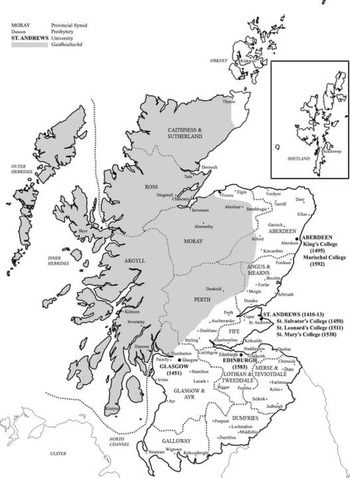
On the heels of the royalist defeat in the Bishops’ Wars in 1640, Charles I conceded to a number of the victorious Scottish Covenanters’ demands. In addition to accepting the abolition of episcopacy and upholding the Church of Scotland's Presbyterian polity and doctrine, the king assented to transferring the rents of vacated bishoprics to churches, schools, and universities.Footnote 1 Seizing upon this opportunity, staff at the University of Glasgow proposed adding several professorships and six divinity bursars.Footnote 2 Tasked with reviewing Glasgow's finances to execute this scheme, James Hamilton, third marquess of Hamilton and the king's commissioner in Scotland, and Archibald Campbell, first marquess of Argyll and a leading Covenanter, recommended that funds be collected for two new divinity professors and six bursars, four of whom were “to have the Irish language.”Footnote 3 The inclusion of “Irish” or Gaelic-speaking bursars was likely Argyll's doing: in the original manuscript in the Glasgow University Archives, the stipulation that four bursars should know Gaelic appears in the margin as an addition to the text with Argyll's autograph directly underneath.Footnote 4 The proposal encapsulated the central thrust of the Covenanters’ educational policy toward the Gaidhealtachd, the Gaelic-speaking portions of Scotland (see figure 1): transporting Gaelophone students to the Scots-speaking Lowlands for their education, with the hope that they would return to the Gaidhealtachd to spread Reformed religion in its Covenanted mold.
Scotland in the mid-seventeenth century, with provincial synods, presbyteries, and universities. Map courtesy of the author.

At first glance, the Covenanters’ plan echoes earlier efforts to “civilize” the Gaidhealtachd. Perhaps the best-known example is the 1609 Statutes of Iona, which, among other things, required Gaelic landowners of means to send their eldest children to learn English in the Lowlands.Footnote 5 A 1616 order of the Scottish Privy Council and 1633 act of Scottish Parliament supplemented the statutes by mandating the planting of English schools in the Gaelophone Highlands in order to eliminate Gaelic.Footnote 6 Such schemes sought to negotiate the lack of religious and educational provision in the Gaidhealtachd and, crucially, extirpate Gaelic language and culture, “the chief and principall causis of the continewance of the barbaritie and incivilitie amongis the inhabitantis of the Ilis and Heylandis.”Footnote 7 As I demonstrate in what follows, the Covenanters, while incorporating the goals of these earlier schemes, also pursued novel educational policies for the Gaidhealtachd. Specifically, they developed a scheme that utilized the kirk's superstructure of local, subregional, regional, and national courts to create a national funding structure to ensure a steady flow of promising Gaelophone students to Scotland's universities.
The program sought to address the problems that had plagued the Gaidhealtachd and vexed central authorities: the dearth of clergy in the Highlands, the ability of that clergy to minister in Gaelic, and the lack of moneys for building schools, paying schoolmasters, and funding university students. Scholars, relying largely on Duncan MacTavish's printed edition of the minutes of synod of Argyll, have examined this initiative in only a cursory manner.Footnote 8 Charles Withers's treatment of the topic in his seminal geographic history of Gaelic in Scotland, moreover, is rooted largely in an overview of the printed General Assembly acts without an examination of the trials and events that influenced the implementation of Covenanter policy.Footnote 9 Depending on this small—albeit important—documentary evidence runs the risk of trivializing the Covenanters’ educational schemes. However, as I demonstrate here, the educational scheme for the Gaidhealtachd was as a key pillar of Covenanter state building in the aftermath of the Scottish revolution. In doing so, I incorporate a wider body of printed and manuscript kirk session, presbytery, synod, and General Assembly records from across the Highland/Lowland divide to analyze the development, implementation, and outcomes of the Covenanters’ educational schemes for the Gaidhealtachd in the 1640s. Ultimately, the Covenanters, if pursuing a strategy that eventually sought to uproot Gaelic, nevertheless wielded new tactics and broke with the tenor of their immediate predecessors. The initiative was not bald cultural imperialism of the type wielded by the nineteenth-century British state, but instead represented a more “collaborative” approach, to borrow Allan Kennedy's lexicon, to engineering cultural transformation in the Gaidhealtachd.Footnote 10 The Covenanters thus did not immediately pursue overtly anti-Gaelic initiatives but instead sought practical, if temporary, accommodation of Gaelic in order to serve the nascent Covenanted state.
I therefore build upon recent scholarship that has sought to understand how the Covenanters marshaled Scotland's secular and ecclesiastical institutions to construct a confessional state predicated on the limited monarchy espoused in the National Covenant and strict adherence to Presbyterian mores.Footnote 11 The Covenanters’ educational initiatives for Scottish Gaeldom—and particularly the scheme to funnel Gaelophone students to the universities—represented another way to consolidate the control of the fledgling Covenanted state.Footnote 12 Recent scholarship on the Covenanting regime's reforms of the universities—St. Andrews (including the colleges of St. Leonard's, St. Salvator's, and St. Mary's), Glasgow, Aberdeen (including King's and Marischal colleges), and Edinburgh—highlights how the Covenanters aimed to cultivate conformity to the Covenant and ensure that university students could apply their knowledge effectively. This approach to higher learning underlines the fact that the Covenanters sought a practical education for Scottish university students, who were to emerge from the academy well versed in argumentation, rhetoric, and divinity in order to serve the Covenanted kirk.Footnote 13 Indeed, scholars have also shown that the Covenanter literati, including a number of university professors, were steeped in contemporary philosophical and Reformed theological trends.Footnote 14 But as a process of Covenanter state formation, historians’ examination of Covenanting educational policies has been muted. Scholars of higher education have long identified universities as central institutions in the formation and consolidation of confessionalized states in Germany and the Dutch Republic, for controlling higher learning was a key way to inculcate “true” religion and learning.Footnote 15 The construction of states predicated on specific confessional ideals—such as the Scotland of the Covenant—was contingent on universities producing governing elites trained in a confessionalized academic setting.Footnote 16 In the Gaidhealtachd, Gaelic-speaking ministers trained in the universities under Covenanting auspices would be powerful conduits to distill political and religious conformity to the Covenanted state.Footnote 17 The way in which the Covenanters sought to advance Gaelic-speaking students to the universities represented a key innovation: exploiting the kirk's system of courts to form a centralized funding scheme to ensure university access for students from the Gaelic periphery. Historians have already highlighted how the kirk's hierarchical structure of courts doubled as an apparatus for systematized poor relief.Footnote 18 This article posits that the kirk's structure also provided a ready-made system for public funding in order to direct Gaelic students to the universities, which would in turn extend the reach of the Covenanted state to the Gaidhealtachd.
The manner in which the Covenanters pursued their Gaelic educational policy set the regime apart from its predecessors and made the Covenanters’ scheme unique within the wider Gaelic-British educational context. In Ireland, for instance, Trinity College, Dublin was, despite the pretenses of its founding in 1592, nearly completely closed off to the Gaelic, and predominantly Catholic, native Irish.Footnote 19 Gaelic Ireland did possess what Gaelic Scotland long went without: the translation of the New Testament into the Irish vernacular, a task that was completed in 1603 under Trinity's auspices by Uilleam Ó Domhniall, the future archbishop of Tuam.Footnote 20 But the translation of the central text of evangelization was never complemented by the necessary training of a Gaelic clergy in the university; by the 1630s, Trinity was overwhelmingly the institution of the Anglophone New English and served a hotly Calvinist Church of Ireland that was largely uninterested in ministering to the Irish.Footnote 21 Provost William Bedell's academic interest in Irish notwithstanding, at least prior to Provost Narcissus Marsh's tenure in the late seventeenth century, Trinity was in its early years an institution that fortified a cultural, linguistic, and religious boundary between Gaelophone and Anglophone (Protestant) Ireland. The Covenanters, however piecemeal their strategies were, sought to use the universities to traverse Scotland's linguistic boundary. To be sure, this approach did not demonstrate any zeal to promote the Gaelic language: at the time of the Covenanting revolution, Scotland lacked vernacular devotional texts, for John Carswell's translation of the Book of Common Order in 1567 was rendered in Classical Common Gaelic, not the Scottish Gaelic vernacular understood by a larger number of Scottish Gaels, both literate and illiterate.Footnote 22 But the Covenanters’ scheme for the Gaidhealtachd did precede translations of additional devotional texts—including the Psalms and Westminster Shorter Catechism, as well as proposals for several Old Testament books, spearheaded in the 1650s by the synod of Argyll under the direction of the powerful marquessFootnote 23—which suggests that authorities recognized that the education of Gaelic students and the translation of devotional texts went hand in hand. And while powerful Gaelic lords had long been sending their sons to the Scottish universities—particularly Glasgow and Aberdeen, both closer to Scotland's Gaelic heartlandsFootnote 24—the Covenanters’ use of the Kirk's courts to integrate students signaled an attempt to expand university access beyond the traditional Gaelic elite. The study that follows thus examines the genesis of Covenanter policies for the Gaidhealtachd, their implementation, and their successes and failures in an effort to provide new insight into the manner in which the Covenanters constructed their fleeting confessional state in the 1640s.
The Development of Covenanter Educational Policies for the Gaidhealtachd
The early modern Gaidhealtachd was served by a diffuse patchwork of grammar schools that focused on catechistic and grammatical instruction in Latin, in part to prepare promising students for university.Footnote 25 Local ministers and elders ensured that schoolmasters carried out their duties and that the fabric of the schools remained serviceable, but schools nevertheless suffered from funding and staffing shortages.Footnote 26 Ministers were also few, ill paid, and ill equipped to preach in Gaelic, regardless of religious confession: many clans remained Catholic, like Clanranald, but a greater number, like the Campbells and Mackenzies, became Protestant following the Reformation.Footnote 27 University-educated Protestants had no Gaelic Bible to assist preaching, while Scots Catholic colleges in Europe preferred Lowland Anglophone students.Footnote 28 The few clerics who served the Gaidhealtachd often did so in dilapidated churches within expansive parishes that required long travel and island hopping.Footnote 29 It was thus necessary to send children to the better-staffed and better-funded schools in the Lowlands, which was the main practice of educational policies for the Gaidhealtachd after 1603: transferring Gaelic youths to the Lowlands for an Anglophone education. But while the Statutes of Iona and the policies of 1616 and 1633 bore some fruit—Ruiaridh Mòr Macleod of Dunvegan, chief of Clan Macleod, sent his four sons and nephew to Glasgow University between 1624 and 1631, and none of his sons have any surviving letters that indicate tuition in GaelicFootnote 30—they broke neither the traditions nor language of Scottish Gaeldom, while want of schools and funding persisted.
The Covenanters inherited the Gaidhealtachd's educational and religious issues. Any attempts to reform education in the region would contribute directly to the regime's goal of funneling students to universities, which the Covenanters actively reformed in the 1640s. Drawing on contemporary academic trends, Covenanter university learning blended traditional Aristotelianism with the methodological innovations of Calvinist educational reformers.Footnote 31 The “covenant” theology popular in Scotland, among the theological foundations that justified resistance to over-mighty princes, also permeated the curriculum.Footnote 32 Combined with regular visitations that ensured the competency, orthodoxy, and conformity of all university staff and students, the Covenanting regime sought to effectively arm university students intellectually and rhetorically to serve Covenanted Scotland.Footnote 33
This was the confessionalized academic milieu, the ideological bedrock of the Covenanted state, within which the Covenanters sought to integrate Gaelophone university students. It was also a key part of the wider structural matrix that served Covenanted Scotland. The General Assembly and its standing committee, the Commission of the Kirk, distributed educational and clerical provision and translated ministers, defined orthodoxy, and ensured conformity to the Covenanted Church of Scotland.Footnote 34 But despite extending the ecclesiastical structure of the kirk into a key region of the Gaidhealtachd through the creation of the synod of Argyll in 1638 (see figure 1, above), the kirk's initial attempts to establish educational provision for the Gaidhealtachd was largely piecemeal and ad hoc.Footnote 35 Much of the Covenanters’ attention was devoted to the Western Highlands and Islands, which had for centuries been part of the pan-Gaelic world that spanned the North Channel.Footnote 36 MacDonald-Campbell enmity guaranteed that this region remained a strategic theater during the Bishops’ Wars (1639–40), while the retaking of MacDonald lands from Clan Campbell animated the efforts of Alasdair MacColla during his devastating yet ultimately failed campaigns in (1644–1647).Footnote 37
For the Covenanters, however, upheaval within the Gaidhealtachd was not met with overt calls for Gaelic's extirpation, nor were Scottish Gaels shuttered from the universities, which had been the case in Ireland both before and after the 1641 Rebellion. Prior to the Rebellion, the Irish Commons, in a fleeting moment of interconfessional unity, had moved to reinfuse Trinity with Irish “natives” over Laudian-sponsored English students.Footnote 38 But as records show, these “natives” were rarely, if ever, Gaelic, and were instead the sons of the New English and Protestant Old English—“natives” born in Ireland of Anglophone extraction.Footnote 39 Irish nobles cited this lack of access to educational institutions, and to Trinity specifically, among their grievances.Footnote 40 There was, of course, a clear sectarian dimension to Trinity's inaccessibility, especially amid the heightened anti-Irish and anti-Catholic climate after 1641.Footnote 41 In Ireland, the Rebellion reinforced Trinity's confessional and cultural insularity. In Scotland, the universities would be used to extend, not restrict, the Covenanters’ vision to the Gaelic world. To be sure, Gaelic was neither celebrated nor promoted, despite Covenanter propagandists endorsing the myth of an ancient, non-Episcopal, Dalriadic church. Yet Gaelic was still alien: in December 1641, General Assembly commissioners made clear their intention to “plant” religion among the Gaels to “bring them to civility.”Footnote 42 The resolve to uproot Gaelic existed, but lack of resources meant that the approach to Scottish Gaeldom was more ambivalent than virulent.Footnote 43 The long-term goal remained the Anglicization of the Gaidhealtachd, but potential university students’ existing knowledge of Gaelic was recognized as a practical tool to support the development of the Covenanted state.Footnote 44
That the marquess of Argyll, arguably Scotland and Britain's most powerful statesman, was a Gaelic noble and leading Covenanter helped to ensure Gaelic's currency on the Covenanting agenda. Argyll is the prime example of the fact that, by the mid-seventeenth century, many chiefs had also become influential statesmen and thus had at least one foot in the Anglophone Galldachd, assuming hybridized identities as Gael and Gall.Footnote 45 Argyll wielded this status to the benefit of education; after the Covenanters’ victory in the Bishops’ Wars, he was a key broker who ensured that the funds of vacated bishoprics would in part be funneled to the universities, with provision established for four Gaelophone bursars at Glasgow.Footnote 46 Argyll's recommendation that Gaelic bursars attend Glasgow underlines the university's long-established utility as an educational conduit for the Western Highlands, Islands, and Ulster, and Argyll's sphere of influence specifically.Footnote 47 His involvement in university affairs is also unsurprising: he attended St. Andrews and sent his sons to Glasgow after their fosterages, personally entrusting their care to Principal John Strang.Footnote 48 Robert Baillie also counted Argyll as among the more diligent commissioners for visiting the universities, and he regularly served as a visitor to each university in the 1640s. The marquess was also active in the newly formed synod of Argyll, where he sat as an elder for the presbytery of Argyll (Inveraray) beginning in May 1640.Footnote 49
Beyond signaling an intention to educate Gaelophone students, Argyll's report for Glasgow highlighted the importance of bursars—a student who received a funded “burse” or “purse”—within the Covenanters’ university schemes.Footnote 50 Many bursaries came from wills and testaments, with benefactors allocating to local town councils funds that were often earmarked specifically for impoverished scholars, members of a certain family, or students from a specific locale to undertake philosophical or divinity studies.Footnote 51 A good deal of the funding for such students, therefore, came from donations, while the daoine uaisle and fine of the clans—the upper castes of clan society, including the chiefs and leading gentry, such as the marquess's sons—were capable of funding their own educations.Footnote 52 But the Covenanter General Assemblies endeavored to augment private benefactions with public funding. The 1641 Assembly ordered every presbytery in the kirk with twelve ministers (presbyteries with fewer ministers were to join with others) to maintain a bursar of divinity.Footnote 53 This particular measure was not geographically specific, but its condition that presbyteries with fewer than twelve ministers combine accounted for the Gaidhealtachd's sparse distribution of parishes and paucity of churches.Footnote 54 However, the Assembly did petition Parliament specifically for the education of students from Scotland's peripheries, including the Gaidhealtachd and the Borders, requesting “that for youths of the finest and best spirits of the highlands and borders, maintenance be allowed as to bursars to be bred in the universities.”Footnote 55 This was an extension of the Iona approach: funneling the “finest and best” from the peripheries to be instructed in the Covenanted universities of the Anglophone Lowlands. The General Assembly repeated this overture in 1642.Footnote 56
There is evidence that Highland synods, both within and outside the Gaidhealtachd, heeded these proposals. In early 1642, the synod of Moray approved the Assembly's measures and ordered a collection in each presbytery to fund divinity bursars of the “Irish tong.”Footnote 57 By October, the presbyteries of Inverness, Forres, Elgin, Aberlour, and Strathbogie had either paid their contribution or had signaled their intention to do so.Footnote 58 In October 1642, similar measures were taken in the synod of Argyll, where representatives decided that, because of lack of clerical numbers, “every two presbyteries should contribut and send a student to the Colledge of Divinity.”Footnote 59 The synod ordered the presbyteries of Dunoon and Kintyre to join in funding Archibald McClaine and the presbyteries of Inveraray and Lorne (Kilmore) to combine to fund John Campbell “to repair to some colledge of theology.”Footnote 60 But despite combining presbyteries, the synod still faced funding problems: Campbell “went not at all to the Colledge,” while McClaine did not leave for university until Candlemas, as opposed to Michaelmas, the customary beginning of the university term, because neither Dunoon nor Kintyre contributed their funds on time.Footnote 61 McClaine would assume the ministry of Kingarth in Dunoon in 1645, though it is unclear if he completed his studies.Footnote 62 Nevertheless, the General Assembly's proposals and their implementation in Argyll and Moray demonstrate how the Covenanters drew on the apparatus of local church courts to provide maintenance for bursars, as opposed to depending solely on private benefactions.Footnote 63 But they also highlight the poverty of synods in the Gaidhealtachd and the unreliability of heritors—those responsible for sustaining the local church, manse, and glebe, in addition to schools—in providing maintenance for bursars.Footnote 64
Alongside the requisite financial commitment, efforts to send Gaelophone bursars to the universities required that schools in the Gaidhealtachd be constructed, funded, and staffed by masters who would enable students to enter the universities. Echoing earlier proposals, the 1642 General Assembly ordered grammar schools to be built in every parish and specified that commissioners in the Highlands were to report to each successive General Assembly concerning the progress of these efforts. This was coupled with another overture to Parliament supplicating for maintenance of Highland bursars “to be bred in Universities.”Footnote 65 There were no allusions to extirpating Gaelic in these overtures, but they nevertheless recalled the Privy Council and Parliament's earlier notions that the Gaelic language would be eroded via schooling.Footnote 66 The grammar schools were a key part of the overall educational infrastructure that would feed Gaelophone youths into the Lowland Anglophone universities for their Covenanted education and acculturation. And the evidence suggests that synods in the Gaidhealtachd attempted to build these schools: in October 1642 the synod of Moray claimed that it was “so necessary amongst them” to plant another grammar school,Footnote 67 while the synod of Argyll endeavored to erect a grammar school at Inveraray in 1640.Footnote 68 However, funding was lacking, and the failure of these projects can be attributed at least in part to local heritors. In May 1643, the synod of Argyll cited “the gentlemen and heretors of the countrey” for “refuseing to give their concurrence to the exercise of kirk discipline” and requested that the Marquess of Argyll, again sitting as an elder for Inveraray, entreat the General Assembly to prompt the heritors—among the daoine uaisle and fine—to embrace their duty. The synod also petitioned the General Assembly to use the rents of vacant churches, given the “paucity of expectants” in the province, for the “traneing up and education of yong ones for the ministry.”Footnote 69 If there were no expectants to fill churches, the synod labored to ensure that there would be in the future.
It needs to be reiterated that the Gaidhealtachd during this period was not a barren region desperate for spiritual and educational provision. It was, as Scott Spurlock has shown, a theater of war where Catholics, and particularly the dispossessed Clan Donald, energized by cultural and spiritual animus that pitted the Catholic Gael against the Protestant Gall, combatted militant Protestantism. Despite the lack of resources for Protestant and Catholic Gaels, the Gaidhealtachd, and specifically the Western Highlands, was a contested region,Footnote 70 adding urgency to Covenanter initiatives. Thus, in 1643, the General Assembly made its clearest overture yet concerning the importance of expanding educational provision in the Gaidhealtachd:
The Assembly considering the lamentable condition of the people in the Highlands, where there are many that gets not the benefite of the Word, in respect there are very few Preachers that can speak the Irish language. Do for remeid thereof think good, that young Students who have the Irish tongue, be trained up at Colledges in Letters, especially in the studies of Divinitie, And to this effect recommend to Presbyteries and Universities to preferre any hopefull Students that have the language aforesaid, to Bursaries, that they by their studies in processe of time attaining to knowledge, and being enabled for the Ministrie, may be sent forth preaching the Gospel in these Highland parts, as occasions shall require.Footnote 71
In order to begin this cycle, in July 1644, Parliament allowed the use of vacant stipends for educational purposes. Though it was likely born from the synod of Argyll's application, the act was not specific to Argyll and was applicable to the Highlands as a whole.Footnote 72 Parliament also stipulated “that the vacant benefices or stipends of kirks in the highlands shall be employed for training up of youths that have the Irish tongue in schools and colleges only and to no other pious use.”Footnote 73 This was, at its core, the Iona solution: preference was given to Gaelophone students so that they might return to the Gaidhealtachd following their education to minister.
The General Assembly thereafter issued overtures in 1645 that called for the erection and regulation in every parish of schools staffed by capable schoolmasters; for students to possess a sufficient knowledge of Latin prior to university entry; and for universities to cooperate in establishing uniform standards of instruction.Footnote 74 In February 1646, Parliament passed the “Education Act,” which required that a school be established in every parish, with heritors financing their construction and stipends of between 100 and 200 merks for schoolmasters.Footnote 75 This legislation echoed the 1633 act, but it also repeated its central defect by depending on parish heritors despite the fact that the region was destitute following Alasdair MacColla's campaigns in the Western Highlands. Indeed, the General Assembly approved new overtures to spread true religion “through the Highlands and Islands (for in lack whereof the land hath smarted in the late troubles),” as there were reports of “friers and seminarie priests” who spread “Poperie” marching alongside MacColla's retinue.Footnote 76 It is clear that the Covenanters attributed MacColla's successes in part to the failure to imbue Protestantism in the Gaidhealtachd, and the contested Western Highlands most of all. The ensuing Assembly therefore ordered that schools be constructed in the Gaidhealtachd according to the Education Act, and that they be visited by ministers and elders “that have the Irish language.” The Assembly also proposed having “Gentlemen who are able” send their eldest sons “to be bred” in the Lowlands to ready “Ministers and expectants who can speak the Irish language” to “imploy their talents”—that is, their conditioning in Reformed Protestantism of the Covenanted hue, ministered orally through the Gaelic language but with the notable lack of Gaelic Scripture—in the Gaidhealtachd.Footnote 77 Crucially, these efforts envisioned the formation of an education infrastructure for the Gaidhealtachd from the grammar school to the university without overt reference to the elimination of Gaelic. Unlike the 1616 Privy Council order, which itself was a response to violent unrest in the Western Islands, the Covenanters did not respond to MacColla's campaigns with calls to extirpate Gaelic. It does not seem that the Covenanters viewed Gaelic as an impediment to the promotion of religion in the Gaidhealtachd, though it must be reiterated that Gaelophone students would be schooled in Latin and Scots in the Lowlands.Footnote 78 Adequate schools would funnel Gaels into the universities, where they would be trained under Covenanter auspices and then returned home to entrench the Covenanted Kirk.
Ultimately, these initiatives did not bear fruit. But it is clear that efforts to enroll Gaelophone boys in the universities occupied a key place within Covenanting state building, and the education of Gaels was a repeated theme on the Covenanters’ docket at the annual meeting of the General Assembly. Lack of funds, unreliable heritors, and MacColla's campaigns impeded the implementation of such policies. Yet this period did illustrate the extent to which the Covenanters employed the Kirk's system of courts, in concert with Parliament, to pursue policies for education in the Gaidhealtachd. Such measures would be implemented more fully, with some moderate, measureable success, in the period immediately preceding the Cromwellian conquest.
A National System of Public Funding
MacColla's defeat did not see an end to the turmoil in Scotland. The Engagement of December 1647 sparked a controversy that would ultimately sunder the Covenanting movement into rival moderate and radical camps by the time that Oliver Cromwell completed his conquest in September 1651.Footnote 79 Despite this upheaval, it was during this fevered period that the Covenanters advanced two key higher education schemes. The first was the creation of a commission of representatives from each university, which met annually to regulate order and correspondence between the universities and create a unified philosophy curriculum.Footnote 80 The commission also focused on funding bursars, and at its first meeting in August 1647, and then again in July 1649, the delegates from each university pressed the General Assembly to ensure that presbyteries continued to earmark money for bursaries.Footnote 81 The second scheme attempted to solve the problem of marginal educational provision and infrastructure in the Gaidhealtachd and specifically in Argyll. Evoking the General Assembly's overtures of 1646, in May 1648 the synod of Argyll ordered each presbytery within its bounds to identify “boyes most capable of learneing within thir bounds” to be recommended to the General Assembly for matriculation at Lowland schools. In a letter to the Commission of the General Assembly, representatives from the synod noted that they had identified forty boys.Footnote 82 In August, the Assembly decided that the boys should not risk losing their Gaelic fluency by being “scattered through the Kingdom” and ordered the cohort sent to grammar school in Glasgow, again highlighting the burgh's utility to the Western Highlands.Footnote 83
While transferring boys from Argyll to the Lowlands recalled the Iona scheme, the 1648 General Assembly also recommended that four of the forty youths who were of sufficient schooling should be “recommended to the Universities to get Burses on in every Colledge.”Footnote 84 The key innovation to this scheme was that, rather than depending for funding on the students’ home presbyteries, and thus their heritors, the General Assembly ordered each presbytery in Scotland to pay 40s. Scots annually for a period of twelve years for students’ education in the Glasgow grammar schools and in the universities. The General Assembly would then transfer the funds to two ministers in Glasgow—David Dickson, divinity professor at Glasgow University, and Robert Ramsay, minister of St. Mungo'sFootnote 85—who were to manage the students’ boarding and schooling and report on their progress.Footnote 86 This scheme was reinforced by two concurrent acts. The first recalled an act from the 1638 General Assembly at Glasgow and required all students “at their first entry to Colledges” to subscribe to the Covenant; in the politically charged climate of post-Engagement Scotland, it was necessary to reaffirm conformity to the Covenant among Scotland's future ministers. The second ordered all presbyteries to continue funding bursars.Footnote 87 These measures again evinced the Covenanters’ commitment to advance educational provision for Gaelophone students. They also demonstrate how the Kirk's national system of courts could serve as an apparatus to provide public assistance to fund students from the Gaidhealtachd.
The educational funding scheme for Argyll in particular paralleled the general charitable drive that the Commission of the General Assembly ordered for the synod in the wake of MacColla's war.Footnote 88 Moreover, it indicated the vigilance of the marquess of Argyll, the political leader of the radical Covenanters following the Engagement, in upholding the principles of the Covenant and protecting his estates from Engagers and opponents of Clan Campbell.Footnote 89 Argyll would take an active stance in revamping his region's educational infrastructure. But the western Gaidhealtachd was not the only region in need of Gaelic-speaking ministers. In May 1647, the synod of Moray supplicated the Commission of the General Assembly for aid due to the “vacancie of all the Kirks, which cannot be supplied but be ministers who have the Irish toung.”Footnote 90 The commission translated William Fraser to the “Irish” charge at Inverness the following year.Footnote 91 The measure appeared to be a contingent one that did not necessarily address the larger problem: the lack of clerical tuition in Gaelic in the long term, which was the underlying logic of the Argyll scheme. The northern Gaidhealtachd would see no arrangement analogous to that for Argyll, with its influential marquess and populace still reeling from MacColla's war. But the north was not forgotten: presbyteries in the synods of Moray, Ross, and Caithness were exempted from the 40s. annual payment for the Argyll students. They were instead required to sustain their own Gaelic-speaking bursar.Footnote 92
In regards to the western Gaidhealtachd, there is evidence of collections being taken for both the Argyll bursars scheme and charitable donations. The St. Andrews presbytery, for instance, held collections for the “distressed people of Argyle” and for the support of students “such as have the Irish tongue [to] be trained at schooles and colledges.”Footnote 93 But whether due to unpopularity or lack of funds, the scheme for funding bursars was plagued by problems from the start. The synod of Argyll reported in October 1648 that Glasgow was unable to accommodate the forty boys initially selected and thus settled on twenty-two, though in May the synod nominated another twenty-five.Footnote 94 The more pressing issue, however, was that Lowland presbyteries were neglecting their 40s. contributions. Beyond the Dalkeith kirk session, which took a modest collection for “ane hieland bursser” in March 1649, evidence of contributions is virtually nonexistent.Footnote 95 This concern did not go unnoticed by the Commission of the General Assembly, which appointed James Hamilton, an Edinburgh minister, to collect funds and transfer them to Glasgow.Footnote 96 In May 1649, the commission admonished the presbyteries and urged the 40s. payment, noting, “We are both sorry and ashamed that the Irish boyes who were brought to Glasgow for their breading at schools, that there might be a seminary for Ministers in the Highlands, are like to be necessitat to leave the schools for lack of maintenance . . . because litle or nothing is as yet sent from the Presbyteries.”Footnote 97
What is telling about the Argyll scheme—both in sending students to Glasgow for grammar school and for funding bursars in the universities—is that it exported the traditional responsibilities of local Highland presbyteries to the Lowlands. In essence, it made the educational situation in the western Gaidhealtachd an issue of national importance. Despite this, the scheme got off to an inauspicious start, suggesting that dependence on Lowland presbyteries could be just as tenuous as dependence on local heritors. At its May 1649 meeting, the synod of Argyll resolved to construct schools in Inveraray, Dunoon, and Kilmore, and recommended to the Marquess of Argyll that schools be established at Lochlead (or Campbelltown) and Kilberry.Footnote 98 In Parliament in June, the marquess oversaw the expansion of the 1644 act for the use of vacant stipends for the “training up of youths that have the Irish tongue in schools and colleges” by permitting the stipends to be used for “some other pious uses” in Argyll, ostensibly for building schools.Footnote 99 In July, the Commission of the Kirk approved the use of vacant stipends and a further 11,000 merks for the construction of schools in the province.Footnote 100 Additionally, in October 1649 the marquess mortified an additional 600 merks yearly for the Inveraray grammar school.Footnote 101 Clearly, the marquess was a key player in advancing legislation within his sphere of influence in the Gaidhealtachd. Beyond his status as the preeminent Covenanting noble, Highland lord, and British statesman, his management of educational schemes in the western Gaidhealtachd alongside the legislative measures of both the General Assembly and Parliament highlighted the synergy between religious and secular institutions that was emblematic of the process of confessional state building.Footnote 102
Thus by the time the General Assembly passed an “Act for a Collection of entertaining High-land Boyes at Schooles” on 6 August 1649, major steps had been taken to revamp education in Argyll. Noting that the initial scheme had “not taken the intended effect,” the Assembly scrapped the 40s. payment and ordered that an “extraordinary collection at the Kirk doors” be taken on “a certain Sabbath yearly,” with ministers instructed to promote the “necessity and usefulness” of the collection to their congregants.Footnote 103
Following this order, activity in the presbyteries was intermittent, and evidence of contributions is piecemeal. In the synod of Lothian and Tweeddale, both the Dalkeith kirk session and presbytery received orders to send money to James Hamilton and to “maintaine Irish boyes att scooles” in May 1649 and March 1650,Footnote 104 while the Peebles presbytery recorded the orders from the commission in January 1650.Footnote 105 On 15 January 1650, Edinburgh's Canongate kirk session collected £24 Scots “to conforme to the General assembies ordinance for the maintenance of 40 Irish boyis at the colledge of Glasgow,” and ordered it delivered to James Hamilton.Footnote 106 In the synod of Fife, the presbytery of St. Andrews appointed James Wood, a leading Covenanter and professor of divinity at St. Mary's College, to collect that presbytery's contribution for Gaelophone students in July 1649.Footnote 107 Further, the Dunfermline kirk session reported a collection of £7 14s. Scots in April 1650, while the following month the Dunfermline presbytery submitted £50 Scots to Hamilton in Edinburgh.Footnote 108 In the synod of Glasgow and Ayr, the presbytery of Lanark delivered £20 Scots for the “hieland” boys in June 1651, while in Angus and Mearns, the Tealing kirk session issued a collection in August.Footnote 109 This evidence provides two important conclusions about the funding scheme. First, the General Assembly's orders did not go ignored. Second, from 1649, when the General Assembly relaxed the 40s. requirement, there was more movement in Lowland localities for funding the Argyll students in Glasgow and the bursars in universities.
Elsewhere there is evidence for the funding of students from the Gaidhealtachd beyond Argyll. For instance, in April 1649 the presbytery of Brechin, in the synod of Angus and Mearns, ordered its ministers to bring their collections “to be payitt for training up at scoles som Irish boyes who cam from Argyll.” But the presbytery also appointed its ministers to collect funds “for paying the boord of the Irish boyes at the schole of dundie.”Footnote 110 The Brechin measures made no reference to sending funds to either Hamilton in Edinburgh or to Dickson and Ramsay in Glasgow. Rather, it appears that Gaelophone scholars were attending school in the province, ostensibly at the Dundee grammar school.Footnote 111 Moreover, the presbytery of Brechin almost certainly contained Gaelic-speaking populations within its bounds, as significant portions of Angus were still Gaelic into the nineteenth century.Footnote 112 This is a key reminder that, as in the western Gaidhealtachd, the divide between Gael and Gall was not necessarily stark. It also suggests that boys from Argyll may have been sent farther afield than Glasgow for their grammar school education. But despite the fragmentary nature of the evidence, these efforts within kirk sessions and presbyteries evince the operation of a national system of public funding that went beyond impromptu measures for funding education at the grammar school and university levels.
But the collections were not meant solely for the schooling of boys at grammar schools in Glasgow and beyond. There was also the matter of the four Gaelophone bursars at each of the universities. As noted above, the sons of clan chiefs had long been attending the universities. The major transformation that took place under the Covenanters was not if boys from the Gaidhealtachd would attend university but how they would be able to do so. Further, the social standing of the four boys identified also potentially set them apart from the daoine uaisle and fine of clan society: none seemed to have been sons of clan elites. Rather, they were sons of ministers, if their parentage is known at all. In the initial overtures of August 1648, the General Assembly recommended that Zachary McCallum, son of the Glasgow alumnus and minister of Poltalloch Archibald McCallum, should attend St. Leonard's College, St. Andrews, and that Patrick Campbell, son of Dugald Campbell, minister of Knapdale, should attend Glasgow.Footnote 113 Two other Campbells, Colin and Duncan, were to attend Aberdeen and Edinburgh, respectively, though comparatively little is known about their lineage.Footnote 114 Colin almost certainly attended King's College, Aberdeen, entering in 1648, but he is not listed among the graduates in 1652.Footnote 115 In October 1649, the Canongate kirk session recorded collecting 20 merks for “duncane Campbell,” indicating that local courts also maintained Gaelophone bursars in the nearby university.Footnote 116 Another bursar, Alexander McClaine, although not initially identified by the General Assembly in 1648, appears to have briefly attended St. Mary's College through the support of the synod of Merse and Teviotdale, with the synod of Argyll providing further support for his education out of the stipends of Arran.Footnote 117 This is particularly intriguing, because McClaine had already attended and graduated from Edinburgh in 1646; beginning in 1651, he served as minister of several charges in Argyll, and in 1655 he took part in the translation of the metrical psalms into Gaelic.Footnote 118 It appears that McClaine attempted, but was ultimately unsuccessful, in attaining a postgraduate education in divinity at St. Mary's, which since the reforms of Andrew Melville in the late sixteenth century had served as Scotland's chief seminary, and which the Covenanters had envisaged as sitting atop Scotland's matrix of higher learning.Footnote 119
There is comparatively more evidence illustrative of Zachary McCallum's path to St. Andrews than for the education trajectories of his Campbell counterparts. In October 1647, the synod of Fife approved James Wood's resolution to the General Assembly that McCallum, “ane boy . . . having the Erish tongue,” should be maintained at the St. Andrews school for one year before entering the university.Footnote 120 The next April, the St. Andrews presbytery permitted Wood to send for McCallum, whose father was unable to fund his education.Footnote 121 It is unclear how Wood knew McCallum, but it is likely that Wood's authority as a leading Covenanter and St. Mary's professor influenced the General Assembly's decision to include the boy in its Argyll funding scheme. The following April, the synod of Fife ordered each church in the province to pay 40s. Scots for McCallum's maintenance at St. Andrews.Footnote 122 Yet he did not complete his studies there. In May 1650, the synod of Argyll was informed that McCallum was “depryved of the benefite” that was due to the bursars. The synod sent to the ministers of Glasgow to see if McCallum could join the Argyll boys there, “seing he is amongst these that are of greatest progresse in learneing, and of nearest expectation to fulfill the generall assemblies intended desyre.”Footnote 123
This desire was to plant the Gaidhealtachd with Gaelic-speaking ministers who had studied at Covenanted universities. The success of the Argyll scheme rested on whether the bursars would complete their studies and return to the Gaidhealtachd, and to the province of Argyll specifically, to minister. This was the stipulation of Alexander McClaine's bursary for St. Mary's: he was to receive funding “on condition that he would embrace a charge” in Argyll.Footnote 124 Of the four Gaelophone bursars, it is only certain that Patrick Campbell, who graduated MA from Glasgow in 1651, became a minister in Argyll, where he assumed a post in the parish of Glenaray in Inveraray.Footnote 125 It is unclear if and where Colin Campbell, who attended King's College, took up a ministry. There is also some indication to suggest that Duncan Campbell, originally the bursar at Edinburgh, completed his studies at Glasgow in 1651 before being licensed by the presbytery of Haddington in Lothian and Tweeddale in 1655 and ordained in Glenorchy in Argyll in 1657.Footnote 126 The evidence is circumstantial, but if it is the same Duncan Campbell, it means that he moved to Glasgow to finish his studies. There was precedent for moving bursars to Glasgow, as the synod of Argyll had attempted to move Zachary McCallum there in May 1650. The Covenanters’ commission for the universities, in addition to creating a unified curriculum, also regulated the movement of students between Scotland's universities. At their July 1648 meeting, the commissioners mandated that no students were permitted to move from one university to another without sufficient testimony.Footnote 127
Nevertheless, one university-educated minister was not an adequate return—the Argyll funding scheme fell short of its goal of producing a flow of Covenanted, Gaelic-speaking, university-educated ministers for the western Gaidhealtachd. Added to this failure was the collapse of support for the Argyll students in Glasgow, who returned to the province to attend the Inveraray grammar school.Footnote 128 A national system of public funding, rooted in the Kirk's courts, had not materialized, yet it would be a stretch to call the Covenanters’ initiatives a complete failure. Difficulties in keeping parishes staffed persisted, but a perusal of Hew Scott's Fasti Ecclesiæ Scoticanæ shows that, besides some noticeable gaps, the Covenanters were largely successful in keeping an active ministry in Gaelic parishes.Footnote 129
Though the bursars scheme collapsed, it is important to reiterate that it represented one innovative facet of a wider initiative to improve the Gaidhealtachd's educational provisions in order to spread Covenanting mores in the region. The fact that forty Argyll boys had been initially transferred to Glasgow—ostensibly to avoid the chaos wrought by MacColla's campaigns—but then returned to the grammar school at Inveraray, which had been recently established under Covenanter auspices, suggests that the province's educational infrastructure had been improving in the wake of the upheaval in the region. Adequate grammar schools—that taught English and Latin—would mean that scholars would not be required to attend a Lowland school before matriculating at one of Scotland's universities; nor would it mean that Gaelic bursars would have to depend on the public funding of Lowland parishes. It should be remembered that such initiatives also took place alongside the translation of the Westminster Shorter Catechism and metrical psalms into Gaelic; several books from the Old Testament were attempted in the latter 1650s. What is more, these efforts were spearheaded by Gaelophone ministers educated in the Scottish universities.Footnote 130 Such undertakings were indicative of the effort not only to spread religion in the Highlands but also to entrench Covenanter-approved devotional materials in the Gaidhealtachd, even as the regime collapsed amidst the Cromwellian conquest. As discussed above, such initiatives set the Covenanters apart from their counterparts in Ireland, where the existence of Protestant devotional works in Gaelic was not complemented by the education of a ministry who could employ these materials in their preaching. For a period under the fleeting Covenanter rule, the initiative to produce a greater Gaelophone ministry was pursued in tandem with the translation of Gaelic texts. Moreover, the Argyll scheme was a clear example of the Covenanters’ use of the system of courts to coordinate public funding, orchestrate control of education via the General Assembly, and thereby extend Covenanter authority into the Gaidhealtachd via the conditioning of Gaelophone students in confessionalized universities in the Covenanted mold.
Conclusions
The Covenanted state did not survive, but at least part of the scope of the policy it enacted for the Gaidhealtachd did. University students from Argyll were funded via bursaries out of vacant stipends during the Interregnum, while during the Restoration period a greater number of scholars were funded this way, even with the reintroduction of episcopacy; the practice endured into the later seventeenth century. The unique circumstances of the Covenanting period did therefore have some lasting impact on the manner in which central authorities sought to negotiate the dearth of capable Gaelophone ministers in the Gaidhealtachd.Footnote 131 Within its specific early modern context, Covenanter university policies were also emblematic of a process of confessionalized state building. The Covenanters remolded existing institutions, and especially the universities, to support their political and religious agenda. As elsewhere in seventeenth-century Europe, the vitality of the church and state was contingent on training the next generation of ministers and magistrates in the universities.
The Covenanters sought to integrate Scotland's Gaelic element actively into the infrastructure of higher learning in order to serve the nascent Covenanted state. The unique aspect of the Covenanters’ schemes rested in the favoring of Gaelic tuition; this represented a stark departure from the more openly anti-Gaelic tenor of the policies of the Scottish Privy Council in 1616 and Parliament in 1633, as well as the approach to Gaels and higher education in Ireland, which was characterized by complete hostility. Under the Covenanters, Gaelic language was not celebrated, and the process of transplanting Gaelophone students to the Anglophone Lowlands for their education echoed the Statutes of Iona; if anything, the Covenanters, somewhat ironically, built on the legacy of the early Stuart state. Gaelic was, however, used practically to further solidify Covenanter control of Scotland. That the Marquess of Argyll marshaled many of these initiatives and served as a proxy between the synod of Argyll, the General Assembly, and the Scottish Parliament also aided their implementation.
The schemes for education in the Gaidhealtachd, like the Covenanters’ concurrent reform of higher education, were pragmatic measures that sought to address the Gaidhealtachd's Protestant educational deficiencies and the persistent lack of Gaelic-speaking ministers. The end goal was to create ministers who would promote Covenanted mores from the pulpit and eventually sow the seeds that would debase the Gaelic language completely. The key features of the eventual bursars scheme involved how students were directed to universities—beyond the use of vacant stipends, financial responsibility was placed on the rest of the Covenanted nation via a national collection in Lowland presbyteries—and who was selected to attend—potentially poorer sons of ministers rather than the offspring of the clan elite. To implement such a policy, the Covenanters drew on the existing machinery of the Scottish church and state: the General Assembly and the kirk's matrix of courts, the Scottish Parliament, and the universities. Situated as they were at the intersection of language, religion, and education, the Covenanters’ policies for the Gaidhealtachd provide an intriguing episode for scholars to study as they continue to probe the nature of state formation in early modern Scotland and beyond.