INTRODUCTION
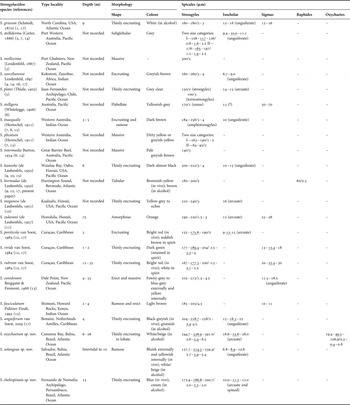
The family Chondropsidae contains eighty-one valid species, most of them recorded from the Tropical Western Pacific and distributed in five genera: Batzella Topsent, 1893; Chondropsis Carter, Reference Carter1886; Phoriospongia Marshall, 1880; Psammoclema Marshall, 1880; and Strongylacidon Lendenfeld, Reference von Lendenfeld1897. Strongylacidon is characterized by the presence of strongyles, arcuate or unguiferate chelae (which may be absent), and occasionally of sigmas. Sand may be present in low quantities but does not dominate the fibres (van Soest, Reference van Soest, Hooper and van Soest2002a). There are nineteen known species of Strongylacidon, all restricted to tropical regions (Table 1), of which six were described from the Caribbean (Schmidt, Reference Schmidt1870; de Laubenfels, Reference de Laubenfels1950; van Soest, Reference van Soest, Hummelinck and Van der Steen1984, Reference van Soest2009), one from Chile–Peru (Thiele, Reference Thiele1905), three from the Central Pacific (de Laubenfels, Reference de Laubenfels1950, Reference de Laubenfels1951, Reference de Laubenfels1957), one from New Zealand (Bergquist & Fromont, Reference Bergquist and Fromont1988), seven from Australia (Bowerbank, Reference Bowerbank1876; Carter, Reference Carter1886; Lendenfeld, Reference von Lendenfeld1887; Whitelegge, Reference Whitelegge, Ridley and Dendy1906; Hentschel, Reference Hentschel, Michaelsen and Hartmeyer1911; Burton, Reference Burton1934 ) and two from the western Indian Ocean (Lendenfeld, Reference von Lendenfeld1897; Pulitzer-Finali, Reference Pulitzer-Finali1993). Despite the considerable diversity of the genus Strongylacidon in the Caribbean and the high affinity of the Caribbean fauna to that of the south-western Atlantic, the genus has so far been represented in Brazil only by unidentified records: Strongylacidon sp. nov. (Muricy et al., Reference Muricy, Hajdu, Custodio, Klautau, Russo, Peixinho, Magoon, Converse, Tippie, Tobin and Clark1991) and Strongylacidon sp. (Muricy & Moraes, Reference Muricy and Moraes1998; Muricy & Silva, Reference Muricy, Silva, Silva and Lavrado1999; Moraes et al., Reference Moraes, Ventura, Klautau, Hajdu, Muricy, Alves and Castro2006; Andréa et al., Reference Andréa, Batista, Sampaio, Muricy, Custódio, Lôbo-Hajdu, Hajdu and Muricy2007).
Comparative micrometric data on the spicules and overview of distribution of the living species of Strongylacidon. Values are in micrometres (μm), expressed as follows: minimum–maximum or minimum–mean–maximum length, length/width or length (in the case of sigmas and/or isochelae). References are numbered in parentheses and listed after the table.

References: (1) Schmidt (Reference Schmidt1870); (2) Carter (Reference Carter1886); (3) Lendenfeld (Reference von Lendenfeld1887); (4) Lendenfeld (Reference von Lendenfeld1897); (5) Thiele (Reference Thiele1905); (6) Whitelegge (Reference Whitelegge, Ridley and Dendy1906); (7) Hentschel (Reference Hentschel, Michaelsen and Hartmeyer1911); (8) Burton (Reference Burton1934); (9) de Laubenfels (Reference de Laubenfels1950); (10) de Laubenfels (Reference de Laubenfels1951); (11) de Laubenfels (Reference de Laubenfels1957); (12) van Soest (Reference van Soest, Hummelinck and Van der Steen1984); (13) Bergquist & Fromont (Reference Bergquist and Fromont1988); (14) Wiedenmayer (Reference Wiedenmayer1989); (15) Pulitzer-Finali (Reference Pulitzer-Finali1993); (16) van Soest (Reference van Soest, Hooper and van Soest2002a); (17) van Soest (Reference van Soest2009).
In this study, three new species of Strongylacidon are described from north-east Brazil, increasing to nine the number of species of the genus in the Tropical Western Atlantic. Additionally, we propose an amendment to the definition of the genus based on the discovery of two new categories of spicules for this genus, viz., oxychaetes (previously known only for the genus Chaetodoryx, family Coelosphaeridae) and spined arcuate isochelae (here termed acanthochelae), which characterize Strongylacidon oxychaetum sp. nov. and S. chelospinata sp. nov., respectively. A taxonomic key for all species of Strongylacidon from the Tropical Western Atlantic is included.
MATERIALS AND METHODS
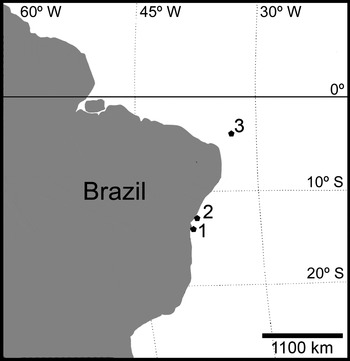
The sponges were collected by SCUBA or free diving in rocky substrate and by Petersen dredge or bottom trawl in soft bottoms in three localities in north-eastern Brazil (Figure 1). The samples of S. oxychaetum sp. nov. and S. solangeae sp. nov. are deposited in the Porifera Collection of Museu de Zoologia, Universidade Federal da Bahia (UFBA-POR) and the specimens of S. chelospinata sp. nov. are housed in the Porifera collection of Museu Nacional, Universidade Federal do Rio de Janeiro (MNRJ). The morphology of spicules was analysed in detail using a JEOL JSM 6390-LV scanning electron microscope. Dissociated spicule mounts and skeletal sections were made using classical procedures for Demospongiae (Hajdu, Reference Hajdu1994). Spicule measurements (N = 50 for each spicule category per specimen) were made in light microscopes BIOVAL L2000A and Nikon E200.
Location of the collection sites of Strongylacidon oxychaetum sp. nov. (1); S. solangeae sp. nov. (2); and S. chelospinata sp. nov. (3).

Abbreviations used: CAPES, Coordenação de Aperfeiçoamento de Pessoal de Nível Superior; CNPq, Conselho Nacional de Desenvolvimento Científico e Tecnológico; IBIO-UFBA, Instituto de Biologia, Universidade Federal da Bahia; FIOCRUZ-BA, Fundação Osvaldo Cruz, Salvador, Bahia; MNRJ, Museu Nacional, Universidade Federal do Rio de Janeiro; SEM, scanning electron microscopy; UESB, Universidade Estadual do Sudoeste da Bahia; UFBA-POR, Porifera Collection of Museu de Zoologia, Universidade Federal da Bahia; ZMA, Zoological Museum of Amsterdam.
DIAGNOSIS
Encrusting, massive, flabellate or digitate growth forms. Ectosomal skeleton frequently absent, replaced by arenaceous or spicular detritus, but often with areolate porefields on surface. Ectosomal smooth strongyles or occasionally styles often rare or secondarily lost. Choanosomal spicules, if present, are auxiliary megascleres of ectosomal origin, strongyles or occasionally styles, whereas principal spicules appear to be absent. Microscleres are smooth or spined arcuate isochelae, oxychaetes and sigmas, although often absent (amended from van Soest, Reference van Soest, Hooper and van Soest2002a).
DIAGNOSIS
Encrusting to massive; ectosomal skeleton with protruding brushes of strongyles from the ascending choanosomal fibres; choanosomal skeleton plumose in encrusting specimens becoming plumoreticulate in more massive specimens; fibres cored by strongyles and occasionally some detritus; microscleres are smooth or spined arcuate–unguiferate isochelae, sigmas, and oxychaetes in one species (amended from van Soest, Reference van Soest, Hooper and van Soest2002a)
REMARKS
This genus presently contains about 20 species (Table 1). Type-species: Strongylacidon zanzibarense Lendenfeld, Reference von Lendenfeld1897.
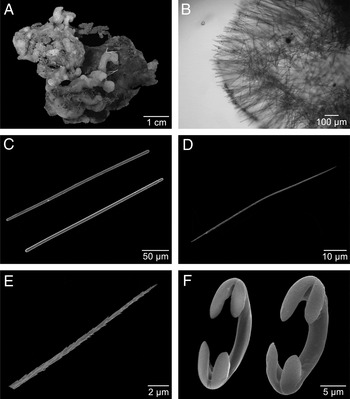
Strongylacidon oxychaetum sp. nov. (A) Holotype (UFBA-POR 2691); (B) ectosome and choanosome in transverse section; (C) strongyles; (D) oxychaete; (E) detail of the oxychaete end; (F) arcuate isochelae.

DIAGNOSIS
Shape encrusting, irregular, tending to lobate. Skeleton plumoreticulate. Spicules are strongyles, smooth arcuate isochelae and oxychaetes.
TYPE MATERIAL
Holotype: UFBA-POR 2691, Camamu Bay (13°52′41″S 39°00′32.1″W), estuary of Maraú River, Maraú, Bahia State, Brazil, 6.1 m depth, bottom trawl, coll. M.C. Guerrazzi, 24 April 2004.
Paratypes: UFBA-POR 2690, Camaçari (12°47′05.0″S 38°06′38.4″W), Bahia State, Brazil, 26 m depth, Petersen dredge, coll. W. Andrade, July 2008. UFBA-POR 3298, between Maraú and Itacaré (14°03′10.1″S 38°54′52.2″W), Bahia State, 16–21 m depth, SCUBA diving, coll. C. Menegola, 6 October 2009.
COMPARATIVE MATERIAL
Strongylacidon bermudae (de Laubenfels, Reference de Laubenfels1950): ZMAPOR 05885, Harrington Sound, Bermuda, coll. R.W.M. van Soest, 25 November 1985, det. R.W.M. van Soest.
Strongylacidon poriticola: ZMAPOR 04764 (holotype), Curaçao, Netherlands Antilles, Lagoen: latitude 12.32°N and longitude –69.158°W, coll. R.W.M. van Soest, 27 December 1980, det. R.W.M. van Soest.
DESCRIPTION
Shape thinly encrusting, irregular. The holotype (Figure 2A) is 6.3 cm long, 2.5 cm wide and 3.0 mm thick. In some portions, it presents finger-like projections or lobes ranging from 5 to 16 mm in height with strongyles traversing the surface, giving it a velvety texture. The paratypes measure 1.0–3.5 cm long by 1 mm thick. Colour ranges from brown or beige to whitish grey externally and internally in preserved specimens. Live coloration unknown. Oscules and pores not visible in preserved specimens. Consistency soft, fragile.
SKELETON
Thicker portions and finger-shaped projections with ectosome plumose and choanosome reticulate; thinner portions presenting both ectosome and choanosome reticulate. In the plumose ectosomal skeleton strongyles form irregular bundles or bouquets 260 µm wide crossing the surface (Figure 2B). Large isochelae are randomly dispersed among the strongyles and rare oxychaetes are arranged almost parallel to the surface. The choanosome is densely reticulate, with aquiferous canals ranging from 150 to 300 µm in diameter. Spongin scarce. Some specimens have sparse detritus randomly dispersed in the choanosome.
SPICULES
Megascleres: strongyles (Figure 2C) long and cylyndrical, smooth, usually straight, with rounded tips, which are sometimes slightly different in width and shape: 245–337–391/2.6–5.5–8.5 µm. Microscleres: Oxychaetes (Figure 2D, E) rare, straight, symmetrically spined, with thin sharp spines obliquely disposed: 19.4–49.3–106.9/0.2–0.5–0.9 µm. Arcuate isochelae (Figure 2F) abundant, with smooth and curved shaft, C-shaped in lateral view, with spatulate teeth: 18.6–23.9–26.6 µm.
ECOLOGY
The specimens agglutinate pieces of shells, coralline algae, grains of sand and gravel. The surface of all specimens is free of epibionts. The sponges were found on sand, mud, and minute gravel in Camamu Bay and Camaçari, and on rocky substrate between Maraú and Itacaré.
GEOGRAPHICAL DISTRIBUTION
Brazil: Bahia State: from 12°47′05.00″S (Camaçari) to 14°03′10.14″S (between Maraú and Itacaré).
BATHYMETRIC DISTRIBUTION
From 6.1 m depth at Camamu Bay to 26 m depth at Camaçari.
ETYMOLOGY
The name oxychaetum refers to the presence of oxychaetes, unique to this species within the genus.
REMARKS
The new species clearly belongs to the genus Strongylacidon as currently defined (Wiedenmayer, Reference Wiedenmayer1989; van Soest, Reference van Soest, Hooper and van Soest2002a) due to its skeleton composed of bouquets of strongyle megascleres and a spicule complement of mainly strongyles and isochelae.
Strongylacidon oxychaetum sp. nov. shares the shape usually encrusting with ten species (Table 1): S. griseum Schmidt (Reference Schmidt1870); S. inaequalis (Hentschel, Reference Hentschel, Michaelsen and Hartmeyer1911); S. kaneohe (de Laubenfels, Reference de Laubenfels1950); S. meganese (de Laubenfels, Reference de Laubenfels1951); S. platei (Thiele, Reference Thiele1905); S. poriticola van Soest (Reference van Soest, Hummelinck and Van der Steen1984); S. rubrum van Soest (Reference van Soest, Hummelinck and Van der Steen1984); S. unguiferum van Soest (Reference van Soest2009); S. viride van Soest (Reference van Soest, Hummelinck and Van der Steen1984); and S. zanzibarense Lendenfeld, Reference von Lendenfeld1897. The presence of arcuate isochelae distinguishes S. oxychaetum sp. nov. from five Caribbean species (S. griseum, S. bermudae, S. rubrum, S. viride and S. unguiferum), the seven Australian species (S. inaequalis, S. intermedia Burton, Reference Burton1934, S. mollissima Lendenfeld, Reference von Lendenfeld1887, S. plicatum Hentschel, Reference Hentschel, Michaelsen and Hartmeyer1911, S. plumosum Bowerbank, Reference Bowerbank1876, S. stelliderma Carter, Reference Carter1886 and S. stelligera Whitelegge, Reference Whitelegge, Ridley and Dendy1906), the three Hawaiian species (S. kaneohe de Laubenfels, Reference de Laubenfels1950, S. meganese and S. zukerani de Laubenfels, Reference de Laubenfels1957), the two African species (S. fasciculatum Pulitzer-Finali, Reference Pulitzer-Finali1993 and S. zanzibarense), and from S. conulosum Bergquist & Fromont, Reference Bergquist and Fromont1988, from New Zealand (Table 1). The new species shares the arcuate isochelae with the Chilean species S. platei and the Caribbean S. poriticola (Table 1), but its chelae are considerably larger (18–26 µm against 14–15 and 9–15 µm, respectively: Thiele, Reference Thiele1905; van Soest, Reference van Soest, Hummelinck and Van der Steen1984). The absence of sigmas in Strongylacidon oxychaetum sp. nov. distinguishes it from S. griseum, S. fasciculatum, S. rubrum, S. stelligera and S. viride. Finally, the random arrangement of large isochelae, the presence of oxychaetes in the ectosome, the large strongyles (up to 391 by 8.5 µm) scattered in the choanosome and in bouquets at the surface distinguish the new species from all other species of the genus. Moreover, the presence of oxychaetes led us to amend the definition of the genus in order to include this feature, which, despite its low density, is remarkable in all specimens of S. oxychaetum sp. nov.
Onychaetes of Tedania species, such as Tedania (Tedania) ignis (Duchassaing & Michelotti, Reference Duchassaing de Fonbressin and Michelotti1864) (Cristobo, Reference Cristobo2002; van Soest, Reference van Soest, Hooper and van Soest2002d; Campos et al., Reference Campos, Mothes, Lerner, Carraro, Veitenheimer-Mendes, Custódio, Lôbo-Hajdu, Hajdu and Muricy2007), differ from the oxychaetes of S. oxychaetum sp. nov. by the asymmetry of the extremities, whereas oxychaetes have symmetrical ends.
The new species also superficially resembles Coelosphaera (Coelosphaera) raphidifera (Topsent, 1892 as Fibularia raphidifera, from the western Caribbean) (Myxillidae: Coelosphaeridae), but differs from it by having rare oxychaetes averaging 106.9 µm long tangentially arranged in the ectosome instead of raphides 60 µm long widely distributed throughout the skeleton of C. (C.) raphidifera.
Strongylacidon oxychaetum sp. nov. shares the presence of oxychaetes with Chaetodoryx Topsent, 1927 (Myxillina: Coelosphaeridae) (van Soest, Reference van Soest, Hooper and van Soest2002b) and with Celtodoryx girardae Perez et al., Reference Perez, Perrin, Carteron, Vacelet and Boury-Esnault2006 (Myxillina, Coelosphaeridae), but differs from both species by the absence of echinating acanthostyles.
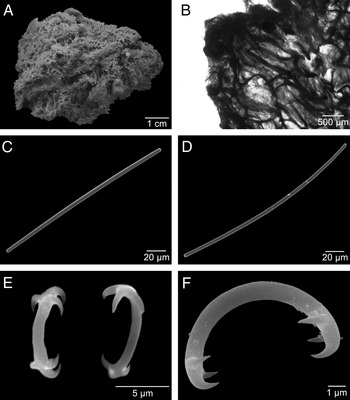
Strongylacidon solangeae sp. nov. (A) Holotype (UFBA-POR 341); (B) ectosome and choanosome through transverse section; (C) straight strongyle; (D) slightly curved strongyle; (E) back and front views of isochelae; (F) side view of isochelae.

DIAGNOSIS
Strongylacidon with massive or ramose shape and soft consistency. Skeleton with plumose fibres and columns of megascleres embedded in spongin. Spicules are straight strongyles and unguiferate chelae.
TYPE MATERIAL
Holotype: UFBA-POR 341, Itapoã (12°57′09.51″S 38°21′45.28″W), Salvador, Bahia State, Brazil, depth <10 m, free diving, coll. S. Peixinho, 19 November 1982.
Paratype: UFBA-POR 913, tidal pool, Ondina beach (13°00′44.04″S 38°30′27.21″W), Salvador, Bahia State, Brazil, 1 m depth, free diving, coll. S. Peixinho, 13 June 1988.
DESCRIPTION
Shape massive or ramose, up to 6.8 cm long by 2.5 cm high (Figure 3A). Colour in vivo blue in the surface and yellow in the interior; after fixation it becomes yellowish-brown to beige. Surface rough and irregular, or smooth with a thin detachable film in some areas. Oscules and pores not visible in preserved specimens. Consistency compressible, fragile.
SKELETON
Skeleton fibrous with scattered megascleres and microscleres (Figure 3B). Some areas of the ectosome present small conical or rounded projections with bundles of 20 to 30 strongyles thick, perpendicular to the surface. At most parts of the ectosome, especially those devoid of protuberances, the strongyles are tangentially disposed. Choanosome with sinuous ascending fibres 50–95 µm wide, filled by 25–60 megascleres embedded in spongin, disposed throughout the sponge body. Spicule bundles rarely anastomose. Megascleres sparse around the bundles and unguiferate chelae scattered throughout the choanosome.
SPICULES
Megascleres: strongyles (Figure 3C, D) abundant, long, thin, smooth and cylindrical, straight to slightly curved, with rounded ends, sometimes slightly distinct (anisostrongyles): 127.7–214.4–255.3/2.7–3.9–5.4 µm. Microscleres: unguiferate isochelae (Figure 3E, F) abundant, smooth, with thin shaft and three conical teeth at both ends, one frontal and two lateral, strongly curved almost in a right angle, all identical in shape: 6.8–8.9–10.8 µm.
ECOLOGY
Both specimens were collected on hard substrate in shallow tide pools, exposed to light. Their surfaces were free of epibionts.
GEOGRAPHICAL DISTRIBUTION
Brazil: Bahia State: Salvador: Ondina and Itapoã.
BATHYMETRIC DISTRIBUTION
Intertidal to shallow water (less than 10 m depth).
ETYMOLOGY
The species name is in honour of Professor Solange Peixinho e Silva (in memoriam) for her great contribution to the development of Zoology in Brazil, guiding biologists who now teach at various universities and transmitting her knowledge and passion for sponges to students in the last three decades.
REMARKS
The new species clearly belongs to the genus Strongylacidon by having strongyles and tridentate chelae (van Soest, Reference van Soest, Hooper and van Soest2002a). Strongylacidon solangeae sp. nov. is similar to S. kaneohe, S. plicatum, S. stelliderma, S. unguiferum and S. zanzibarense in general shape and size of strongyles and unguiferate chelae (Table 1). However, Strongylacidon kaneohe, S. unguiferum and S. zanzibarense are distinguished from S. solangeae sp. nov. by their encrusting shape and their colour black or reddish-brown, black-grey and grey-brown, respectively (Lendenfeld, Reference von Lendenfeld1897; de Laubenfels, Reference de Laubenfels1950; van Soest, Reference van Soest2009). Strongylacidon plicatum and S. stelliderma differ from the new species by their lobate shape (Carter, Reference Carter1886; Hentschel, Reference Hentschel, Michaelsen and Hartmeyer1911); the latter also presents strongyles in two categories (Hooper & Wiedenmayer, Reference Hooper, Wiedenmayer and Wells1994). Strongylacion zanzibarense is similar to the new species in many characters: size of strongyles (160–260 µm) and chelae (6–9 µm); shape of chelae, which are slightly anisochelae, invariably with three teeth at both ends, less curved at one end than at the other in S. zanzibarense and equally curved but with slightly variable ends and teeth sizes in S. solangeae sp. nov. Furthermore, despite the spicule bundles being embedded in spongin in both species, in S. zanzibarense the skeleton is supported by symbiotic alga from the base to the surface, whereas S. solangeae sp. nov. has the choanosome filled by sinuous bundles or columns of megascleres. Although small, these differences are clear enough to make unlikely that Zanzibar and Brazilian specimens are the same species.
As in Strongylacidon oxychaetum sp. nov., the absence of sigmas in Strongylacidon solangeae sp. nov. distinguishes it from S. griseum, S. fasciculatum, S. rubrum, S. stelligera and S. viride. Strongylacidon solangeae sp. nov. differs from Strongylacidon oxychaetum sp. nov. by its ramose aspect, absence of oxychaetes, and presence of unguiferate isochelae (Table 1).
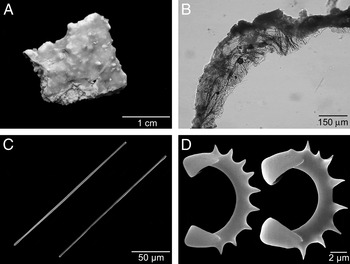
Strongylacidon chelospinata sp. nov. (A) Holotype (MNRJ 7881); (B) ectosome and choanosome through transverse section; (C) strongyles; (D) spined arcuate isochelae (acanthochelae).

Strongylacidon sp., Muricy & Moraes, Reference Muricy and Moraes1998: 215; Moraes et al., Reference Moraes, Ventura, Klautau, Hajdu, Muricy, Alves and Castro2006: 168.
DIAGNOSIS
Strongylacidon thinly encrusting, with uniform blue colour in life and no fibrous skeleton. Spicules are straight strongyles and unique spined arcuate isochelae.
TYPE MATERIAL
Holotype: MNRJ 7881; paratype: MNRJ 7869, both from Cagarras, Fernando de Noronha Archipelago (03°48′31.65″S 32°23′22.96″W), Brazil, 15 m depth, coll. Fernando Moraes, 8 November 2003.
DESCRIPTION
Shape thinly encrusting, 50 × 30 mm wide by 1 mm thick (Figure 4A). Colour blue in vivo, becoming cream in alcohol. Surface smooth, regular. Oscules not visible in preserved specimens. Consistency fragile.
SKELETON
Ectosome unspecialized, tapped by the terminal strongyles bundles, without distinction from the choanosome (Figure 4B). Choanosome with multispicular tracts of strongyles (7.4–16.5–24.7 µm wide) without spongin, oriented from the base to the surface of the sponge, without crossing it; arcuate isochelae randomly dispersed.
SPICULES
Megascleres: strongyles (Figure 4C) straight, with slightly expanded edges and axial canal visible under light microscopy: 172.9–186.8–200.7/2.0–2.3–3.0 µm. Microscleres: arcuate isochelae, with large spines along the external portion of the axis (Figure 4D). The spines are sharp and conical (0.5–2.0 µm long), distributed in eight or nine rows containing two spines each, except for the first and last ones, that have only one; the ala is single and oriented upward against the shaft: 10.0–11.2–12.0/2.0–2.8–4.0 µm.
ECOLOGY
Found on rocky bottom covered by calcareous algae, exposed to sunlight. No associated organisms were observed.
GEOGRAPHICAL DISTRIBUTION
Brazil: Pernambuco State: Fernando de Noronha Archipelago.
BATHYMETRIC DISTRIBUTION
Collected at 15 m depth.
ETYMOLOGY
The name chelospinata refers to the presence of characteristic and unique arcuate isochelae with spines along the external part of the shaft.
REMARKS
Strongylacidon chelospinata sp. nov. is distinguished from all other species of the genus by its exclusive arcuate isochelae, which have well developed conical spines along the outer region of the axis. These spicules slightly resemble highly modified displaster-like arcuate-derived chelae seen in Acanthancora clavilobata (Poecilosclerida: Myxillina: Hymedesmiidae). The uniform blue colour of S. chelospinata sp. nov. is also unique among the species of Strongylacidon. The only two other species with blue colour are S. conulosum Bergquist & Fromont, Reference Bergquist and Fromont1988 and S. solangeae sp. nov., but they differ from S. chelospinata sp. nov. by the yellowish interior and massive shape. The spicular assemblage of only strongyles and isochelae of S. chelospinata sp. nov. is shared with another 10 species of the genus: S. stelliderma (Carter, Reference Carter1886); S. zanzibarense Lendenfeld, Reference von Lendenfeld1897; S. platei (Thiele, Reference Thiele1905); S. plicatum (Hentschel, Reference Hentschel, Michaelsen and Hartmeyer1911); S. kaneohe (de Laubenfels, Reference de Laubenfels1950); S. meganese (de Laubenfels, Reference de Laubenfels1951); S. poriticola Van Soest, Reference van Soest, Hummelinck and Van der Steen1984; S. conulosum Bergquist & Fromont, Reference Bergquist and Fromont1988; S. unguiferum Van Soest, Reference van Soest2009; and S. solangeae sp. nov. (Table 1). Strongylacidon stelliderma is subglobular and has two size categories of strongyles. Strongylacidon zanzibarense and S. platei are also encrusting like S. chelospinata sp. nov., but both are grey and differ also by the unguiferate isochelae in the first one, and the presence of tornostrongyles besides strongyles in the second species. Another two encrusting species of Strongylacidon are S. meganese and S. poriticola. The first one differs from S. chelospinata sp. nov. by its yellow-grey to ochre colour and the larger size of the strongyles and chelae, and the second species by the bright red colour. Strongylacidon plicatum clearly differs from S. chelospinata sp. nov. by the massive shape, yellowish colour, two size-classes of strongyles and unguiferate isochelae. Strongylacidon kaneohe is also thinly encrusting, but has dark colour (almost black), and its isochelae are unguiferate, characters not shared with S. chelospinata sp. nov.
DISCUSSION
The three new species here described display the typical morphology of Strongylacidon, which may be highly diverse, but most frequently consists of thinly or thickly encrusting or ramose sponges. The spiculation of strongyles and arcuate–unguiferous chelae is also typical of the genus, although it does not allow the identification of species of Strongylacidon. Strongylacidon oxychaetum sp. nov. is distinguished from other Strongylacidon by the presence of acanthose oxychaetes, recorded for the first time in the genus and in the family Chondropsidae. These spicules were considered by van Soest (Reference van Soest, Hooper and van Soest2002d) as modified raphides, highly informative phylogenetically. Before this paper, onychaetes were considered a synapomorphy of a single family of Myxillina–Tedaniidae—containing three genera: Tedania, Hemitedania and Strongylamma, where they are commonly associated with tornotes, tylotes or strongyles, but never with chelae. The presence of oxychaetes in Chondropsiidae may be indicative of its relationship with Coelospharidae, due to their presence in the genus Chaetodoryx and in Celtodoryx girardae, and with Tedaniidae, which has onychaetes. The new species, Strongylacidon oxychaetum, resembles superficially Coelosphaera (C.) raphidifera (Topsent, 1892), but differs from it by having rare oxychaetes tangentially disposed only in the surface layer of the ectosome in all the three specimens examined, contrasting with the raphides of Coelosphaera, which are profusely scattered throughout the body of the sponge. Coelosphaera is characterized by a fistular shape, presence of tylotes or strongyles, echinating acanthostyles, arcuate isochelae, sigmas and raphides that can be completely absent (van Soest, Reference van Soest, Hooper and van Soest2002b). The distinctions are reinforced by the absence of fistules, tylotes and acanthostyles megascleres in Strongylacidon.
Special arcuate and spined chelae (acanthochelae) are equally unknown in the genus Strongylacidon, as well as for Chondropsiidae. Prior to this paper, acanthochelae were recorded in the Hymedesmiid genera Acanthancora Topsent, 1927, Pseudohalichondria Carter, 1886 and Hymedesmia Bowerbank, 1864 (van Soest, Reference van Soest, Hooper and van Soest2002c). All spined chelae and megascleres reported for these genera are distinct from those present in Strongylacidon chelospinata sp. nov.; Acanthancora has acanthostyles arranged at the base of the sponge and tuberculate spined isochelae. Pseudohalichondria has spongin fibres cored by sand grains and subtylostyles, as well as sigmoid isochelae with ripples on the shaft resembling rounded spines; and Hymedesmia presents one or two categories of acanthostyles, tornotes and isochelae (van Soest, Reference van Soest, Hooper and van Soest2002c).
KEY TO THE STRONGYLACIDON SPECIES OCCURRING IN THE TROPICAL WESTERN ATLANTIC
(Modified and expanded from van Soest, Reference van Soest2009.)
1. Microscleres present; shape massive, encrusting or ramose sponges………2
— Microscleres absent; shape tubular………S. bermudae
2. Chelae present (may be rare)………4
— Chelae absent; only microscleres are sigmas………3
3. Sigmas 13–18 µm; colour green (preserved in alcohol)………S. viride
— Sigmas 20–30 µm; colour red (becomes white in alcohol)………S. rubrum
4. Chelae unguiferate………5
— Chelae arcuate………6
5. Sigmas present; strongyles less than 200 µm………S. griseum
— Sigmas absent………7
6. Oxychaetes present; strongyles 244–391 µm; smooth chelae………S. oxychaetum sp. nov.
— Oxychaetes absent………8
7. Chelae anchorate–arcuate and smooth; sigmas 13–15 µm; colour red (reddish brown in alcohol)………S. poriticola
— Chelae arcuate, spined at the external face of the shaft; sigmas absent; colour blue (in vivo)………S. chelospinata sp. nov.
8. Shape thinly encrusting; strongyles 200–300 µm; chelae 15–22 µm………S. unguiferum
— Shape ramose; strongyles 127–255 µm; chelae 6–11 µm………S. solangeae sp. nov.
ACKNOWLEDGEMENTS
We thank the Post-Graduate Programme in Animal Diversity (IBIO/UFBA), FAPESB and CAPES for Master fellowships to G.J.G.S. and CNPq for a fellowship to G.M. The donation of type-specimens of S. oxychaetum sp. nov. by Drs Maria Cecilia Guerrazzi (UESB) and Marlene Campos Peso Aguiar (IBIO/UFBA) and the loan of specimens of Strongylacidon poriticola and S. bermudae for comparison by Dr Rob van Soest (ZMA) and of literature by Dr Eduardo Hajdu (MNRJ) are greatly appreciated. We also thank Elivaldo de Lima (Museu Nacional) and Adriana Rangel (FIOCRUZ-BA) for help in SEM. This work was supported by FAPESB (Fundação de Amparo à Pesquisa do Estado da Bahia) (C.M., grant PPP 0010/2006) and PETROBRAS (Projects FAPEX 07.0213 and MNRJ/SAPE 460022548-3).