Introduction
Schistosomiasis, caused by trematode flatworms of the genus Schistosoma, is one of the most significant neglected diseases, with major economic and public-health consequences (Rapado et al., Reference Rapado, Nakano, Ohlweiler, Kato, Yamaguchi, Pereira and Kawano2011). The major aetiological agent of human schistosomiasis is Schistosoma mansoni, and it is estimated that more than 200 million people are infected (WHO, 2011), and 779 million people are at risk of infection, worldwide (Steinmann et al., Reference Steinmann, Keiser, Bos, Tanner and Utzinger2006; Botros et al., Reference Botros, William, Beadle, Valiaeva and Hostetler2009; Moraes et al., Reference Moraes, Nascimento, Lopes, Nakano, Yamaguchi, Kato and Kawano2011). Praziquantel (PZQ), the drug of choice for the treatment of schistosomiasis, is relatively safe and highly effective against all species of Schistosoma. However, PZQ does not prevent re-infection and is inactive against juvenile schistosomes (Stelma et al., Reference Stelma, Talla, Sow, Kongs, Niang, Polman, Deelder and Gryseels1995; Moraes et al., Reference Moraes, Nascimento, Lopes, Nakano, Yamaguchi, Kato and Kawano2011). In addition, the widespread and intensive use of PZQ has caused increasing concern about the development of drug-resistant strains, which reinforces the need for the development of novel, safe and effective schistosomicidal drugs (Steinmann et al., Reference Steinmann, Keiser, Bos, Tanner and Utzinger2006; Botros et al., Reference Botros, William, Beadle, Valiaeva and Hostetler2009). In order to provide new lead structures, for use in future strategies to control schistosomiasis, the search for schistosomicidal compounds from natural sources, mainly plants, has intensified in recent years (Parreira et al., Reference Parreira, Magalhães, Morais, Caixeta, de Sousa, Bastos, Cunha, Silva, Nanayakkara, Rodrigues and Da Silva Filho2010; Melek et al., Reference Melek, Tadros, Yousif, Selim and Hassan2011; Moraes et al., Reference Moraes, Nascimento, Lopes, Nakano, Yamaguchi, Kato and Kawano2011; Yousif et al., Reference Yousif, Wassel, Boulos, Labib, Mahmoud, El-Hallouty, El Bardicy, Mahmoud, Ramzy, Gohar, El-Manawaty, El Gendy, Fayad and El-Menshawi2012).
Plants of the genus Piper (Piperaceae) are used in Brazilian folk medicine to treat many ailments, including gastrointestinal and infectious diseases (Estevez et al., Reference Estevez, Castillo, Pisango, Arevalo, Rojas, Alban, Deharo, Bourdy and Sauvain2007; Agra et al., Reference Agra, Silva, Basílio, França and Barbosa-Filho2008). Phytochemical studies have shown that Piper species contain several biologically active metabolites, including lignans, chalcones, amides, alkaloids and chromenes (Parmar et al., Reference Parmar, Jain, Bisht, Jain, Taneja, Jha, Tyagi, Prasad, Wengel, Olsen and Boll1997; Lago et al., Reference Lago, Ramos, Casanova, Morandim, Bergamo, Cavalheiro, Bolzani, Furlan, Guimarães, Young and Kato2004; Silva et al., Reference Silva, Coimbra, Pereira, Almeida, Lima, Costa, Vinhólis, Royo, Silva, Da Silva Filho, Cunha, Furtado, Martins, Carvalho and Bastos2007). Piper amalago, popularly known in Brazil as falso-jaborandi, is also used in folk medicine as a vermifuge (Heckel, Reference Heckel1897). Rapado et al. (Reference Rapado, Nakano, Ohlweiler, Kato, Yamaguchi, Pereira and Kawano2011) found that some crude extracts of Piper species possess molluscicidal and ovicidal activities against Biomphalaria glabrata, the major intermediate host of S. mansoni. Also, the essential oil of Piper cubeba shows schistosomicidal activity in vitro (Magalhães et al., Reference Magalhães, Souza, Wakabayashi, Laurentiz, Vinhólis, Rezende, Simaro, Bastos, Rodrigues, Esperandim, Ferreira, Crotti, Cunha and Silva2012); and an amide isolated from P. tuberculatum possesses schistosomicidal activity against adult worms of S. mansoni (Moraes et al., Reference Moraes, Nascimento, Lopes, Nakano, Yamaguchi, Kato and Kawano2011).
Given the molluscicidal and ovicidal activities of Piper species and continuing the search for active metabolites with schistosomicidal activity (Caixeta et al., Reference Caixeta, Magalhães, Melo, Wakabayashi, Aguiar, Aguiar, Mantovani, Morais, Oliveira, Tavares, Groppo, Rodrigues, Cunha, Veneziani, Da Silva Filho and Crotti2011; Pereira et al., Reference Pereira, Magalhães, Gonçalves, Luz, Moraes, Rodrigues, Guedes, Da Silva Filho, Cunha, Da Silva Filho, Cunha, Bastos, Nanayakkara and Silva2011), the present study evaluated the in vitro schistosomicidal effects of crude fractions of different Piper species. The dichloromethane fraction of P. amalago leaves was subjected to phytochemical fractionation in order to isolate its major active compound, which was evaluated in vitro against S. mansoni.
Materials and methods
Collection and examination of Piper species
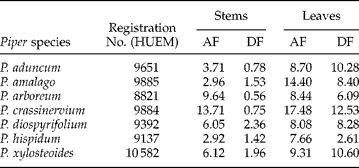
Leaves and stems of Piper aduncum Linnaeus, P. amalago Linnaeus, P. arboreum Aublet, P. crassinervium Humboldt, Bonpland & Kunth, P. diospyrifolium Kunth, P. hispidum Swartz and P. xylosteoides (Kunth) Steud. were collected from the Horto Florestal Dr. Luís Teixeira Mendes in Maringá, Paraná, Brazil. Voucher specimens were deposited in the herbarium of the Department of Botany, University of Maringá (table 1). Fresh leaves and stems were dried in a forced-air convection oven (QUIMIS®, model Q-31, Diadema, São Paulo, Brazil), at 40°C. After 3 days, the material was crushed in a knife grinder (Tecnal Marconi®, model TE 048, Piracicaba, Brazil).
Yields (%) of aqueous (AF) and dichloromethane fractions (DF) from stems and leaves of seven species of Piper.

Preparation of crude fractions
Leaves and stems of Piper species were macerated at room temperature with ethanol:water (9:1; v/v), filtered, and concentrated under vacuum at 25°C. This procedure resulted in water-soluble phases and dark residues. The water-soluble phases were lyophilized to obtain the aqueous fractions. The dark residues were dissolved in dichloromethane and transferred to a previously weighed flask. The solvent was evaporated at room temperature, yielding the dichloromethane fractions (table 1).
Purification of an active compound
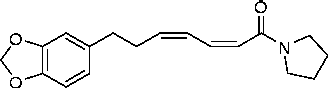
Considering its best activity in the schistosomicidal assay, the dichloromethane fraction (15 g) of P. amalago leaves was eluted with hexane, hexane–dichloromethane (50:50; v/v), dichloromethane, ethyl acetate and methanol in a vacuum silica-gel column (70–230 mesh). The ethyl acetate fraction (1 g) was chromatographed by silica-gel column chromatography using hexane, hexane–chloroform (98:2 to 50:50; v/v), chloroform, chloroform:ethyl acetate (95:5 to 50:50; v/v), ethyl acetate, acetone and methanol, yielding 14 fractions. Fraction 2 (F2: 100 mg) was further chromatographed using hexane–ethyl acetate (50:50; v/v), ethyl acetate and methanol, yielding 35 mg of compound 1. Compound 1 was identified as the piperamide N-[7-(3′,4′-methylenedioxyphenyl)-2(Z),4(Z)-heptadienoyl] pyrrolidine (fig. 1) by electron ionization mass spectrometry (EIMS), 1H- and 13C-NMR (nuclear magnetic resonance) spectral data and by comparison with literature data (Alécio et al., Reference Alécio, Bolzani, Young, Kato and Furlan1998). The spectral data were described in a previous study (Carrara et al., Reference Carrara, Serra, Cardozo-Filho, Cunha-Júnior, Torres-Santos and Cortez2012).
Chemical structure of the active compound, piperamide 1, N-[7-(3′,4′-methylenedioxyphenyl)-2(Z),4(Z)-heptadienoyl] pyrrolidine.

In vitro studies with S. mansoni
The LE (Luiz Evangelista) strain of S. mansoni was maintained by passage through B. glabrata snails and Balb/c mice. After 8 weeks, S. mansoni adult worms (males and females) were recovered under aseptic conditions from mice previously infected with 200 cercariae, by perfusion of the liver and mesenteric vein (Magalhães et al., Reference Magalhães, Machado, Morais, Moreira, Soares, Silva, Da Silva Filho and Rodrigues2009). Worms were washed in RPMI 1640 medium (Invitrogen Life Technologies, Carlsbad, California, USA), kept at pH 7.5 with 20 mm HEPES supplemented with penicillin (100 UI/ml), streptomycin (100 μg/ml) and 10% bovine fetal serum (Gibco, Life Technologies, Gaithesburg, Maryland, USA). After washing, one pair of adult worms was transferred to each well of a 24-well culture plate containing 2 ml of the same medium and incubated at 37°C in a humid atmosphere containing 5% CO2 prior to use. For the in vitro test with S. mansoni, a preliminary screening of aqueous and dichloromethane fractions of Piper species was performed at 100 μg/ml, as described by Magalhães et al. (Reference Magalhães, Souza, Wakabayashi, Laurentiz, Vinhólis, Rezende, Simaro, Bastos, Rodrigues, Esperandim, Ferreira, Crotti, Cunha and Silva2012) and Ramalhete et al. (Reference Ramalhete, Magalhães, Rodrigues, Silva, Da Silva Filho and Ferreira2012). The most active sample (dichloromethane fraction of P. amalago leaves) was submitted to phytochemical study in order to isolate its major compound (compound 1), which was further evaluated at concentrations of 10–100 μ m. Samples were dissolved in 1% dimethyl sulphoxide (DMSO) and added to RPMI 1640 medium containing one pair of adult worms that had been allowed 24 h to adapt to the culture medium. Parasites were kept for 120 h and monitored every 24 h to evaluate their general condition, based on the motor activity and mortality rate. Alteration in motor activity was classified as either slight or significant. Slight was defined as reduced movement compared with the negative control, and significant was defined as minimal movement observed for 1 min (Magalhães et al., Reference Magalhães, Machado, Morais, Moreira, Soares, Silva, Da Silva Filho and Rodrigues2009). Worms were considered dead when no movement was observed for at least 2 min. All experiments were carried out in quadruplicate, using RPMI 1640 medium and RPMI 1640 with 1% DMSO as negative controls and 10 μ m praziquantel (PZQ) as a positive control group. All experiments were authorized by the Committee for Ethics in Animal Care of the University of São Paulo, in accordance with nationally and internationally accepted principles for laboratory animal use and care. Data were analysed by one-way analysis of variance, followed by Tukey's multiple comparison test, with the level of significance set at P< 0.05.
Results
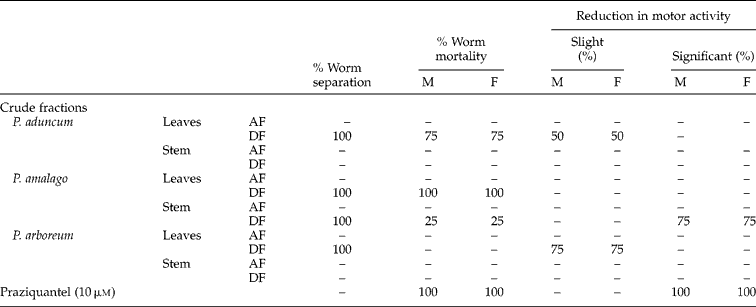
In a preliminary screening, several crude fractions from Piper species were tested, at 100 μg/ml, against S. mansoni adult worms, as shown in table 2. The dichloromethane fraction from leaves of P. amalago was the most active, causing 100% mortality of the parasites and a significant decrease in motor activity, without tegumental alterations (results not provided), after 24 h of incubation. In addition, after incubation with the dichloromethane fraction of P. aduncum leaves, all pairs of worms had separated. Similarly, incubation with dichloromethane fractions (100 μg/ml) of P. amalago stems and P. aduncum leaves caused 25% and 75% mortality, respectively, of the worms. All pairs of worms had separated after 24 h of incubation with dichloromethane fractions of P. amalago stems, P. aduncum leaves, and P. arboreum leaves.
In vitro effects of crude fractions (100 μg/ml) from species of Piper on eight pairs of adult Schistosoma mansoni for comparison with praziquantel (10 μ m) over a 24-h incubation period, with the level of significance at P<0.05.

M, males; F, females; AF, aqueous fractions; DF, dichloromethane fractions.
On the other hand, no significant results were found for other fractions from P. crassinervium, P. diospyrifolium, P. hispidum and P. xylosteoides. None of the aqueous fractions was active against adult S. mansoni after 24 h of incubation.
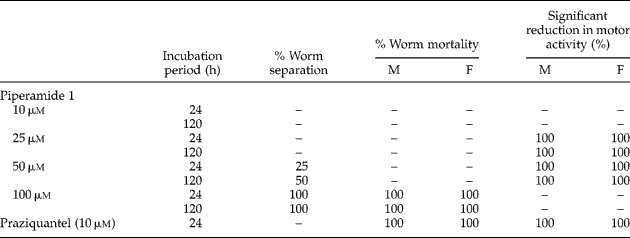
Piperamide 1, isolated from the dichloromethane fraction of P. amalago leaves, was also evaluated against adult S. mansoni, as presented in table 3. When piperamide 1 was tested at 100 μ m, it caused 100% mortality of adult worms after 24 h of incubation. Additionally, all pairs of worms separated when exposed to 100 μ m of piperamide 1, while at 50 μ m, 75% of the pairs remained coupled. Moreover, male and female adults showed a significant decrease in motor activity after incubation with piperamide 1 (in concentrations ranging from 25 to 50 μ m). PZQ (10 μ m) caused 100% mortality but no separation of pairs, whereas no effect was observed in worms in the negative (RPMI 1640 medium) and control (RPMI medium plus 1% DMSO) groups.
In vitro effects of the active compound 1 (piperamide) on eight pairs of adult worms of Schistosoma mansoni for comparison with praziquantel (10 μm) with the level of significance at P<0.05.

M, males; F, females.
Discussion
Several species of Piper have been reported as promising sources of antiparasitic compounds (Moraes et al., Reference Moraes, Nascimento, Lopes, Nakano, Yamaguchi, Kato and Kawano2011; Rapado et al., Reference Rapado, Nakano, Ohlweiler, Kato, Yamaguchi, Pereira and Kawano2011; Carrara et al., Reference Carrara, Serra, Cardozo-Filho, Cunha-Júnior, Torres-Santos and Cortez2012). In the present study, crude fractions of different Piper species were prepared and evaluated in vitro against S. mansoni adult worms. None of these Piper species has been tested previously against S. mansoni. The preliminary schistosomicidal assay showed that the crude fractions obtained from leaves were more active than those from stems. These results are in accordance with those of Regasini et al. (Reference Regasini, Cotinguiba, Passerini, Bolzani, Cicarelli, Kato and Furlan2009), who reported that crude extracts from leaves exhibited better trypanocidal activity than the extracts from stems. Also dichloromethane fractions were more active than aqueous fractions, suggesting that the major schistosomicidal compounds of Piper species might have medium polarity. These results are in agreement with those of Atjanasuppat et al. (Reference Atjanasuppat, Wongkham, Meepowpan, Kittakoop, Sobhon, Bartlett and Whitfield2009), who showed that dichloromethane extracts of Piper nigrum and Piper chaba were the most active against cercariae of S. mansoni.
Of all the samples tested, the dichloromethane fraction of P. amalago leaves (at 100 μg/ml) was the most active, due to its ability to kill all parasites and separate all pairs of adults. In a preliminary schistosomicidal assay, similar results were obtained for the crude methanol extract of Momordica balsamina (Cucurbitaceae), which caused 100% mortality of S. mansoni adults, at 100 μg/ml, after 24 h of incubation (Ramalhete et al., Reference Ramalhete, Magalhães, Rodrigues, Silva, Da Silva Filho and Ferreira2012). Because of its relatively high schistosomicidal activity, the dichloromethane fraction of P. amalago leaves was chromatographed on silica gel, using different mobile phases as eluents, to identify its major compound, a piperamide named N-[7-(3′,4′-methylenedioxyphenyl)-2(Z),4(Z)-heptadienoyl] pyrrolidine (piperamide 1) (fig. 1). Dichloromethane fractions from P. amalago stems and P. aduncum leaves showed moderate activity at 100 μg/ml. Phytochemical and biological studies with the dichloromethane fraction of P. aduncum leaves are in progress, in order to identify its major active compound against adult schistosomes.
Among the major compounds in Piper species, several compounds, mainly amides and lignans, have been identified as active in previous phytochemical investigations (Parmar et al., Reference Parmar, Jain, Bisht, Jain, Taneja, Jha, Tyagi, Prasad, Wengel, Olsen and Boll1997; Alécio et al., Reference Alécio, Bolzani, Young, Kato and Furlan1998; Lago et al., Reference Lago, Ramos, Casanova, Morandim, Bergamo, Cavalheiro, Bolzani, Furlan, Guimarães, Young and Kato2004). Some lignans from Piper species proved to be active against Trypanosoma cruzi (Souza et al., Reference Souza, Silva, Pereira, Royo, Saraiva, Montanheiro, Souza, Da Silva Filho, Grando, Donate, Bastos, Albuquerque and Silva2005), Leishmania sp. (Bodiwala et al., Reference Bodiwala, Singh, Singh, Dey, Sharma, Bhutani and Singh2007) and S. mansoni (Magalhães et al., Reference Magalhães, Souza, Wakabayashi, Laurentiz, Vinhólis, Rezende, Simaro, Bastos, Rodrigues, Esperandim, Ferreira, Crotti, Cunha and Silva2012; Patent 0503951–7). Piperamides, such as compound 1, are abundant in members of Piper, and possess several kinds of activity, including leishmanicidal, trypanocidal, insecticidal and antifungal (Regasini et al., Reference Regasini, Cotinguiba, Passerini, Bolzani, Cicarelli, Kato and Furlan2009; Silva et al., Reference Silva, Nakamura, Dias-Filho, Ueda-Nakamura and Cortez2009; Carrara et al., Reference Carrara, Serra, Cardozo-Filho, Cunha-Júnior, Torres-Santos and Cortez2012).
In this study, the isolated piperamide 1 showed significant schistosomicidal activity against S. mansoni adults, with a similar effect on both sexes. Male and female adults of S. mansoni differ in their sensitivity to drugs (Moraes et al., Reference Moraes, Carvalho, Nakano, Almeida, Marques, Andrade, Freitas and Sousa2013). For example, males of S. mansoni exposed to the essential oil from Ageratum conyzoides tended to be more susceptible than females (Melo et al., Reference Melo, Magalhães, Carvalho, Wakabayashi, Aguiar, Ramos, Mantovani, Turatti, Rodrigues, Groppo, Cunha, Veneziani and Crotti2011). Similarly to piperamide 1, other schistosomicidal compounds, such as epiisopiloturine and piplartine, have shown no differences in their effect on male and female worms (Moraes et al., Reference Moraes, Nascimento, Lopes, Nakano, Yamaguchi, Kato and Kawano2011; Veras et al., Reference Veras, Guimarães, Campelo, Vieira, Nascimento, Lima, Vasconcelos, Nakano, Kuckelhaus, Batista, Leite and Moraes2012).
Piplartine, a piperamide isolated from P. tuberculatum, exhibited an optimal activity against S. mansoni, affecting mainly the motor activity of all parasites (Moraes et al., Reference Moraes, Nascimento, Lopes, Nakano, Yamaguchi, Kato and Kawano2011). Piperamide 1 also affected the motor activity of all parasites, compared with the negative control group. In lower doses of piperamide 1 (25–50 μ m), early loss of spontaneous movement and complete immobilization of both males and females were observed. Since motility is affected, it is possible that piperamide 1 acts on muscles of adult worms, causing paralysis (Caixeta et al., Reference Caixeta, Magalhães, Melo, Wakabayashi, Aguiar, Aguiar, Mantovani, Morais, Oliveira, Tavares, Groppo, Rodrigues, Cunha, Veneziani, Da Silva Filho and Crotti2011 ; Magalhães et al., Reference Magalhães, Souza, Wakabayashi, Laurentiz, Vinhólis, Rezende, Simaro, Bastos, Rodrigues, Esperandim, Ferreira, Crotti, Cunha and Silva2012). However, despite its effect on motor activity, the exact mechanisms by which piperamide 1 causes mortality in adult worms remain unclear. On the other hand, some piperamides show toxicity to mammal cells (Tang et al., Reference Tang, Chen, Oiu, Sheng, Wang, Hu, Zhao, Ma, Huang, Huang, Xu, Long and Li2011). In this sense, the schistosomicidal activity of piperamide 1 (at 100 μ m) might be due to a cytotoxic effect on adult S. mansoni. Further studies should be conducted to clarify the schistosomicidal effect of piperamide 1 on adults of S. mansoni.
In summary, our results indicate that the dichloromethane fraction of P. amalago leaves possesses in vitro schistosomicidal activity against S. mansoni adult worms. Our study reinforced the traditional use of P. amalago as a vermifuge, and identified piperamide 1 as its major active schistosomicidal compound. Further biological and toxicological investigations of piperamide 1 should be undertaken in order to elucidate its mechanism of action. Finally, this study ratifies the potential of Piper species as promising sources of natural lead compounds that may be used to develop new schistosomicidal drugs.
Acknowledgements
The authors are grateful to Fundação de Amparo à Pesquisa do Estado de São Paulo (FAPESP, Proc. 2006/60132-4) and Fundação de Amparo à Pesquisa do Estado de Minas Gerais (FAPEMIG, Proc. APQ 00171/11) for financial support, and to Conselho Nacional de Desenvolvimento Cientìfico e Tecnológico (CNPq) for fellowships.