

Family wellbeing and, of specific interest to this paper, child wellbeing are at the core of a strong and resilient civil society. To sustain a healthy level of wellbeing, there needs to be investment in the children who will become the future families and communities of the nation. Having the skills and resources to fully participate throughout life is the result of a good start in the early childhood years. However, there are still specific barriers to family wellbeing faced by families whose children require additional specialist support to achieve optimal early childhood development and learning outcomes. ‘Specialist’ support refers to all professional disciplines that can contribute to child development and learning, including allied and other health workers (e.g., speech pathologists and occupational therapists) and special educators, to name a few.
The challenges of delivering specialist services to Indigenous, rural and remote communities are well documented (Bourke et al., Reference Bourke, Humphreys, Wakerman and Taylor2012; Maxwell, Reference Maxwell2012; O'Callaghan, McAllister, & Wilson, Reference O'Callaghan, McAllister and Wilson2005). The issues reported relate to geographic distance, the relatively small pool of available specialist practitioners, and the challenges of engaging communities in the design of culturally appropriate and locally relevant programs. Under current arrangements, many disadvantaged communities and families do not have access to the array of services available to those who live in urban locations. Timely and coordinated access to the services that are available is further complicated by a significant demarcation between the roles and boundaries of specific agencies such as education, health and disability services. Limited access to specialist support and educational services by Indigenous and rural and remote families has long-term costs. These contribute to intergenerational disadvantage through reduced opportunities for children to achieve their full learning and social potential (McCormack, Harrison, McLeod, & McAllister, Reference McCormack, Harrison, McLeod and McAllister2011).
Recently, there has been an increased awareness of the need for collaborative responses to early childhood development and education in Australia (Johns, Reference Johns2010; Maxwell, Reference Maxwell2012). This is in part because of the recognition that many of the determinants of disadvantage fall outside the specific sectors with whom responsibility for implementing reform sits (Baum, Reference Baum2007). For example, many of the factors that determine educational disadvantage are not the sole responsibility of the Education sector, just as the factors that determine health disadvantage are not the sole responsibility of Health alone. The National Indigenous Reform Agreement (http://www.federalfinancialrelations.gov.au/content/npa/health_indigenous/indigenous-reform/national-agreement_sept_12.pdf), approved by the Council of Australian Governments (COAG) in 2007, mandated improvement in the way all services, including specialist services, are delivered to Indigenous, rural and remote communities in order to ‘close the gap’ in Indigenous disadvantage and to reduce social exclusion.
More recently, the Coordinator General's report on the implementation of the National Partnership Agreement for Remote Service Delivery notes the need for, but still limited, collaboration between specialist services (Gleeson, Reference Gleeson2012). Despite this commentary and a policy context mandating collaborative efforts, policy aspirations are often not translated into action (ANAO, 2007; Shergold, Reference Shergold2004; Tenbensel, Cumming, Ashton, & Barnett, Reference Tenbensel, Cumming, Ashton and Barnett2008).
Essentially, to support the capacity to put policy into action, a ‘cultural shift,’ that is, a change in how we think and act, is required in order to successfully achieve increased wellbeing. This shift is necessary within and across tiers of government, agencies (such as Education and Health), non-government organisations and communities (Trickett et al., Reference Trickett, Beehler, Deutsch, Green, Hawe, McLeroy and Trimble2011). A cultural shift can be achieved by rethinking and acting in a different way about engagement and collaboration, sustainability, developing a future workforce, and building the capacity of the current workforce. Therefore the argument developed here, is not whether various government agencies and the service sector should be modifying delivery models, but ‘how’ to evolve and develop alternate, inclusive, participatory, cross-sector strategies of service delivery which would be of benefit to the entire community. Without a cultural shift, the frequently heard refrain of parents — ‘I just don't want my kid to struggle like I did at school’ — will continue.
This article proposes a new approach to delivering specialist services in Indigenous, rural and remote communities. The Specialist Integrated Community Engagement (SpICE) Model is based on ‘Red Dirt thinking’. By Red Dirt thinking we are referring to grounded thinking and doing that creates opportunity out of adversity. SpICE applies Red Dirt thinking by using community engagement to build and link social networks and harness community capacity. For example, SpICE enables Indigenous, rural and remote communities and their service partners to look differently at the variety of resources and institutions available around them and to shape them in new ways to meet local needs.
Adversity in the Indigenous, Rural and Remote Context
The SpICE Model aims to simultaneously address three key areas of need that impact on family and community wellbeing, namely: poor childhood development and learning outcomes; Indigenous, rural and remote community disadvantage; and rural and remote workforce challenges. In order to illustrate the adversity that persists in these Australian contexts these three key areas of need are discussed below.
Child Development, Learning, and Family Wellbeing
The Australian Early Development Index (Department of Education, Employment and Workplace Relations [DEEWR], 2013) provides data on how Australia's children are developing. The information collected in 2012 indicates that while the majority of Australian children are ‘on track’ developmentally, there are still groups of children who are developmentally ‘vulnerable’ or ‘at risk’: ‘There are 4.9% of children reported as having chronic physical, intellectual and medical needs (special needs status) and 10.3% of all children were identified by teachers as requiring more assessment’ (DEEWR, 2013, p. 29). This suggests that nearly 15% of Australian children need some additional support from specialist services when they start school to achieve positive life outcomes.
There are three distinct factors that contribute to children having significantly poorer childhood development progression: geographic location, socio-economic status and being Indigenous (DEEWR, 2013). Not only are there more children from these cohorts who are not ‘on track,’ there are also more children who score poorly in more than one developmental domain, suggesting more complex issues are faced by these groups.
To illustrate the impact of developmental vulnerability at an educational level, teachers gave evidence to a NSW Parliamentary inquiry that they were failing to meet the education needs of students with additional needs. They also made the point that schools would benefit from more support and guidance on how to get the most out of available resources (Parker, Reference Parker2010).
A teacher at a rural school explained to one of the authors her frustration (personal communication, May 3, 2010):
We have . . . I don't know . . . maybe six programs about teaching kids to speak clearly . . . like how to say ‘r.’ But they're designed for use with one child at a time. Do you think I can find a speech pathologist to come and show me how to use them with the whole class? No! So the kids keep writing ‘wun’ instead of ‘run’ because that's how they say it, and the programs sit on the shelf gathering dust.
While by no means the only developmental domain of significance, speech, language and communication issues with children have been a growing community concern. A study reporting that language and speech problems were experienced by 25% of preschool-aged children, putting them at higher risk of learning and social problems at school (McCormack et al., Reference McCormack, Harrison, McLeod and McAllister2011), highlights the challenges educators face. The disadvantage experienced in school years is also described in a NSW study which found that up to 13% of the school-age population have some kind of communication issue that impacts on their ability to learn (McLeod & McKinnon, Reference McLeod and McKinnon2007). A common example is children being misidentified as needing behaviour management programs that remove them from the learning environment, when in fact their language skills are insufficient to understand a teacher's instructions. A child who doesn't understand what ‘after’ means will ignore it in a sentence, so that they hear ‘You can go outside after you finish your writing’ as ‘Go outside then finish your writing’.
According to the National Action Plan for Young Australians, “. . . negative trends in child and youth wellbeing are costing Australia $22 billion per annum” (ARACY, 2010, p. 54). Citing costs from reduced skill levels, suboptimal workforce participation and productivity and increased welfare dependency, the plan notes that this situation also results in . . .“unsustainable expenditure on crisis interventions when investments in prevention are both effective and cost effective” (ARACY, 2010, p. 54). The Action Plan also identifies what this paper strongly advocates; that the complex way in which children develop and learn requires collaborative and whole-of-community action to promote wellbeing.
Indigenous Rural and Remote Communities
Contributing to the continuing disparity between urban and rural/remote communities’ wellbeing, particularly in Health (DoH, 2007) and Education (Parker, Reference Parker2010), is the fact that rural and remote communities have limited access to the specialist services that could help improve the situation. Many of the sources of inequity in rural and remote specialist services have been documented in the literature (Penman, Reference Penman2010). For example, a study looking at consumers’ perceptions of rural specialist services points out that barriers to access “limit rural and remote consumers’ usage of health services, regardless of need, indicating a possible inequity if compared to larger, more accessible urban areas” (O'Callaghan et al., Reference O'Callaghan, McAllister and Wilson2005, p. 162). There is no denying that there are many types of inequities experienced by rural and remote communities, as outlined in the study, including reduced access to health services, inappropriateness of services, poor policies and difficulty recruiting and retaining a specialist workforce.
Rural and remote communities not only face inequalities in available specialist services, but also the challenge of accessing relevant services in a timely and coordinated way. Families in regional communities often tell a disheartening story of seeking support for their children only to be met with a requirement for the child to undertake a series of assessments and tests. Each service has a waiting list for assessment; each assessment takes time; each piece of advice is given in isolation. Parents say all they want is ‘some way to move forward, intact’. We can only conclude that the aim of these assessments is to find a ‘name’ for the child's needs, but fitting into a classification does not provide meaning or a solution for the family.
Unfortunately, many specialist providers are constricted by policies, boundaries and tiers of government that create a segmented rather than integrated service landscape (Bourke et al., Reference Bourke, Humphreys, Wakerman and Taylor2012). The following statement made by a rural community member captures this dilemma (personal communication, May 24, 2010): “This has to be the most over-serviced under-serviced town ever!” By this he meant that the services which were working in the community were not working collaboratively and/or in the interests of the community. Major government departments that provide health, education and disability services all have different geographic boundaries and the borders change every few years. Negotiating the complexities of the access criteria for each service is a further significant barrier for rural and remote people.
There is recognition from cross-sector sources of the importance of collaboration, capacity building, leadership and community engagement to effect quality and sustainable reforms (Mulford, Reference Mulford2011). It follows then, that a community's wellbeing will be built on experiences of success and the growth of competencies that lead to the development of local solutions to problems, rather than a process of being passive recipients of services or support. In a regional and remote community context with limited access to specialist services, the need for initiatives that ‘maximise’ available resources through engagement, collaboration and networking at local levels becomes imperative. Examples of this could include schools in remote areas facilitating specialist student workplace learning experiences. Communities would gain a student workforce and students would benefit from valuable ‘real-life’ experience working with communities.
Indigenous Rural and Remote Specialist Workforce
Providing a sustainable workforce suited to the needs of rural and remote Australia has been identified as a national challenge as evidenced by COAG's recent formation of Health Workforce Australia (HWA). Part of HWA's mandate is the development of a rural and remote health workforce innovation and reform strategy. Redefining the scope-of-practice and the job description and delivery of specialist services, including teaching, is becoming more necessary in response to the changing work contexts, population and workforce demographics and new understandings about what works successfully in Indigenous, rural and remote settings. A key finding in the literature reported by HWA is the need for the rural and remote health workforce to become more ‘generalist’ in nature in order for it to be more adaptable to changing contexts and future needs (Miller, Reference Miller2011). This point was also made in relation to the necessity for all teachers to have skills in supporting children with additional needs (Parker, Reference Parker2010) even though this knowledge has not traditionally been in their scope-of-practice. This need to redefine roles has implications for both the evolution and development of existing workforces and in the preparation of future workforces. Given the factors outlined in this section and the number of initiatives that identify the issue, it becomes apparent that it is unlikely there will ever be enough specialist services to sustain traditional approaches to addressing child wellbeing and learning. This is particularly the case in rural and remote areas. Therefore, local capacity and innovative and inclusive methods need to be developed from on-the-ground learning, maximising the reach and effectiveness of specialist programs and services.
Catalyst for Change: Twin Drivers of Change — Adversity and Opportunity
This context of adversity in Indigenous, rural and remote areas is unlikely to change unless blue sky, abstract thinking results in practical, Red Dirt activities to support child wellbeing and learning (Armstrong & Kendall, Reference Armstrong and Kendall2010). Indigenous, rural and remote — Red Dirt — contexts are fertile grounds for growing opportunity. Red Dirt principles of participation by local people, and application of practical and locally relevant strategies, are also in keeping with ‘what works’ to overcome disadvantage in Indigenous communities (AIHW & AIFS, 2011) and in the specialist workforce (Miller, Reference Miller2011).
The previous section illustrates the adversity that Indigenous, rural and remote communities face in relation to child wellbeing and learning. To move forward by harnessing opportunity, requires concerted and multifaceted actions, and for knowledge about ‘what works’ to be communicated and shared (Armstrong & Kendall, Reference Armstrong and Kendall2010). People who live and work in Indigenous, rural and remote communities gather a wealth of experience and knowledge about what works and why, and this underpins the development of the SpICE Model.
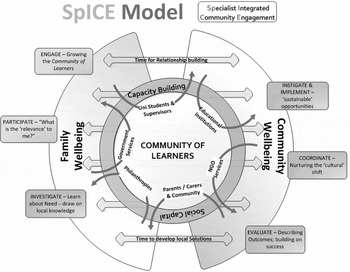
The SpICE Model, as shown in Figure 1, illustrates how to enhance family and community wellbeing by building capacity and social capital in a community, with genuine engagement of all key stakeholders, fostering cross-sector initiatives and delivery partnerships and embedding sustainable approaches.
The SpICE Model.

This process develops a community of learners guided by six dynamic practices. These include: engagement, participation, investigation, implementation, coordination and evaluation. These practice elements should be seen as collectively growing and developing the community of learners and guiding the actions of this group. The implementation of these practice elements will strengthen collaboration and support innovation, which in turn will foster child and family wellbeing.
The intent of this article is to explain the underlying principles of SpICE. Further in-depth discussion of the SpICE Model and how to implement it is the topic of a draft unpublished manuscript by the authors.
The SpICE Model has been developed from the on-the-ground delivery of programs and specialist services in Indigenous, rural and remote communities, and more recently from a cross-sector, strategic investment in speech pathology services in rural and remote NSW communities (Department of Families, Housing, Community Services and Indigenous Affairs, 2012). The Model is relevant to any community that identifies with the hardship outlined in previous sections of this article. Its relevance comes from key principles of recognising the need to simultaneously build capacity in all relevant sectors of the community through a community of learners; advocating local, inclusive, practical solutions; and embedding sustainable, long-term and dynamic approaches to enable a cultural shift.
Key Principles of How the Spice Model Harnesses Opportunity
Relationships — The Community of Learners
As has already been mentioned, the complex issues relating to child wellbeing and learning require methods that combine the knowledge bases, expertise and resources of a broad cross-section of the community (Dew, Howden-Chapman, & Matheson, Reference Dew, Howden-Chapman and Matheson2005). However, it is often the case that because of fragmented, non-collaborative effort, little is achieved to improve outcomes (Lasker & Weiss, Reference Lasker and Weiss2003). This is particularly true of specialist service providers who, for a variety of reasons, find it difficult to make the cultural shift required to draw on experience, knowledge and skills outside their own domain of practice, even when they understand that more could be achieved by working collaboratively. One group that is often overlooked, is community members. They are often excluded from endeavours to improve an adverse situation, as they are considered to be the ‘recipients’ of services rather than people with a wealth of knowledge who could ably contribute to specialist servicing (Denhardt & Denhardt, Reference Denhardt and Denhardt2000). Community members are an integral part of the SpICE Model.
The community of learners is the core of SpICE and provides a way forward by addressing fragmented, exclusive servicing and barriers preventing a cultural shift. It achieves this by harnessing the opportunity for Indigenous and rural and remote communities to build social capital, that is, through engagement, they develop meaningful relationships at many levels and across many traditional divides. Working within the community of learners, in partnership and learning from each other and from the broader collaborative experience, builds social capital (Dale & Newman, Reference Dale and Newman2010). Simultaneously implementing locally derived and owned strategies is also an integral part of achieving social inclusion and will contribute to ‘closing the gap’. The community of learners builds social capital, the pre-eminent form of capital necessary for a civil society (Cox, Reference Cox1995, p. 17) and a for a community to emerge from adversity (Baum, Reference Baum2007; Mulford, Reference Mulford2011; Penman, Reference Penman2010).
The following reflection demonstrates how the concept of building social capital provides an appropriate framework for understanding how specialist services can develop relationships in a community and vice versa.
A clear lesson I learnt from the implementation of SpICE, is that relationships and engagement are everything. It was relatively unimportant that I'd designed a website full of resources for teachers. What was important was that I sat down with teachers in their classrooms and showed them resources from the website that they could use straight away. And then I came back to see how they were going . . . and then came back again. You know, it's like you build trust through face-to-face encounters and by trying really hard to do stuff that's relevant and fun.
The concept of social capital and its levels of ‘linking’ between an organisation and a community, ‘bridging’ between an organisation and other similar organisations,and ‘bonding’ within the organisation, has been described in relation to building quality in schools and teaching (Mulford, Reference Mulford2011). On an early venture into social capital one of the authors reflected on their experience saying:
It would have been overwhelming to go so far outside my comfort zone if it hadn't been for some key factors: I was one part of the community of learners so the responsibilities as well as the successes were shared; I had a specific set of skills and interests that gave me a sense of legitimacy and motivation; and opportunities arose, like receiving mentoring, that wouldn't have been available in the normal course of my work.
The following process demonstrates how nurturing ‘linking’ social capital has worked within the SpICE Model. Speech pathologists have used their natural connections with childhood educators and with organisations that support families to further develop networks that engage and link with families and communities. Speech pathologists have connected with communities by sharing resources like the Speech SPACE website (http://csusap.csu.edu.au/~mdenton/pages/), linking through the application of resources, and tapping into existing networks (e.g., Schools as Communities, Family Support services and online learning programs like Inclusion Online (http://www.inclusiononline-aus.net/index_local_1.asp). Through ‘linking’, a better understanding of context is achieved and genuine engagement is enabled with members of the community who may never access traditional speech pathology services.
Local, Rural and Remote Solutions
Current information clearly identifies that Australian Indigenous, rural and remote communities still face adversity when it comes to health and education outcomes, which are partly the result of inequities in access to specialist services and inappropriateness of some approaches in these communities (AIHW, 2012; O'Callaghan et al., Reference O'Callaghan, McAllister and Wilson2005; Parker, Reference Parker2010; Penman, Reference Penman2010). In Australia, a democratic society, we should therefore be striving to address this inequity by working from a values base of all our people having a right to participate and have a say about servicing decisions that affect them (Baum, Reference Baum2007; Lasker & Weiss, Reference Lasker and Weiss2003). Complex issues require the “powerful combination of evidence, knowledge, understanding and values” (Baum, Reference Baum2007, p. 90) applied to them. A key strategy in achieving this is to use all the resources and local knowledge available through community engagement and building the capacity of community members to be partners in effecting change (Denhardt & Denhardt, Reference Denhardt and Denhardt2000; Penman, Reference Penman2010).
It follows then that methods like collaborating within a community of learners provide opportunities for all members of a community to contribute and participate and ensure ideas are grounded and driven by locally relevant activities. The SpICE Model has been derived from the authors’ experiences of working with a number of ‘communities of learners’ with a common focus on improving child, family and community wellbeing. It was observed that behavioural change was brought about by involving local people in developing the solution and responding to local need. This type of cultural shift is rare if people are only passive recipients of specialist services and health promotion campaigns. This lesson of engaging with the community in developing local solutions is also being learnt at an international level where the evidence suggests that two key agents of change are “the accumulation of collective experiential knowledge” and “the full engagement of the clinical and community sectors to drive local activity” (Armstrong & Kendall, Reference Armstrong and Kendall2010, p. 10).
A precept of the SpICE Model is that any seed funding and underutilised resources are leveraged as part of a multifaceted and dynamic approach to the development of activities that meet the specifically articulated needs of a community. This ensures that the community: increases its capacity to continue to drive transparent inclusive and partnered servicing; has relevant resources; and becomes an informed user of the resources, developing relationships so that there can be continued. The Lachlan Shire Speech Pathology project case study provides a good example of the value of local solutions. The project addressed speech and language issues of young children through collaborative alliances and training of school personnel. A regional “community of learners has evolved to build capacity in supporting children's communication into the future.” (FaHCSIA, 2012, p. 58).
Sustainability
Investment in sustainable solutions is vital in communities where adversity exists (AIHW & AIFS, 2011). This is particularly necessary because of the legacy of mistrust communities have of government and institutions which have historically not delivered on promises, nor honoured the concept of reciprocity (Hislop, Reference Hislop, Hildreth and Kimble2004). In Australia, this mistrust is unfortunately a common perception in many Indigenous, rural and remote communities (Alston & Kent, Reference Alston and Kent2004; Baum, Reference Baum2007). From their work, the authors are also aware of a desperation felt in many Indigenous, rural and remote sectors about solutions being sought from short-term pilot projects rather than well-planned, permanent service strategies. One of the authors recalls a conference presentation where it “was suggested to ‘forget the pilots and send us the planes’ and how this resonated with the stories coming from many small communities”. The issue is not really about pilot projects, as they do serve to provide valuable data about specific projects or issues, but more about the lack of potential to develop sustainable solutions when an initiative only has a short timeframe, is not integrated into other local endeavours, and has limited funding.
Sustainable solutions to complex issues are derived from the distinctive features of the context and it takes time to fully understand the nuances of a particular context (Lasker & Weiss, Reference Lasker and Weiss2003; Okubo & Weidman, Reference Okubo and Weidman2000). It also takes time for a community of learners to grow because it is made up of people who come from very different contexts and backgrounds. Time is required to develop the trust and understanding of others' contexts and a sense of a shared identity to enable the knowledge sharing and growth of social capital that is required to address complex problems (Hislop, Reference Hislop, Hildreth and Kimble2004).
The practice of SpICE has shown that sustainable solutions can be achieved when a community of learners matures through its collaborative endeavours. Common goals, collective knowledge, shared experience and deeper understanding is built over time. This enables fresh eyes and innovative thinking to be applied to current and new challenges.
The following observation demonstrates how a community of learners used SpICE practices to build inter-professional collaboration and prepare a future specialist workforce.
I'm always surprised that specialists who work in such similar fields don't often see how their combined efforts would make a much bigger change. I've seen that when a child presents in an educational setting with developmental issues, the teacher will have difficulties in supporting the child's learning. I've seen that usually it is the child's impairment which becomes the focus of specialist intervention, that is, if there is a specialist service available. But now I've seen a change starting. By bringing university students into the mix . . . like an extra set of helping hands . . . people start to think outside the square. In one example, teachers, parents and the ‘speechies’ (including the university students), made books in ‘home languages’ . . . and the class had a lot of different home languages including Aboriginal English, Dutch, Hindi, Indonesian and Russian! To see the enjoyment everyone had playing with language, like sharing their different words for ‘grandmother’, ‘food’ and ‘sandals’, showed how engaged everyone was. It took away the stigma of being different but also helped the kids understand that at school it's much easier if everyone uses a common language. But one of the best things to see was how those relationships between the grown-ups lasted and how the trust that grew was a basis for a whole lot of other joint activities. And for some of those parents, they finally had an experience with school that they could see helped their kids, which they could be part of, and gave them hope that maybe their child wouldn't have to ‘struggle like they did at school’.
Challenges and Conclusions
Derived from Red Dirt thinking, the SpICE Model provides an achievable way to harness opportunity to address adversity in Indigenous, rural and remote family and child wellbeing. SpICE is particularly effective in developing integrated specialist service delivery. Its rigour is based on a combination of theory and reflection on practice that is grounded in the Red Dirt community, and the Model delivers in keeping with current policy mandates. The SpICE Model argues for a perspective that recognises that our society values social inclusion, equality and positive life opportunities as paramount. SpICE therefore advocates for the ‘We can’ attitude rather than the ‘We can't’ perspective.
The authors have no doubt that, despite its rigour, uptake of the SpICE model will face challenges. Primarily, it is no small task to realise the cultural shift necessary to embed a model based on collaboration and engagement for sectors that are already overstretched and struggling to deliver their services within an ever-tightening fiscal environment. It must be recognised that more can be gained by working ‘with’ people rather than by doing things to or for them, participating in partnered change results in sustainable outcomes rather than perpetuating a passive-recipient model of servicing, and financial and resource leveraging can maximise opportunities from scant resources. The benefits of investing in the cultural shift therefore become obvious.
Capturing the evidence of outcomes achieved through application of the SpICE Model poses another challenge. The need to be accountable for policies, programs and services, means we have to be able to measure progress. In the social services, such as Health and Education, we want to quantify to justify; for example, the number of people seen for therapy, or the number of children who have age-appropriate literacy skills. However, the complexity of ‘wicked problems’ defies easy measurement (APSC, 2007). The SpICE Model is not averse to metrics. It is just honest about what can and cannot be measured. Indeed, the goal of the Model is to build a community of learners who eventually have the knowledge required to measure what is important. Only those who experience the cut and thrust of everyday life in the community are likely to have any hope of devising metrics that capture its progress to any meaningful and accurate extent (Matheson, Reference Matheson2009).
We, who work in the social services, know that metrics alone will not close the social exclusion gap. Some things are complex and child and family wellbeing is one of the more elusive complexities. When dealing with something as complex as wellbeing, we need in the first instance to build up an impression of the context. If we approach the problem in a simplistic way or in isolation, we lose valuable perspective. It takes a lot of time and effort to build relationships with communities, particularly for those outside them, and to get a feel for what is going on. Once we know something more intimately and increase our understanding of it, we can probably put together ‘rules of thumb’, but it takes an inclusive learning community to do this.
The SpICE Model is a practical and sustainable way to work towards better child wellbeing and educational outcomes. This is done through genuine community engagement to build capacity in all relevant sectors of the community and supporting collaborative, integrated servicing. The SpICE Model takes a ‘theory of change’ approach to developing local solutions with the community. It is through involvement in this process of change that the community starts to feel that their children really do have a brighter future. To summarise what SpICE is about, and to borrow the words of Marcel Proust: “The real voyage of discovery consists not in seeking new landscapes, but in having new eyes.”
About the Authors
Kendall Clarke is a community development facilitator who has been living in and working with Aboriginal communities across Australia for 20 years. He has a passion for improving cross-sectorial servicing initiatives to support vulnerable and disadvantaged communities. He currently works for the Australian Government in the Indigenous Affairs Group of the Department of the Prime Minister and Cabinet.
Marijke Denton is a speech pathologist who has worked in regional and rural settings throughout her professional life. Working as a student educator in a paediatric community health setting in the Murrumbidgee Local Health District has led her to broader collaborative opportunities. She is now undertaking the challenges of training inter-professional undergraduate students to be well equipped for the changing landscape of specialist practice.