It can be argued that the Holy Grail for American social movements is to institutionalize and entrench their policy victories by amending the U.S. Constitution, a feat achieved by American prohibitionists in 1919. Indeed, when the Eighteenth Amendment became part of the Constitution, Senator Morris Sheppard (D-Tex.) predicted that “there is as much chance of repealing the Eighteenth Amendment as there is for a hummingbird to fly to the planet Mars with the Washington Monument tied to its tail.”Footnote 1 Yet, what makes the amendment truly remarkable is not its repeal fourteen years later, but the very fact that it was passed without formal support from either of the dominant political parties of the day. Given that political parties at the time functioned as the primary vehicles for mass political mobilization, what explains the passage and later repeal of a constitutional amendment where neither dominant party developed a clear position on arguably one of the most pressing issues of the day?
While there is much truth to the conventional explanations about the passage of the Eighteenth Amendment that have been put forth by historians and scholars, we argue that the unusual character of early twentieth-century partisan politics, in which minor parties became increasingly competitive and threatened the foothold of the two dominant parties, has been ignored by scholars and historians alike. We further argue that partisan elites tolerated national prohibition because doing so allowed them to manage fissures within their electoral coalitions while also placating the newly emerging single-issue pressure groups that demanded an end to large-scale manufacture of liquor. Thus the combination of elite partisan ambivalence about prohibition as a policy, acute interest-group pressure in favor of it, and the extraordinary electoral instability during the transition between the third and fourth-party systems (1880–1920) played important roles in the passage of the Eighteenth Amendment.
We also argue that once passed, the Eighteenth Amendment set into motion a unique process of policy feedback that sowed its own seeds of demise. The immediate aftermath of constitutional prohibition marked a dramatic expansion of the American state in the hiring of thousands of state and federal agents to enforce the law, which would have long-lasting consequences for modern American state development.Footnote 2 When prohibition supporters lost their raisons d’être and their movements atrophied in the wake of the Eighteenth Amendment,Footnote 3 groups such as the Association Against the Prohibition Amendment (AAPA) mobilized. The transition from the fourth to the fifth party system magnified the power of these antiprohibition groups in the late 1920s and early 1930s, when the parties’ political coalitions showed signs of stress. Additionally, whatever elite partisan support existed for prohibition during the early 1920s began to give way when Bureau of Prohibition employees were placed under civil service protection in 1927. This eliminated the key patronage resource that had at one time benefited partisan elites. To effect repeal of prohibition, it was necessary for party elites to bypass state legislatures by calling for state ratifying conventions instead, the first and only time this procedure has been used in American history. During that process, supporters of repeal discovered that southern Democrats, whose support for repeal was essential, opposed the imposition of federal standards in the selecting of state convention delegates. Ignoring the possibility that southern states might gerrymander delegate selection, party elites acceded to southern insistence on state sovereignty over delegate selection, thereby taking a surprising leap of faith that concluded in the ratification of the repeal amendment.
Prohibition and Political Parties, 1880–1920
A century after passage of the Eighteenth Amendment, there is no shortage of explanations for the rise and success of the American prohibition movement.Footnote 4 One explanation is that prohibition represents a successful victory that was won by rural “drys” in a broader culture war against the cities.Footnote 5 Other scholars describe prohibition as a response by corporate elites to cope with a maldistributed labor supply,Footnote 6 or argue that the spirit of Progressive Era reform and the social outlook of an emerging middle class explains the success of prohibition.Footnote 7 The early twentieth century is also identified as a period where the power of national interest groups became magnified, and so numerous scholars have singled out the importance of temperance groups like the Frances Willard–led Women’s Christian Temperance Union (WCTU)Footnote 8 and Wayne Wheeler’s Anti-Saloon League (ASL)Footnote 9 as key players behind successful passage of national prohibition.Footnote 10
These explanations all suggest that the dominant political parties played a relatively unimportant role in the passage of the Eighteenth Amendment.Footnote 11 This, despite the fact that parties during this time have been shown to be key national political actors,Footnote 12 and that, given the relative parity in party control of the 65th Congress, the amendment never could have passed had it been opposed by either major party.
To better understand the role of the major parties in the passage of prohibition, we analyzed party platforms of the Democratic, Republican, Prohibition, Populist, and Progressive parties between 1872 and 1940, to determine the extent to which presidents supported or opposed these laws.Footnote 13 We also analyzed presidential inaugural addresses, State of the Union (SOTU) addresses, and annual messages to Congress delivered by Democratic and Republican presidents between 1872 and 1940. Remarkably, our analysis of major presidential addresses during this period found virtually no discussion of temperance, prohibition, or alcohol control between 1872 and 1920. The issue simply did not register as a concern for presidential rhetoric during this period.Footnote 14
Our analysis of party platforms is, however, more informative. Although party platforms often serve symbolic or other functions, previous scholarship has demonstrated that platforms correlate with positions taken by party members in the policymaking process.Footnote 15 Party platforms are also good indicators of party unity and interparty competition and function as sites for negotiating a party’s broader constitutional commitments and views on important issues.Footnote 16
In general, our analysis of the platforms during this period found that the only party to consistently address issues related to temperance and prohibition was, perhaps not surprisingly, the Prohibition Party. Our analysis of the Republican and Democratic platforms during this period revealed a different pattern. Although they, too, advanced many of the policies and constitutional proposals of Populists and Progressives, they avoided taking positions on temperance or amending the constitution to achieve prohibition. The only period when the major parties discussed alcohol regulation was between the late 1880s and late 1890s, when presidential elections were extremely close and the electoral leverage of the Prohibition Party, and other third parties, was at its height. During this period, Republicans briefly supported temperance legislation, but not a constitutional amendment, while Democrats merely spoke out against “anti-sumptuary” legislation. In other words, Republican and Democratic Party elites strategically addressed prohibition during this period mainly as a way to prevent voter drift to the third parties. However, neither party addressed the subject after 1908, when the prospect for a constitutional amendment became increasingly more likely.
If it were the case that dominant parties do not historically address issues relating to constitutional amendment debates, then it probably would not matter that the dominant parties neglected to address prohibition in their platforms. Yet, passage of the Eighteenth Amendment stands in stark contrast to the other Progressive Era–inspired constitutional amendments passed during this same time period: the Sixteenth Amendment, authorizing an income tax, submitted in 1909 and ratified in 1913; the Seventeenth Amendment, providing for direct election of the Senate, submitted in 1912 and ratified a year later in 1913; and the Nineteenth Amendment, extending the franchise to women, submitted in 1919 and ratified in 1920. Unlike the prohibition amendment, these constitutional amendments were supported repeatedly in the formal platforms of one or both of the major parties before their introduction in Congress.
What explains the silence of the two major political parties about one of the major political issues of the day? The nature of the divisions in the major political parties, and the dynamics of the shift from the third (1854–96) to the fourth-party systems (1900–1932), played an integral part in the passage of the Eighteenth Amendment. Although the Republican Party ostensibly dominated electoral politics during most of this period, in actuality it was a time of closely contested elections, fierce competition from third parties, and instability in electoral coalitions and control of national electoral institutions. This is especially true during the extended transition between the two party systems from 1880 to 1920. Prohibition played a crucial role in partisan politics during this period, splitting the electoral coalitions of both major parties and producing a potent single-issue third party, the Prohibition Party.
Electoral Instability: Transition from the Third- to the Fourth-Party System
The third-party system began with the formation of the Republican Party (GOP) in 1854, which elected its first president in 1860. Lincoln’s party led the Civil War, saved the Union, and easily won the next three presidential elections. As debate over reconstruction in the South waned, however, the GOP’s electoral dominance eventually gave way to a more divided, unsettled period of electoral politics. By 1876, Democratic presidential candidate Samuel Tilden won the popular vote over Republican Rutherford B. Hayes by nearly 250,000 votes (3 percent of the total), but he lost in the Electoral College. Eight years later, in 1884, Grover Cleveland became the first post–Civil War Democrat to capture the presidency, winning the popular vote by a margin of sixty thousand votes, or .5 percent. Electoral volatility continued four years later in 1888, when Cleveland again won the popular vote but was denied reelection in the Electoral College by Republican Benjamin Harrison. In the election of 1892, Cleveland returned, winning the presidency for a second time by defeating Harrison 46 percent to 43 percent in the popular vote, but a third-party candidate, James Weaver of the Populist Party, captured 8.5 percent of the vote.
With William McKinley’s two decisive victories over Democratic candidate Williams Jennings Bryan in 1896 and 1900, the third-party system is usually regarded as coming to an end.Footnote 17 It was during this time that the Republican Party consolidated its electoral support in the industrial northeast, the Border States, and newly admitted states in the west, while southern states continued to vote solidly Democratic. For Republicans to protect their coalition, they needed to attract the growing bloc of “anti-pietist” voters that were beginning to settle in large, urban areas in the north,Footnote 18 at a time when several new policy cleavages over social issues like child labor, immigration, women’s equality, and prohibition were beginning to divide the parties.Footnote 19
Although the electoral realignment that took place in the 1890s strengthened the GOP coalition, the party remained divided during the first two decades of the twentieth century. After winning four presidential elections in a row, Republicans lost the White House in 1912 to Democrat Woodrow Wilson because their party split between its more progressive faction led by Theodore Roosevelt and the business-oriented faction led by William Howard Taft. For similar reasons, Democrats also recaptured control of the House in 1912, and briefly took control of the Senate two years later in 1914, holding both chambers until 1920. It was not until Republican Warren G. Harding’s landslide victory against Ohio’s James Cox in 1920 with over 60 percent of the popular vote that Republican domination of the White House and both chambers of Congress was reestablished.
Thus the period between the 1880s and 1920s is one of the longest periods of electoral instability in American history, with no clearly dominant national party. Complicating the electoral picture was the important role played by third parties like the Progressives, the Populists, and the Prohibition Party. At least three times during this period, third parties posed serious challenges to the two major parties in presidential contests and saw significant numbers elected to Congress.Footnote 20 Electoral margins between the major parties were often razor thin, and third parties often captured a higher percentage of the vote than the margin separating the Democratic and Republican candidates.
The nature of the challenge posed by third parties during this period can be seen in Figure 1, which shows that during the four presidential elections between 1880 and 1896, the third-party vote share was greater than the difference in vote share won by the candidates of the two major parties.
The Third-Party Challenge, 1872-1940.

Indeed, in three of those elections (1880, 1884, and 1888), the Prohibition Party alone could have altered the outcome of the presidential election had it cast its votes with one of the two major-party candidates that lost the election. Even after 1896 the margin of victory for Republican candidates was never more than one or two percentage points over the vote cast for third-party candidates. Consequently, the leaders of the major parties could not afford to ignore third parties and their policy priorities. Even more important, the strategic power of the third-party vote returned in the presidential elections of 1912 and 1916, and in the control of Congress just prior to the adoption of the Eighteenth Amendment.
The Prohibition Party and Other Third-Party Insurgents
Although many Progressives and Populists supported the temperance movement and were sympathetic to prohibition, the only national party to clearly and consistently address the alcohol issue throughout this period was the Prohibition Party, which was founded in 1869 and became what Richard Hamm calls “the leading temperance organization in the 1870s and 1880s.”Footnote 21 Although the Prohibition Party did not initially pursue a constitutional strategy for outlawing liquor in 1872, four years later the party’s line hardened and it proposed a constitutional amendment to “to render these Prohibitory measures universal and permanent, and . . . [supported treaties] to prevent . . . all alcoholic beverages.” The Prohibition Party’s appeal was limited in its early years, but during the 1880s its electoral strength began to grow just as presidential contests between the two major parties also began to tighten.
In 1880, the party’s candidate, Neal Dow of Maine, captured only .1 percent of the national vote, but that was the same amount by which Republican James Garfield defeated his Democratic opponent, Winfield Hancock, to win the presidency. In such closely contested elections, even a handful of votes could make the difference. In 1884, the party’s share of the national vote grew to 1.5 percent and in 1888 to 2.2 percent. In each of these elections the party’s vote share was more than double the difference that separated the candidates of the two major parties. In 1892 the party captured its largest vote share to date with 2.4 percent in an election that saw Democrat Grover Cleveland defeat Benjamin Harrison by only 2.9 percent.
With its political appeal growing, the Prohibition Party also altered its electoral strategy to seek alliances with other third parties. The 1892 platform, for example, broadened the party’s policy agenda beyond prohibition for the first time to advocate other issues such as support for women’s suffrage and government regulation of railroads, both of which held out the possibility of an alliance with the Progressive or the Populist parties. Although the Prohibition Party reverted back to a single-issue platform in 1896, by 1904 it was again trying to build alliances with other third parties by broadening its agenda to include other issues, a strategy that continued until passage of the Eighteenth Amendment, which effectively removed the party’s raisons d’être and diminished its electoral support.
Prohibition and the Major Parties
Given the volatility and closely divided nature of elections between 1880 and 1920, one might have expected that the two major parties would appeal to prohibitionists by co-opting the Prohibition Party’s issue agenda, much like they did with issues advanced by the Populists and Progressives. Even though the dominant parties embraced in their platforms constitutional amendments for an income tax, direct election of the Senate, term limits, women’s suffrage, and a ban on child labor during this period, they did not adopt a position about a constitutional amendment on prohibition. Why?
Unlike other Progressive Era constitutional amendments, prohibition deeply split both parties and neither could afford to alienate important elements of their electoral coalitions by taking a clear position on the issue. Indeed, a distinctive feature of the party coalitions during this period was the sharply drawn religious and geographic lines in the parties. The “drys” in both parties advocated prohibition as a solution to many social ills, while “wets” viewed prohibition as a threat to ethnic customs, personal liberties, and states’ rights.Footnote 22 The Republican Party’s northern base of support generally led it to support prohibition policies, although a deep class divide existed between rural working-class Republicans, and wealthier urban ones who often opposed such laws. For the Democratic Party its northern base of ethnic groups strongly opposed such laws as a threat to ethnic and social customs, while in the South the large protestant representation in the party strongly supported prohibition.Footnote 23 Complicating the matter further for the Democrats was the fact that many of its southern members opposed national prohibition as a violation of the sacred principle of states’ rights and localism.Footnote 24
Given these divides, it was difficult or impossible for national elites of either party to strongly support or oppose prohibition. Realizing this, prohibitionists focused their efforts at the state and local level, and turned to mechanisms of direct democracy in order to bypass political parties altogether.Footnote 25
For its part, the GOP flirted with pro-temperance positions in its platforms in 1888 and 1892, the period when the Prohibition Party’s leverage was at its height. But the party stopped short of supporting complete prohibition of alcohol or a constitutional amendment, and after 1896 neither temperance nor prohibition again appeared in GOP platforms, even though the party explicitly embraced a variety other constitutional amendments during this period. In fact, as late as 1918, former president William Howard Taft continued to strongly and publicly oppose a prohibition amendment even though many progressive Republicans were supportive.Footnote 26
After adoption of the Eighteenth Amendment in 1920, GOP platforms did pledge to enforce prohibition laws (although this was often just an effort to draw a contrast with the lawlessness of “wet Democrats,” especially in 1928, when the “wet Catholic” Al Smith was the party’s nominee). Republican presidents Harding, Coolidge, and Hoover each made commitments to enforce the amendment and address problems associated prohibition during annual addresses to Congress. However, by the 1930s Republicans were speaking agnostically about the issue. Although the 1932 GOP platform did not endorse repeal, it recognized for the first time that members of the party “hold different opinions” on the matter and no official should be “forced to choose between his party affiliations and his honest convictions upon this question.” Indeed, in an obvious effort to punt the issue, the platform called for a new constitutional amendment to shift the problem back to the states “to deal with the problem as their citizens may determine.”
Like the Republicans, Democratic Party elites were also strategic in addressing the issue between 1880 and the early 1900s. Rather than take a position on the alcohol issue directly, they instead came out against “sumptuary laws,” which referred mainly to laws involving public propriety and decency. Many of these sumptuary restrictions were implicitly biased and targeted working-class immigrant communities, and Democrats, who relied on these communities for votes, thus opposed them. The 1880 Democratic Party platform flatly called for a ban on sumptuary laws, and the 1884 and 1892 platforms explained that “we are opposed to all sumptuary laws, as an interference with the individual rights of the citizen,” a position the party reiterated in 1904, when it declared support for “liberty of personal contract untrammeled by sumptuary laws.”
Other than these three short references to sumptuary laws, however, national Democrats avoided taking any position on prohibition in their platforms and major presidential addresses before 1924. Like Republicans, Democrats also repeatedly called for a variety of other constitutional amendments associated with Progressive Era politics but never called for a prohibition amendment.
After passage of the Eighteenth Amendment, the strategy of the Democrats changed. The party’s platforms criticized Republican administrations for failing to enforce prohibition vigorously enough, and pledged that Democrats would “respect and enforce the constitution and all laws.” Even in its 1928 platform, upon which the “wet” Al Smith campaigned, the party continued to say that it stood for “an honest effort to enforce the eighteenth amendment and all other provisions of the federal Constitution.”
If the divisions within the two major parties kept them from embracing a prohibition amendment, it also left them unable to stop it when Congress finally began to consider it in 1917. Indeed, with the parties unable and unwilling to take a formal position on prohibition, single-issue pressure groups like ASL worked outside the parties to build broad-based coalitions of groups over which the parties had no control. Indeed, the ASL’s power in Congress came precisely because it operated outside the established party structure and could pressure members of both parties by threatening to challenge or support them in upcoming elections. Thus the ASL proved far more effective at mobilizing congressional support for an amendment than the Prohibition Party, which had struggled to elect members and had no way to exert direct influence on those from other parties. In the midst of wartime emergency measures, shifting demographics, and knowing that imminent reapportionment on the basis of a new census might change the political futures of prohibition supporters, Congress took up the issue and easily adopted the Eighteenth Amendment on August 1, 1917, with Democrats and Republicans both split but supporting the amendment in roughly equal proportions.
The Decline of Prohibition, Policy Feedbacks, and the Twenty-first Amendment
Conventional explanations for the repeal of the Eighteenth Amendment have identified the emerging power of antiprohibition pressure groups like the AAPA,Footnote 27 the desire on the part of elected elites to end the graft and corruption created by the bootlegging industry, and the need for tax revenue as some of the key factors that caused the demise of prohibition.Footnote 28 It also cannot be ignored that the period between prohibition and repeal represented a fundamental shift in cultural and economic conditions, especially when Americans came to deal with the effects of the Great Depression. In addition, we argue that repeal can be more clearly understood by recognizing the policy feedback effects that set into motion the amendment’s swift demise. Policy feedback effects occur when previously enacted policies “reconfigure the political landscape . . . and these transformed circumstances affect . . . how policymaking occurs later on.”Footnote 29 The political landscape can be altered, for example, when policies bestow new resources on some groups and not others. It is commonly agreed that one of the most important resources in the early twentieth century was political patronage.Footnote 30 In the case of the Eighteenth Amendment, the lack of ideological support by either major political party meant that elite support for prohibition, to the extent it existed, was often reliant on the creation of patronage positions spread across the country. The Department of Treasury employees hired to enforce prohibition were not initially subject to civil service laws because the ASL insisted on having influence over the hiring and firing of agents without involvement by the Civil Service Commission. Members of Congress agreed, and in a letter the bill’s namesake, Andrew Volstead, wrote: “Such a plan [to place agents under civil service protection] would be inadvisable because . . . it would make it mandatory on the Bureau to accept as agents men who might not be in sympathy with the law.”Footnote 31
Even though these patronage resources were valuable to the ASL and its concerns about bureaucratic resistance to the new law were reasonable, insisting that prohibition enforcement agents be exempt from civil service protection was a grave miscalculation. It exposed new fissures in the natural progressive coalition of prohibitionists and civil service reformers, leading the National Civil Service Reform League (NCSRL) to mobilize against the ASL. When the former eventually succeeded in bringing the Bureau of Prohibition agents under civil service protection in 1927, what little support for prohibition remained among elected elites began to drain away. This combination of declining elite partisan support due to the elimination of patronage, along with the political debate over the design of state ratifying conventions to effect repeal, offers important insights into prohibition’s demise and the success of the Twenty-first Amendment.
The National Civil Service Reform League, the ASL, and the Politics of Prohibition Bureau Employees
With passage of the Eighteenth Amendment, Congress moved to create national enforcement legislation through the Volstead Act, which was passed over President Wilson’s veto in 1920. The passage of the Volstead Act created the Treasury Department’s Prohibition Unit, which immediately hired 1,550 field agents to enforce the law with staff support from another 1,000 employees.Footnote 32 The NCSRL immediately supported placing these agents under civil service protection, but Congress balked. If not exactly enamored with prohibition as a policy, partisans in Congress were “not ill-pleased that so large a number of financial plums would be available for distribution.”Footnote 33 The posts could be used to reward party supporters with “extremely lucrative offices, which . . . [became] the more lucrative by bribery.”Footnote 34 Wayne Wheeler, the head of the ASL, was a “formidable opponent” of civil service protection for agents,Footnote 35 because it allowed him to personally exert greater control over the appointments, which Wheeler politically used “to maintain a dry Congress and gain influence for himself in the Republican Party.”Footnote 36 The ASL also had extensive experience aiding and pressuring local law enforcement in the prosecution and enforcement of local liquor laws, a strategy that the organization sought to institute nationally through its influence.Footnote 37
The prohibition enforcement positions were valuable patronage resources to both the ASL and partisans in Congress because of the “ease and quickness with which fortunes could be made” by individuals in the positions and those who appointed them.”Footnote 38 When the Wickersham Commission report was released in 1931, one of the committee’s members, William Kenyon, wrote separately about how politicians used these resources: “Politicians, some of them high in national affairs, attempted to force upon [a New York Prohibition Administrator] men with criminal records . . . which apparently was the test of the politician for good prohibition agents. Prohibition was expected evidently by some politicians to furnish a fine field for the operation of the spoils system in politics.”Footnote 39 Indeed, the National Council of Churches complained that as long as senators regarded the appointments “as a legitimate field of personal exploitation, official integrity will remain at a discount.”Footnote 40
Without professional screening or training, the agents hired in the Bureau of Prohibition were largely unqualified and corrupt. The 4,000 prohibition employees eventually hired was a “national police force,”Footnote 41 but one full of “illiterates, incompetents, misfits and criminals.”Footnote 42 Graft ensued as organized crime figures and bootleggers conspired with corrupt federal prohibition agents.Footnote 43 After indicting prohibition agents for conspiring to violate the Volstead Act, a federal grand jury reported that prohibition enforcement positions “have been made the dumping ground for influential politicians who secured appointments for their henchmen.”Footnote 44 What made matters worse is that the Bureau of Prohibition experienced severe turnover at a rate of 39 percent in higher administrative jobs and 40 percent in field enforcement positions during the first eleven years.Footnote 45
The dismal state of prohibition enforcement inspired a popular backlash that Democrats tried turning to their electoral advantage. By 1924, Democrats knew that Wheeler’s use of patronage had drawn the GOP and the ASL closer together and used the bureau’s poor enforcement record to attack the Coolidge administration.Footnote 46 For the first time ever, the Democratic Party platform included a “Prohibition Law” plank, in which the party charged that “the Republican administration has failed to enforce the prohibition law; is guilty of trafficking in liquor permits, and has become the protector of violators of this law. The Democratic Party pledges itself to respect and enforce the constitution and all laws.”
During an era inspired by progressive reform proposals, the solution to the Prohibition Unit’s poor track record was to professionalize agents by placing them under civil service protection.Footnote 47 In 1923 the NCSRL insisted that all agents in the bureau “give up their present political tenure and be eligible to remain in office only . . . if they are the best qualified.”Footnote 48 The NCSRL’s president, William Dudley Foulke, wrote: “[The Volstead Act] inaugurated an era of corruption in this branch of the service unheard of even in the worst days of spoils politics. Every important appointment was the political booty of some congressman, often a spoilsman of the lowest type, and hundreds of these appointees . . . have grown fat on the bribes received from bootleggers and other miscreants engaged in defying the law.”Footnote 49 In addition to recruiting other organizations to support its call for reform,Footnote 50 the NCSRL pressured the ASL to reverse its position on reforming prohibition enforcement, and it singled out the ASL’s Wayne Wheeler for refusing to “give up any area of his personal power” if the bureau was not reformed.Footnote 51
Partisan elites nevertheless jealously guarded their patronage resources and rebuffed efforts to reform the bureau. Coolidge had an opportunity to place prohibition officials under civil service protection but offered “the absurd reason that some future president may rescind the order.”Footnote 52 The turning point came in 1927, when Wheeler died, public opinion about prohibition soured, and Congress could no longer ignore the bureau’s poor performance.Footnote 53 By that time, sensationalized media treatment of prohibition’s failures and corruption proliferated and headlines such as “Enforcement Farce” and “Prohibition Graft” dominated the newspapers.Footnote 54 Although Coolidge continued to oppose an executive order on the subject, his Assistant Secretary of the Treasury was “convinced that for the long future a civil-service status for the field forces . . . would be advantageous for law enforcement.”Footnote 55
With Treasury Department support, the Sixty-ninth Congress finally enacted legislation in 1927, bringing all 3,589 Bureau of Prohibition employees,Footnote 56 except the Prohibition Commissioner, under the civil service and requiring agents to take the civil-service entrance exam in order to remain in their positions.Footnote 57 When the exam was administered: “Three-quarters of the examinees flunked. An agent named Gosnel, who had been on the prohibition payroll from the beginning could neither read nor write. With 2,500 field jobs to fill, the bureau had no alternative but to draft still-easier questions.”Footnote 58 Around the time that bureau employees were placed under civil service protection, efforts were also underway to reorganize the agency. In 1925 the Prohibition Unit’s forty-eight state prohibition directors were reduced to twenty-four, who oversaw districts “being coterminous with one or more federal judicial districts.”Footnote 59
Even with the reforms and more qualified personnel in place, enforcement of the Volstead Act remained inadequate and the elite support that sustained prohibition laws quickly gave way.Footnote 60 This may in part explain the huge increase in the number of proposed constitutional amendments in Congress at the time.
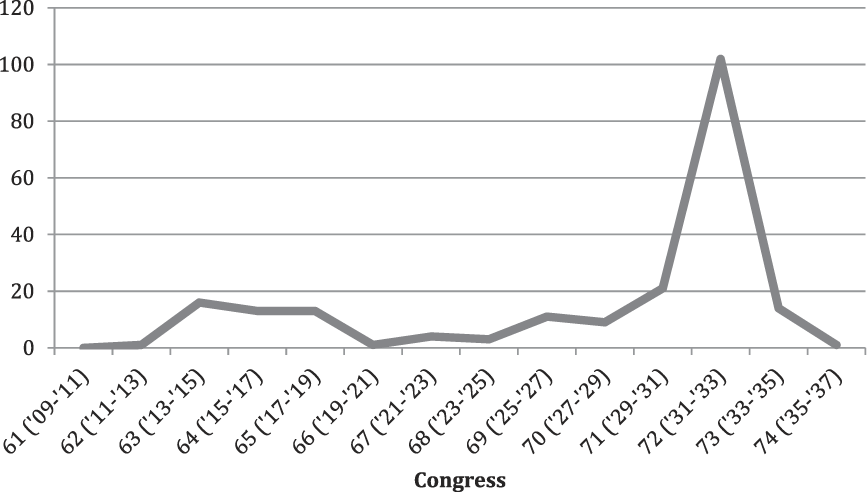
Figure 2 shows that from seven amendment proposals during the Sixty-seventh and Sixty-eighth Congresses (1921–25), the number increased to twenty amendment proposals during the Sixty-ninth and Seventieth Congresses (1925–29). By the Seventy-first Congress (1929–31) there were 21 constitutional amendments proposed, more than the previous two Congresses combined, and in the Seventy-second Congress (1931–33) there were 102 joint resolutions proposed to amend the Constitution. As the tide in Congress turned toward repeal of the Eighteenth Amendment, there was still a question about which method of repeal would be most likely to succeed.
Resolutions Proposed to Amend Constitution Relative to Liquor Traffic.

Designing Constitutional Change: The AAPA and a Blueprint for Change
Between World War I and the Great Depression, cultural attitudes toward prohibition underwent dramatic change and the majority of Americans now supported repeal.Footnote 61 However, these attitudes were filtered through an institutional structure that dampened and obstructed political change. Despite the growing unpopularity of prohibition,Footnote 62 the structure of the U.S. Senate, the institutional rules of Congress, malapportionment, and gerrymandered legislative districts all conspired to advantage rural and southern voters while disadvantaging larger northern states and populous urban areas.Footnote 63 The dominance of protestant “drys” over southern state legislatures posed a particular problem for ratification of any repeal amendment. Given these institutional blockages, antiprohibitionists led by the AAPA needed alternative pathways to effect policy change.
In the late 1920s, the AAPA counted among its membership many prominent and politically powerful members, such as Pierre du Pont, John Raskob, James Wadsworth and other men, who according to one estimate “direct[ed] the management of $40,000,000,000 and the employment and occupation of 3,000,000 employees.”Footnote 64 It was at an AAPA meeting held one night in James Wadsworth’s Washington mansion that a strategy was adopted to attack the constitutionality of the prohibition amendment, one developed and supported by lawyers from the Voluntary Committee of Lawyers (VCL) and the New York County Lawyers’ Association (NYCLA).Footnote 65
By 1928 the VCL and NYCLA both had taken on larger roles in agitating for constitutional change. Focusing on the Wickersham Commission Report, which highlighted the problems of prohibition enforcement, the VCL used the commission’s findings to argue for repeal and to recruit local bar associations to formulate public positions on the issue.Footnote 66 Meanwhile, NYCLA lawyer Elihu Root met frequently with the AAPA and played a key role. One of the most eminent litigators of his day, Root had earlier challenged the Volstead Act in a case titled Ruppert v. Caffey (1920). In that case, Root argued unsuccessfully that the Volstead Act sought to extend wartime measures to peacetime, a power exclusive to the president, not Congress. The unanimous Court rejected the challenge and upheld the act, but in 1931 Root brought another case, United States v. Sprague, challenging the process by which the Eighteenth Amendment had been ratified. Root’s argument was that
the choice of amendment ratification methods—state legislature or conventions of the people—ought to be determined not by congressional whim but on the basis of whether the proposal affected the functions of the state or the rights and powers of citizens. Unlimited amending power . . . permitted two-thirds of Congress and majorities of the legislatures in three-fourths of the states to wipe out all individual rights protected by the first eight amendments. When adopted, those amendments were assumed to be beyond federal usurpation. Only the people themselves had authority to surrender them [through ratifying conventions].Footnote 67
The Court, however, again rejected the argument that state conventions were to be held when affecting individual rights. Writing for the Court, Justice Roberts said that the language of Article V “plainly and without ambiguity places the choice between these two modes in the sole discretion of Congress.”
Despite Root’s defeat, the idea of ratifying a constitutional amendment through the state convention process, while involving the protection of a personal liberty, took hold and grew in popularity. According to the AAPA’s 1931 report: “By the end of the year the idea of submitting repeal of the Eighteenth Amendment to special conventions in the several states . . . had caught the imagination of politicians in many parts of the country, and that plan of procedure may be said now to have achieved pretty general recognition and acceptance among party leaders.”Footnote 68 State conventions thus became the AAPA’s principal strategy in the campaign seeking to effect the first-ever repeal of a constitutional amendment and avoiding the South’s malapportioned state legislatures, which were viewed as the primary impediment to repeal.
The Democratic and Republican Party Conventions of 1932
Now with a workable strategy in place for ratifying a repeal amendment, and no longer having to compete with strong third parties that were siphoning votes away from them, political elites began turning their efforts to repealing prohibition. Even though the Democratic Party promised in its 1928 platform “an honest effort to enforce the eighteenth amendment,” it also nominated “wet” Al Smith as the Democratic Party’s presidential candidate. The move “channel[ed] for the first time the concerns of a rising block of immigrant ethnic voters, and in doing so cemented their allegiance to the national Democratic Party,”Footnote 69 helping to produce a New Deal coalition that would come to dominate the Fifth Party System.Footnote 70 When public opinion polls began showing widespread support for eliminating the Volstead Act and repealing the Eighteenth Amendment,Footnote 71 both major parties were forced to confront repeal.
At their 1932 convention, Republicans renominated Herbert Hoover, but equivocated on prohibition in spite of pressure from the VCL to come out against it. A plank advocating outright repeal of the Eighteenth Amendment was considered but defeated.Footnote 72 When Senator Bingham (R-Conn.) read a minority plank in support of repeal, he was interrupted repeatedly by applause and cries from delegates of “We want beer!”Footnote 73 Rather than adopting that plank, however, the party pledged instead to enforce prohibition laws but also to pass a new amendment to “allow the States to deal with the problem as their citizens may determine.” Recognizing the sectionally divided nature of their own coalition, such an amendment, the platform read, “should be promptly submitted to the States by Congress, to be acted upon by State conventions called for that sole purpose in accordance with the provisions of Article V of the Constitution and adequately safeguarded so as to be truly representative of the people.”
Democratic Party elites, by contrast, adopted a clear repeal strategy throwing their lot with both the AAPA and the VCL.Footnote 74 When the Democratic Party selected John Raskob to become chair of the party, as a member of the AAPA he had already been exposed to the idea of using state ratifying conventions to avoid the problem of malapportionment and sectional divisions. During the convention, the front-runner, Franklin D. Roosevelt, skillfully managed the friction between supporters of repeal and those supporting stronger enforcement under the Eighteenth Amendment. The candidacy of Al Smith, a fellow New Yorker, complicated Roosevelt’s path to the nomination, and the possibility of a divisive battle over prohibition led Roosevelt to delay action on the prohibition issue until after the presidential candidate had been selected.
Even party elites like House Speaker John Garner, a prominent southerner from Texas, had begun to publicly oppose prohibition, declaring that “I have never believed [prohibition] sound or workable, and it should be repealed.”Footnote 75 Roosevelt nevertheless needed to act carefully so as not to alienate the support of southern “drys” and risk dividing his nascent New Deal coalition. One prominent Roosevelt adviser and former prohibitionist, Governor Harry Byrd (D-Va.), argued forcefully that a constitutional amendment could remove the issue “from party politics” by submitting it “directly to the people themselves for decision.”Footnote 76 Another former prohibitionist and Roosevelt surrogate, Alben Barkley (D-Ky.), gave a two-hour speech on the convention floor, chiding Republicans: “Two weeks ago in this place, the Republican Party promulgated what it called a plank on the Eighteenth Amendment. . . . It is not a plank. It is a promiscuous agglomeration of scrap-lumber. . . . This convention should recommend the passage by Congress of a resolution repealing the Eighteenth Amendment of the Constitution.”Footnote 77 Heeding Barkley’s call, the convention eventually adopted a plank declaring the party’s position in unambiguous terms:
We advocate the repeal of the Eighteenth Amendment. To effect such repeal we demand that the Congress immediately propose a Constitutional Amendment to truly represent the conventions in the states called to act solely on that proposal; we urge the enactment of such measures by the several states as will . . . bring the liquor traffic into the open under complete supervision and control by the states.
The only state delegations refusing to support the position on repeal were the southern and border states of Alabama, Arkansas, Georgia, Kansas, Mississippi, and Oklahoma.Footnote 78
Passage of a Repeal Amendment and State Ratification Conventions
The 1932 elections were immediately followed by introduction of repeal resolutions in both the House and the Senate. Fresh in the memories of members of Congress was the child labor amendment, which was proposed in 1924 but still lingered eight years later, waiting ratification by the requisite number of states because a coalition of southern state legislatures had rejected it. Progressives and populists had also become increasingly disaffected with legislatures, viewing them as corrupt and infected with regional bias. They had previously worked hard to pass the Seventeenth Amendment because they considered state legislative selection of U.S. senators to be undemocratic and procedurally unfair.Footnote 79
Against these concerns, the convention route, supported by the VCL and AAPA, offered an opportunity that seemed more likely to succeed. Writing to Senator William Barbour (R-N.J.), Judge William Clark explained the advantages: “A convention affords no opportunity for reelection. There is then no office to which to cling. The influence of the lobby is at once emasculated and judgment restored to its intended independence.”Footnote 80
With no precedent for ratification through state conventions, members of Congress had to debate their role in supervising the selection and operation of those conventions. On the one hand, members worried that state conventions might have the same problems as state legislatures if states were left free to gerrymander or malapportion them. On the other hand, if Congress mandated requirements for delegate selection and convention procedures, then the southern members of Congress would withdraw their support for repeal as an affront to state sovereignty, thus depriving the process of the two-thirds majority in Congress that it needed.
During congressional debates over the procedure for ratification, southern Democrats argued strongly in favor of state control of conventions. Rep. John McSwain (D-S.C.), for example, argued:
To talk about sovereign States, and yet say that the Federal Government could call a convention within such sovereign States, and tell the people of the sovereign States who could vote, and where they could vote, and for what classes of delegates they might vote, and where the delegates should assemble, and within what they should act, would be to assert that States’ sovereignty is a hollow mockery.Footnote 81
Another southern Democrat, Rep. George Huddleston (D-Ala.), similarly suggested:
It is obvious that, as instrumentalities of ratification, legislatures and conventions stand upon equal ground. The power of Congress over the conventions is made identical with its power over the legislatures. If Congress may create conventions, it may create legislatures. If it may provide when a convention shall assemble, Congress may also say when a legislature shall meet. . . . The proposal that Congress has power to create a ratifying body or to supervise its actions is, from a constitutional standpoint, nothing short of preposterous.Footnote 82
With southern Democrats unwilling to tolerate federal control over state convention procedures, supporters of repeal were left relinquishing procedural control of conventions in exchange for the necessary votes needed to get a repeal amendment through Congress. By vesting authority in states to design these procedures, southern Democrats also gained added political cover to argue that their vote for a repeal amendment was in all actuality a vote for state sovereignty.
Northern and urban Democrats understood the trade-off that was being made. Rep. Emanuel Celler (D-N.Y.), for instance, noted:
I incline to the belief that [the question of the design of state conventions] must and shall be a State matter exclusively. . . . There may be 48 different types of machinery. . . . The election of delegates at large would prevent gerrymandering by the drys. It may be necessary, however, to blink [at] the possibility of gerrymandering and refrain from exercising compulsion of any sort upon the States, in order to get the amendment ratified expeditiously.Footnote 83
By accommodating southern Democrats’ strong position on the design of convention procedures, the fissure that divided Democrats along sectional lines was overcome, allowing the repeal resolution to pass by a vote of 289–121 in the House and 63–23 in the Senate. In the end, with Michigan the first state to ratify in April 1933 and Utah the last, the amendment was ratified in December of that year. Surprisingly, six southern states ratified (Arkansas, Alabama, Tennessee, Florida, Texas, and Kentucky), as well as several border states (including Virginia, West Virginia, and Missouri).
Conclusion
We have argued that the dynamics of party politics were in fact a very important part of the passage of both the Eighteenth and the Twenty-first Amendments. The tumultuous electoral dynamics during the transition from the third- to the fourth-party systems produced closely contested elections and divided coalitions in both parties. This in turn magnified the role of third parties like the Prohibition Party, but also left the two major parties vulnerable and unable to protect their members from the power of single-issue interest groups like the ASL, which sought to constitutionalize prohibition policy.
The ratification of the prohibition amendment without institutionalized party support, however, set into motion a unique policy feedback process that quickly led to the amendment’s ineffectiveness, unpopularity, and ultimately its repeal. Attracting elite partisan support for enforcement of prohibition meant protecting patronage power in its enforcement. The appointment of corrupt and incompetent enforcement officers, however, led to graft, lawlessness, and eventually to calls for reform. When these calls could no longer be resisted, Bureau of Prohibition employees were placed under civil service protection with the prodding of the NCSRL, which in turn undercut any elite partisan support for the policy.
To effect repeal, partisan elites also had to act strategically to address internal divisions within their parties. The price of southern Democratic congressional support in Congress was the use of ratifying conventions rather than state legislatures, but conventions nevertheless controlled by the states. The compromise was a gambit on the part of northern and urban repeal proponents, but one that paid off by giving southern Democrats the political cover needed to send the amendment to state conventions. The strategy not only secured ratification of the repeal amendment and put to rest a policy issue that divided Democrats, but it provided elected officials everywhere political cover, allowing them to claim the issue had been directly decided by the American people.
Besides the partisan political dynamics involved, there are other lessons that can be drawn from our analysis of the passage of these two constitutional amendments. The Twenty-first Amendment will no doubt become the model for state ratification conventions if future events should ever lead to their use again. In this sense, when members of the Seventy-second Congress debated about state convention procedures, they were engaged in the practice of constitutional construction,Footnote 84 and future political actors may be tempted to interpret their deference to state legislatures as an authoritative precedent for designing future state ratifying conventions. Yet, this may be a misguided interpretation of Congress’s debate over ratification. That is because the decision to grant states power to design state conventions was a political concession to southern legislators and a strategy by Democrats to overcome their party’s sectional divisions. Future debates over ratification of constitutional amendments through state conventions may belie the same geographical dynamics, and so the historical “precedent” that granted states broad power to design conventions may not politically settle future conflicts over state convention design.
If it is true that elite partisan support began eroding when prohibition agents were brought under civil service laws, then this presents a new avenue for historical inquiry into the interaction of patronage politics and support for government programs. Students of state and local political history might consider exploring how the emergence of state civil service reforms caused changes in state and local policy programs. Another line of inquiry may explore how the popularity of civil service reform changed the complexion of elite political support for programs with historically entrenched patronage systems that were national in scope, such as those associated with the U.S. Post Office.
Finally, we believe that there are other important insights that can be drawn from the transformations in prohibition enforcement, passage of the Twenty-first Amendment, and the devolution of liquor regulation to the states. That devolution caused state alcohol distribution and manufacturing systems to emerge that are, in some states, dominated by powerful unions and middlemen who are overseen by a panoply of state- and city-level control boards and commissions. The fifty different state systems that have emerged after prohibition’s repeal demonstrate not only how the critical decisions made in each state in the immediate aftermath of repeal continue to have differential economic and political consequences even today, but also how prohibition’s repeal redirected the flow of political and financial resources upon actors involved in the alcohol distribution, manufacturing, and regulatory systems of the American states.