Introduction: Photography, Travel, and Visualizing Empire
The physical remains of bygone civilizations and their reproductions in the form of sketches, lithographs, prints, and postcards have captured the imagination of writers, scholars, explorers, artists, publishers, filmmakers, and untold numbers of tourists for more than two centuries. The development of print culture was revolutionized by the invention of the camera and printing machines, which were quickly embraced in the 1840s by the pioneers of two closely related academic disciplines, archaeology and art history.Footnote 1 Since then, because of the camera’s ability to render precise and minute architectural details as well as its panoramic quality to position ancient relics, individual buildings, and archaeological sites in their original geographic and topographic settings, art and architectural photography have been studied as “texts in stone” in order to decipher the relationship between architecture, ornament, and cultural values. Claire Lyons, curator at the Getty Institute in her preface to the exhibition catalog, Antiquity and Photography, dubbed this photographic ability as “visual mapping.”Footnote 2 The physical documentation of ruins by antiquarians, architects, travelers, or photographers either as sketches on paper or printed photographs is ultimately an act of arresting time in order to preserve an image of a once-glorious past, reveal the origins of the present, and thereby confer a sense of immortality, belonging, and nostalgia to the beholder.Footnote 3
Victorian era explorers, surveyors, and photographers operated under the assumption that the more “authentic” and “antiquated” remains of human past were to be found in the newly discovered lands where “backward” peoples incapable of progress continued to live a “primitive/prehistoric” existence well into the 20th century.Footnote 4 By the 1860s, with the introduction of the portable camera for the amateur, photography emerged as the most popular method of cataloging peoples, customs, art, architecture, and objects as empirical evidence in the classification of the conquered “Other.” These same photographs were also staged as dioramas at world’s fairs’ pavilions and reprinted in metropolitan dailies (Illustrated London News, The Daily Graphic, Le Petit Journal, etc.) and magazines, such as National Geographic, targeting urban consumers curious to get the first glimpses of the latest colonial destinations.Footnote 5 Such variants of romanticism, colonial racism, and imagined imperialist nostalgia also inspired commercial photographers to trek further east to set up shop in Shanghai, Hong Kong, Tianjin, Yokohama, and Kobe in the 1870s.Footnote 6 At these newly opened treaty ports, their studios specialized in souvenir albums and postcards showing off the many sights and flavors of the “Mysterious Orient.” This enduring visual, commercial, and cultural legacy of the “imperial tourist gaze” determined the aesthetic template of what is generically referred to as “local color” or the “customs and manners” of the land.
Using Korea’s 600-year-old capital as a case study, this article will introduce a select number of stock images of famous places that have served as “scenic” backdrops for framing deposed royals, officials, peasants, children, and tourists at the turn of the century. This narrative is dedicated to uncovering the intertwined nature of colonial power and commercial relationships of the producers and distributors of travel and heritage knowledge. Because identical views of scenic places have been reproduced in diverse formats and mediums for more than a century, only images with established provenance, that is, we can identify the publisher, date of publication, and/or ideally, the photographer in question, were chosen for analysis. The photographs discussed here are taken from two widely read travelogues, one stereo-view photographer, and local photo-studios and printers dating from 1883 to 1910. The significance of their early photographs of Seoul is that unlike its close neighbors China and Japan, the Korean peninsula still had not been photographed extensively and therefore, any surviving record by an experienced photographer is an important contribution.Footnote 7
More importantly, the travel records of these three experienced photographers bear witness to the major social and historical events set against the inter- and intraregional imperial rivalry between China, Russia, and Japan, which culminated in the Sino-Japanese Wars (1894–1895) and Russo-Japanese Wars (1904–1905). The first travelogue, Chosŏn: The Land of the Morning Calm, was written by Percival Lowell (1855–1916), a scion to a Boston Brahmin family who had traveled widely in the Far East and was known as a scholar of Japan. Published in Boston in 1885, the volume went through several printings and for a time was widely cited as the definite scholarship on Korea. Lowell’s assigned duty as “Foreign Secretary” and “Counselor” was to accompany the first embassy sent by King Kojong (1852–1919) to the United States imitating earlier fact-finding missions dispatched by the Tokugawa Shogunate in the 1860s.Footnote 8 In gratitude for his services rendered, the king invited Lowell as a personal guest to Seoul in the winter of 1883. Lowell was granted unprecedented access into the inner palace sanctums and was also given the honor of being the first foreigner to photograph his majesty and the young crown prince.Footnote 9
The second travelogue, Korea and Her Neighbours, cited here was first published in 1898 by Isabella L. Bird (Mrs. Bishop), who was by then much admired as a globe-trotter as well as an enthusiastic and practiced photographer among her peers because of her accounts on JapanFootnote 10 and the South Pacific.Footnote 11 Although Lowell and Bird were both well-traveled high-status intellectuals, their narratives did not deviate in any significant manner from the negative views of Koreans adopted by earlier generations of European travelers, including merchants, mercenaries, soldiers, missionaries, and foreign advisors, dating back to the late 17th century. The general opinion expressed in mainstream Western media in the late 19th century was that the kingdom was in a state of severe and irreparable decline due to centuries of isolation imposed by an ineffectual and corrupt government incapable of change or progress. The latter’s arrogance and disdain for the sufferings of their citizenry had thus left the masses mired in desperate poverty and ignorance. In Bird’s preface to Korea and Her Neighbours, she emphasized that the dire situation was further exacerbated by the deteriorating physical and cultural environment leaving the capital city with no commerce or manufacturing, and the “arts are nil.”Footnote 12 One of her dismissive statements on the dreariness of Seoul’s landscape with its barren hillsides devoid of forests (all cut down for fuel), lacking any religion or architecture reads thus; “Yet, it has no objects of art, very few antiquities, no public gardens, no displays except the rare one of the Kur-dong [see Figure 1, which is the pagoda will be discussed later], and no theatres. It lacks every charm possessed by other cities. Antique, it has no ruins, no libraries, no literature, and lastly an indifference to religion, without parallel has left it without temples, while certain superstitions which still retain their hold have left it without a tomb.”Footnote 13
The oldest photo of Wŏngaksaji Pagoda, the only surviving Buddhist art in central Seoul (ca. 1883) by Percival Lowell. Source: “The Pagoda,” in Percival Lowell, Chosŏn: The Land of the Morning Calm, Boston: Ticknor and Co., 1886, p. 188.

The third traveler introduced here is George Rose (1861–1942), a successful Australian photographer who arrived in Korea in 1904 to take pictures for his own Rose Stereograph Company based in Melbourne, Australia. Rose came to Korea to take a special kind of photograph called a “stereograph” or stereo-view.Footnote 14 Stereographs are taken with a camera that has dual lenses to create a pair of images, side by side. Usually, these are then mounted on a card. When inserted into a special viewer, the dual images produce a dramatic 3-D effect. From the late 19th and early 20th centuries, stereographs were popular parlor entertainment around the world, and many photographers went around the world to take pictures to sell for home viewing.Footnote 15 Finally, as a scholar trained in the disciplines of archaeology and anthropology, my article concentrates mainly on contextualizing the ethnographic and historical knowledge gleaned from the photographers’ descriptions and captions supplemented by information taken from contemporary travel guides.
I. Pagoda Park
Percival Lowell’s 1883 photo of the Wŏngaksaji Pagoda (Figure 1) demonstrates a classically trained art student’s manner of portraying decaying ruins widely seen in 19th-century travelers’ paintings and descriptions of the Oriental city. His camera lens is focused on the architectural details of the broken marble pagoda, which stands tall and in sharp contrast against the soft background of rows of tiled roofs of yangban court houses, distant contours of Seoul’s city walls, and the sloping northern mountain peaks etched against an empty sky. In his own words, accompanying the photo in his book, he was keen on capturing this neglected monument for not only its beauty but for its “lonely survivorship” as the only pagoda still extant in Seoul.Footnote 16 The repeated attempts by Lowell’s and Bird’s to frame an unobstructed view of the pagoda and record its reliefs clearly demonstrate their preferences and tastes emphasizing the following:
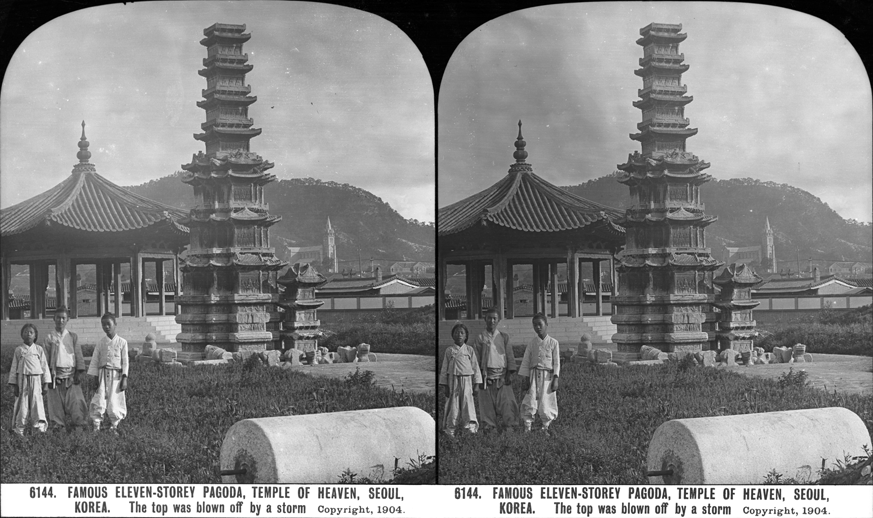
(1) Its “unique” status as the singular pagoda standing in Seoul; (2) its “antiquity,” and “historicity” since both Lowell and Bird had estimated its true age dating to the Yuan dynasty (ca. late 14th century) as well as its close historical connections to a Japanese conquerer, Toyotomi Hideyoshi, who invaded the peninsula several times (Imjin Wars) over a span of seven years (1592–1598). Bird relates the story of a general serving under Hideyoshi, who had failed to dismantle the pagoda to take it back as war loot. Unable to transport it, he had abandoned it in its broken state with the top three stories chopped off and discarded to the side (Figure 2) as we can see in Rose’s stereograph view taken in 1904. (3) Its “materiality” and the artisanal quality of its marble reliefs that Bird observed were being threatened as she had witnessed from street children’s scavenging activities.Footnote 17 Bishop’s insight into the supply end of the market in looted antiquities is consistent with experts who calculated that the bulk of curios (the most popular being celadon ware) that are part of foreign collections were smuggled out during the chaotic three decades spanning the Sino-Japanese and Russo-Japanese Wars (1895–1905) and 1916, when the Colonial Government-General of Korea (hereinafter CGK) promulgated preservation laws to stop the trafficking in cultural properties.Footnote 18 Despite police presence and customs regulations, due to the violence, war, and poverty spanning the five decades of the Japanese colonial era (1910–1945), the sudden collapse of the Japanese empire (1945), and the Korean War (1950–1953), impoverished yangban selling off heirlooms and enterprising tomb raiders supplied a large number of secondhand stores (furui doguya) in the major treaty ports (Pusan, Seoul, Wonsan, Shinŭiju) catering to Japanese soldiers, colonialists, merchants, and curio collectors, such as Itō Hirobumi, Yanagi Soetsu, and the Asakawa brothers.Footnote 19
Stereo-view of the temple site and the pagoda’s ruins, circa 1904. Rose’s caption and identification of the photograph as “Eleven Story Pagoda Temple of Heaven Seoul” is not correct. The latter is another shrine, elsewhere in Seoul. Source: Albumen print stereograph by George Rose. Courtesy of Keystone-Mast Collection [1996.0009.A1504], California Museum of Photography, University of California, Riverside.
The Irishman named John McLeavy Brown, LL.D. who was then serving as Chief Commissioner of Korean Customs for the British Consulate and advisor to the Mint for the Great Han Empire (1897–1905) is attributed as the main architect of Seoul’s oldest public park, which was then given the English moniker “Pagoda Park.” This popular name survives to this day rather than the awkward Korean translation of “T’apgol Gongwŏn.” As the oldest historical relic located in central Seoul, renamed as Keijō by the Chōsen sōtokufu (hereafter CGK [Colonial Government General of Korea]), it was the first monument to be registered as an Ancient Remain (Koseki No. 1) in 1916, the first year the Colonial Registry of Ancient Sites and Relics was cataloged by the CGK Committee on Korean Antiquities.Footnote 20 As we can see in Figure 2, it was common practice for travel photographers to pose street children next to monuments. As native markers, sympathetic portraits of street children are recurrent motifs of the “conquered other” in views of the capital of Seoul. From the perspective of the commercial photographer, the children’s innocent expressions and demeanor embellished the exotic and pristine quality of their travel experiences and affirmed their status as discoverers of unknown, distant lands and peoples.
II. The Palace of Summer
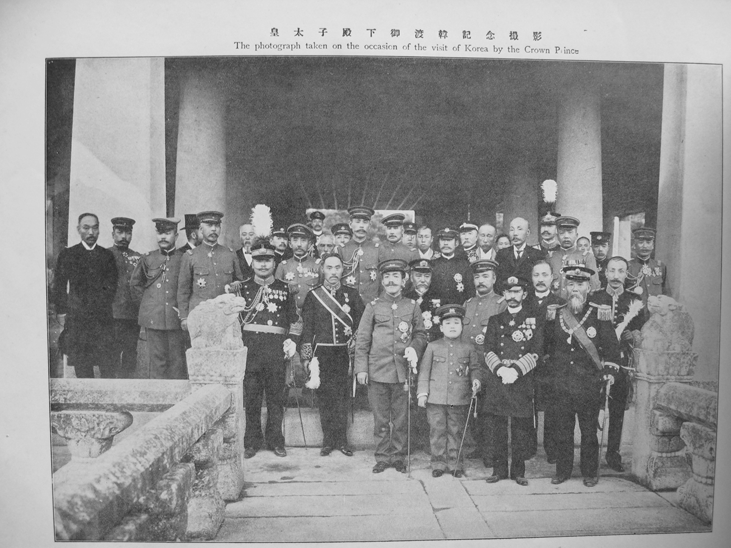
The second exception to the lack of notable architecture featured in Lowell’s travelogue includes several photos of Kyŏngbok palace architecture, which were included in his chapter, “Landscape Gardening.”Footnote 21 As a special guest of the king, Lowell is remembered as the first Westerner given permission to photograph the inner palace.Footnote 22 Lowell captioned his photograph the “Palace of Summer” (Figure 3) because in his eyes, the pavilion’s architectural finesse with “two stone cause-ways spanning the narrowest part of the pond joining the central island to the grounds without,” rivalled the beauty and grandeur of the more well-known Old Palace of Summer (a.k.a. Yuan Ming Yuan) in Beijing.Footnote 23 As the most famous building that once functioned as a banquet hall for VIP receptions, it comes as no surprise that the pavilion was the chosen destination for an official group photo (Figure 4) commemorating the imperial tour when Crown Prince Yoshihito of Japan (the later Taishō emperor, r. 1912–1926) visited the colony in 1907. Here, in military uniform, he is standing side by side with the handpicked successor to the Korean throne, Prince Yi Un/Yŏngchin (1897–1960) as a young boy. Next to the two princes stands the imposing senior statesman Itō Hirobumi, flexing his muscle as the newly installed Resident-General (r. 1905–1909), flanked by admirals Tōgō Heihachirō and Katsura Tarō, heroes of the Sino-Japanese and Russo-Japanese wars. This picture was included in a CGK-commissioned official photo album, which cataloged a total of 88 photos of imperial royalty, Prince Yi royal household courtiers, CGK officials, new cabinet members, prominent businessmen, and postcard views of Korea.Footnote 24 The photo album was simultaneously published in Tokyo and Seoul, renamed Keijō by the CGK.Footnote 25 In these two photos, we can see that decaying palatial ruins most identified with Korea’s fallen kingdoms were selected as theatrical backdrops signaling the inevitable decline of past dynasties, who just like the Yi royal clans, having lost out in the struggle for survival, had been saved by more advanced foreign leadership.
The “Palace of Summer” by Percival Lowell (ca. December 1883). Source: Percival Lowell, Chosŏn: The Land of the Morning Calm, Boston: Ticknor and Co., 1886. Scan courtesy of Museum of Fine Arts, Boston for “Exterior of the so called summer palace in the old palace, Seoul” (NRICP Relic No. 2905) by Percival Lowell (2003.684).
Palace architecture as visual propaganda of Imperial Japanese Annexation of Korea. Original caption, “1910 Annexation Commemoration Photo Album Crown Prince Yoshihito of Japan (the later Taishō emperor, r. 1912–1926), Yi Un/Yŏngchin (1897–1960) and Itō Hirobumi, the CGK Resident-General flanked by admirals Tōgō Heihachirō and Katsura Tarō.” Photographer unknown (ca. 1907). Source: Rōbei Sugiichi, ed. Heigō kinnen Chōsen shashinjō [Commemoration photo album of the annexation of Chōsen], joint publication, Tokyo: Gengentōshobō, Keijō: Shinhantōsha, 1910.
III. Commercial Photo Studios and Standardization of Postcard Views
At the turn of the century, with the rapid territorial advancement of Japanese military and economic penetration into Northeast Asia, the medium of the postcard as in the other European colonies attracted a diverse range of large and small producers and sponsors, because it was the most efficient and economical means for mass communication and advertising. Throughout the formal and informal territories of the Japanese empire from Manchuria, Korea, Taiwan, and Singapore, public institutions as well as private organizations, such as Governor-General Offices, colonial exposition committees, postal offices, the military, museums, retail merchants, and the tourist industry, including hotels, hot springs, geisha houses, department stores, local transportation companies, and print shops, were all engaged in postcard production and distribution.Footnote 26
It is not an exaggeration to state that South Gate (Sungnye-mun) was and remains the most reproduced architectural landscape representing “Old Korea” since the late 19th century (Figures 5–7). First, as the main entryway into the capital coming in from the southern road since its first construction in 1398, it made a lasting impression on soldiers, merchants, and travelers passing through. In Lowell’s Reference Lowell1886 travelogue, he raves upon its first sighting:
I have seen sights as beautiful and as strange before: but I never beheld anything so completely realized my boyish dreams as what I stood gazing upon then. There they all lay spread out before me as I conjured up into life, the imaginations of the time when, as a lad, my thoughts sped away from the pages of the “Arabian Nights” to the dreamy Orient. In front of me rose the south gate, by name, “The Gate of Everlasting Ceremony,” one of the eight clasps of the city’s girdle. On either hand stretched a crenelated wall, encircling as with an arm the spot it loved. Protected within, nestling to it for safety from without, huddled the low one-storied houses, a sea of roofs, some tiled, some thatched. I seemed to recognize the very spot where the princess of my youth was let over the wall and made good her escape. I saw the house where the robbers rendezvoused on the night before the deed. The men I descried walking about, bore the look of those whose lives the old tales had made me familiar. It was all there before me. It was all real and I was myself an actor in the scene.Footnote 27
South Gate, circa 1895. Photographer unknown. Source: Chōsen koseki zufu [Album of Korean antiquities], Vol. 11. Plate No. 4818. Title: Keijo Sungnye-mun (Nandaimon Gate) Front View. Scan Courtesy of the University of California Santa Barbara Arts Library.
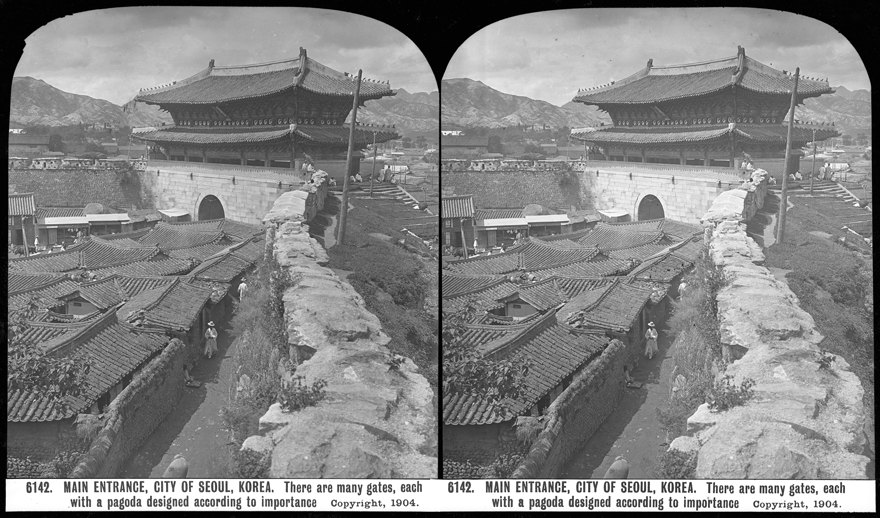
South Gate view from the eastern wall. Original stereo-view caption: “Main Entrance, City of Seoul, Korea. There are many gates, each with a pagoda designed according to importance.” Albumen print stereograph by George Rose (ca. 1904). Courtesy of Keystone-Mast Collection, California Museum of Photography, University of California, Riverside.
South Gate, after reconstruction (ca. 1925). Author’s collection.
In Lowell’s rapturous experience, the vision of South Gate represented the fulfillment of his childhood dreams fed by familiar romantic tales from the Arabian Nights and thus, surpassed his expectations and fantasies of stepping into an “Oriental City,” in this case, Seoul.Footnote 28
In Figure 6, Rose’s stereo-view of South Gate (ca. 1904) stands out because unlike most photographers who usually framed a gate straight on and centered grandly in the middle of the photo as in Figures 5 and 7, his perspective was to take a side-angle view along the same height as the wall as if one was walking toward the gate. According to the curator Norman Thorpe, who organized a major retrospective on the body of Rose’s work, Rose made special efforts to photograph scenes that contained objects at several different distances.Footnote 29 He especially liked things stretched into the background, such as a wall shrinking into the distance, because these have a very strong 3-D effect when viewed through a stereo-viewer.Footnote 30 Rose’s personal comments also noted how the city gates used to be closed at dusk, but nowadays, “the gates are ever open, and a modern electric tram, at popular fares, shoots through the gateway. The wall is now in partial state of decay, but it was a solid circuit of masonry battlements and loop-holes for the old-time archers … its heavy wooden doors were sheathed and clamped with iron.”Footnote 31 In Figure 6, one can glimpse the traffic through the main thoroughfare going to and from the gate. We also see open shops, and at the far left a less common two-storey Korean-style building. In the foreground is a cluster of tiled roofed houses that may belong to other shopkeepers like the houses across the street. In the shadows at the bottom of the photo a vendor is selling his wares to passers-by.”
Sekino Tadashi (1865–1935), a graduate of the engineering department of Tokyo University, was the first architect to systematically survey the gate’s art and architecture.Footnote 32 His detailed photos, maps, and measurements were included in his 1904 report “Kangoku kenchiku chōsa hōkoku” published in the prestigious Tokyo University Engineering Department Research Report Series.Footnote 33 Sekino’s research into the Yi dynastic records indicated that it was the oldest gate in the capital built in 1398 during the seventh year of the founder of the Yi dynasty, King T’aejo’s reign (1392–1398). Praising the gate’s magnificent wood architecture for its symmetry, sturdy construction, and decorative elements epitomizing Yi dynastic craftsmanship, he emphasized that its preservation quality was an even a rarer occurrence considering its advanced age of 600 years.Footnote 34 Because of Sekino’s recommendation, the gate’s main arch was spared destruction when in 1907, the CGK purchased the surrounding real estate, effectively pushing out the dense enclave of shops and street vendors as seen in Figures 5 and 6.
By the 1920s, South Station became the designated meeting point where regularly scheduled city tour buses and trams departed for “through-ticket” Chōsen Government Railway (CGR) passengers who wanted to rest or dine at the chic Chōsen and Bando hotels or undertake a half-day’s sightseeing en route to China or Manchuria.Footnote 35Figure 7 is a standard postcard convention of capturing city views with South Gate dating from the late 1920s devoid of tourists and shoppers. The “empty” cityscape brings forth the gate’s well-maintained architectural façade, protective barrier, and clean city streets. At the same time, it projects an image of the colony as a pristine, empty, and unpolluted destination ripe for exploration, adventure, and colonization However, here we have to note that by the 1920s, this gate’s intersection was in fact the busiest traffic junction in Korea, with an estimated 5000 daily visitors and shoppers. Therefore, the sparsely populated street view of South Gate, with only a few strategically placed coolies, pedestrians, and street children, would have been a highly unusual occurrence. The photographer probably shot the gate very early in the morning to show off its architectural splendor, decorated with the distinct signs of urban modernity represented by the symmetry of the street lamps, clean, well-paved pathway, and a Japanese police box guarding the reconstructed gateway.Footnote 36
Therefore, architects, colonial developers, retail merchants, and commercial print media were responsible for transforming South Gate into the iconic gateway to Chōsen, advertised to the millions of inbound train passengers disembarking from the Keifu (Keijō-Pusan) trunk line.
Conclusion
Even from our small sampling of three monuments in Seoul, it is clear that established photographic conventions for framing ruins played a critical role in the creation and dissemination of highly exoticized and romanticized tableaus of an ancient land dotted with pagodas and quaint natives. Skilled photographers and technicians, by adjusting lighting angles, lens focus, and/or embellished with local props from street urchins, fallen yangban or deposed royals, and beautiful women, manufactured visually arresting images of the colonies to incite curiosity and the desire to travel. Visions of ruins in many formats and guises were thus deployed to convey complex messages including a sense of discovery and scientific documentation, as well as advancing CGK’s civilizing mission as evidenced by the building of cultural spaces, such as zoos, botanical gardens, art galleries, historical parks, and museums targeting audiences at home and abroad.Footnote 37
I will conclude by mentioning five of the most enduring colonial, visual, and cultural legacies of this body of early travel photography on the future trajectory of cultural heritage management policies. First, by the 1920s and 1930s, the expanding Japanese tourist industry, spearheaded by the Japan Tourist Bureau (1912–present), steamer liners, such as the Japan Mail Steamship Company (Nippon Yusen Kaisha [NYK] Line), Japan Imperial Railways, South Manchuria Railway Company, and local transportation and tourist enterprises (trams, buses, station hotels, photo studios) were advertising Korea’s scenic temples, pagodas, and palaces in a wide range of travel media as the most “picturesque” and “authentic” must-see destinations in the empire to citizens of Japan’s colonies as well as foreign tourists.
Second, in postwar South Korea, highly centralized state-appointed preservation committees, mostly made up of academics and museum curators who inherited the vast colonial inventory of treasures have continued to favor royal tombs, temple complexes, shrines, and palaces. As tangible sources of antiquity, authenticity, and dynastic continuity, they have received the majority of scarce state funding for the excavations and reconstructions to be developed as national spaces exhibiting racial identity, historical memory, and patrimony. Consequently, we will never know how many “less glamorous” prehistoric sites (shell mounds, subterranean dwellings, etc.), foreigners’ legations’ buildings, churches, Japanese colonial architecture, and vernacular architecture (yangban houses, clan villages), which did not meet the disciplinary and aesthetic criteria as “national treasures” worthy of protecting were bulldozed and disappeared without a trace.
Third, these visual archives are invaluable for the student of art and architectural and modern Korean history because they reveal how the unstoppable forces of modernization and passage of time brought on by both manufactured and natural factors have defined and shaped ruins over the centuries.Footnote 38 As in other parts of the colonized world, the fate of Korea’s monuments were impacted over the centuries by invading armies, bombs, scavengers, urbanization, and tourist development as well as their by-products, such as physical and environmental damage (traffic, tourists, and pollution).
Fourth, in the postwar Republic of Korea, the Cultural Heritage Administration Bureau (CHA) and National Research Institute of Cultural Heritage (NRICH) have collected, studied, and referenced the same visual archives as invaluable architectural “blueprints” used by archaeologists, art historians, and carpenters when reconstructing ancient palaces, tombs, and temples. When a devastating arson fire on February 2008 destroyed most of the South Gate’s structure, Rose’s 1904 stereo-view photograph, because of its 3-D qualities, was consulted by the National Institute of Cultural Properties and NRICH during the five years’ excavation and rebuilding of South Gate. Five years of excavations of the gate’s environs confirmed the accuracy of Rose’s photographs when the eastern sections of the gate walls were exposed confirming the steps leading up to the gate’s roofs as seen in Figure 8.Footnote 39 As the noted historian of photography Elizabeth Edwards has emphasized, the enduring power of photography derives from its very “fluid relationships” between a photograph’s production, consumption, materials forms, ownership, institutionalization, exchange, possession, and social accumulation, in which equal weight is given to content and use value.Footnote 40 Therefore, as we have seen with the case study of Korea’s oldest registered national treasure’s photographic reproductions of South Gate, physical remains and objects can constitute a “novel form of agency,” as they are constantly evolving in their forms, functions, delivery mechanisms, as well as symbolic cultural meanings being reinterpreted for new generations of audiences.
Picture numbers and captions: No. 90 Estimated locations of stone steps on the eastern wall; No. 91 Stone side steps leading up to the eastern wall; No. 92 Eastern wall steps seen from the north; No. 93 North-South trench incline of the eastern wall as seen from the southeast; No. 94 View of excavations of the eastern walls as seen from the east. Reproduced from National Research Institute of Cultural Heritage (NRICH), Sungnye-mun palgul chosa pogosŏ [Sungnye-mun excavation report], Taejŏn: Kŭmkang Press, 2011, p. 131. Scan courtesy of the National Research Institute of Cultural Heritage.
Finally, these postcard views are currently being reevaluated as artworks by curators and scholars. Due to the enduring power and emotional pull of “ethnic nostalgia,” for a long-lost past, accompanied by recent advances in high-resolution scanning and digital printing technology, the Seoul National Museum, the National Folk Museum, Pusan Museum, Seoul History Museum, Inch’ŏn Port Museum, and Sŏnggyun-kwan University Museum, to name the most prominent few, have coordinated major exhibitions featuring reproductions of colonial-era postcards of must-see destinations including royal palaces, gates, temples, tombs, kisaeng, and even the far-off hiking destination, Diamond Mountain. Curators of national and municipal cultural institutions, ever eager to promote local pride, sense of place, belonging, and boost museum attendance, are staging photographic exhibitions to lure older generations of visitors who retain fond memories of a by-gone era.
Last but not least, outside of museums and heritage specialists, these early photographs of native types posed amid ruins in various stages of decay continue to be widely circulated as illustrations and visual aids in textbooks, newspaper articles, photo albums, travel guides, web sites, and stamped-on souvenirs sold in tourist gift shops. Thus, anachronistic views of Koreans trapped in space and time as the conquered “Hermit Kingdom,” continue to be reinscribed in the cultural memory and tourist imaginary well into the 21st century.