Introduction
The view on people with dementia has changed in recent decades. In reaction to the more psychiatric and medically based approaches, that viewed dementia as a “loss of the self”, there has been growing awareness that psychosocial factors like personality, social interaction, and coping mechanisms influence the way dementia presents itself. Nowadays, various environmentally based interventions are available to make people with dementia living in long term care more comfortable and less prone to exhibit challenging behavior (Padilla, Reference Padilla2011). A large number of psychosocial interventions is available that aim at either improving quality of life or diminishing the challenging behavior of people with dementia (Livingston et al., Reference Livingston, Johnston, Katona, Paton and Lyketsos2005; O'Connor et al., Reference O'Connor, Ames, Gardner and King2009a; Reference O'Connor, Ames, Gardner and King2009b; Cooper et al., Reference Cooper2012; Cohen-Mansfield, Reference Cohen-Mansfield2013). The proven effects of these interventions, however, remain modest (Livingston et al., Reference Livingston, Johnston, Katona, Paton and Lyketsos2005; O'Connor et al., Reference O'Connor, Ames, Gardner and King2009b; Reference O'Connor, Ames, Gardner and King2009a; Padilla, Reference Padilla2011; Cooper et al., Reference Cooper2012; Cohen-Mansfield, Reference Cohen-Mansfield2013).
The idea behind most psychosocial interventions is that more attention for the world of experience of the person with dementia will eventually result in the person feeling more respected, more comfortable, and less prone to exhibit challenging behavior. Challenging behavior supposedly diminishes because by adjusting care and communication to the world of experience of people with dementia, they will be less anxious. In the early stages of dementia, these insights are fairly well established. However, in the later stages of dementia, it becomes harder to communicate about the experience of the world that people with dementia have and about the needs they experience. The concept of a shared world between the person with dementia and carers is lost (Hertogh et al., Reference Hertogh, The, Miesen and Eefsting2004), which makes up a large part of the “challenge” that the behavior causes. Still, when advocating that the wishes, beliefs, and needs of people with dementia should be accounted for, we need to have some concept of the way people with dementia experience themselves and how they perceive the world around them.
Several authors have proposed ideas about experiencing and coping in dementia (Dröes, Reference Dröes1991; Feil, Reference Feil1994; Kitwood, Reference Kitwood1997; Cohen-Mansfield, Reference Cohen-Mansfield2001; Clare et al., Reference Clare, Markova, Roth and Morris2011). The lack of decisive evidence for many psychosocial interventions that are (to some extent) based on these models might imply that the models do not fully explain the experience of living with severe dementia. As a reaction to the disease-oriented view, current explanatory models usually do not incorporate biological and neurological factors like the influence of infection or the consequences of diminished cognitive functioning. It is possible that, by omitting the biological and neurological side of dementia, the psychosocial approach to dementia is not a complete, satisfactory answer to the earlier medical models. In this paper, we will review and reflect on the currently available psychosocial models and we will outline the possibility of a knowledge gap on experience in late stage dementia in the current models.
Current models on experiencing the world with dementia
The current view on the world of experience of people with dementia was greatly influenced by the work of Kitwood. In his work, he emphasized that the personhood of people with dementia should be fully acknowledged rather than considered almost absent (Kitwood, Reference Kitwood1993; Reference Kitwood1997). Kitwood explains dementia as an interplay between neurological impairment, personality, biography of the person, health status, and social psychology. Because, as Kitwood contends, the neurological impairment, personality, and biography are more or less fixed factors, and the role of social psychology in dementia is much emphasized in this model. It is even stated that, when the communication with a person with dementia is “malignant” (e.g. ignoring the personhood of the person with dementia), this can lead to a preventable decline of (psychological) functioning. Carers and relatives should consider the person with dementia as a person who is a “sentient, relational, and historical human-being” (Kitwood, Reference Kitwood1993) and act accordingly. Kitwood states that the inner sense of security and stability vanishes in people with dementia and the outside world should do everything in their power to sustain the personhood of the person with dementia by recreating the feeling of stability and security previously established by inner judgment and memory.
The idea that the loss of (cognitive) functions can lead to anxiety and feelings of insecurity can also be found in the work of Feil (Feil, Reference Feil1992). According to Feil, when old people experience functional and social losses, their mind will return to the past, when they were still “needed, loved, and productive people”. Because of feelings and thoughts originating from unsolved issues in the past, people become disoriented. When relatives and carers use validation methods that recognize and acknowledge the feelings and world that the disoriented person experiences, the unresolved issues can be resolved and the disoriented person can become less disoriented.
Sabat (Sabat, Reference Sabat2005; Sabat, Reference Sabat2006) developed a view on experiencing the world and oneself in that world that might explain certain behavioral reactions of people with dementia. This concept of selfhood is based on social constructionist theory regarding role taking in social engagement (Davies and Harré, Reference Davies and Harré1990). Sabat presents a framework that consists of three aspects of selfhood; Self 1 (referring to oneself as “I”, understanding you are a unique human being), Self 2 (valuing individual personal characteristics), Self 3 (the self in social context, life story) (Sabat et al., Reference Sabat, Johnson, Swarbrick and Keady2011). In line with the work of Kitwood, it is argued that the (tone of) interaction with people with dementia can be either beneficial or detrimental for their well-being. Sabat and Harré (Sabat and Harré, Reference Sabat and Harré1994) argue that all people should be seen as “semiotic subjects”, e.g. behavior is driven by the meaning people give to a situation. Viewing the situation from the personal concept of Self 2 and 3 of the person with dementia; that is, their personal background of beliefs, values and experiences, may shed a whole new light on the meaning of the behavior they exhibit (Sabat et al., Reference Sabat, Johnson, Swarbrick and Keady2011).
While the authors mentioned above mainly used their practical experience and theoretical knowledge in building their theories about experience in dementia, Clare takes another approach in her work on how people with dementia experience the world. In the later stages of dementia, cognitive functioning deteriorates, which might imply that the ability to make “an accurate appraisal of a given aspect of one's situation, functioning or performance” (Clare et al., Reference Clare, Rowlands, Bruce, Surr and Downs2008), in other words “awareness”, deteriorates as well. Based on empirical research, however, Clare states that awareness is never completely absent but merely altered (Clare et al., Reference Clare, Rowlands, Bruce, Surr and Downs2008). Subsequently, it is stated that awareness of altered awareness (i.e. realizing something is wrong) can make people fearful. Some coping strategies to deal with this fear, for example denial of indifference, could be interpreted as unawareness (Clare et al., Reference Clare, Roth and Pratt2005; Clare et al., Reference Clare, Rowlands, Bruce, Surr and Downs2008). Markova and Clare additionally point out that the concept of awareness is highly dependent on the object and the field in which awareness is studied (Clare et al., Reference Clare, Rowlands, Bruce, Surr and Downs2008; Markova et al., Reference Markova, Clare, Wang, Romero and Kenny2005; Clare et al., Reference Clare, Markova, Roth and Morris2011). People can notice their altered awareness by environmental feedback (Clare et al., Reference Clare, Rowlands, Bruce, Surr and Downs2008; Reference Clare, Markova, Roth and Morris2011) and environments that encompass clarifying clues (such as a kitchen, a sitting area with comfortable chairs or nametags and photographs on patient rooms) can therefore help people with dementia.
In the work of Clare, it is also stated that an accurate model of awareness and coping should take the influence of neurological deterioration into account. Although Clare opposes the illness-based view that awareness is lost in dementia, she reckons that there are influences of neurological and neuropsychological functioning on awareness and behavior in dementia. From a different theoretical perspective – that of the progressively lowered stress threshold theory – Hall & Buckwalter also recognize the influence of neuropsychology on behavior in dementia. In this theory, it is presumed that neurological damage leads to heightened perceived stressors and a lowered threshold for stress (Hall and Buckwalter, Reference Hall and Buckwalter1987; Smith et al., Reference Smith, Gerdner, Hall and Buckwalter2004). As a result of cognitive dysfunction, people with dementia experience more stressors in ordinary situations, which may lead to inappropriate behaviors. Hall & Buckwalter and Clare are some of the few who have endeavored to incorporate the influence of neurological deterioration into their models. The majority of authors in recent decades attribute the major part of (the solution for) aberrant behavior of people with dementia to psychological functioning, coping, and social interaction, thus neglecting the neurological dimensions (Dröes, Reference Dröes1991; Feil, Reference Feil1992; Kitwood, Reference Kitwood1993; Kitwood, Reference Kitwood1997; Fortinsky, Reference Fortinsky2001; Woods, Reference Woods2001; Kooij, Reference Kooij2002; Norman et al., Reference Norman, Redfern, Briggs and Askham2004). Kitwood, for example, finds justification for the focus on “malignant social psychology” in the statement that neurological impairments are fixed factors, i.e. irreversible, implying that any emphasis on these impairments is a waste of effort. Elaborating on the work of Kitwood, Cohen-Mansfield developed the unmet-needs framework for use in care practice. This framework covers a very broad range of explanations for challenging behavior in dementia (Cohen-Mansfield and Billig, Reference Cohen-Mansfield and Billig1986). It does include the option that unmet needs can stem from cognitive impairments, but, as in the work of Clare, the notion of the influence of these impairments is merely an observation; the different ways in which neurological impairments may influence experiences and behavior are not elaborated.
A knowledge gap?
For the last 30 years, people have advocated a shift from pathology to people (Reid et al., Reference Reid, Ryan and Enderby2001). Notwithstanding the obvious improvements on approaching people with dementia the more psychosocially based view has had, it seems that the lack of attention for the fact that dementia is a neurodegenerative disease has taken its toll on the effectiveness and the applicability of the models, as seen in the modest effects they have in practice. The usefulness of a holistic biopsychosocial model is often proposed but this merely seems to have been used to justify the emphasis on psychological and social influences on experiencing the world with dementia. To truly develop a biopsychosocial model for dementia, the influence of biological factors should also be integrated. When concentrating on the explanatory models of experiencing the world with dementia, the neuropsychological deficits of individual people with dementia should be taken into account. Neurological damage can have a great impact on the way people see, interpret and experience and interact with the world around them. Currently, it is largely unclear in what way altered neuropsychological functioning influences the way people with dementia experience the world and how it affects their behavior. For a better understanding and a more suitable approach to people with dementia, we must know more about how distinct neurological damage influences their perception of the world and oneself in that world. After all, how can we even make a start with understanding and adapting to the needs of people when we do not know how they perceive the world around themselves?
Methods
To take the influence of neuropsychological functioning into account when developing a model of experiencing the world in dementia, we must take a look at the current state of knowledge on how cognitive and neuropsychological functioning may influence the experience of the world by people with dementia.
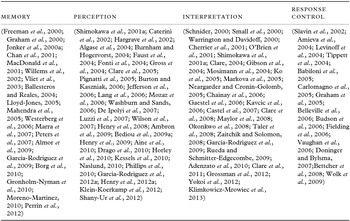
For this aim, the literature was selected through a computer-aided search in the PubMed and Psychinfo databases (search date 27-3-2014). First, a search was conducted with a combination of terms regarding (1) perception and (2) dementia and (3) behavior. Second, a search was conducted combining (1) awareness and (2) dementia and (3) long term care. To ensure the search would result in the current state of knowledge on perception and dementia, the search was limited to papers published in or after 2000. The search was also limited to papers written in English. This resulted in 631 papers. Papers from this selection were excluded when they (a) involved non-human research (b) involved only rare types of dementia like Creutzfeldt–Jacob or Kluver–Bucy (c) only involved methodological issues (d) did not involve cognitive or neuropsychological research. This resulted in 94 papers being selected (Table 1).
Results of the literature search on cognitive and neuropsychological functioning in late stage dementia. Results are divided in research regarding memory, perception, interpretation, and response control

Results
Current state of knowledge on neuropsychological functioning in dementia
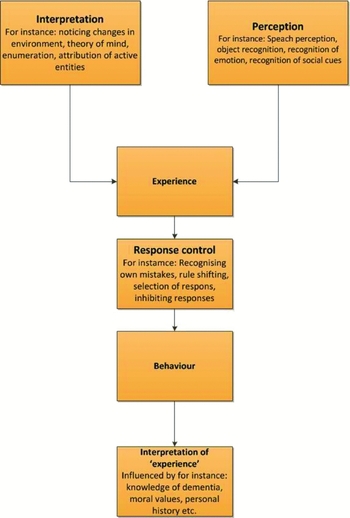
The literature research on cognitive and neuropsychological functioning of people with dementia is limited to patients in the early stage of Alzheimer's disease or people with mild cognitive impairment (MCI). Next to memory impairments, the literature implies that people with dementia might experience difficulty in perceiving the direct environment (perception), interpreting the environment (interpretation), or inhibiting their own responses to the environment (response control) (Figure 1). Because of memory impairments, however, it is difficult to determine whether other deficits are distinct impairments or simply consequences of impaired memory.
Proposed model of the influence of neuropsychological functioning on experience & behavior of people with dementia. Without knowledge on perception, interpretation and response control of the person with dementia, behavior can easily be misinterpreted and wrong assumptions about “experience” are likely to be made.

Memory
The most obvious and well known cognitive impairment that influences perception in dementia, specifically in Alzheimer's disease, is the impairment of memory (Jonker et al., Reference Jonker, Geerlings and Schmand2000b). Research suggests memory impairments might not be as straightforward as once believed. Memory itself is not a uniform concept and research suggests that different modalities of the memory can be independently affected by neurodegenerative diseases.
For example, semantic memory (memory of general facts and knowledge) seems to be more impaired than episodic memory (autobiographical memory) and people with Alzheimer's or MCI have a better memory for living than for non-living things (Almor et al., Reference Almor2009; Borg et al., Reference Borg, Thomas-Anterion, Bogey, Davier and Laurent2010; Moreno-Martinez, Reference Moreno-Martinez2010). Furthermore, the “mere exposure effect”, which is an increase in the positive appraisal of stimuli we are repeatedly exposed to, seems to be intact in Alzheimer's patients while the explicit recognition of these stimuli is impaired (Willems et al., Reference Willems, Adam and van der Linden2002; Westerberg et al., Reference Westerberg2006). This implies people with dementia may have deficits in their explicit memory, which is used for the conscious recollection of facts and events, while the implicit memory, the memory for learning new tasks and procedures without explicit knowledge on the task or on the previous experience, might be better retained. This advocates for surrounding people with dementia with familiar faces and objects, despite the fact they do not explicitly recognize them anymore.
Perceiving the direct environment
With regard to perceiving the direct environment, there is an ongoing debate as to whether impaired facial expression recognition that is often seen in dementia patients stems from general cognitive decline in memory, a decline in attention and visuospatial functioning, or a distinct impairment (Bediou et al., Reference Bediou2009b; Phillips et al., Reference Phillips, Scott, Henry, Mowat and Bell2010; Garcia-Rodriguez et al., Reference Garcia-Rodriguez, Vincent, Casares-Guillen, Ellgring and Frank2012b; Klein-Koerkamp et al., Reference Klein-Koerkamp, Beaudoin, Baciu and Hot2012;). Henry et al. found that in case of recognizing emotional gestures, this deficit stems from more general impairment in recognizing visual motion (Henry et al., Reference Henry2012b). Shany-Ur et al. found that the impaired recognition of insincere speech (lies or sarcasm) is also caused by a general decline, except in frontotemporal dementia in which this is a distinct impairment that is apparent in the early stage of the disease (Shany-Ur et al., Reference Shany-Ur2012). Setting aside the discussion about the origin of the impairment, the impaired recognition of other people's emotions (Phillips et al., Reference Phillips, Scott, Henry, Mowat and Bell2010; Garcia-Rodriguez et al., Reference Garcia-Rodriguez, Vincent, Casares-Guillen, Ellgring and Frank2012b; Henry et al., Reference Henry2012b; Klein-Koerkamp et al., Reference Klein-Koerkamp, Beaudoin, Baciu and Hot2012), impaired judgment of threat (Henry et al., Reference Henry2009), impaired ability to communicate and comprehend social cues or gestures (Shimokawa et al., Reference Shimokawa2001b; Mozaz et al., Reference Mozaz, Garaigordobil, Gonzalez Rothi, Anderson, Crucian and Heilman2006; Washburn and Sands, Reference Washburn and Sands2006; Horley et al., Reference Horley, Reid and Burnham2010) are all seen in dementia patients and may lead to seemingly improper and aberrant behavior. In addition, Jefferson et al. (Reference Jefferson, Barakat, Giovannetti, Paul and Glosser2006) concluded that the degree of impairment in object perception (recognizing objects) is a predictor for functional decline.
Interpreting the environment
The interpretation of the environment is also influenced by cognitive capacities. For example, being able to divide one's attention is important for correctly interpreting several stimuli at the same time. For people with Alzheimers’ disease, dividing attention becomes difficult, especially when visuospatial stimuli are presented amongst other information (Castel et al., Reference Castel, Balota, Hutchison, Logan and Yap2007; Garcia-Rodriguez et al., Reference Garcia-Rodriguez, Vincent, Casares-Guillen, Ellgring and Frank2012b), which might explain the altered ability to detect changes in naturalistic scenes, such as changes in the environment or differences between pictures (Neargarder and Cronin-Golomb, Reference Neargarder and Cronin-Golomb2005). The problems with spatial orientation and topographic disorientation seen in Alzheimer's’ (Cherrier et al., Reference Cherrier, Mendez and Perryman2001) might also be explained by the difficulties in dividing attention, combined with the problems in global pattern and motion recognition (O'Brien et al., Reference O'Brien, Tetewsky, Avery, Cushman, Makous and Duffy2001). The ability to assess the amount of stimuli present (enumeration), either through counting or at a single glance, is affected in people with dementia as well (Maylor et al., Reference Maylor, Sheehan, Watson and Henderson2008). In addition, people with Alzheimer tend to over-attribute active entities as agents; e.g. as living things (Zaitchik and Solomon, Reference Zaitchik and Solomon2008). Combined with a diminished ability to process visual information of the surroundings (Kavcic et al., Reference Kavcic, Fernandez, Logan and Duffy2006), these impairments can make it very difficult to correctly assess and evaluate a situation.
Inhibiting responses to the environment
Lastly, people with dementia might experience trouble in inhibiting responses to environmental stimuli (Slavin et al., Reference Slavin, Mattingley, Bradshaw and Storey2002; Belleville et al., Reference Belleville, Rouleau and van der Linden2006; Vaughan et al., Reference Vaughan, Hughes, Jones, Woods and Tipper2006). This might explain the diminished ability in Alzheimer's patients to detect their own errors and to correct mistakes in a timely manner (Bettcher et al., Reference Bettcher, Giovannetti, Macmullen and Libon2008). Additionally, this could be an explanation for the presence of “empty speech” of some people with dementia. In an experiment on referential communication, people with mild to moderate Alzheimer's disease were well aware of the task instruction to effectively describe a picture to a listener, but they seemed unable to restrain themselves from including irrelevant details or details from distracting pictures (Carlomagno et al., Reference Carlomagno, Santoro, Menditti, Pandolfi and Marini2005). The authors suggest that this deficit stems from a combination of problems with inhibiting irrelevant responses and selecting the discriminating features of a picture. Impairments in inhibition and problems with rule shifting (Amieva et al., Reference Amieva2004) can result in difficulties in keeping up with and reacting to a rapidly changing environment.
Discussion
The emphasis of the current available explanatory models on the way people with (severe) dementia experience the world tends to bypass the neurodegenerative aspect of the disease and the resulting neuropsychological consequences. Although the development of incorporating psychological and social factors in explaining behavior of people with dementia is an obvious step forward, neglecting the influence of neurological damage and other physical factors does not do justice to the situation people with dementia and their carers find themselves in. It can even be harmful, since focusing solely on psychosocial factors may lead to a missed diagnosis of co-morbid diagnoses (infection, delirum, etc.) as a possible explaining factor for challenging behavior. Also, it may lead to an overestimation of the degree to which people with dementia show intentional behavior that can be altered by good will. If neuropsychological deficits lead to challenging behavior, it is a misapprehension to suggest that if carers would try harder to adapt care to the world of experience of the person with dementia, she/he would be “willing” to alter his challenging behavior. Moreover, overlooking the possibility that neurodegeneration might ultimately lead to a loss of self-awareness or personhood could be detrimental to people with dementia themselves as well as to their carers, for this view might lead to overburdening people with dementia, improper life-extending treatments and a deficient grieving process (Davis, Reference Davis2004).
Models and interventions that take the individual neuropsychological profile of people in several stages of dementia into account may very well be more applicable and effective in actual dementia care. The current research on cognitive and neuropsychological functioning in dementia implies that neuropsychological functioning might influence the way people with dementia recognize, interpret, and respond to the world around them. These findings are important, for these abilities might directly influence behavior and the experience of people with dementia. Up until now, behavior is often seen as one of the few ways to get an insight into the experience of dementia. Without knowledge on how perception, interpretation, and the ability for response control are altered, the behavior of people with dementia can easily be misinterpreted and wrong assumptions about how people with dementia experience the world and themselves in that world are likely to be made (Figure 1).
Some findings, like those on implicit memory, impaired recognition of insincere speech or problems with dividing attention could be directly translated into practice by changing the surroundings and the way people with dementia are approached by carers. For instance, the use of photographs or name tags to label belongings or rooms directly make use of the preserved ability of people with moderate to severe dementia to recognize their own name and picture and to interpret objects with this form of signing as their own (Gross et al., Reference Gross2004). Furthermore, with a better understanding about whether there are modalities of memory that are relatively spared in even more severe stages of dementia, cognitive rehabilitation techniques like spaced retrieval and cued recall might be adapted for people in the more severe stages of dementia (Boccardi and Frisoni, Reference Boccardi and Frisoni2006).
However, the present state of knowledge on experiencing the world with dementia from a neuropsychological view is inconclusive. The current research on neuropsychological functioning is almost exclusively limited to people with MCIs or mild dementia, which is partially due to the lack of reliable neuropsychological tests for more severe dementia. Consequently, this raises new challenges in developing reliable procedures to determine the neuropsychological functioning of severely impaired people. Also, the majority of research focuses on Alzheimer's disease, while research shows that different forms of dementia might result in distinct neuropsychological profiles (Smits et al., Reference Smits2012; Kales et al., Reference Kales, Gitlin and Lyketsos2015). Research into neuropsychological functioning of people in more severe stages and different forms of dementia is needed to be able to develop a model that truly incorporates psychological, social, and biological factors that alter experiencing the world with dementia. The proposed model on recognition, interpretation, and response can be used in such research as a starting point for developing tests and theories.
Conflict of interest
None.
Description of the authors’ roles
SZ formulated the research question and designed the study in collaboration with CH. SZ carried out the study, analyzed the data and wrote the article. CH assisted in analyzing the data and critically reviewed the article. EP critically reviewed the article.