Introduction
Disaster incidents are occurrences that health care institutions must be prepared to respond to at all times. These can be natural or man-made incidents. Health care institutions and health care workers (HCWs) often are faced with the dilemma of how much resources they should channel into this aspect of their work; and what priority to accord to disaster preparedness activities.
Disaster preparedness and response is a costly undertaking. While it calls for much financial and time allocation, its occurrences are unpredictable. In many institutions, these plans may not have to be activated for years. In addition, these same institutions and HCWs have to respond to other challenges of daily, routine patient care. With each society's ever-increasing expectations of health care institutions, much resources, time and energy are often allocated for patient care activities focused on immediate needs. On the other hand, low-incident activities (although high impact) often fare unfavorably on the list of priorities.
The events of September 11, 2001 have rekindled attention to the level of disaster preparedness amongst health care institutions. In Singapore, the severe acute respiratory syndrome (SARS) experience in 2003Reference Ong1-Reference Seow3 and the recent Influenza A subtype H1N1 outbreakReference Hsu, Derrick Heng and Leo4, Reference Chan, Goh and Vasu5 have thrust emergency preparedness further into the limelight. While priorities have been recalibrated, the level of preparedness of both individual HCWs and of institutions is still not sufficient.
The aim of this study was to investigate the perception of HCWs towards their individual and their institutional preparedness for a disaster.
Methods
Study Design
A cross-sectional, anonymous survey was conducted August 1, 2010 through September 30, 2010 in Tan Tock Seng Hospital of Singapore. The hospital is a 1000-bed acute adult tertiary hospital receiving referrals from all over the country. All staff involved in the hospital's emergency preparedness activities was surveyed. These HCWs were from the medical, nursing and allied health disciplines within the hospital. Staff participation was strictly voluntary.
Paper-based, anonymous survey forms were distributed to participants in sealed envelopes during departmental staff meetings in various hospital disciplines. The forms had an explanatory note attached. One investigator was on site at each meeting to ensure blinding during the conduct of the survey. Respondents were asked to deposit completed questionnaires into drop boxes to ensure confidentiality.
This study was approved by the institutional review board of the National Healthcare Group in Singapore (DSRB-C/10/331) for waiver of consent.
Survey Instrument
The survey questions were formulated with inputs from hospital staff and reference literature.Reference Balicer, Omer and Barnett6-Reference Ehrenreich9 Feedback from a pilot survey was used to develop the final questionnaire used for data collection.
Besides collecting information about demographics and job type within the hospital, participants were asked to respond to five main domains of disaster preparedness. These domains were the individual's prior experience in disaster response, knowledge about mass-casualty incidents (MCIs), institutional preparedness, individual preparedness and training for MCIs.
For the individual prior experience in disaster response, the respondents were asked about their level of confidence in their ability to respond to any MCI and about emotional difficulties they might face after such an event. In the domain of knowledge of MCIs, respondents’ prior knowledge regarding a wide range of MCIs including bomb blasts, chemical and radiological incidents as well as biological disasters, was surveyed. With regards to individual and institutional preparedness, respondents were asked about their individual frequency of disaster training and knowledge of institutional disaster drills and response plan. In the final domain of training for disaster incidents, respondents were surveyed on their willingness to participate in disaster response training and the level of importance they placed on such professional training.
For each of the above five domains, participants were asked to fill in their responses to a subset of questions. A five-point Likert scale with the response options: “strongly agree,” “agree,” “unsure,” “disagree,” and “strongly disagree” was used to categorize their responses.
The primary outcomes were factors that might affect staff's perception of the institutional and individual preparedness for disaster response. The secondary outcomes were the proportions of staff willing to participate and place importance on disaster response training as well as their knowledge of access to such training.
Data Analysis
All statistical analyses were performed using SPSS 17.0 (SPSS Inc., Chicago, Illinois USA). Data was analyzed using descriptive statistics. Chi-square and Fisher's exact tests were used to compare category variables. For further analysis, the five-point Likert scale was dichotomized into Agreed (“Strongly Agreed” and “Agreed”) and Disagreed (“Strongly Disagree” and “Disagree”).
Logistic regression was used to assess the participants’ perception of their readiness to respond to a disaster incident. The dependent variables included factors that might affect this perception. The same test was repeated to study the factors that might affect the participant's perception of institutional preparedness for disaster response.
All tests were conducted at a 5% level of significance, and odds ratios (ORs) and corresponding 95% confidence intervals (CIs) were reported where applicable.
Results
One thousand seven hundred HCWs from the medical, nursing and allied health disciplines who worked at the hospital were recruited over two months in 2010. Participants at all levels of seniority and work experience were included.
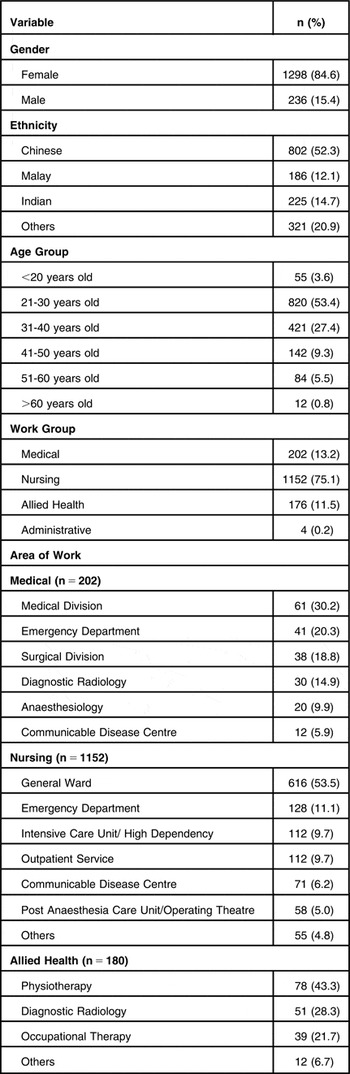
One thousand five hundred thirty-four (90.2%) completed survey forms were returned. The largest proportion of surveys was completed by the nursing staff (1152/1534 or 75.1%). Most of the respondents were females (1298/1534 or 84.6%) and fell within the age group of 21-40 years old (1241/1534 or 80.8%). Table 1 shows the baseline features of the study population.
Baseline Characteristics of the Study Population (N = 1534)

Perception of Institutional Readiness
Of the 1534 respondents, 1155 (75.3%) agreed that the institution would be able to respond to a disaster incident. More staff among the nursing cohort (923/1152 or 80.1%) felt that the institution would be able to respond to a disaster compared with the medical (129/202 or 63.9%) and allied health (118/176 or 67.0%) cohorts in the study.
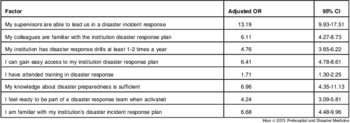
Several factors were shown to be associated with a positive staff perception of institutional preparedness to respond to a disaster (Table 2). The respondents were more likely to perceive that their institution was ready to respond to a disaster incident if they felt that their supervisors (OR = 13.19; 95% CI, 9.93-17.51) and colleagues (OR = 6.11; 95% CI, 4.27-8.73) are prepared. Access to hospital disaster incident response plans (OR = 6.41; 95% CI, 4.78-8.61) and personal knowledge in disaster response (OR = 6.96; 95% CI, 4.35-11.13) was also noted to affect perception of institution preparedness.
Factors Associated with a Respondent's Perception of Institutional Preparedness to Respond to a Disaster

Abbreviations: OR, odds ratio; CI, confidence interval
Perception of Individual Readiness
Of the respondents, 36.4% (558/1534) felt they were ready to be part of a disaster response team. The proportion of nurses (475/1152 or 41.2%) with a positive perception of individual readiness for a disaster response was higher than that among the medical (46/202 or 22.8%) and allied health (34/176 or 19.3%) staff in this study.
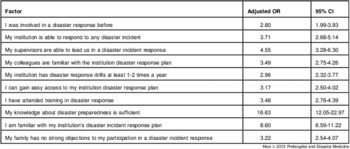
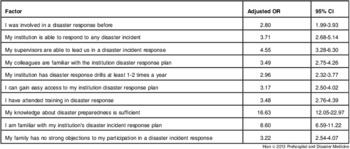
The respondents were more likely to perceive that they were ready to respond to a disaster if they had been involved in a previous disaster incident response (OR = 2.80; 95% CI, 1.99-3.93) and if they felt that their institution (OR = 3.71; 95% CI, 2.68-5.14), supervisors (OR = 4.55; 95% CI, 3.28-6.30) or colleagues (OR = 3.49; 95% CI, 2.75-4.26) are prepared (Table 3). Disaster response training, access to hospital disaster response plans, personal knowledge in disaster response and family support were also noted to affect perception of individual preparedness.
Factors Associated with a Respondent's Perception of Individual Preparedness to Respond to a Disaster
Abbreviations: OR, odds ratio; CI, confidence interval
Training
Of the respondents, 80.7% (1238/1534) indicated that they would like to participate in future disaster response training; 74.5% (1143/1534) of the study cohort felt that being able to respond to a disaster constituted part of their professional competency and 90.4% (1387/1534) agreed that they should be trained before they were deployed to respond to MCIs.
At the time of the survey, only 19.8% (304/1534) of the respondents had been trained in the previous two years to don a personal protection suit to protect against hazardous materials and only 19.4% (297/1534) knew where to obtain a suit if they were activated.
In addition, only 31.0% (476/1534) of the respondents agreed that disaster response training was readily available and 27.8% (426/1534) knew how to access these training opportunities.
Discussion
This study identified institutional gaps in disaster preparedness and response. Specific gaps were noted in the availability of and access to disaster preparedness training. Factors that had an influence on the perception of the respondents regarding institution and individual preparedness towards a disaster incident were identified. The ability of the institution to address this gap will have a direct impact on HCW perception of the institutional and individual disaster preparedness, and thus on their willingness to respond.Reference Balicer, Omer and Barnett6
Most (75.3%) respondents felt that the institution was ready to respond to a disaster. This contrasts greatly with the approximately 30% reported by Alexander GC et al.Reference Alexander, Larkin and Wynia7 Singapore and its health sector had been credited with responding well when SARS and H1N1 descended on them. These two incidents, coupled with the regular training exercises conducted at the hospital and government levels, have added confidence to the respondents that the institution is capable of responding to a disaster incident.
While the HCWs perceived this institution as being well prepared, only 36.4% of them felt they were ready individually. The concerns of these respondents and factors affecting their readiness were also identified. This perceived readiness level was lower than the approximately 50% reported among medical studentsReference Heather, Daniel and Edbert10 and 43% among emergency physiciansReference Alexander, Larkin and Wynia7 reported in other studies. Nonetheless, the level of readiness amongst HCW is higher when compared with that of general practitioners (21%).Reference Alexander, Larkin and Wynia7, Reference Alexander and Wynia11
The study's findings identified some important factors that could influence HCWs’ perception of their institutional and individual preparedness for a disaster: leadership, prior experience, training, family support, and peer support.
Leadership
Respondents had more confidence in their institution's disaster preparedness when they felt that their supervisors were able to lead them during a disaster incident response They were also more confident of their own disaster preparedness when they perceived that their supervisors and the institution were prepared.
As with most operations, the ability to identify with the leaders and the organization is extremely important. The need for a shared mental model cannot be understated. It is thus imperative that the leaders in the organization ensure that they are well trained and well versed on the disaster response plan of their institution. Their visibility and support during institution disaster response training is essential to increase the level of confidence among the HCWs that their leaders are well placed to lead them in an MCI response.
Prior Experience
Respondents with prior experience in disaster response were more likely to feel that they were ready. Most (90.4%) of the respondents would also like to be trained prior to being deployed for a disaster incident.
Singapore is a country spared from most of the natural and manmade disasters. It is thus essential that Singapore's HCWs and institutions do not become complacent as these occurrences are never predictable. The importance of constant training for mass-disaster response is exceptionally critical for Singapore as most of its HCWs will not have experience with an actual incident. This study supports the importance of health care institutions in planning and implementing regular training drills and education for their HCWs to make them feel prepared at an individual level.
Training
The results of the study showed that those who had attended disaster response training were more confident of institutional and individual disaster preparedness.
The hospital participates in approximately one disaster response exercise every one to two years. This is noted to have an impact on the respondent's perception of institutional and individual disaster preparedness. The respondents also were more likely to perceive that they and their institution were prepared for disaster response when they were familiar with the institution's disaster response plan.
However, the amount of disaster response training between these exercises is left to the individual departments with no centralized organizational control. Furthermore, the number of staff attending each of these exercises is limited; thus, the potential impact for the entire institution is limited. The effectiveness of this training in ensuring the hospital disaster plans are disseminated and practiced also will be limited.
There is evidence from this study to suggest that respondents were keen for these training opportunities. Most (80.7%) of them wanted to participate in future disaster response training and 74.5% felt it was part of their professional competency. However, the fact that only 31% felt that training was readily available shows deficiencies in the planning, publicity and monitoring of such training.
In the future, disaster response training should be given the importance and relevance accorded to other patient-care training activities. It is also recognized that having “just-in-time” training that is easily accessible will go a long way towards fulfilling the needs of the HCW. This need was also identified in a focus group study conducted by Rebmann.Reference Rebmann, English and Carrico12 While program development is essential, governance and a formal monitoring mechanism will ensure the success and sustainability of this initiative.
Family Support
Family support for the HCWs played a key role in their ability to respond to a disaster incident. The importance of home support was also documented in the study by Qureshi et al,Reference Qureshi, Gershon and Sherman8 where concern for family's wellbeing affected the HCWs’ willingness to respond for duty during disasters.
Sharing information on the HCWs’ scope of work with their family members would be useful. This would allow family members to understand and support their work, especially in times of disasters. Having a social support network that binds the families together and allows for channels of communication and information will help decrease the uncertainties faced by family members when their loved ones are at work during a disaster incident.
Peer Support
The perception that their colleagues are well versed on the institutional disaster response plan was also noted to increase the respondent's confidence of institutional and individual disaster preparedness.
There is currently a “buddy system” in place for the nurses in this institution. It serves the nurses well in providing peer support, which is a good confidence-building mechanism and also provides peer support in the event of psychological stress for the HCW. Looking ahead, other modes of peer support will be explored for the entire spectrum of HCWs.
Limitations
The number of medical and allied staff who participated in the study was proportionally less compared to the nurses. This was despite the efforts made to educate these staff members about the importance of this study and the good support from hospital senior management.
The high turnover rate of staff resulted in only 12.6% of the staff having been involved in a disaster response. This is despite the fact that this hospital was designated as the “SARS hospital” in Singapore. This cross-sectional study did not explore how movement of staff affects their perception of preparedness for mass-casualty incidents over time.
In addition, this survey was conducted in a single center and generalizability cannot be assumed.
Conclusions
This study suggested that HCWs perceived themselves as poorly prepared for disaster response and having suboptimal knowledge on access to training opportunities in this area. The study identified some factors associated with this, especially institutional leadership, prior experience with a mass incident, family and peer support.
There is an urgent need to review, publicize, implement and monitor disaster incident response training program in the organization to elevate the HCWs’ perception of their preparedness. Keeping the leadership up-to-date with disaster training and their awareness of the uncertainties of their staff and family in times of crisis will prepare their HCWs to respond better to any disaster incident that may come their way.