INTRODUCTION
One of the major goals in ecology is to understand the responses of organisms to environmental variation. In particular, environmental fluctuations that result in changes in resource availability or pattern of resource acquisition can alter reproductive performance of organisms over ecological and evolutionary time frames (e.g. Martin, Reference Martin1987; Sutherland, Reference Sutherland1996, Bonnet et al. Reference Bonnet, Naulleau, Shine and Lourdais2001). Therefore, environmental fluctuations are commonly considered as important selective forces (Boyce and Daley, Reference Boyce and Daley1980). The responses to environmental fluctuations have been repeatedly investigated in studies on experimental evolution of various taxa (Reboud and Bell, Reference Reboud and Bell1997; Kassen, Reference Kassen2002; Buckling et al. Reference Buckling, Brockhurst, Travisano and Rainey2007; Venail et al. Reference Venail, Kaltz, Olivieri, Pommier and Mouquet2011). However, these studies produced contradictory results and the evolutionary role of environmental fluctuations is still poorly understood. For example, algae performed worse in fluctuating rather than in stable environments (Reboud and Bell, Reference Reboud and Bell1997). In contrast, phytophagous arthropods performed better in terms of juvenile survival in fluctuating environments, where their host plants alternated, than in stable environments where they fed on the same host species (Magalhães et al. Reference Magalhães, Cailleau, Blanchet and Olivieri2014). One of the reasons behind the contradictory results of earlier studies is that environment fluctuation did not have immediate negative effects on fitness in all taxa. Indeed, for special adaptations to fluctuating environments to evolve, organisms must first experience decreased fitness in them relative to stable environments. However, immediate negative effects of environmental fluctuation have rarely been studied (but see Magalhães et al. Reference Magalhães, Cailleau, Blanchet and Olivieri2014 for spider mites).
The effects of environmental fluctuations on various organisms are important from both theoretical and conservation points of views. Moreover, investigations of these effects on parasites are essential for our understanding of the implications of anthropogenic disturbances and climate change on disease dynamics (see Chapman et al. Reference Chapman, Gillespie and Goldberg2005; Brooks and Hoberg, Reference Brooks and Hoberg2007). Several earlier studies involving parasites in fluctuating environments considered fluctuations in abiotic factors (reviewed by Wolinska and King, Reference Wolinska and King2009). However, the main environment of a parasite is a host whose identity determines the availability and quality of its resources as well as the pattern of resource acquisition by a parasite (Combes, Reference Combes2001). Thus, a promising way to understand the effects of environmental fluctuations on parasite fitness is to model environmental fluctuation via host alternation. Here, we studied reproductive performance of fleas under alternating hosts or stable host regimes and asked whether host alternation has an immediate negative effect on their fitness. Obviously, two alternating environments can rarely be identically suitable from a perspective of an organism experiencing these environments, but rather one of these environments is expected to be more favourable than the other. Consequently, we modelled environmental fluctuations by forcing fleas to feed alternatively on a preferred and a non-preferred host species. We then compared the reproductive output of these fleas with conspecifics that were continuously fed on either preferred or non-preferred host species.
Environmental fluctuation is often regarded as an important force in the evolution of ecological specialization that promotes generalism (Gavrilets and Scheiner, Reference Gavrilets and Scheiner1993; Reboud and Bell, Reference Reboud and Bell1997; Kassen, Reference Kassen2002; Buckling et al. Reference Buckling, Brockhurst, Travisano and Rainey2007; Venail et al. Reference Venail, Kaltz, Olivieri, Pommier and Mouquet2011). If this is the case, then the response to environmental fluctuation should manifest more strongly in the originally specialist species than in originally generalist species because, by definition, generalists are better adapted to a range of conditions. Here, we compared the responses to host alternation in three flea species, a host specialist, Parapulex chephrenis, and two host generalists, Synosternus cleopatrae and Xenopsylla conformis. We predicted that under an alternating host regime, a specialist flea will exhibit a more pronounced decrease in fitness than generalist fleas, as compared with flea fitness under stable host regimes.
The effect of environmental fluctuations may differ depending on the order in which each environment is experienced. For example, parasitic plants Cuscuta attenuata had greater stem volume if they grew on multiple host species rather than on conspecific plants (Kelly and Horning, Reference Kelly and Horning1999). However, this enhanced growth only occurred when C. attenuata first encountered its preferred host plant, Ambrosia artimisiifolia, and only then infested another host plant, Aster ericoides (Kelly and Horning, Reference Kelly and Horning1999). Consequently, if an organism experiences a more favourable environment before a less favourable one, the previous environment may somehow compensate for the negative effects of the latter. In fleas, the first feeding triggers several important processes, such as physiological processes that affect the metabolic rate, which could have an effect on subsequent fitness (Filimonova, Reference Filimonova1986; Fielden et al. Reference Fielden, Krasnov and Khokhlova2001, Reference Fielden, Krasnov, Khokhlova and Arakelyan2004). To test this concept, we compared flea performance under two alternating host regimes with different order of host alternation. We allowed newly-emerged fleas to either feed first on a preferred and then on a non-preferred host or vice versa. We predicted that fleas that originally fed on a preferred host would exhibit a less pronounced decrease in fitness compared with fleas that originally fed on a non-preferred host.
MATERIALS AND METHODS
Rodents and fleas
We used fleas (S. cleopatrae, X. conformis and P. chephrenis) and rodents (Gerbillus andersoni, Gerbillus henleyi, Meriones crassus, Gerbillus nanus, Acomys cahirinus and Gerbillus dasyurus) from our laboratory colonies (see Krasnov et al. Reference Krasnov, Khokhlova, Fielden and Burdelova2001a ; Khokhlova et al. Reference Khokhlova, Fielden, Degen and Krasnov2012). Briefly, flea colonies of S. cleopatrae, X. conformis and P. chephrenis are routinely maintained in our laboratory on G. andersoni/Gerbillus pyramidum, M. crassus and A. cahirinus/Acomys russatus, respectively. Rodents are kept in plastic cages (33 × 23 × 13 cm3 at 25 ± 1 °C and 12: 12 D: L) with sawdust as bedding and fed millet seed and fresh alfalfa ad libitum as a source of water. To maintain genetic diversity, eight to ten new field captured rodents and 100–150 field-collected fleas are added to laboratory colonies every year. This study was conducted under permits from Ben-Gurion University Committee for the Ethical Care and Use of Animals in Experiments (IL-52-07-2012).
Fleas and rodents for the experimental trials were randomly selected from the respective colonies. We used newly emerged fleas ca. 48 h old that had never fed prior to experiments. Rodents were 6–8-month-old, sexually naïve males that had never been exposed to flea parasitism. Each rodent was used in only one trial and was exposed to parasitism by the same group of fleas once every 2 days or once daily (see below) during 6 days.
Experimental design
The preferred and non-preferred hosts for each flea species were identified according to flea abundance and prevalence found in our earlier field studies (see Krasnov et al. Reference Krasnov, Shenbrot, Medvedev, Vatschenok and Khokhlova1997, Reference Krasnov, Hastriter, Medvedev, Shenbrot, Khokhlova and Vatschenok1999). We considered a given rodent species to be the preferred host for a given flea species if this flea attained the highest abundance and prevalence on this host. All other rodent species on which this flea was recorded were considered as non-preferred hosts. For each flea, we selected a non-preferred host that naturally co-occurs with the preferred host. Thus, the preferred and non-preferred hosts for S. cleopatrae were G. andersoni and G. henleyi, respectively; for X. conformis – M. crassus and G. nanus, respectively; and for P. chephrenis – A. cahirinus and G. dasyurus, respectively.
The experimental trials for each flea species consisted of seven (X. conformis and P. chephrenis) and eight (S. cleopatrae) replicates, respectively. Each replicate consisted of two treatments under a stable host regime (six consecutive daily feedings on either preferred or non-preferred hosts; further referred to as PH treatment and NH treatment, respectively) and two treatments under alternating host regime (six consecutive daily feedings on alternating hosts; starting either with preferred or non-preferred host; further referred to as AH treatment). Prior to trials, 20 female and ten male newly-emerged fleas of each species were randomly collected, placed in Erlenmeyer flasks and kept in an incubator (FOC225E, Velp Scientifica srl, Milano, Italy) at 25°C and 90% relative humidity overnight.
To feed fleas, a rodent was placed in a wire mesh (5 × 5 mm2) tube with diameter and length suitable to its size (150 × 50 mm2 for M. crassus and 100 × 20 mm2 for the remaining species) to prevent it from grooming. The tube with a rodent was placed in a plastic box on a stand about 20 mm from the surface of the cage on top of a piece of white paper towel to prevent fleas from drowning in the rodent's urine. Then, a group of fleas (20 females and ten males) was released into the hair of each rodent and allowed to feed for 3 (S. cleopatrae and X. conformis) or 7 h (P. chephrenis) as the amount of time necessary for engorgement of all fleas established in our earlier studies (see Khokhlova et al. Reference Khokhlova, Ghazaryan, Krasnov and Degen2008). After each feeding, all fleas were collected with soft custom-made forceps by systematically examining rodents over a white plastic tray and then placed in a Petri dish (40 mm diameter; a new dish after each feeding). Fleas were stored in an incubator at 25°C and 90% relative humidity overnight until the next feeding. Petri dishes with fleas were checked for oviposition the next morning using a digital microscope camera, Moticam 2000 with Motic Images Plus 2·0ML program (Motic, Speed Fair Cp., Ltd, Causeway Bay, Hong Kong). Photos were taken of every egg and then maximal length and width of every egg were measured on-screen up to nearest 0·01 mm with 40× magnification and calibration using an object-micrometer. Total number of eggs produced by a group of fleas during 6 days of feeding was recorded. Eggs were then covered with a thin layer of sand amended with larval nutrient medium (94% dry bovine blood, 5% millet flour, 1% ground feces of the host species) and stored in an incubator. Feces were taken from the host species involved in a respective treatment (both host species under alternating host regime). Petri dishes were then checked for emerging fleas every day starting on day 27 after first oviposition for S. cleopatrae, on day 23 for X. conformis and on day 32 for P. chephrenis until all cocoons hatched or 14 days after the last hatching. Newly-emerged imagoes were placed into 500 µL Eppendorf tubes containing 70% ethanol and stored until further processing. Fleas were mounted in a water medium between two glass slides and photographs were taken with a digital microscope camera (see above). To estimate size of every new imago, we measured maximal length of its left hind femur as described above. Sex of each new imago was also recorded.
Data analyses
To assess flea reproductive performance, we calculated four variables, namely mean number of eggs produced per female for a group of fleas, volume of an egg, duration of pre-imaginal development and body size of a newly-emerged flea. Mean number of eggs per female was calculated by dividing total number of eggs by the total number of females in a group of fleas. Egg volume was used as a proxy for egg size and was calculated as V = 1/6π × W2 × L, where V is egg volume, W is maximal egg width and L is maximal egg length (following Berrigan, Reference Berrigan1991). Duration of development for each newly emerged imago was calculated as the number of days from oviposition until emergence. We used maximal length of the left hind femur as a proxy of body size. Femur length is a reliable proxy for flea body size as these two variables are highly correlated (Krasnov et al. Reference Krasnov, Burdelov, Khokhlova and Burdelova2003a ; Khokhlova et al. Reference Khokhlova, Serobyan, Degen and Krasnov2010).
We visually assessed the distribution of residuals by plotting them in R v3·3·2 (R Development Core Team, 2015). All response variables did not reveal any obvious deviations from homoscedasticity or normality. We analysed the effect of treatment on reproductive variables using linear mixed-effects models (LMEs) implemented in nlme package (Pinheiro et al. Reference Pinheiro, Bates, DebRoy and Sarkar2016) in R separately for each flea species and each response variable. First, to test whether feeding on alternating hosts affected reproductive performance, we used treatment as three-level factor (a preferred host, alternating hosts and a non-preferred host). Then, we tested for the effect of host order under the alternating host regime by analysing data on fleas fed on alternating hosts only and used treatment as two-level factor (initial feeding on preferred host versus initial feeding on non-preferred host). To account for a possible period-effect and variation between replicates (see above), we included replicate number as random effect in each model. Data on imago size and development rate were analysed separately for males and females. Flea imago size is known to differ between sexes (Krasnov et al. Reference Krasnov, Burdelov, Khokhlova and Burdelova2003a ), whereas the development rate could be similar when feeding on non-preferred hosts (Krasnov et al. Reference Krasnov, Khokhlova, Fielden and Burdelova2001b ). Therefore, to test if the development rate differed between males and females in each species, we ran preliminary analyses of variance with the duration of development as a response variable and flea sex as an explanatory variable and found a significant effect of this factor in all three species (F = 157·9-365·2, P < 0·001 for all). Consequently, the development rate was analysed separately for male and females. We then performed Tukey's HSD single step multiple comparison post hoc tests using the glht function implemented in package multcomp (Hothorn et al. Reference Hothorn, Bretz and Westfall2008) in R to assess pairwise differences between feeding on a preferred host, a non-preferred host and alternating hosts in their effect on response variables.
RESULTS
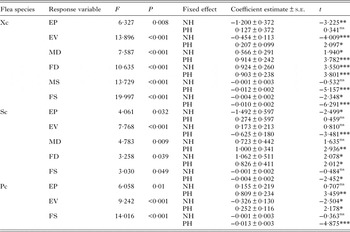
Linear LMEs demonstrated that treatment had a significant effect on egg production, egg size and size of new imagoes in all three species (Table 1). The rate of pre-imaginal development differed among treatments in X. conformis and S. cleopatrae, but not in P. chephrenis (Table 1).
Summary of linear mixed-effects models of the effect of treatment [preferred (PH), non-preferred (NH) and alternating host species] on egg production (EP), egg volume (EV), development rate of male offspring (MD), development rate of female offspring (FD), femur length of male offspring (MS) and femur length of female offspring (FS) in Xenopsylla conformis (Xc), Synosternus cleopatrae (Sc) and Parapulex chephrenis (Pc)

Reference level for the fixed effect of treatment was alternating host species. Only models with at least one significant coefficient are shown. ns-non-significant;*−P < 0·05; **−P < 0·01; ***−P < 0·001.
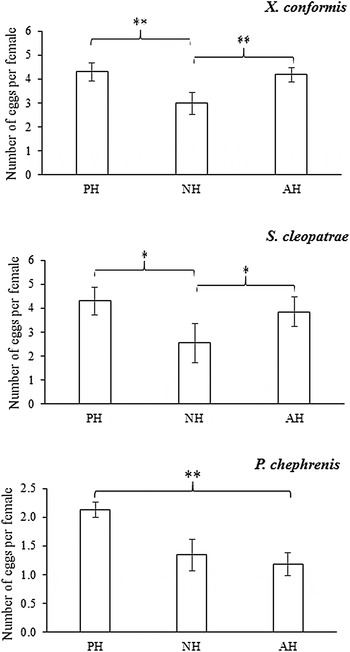
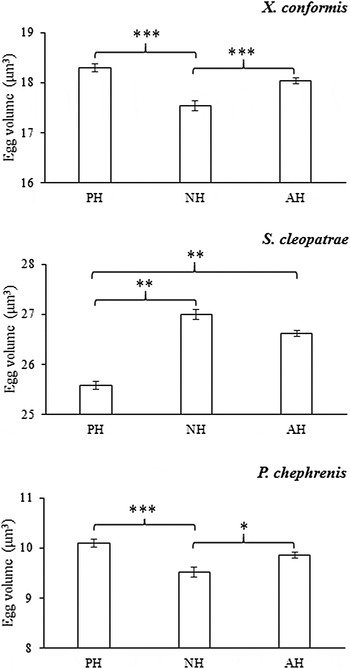
Both X. conformis and S. cleopatrae produced a similar number of eggs in AH (alternating hosts) and PH (preferred host) treatments (Tukey's HSD tests; |z| = 0·341 and |z| = 0·459, respectively, P > 0·05 for both), but significantly fewer eggs in NH (non-preferred host) treatment (Tukey's HSD tests; |z| = 3·088–3·225, and |z| = 2·499–2·561, respectively, P < 0·004 for all) (Fig. 1). Parapulex chephrenis produced fewer eggs in AH and NH than in PH treatment (Tukey's HSD tests; |z| = 2·459–3·459, P = 0·002–0·037) (Fig. 1). Xenopsylla conformis and P. chephrenis produced marginally significantly smaller eggs in AH and PH treatments than they did in NH treatment (Tukey's HSD tests; |z| = 2·097–5·223 and |z| = 2·178–4·295, respectively; P < 0·001–0·089) (Fig. 2). In contrast, eggs produced by S. cleopatrae in AH treatment were significantly larger than those in PH treatment (Tukey's HSD test; |z| = 3·481, P = 0·001), although these eggs were similar in size to those produced in NH treatment (Tukey's HSD test; |z| = 0·810, P = 0·694) (Fig. 2).
Egg production (mean ± s.e.) in Xenopsylla conformis, Synosternus cleopatrae and Parapulex chephrenis feeding solely on a preferred host (PH), a non-preferred host (NP) or on alternating host species (AH). *−P < 0·05; **−P < 0·01; ***−P < 0·001.

Egg volume (mean ± s.e.) in Xenopsylla conformis, Synosternus cleopatrae and Parapulex chephrenis feeding solely on a preferred host, a non-preferred or on alternating host species. See Fig. 1 for abbreviations of treatment names. *−P < 0·05; **−P < 0·01; ***−P < 0·001.

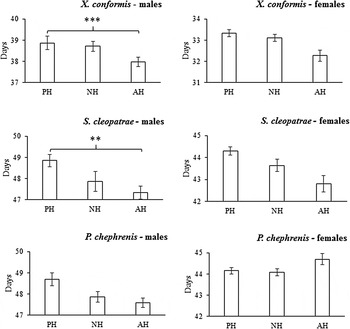
Male offspring of X. conformis and S. cleopatrae of mothers in AH and NH treatments developed significantly faster than those of mothers in PH treatment (Tukey's HSD tests; |z| = 3·782 and |z| = 2·936, respectively; P < 0·001 for both) (Fig. 3). Female offspring of X. conformis (but not S. cleopatrae) developed significantly faster in AH treatment than in other treatments (Tukey's HSD tests; |z| = 3·551–3·801, P < 0·001 for all) (Fig. 3).
Duration of development (number of days ± s.e.) of male and female new imagoes of Xenopsylla conformis, Synosternus cleopatrae and Parapulex chephrenis feeding solely on preferred host, non-preferred and or on alternating host species. See Fig. 1 for abbreviations of treatment names. *−P < 0·05; **−P < 0·01; ***−P < 0·001.

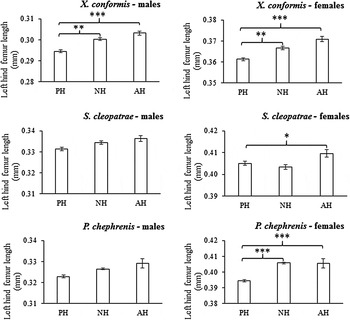
The significant effect of treatment on size of male offspring was found in X. conformis only. Newly-emerged male imagoes in AH and NH treatments were (a) significantly larger than those in PH treatment (Tukey's HSD test; |z| = 3·511–5·157, P < 0·001 for all), but (b) did not differ in size between the two former treatments (Tukey's HSD test; |z| = 0·532, P > 0·05) (Fig. 4). The largest female offspring of both X. conformis and S. cleopatrae were produced by mothers fed in AH treatment (Tukey's HSD tests; |z| = 2·348–6·291 and |z| = 0·484–2·452, respectively, P < 0·001–0·877) (Fig. 4). In contrast, P. chephrenis produced larger female offspring in AH and NH treatments than in PH treatment (Tukey's HSD tests; |z| = 4·048–4·875, P < 0·001) (Fig. 4).
Length of the left hind femur (mean ± s.e.) of male and female imagoes of Xenopsylla conformis, Synosternus cleopatrae and Parapulex chephrenis feeding solely on preferred host, non-preferred and or on alternating host species. See Fig. 1 for abbreviations of treatment names. *−P < 0·05; **−P < 0·01; ***−P < 0·001.

Under alternating host regime (i.e. AH treatment), host order had a significant effect on the size of eggs in X. conformis and S. cleopatrae as well as on the rate of development and size of female offspring in X. conformis (Table 2). Both fleas produced larger eggs when the first feeding involved a non-preferred host, whereas X. conformis female offspring developed faster and new imagoes were larger when first feeding was done on a preferred host (Table 2).
Summary of linear mixed-effects models of the effect of host order under alternating host regime (initial feeding on preferred or non-preferred host) on egg volume (EV), development rate of female offspring (FD) and femur length of female offspring (FS) in Xenopsylla conformis (Xc) and Synosternus cleopatrae (Sc)

Reference level for the fixed effect of host order was a non-preferred host. Only models with significant coefficients are shown.
DISCUSSION
Our results showed that host alternation affected flea reproductive performance, but the responses of host specialist and host generalist fleas differed. The host specialist, P. chephrenis performed worse under host alternation than it performed when exploiting a preferred host in terms of the offspring quantity, albeit not their quality. Moreover, reproductive performance of this flea on alternating hosts did not differ from that on a non-preferred host. This suggests that even intermittent consumption of a lower-quality resource (i.e. a non-preferred host) had some negative effect. In contrast and surprisingly, host generalists, X. conformis and S. cleopatrae, generally performed better under host alternation than when exploiting either their preferred or non-preferred hosts. Moreover, this better performance in generalist fleas concerned quality of the offspring without compromising their quantity. This suggests that (a) alternating consumption of a high-quality resource and a low-quality resource may boost flea reproduction; and (b) even intermittent consumption of a high-quality resource can compensate for the presumably negative effect of a low-quality resource (i.e. a non-preferred host). Thus, enhanced reproductive performance in the two generalist flea species under host alternation could be a result of overcompensation for exploitation of a low-quality resource facilitated by sporadic addition of a high-quality resource to their diet.
As we predicted, P. chephrenis produced fewer and smaller eggs under host alternation than it did when it exploited its preferred hosts. Intraspecific variation in egg size is well known for insects (Harvey, Reference Harvey1983a ; García-Barros, Reference Garcίa-Barros1992; Fischer and Fiedler, Reference Fischer and Fiedler2001; Torres-Vila and Rodríguez-Molina, Reference Torres-Vila and Rodríguez-Molina2002) with egg size depending on a variety of factors, including maternal age (Fox, Reference Fox1993) and maternal feeding (Harvey, Reference Harvey1983b ). In our study, maternal age could not play any role because females were of the same biological and physiological age as they never reproduced before the experiment. Consequently, the main cause for egg size difference between treatments was the source of maternal food (i.e. host). In other words, consumption of blood from a non-preferred host resulted in decreased egg production and smaller egg size (but see Khokhlova et al. Reference Khokhlova, Fielden, Williams, Degen and Krasnov2013) even if blood from a preferred host was consumed as well. However, smaller egg size does not necessarily lead to decreased viability of new imagoes or smaller new imago (at least, in P. chephrenis; Kiefer et al. Reference Kiefer, Warburton, Khokhlova and Krasnov2016). This is because maternal investment into offspring is associated not only with egg size, but also with egg provisioning (e.g. protein and lipid concentration; McIntyre and Gooding, Reference McIntyre and Gooding2000; Giron and Casas, Reference Giron and Casas2003). Therefore, P. chephrenis mothers that produced fewer eggs of smaller size under unfavourable conditions could invest more into each egg in terms of nutrient content, which then resulted in larger new imagoes. However, this was true for female, but not male, offspring. This suggests that, given resource limitation, maternal investment into quality of female rather than male offspring would be beneficial because the reproductive success of the next generation is likely associated with the size of females rather than males (Packer and Corbet, Reference Packer and Corbet1989).
Contrary to our expectations, egg production of both S. cleopatrae and X. conformis did not differ between mothers exploiting alternating hosts and those exploiting preferred hosts. Moreover, the former flea laid larger eggs and the latter flea laid smaller eggs, as compared with eggs produced on preferred hosts, but offspring of both species developed faster and were larger under host alternation than when mothers fed solely on preferred hosts. This difference between the two fleas indicates different strategies of maternal investment which resulted in larger offspring (either females only or both males and females). Furthermore, greater investment in eggs size could increase the probability of egg survival as larger eggs are often, albeit not always, associated with better offspring performance (Pöykkö and Mänttäri, Reference Pöykkö and Mänttäri2012). Larger size of new imagoes emerged from larger eggs could be attributed to amount rather than concentration of nutrients provided by a mother (Pöykkö and Mänttäri, Reference Pöykkö and Mänttäri2012). Given that S. cleopatrae females produced larger eggs under host alternation, it seems that they invested greater amounts of nutrients into each egg. In contrast, given that X. conformis produced smaller eggs under host alternation, it seems that this species invested higher nutrient contents into each egg.
In addition to egg number and/or size, maternal investment into offspring may be realized via rate of pre-imaginal development that could affect the competitive ability of larvae. For example, flea larvae compete for food as the amount of organic matter available in the burrow or nest of their host may be limited (Day and Benton, Reference Day and Benton1980; Krasnov et al. Reference Krasnov, Burdelova, Khokhlova, Shenbrot and Degen2005a ). In addition, intra- and interspecific cannibalism is a common occurrence in flea larvae, with older larvae feeding on younger larvae and naked pupae (Lawrence and Foil, Reference Lawrence and Foil2002). Consequently, larvae that hatch earlier may have a competitive advantage over those that hatch later. Faster development of S. cleopatrae pre-imago under host alternation is likely associated with larger eggs (Kiefer et al. Reference Kiefer, Warburton, Khokhlova and Krasnov2016). However, shorter pre-imaginal development of smaller eggs produced by X. conformis fed on alternating hosts contradicts patterns found earlier in a congeneric flea (Xenopsylla ramesis; Kiefer et al. Reference Kiefer, Warburton, Khokhlova and Krasnov2016). This can be an indication of a trade-off between egg size and egg provisioning. Such a trade-off has, for example, been reported for birds, although it does not occur in all species (see review in Williams, Reference Williams1994). The exact mechanism behind the relationship between duration of development and egg size in X. conformis under host alternation is unclear and warrants further investigation.
Between-flea differences in the effect of host alternation could be associated with differences in the degree of their host specificity that determines the range of conditions to which fleas are adapted. These include ecological, behavioural, physiological and biochemical traits of a particular host (Ward Reference Ward1992; Poulin Reference Poulin1998, Reference Poulin2007). The strength of the effect of host species identity differs between host-specific and host-opportunistic parasites. For example, converting resources into offspring while feeding on a non-preferred, as compared to a preferred host, is more energetically costly in a host specialist than a host generalist flea (Khokhlova et al. Reference Khokhlova, Fielden, Williams, Degen and Krasnov2013). As a result, host generalists could be better adapted to feeding on different (including alternating) hosts merely because of their opportunistic feeding strategies.
A generalist feeding strategy allows female fleas to adjust offspring quality in anticipation of their future environment (Parker and Begon, Reference Parker and Begon1986; Fox et al. Reference Fox, Thakar and Mousseau1997). Under an alternating host regime, host order affected reproductive variables in X. conformis and S. cleopatrae but not in P. chephrenis. Both produced relatively larger eggs when the feeding started from a non-preferred host. The very first feeding in fleas takes longer than subsequent feeding events and it is thought to be a trigger of important physiological processes that affect blood digestion rates and could ultimately affect fitness (Filimonova, Reference Filimonova1986; Fielden et al. Reference Fielden, Krasnov and Khokhlova2001, Reference Fielden, Krasnov, Khokhlova and Arakelyan2004). Thus, X. conformis and S. cleopatrae could adjust quality of their offspring according to the host they started with. If the latter was a non-preferred host, mothers invested more in size of the eggs in an attempt to compensate for non-favourable conditions that their offspring would possibly experience.
Furthermore, faster developing and larger new imagoes in X. conformis, but not S. cleopatrae, when host alternation started from a preferred host might be associated with differential pattern of host selection of the two species. For example, field observations demonstrate that X. conformis always selected M. crassus over G. dasyurus, whereas S. cleopatrae selected G. andersoni and G. pyramidum randomly (Krasnov et al. Reference Krasnov, Khokhlova and Shenbrot2003b ). As a result, X. conformis produced more eggs when exploiting M. crassus than when it fed on G. dasyurus (Krasnov et al. Reference Krasnov, Khokhlova, Burdelova, Mirzoyan and Degen2004a ), whereas egg production of S. cleopatrae did not substantially differ between G. andersoni and G. pyramidum (I. S. Khokhlova and B. R. Krasnov, unpublished data). Consequently, the negative effect of a non-preferred host might be compensated in host-alternating X. conformis by resources taken from a preferred host. In contrast, S. cleopatrae with its random host selection strategy seems to be less able to perceive between-host difference than X. conformis and thus less able to compensate for the negative effect of a non-preferred host by either prior or subsequent feeding on a preferred host.
From an evolutionary perspective, the ability of a host generalist, but not a host specialist, to increase quality of the offspring under host alternation without compromising their quantity could facilitate host switching and/or expansion of geographic ranges. This is also supported by the negative correlation between level of flea host specificity and their average abundance (Krasnov et al. Reference Krasnov, Poulin, Shenbrot, Mouillot and Khokhlova2004b ) as well as size of their geographic ranges (Krasnov et al. Reference Krasnov, Poulin, Shenbrot, Mouillot and Khokhlova2005b ). This ability of host generalists could form the functional basis for evolutionary events such as ecological fitting (Janzen, Reference Janzen1985; Brooks et al. Reference Brooks, León-Règagnon, McLennan and Zelmer2006) and co-evolutionary alternation (Nuismer and Thompson, Reference Nuismer and Thompson2006). In particular, ecological fitting is the process whereby a parasite is adapted to a particular resource rather than to its representation (a particular host) allowing the parasite to colonize novel hosts and/or novel environments (Brooks et al. Reference Brooks, León-Règagnon, McLennan and Zelmer2006). Co-evolutionary alternation occurs when parasites co-evolve with several hosts by alternating between these hosts (independent of their phylogenetic relatedness) over several generations (Nuismer and Thompson, Reference Nuismer and Thompson2006).
An alternative explanation for difference between X. conformis/S. cleopatrae and P. chephrenis in the pattern of their response to host alternation could be associated with the relatedness of the two alternating host species. Alternating hosts of the formers belonged to the same subfamily albeit to different genera or subgenera, respectively, whereas those of the latter belonged to different subfamilies. Reproductive performance of a parasite exploiting a given host often decreases with an increase of phylogenetic distance of this host from the principal host of the parasite (Khokhlova et al. Reference Khokhlova, Fielden, Degen and Krasnov2012, but see Krasnov et al. Reference Krasnov, Korine, Burdelova, Khokhlova and Pinshow2007). As a result, a response of parasite to alternating hosts could be weaker if these hosts are closely-related and stronger if they are distantly-related. However, this explanation of the X. conformis/S. cleopatrae versus P. chephrenis difference seems to be less reasonable than the explanation associated with differential degree of host specialization of the three fleas described above. If the former explanation were true, then reproductive success of X. conformis/S. cleopatrae under host alternation would likely be either similar to or lower, but never higher, than that on their preferred hosts.
In conclusion, we demonstrated that the immediate negative effect of host alternation on parasite fitness depended on the degree of host specialization of a parasite species. Consequently, if this effect is a pre-requisite for subsequent development of special adaptations, then the development of these adaptations is expected in host-specific rather than host opportunistic parasites. Nevertheless, we recognize some limitations of our study because we examined the effects of host alternation over one parasite generation only. Future investigations should explore these effects over several generations of parasites and involve other parasite–host systems.
ACKNOWLEDGEMENTS
We thank three anonymous referees for their helpful comments on the earlier version of the manuscript. Daniel Kiefer assisted with laboratory work. This is publication no. 924 of the Mitrani Department of Desert Ecology.
FINANCIAL SUPPORT
This study was supported by the Israel Science Foundation (Grant no. 26/12 to B.R.K. and I.S.K.). L.V.D.M. received financial support from the Blaustein Center for Scientific Cooperation and the French Associates Institute for Agriculture and Biotechnology of Drylands. E.M.W. received financial support from the United States-Israel Educational Foundation (USIEF Fulbright Post-Doctoral Fellowship) and the Swiss Institute for Dryland Environmental and Energy Research.