The American Century began at the end of the First World War and ended, if pundits are to be believed, with the election of Donald Trump. In that era, the US backed a set of rules and procedures that facilitated the re-emergence of international trade, supported the enlargement of international organizations to oversee monetary and commercial policy, and created a security system that facilitated deep international engagement and expanded production around the globe. Without a doubt, the ensuing century produced unprecedented levels of economic wealth and political integration, and much credit for this growth goes to American decision makers who were willing, in Kindleberger's words, to be the national “underwriter to the system.”Footnote 1 But not all of America's decisions were forward looking. While the United States deserves credit for providing collective goods in the postwar years, we suggest that the American choice of how to rebuild the world economy had the unintended effect of later fostering its own resistance. As the editors note in their introduction, the Liberal International Order (LIO) was a particular form of economic liberalism. We look back at the early days of US economic hegemony to better understand this choice of form and its long-term effects.Footnote 2
To better understand the imprint of America on the LIO, we take up the case of commercial policy. In no other arena has the shift in US commitments to the LIO been more significant, with the US going from its biggest advocate and greatest beneficiary to becoming a vocal critic. While no country is more responsible for the design of the General Agreement on Tariffs and Trade/World Trade Organization (GATT/WTO) regime than the US, that specific design is now subject to bipartisan criticism. And more unusual, this opposition to the GATT/WTO regime is tied to neither a particular electorate nor a party but is found in a Baptist–bootlegger coalition on both sides of the ideological spectrum. Given the importance of the US market and American support for economic integration, unpacking what happened in commercial policy and why is critical to any assessment of the LIO.
What explains this shift in American commercial policy? We argue that, in part, the backlash reflects the absence of remedies for workers and firms who face competition and dislocation from foreign goods. This lack of institutional support, we suggest, reflects the original design of American trade institutions, which disrupted the organizational opportunities and voice of import-competing groups while giving priority to exporting interests. Unlike the classic study by John Ruggie, and Mansfield and Rudra in this volume,Footnote 3 we find few examples of “embedded liberalism” in US policy. We make this case in three parts.
The first part of the paper takes a closer look at the design of trade liberalization institutions in the US. Since the American political system gave statutory authority to Congress, with its small electoral districts and short electoral time horizon, unilateral free trade policy was not easily maintained. To prevent a “veto” coalition which would undermine American leadership, the US Congress developed a set of institutions that shifted policy access. In particular, the delegation of agenda control to the president set up procedures that facilitated the voice of exporter interests over that of wholly domestic producers or their employees.Footnote 4
The second part of the paper examines the implications of the American-led trade regime, first for the institutional design of the GATT/WTO, and second for the domestic response to those hurt by globalization. We argue that in crafting the trade regime, the US advocated formal rules and a structure of trade negotiations that were consistently oriented toward deeper market access that almost exclusively benefited the interests of its export industries.Footnote 5 While assuring the interests of US export groups, US negotiators failed to support proposed policies for those displaced by global forces. The same bias existed at home. As US workers increasingly found themselves competing with cheaper foreign labor and as manufacturing diversified and internationalized, we find limited support for those hurt by US pro-LIO policies. While American presidents were willing to punish nations for resisting US exporter access, the programs aimed at dislocation at home were anemic. In the absence of a robust adjustment infrastructure, hurt industries and workers increasingly asked for help via other trade remedies, forcing other nations to bear some of these adjustment costs and making the US an increasingly weak protector of the LIO.Footnote 6
The last part asks more directly whether or not the United States could have established a trade regime more sensitive to the interests of displaced workers and firms. The choice to prioritize export growth without accompanying support for adjustment may have been the Achilles’ heel of the LIO, but it reflected a political necessity. As noted in the introduction, international orders are not “neutral,” and they have distributional effects. In the US, the design of the institutions was purposefully “illiberal”—that is, decision makers felt the need to undercut the voice of certain groups in order to lead the world economy. The unintended result was less pressure for a rational and robust system to redistribute the gains from trade. As globalization intensified and jobs moved abroad, both the left and the right sides of the political spectrum blamed the multilateral trade regime.
To summarize, we see America's current antipathy for the trade regime as having deep historical roots. To open the economy in the wake of the Great Depression, the US adopted a structure of reciprocal trade agreements that mobilized exporter interests to counterbalance the more pro-protection policies advocated by domestic firms and their employees. Over the ensuing century, the voice of workers was muted by the interests of large exporting firms, resulting in increasingly deeper liberalization and an accompanying internationalization of production. As America's production profile changed, there were few policies in place to help re-employ or retrain those now hurt by international trade. Instead, in the face of electoral pressures, policymakers responded by overusing trade remedies, most of which were created for other purposes. The rise in border protectionism in an era of declining manufacturing employment politicized trade policy and undermined support for the LIO.
Creating Support for Trade Liberalization
By the close of the Eisenhower administration, both major US parties had endorsed the reciprocal trade regime. While the Democratic Party had traditionally favored low tariffs, the Republican Party's acquiescence to tariff reform should be viewed in its historical context: this was a substantial shift in policy from that advocated for the previous century. In part, this reflected shifts in their constituents’ economic interests and what had become an association between open markets and security interests. Yet neither the export interests nor security justification for trade was apparent when the US was beginning its path of reform.Footnote 7
Institutional Reform
In 1934, Congress formally granted the president substantial new authority to set commercial policy in a manner that changed the information environment, and thus the incentive to organize, for trade-related interest groups. The long-standing conventional explanation for this delegation was to prevent congressional log-rolling and the resultant high tariffs that were thought to have contributed to the Great Depression.Footnote 8 Two empirical problems have plagued this explanation for the shift in policy. First, the few Republicans who remained in office after the Democratic landslide of 1932 appear not to have learned any lesson: they continued to vote for high tariffs and opposed trade liberalization.Footnote 9 Second, the new majority party came to Congress with a position unchanged since the antebellum period: their platform endorsed unilateral tariff reductions.Footnote 10 What needs explanation is not lower tariffs, which could have been legislated directly by the Democratic majority, but the manner in which they chose to reach that goal: reciprocal reductions led by the president. The Reciprocal Trade Agreement Act (RTAA) of 1934, itself an amendment to the 1930 Smoot-Hawley Act, was unlike earlier trade legislation. The RTAA did not stipulate individual tariff reductions but set out procedures by which rates would be set. Specifically, it relieved Congress of its responsibility to directly set tariff rates and instead granted the president agenda control over tariff setting, authorizing a reduction in tariffs of up to 50 percent as long as it was done in concert with other nations.
By choosing to delegate rates to subsequent negotiations, the 1934 bill created a pro-export interest group bias. The mandate to the executive from Congress was to negotiate tariff reductions reciprocally, that is, in return for the immediate and monetarily equal gain in access to the partner's market.Footnote 11 The president assured the participation of exporter-oriented firms by pre-announcing a potential bilateral treaty.Footnote 12 This clarified for particular exporters that they could, and should, voice support for the treaty.Footnote 13 Reciprocity was an incentive for export groups to come to Washington and, as such, became a counterweight to the more traditionally well-organized import-competing firms.Footnote 14
While the president's actions would mobilize exporters, import-competing groups remained a risk. The RTAA incorporated procedures that made it more difficult for groups who felt competition from foreign exports, or who feared upcoming competition, to claim the need for protection. Whereas before the RTAA import-competing groups lobbied Congress directly, producers now went to a variety of administrative agencies. These agencies often had sector-specific constituencies, creating a stovepipe effect that limited the broadening of the protectionist coalition. In addition, because negotiations were to occur reciprocally, individual producers could not be sure that their product would be part of the foreign requests for reductions because there were long lists of authorized products. Overall, the procedures became more opaque and created greater distance between tariff reduction decisions and local officials.
Policymakers understood that opacity could undermine the organization of anti-trade groups and cut off an important channel of information regarding which groups were most sensitive to tariff reductions. To collect this additional information, the RTAA reforms created the Committee for Reciprocity Information and tasked it with giving interested parties the opportunity to present their views. They took briefs and held public hearings, but had no policymaking authority. This was necessary to maintain the overall uncertainty about which products would be cut while still collecting information about negotiating priorities. Meanwhile, tariff-setting authority was allocated to the Committee on Trade Agreements, a body that did not reveal its membership, even to Congress.Footnote 15
The result of these institutional choices was immediately apparent. Whereas the 1930 Smoot-Hawley Act elicited 11,000 pages of testimony in forty-five days in the House, the 1934 Act had fourteen witnesses, six of whom were from the administration.Footnote 16 The trade authority granted with the initial delegation required regular congressional renewal, but these were rarely contentious. Whereas tariff setting had been very public and politicized for over a century, the politics of trade became uncontroversial: giving agenda control to the president allowed Congress to open markets under a “veil of ignorance” of exactly what products, and what constituents, would be subject to market competition.
Over time, trade negotiations became organized into a set of sequential bargains that allowed exporters to move first. Negotiations would begin with each country “asking” the other for a specific reduction in tariffs on a set of products named by exporter interests. Having looked at the “asks,” the other side could respond with “offers.” The two sides then sat together and negotiated on details. By beginning with an “ask” for market access, both sides privileged export interests. Import-competing interests were concessions to be traded away. Still, given the shadow of a congressional backlash, not all deals were doable, and the US would often find it politically expedient to take certain products, in some cases whole industries, off the bargaining table. And to get around potential resistance, negotiators would protect some producers by a reclassification of the product on the tariff schedule.
When negotiations were complete, the RTAA agreements inscribed a complex set of trade-offs that were hard to untangle, even if there had been resistance. But criticism was rare: Congress had to give only ex ante permission to negotiate and was not asked to do an ex post review. To be clear, this system worked not only by ignoring groups but because the executive office used its foresight on potential congressional veto players to undermine resistance. If we review the particular products that were subject to a tariff reduction, by treaty, both in the RTAA years and later, we see that not all nations and not all products were subject to market forces. The president was on a “short leash” and needed to return regularly to Congress to get authorization to continue to negotiate. There was an awareness in the executive branch of district interests, on both the export and import-competing sides, and whether or not a treaty would sufficiently serve that legislator's district and thus support for the program. This sensitivity to district interest turned out to be important: we now see that moving slowly in the early years of the program facilitated a more natural adjustment in production and less political resistance.Footnote 17
This institutional design was effective in the early years of trade liberalization but it was poorly set up to deal with a set of problems that arose toward the end of the century. Deeper globalization, lost jobs, and easier communication increased pressure on Congress from both unions and less competitive firms. As we will show, trade remedies were used more often in response, but these remedies were narrow and temporary and did not recover a pro-trade consensus. While the arrival of cheap Chinese goodsFootnote 18 did much to fracture this pro-trade coalition, even earlier, the inability for the ex ante delegation strategy to extend beyond tariffs had splintered the coalition.
Looking back, the vulnerability of ex ante delegation should have been obvious. At the close of the Kennedy Round, American negotiators agreed to reform the American Selling Price system, a domestic regulatory policy that required Congressional assent but was rejected.Footnote 19 While the rejection of the American Selling Price reforms should have been a bellwether of the design flaw that would undercut US leadership, the administration responded by advocating only a small “fix.” Fast-track authority was created in the image of earlier delegation, but instead of ex ante approval, the reform addressed the potential of an ex post veto.Footnote 20 In return for congressional involvement in the write-up of the legislation, trade deals would come to Congress under specific time constraints, would address certain negotiating priorities, and would be limited to an up-or-down vote, with no amendments. The procedural change enabled the introduction of behind-the-border issues and would allow the introduction of politically sensitive areas to the negotiating table. Specifically, this authority opened the door for the incorporation of “trade-related” investment measures, intellectual property provisions, and health and safety standards that would later become known as “behind the border” measures. Unintentionally, the shift to an ex post veto facilitated a drift between the aims of negotiators in Geneva and those at home; the expansion of the agenda itself encouraged a new set of interested parties to contest aspects of trade negotiations.
Whence Workers' Interests?
If the electoral system was sensitive to constituent pressures, and the nation was in the middle of a depression with a quarter of the workforce out of work, did the Congress of the 1930s understand that delegation would benefit nascent export interests at the expense of import-competing firms and their workers?Footnote 21 Before the GATT years, trade and jobs were thought to be interconnected. For example, in 1928, the then-majority Republican Party's platform argued in defense of high tariffs “because of lower foreign wages.”Footnote 22 Ten years later, with a Democratic majority, the same worry was heard on the floor of Congress. In debate on the future of a tariff for wool manufacturing, it was noted that wages paid by American mill owners were three times those in Britain.Footnote 23
This association between trade and jobs declined as a policy concern over the course of the post-RTAA years. Research using congressional floor speeches on commercial policy pre-RTAA (Congresses between 1881 and 1900) finds that members of Congress would frame their debates over international trade in terms of the groups that would be positively or negatively affected.Footnote 24 Post-RTAA, this distributional frame gave way to a focus either on the efficiency gains or costs of open borders or, beginning with the 1950s, on geopolitical competition and fairness in global markets. By the 1980s congressional representatives rarely identified specific domestic groups hurt by trade. Even as globalization deepened, the link between adjustment and trade policymaking became increasingly attenuated in Congress.
This decline in congressional sentiment runs parallel to shifts in general policy for the unemployed. Before the 1930s, there was no federal government assistance for the unemployed. Most aid was private charity, and even in later years, welfare support in the US remained a public/private hybrid. As the depression deepened, state governments and not the federal government took the primary role in support efforts. There was no federal assistance at all until 1932, when the Hoover administration supplied funds to support existing state programs.Footnote 25 The Roosevelt administration followed the same pattern but in an expanded form. Upon taking office, FDR's administration passed the Federal Emergency Relief Act, but it too stayed away from universal aid, instead offering matching grants to states and supporting programs for employable persons and dependents. Even after the Social Security Act of 1935, the federal government left the responsibility for unemployment aid to the states, which varied in what they were willing to offer as a safety net. By the 1940s, tariff policy remained part of the federal portfolio, while unemployment aid was directed by the states to individual recipients.
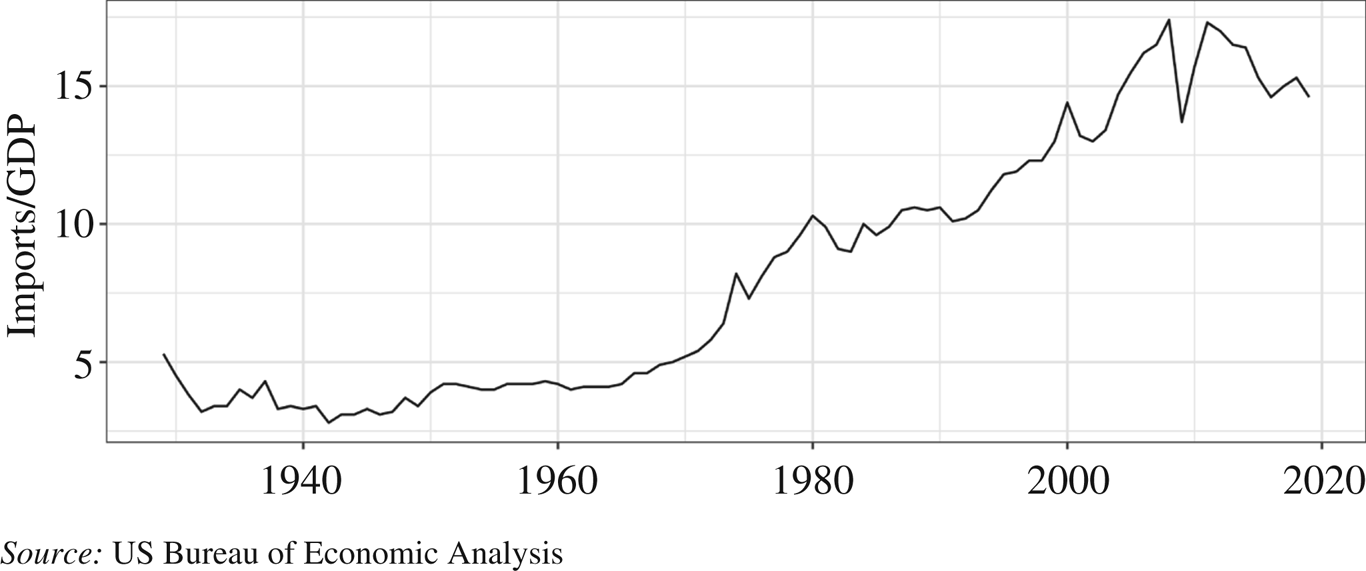
The absence of deeper debate about, and federal legislation on, worker needs in a more globalized economy is surprising only from the vantage point of the twenty-first century. Unlike the smaller European nations, these decisions about protecting labor were made when the US was essentially isolated from international markets.Footnote 26 Most of the movements in goods came from intra-US trade between the various states. Having differential unemployment policies across the states was consistent with that trade pattern. When the US legislated its first reciprocal trade treaty, the trade-over-GDP ratio for imports was in the 4 percent range (Figure 1), and 25 percent of the workforce was still employed in the farm sector.
US Trade Exposure (1929–2019)

Setting and Ignoring the Rules
On the heels of congressional reform of American trade policy, the US engaged in a set of international meetings to plan for the more general governance of commercial relationships after World War II. These discussions concluded with agreement on the need to create a comprehensive organization that would ensure that the policies pursued in the interwar years would not be repeated. As part of this task, the US offered proposals that codified the RTAA's procedures for more general use. With these rules in hand, and while the larger organization, the International Trade Organization (ITO), waited for international approval, twenty-three nations met and agreed to lower their tariffs. The compilation of the final tariff concessions, and the accompanying obligations to abide by those concessions, became known by the title of the ITO's subsection: the General Agreement on Tariffs and Trade (GATT). While originally thought to be temporary, the rejection of the ITO charter made the GATT the de facto backbone of the postwar trade regime. Having been written to reflect American preferences, the GATT was “thin” and ambiguous. While this served US interests at the time, imprecision turned out to be functional for all regime members, allowing them space to placate powerful domestic groups when necessary without endangering their general commitment to the regime. As the regime expanded, however, so too did the rules of conduct, increasingly constraining members’ behavior.
To illustrate the long-term effects of America's form of liberalization, we examine different aspects of the ensuing years of trade liberalization. First, we look at the expansion of the regime, both in membership and in depth of liberalization. We find that America's decision to pursue exporter-led liberalization pushed the GATT/WTO toward more universal and binding rules. Second, we review the US position on potential protections for labor in the GATT/WTO and at home. Here we find that the US never prioritized supports for adjustment and was willing to trade off protections for other more sought-after goals. Third, we look within the US and review US policy, with particular attention to how the US responded in the era of declining manufacturing jobs. Here we look at the adjudication of trade cases, brought either by a firm or a labor group. We argue that in the absence of a robust domestic system of support for those hurt by imports, the US relied on border measures, asking trading partners to bear the cost of US adjustment issues.
Growing the GATT/WTO
We can identify three core features of the regime that may have been rational at the time of creation but over time undermined support among a range of regime participants. First, we look at the process by which a growing number of diverse nations came into the regime. Second, we examine how negotiations were structured among existing members, transitioning from product-by-product swaps to more universal reductions in trade barriers. Third, we look at what was excluded from deliberations, particularly labor standards, and argue that the US eschewed attempts by others to address labor's concerns.
Rule-based trade
The initial trade regime was established in an era of relatively closed borders: the goal of institutional reform was to restart world trade, which had stalled with the Great Depression and World War II. The mechanism chosen was progressive improvements in market access for exporters. From the earliest days, negotiators shared an assumption that liberalization was to be a continuous process in which more nations would join and gradually erode barriers to trade. Part of this was because experts in national capitals and in the halls of Geneva believed that in the absence of legislated international agreements, nations would return to the era of beggar-thy-neighbor policies, high protective barriers, and the specter of war. But negotiators also needed to find support at home, and the thought was that this required exporter buy-in. In 1973, C. Fred Bergsten offered a name for this thinking, calling it the bicycle theory of trade liberalization. Bergsten declared trade policy “dynamically unstable,” making “maintenance of the status quo … untenable … Steady movement toward trade liberalization is necessary,” he explained, “to halt the acceleration of the trend toward increasing trade restrictions.”Footnote 27
To fulfill this goal, the regime was inherently expansionist. One part of this related to increasing the number of nations agreeing to the rule-based system. The twenty-three-member GATT had expanded to forty-five nation-members by the early 1960s, and over 100 in the early 1970s, and would add fifty more in the ensuing years. While each additional member would require extending most-favored-nation access in terms of liberalizing domestic markets, the exchange was in terms of additional export access for existing members. For instance, Germany's accession to the GATT meant exposing a wide variety of workers to competition from an industrialized power and was paid for by market access concessions from Germany. These rules were subsequently modified by GATT Part IV and the incorporation of more emerging-market nations. One of the few additions to the original text, Part IV granted a subset of acceding developing nations “differential and special access” to other members’ markets, creating two classes of states.Footnote 28 Exporters from the developing world were empowered to help bring these countries into the regime, helping establish an indirect channel of liberalization.
The second aspect of expansion related to the breadth of policy that was to be rule based. As we noted, the GATT initially restricted issues to fit political needs. This meant that particular sectors and issue areas were off the negotiating agenda. For example, GATT Article XX allowed governments to void obligations contrary to the interest of environmental activists (b, g), labor rights organizations (e), and even religious organizations (a). By the turn of the century, just about all nations were members or were in line waiting for accession, supply chains had expanded around the globe, and the movement of goods and services was so globalized as to reach into just about all domestic economies. In part because of earlier success, exporters were no longer constrained by tariffs but instead faced an array of non-tariff barriers, including diverse domestic regulations. To handle this additional complexity, governments developed new treaties and GATT/WTO provisions. While these resources allowed the member states to negotiate more complex issue areas, it also helped produce what Börzel and Zürn see as the source of today's legitimation crisis, a feeling of loss of sovereignty to a less accountable centralized bureaucracy.Footnote 29
From swaps to universalism
The GATT/WTO expansion may have appeared an inevitable outcome of market growth, but the way these barriers were addressed held a bias. Negotiating procedures—that is, how countries exchanged requests, whether or not negotiations occurred on a good-by-good basis or sectorally, and which areas are open or closed to negotiation—were in many ways as important as the substantive content of each round. While procedures evolved over the course of the history of the regime, they remained controlled by the American delegation, whose primary interest remained market access. How did the US-led system work?
In the early years of the trade regime, negotiators operated on the basis of product-by-product swaps. To assure parity and to provide foresight on which producers would see increased market pressures, negotiators monetized tariff schedule changes in terms of expected trade flows and sought to achieve something akin to reciprocity. While all concessions would be extended to prior treaty partners, the focus of negotiations was kept to principal suppliers, ensuring the maximal benefit for each concession.Footnote 30
At the beginning, product-by-product swaps were not applied universally to all sectors—for example, the framers of the GATT were wary of having to defend liberalization of agriculture. So despite the centrality of agricultural protection, farm legislation was never centralized within the trading program. Instead, the US sided with its own farm subsidy program (which included automatic price stabilizers that mandated import controls), requesting and receiving a formal exception in the GATT. The European Common Agricultural Policy in 1962 was legislated under this GATT exception. As a result of agriculture's exclusion from negotiations, exporters of food products faced far higher tariffs than other sectors of the economy. When the US attempted in the later part of the twentieth century to reintroduce agriculture into GATT/WTO talks, it faced an uphill battle, far steeper than in other sectors. Having allowed protections to persist, agricultural groups had become well-organized and formidable defenders of agricultural exceptionalism.
Over time, product-by-product swaps proved to be slow, complex, and protective of favored sectors.Footnote 31 While flexibility for political purpose had been useful in retaining support in the early years of the GATT, by the 1980s it was thought to have undermined the intent of the regime by granting members license to ignore the spirit of the rules. Flexibility encouraged “gray-area” responses to problems, and the fundamental rules of the system became rife with exceptions. The response to this perception of national “shirking” was to more clearly specify rules and then, relatedly, make it more difficult to break an agreement. From the perspective of the reformists, and in particular the US, Canada, and the EU, there was a need for a more robust organization. To extend liberalization, negotiators developed two strategies: they adopted generalized tariff reductions via formulas, and they expanded the agenda.
Why formulas? Formulas make targeting protection more difficult and provide a far quicker method of lowering rates both at home and abroad. Formulas often target the higher end of the tariff schedule while distancing negotiators from having to explicitly endorse cuts as they would with product-by-product swaps. With a formula, no producer could be sure that the particular negotiations were targeting their product purposefully or even as an accidental byproduct of wide-ranging negotiations. However, the fact that it also made it difficult to exclude sensitive sectors put pressure on negotiators to find alternatives to an informal “carve-out” strategy afforded by product-by-product swaps.
Even given this constraint, American negotiators were willing to trade off the ability to provide particularistic protection at home for previously unattainable access for exporters. Looking back at the GATT rounds, the move to formula-based negotiations was again a choice to adopt a temporary solution to the problem of social resistance. The first attempts were limited: the 1962 Kennedy negotiations adopted a linear rate of reduction for several sectors, but still maintained carve-outs. The linear rate of reduction had the effect of leaving very high tariffs intact. Moreover, governments could designate a list of goods as “sensitive products” to be exempt from the formula. The US used this authority to limit exceptions for textile products from the southern states, among other carve-outs. The conclusion of the Kennedy Round saw products that were highly protected still highly protected.Footnote 32
To address these highly protected individual products, the Tokyo Round (1973–1979) negotiators modified the formula to increase cuts on the most protected products. The Tokyo Round formula was, again, not a permanent solution, and negotiators in the Uruguay Round turned back to using a linear approach to address remaining sectors. It was in that round that GATT negotiators turned their attention to the last excluded sectors: textiles, clothing, and agriculture. While the far-reaching goal was not reached, producers found themselves with far fewer ways to shield themselves from import pressures.
In addition to the back and forth between various formulas for tariffs, the tendency toward universalism and the elimination of exceptions was a feature of the expanded agenda in the Uruguay Round. The incorporation of investment-relevant provisions and intellectual property threatened to bring fundamental changes in the domestic legal and regulatory regimes of member states. Moreover, as the rules became more demanding, so did compliance expectations, with a revamped dispute settlement system. This expanded commitment to open markets bolstered the argument that harmonization was leading to a “race to the bottom.”Footnote 33 By the end of the century, labor and environmental groups, particularly in industrialized countries, had turned against the WTO. From the perspective of leaders in national capitals, the WTO membership appeared to have turned a deaf ear to the changing political landscape they faced at home. Even the early supporters found themselves in court over rule violations, and rule specificity and mandatory dispute settlement created a fear of signing onto any new agreements.
The absence of labor issues in the GATT/WTO
While American leaders have long said that they support the interests of labor in a globalized world, a more careful reading of the historical record suggests the opposite: the US was never a consistent supporter of such policies. Negotiators today regularly explain that the failure to include labor provisions reflects the preferences and needs of the developing world, which views standards as a form of hidden protectionism. Too much pressure, it has been said, would unravel the system and/or undermine efforts at deeper market access. As result, the American position has been to exclude labor standards from trade agreements and instead have either the International Labour Organization or individual domestic governments address issues of concern to worker groups.
It could have been otherwise. In the early postwar years, the British had argued that the goal of trade liberalization was high employment. For them, the two were interconnected: trade was the means, and full employment was the goal. We see this same logic being defended by organized labor in the US. In 1945, for example, the Congress of Industrial Organizations argued to its membership that they should support the RTAA because trade would be good for jobs. But the US never supported this trade and employment relationship in international talks; it stood in opposition to British preferences on this issue. The US vetoed the various labor protections the British negotiating team had written into the drafting documents of the ITO. Contrary to the position of Keynes, the US did not agree that full employment was the goal of trade talks. In response, Keynes urged British negotiators with the US to retain the right to raise a general tariff to maintain domestic employment. The American team's interest in domestic employment policy was quite different: they feared that policies to create jobs in one nation could create unemployment in the next, and they wanted assurances that governments would not use domestic law to limit exports. In the end, the Havana Charter of the ITO referenced the use of nullification-or-impairment clauses in “matters relating to labor standards,” but was silent on the British position that the central goal of trade rules was to assure that they did not undermine jobs at home.
Much of the fight over the ITO charter became moot with America's decision to abandon the agreement. And the residual agreement, the 1947 GATT, reflected US preferences. That is, the document contained but a single reference to labor, a clause allowing prohibition of imported goods made with prison labor. The British, however, remained focused on the relationship between the regime, trade, and jobs, and the issue was relitigated in 1952 with British objections to the accession of Japan. In that accession negotiation, the US again considered a British proposal to incorporate a labor provision into the GATT, and again it was sidestepped. Alben reports that American discussions of the British proposal were merely strategic and oriented toward needed support from Britain in the midst of other problems with Japanese trade that could have forced the US to support more stringent anti-dumping protections. The US position was not that labor protections were bad, just that they were less important, and in talks could “be withdrawn if it should prove to be a hindrance rather than a help in obtaining support of other contracting parties.”Footnote 34
For the next thirty years, negotiators rarely expressed worry that tariff cuts were leading to job losses; this changed in the 1980s. By the time negotiations began for the Uruguay Round, adjustment issues were a central problem faced by Organisation for Economic Co-operation and Development (OECD) participants. In the US, pressure had mounted from domestic groups who were increasingly critical of factory closures and growing competition from newly developing nations. Labor groups demanded that the US incorporate enforceable rules on labor issues. But labor's voice was either unheard or ignored; the US remained focused on expanding market access provisions and was more than willing to trade off access for labor standards. The stated American trade objectives for the 1988 Uruguay Round included “extending GATT coverage to new major areas (such as services and intellectual property)” and “reinvigoration of the GATT system of international rules through timely and efficient enforcement” to the benefit of “farmers, businesses, and consumers.”Footnote 35 Labor was absent from the list of both policy goals and potential beneficiaries of the round.
Again, this is not to say that the US was silent on labor issues in Geneva, but rather that it was willing to trade off the interests of labor for other goals. Thus in 1987, following the Punta del Este meeting that kicked off the Uruguay round, the US discussed but then tabled a formal motion to have a working party consider whether workers’ rights should be recognized in the GATT. Negotiators would later explain that the proposal for a working party had only been made so that the Reagan administration could forestall unilateral actions by other countries, including using unilateral tariff measures that would encourage retaliation.Footnote 36 As stated in its initial proposal, “the United States believed that a dialogue in the GATT on this issue would help reduce these pressures.”Footnote 37 In addition, the actual labor standards the US had entertained excluded any consideration of wages, instead focusing on working conditions and the right to unionize. As it was, the US had already committed to obtaining such protections in a number of already-signed commodity agreements.Footnote 38
A similar dynamic repeated itself in the evolution of programs such as the 1974 Multifiber Arrangement, which reflected compromise efforts by the US president to expand exports more than to protect American workers. The arrangement governed world trade in textiles by imposing quotas on products from certain developing countries. The American debate over the 1981 renewal of the 1974 regime introduced opportunities for protectionism, but renewal was seen as a means of preventing action from a more protectionist Congress. According to a position paper at the time, it was also identified as a means to “minimize the likelihood of the meeting deteriorating into strong north/south dialogue that could spill into other fora” or that the textile industry would take to Congress, and that “a legislative solution would undoubtedly be extremely protectionist and undermine the Reagan administration's espoused free trade stance.”Footnote 39 Aggarwal concludes that the US developed a weak regime to prevent a strong protectionist accord.
Looking at the evolution of US policy, it would be wrong to say that the US refused to discuss the issue of labor standards and competition. The issue came up regularly as an item “to be discussed”; it was just an item that never took priority. The US had supported a proposal at the 1996 Singapore Ministerial, but dropped it in exchange for access to information technology markets. In 1999, during the Seattle Ministerial, President Clinton floated a proposal to use trade sanctions against countries violating international labor standards, but the proposal, and the entire ministerial, was unsuccessful. In 1987, 1996, 1999, and again during the Doha Round, the US finessed the issues of wages and employment, instead suggesting that these were issues to be addressed by the far less consequential International Labour Organization.
The Globalization of the American Market
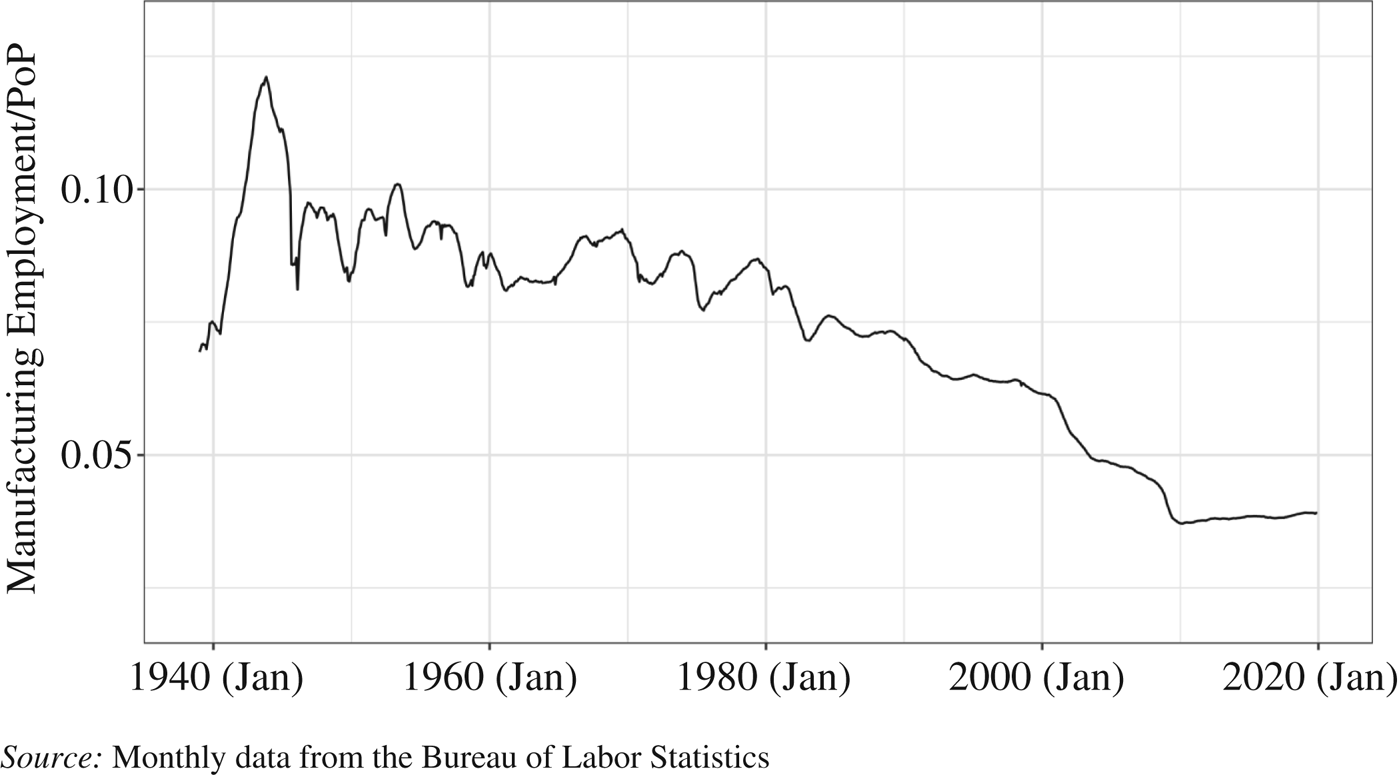
By the 1980s, the success of the trading regime was evident in cheaper and more diverse goods now available in the US market; fewer of these products, however, were made by the American workforce.Footnote 40 Manufacturers increased their productivity and differentiated their production profile to maintain output, but jobs in the sector began a linear decline (Figure 2). After the turn of the century and China's admission to the WTO, these pressures escalated further.Footnote 41 Import competition was not met by a robust domestic adjustment program. While trade bills after 1962 regularly included text that recognized the need to help workers and firms, the programs were insufficient. Instead, as pressures mounted, workers and their employees turned to other border protections as a means to slow imports.
Share of US population employed in manufacturing

Looking at America's broader domestic policy in this era of declining manufacturing jobs, we make four observations. First, the US regularly adopted border protections, making the US a problematic leader of the LIO. Second, exporting firms were always a special class of interests. Third, looking more closely at one type of remedy for job loss, statutes under Title VII of the WTO, we find that the government granted aid even when that was not its legislated purpose. And fourth, we look at adjustment programs to illustrate their limited utility.
Border measures
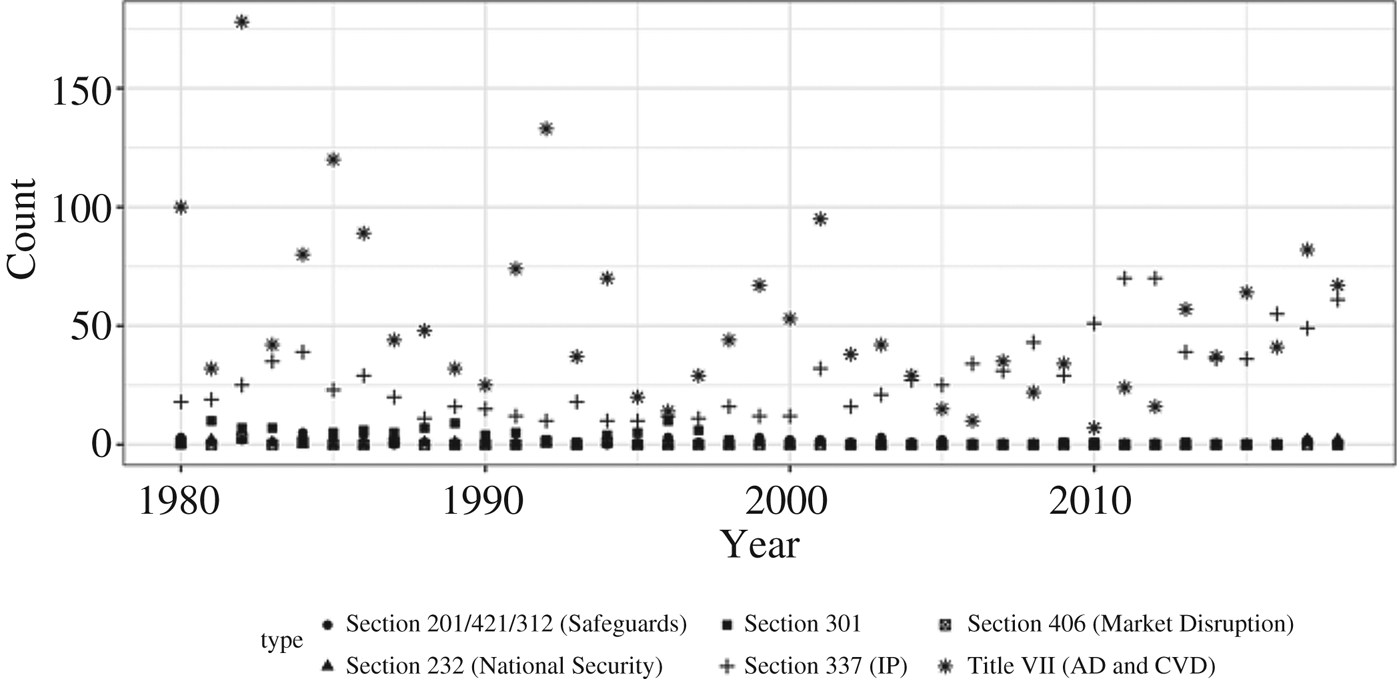
Figure 3 illustrates US border measures since 1980, categorized by type of legislative authorization. These data suggest that while the US maintained low most-favored-nation tariffs, it was also a heavy user of other remedies, especially those having to do with unfair business practices. The persistence of these measures suggests that the US was experiencing some pressure to satisfy import-competing groups.Footnote 42
US border measures by authority

The remedies most often used by the government fall into the category of laws that regulate unfair trade and are claims that a foreign producer is acting in a predatory manner to undercut a domestic firm. The legislative mandates for unfair-trade claims are of two types. A group of remedies (Title VII cases) protect the domestic market and are outside the direct control of the president. As globalization deepened, more firms garnered aid. These protections are unlike the more recent second type, those under Section 301, where aid to export groups is a “hammer,” forcing other nations to open up further. In the former, aid was a signal that US firms were not adjusting to global forces; in the latter, foreign nations were protecting their own domestic producers against the more productive US firms. Section 337 cases are somewhat of a hybrid of these two types. Under the law, a US firm can demand protection from a foreign entity that has violated its intellectual property. Intellectual property issues are of interest to both importers and exporters, and unlike other forms of temporary protection, Section 337 complainants include the largest and most productive exporters.Footnote 43
The data also demonstrate the novelty of the Trump presidency's choice of Section 232 national security exemption. While antidumping and countervailing duties were rule-based alternatives to an all-out trade war, Section 232 law lacks established economic or legal boundaries. Because of the subjective nature of the rule and the potential of a slippery slope in which anything could be justified on the basis of national security, earlier presidents avoided using this measure.
While it is difficult to prove a counterfactual, that is, that adequate attention to the interests of workers would lead labor groups and their employers to support globalization, we can look in the other direction at the tertiary effect of import pressures on government in the absence of adjustment programs.Footnote 44 In fact, the pattern of border protections is a window into the difficulty the US faced as regime leader, and until the Trump administration, presidents understood the need to either restrain the use of border measures at home or forfeit authority within the regime.
Unfair trade abroad
Protections for firms against unfair foreign treatment often extended beyond the US border. Beginning in 1974, the executive office regularly used powers under Section 301, Special 301, and Super 301 to put pressure on other governments to respond to US exporters’ claims of discrimination. The initial defense of US action was that the GATT regime had failed to address a range of barriers faced by exporters, so the US was justified in exerting unilateral pressure on nations of its choosing. Then, in 1984 and 1988, at the urging of the pharmaceutical and copyright industries, Section 301 was amended to expand the remedy to intellectual property. Figure 3 shows the relative use of a Section 301 remedy compared to others. While they are less common than those filed under Title VII, there have been 127 cases prosecuted, and although the numbers slowed after the creation of the WTO, thirty-two of these were after 1995.
No issue has enraged America's trading partners more than the (allegedly) capricious use of Section 301 tariffs. It was in part the uptick in use of this statute that motivated both the reform of the dispute settlement mechanism in the GATT and, ultimately, the creation of the WTO. Unlike most other statutes, there are few constraints on the executive's use of this tool to punish a foreign nation. Further, the remedy is open-ended and allows sanctions based on the simple proof that there had been a burden put on a US exporter. Unlike with other elements of the rule-based regime, the US can claim a violation even if the nation is not a party to a GATT agreement. Most problematic from the perspective of regime members is the “watch list”: the list of countries the US is considering for a sanction. In 1999, taking up a complaint, WTO jurisprudence suggested that even the listing of potential products and nations was in itself a trade barrier. As the panel explained, the “threat alone of conduct prohibited by the WTO would enable the Member concerned to exert undue leverage on other Members.”Footnote 45 As of the spring of 2020, thirty-three nations remained on the watch list, further undermining American credibility as a trading partner.
Unfair trade at home
Title VII cases are a counterpoint to the Section 301 cases we described, focusing on firms and workers at home who are unable to compete because of cheaper foreign production. In general, these attempts to moderate the effects of price competition have been less successful at home than their Section 301 counterparts have been abroad. And when remedies have been used, the composition of claims suggests that the government was more willing to act on behalf of larger, more productive firms’ intellectual property claims than those closed out by import competition. Although Title VII is a potential remedy for job losses in manufacturing, the rules are constrained by very specific laws. We look at case adjudication and ask whether or not this “tool” has been expanded as US jobs have declined.
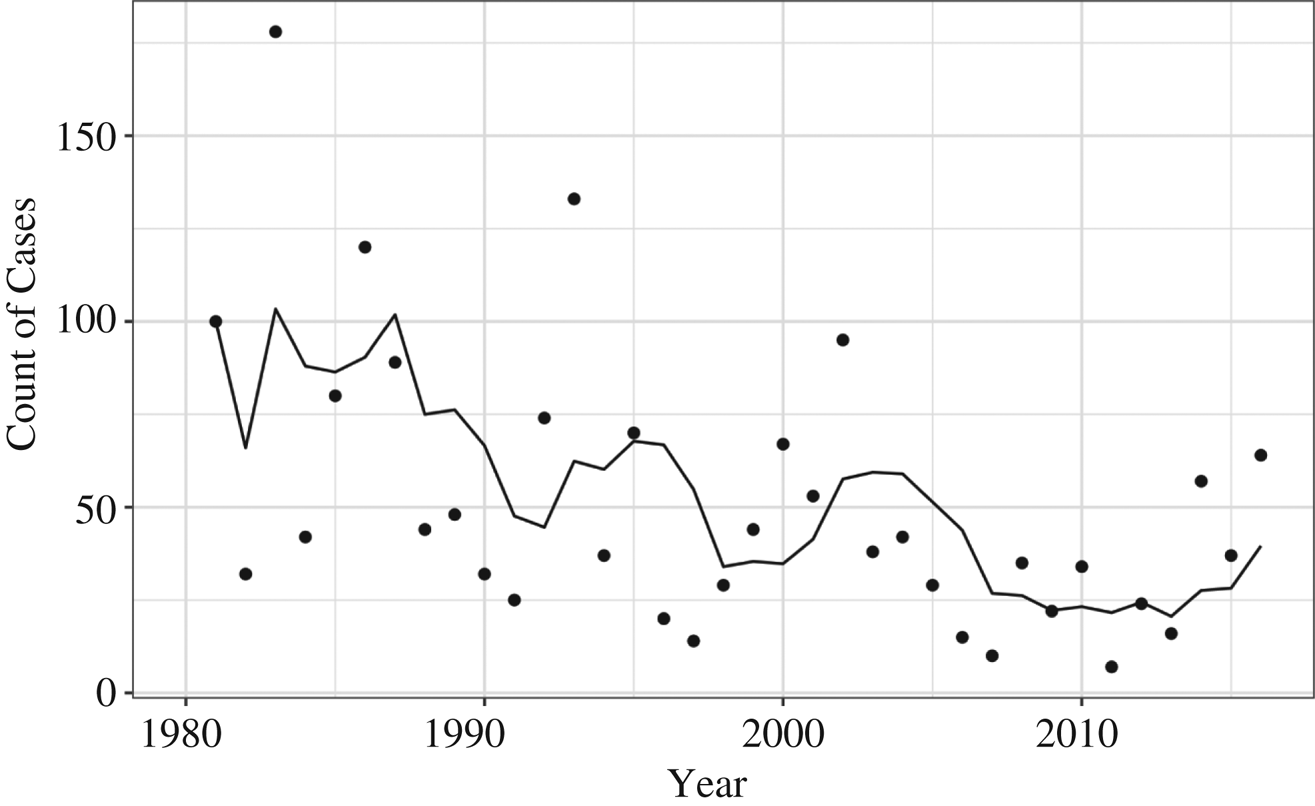
According to statute, the US will protect a domestic producer if it competes either with a foreign product selling below its production cost (antidumping, AD) or with a foreign firm that has been given an illegal subsidy from its government (countervailing duties, CVD). If a domestic firm believes that either is the case, it can initiate an investigation.Footnote 46 While general unemployment should and is often a predictor of other forms of aid, here, the import-competing firms must prove not only lost market share but also that the cause was an illegal action by a foreign exporter. Otherwise, the petition for assistance fails. In the absence of substitution effects, the AD and CVD decisions should not be related to overall US unemployment rates. But we do find a relationship between use of these unfair trade statutes and employment. Our data are displayed in Figures 4 and 5 and Table 1 in the appendix.
Title VII cases from the International Trade Commission's annual reports archive

Title VII approval rates and US unemployment, controlling for the number of cases; shaded area indicates 95% confidence intervals

First, as background, unlike in the Section 301 cases, filing a case is not easy but requires extensive time, information, and money. It is not a frivolous act but a significant signal of need.Footnote 47 The cost of an AD or CVD petition is high, running to many millions of dollars for legal representation. Still, 1,897 cases were filed between 1980 and 2016.Footnote 48 As expected from the decline in manufacturing employment shown in Figure 2, this number has gone down over time. There are now fewer US firms in the sector.
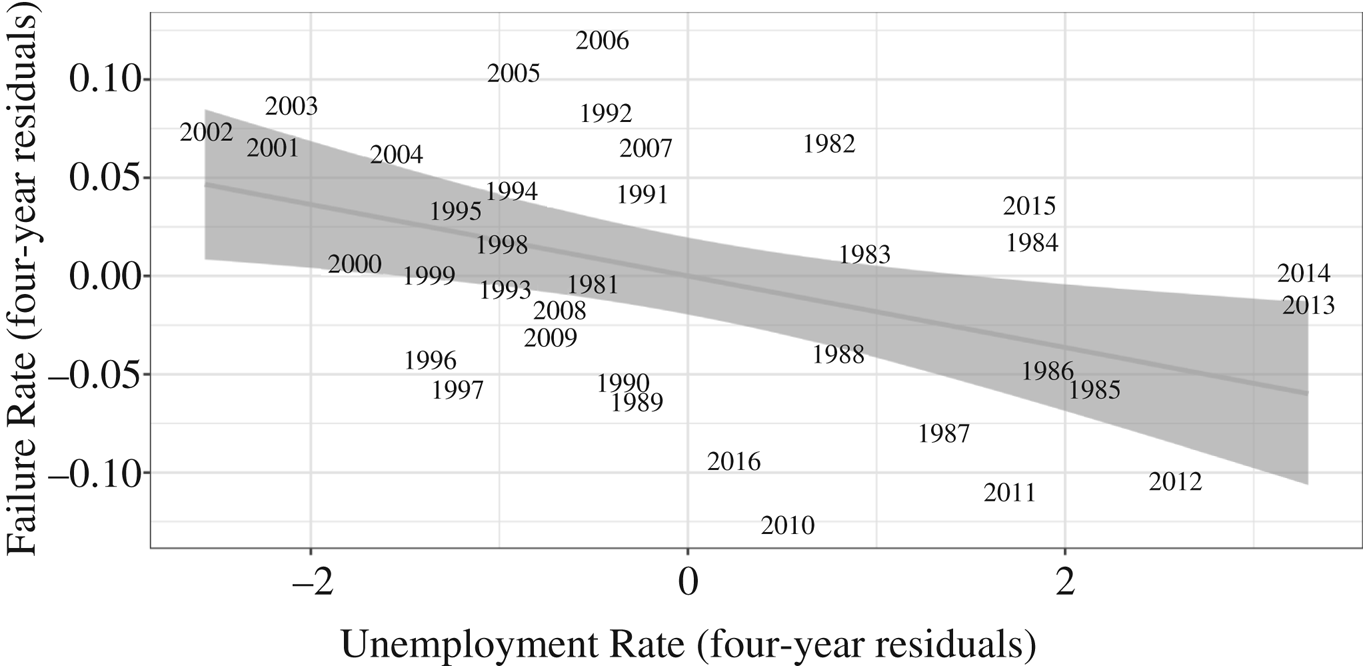
Second, we unpack the determinants of success of these petitions and the role of generalized unemployment. Overall, in the years since 1980, about half of Title VII (AD+CVD) cases, 826, obtained a positive outcome. Examining the association between the average rate of rejection of petitions and the number of cases, we find that as more firms apply for assistance in a year, the acceptance rate declines. We take this as evidence that economic conditions encourage less qualified applicants to seek remedies. This pattern also holds when controlling for the unemployment rate, as depicted in Appendix Table 1, which displays regression coefficients of four-year moving averages of failure rates on both unemployment and the number of cases.
We also find evidence of a relationship between national unemployment and the government's determination on a case. Unsurprisingly, unemployment appears to drive up the number of cases, which we have shown is negatively associated with success. However, there is a negative marginal relationship between the previous year's unemployment and case failure, net of each variable's association with the number of cases filed (Figure 5).Footnote 49 Independently of the number of cases, the failure rate declines with higher unemployment. The government appears to be using Title VII border measures as an escape valve. We believe that this use is a function of the absence of adjustment programs.
The failure of adjustment programs
Soon after the US initially agreed to lower tariffs, the Randall Commission suggested the creation of a program to compensate firms and workers hurt by import pressures.Footnote 50 David J. McDonald, then president of the United Steelworkers, urged the use of federal financial aid, in place of other trade remedies, to help injured workers, as well as firms and communities, adjust to foreign competition.Footnote 51 Agreeing that there was such a need, the Kennedy administration included a program for workers and firms in its 1962 trade bill. The program, Trade Adjustment Assistance (TAA), did not initially have widespread support, but over time aid for groups and communities hurt by market pressures became an increasingly popular part of the trade package. In the early years restrictive qualification rules and small budgets significantly limited the number of beneficiaries.Footnote 52 These restrictions eased over time, and by the 1980s, TAA was assumed to be part of all major trade legislation, with most program money funneled into the extension of unemployment benefits.
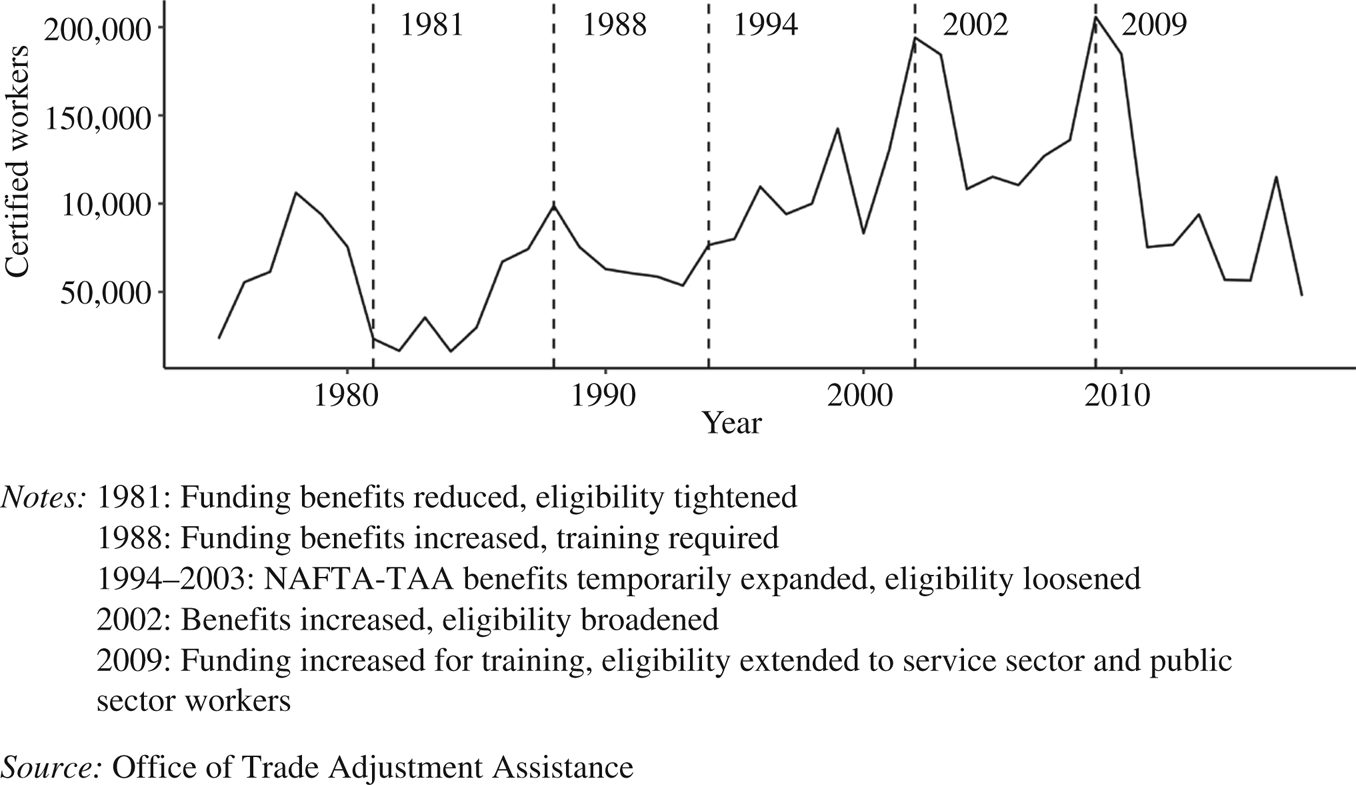
Still, from the perspective of organized labor, the program never fulfilled its core purpose of aiding adjustment. Figure 6 displays the overall number of individual workers certified as eligible for TAA assistance across five periods of the program. While over time more workers were able to take advantage of federal funds, the program was small compared to the reduction in the number of firms and manufacturing employment in the same period. And while aid spiked in response to Chinese imports, and then again with the financial crisis, the numbers returned quickly to pre-crisis support level.
Number of workers certified for Trade Adjustment Assistance from 1975 to 2017

Analysis by Hyman suggests that the problem with TAA may be more than a lack of resources.Footnote 53 He examines the effects of participation in the program driven by the administratively arbitrary assignment of TAA cases to investigators. Relative to those that applied but were not certified, TAA recipients gain USD 50,000 over ten years, but all of these gains fully depreciate: TAA has no effect on education or other more permanent determinants of long-run success. This suggests that even if there were more funding, the program might not be able to successfully retrain workers for more globalized occupations. Even though the administration of the program has been given to relatively sympathetic agencies, which have actively encouraged groups to use the petition process, upgrading the skills of those who have lost manufacturing jobs is difficult.Footnote 54
Other nations deal more effectively with job displacement. In Europe, workers benefit from both universal health coverage and job protections that are far more robust than those in the US. Take, for example, what occurred with the COVID-19 pandemic, which affected both the US and Europe at about the same time and to the same degree. Before the crisis, Americans on unemployment were collecting an average of $372 a week (although it varied widely, from $215 in Mississippi to over $500 in Hawaii). The rescue package in the US increased the weekly amount by $600, but it was a short-term fix. By comparison, Germany's jobless benefit pays 60 percent of the worker's salary, and France provides 75 percent for up to two years. More important to the security of workers is Europe's short-hours programs, which pay most of a worker's salary if the company puts them on shorter hours through a temporary disruption. The US decision during the crisis to provide an emergency loan program to incentivize firms to keep workers on the payroll was a poorly executed attempt to do what is guaranteed in Europe.Footnote 55 The absence of these labor protections in the US creates pressures not felt by elected leaders elsewhere.
The Inevitable Backlash
Putting this together, we see the roots of current antipathy to free trade policy. The US-sponsored trade regime succeeded far beyond the expectations of its creators in 1947. Barriers to trade are at historic lows; goods and services can traverse the globe. Yet, almost everywhere, leaders are critical of the multilateral regime. In the US, the government has increasingly turned to bilateral trade agreements as the preferred tool of commercial policy, eschewing the GATT/WTO. In addition, if we look at Americans’ views of foreign trade we see an odd pattern. When Trump took office, Gallup reported a record 72 percent of respondents agreeing that trade was an opportunity for US growth. This is fourteen points higher than polling under President Obama.Footnote 56 Soon afterwards, surveys began reporting evidence of polarization on trade. In July 2018 Pew found that only 40 percent of respondents believed that trade was good for the US, with large differences between parties. About seven in ten Republicans said that increased tariffs are a good thing; about the same percentage of Democrats said that tariffs are a bad thing.Footnote 57 Even more telling, in a panel study of trade attitudes, we see people shifting their trade preference to match that of their preferred candidate. While there was no statistical difference in 2007 between the trade attitudes of those who would and would not support Trump in 2016—that is, both supporters and critics were evenly distributed between the two parties—by the time of the election, those who are more critical of trade are also more likely to support Trump.Footnote 58 Trade has moved from being mostly bipartisan to being highly politicized.
These preferences offer insight into the strengths and weakness of US leadership. The exporter-led regime bolstered trade liberalization and finessed labor's opposition. The result was economic growth. But the regime was never deeply internalized, and there was insufficient attention to the domestic consequences of deep market liberalization and the growth of inequality.Footnote 59 In the absence of a powerful import-competing opposition, the demands of exporters created an internal dynamic that pushed for ever-deeper globalization. In the trade arena, this required moving beyond the limited obligations of “national treatment” to a more complicated set of “behind-the-border” rules. And this shift had the unintended effect of mobilizing broad resistance, in the US and elsewhere.
From National Treatment to Behind the Border
From the beginning, the framers of the GATT had an ordering of commercial policy instruments that are in line with economic theory: the embedded liberalism compromise presumes that the internationally efficient policy would be no tariffs joined with high internal transfers. Second-best would be nondiscriminatory tariffs and no other barriers to trade, along with nondistortionary domestic policies. This is the world imagined by the framers of the GATT, who never explicitly advocated the complete disavowal of trade barriers. For instance, GATT Article XX explicitly authorized barriers for issues including the conservation of exhaustible natural resources, and Article XIX allowed withdrawal of tariff concessions if unforeseen developments lead imports to cause or threaten serious injury to domestic producers. The overall goal was “tariffication”: replacing the various distortionary policies with tariffs and then negotiating these tariffs down.
Exceptions and limitations to liberalization were endorsed in part to avoid the kinds of policies that would be more distortionary than tariffs. Coming out of the interwar years, the framers well understood that behind-the-border trade barriers, such as import licenses, product standards, and other regulations, distort both global and internal markets in nontransparent or (even more dangerous) discriminatory ways. Before the GATT, these barriers were as important for commercial policy as tariffs.Footnote 60 In anticipation and fear of the use of such barriers, Article III of the GATT promised their elimination by requiring all products to be given national treatment on importation. While the obligations of national treatment extended behind the border, the rule only obligated governments to not discriminate against imports, a simple demand that had the advantage of sounding akin to fairness. In effect, this rule guarded against the use of targeted policies that hurt a trading partner but allowed states to pursue their own social and economic aims.
In theory, the GATT required tariffication, or the transition from behind-the-border barriers to ad valorem tariffs; over time, however, negotiators turned their attention to nondiscriminatory yet trade-disrupting policies, particularly subsidies, standards, and intellectual property. Discussion of these measures was not new to the regime. Subsidies, for example, were an early and persistent source of disputes, particularly in agriculture.Footnote 61 As governments removed these discriminatory policies, the effect was to make trade rules a factor for industrial, environmental, and competition policy, delving further and further behind the border.
Until the 1980s, the primary activity of the global trade system had been a focus on tax instruments such as tariffs and antidumping duties; but after that, negotiations attempted to meet exporter demands to reduce regulatory barriers to trade.Footnote 62 Because regulatory protectionism is often an outcome of some other public policy goal, governments again could not swap measure for measure but instead discussed ways to harmonize various health, safety, environmental, and investment policies. Although these new efforts were aimed at reassuring opponents of liberalization that the WTO rules would offer sufficient space for developmental, environmental, and labor concerns, incorporating these issues actually exacerbated criticisms.Footnote 63 First, it is not clear that industry was united on harmonization since regulatory differences can afford competitive advantages.Footnote 64 On net, the global trade regime raised fears that the governments’ choices over these matters would be constrained by international rules. Given the range of preferences on these issues, domestic groups in the US and abroad feared that a global rule would reflect a regulatory “race to the bottom.” The result was that the WTO became a lightning rod for the disaffected.Footnote 65
Disaffection was fueled not only by the expansion of the WTO agenda but also by its historic defense of increasing market access. Nowhere was this more clear than with China's accession to the WTO. Making permanent what had been short-term access to the US market fueled their export industries. The result was a radical rise in imports and significant dislocation of jobs throughout the world. The rise in Chinese exports called into question what Krugman had earlier explained to be the unspoken rule undergirding trade policy: “Exports are good; imports are bad; other things equal, an equal increase in imports and exports is good.”Footnote 66
Growing US Antipathy
While the complete history of the WTO has yet to be written, its “fall from grace” in the US was far steeper than would be expected from a review of the regime itself. While unable to close the Doha Round, the 2013 trade facilitation agreement did simplify customs rules to ease border restrictions. During the financial crisis, the WTO calmed markets and, as currencies fell, undercut what could have been a rise in border protectionist measures. But to many in the US, the organization had outgrown its purposes, as evidenced by five attempts on the floor of Congress to force the US to withdraw from the WTO.
In the face of this waning support, the preferred method to address trade issues has been through more limited preferential trade agreements (PTAs). These are outside the boundaries of GATT Article XXIV and do not abide by the stipulated charge of nondiscrimination.Footnote 67 All told, the US is party to twelve bilateral PTAs and two regional agreements: NAFTA (USMCA) and CAFTRA-DR.
The use of PTAs may be less evidence of the failure of the WTO and more about constraints associated with universalistic agreements. Universalistic agreements encourage mobilization and facilitate the creation of broad cross-issue-area coalitions. PTAs are a nimbler political tool, able to incorporate provisions that help assuage individual constituencies without facilitating the formation of a larger anti-agreement bloc. For example, increased offshoring and the diversity of foreign regulations on production are more easily accommodated via agreements among smaller groups of states who share a production profile.Footnote 68 Bilateral and smaller regional agreements also break up the anti-trade coalition of health, labor, and environmental groups and allow the inclusion of lesser and often tailored commitments that are palatable enough to allow passage. As in America's earliest treaties, and in the plurilateral agreements in the Tokyo Round, more limited agreements allow negotiators to specify commitments that are acceptable and enforceable, given variation in the domestic constraints faced by signatories.Footnote 69
The increasing use of PTAs is an example of what political scientists have generally found, that is, that international cooperation is easier on issues without concentrated, active, or informed domestic opposition. The GATT was a textbook example: the regime limited the voice of domestic import-competing groups and targeted the negotiations to avoid organized opposition. But the regime itself was constantly expanding its reach and this, itself, sowed the seeds of contemporary discontent. As the regime expanded, and markets penetrated more deeply into national economies, resistance was sidestepped, and the regime continued to negotiate market access. Ignoring the disillusionment of those on the losing end of market expansion had long-run consequences. Without the pressures from groups hurt by trade, politicians had less of an incentive to produce a transfer scheme that would satisfy protectionist groups in hard times. Thus today the issue facing the pro-trade coalition is not that they cannot anticipate the eventual backlash to trade but that they cannot commit to systems of redistribution. And in the absence of side payments, the alternative is to create roadblocks to the mobilization of anti-trade groups.
Could the US-led regime have been organized to facilitate deep integration and allow a bigger voice for the disaffected? Looking at the history of America's leadership in the regime we conclude that the answer is no: the original institutional structures themselves, and how they developed over time, made redistribution increasingly difficult. The inclusion of regulatory reform in the WTO created even more pressures on the regime abroad as new transnational groups found a common enemy in the elite in Geneva. And, as part of this backlash, the trade regime came to be understood as Börzel and Zürn described, that is, an international institution that “constrained states in their redistributive capacity,” enabling them to “shirk their political responsibility.”Footnote 70
Concluding Thoughts
In Polanyi's telling, the expansion of suffrage and nascent labor organization was the death knell for the British-led trading system. In subsequent years, many others, including some in this volume, have agreed that open markets and liberal democracy can be odd bedfellows. We have taken a close look at democratic constraints via a study of American leadership in the trading regime. We know that in a representational democracy elected officials ignore organized resistance at their own peril. But policymakers are not passive recipients of these pressures; they can create incentives, and disincentives, for groups to organize. This role of government in finessing social pressures is the backbone of our analysis of US leadership. Before the 1930s, producers and their employees could organize and exert effective control over the US tariff schedule. The decision to govern tariffs via executive-run international negotiation shifted the information environment in ways that increased the presence of exporter groups but made it difficult for import-competing groups to organize. The result was rising exporter voice and declining representation of those who feared trade. With muted domestic constraints, the US organized and led a trading regime that was at least as successful as liberalization had been under British hegemony. Over time, the trade regime included just about every national market, and given exporter pressures, new policy arenas. But American-led liberalization had unanticipated consequences. First, the absence of voice from disaffected labor and import-competing firms forestalled the creation of programs to ameliorate market disruptions. And second, the logic of export-oriented international negotiations drove the LIO to adopt an agenda including regulatory, environmental, and health and safety standards. Facing organized resistance at home and abroad, the US became an increasingly unreliable leader of the LIO.
We have made this case in three parts. First, we looked at how the US re-engineered trade policymaking in the years after the Great Depression. From the earliest days of the republic, American policymakers understood that open markets would meet domestic opposition. To finesse resistance, American politicians chose procedures that would balance the traditional voice of import-competing interests with those who sought access to foreign markets. The mechanism was to shift the cost of organization via access to information on the potential benefits or losses of a government policy. Export groups knew with certainty the potential benefit of a trade treaty; import-competing groups operated in an opaque space, never sure whether they would be part of the reciprocal bundle. As a result, Congress was insulated from group pressures, and the executive supported the trade regime.
Second, we explored the effects of this shift in voice on the design of the international trading regime. We looked at accession, the mode of tariff bargaining, and the expansion of the agenda into the regulatory arena, suggesting that these policies reflected an American interest in universal market access. At each stage the US could have, but chose not to, advance policies to prioritize adjustment supports for import-competing interests. This policy had feedback effects on the US, but our review of trade-related legal remedies finds minimal support for workers and firms hurt by competition and robust protections for exporters disadvantaged abroad. This is particularly evident in the government response to unfair-trade cases, that is, US firms who claim injury from predatory practices by foreign producers. These firms were more likely to be granted aid in times of high national unemployment. We suggest that this remedy reflects the absence of a successful adjustment policy: pressures on officials have led to the use of border restrictions, akin to a “side payment.”
Third, we argued that the absence of either meaningful limits on trade liberalization or compensating mechanisms for those hurt by the LIO sowed the seeds of organized resistance at home and abroad. The regime suffered an original sin: by purposefully ignoring the voice of import-sensitive firms and workers at the start, it failed to develop the means to balance its drive toward deep integration with the social costs of global competition.
Like the other papers in this volume, this study was motivated by the editors’ core observation that globalization leads to uneven benefits. The potential mobilization of globalization's “losers” was a particularly acute problem in the US, and if not resolved, would have precluded American leadership of the LIO. To provide the needed leadership, the US found it necessary to bypass the interests of certain groups. The US did not internalize the interests of all parties, let alone construct what Ruggie referred to as a legitimate set of social objectives, but chose to undermine the political voice of potential opponents.Footnote 71 This was less of a problem in the early years. In the 1940s and 1950s, US growth facilitated the re-employment of factors of production, and organized resistance was limited. Over time, growth ebbed, and with it, adjustment issues emerged. The inclusion of new members in the GATT/WTO and the expansion of the agenda to address increasingly complex production networks had the virtue of expanding the rule-based system, but it also unintentionally mobilized a variety of opposing interests. In the US, criticism was managed by a combination of insulation and redirection. The US Congress insulated itself and continued to delegate authority, and in return, the Executive Office actively undermined and redirected the organization of those displaced by trade. Instead of responding by creating systematic redistributional policies, trade and employment policies were stovepiped, with trade in the federal system and employment issues directed to the states.
Today, American commitment to the regime may be at a watershed moment, facing both anti-trade-treaty populism at home and skepticism from its founders abroad. For those who have benefited from internationalization, the anti-trade movement is a mystery—didn't trade agreements bring cheaper and better products, increasing welfare around the globe? But consumers are not an easy group to mobilize, and today's exporters, the backbone of the reciprocal trading system, have come to value the trade regime less as a forum for increasing the depth of trade agreements and more because it lends some stability to prices and rules of commerce. In today's markets with long supply chains, unpredictability is a far greater problem than a known border barrier: producers can always internalize a “tax” into the prices they charge. What is more difficult is to produce products when that rate and/or a regulation is in flux.Footnote 72 As exporters have lost interest in multilateral solutions to issues they face abroad, organized labor and domestic producers remain animated, and American interest in the GATT/WTO regime has waned. But while it may have been necessary to have one large nation, the US, provide the collective good of stability in the early years after World War II, the absence of American support today may have a silver lining. Reform efforts will require a vision of globalization better led by nations that support a regime that seeks to balance the virtues of open markets with their costs to domestic groups, the environment, and development goals.
Our review reinforces a number of fundamental insights that have been offered in this volume and on the political economy of globalization more generally. Much has been written about the interaction of markets and factors of production, and most analyses of globalization begin with an accounting of how the easing of border restrictions will benefit, or challenge, the material interests of different groups.Footnote 73 Building on these fundamental material interests, this paper re-emphasizes the importance of understanding how and when those interests are able to organize for political action.Footnote 74 The political landscape that interests face varies across time, as well as across issue area and form of governance.Footnote 75 In shaping that landscape, we find that governments are not passive: they can and do influence which voices they heed by shifting the costs and benefits of organization.Footnote 76 Our analysis of US policymaking suggests a number of ways that governments intervene to encourage or discourage the articulation of interests. Governments can increase or decrease costs, via bureaucratic hurdles, by controlling information, by stovepiping policy, and by shifting the locus of policymaking. They can also attempt to buy off groups, either by paying for the costs of adjustment or by giving some specific remedy. But we also find that globalization makes controlling opposition increasingly difficult. As international organizations seek more universal membership, and with it common rules and practices, they risk encouraging cross-national and cross-issue mobilization.
In closing, was the rise of antiglobalization in the US inevitable, or a reflection of the failure of institutional design? We think the data support the latter—that is, the method of aggregating social preferences sowed the seeds of its own undoing. If adjustment policies had been part and parcel of the liberalization “program” there would have been far less of a backlash. Proponents of liberalization wrongly assumed that over time labor and capital would adjust and be happily redeployed in the now larger and more productive market. With this belief in the inevitable benefits of open markets, there was no need for a safety net, and instead early liberalization focused on overcoming the hurdles of domestic opposition. But these shifts were not seamless, and the distributional effects eventually fueled a social backlash. Recreating support for deep liberalization in the US will be difficult, if not impossible.
Data Availability Statement
Replication files for this article may be found at <https://doi.org/10.7910/DVN/HT5VY5>.
Supplementary Material
Supplementary material for this article is available at <https://doi.org/10.1017/S002081832000065X>.
Acknowledgments
We owe thanks to many people who have helped us with aspects of this paper. To start, we want to thank the editors of the special issue, David Lake, Lisa Martin, Thomas Risse, and Erik Voeten. We gained much from the criticism of all the participants in the two conferences sponsored by the editors, in Madison, Wisconsin, and Berlin, Germany. This argument was also previewed at Les nouvelles négociations commerciales mondiales et leurs impacts sur le Canada et le Québec in March 2019 and received some preliminary feedback. Special thanks go to Sung Mi Kim and Minju Kim for research help and to a number of readers and commentators on the project, including Christine Toenshoff, Zuhad Hai, Elisabeth van Lieshout, Krysztof Pelc, Kyle Bagwell, and participants in the workshop of the University of Chicago Program on International Political Economy and Security.