INTRODUCTION
Sesbania sesban is an important legume fodder tree with a wide distribution throughout tropical Africa and Asia. It has also been introduced into tropical America (Heering et al., Reference Heering, Nokoe and Mohammed1996). The tree grows vigorously and provides a lot of high quality biomass in a relatively short period (ILCA, 1988). It can be used for fodder, fuelwood, shade, living fences, improving soil fertility through nitrogen fixation and as a mulch (Chintu et al., Reference Chintu, Mafongoya, Chirwa, Mwale and Matibini2004; Kusekwa et al., Reference Kusekwa, Msafiri, Mwilawa, Ngowi, Kyamanywa, Ulime, Kategile and Adoutan1993). Sesbania sesban is the most widely known species in the genus; a large germplasm collection has been assembled from sub-Saharan Africa, which is currently maintained in the International Livestock Research Institute (ILRI) genebank (Hanson, Reference Hanson, Kategile and Adoutan1993; Heering et al., Reference Heering, Nokoe and Mohammed1996).
Research on dormancy and storability of S. sesban seeds is limited (Poulsen et al., Reference Poulsen, Parratt and Gosling1998). It has been reported that the seeds of S. sesban are dormant and germination is low without treatment (Kusekwa et al., Reference Kusekwa, Msafiri, Mwilawa, Ngowi, Kyamanywa, Ulime, Kategile and Adoutan1993; Wanyondu, Reference Wanyondu, Macklin and Evans1990). The hot wire pretreatment, which has been recommended for seed testing (Poulsen et al., Reference Poulsen, Parratt and Gosling1998), results in germination of about 70% (Wanyondu, Reference Wanyondu, Macklin and Evans1990). Some other mechanical pretreatments like chipping the seed coat have also been effective in promoting rapid germination for other species such as Vigna (Wang et al., submitted). However, both the hot wire and seed coat chipping pretreatments are labour intensive and time consuming, meaning that it is important to find more efficient methods to test larger amounts of seed.
Hot water pretreatments are among the simplest, cheapest and most reproducible methods for reducing hard seed dormancy, and good results have been obtained for seeds of many tropical species (Albrecht, Reference Albrecht1993; Smith et al., Reference Smith, Wang, Msanga and Vozzo2002; Velempini et al., Reference Velempini, Riddoch and Batisani2003). Research on four provenances of S. sesban showed that seeds germinated to about 60% in a two-week test following a hot water (80 °C) pretreatment (Wanyondu, Reference Wanyondu, Macklin and Evans1990). Optimum water temperatures and immersion times vary considerably with species, and thus for each species research is needed to determine the pretreatment conditions to maximize germination whilst minimizing seed damage (Argel and Paton, Reference Argel, Paton, Loch and Ferguson1999). One limitation of the hot water pretreatment is that only a proportion of the hard seeds within a seed sample are made water-permeable, and the germination rate is much slower than for mechanical pretreatments (Baskin et al., Reference Baskin, Davis, Baskin, Gleason and Cordell2004; Veasey and Teixeira de Freitas, Reference Veasey and de Freitas2002; Wang et al., Reference Wang, Hanson and Mariam2007).
Based on results obtained from previous studies, there is potential to increase the efficiency of the germination test by using a two-phase treatment technique: pretreating seed with hot water prior to testing the seeds for germination (phase 1), then mechanically scarifying the seed coat for the few hard seeds that remain in the sample at an early stage (four days count) during the germination test (phase 2). This paper reports the results of experiments to determine the (1) optimum water temperature and efficiency of the two-phase technique on breaking hard seed dormancy in S. sesban, and (2) variation in seed dormancy and storability among different accessions and seed lots.
MATERIALS AND METHODS
Experiment 1: Effect of water temperature on breaking seed dormancy
Seeds
One seed lot from each of four accessions (accession 1180, 1229, 1238 and 1275) was selected for the study. The seeds had been harvested from regeneration plots in 1989 at the Zwai ILRI research site in Ethiopia, dried to a seed moisture content of 5% and stored in sealed laminated aluminum foil bags at 8 °C for 16 years.
Seed treatments and data recording
Seeds of each lot were subjected to water-temperature pretreatments of 70, 75, 80 and 85 °C. For each pretreatment, 200 seeds per sample were wrapped in muslin cloth, tied with a plastic thread and immersed in a Gallenkamp water bath at a water depth of 10 cm for eight min at the required temperature. Immediately after pretreatment, four replicates of 50 seeds per sample were plated on top of two layers of filter paper in 90 mm Petri dishes. The Petri dishes were placed randomly in an incubator at 20/30 °C (12/12 hours) without light for a 10-day germination test. The counts for hard seeds and normal seedlings were made after four and 10 days incubation. The seed coat of seeds that remained hard after four days incubation were scarified at the end opposite the radicle using sharp forceps. At the end of the test (10 days), abnormal seedlings and dead seed were also categorized and counted according to the International Rules for Seed Testing (ISTA, 2004).
Experiment 2: Comparison of the two-phase technique with single phase techniques for diverse accessions and seed lots
Seeds
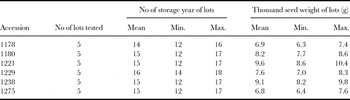
Five seed lots from each of six accessions were selected from samples stored in the ILRI genebank based on different harvest years for each accession (Table 1). The storage conditions of the seeds were as described above.
Number of years stored and thousand seed weight for 30 seed lots of six accessions of S. sesban used for experiment 2.

Seed treatments and data recording
Two hundred seeds per seed lot were subjected to each of the following treatments:
(a) Two-phase technique (hot water followed by scarifying seed coat): Thirty seed lots were immersed in water at 80 °C (this temperature was selected from experiment 1) for eight min before the germination test, then the seed coat was scarified for the hard seeds left after four days incubation, as described above. The time of chipping seed coat was recorded by randomly choosing 10 seed samples that contained more than 15 hard seeds. All hot water treatments were carried out simultaneously on batches of 20 samples in a water bath.
(b) Hot water treatment before the germination test.
(c) The seed coat was scarified for two seed lots from each of the six accessions before germination test.
(d) Untreated seeds were used as the control.
Seedlings were evaluated after 4, 10 and 14 days, and final evaluation was made according to the International Rules for Seed Testing (ISTA, 2004).
The seed coats of any remaining hard seeds in the control after 14 days incubation were scarified, and a final seedling evaluation was made after four days (total 18 days) to obtain information on the total seed viability and the number of abnormal seedling/dead seeds in each lot.
The percentage of hard seed reduced (HS reduced) by the hot water treatment after four days incubation was calculated for each sample using the following formula:

Data analysis
Data were analysed with SAS version 9.1 (SAS Institute, 2003).
RESULTS
Experiment 1: Effect of water temperature on breaking seed dormancy
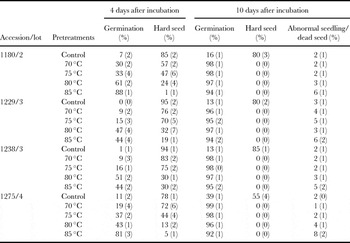
A pretreatment of eight min at 80 °C gave the best result for breaking seed dormancy. After four days of incubation, higher germination percentages were achieved with significantly lower numbers of hard seeds compared to most of the treatments. There was no loss of seed viability at the end of the 10-day test period using this pretreatment (Table 2). The efficiency of the pretreatment increased as the water temperature increased from 70 to 80 °C, and all pretreatments resulted in higher germination percentage than that in the control, although the 85 °C water pretreatment damaged 3–6% of the seeds. The hard seeds of all samples treated by the two-phase technique were reduced to zero, and maximum germination was reached within 10 days incubation. The control seed still maintained 75% hard seed on average for all samples, which varied from 55% (sample 1275/4) to 85% (1238/3) at the end of the 10-day test.
Effect of pretreatment water temperature on breaking hard seed dormancy using the two-phase technique in four accessions of Sesbania sesban.

Experiment 2: Comparison of the two-phase technique with the single phase techniques for diverse accessions and seed lots
Germination test period
The germination test was completed after four days following scarification of the seed coat and after 10 days following hot water pretreatment. At the end of these periods, all scarified seeds had imbibed, while some hard seeds remained in the hot water pretreatment and in the control.
Germination and hard seeds after 4 days incubation
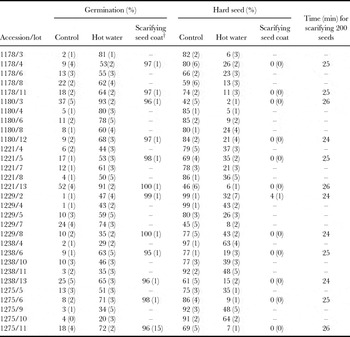
Both the hot water pretreatment and scarifying the seed coat significantly increased germination and significantly decreased hard seed percentage for all samples after four days incubation (Table 3). Although the effectiveness of dormancy breaking by scarifying the seed coat was superior to the hot water pretreatment, the method was time consuming, requiring an average of 25 min for chipping 200 seeds of all samples tested. The mean germination percentage over all samples was 12% (range 1–52%), 58% (20–93%) and 97% (95–100%); and the mean of hard seeds was 77% (42–99%), 26% (2–64%) and 0 in the control, hot water and scarifying the seed coat pretreatment, respectively.
Effect of hot water pretreatment (80 °C) and scarification on percentage germination and percentage of hard seeds after four days incubation for six accessions of Sesbania sesban; time for scarifying 200 seeds is also shown.

†Germination test for scarifying the seed coat was complete after four days incubation.
−: not tested.
Values in parentheses are s.e. of the mean (based on four replicates).
Final germination, hard seeds and abnormal seedlings/dead seeds among the treatments
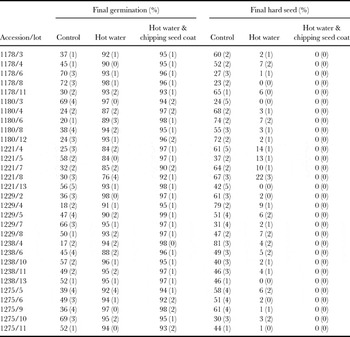
Both the hot water (80 °C) and the hot water followed by seed coat chipping pretreatments increased final germination percentage and decreased hard seed content for all seed lots compared to the control. The highest levels of dormancy breaking were obtained from the hot water pretreatment followed by chipping the seed coat (Table 4). The germination percentages for all samples subjected to this treatment reached the maximum (mean 96%), and there were no hard seeds after 10 days incubation. However, some hard seeds still remained after the hot water pretreatment and in the control after 14 days. The mean germination of all samples was 44% (17–72%) for the control, and 92% (76–98%) after the hot water pretreatment. The mean percentage of hard seeds was 52% (23–81%) in the control and 5% (0–22%) after the hot water pretreatment at the end of the 14 days test period.
Effect of hot water (80 °C) and hot water plus scarification on final percentages of germination and on percentage of hard seeds for six accessions of Sesbania sesban: germination test of hot water followed by chipping seed coat finished after 10 days incubation, other two tests stopped after 14 days incubation.

Values in parentheses are s.e. of the mean (based on four replicates).
The percentages of abnormal seedlings/dead seeds were not significantly different between any treatments and the control. The total mean was 4%, 3%, 3% and 4% in the control, hot water, scarifying seed coat and hot water followed by scarifying seed coat treatments, respectively.
Differences in hard seeds, viability, and the hard seeds reduced by hot water treatment among and within the accession
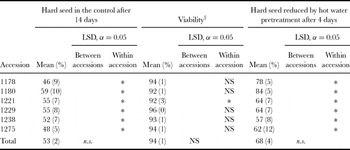
There were no significant differences (p > 0.05) among the accessions for percentage of hard seed in the control (after 14 days) or in reduction in hard seed by hot water pretreatment (after phase 1). However, differences among seed lots within each of the accessions were significant (p < 0.05) (Table 5).
Variation in percentages of hard seed, viability and decrease in hard seeds by hot water pretreatment between the accessions and between seed lots within the accession of Sesbania sesban.

Values in parentheses are s.e. of the mean (based on five samples each with four replicates within the accession, and based on six samples each with five replicates among the accessions).
†Viability is the sum percentage of germination and hard seeds.
*Significantly different.
The average viability of tested samples was 94%, and it varied from 92% to 96% (Table 5). There were no significant differences among or within accessions, except for accession 1221, where differences among the seed lots were significant.
Abnormal seedlings/dead seeds content in imbibed and hard seeds
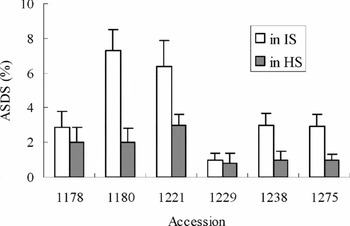
Figure 1 shows that the percentages of abnormal seedlings/dead seeds were higher in the imbibed seed fraction than in the hard seed fraction for all test accessions. The mean percentages of abnormal seedlings/dead seeds from test accessions were very low: 4% (1–7%) in imbibed seed and 2% (1–3%) in seeds that still remained hard after 14 days incubation.
Mean percentage of abnormal seedlings/dead seeds (ASDS) produced in imbibed seeds (IS) and hard seeds (HS) after 14 days incubation for each of the six accessions of Sesbania sesban tested; also shown are the s e. of the mean (based on four replicates).

DISCUSSION
In commercial seed testing, hard seeds are usually scarified during or at the end of the germination test or the percentages of hard seed are reported without any treatment (AOSA, 2005; ISTA, 2004), primarily because the hard seed content is low in cultivated species. However, pretreatment for dormancy breaking is required for viability monitoring of most forage legume seeds stored in genebanks, because (1) most accessions are wild species with a high degree of dormancy, and (2) it cannot be assumed that a seed is viable simply because it has been identified as hard (Ellis et al., Reference Ellis, Hong and Roberts1985). The mean hard seed content of the control was 52% at the end of 14 days (Table 4) in the present study, even though these seeds had been stored for 12–18 years in the genebank (Table 1), and it was expected that hard seed dormancy would have reduced with time. Abnormal seedlings and dead seeds were observed when testing the hard seed fraction (Figure 1), which further confirms that pretreatment to remove seed dormancy is necessary to assess viability of this species correctly.
For seeds of S. sesban, we conclude that the two-phase technique is very effective and more practical than scarifying the seed coat or dipping seeds in hot water. The mean percentage of hard seed of all 30 samples tested was reduced to 26% after phase 1 (Table 3), which is only a very simple hot water treatment dealing with 20 samples each time. Scarifying the seed coat is labour intensive and time consuming, taking an experienced seed analyst approximately 25 min to scarify 200 seeds (Table 3). Use of the two-phase technique reduced labour and time by 74% compared with scarifying the seed coat for all seeds prior to the germination test.
Germination rate was also affected by the two-phase pretreatment. Germination reached 58% after four days incubation (phase 1) (Table 3), which is a suitable time to conduct the first count in seedling evaluation. The test was completed after 10 days incubation, which was much faster than the single phase hot water pretreatment (Table 4). There were no significant differences in response of the accessions to the two-phase treatment, indicating that this method could be widely applied for dormancy breaking of S. sesban. The usefulness of this technique was validated through application as a routine test for S. sesban in the ILRI genebank for about 1000 seed samples. Similar proportions of hard seeds were recorded after the phase 1 pretreatment for all accessions and seed lots, and the test could be completed after eight days incubation for the majority of samples tested. It was concluded that the improved method provided a rapid and cost effective means of breaking hard seed dormancy in seeds of S. sesban with potential for wider use for other hard seeded legume seeds.
The study also demonstrated that the constant hot water pretreatment (80 °C) can be used to treat large quantities of seeds of S. sesban for field sowing. It is easy to carry out the treatment using simple facilities like a water bath. Albrecht (Reference Albrecht1993) reported that pouring 100 °C water over seeds then leaving them to soak in the cooling water for 24 hours was effective in breaking dormancy in commercial seeds of Adansonia digitata, Calliandra calothyrus and S. sesban (Albrecht, Reference Albrecht1993). Further research is needed to determine the proper ratio between volume of water and number of seeds, when using boiled water, to ensure good scarification but avoid damage to the seeds. The authors recorded that water temperature decreased dramatically immediately after pouring the water on the seed if they did not control the water temperature, such as by using a water bath. The degree of reduction in temperature and therefore the efficiency of dormancy breaking were largely dependent on the ratio of water volume to number of seeds (Wang et al., unpublished data).
It has been suggested that water temperature has a greater effect on reducing hardseededness than the immersion time (Oakes, Reference Oakes1984), although both factors are important. Our study supported this suggestion. Further, it demonstrated that the efficiency of the pretreatment increased dramatically as water temperature increased from 70 to 80 °C and that only a small proportion of seeds were damaged by water at 85 °C (Table 2). Water temperature of 80 °C was most effective at reducing seed dormancy in S. sesban, as has been reported for seeds of Sesbania rostrata (Takahashi, Reference Takahashi2003).
Variation in seed dormancy and response to pretreatments exists among and within accessions as a result of genetic and the environmental differences during seed development in wild Vigna species (Wang et al., Reference Wang, Hanson and Mariam2007). Variation in water uptake pattern and testa structure, leading to differential germinability, has been reported in a single seed lot of S. cannabina (Das and Saha, Reference Das and Saha2006). Our study demonstrated that variation in the percentages of hard seed and reduction in hardseededness by the hot water pretreatment were significantly different among seed lots within each accession but not between accessions (Table 5). These results may indicate that environment during seed development had a larger effect than genotype on hardseededness in S. sesban.
Many authors have reported that seeds of S. sesban can be stored for 2–5 years without losing viability, provided proper storage conditions are used (Chin and Hanson, Reference Chin, Hanson, Loch and Ferguson1999; Poulsen et al., Reference Poulsen, Parratt and Gosling1998). The high viabilities (92–96%) (Table 5) and low numbers of abnormal seedlings for seeds of accessions stored for 12–18 years demonstrated that the ILRI genebank storage conditions (5% seed moisture at 8 °C) are suitable for storage of seeds of S. sesban. Thus, the seeds of this species can be stored for long periods of time in genebanks without loss of viability.
Acknowledgements
The authors would like thank Mr Zerihun Taddese for statistical analysis, Dr S. A. Tarawali for the valuable comments on the manuscript and Miss Bethlehem Getachew for the technical assistance. The work was financially supported by the National Key Basic Research Program of China (973) (2007CB108904) and World Bank project ‘Upgrading the Genebanks of the CGIAR’.