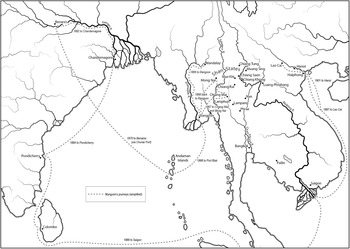
In late 1901, an exiled Burmese prince created a diplomatic flurry when he slipped out of Saigon where he had been living for twelve years. Prince Myngoon, then aged 58, claimed to be the legitimate heir to the Burmese throne, even though he had been exiled from Burma since 1868 following a failed palace rebellion. British administrators in Burma had been worried about Myngoon's seditious influence since they annexed upper Burma in 1886. The Chief Secretary to the Government of Burma considered Myngoon's presence in Hanoi to be ‘very undesirable’ due to its proximity to the Shan states in upper Burma, where he had many supporters.Footnote 1 The Chief Secretary was worried about rumours that Myngoon planned to march on the former royal capital of Mandalay, rallying forces in the Shan states on the way. No doubt, he would have been even more anxious had he known that Myngoon was negotiating with French authorities in Laos to provide arms to a group of his protégés based in northern Siam, close to the southern border of the Shan states.Footnote 2 The Siamese also had reason to be alarmed. Siam's royal government had been watching out for Myngoon-led sedition in Siam for a decade, and in 1900 they received intelligence that Myngoon's supporters in northern Siam were planning a rising to coincide with the cremation of the chief of Chiang Mai.Footnote 3 Myngoon's move to Hanoi added a new element of uncertainty to an unstable geopolitical environment.
About seven months after Myngoon arrived in Hanoi, a Shan rebellion erupted in northern Siam. On 25 July 1902, about two hundred Shan miners, timber workers, traders and farmers (many of them British subjects from the Shan states) launched an early-morning attack on the town of Phrae. The Siamese were gradually consolidating their colonial power in northern chiefdoms like Phrae, appointing Siamese commissioners with wide administrative powers. The Shan rebels who attacked Phrae took only a few hours to dismantle the colonial apparatus the Siamese were building. They scattered the small provincial police force that guarded the town, destroyed the telegraph equipment in the post office, pilfered the mail, ransacked government offices and the courthouse, and liberated prisoners from the jail, who paraded around town in the Siamese Commissioner's looted clothes.Footnote 4 Over the next few days, seventeen Siamese officials, including the Commissioner himself, were captured and executed. The local chief of Phrae, Jao Thepawong, was unharmed; only the ‘southerners’ from Bangkok were targeted by the insurgent Shan. The rebels held Phrae for about two weeks, but after a failed attack on the neighbouring town of Lampang, they retreated northwards, avoiding a confrontation with the advancing Siamese forces.
Was there a link between Myngoon's move to Hanoi and the outbreak of the Shan rebellion in northern Siam soon after? The Siamese general who led the reoccupation of Phrae in August 1902 thought that there was. His investigations in Phrae uncovered a remarkable plot: the attack on Phrae was part of a wider plan for the Shan to seize power in the main towns of northern Siam in the name of Prince Myngoon. Northern Siam would then be used as a base for Myngoon to reclaim the Shan states and ultimately drive the British out of Burma. The Siamese claimed Myngoon had a network of agents in northern Siam, and they uncovered evidence of contact between Myngoon's agents and Jao Thepawong in Phrae, who the Siamese suspected of supporting the plot.Footnote 5
The Siamese evidence for the ‘Myngoon plot’ was circumstantial and fragmentary, much of it collected from the harsh interrogation of very frightened Phrae aristocrats. British consular officials in northern Siam were sceptical, suggesting that the Siamese were attempting to draw attention away from their heavy-handed administration of Phrae before the rebellion, and mismanagement of the enquiry conducted by the Siamese occupying forces.Footnote 6 The British Vice-Consul in Nan, who arrived in Phrae ten days after the Shan took the town, expressed his ‘utter disbelief’ in the Myngoon plot, dismissing it as ‘childish and of little consequence’.Footnote 7 Even the Belgian legal advisor who accompanied the Siamese occupying force was said to be unconvinced.Footnote 8 In fact, following the initial inquiry in Phrae, the Siamese themselves do not appear to have taken the plot particularly seriously, making only passing reference to it in the voluminous correspondence on the rebellion. Subsequent accounts of the rebellion have focused on the perfidy of the Shan, the apparent guilt of Jao Thepawong or, in more scholarly analysis, the social, economic and political causes of Shan discontent.Footnote 9 Since the preliminary reports of the Siamese enquiry, no one has taken the ‘Myngoon plot’ seriously and there has been no detailed historical investigation of it.Footnote 10
This article does just that. It examines the Myngoon plot in the context of Myngoon's long career of political agitation in Burma, India, and Indochina. It argues that the Myngoon plot was a product of what I call ‘seditious state-making’ in the borderlands of mainland Southeast Asia.Footnote 11 This seditious state-making was a feature of a region that was in geopolitical flux; a region where colonial competition had not been settled, where nascent borders were still in motion, and where conceptions of the modern nation-state were still embryonic. This political malleability created opportunities for Myngoon, along with his colonial and subaltern collaborators, to pursue their own projects of state-making, and fashion their own interventions into the region's geopolitical contests. These were state-making projects because they sought to change the organisation of political territory, fashion new modes of authority and rule, and enter into strategic alliances with other governmental powers operating in the region. And they were seditious because they attempted to alter the dominant trajectory of colonial state-making, sometime subtly and sometimes radically challenging the conventional processes of diplomacy, treaty-making and administrative consolidation. In retrospect, the efforts of Myngoon and his collaborators appear improbable but, at the time, the idea that a charismatic leader could establish or seize a ‘kingdom’ through rebellion had not yet been discredited by the modern state's monopoly on military and administrative power. As we will discover, this was not only a traditional idea that persisted in the face of colonialism; it was also actively cultivated by colonial agents in the pursuit of their own unorthodox agendas.
Attention to this world of seditious state-making helps to expand our understanding of the Shan rebellion, an important episode in the history of modern Thailand. Previous accounts of the rebellion situate it in a nationally-oriented history as a local and short-lived resistance to the ultimately successful establishment of the modern Siamese state by King Chulalongkorn.Footnote 12 Siamese state-making is the primary frame of reference, and the rebellion is conventionally portrayed as a two-dimensional conflict between treacherous Shan and the royal administration in Bangkok. From this perspective, the Myngoon plot is just a footnote — and an implausible one at that — to the steady consolidation of Siamese power. However, when we recognise that there were other, seditious, state-making processes in play, new perspectives emerge. In particular, we can appreciate that the historical value of the Myngoon plot lies precisely in its implausibility: how could an exiled Burmese prince, living in French Indochina, possibly be involved in a rebellion by Shan British subjects against the Siamese crown? Answering this question uncovers a cosmopolitan web of subaltern statecraft that extends from India, through Burma and Indochina and into Siam. We see that the Shan rebellion was one outbreak in a region-wide web of Shan agitation dating from the early 1880s. We also discover that the rebellion took place at a point of intersection between the competing colonial agendas of Siam, Britain and France, and that various actors in this colonial competition — opportunistic officials who chafed against metropolitan foreign policy, businessmen with an eye on commercial opportunity, and military officers keen to pursue a more bellicose colonial strategy — had been planting the seeds of a Myngoon-led rising since the 1880s.
Myngoon's experience provides another important insight into this world of seditious state-making: it flourished in exile. Banishment is a formal act of colonial power and boundary enforcement but, as writers on royal exile in Asia have shown, the management of exile also gives rise to colonial tension and anxiety.Footnote 13 Prominent among colonial concerns was the risk that exiles would be inserted into new and expanded networks of agitation and sedition, thus the close supervision and surveillance of deported royals.Footnote 14 This is exactly what happened with Myngoon following his expulsion from Burma in 1868: after a quiet start, his life in exile became an extended seditious engagement with restless colonial officials and aggrieved Shan. With three different colonial powers competing in his zone of aspiration, colonial networks were particularly productive for Myngoon. His remarkably mobile career in exile — punctuated by manipulation, deception, evasion, and escape — took full advantage of these overlapping webs of empire and, in this respect, we can see that the Myngoon plot was a product of what we might call the liberation of exile.
Myngoon in Burma and India: The plot is born
In 1902, Myngoon's name had been associated with rebellion for almost forty years. He was the son of Mindon, Burma's second last royal ruler. Mindon had many sons but had appointed his brother, Kanaung — a capable commander, moderniser and reformer — as heir. Myngoon resented his uncle's influence, and his frustrations boiled over in August 1866 when he led about thirty of his followers to storm the summer palace in Mandalay. Kanaung was promptly decapitated, his head carried by one of the attackers as they proceeded through the palace, and three other princes (Myngoon's half-brothers) were also murdered. Mindon managed to escape and rally forces against the rebels. After a day of fighting, forces loyal to Mindon gained the upper hand, forcing Myngoon to retreat down the Irrawaddy in a royal steamer. Myngoon's rebels controlled a stretch of the river for a month or so, but Mindon was gradually able to reassert control. Realising that he could not defeat his father's forces, Myngoon sought refuge in British territory in lower Burma. His steamer arrived in Rangoon in early October 1866, with about 120 followers on board.Footnote 15 His seditious encounter with colonialism had begun (see map 1).
Myngoon's world in India and Southeast Asia

Soon after his arrival in Rangoon, British authorities became concerned that Myngoon was plotting further action against Mindon. He was placed under rather lax guard in Rangoon's military compound but managed to escape in February 1867.Footnote 16 He travelled to Karenni territory, close to Siam, where he started to rally forces against Mindon. Myngoon claimed to have spent some time in Chiang Mai where he was received by the chief as an ‘Elder Prince of Burma’ but he did not stay long, fearing Siamese intervention. He also spent time in Mong Nai, one of the major eastern Shan states which was to throw off Burmese rule in the early 1880s.Footnote 17 This sojourn in northern Siam and the Shan states provided Myngoon with a foundation for his subsequent cultivation of Shan sedition. Back in Karenni, Myngoon rallied forces and started raiding settlements loyal to Mindon in neighbouring districts of the Shan states, forcing Mindon to mobilise thousands of troops to keep this new Myngoon rebellion under control.Footnote 18 Mindon suspected that British officials had a hand in Myngoon's escape from Rangoon and the subsequent disturbances (and perhaps even the attempted 1866 palace coup), using Myngoon to pressure the Burmese into more favourable trading arrangements.Footnote 19 At this very early stage, we see the first hints of a connection between Myngoon's sedition and colonial guile.
Eventually overcome by superior forces, Myngoon returned to Rangoon where he was arrested in August 1868, this time accused of plotting rebellion against the British themselves.Footnote 20 His exile, which was to last for the rest of his life, commenced in Port Blair on the Andaman Islands, a popular dumping ground for troublemakers from India and Burma. His stay in Port Blair was short; he was moved to Chunar Fort on the Ganges in northern India and ultimately, in 1870, to the nearby town of Benares (now Varanasi), where he lived for twelve years. This was an uneventful period; Myngoon lived on a modest allowance from the British and spent his time learning English, reading widely, and preparing himself to become a ‘Reformer King’ who could rule with a deft combination of Burmese and European ways.Footnote 21
At this stage in his career, Myngoon's engagement with Western colonialism was like that of many other royal troublemakers who experienced the fate of exile: loosely detained in a remote outpost, living off modest colonial benevolence, and entertaining fanciful plans for a return to power. Distinguished irrelevance was the most likely outcome. But his trajectory started to shift in a more actively seditious direction with the death of Mindon in 1878, and the improbable succession of a minor prince, Thibaw. Myngoon rejected Thibaw's legitimacy, suggesting he was the product of an adulterous, and sacrilegious, union between Mindon's ninth queen and a Buddhist monk!Footnote 22 He ‘proclaimed himself lawful heir to the throne of Burma’, a claim bolstered by a palace cull that accompanied Thibaw's rise and eliminated at least eight other rival claimants.Footnote 23 Thibaw's reign was plagued by rumours of Myngoon's appearance in upper Burma, and supporters in Mandalay sent Myngoon money, jewels and gold to fund his return.Footnote 24 Tensions in the palace in Mandalay rose when Thibaw learnt that his mother-in-law had sent a courtier to India hoping to arrange a marriage between Myngoon and the queen's youngest sister. Thibaw quickly put the matter beyond question by marrying the young lady himself. Footnote 25
In December 1882, Myngoon disguised himself as a coolie and escaped from British supervision in Benares, travelling down the Ganges on a steamer to the French enclave of Chandernagore. Eighteen months later, he tried to travel to Indochina, via Colombo, but his plan was foiled and he was returned to Pondicherry, another French enclave in the southeast of India.Footnote 26 Here Myngoon's state-making ambitions found clear expression: he set himself up with all the trappings of a ‘mimic royal court’ complete with his own ‘prime minister’. He lived in a cluster of houses with some sixty followers, who routinely prostrated themselves before him ‘in the fashion enforced before the Burmese king’.Footnote 27 As Myngoon's royal pretensions grew, he sought to enmesh himself in the growing geopolitical rivalry between Britain and France. His position in the unfolding colonial drama shifted from desultory exile to opportunistic engagement. Having a base in French territory in India opened up wonderful new possibilities in his life of exile. During this period, the seditious foundations of the Myngoon plot were laid.
Soon after arriving in Chandernagore, Myngoon asked the British Viceroy of India if he would be permitted to travel to upper Burma, where he could easily take the throne from Thibaw, if he left French territory. British annexation of upper Burma would be simpler, he advised the Viceroy, if it ‘enjoyed internal repose and tranquility under the scepter of a legitimate and popular descendant of its ancient Sovereigns’.Footnote 28 The Viceroy insisted that Myngoon surrender to British authorities before any further representations would be considered. The British told the French government that they would be unhappy if Myngoon was allowed to leave Chandernagore, and authorities in Burma were instructed to arrest him if he succeeded in travelling there.Footnote 29 The official British position was hardly sympathetic to Thibaw's despotic excess, and the prospect of establishing upper Burma as a protectorate with a compliant ruler was an attractive one, but the Viceroy was wary of Myngoon, especially now that he was living under French protection.
The British were right to be wary. Myngoon was pragmatic about his chances of British support, so he was also attempting to ingratiate himself with the French. Colonial pressure groups in France were hoping to increase their influence in upper Burma at the expense of the British, and they were trying to negotiate commercial concessions with Thibaw. Myngoon was happy to help the French cause: ‘the fact is the English Government have thrown me away’.Footnote 30 A few months after his letter to the British Viceroy, he wrote to the French President, promoting his claims as the ‘Elder son and legitimate heir’ of Burma and dismissing Thibaw as a ‘usurper’ who was the ‘object of the hatred of the population because of his cruelty and despotism’. In an early rehearsal of the Myngoon plot, he asked for help to get to Saigon, where he would be within striking distance of the Shan states, and Mandalay itself. Later, Myngoon was even more explicit in his courting of the French, committing himself to a treaty with France, and offering upper Burma as a member of a federation with French possessions in Vietnam.Footnote 31 Myngoon's insurgent statecraft was now clearly linked with French colonial agendas.
Back in Burma, conflict was brewing between Thibaw and the British. A dispute between Thibaw's administration and a British timber firm over royalties, another massacre in Mandalay, and reports the French were close to signing a deal with Thibaw all increased the likelihood of war. As an Anglo-Burmese confrontation loomed, Myngoon changed direction again, concluding that his future lay with the British, rather than the French. He renewed his official representations to the Viceroy of India, but with no further success.Footnote 32 He also tried lobbying Edward Sladen, who had been the British consul in Mandalay in 1866 at the time of Myngoon's failed palace coup, offering his full support to the British cause.Footnote 33 Myngoon's agenda now found a more sympathetic British hearing. Sladen, and some others in Burma including the Chief Commissioner, were cautiously supportive, considering Myngoon to be a potential ‘protected prince’ in upper Burma, providing them with a means to replace Thibaw without the costs of conquest and annexation.Footnote 34 ‘I am one of those who think we made a mistake in not utilizing the Myingun Prince,’ Sladen reflected in late 1884, ‘I think I could have got the Prince to do anything we wanted.’Footnote 35 Some members of the Chamber of Commerce in Rangoon offered more enthusiastic support. In November 1884, two British businessmen visited Pondicherry with a delegation of fourteen Burmese supporters, encouraging Myngoon to topple Thibaw.Footnote 36 The businessmen were keen to see Thibaw gone, and a compliant prince on the throne, so upper Burma could be opened up for trade and investment. The British consul in Chiang Mai was also a Myngoon supporter and another early author of the Myngoon plot. He wrote to the Chief Commissioner in Burma proposing Myngoon be brought into ‘British keeping’ and then shipped to Bangkok from where he could make his way to the Shan states, having been provisioned with arms by the Siamese. With the support of the Shan, and a good many Burmese, the Consul argued, Myngoon ‘would soon be Master of Mandalay’, an outcome that would ‘checkmate the French’.Footnote 37
Myngoon's growing network of British colonial supporters seemed promising but, ultimately, his ambitions were sidelined in late 1885 as the standard colonial procedure for annexation of upper Burma unfolded: the British issued a harsh ultimatum to Thibaw; the Burmese responded equivocally; the British invaded. Ten thousand British troops steamed up the Irrawaddy in a flotilla of more than fifty boats. After only one notable battle at a riverside fort, they arrived in Mandalay. Thibaw was dispatched downriver, on his way to lifelong exile in India. Some French colonialists made a belated attempt to avert the invasion, urging Myngoon to respond to the British ultimatum, accepting its terms as the legitimate ruler of Burma.Footnote 38 Whether or not Myngoon managed to communicate with British authorities is a moot point: they were hardly going to accept Myngoon's word while he was under French protection.
After the conquest of upper Burma, and the exile of Thibaw, the British had no further use for aspirant royals. ‘No Burman Prince will ever rule again in Burma’, they proclaimed in March 1886.Footnote 39 However, they could not dispense with royalty altogether: direct administration of the vast Shan states (that extended for more than 700 kilometres to the east of Mandalay) was impossible and the new rulers of upper Burma relied on the Shan chiefs for indirect colonial rule (as they did in many other parts of the Indian Empire). This left a large, fractious, and fragmented field of royal power in which Myngoon could meddle. Shan chiefs had often rebelled against Burmese royal power, but their mode of rule was deeply imbued with it, and Shan chiefs were more inclined to unite under a Burmese prince than one of their own. The British knew that this restive network of chiefly power was a weakness on their eastern frontier, and they tried to prop it up with military expeditions, British honours, budget allocations and, sometimes, harsh words. However, they were never completely successful, especially in the remote eastern Shan states where ‘intriguing’ against the British became a popular pastime.
Abandoned by his British supporters, Myngoon was quick to capitalise on the turbulence in the Shan states, expanding his network of exile even further. The eastern Shan states had been in turmoil since they rose against Thibaw in 1882 and, for some Shan chiefs, this developed into a campaign against the new British rulers. In November 1887, Myngoon dispatched emissaries from Pondicherry who travelled to Hanoi and then overland to Chiang Tung, the largest of the eastern Shan states.Footnote 40 They carried messages from Myngoon to the ‘brave and true’ Shan chiefs, calling on them to continue their fight against the British and not be deceived by the ‘wily craftiness of … the English [who] plan to take control and exterminate your race’.Footnote 41 Myngoon boasted of his friendship with the President of France and declared that the French had promised their assistance in his fight. Making the most of his contacts with other malcontents that he had met in Pondicherry, Myngoon also advised his allies in the Shan states that the Prince of Punjab would advance on British India from the east, with Russian support.Footnote 42 ‘The British have heavy odds against them and … their power is on the decline.’ Myngoon promised to travel to the Shan states ‘at all speed’, declaring that he had received ‘favourable forecasts and astronomical calculations’ about his success. In the interim, he delegated his full authority to one of the Shan chiefs, providing copies of his royal seal. In case the dissidents had any doubts, Myngoon promised ‘rewards and distinctions … commensurate with your dignity and greatness’ once his object was achieved. Within the Shan states, Myngoon's supporters issued anti-British letters declaring that France and China had declared war on the British, that Calcutta had been occupied by France, and that Myngoon would soon be arriving in Rangoon with a fleet of 180 ships!Footnote 43
The Myngoon plot, which the British had helped to author, had now well and truly turned against them.
Myngoon's seditious networks: The plot thickens
With Myngoon's anti-British credentials now well established, he moved definitively into the orbit of the French colonial faction, and a new phase in his seditious engagement with colonial power commenced. With support from sympathetic French officials, he left Pondicherry on a passenger steamer in early October 1889. Adopting a series of disguises, and even hiding in a coal sack, he managed to avoid British interception in Colombo and Singapore, arriving in Saigon three weeks later.Footnote 44 Myngoon soon assembled a small royal household, supported by a modest French pension and funds from supporters in Burma. Before long, he was passing out business cards, ‘a curiosity in Saigon’ and ‘driv[ing] out frequently, with one official and another’.Footnote 45
For members of the French colonial lobby, an exiled prince from a displaced royal family was a useful asset. The British had triumphed in upper Burma, but Myngoon's connections with the Shan provided restive French colonialists with a useful thorn in British Burma's eastern flank. In Paris, Myngoon had the support of François Deloncle, an influential member of the expansionist parti colonial who had pursued French interests in upper Burma in 1884, and who had met Myngoon in Pondicherry on his way to and from the Burmese capital.Footnote 46 Myngoon was also corresponding with Frederic Haas, another energetic advocate of French colonial expansion, who served in Pondicherry before being posted as consul to Mandalay in the last days of Thibaw's rule.Footnote 47 These connections served Myngoon well: not long after his arrival in Saigon, he was corresponding on friendly terms with the Governor General in Hanoi, and he had also fallen in with members of the ‘Mission Pavie’ — an increasingly influential group of French adventurers, led by the energetic Auguste Pavie, who were preparing for colonial expansion in the Lao states.Footnote 48 Myngoon's emissaries went with Pavie to the northern Shan states in 1891 where, according to Deloncle's later account, the assembled chiefs bowed down when Myngoon's letters were read and ‘piously kissed the signature of the Imperial Prince’.Footnote 49
In October 1893, French gunboat diplomacy forced the Siamese to sign a treaty surrendering all land east of the Mekong, bringing French territorial claims right up against the British Shan states. In the tense lead-up to the Siamese capitulation, the French and British governments had reached a fragile agreement to establish a buffer state between their upper-Mekong possessions to avoid overly intimate colonial proximity.Footnote 50 Myngoon's friends in the parti colonial were strongly opposed to the buffer state proposal, seeing it as compromising France's territorial success over Siam, and potentially limiting French access to the Mekong River and to southern China.Footnote 51 The most energetic French expansionist, Auguste Pavie, who was by now serving as consul in Bangkok, moved quickly to deal the Myngoon card into the upper-Mekong imbroglio. In May 1894, he travelled to the proposed buffer territories (in what is now northwestern Laos), assertively establishing a French administrative presence. In a Shan mining settlement across the Mekong from the Siamese town of Chiang Khong, he made an extraordinary announcement, without any endorsement from Paris, but probably with encouragement from Deloncle, a leader of the anti-buffer state campaign. After appointing local headmen, Pavie declared that Prince Myngoon himself would soon be travelling to the upper Mekong to rule over the Shan who had settled there. The Shan miners were reported to have been ‘highly delighted’ at the news.Footnote 52 Before long, Pavie's subversive seed had blossomed into rumours that Myngoon would be coming up the Mekong with 300 soldiers in a French steamer and, even more extraordinary, that he had travelled to China with 30 steamboats loaded with arms and provisions, in preparation for his descent on Burma.Footnote 53 The upper-Mekong region was awash with tales of Myngoon's arrival.Footnote 54
Pavie's strategic mischief was most disconcerting for the British, and it cast a shadow over the buffer-state negotiations. The British intelligence network, including their diligent consul in Saigon, told them that Myngoon's emissaries were maintaining his seditious correspondence with malcontents in the Shan states, and that the chief of Chiang Tung had offered him ‘plenty of men and two or three thousand muskets’.Footnote 55 The situation in the recently acquired Burmese territories was still fragile, and Myngoon was ‘the one man that could raise a general rebellion in Upper Burma’.Footnote 56 In 1892, an emissary from Burma had tried to persuade Myngoon to return to India or Ceylon, but he was put off by the extravagance of Myngoon's terms.Footnote 57 On hearing about Pavie's announcement at the Shan mining settlement, the Chief Secretary to the Government of Burma wrote that it ‘should be strenuously denounced as an unfriendly act’, and the ‘mere rumour of such a step would raise ferment’ in Burma.Footnote 58 A buffer between British and French territory had some advantages, but the last thing the British wanted was an ambiguous zone where a liberated Myngoon could rally support among the turbulent Shan population. At a gathering of Shan chiefs in May 1895, the Chief Commissioner of Burma urged them to ignore ‘idle tales about the coming of a Burmese prince’, adding ominously that ‘treasonable designs can result only in the ruin of those who conceive them’.Footnote 59
The buffer-state proposal eventually collapsed amidst the diplomatic wrangling between Paris and London, but the spectre of Myngoon's approach persisted. In January 1897, there was further British alarm when Myngoon left Saigon, with the help of French military officers and a captain in the coastal steamer service. He travelled by boat to Haiphong, then overland to Lao Cai in the far northwest of Tonkin where ‘delegations sent by his faithful partisans came to meet him’.Footnote 60 The British Consul in Bangkok had been informed in late 1896 of his likely departure, and suspected that French officials in Saigon either turned a blind eye or actively assisted him. He asked that British representatives in north and northeastern Siam watch out for Myngoon in case he tried to enter the Shan states through Siam.Footnote 61 Myngoon's escape coincided with reports that his followers in Burma were expecting his arrival. Seizures of ‘sulphur and saltpetre’ in the Shan states indicated that there were ‘preparations for a rising’. The Chief Commissioner in Burma was sufficiently alarmed to cancel planned travel which would have taken him beyond the reach of telegraphic communication.Footnote 62
Myngoon had a strong network of supporters in French Indochina and in the parti colonial, but the French government in Paris appeared as concerned as the British about Myngoon's latest escapade. The Minister for Foreign Affairs assured the British ambassador of the ‘perfect good faith of the French Government and authorities in this matter’ telling him that the authorities in Indochina had been ordered to spare no effort in tracking Myngoon down.Footnote 63 Eventually he was detained in northern Tonkin and placed on a river steamer bound for Hanoi before being escorted back to Saigon. In a minor outbreak of Anglo-French goodwill, the British Prime Minister himself asked that ‘appreciation of the friendly action of French colonial authorities’ be passed to the French Minister of Foreign Affairs.Footnote 64
After his failed mission in 1897, Myngoon continued to nurture his regional network, with French support. He had one cluster of Shan supporters in Pailin, an important gem mining centre in eastern Siam (now part of Cambodia). A Burmese monk, U Matima, was active in recruiting Shan miners who travelled to Saigon to meet with Myngoon.Footnote 65 Most of them were single men, with no local attachments, who had been unsuccessful in their mining enterprise. The prospect of adventure and fortune, combined with Myngoon's royal status (and the claim that he was planning to establish a new kingdom) was a powerful lure, though many returned disappointed. U Matima distributed about 600 letters, marked with Myngoon's distinctive peacock seal, granting the bearer free passage in French Indochina. The Siamese received information that the French were supporting Myngoon's recruitment, and were providing military training and arms for Shan recruits so he could ‘take the Shan country and bring it under French rule’.Footnote 66 One informant told the Siamese that the French had provided the Shan with 40,000 guns and 40 artillery pieces!Footnote 67
Another site of Myngoon's support was on the upper Mekong, not far from where Pavie had made his announcement a few years earlier. Here, a group of Myngoon's Shan protégés, led by one Zayadagazima (who had also acted as an agent for Myngoon in Pailin), established a timber business with fifty elephants and a large compound near the Siamese town of Chiang Saen.Footnote 68 This was close to the territory of Chiang Tung and, since the 1880s, Chiang Saen had become an important site of Shan infiltration into the Siamese sphere of influence. Zayadagazima and his colleagues had obtained timber concessions from some rebellious Chiang Saen chiefs, in defiance of the Siamese authorities.Footnote 69 The timber deal with the Shan could proceed because the Siamese were effectively prevented from exercising authority in the 25-kilometre strip on the Siamese side of the Mekong by provisions in the 1893 Franco-Siamese treaty. Following strong lobbying by Myngoon, Zayadagazima's timber business received support and encouragement from French officials on the upper Mekong, both because the timber cut in Chiang Saen could be floated downriver to French merchants in Saigon and because this large French-backed commercial presence in Chiang Saen helped undermine Siamese authority.
The undermining was effective: in mid-1900 British representatives in the north of Siam heard rumours that ‘Agents of the Myngoon Prince’ along the Mekong were planning a ‘native rising’ to coincide with the cremation of the chief of Chiang Mai.Footnote 70 The British took the link to Myngoon sufficiently seriously to obtain confirmation that he was still in Saigon, and they alerted authorities in Rangoon in case trouble spilled across the border into Burma. The British consul in Chiang Mai encouraged the Siamese to delay the cremation until Bangkok could prepare an armed force or take other precautions to ‘conciliate or suppress the malcontents’. The Siamese assured the British they had the matter in hand, but they decided to delay levying some new taxes and took steps to reinforce local security.
Nothing happened in 1900, but in February 1902 a simple message from their consul in Saigon produced another flurry of British concern: ‘Myngoon Prince gone on leave to the north, most probably will return; not quite certain.’Footnote 71 Soon after, a newspaper report from the north of Vietnam advised that Myngoon had taken up residence in Hanoi. Yet again, there were rumours that the Prince was planning on invading Burma; he was reported to be making his way overland to the Shan states; his emissaries were visiting townships in the region; and he had donated gold to construct a temple in Muang Sing, an important township that lay across the Mekong from the British Shan states.Footnote 72 Information obtained by the Siamese suggested Myngoon was planning a meeting in Hanoi with chiefs from the upper-Mekong region. After the meeting, Myngoon's Pailin agent, U Matima, was planning to visit ‘Shan country’ to prepare for Myngoon's arrival.Footnote 73
Once again, Myngoon was on the move.
The Shan attack on Phrae: The plot uncovered
Siam's famous Shan rebellion erupted on 25 July 1902 when a group of about two hundred Shan attacked the lightly-defended township of Phrae. Many of these Shan were settlers from Chiang Tung who had established a mining settlement called Bokeo (literally, gem mine) to the southeast of Phrae. Relations between the Siamese authorities and the residents of Bokeo had been tense for some time. The Siamese were concerned that the mine was a magnet for bad characters, some of whom had taken to banditry along the trading routes between Phrae and Lampang. The Bokeo Shan were skilled gunsmiths and there were local resources available to produce bullets and gunpowder.Footnote 74 After a series of minor clashes with provincial police, the Siamese Commissioner in Lampang dispatched a punitive force to Bokeo. Lured into a narrow valley, with the Commissioner leading bravely from the rear, the Siamese force was routed and retreated in disorder to Lampang. The Shan then decided to stage a surprise attack on the township of Phrae to forestall Siamese reprisals. They easily captured Phrae, and took control of some surrounding settlements, but the momentum for a more widespread rising was lost when their subsequent attack on Lampang was defeated and one of the main leaders, Pakamong, was killed. The Siamese rallied a series of armies which marched north and reoccupied Phrae in the middle of August 1902.
There is no evidence that Myngoon played a direct role in the Shan attack on Phrae. All the evidence points to it having been precipitated by the action of the Siamese Commissioner in Lampang, and the successful ambush staged by the Shan on his punitive force. At the time, Myngoon was living a quiet domestic life in a ‘European style bungalow’ on the outskirts of Hanoi. A British spy, dispatched from Hong Kong, had managed a short interview with Myngoon in May 1902 by posing as a missionary seeking information about the overland route to Burma. He found no evidence of a ‘dangerous political movement’ and concluded that Myngoon was ‘living a harmless life surrounded by a few of his own countrymen’.Footnote 75
However, for the investigating Siamese, the spontaneity of the attack on Phrae did not mean there was not a wider story of Shan sedition. The head of the occupying forces in Phrae and one of Siam's most senior generals, Phraya Surasak, alleged that Myngoon had a network of supporters who were planning to stage a coordinated uprising in the five main northern townships of Chiang Mai, Lamphun, Lampang, Phrae and Nan.Footnote 76 Myngoon would lead the uprising, entering Siam via French territory. Northern Siam would then be used as a base for a rebellion against the British in the Shan states and in upper Burma. The ultimate objective was to create an independent kingdom, based in Mandalay, with Myngoon on the throne. Surasak claimed that the attack on Phrae included some members of Myngoon's network, but it was a premature act brought on by the clash with Siamese forces from Lampang, coming some months before the planned region-wide rising.
According to the Siamese, early groundwork for this seditious state-making was laid by a Shan princess from Chiang Tung, Sao Wen Tip, who visited northern Siam in 1900 when earlier reports of a Myngoon rising were circulating.Footnote 77 According to information the Siamese received, Sao Wen Tip travelled to Chiang Mai, Lamphun and Lampang seeking a treaty of friendship with the region's chiefs. She didn't visit Phrae, because she was concerned that its proximity to Siam may lead to details of the plot being passed to Siamese authorities. According to the Siamese, Sao Wen Tip advised the local chiefs about Myngoon's ambitious plans, reassuring them they didn't need to take any action themselves because there was a strong network of Shan agents in the region's towns. There is evidence that Sao Wen Tip herself had a network of Shan supporters in northern Siam including, notably, Pakamong, the rebel leader who was killed in the failed attack on Lampang and who was said to be indebted to her to the tune of 4,000 Siamese baht.Footnote 78 Some of her Shan followers were among a group of Lampang prisoners executed shortly before the rebel attack on that town.Footnote 79
Under Siamese questioning, members of the family of the chief of Phrae provided details of Myngoon's seditious network, naming ten Shan leaders in the five northern towns. One of these was a Shan from Chiang Tung, known as U Pan. He had married a woman in Phrae and had later gone to work in the Pailin gem mines where, as we have seen, Myngoon had a network of supporters. Back in Phrae, he reported he had visited Myngoon in Saigon where he learnt Myngoon was preparing 500 soldiers for an attack on Mandalay. Myngoon had been in correspondence with ‘all provinces’ and they had agreed to participate in his uprising. Another Shan, known as Kam Pila, a relative of a minor Shan chief, was also alleged to be one of Myngoon's agents.Footnote 80 He was captured by Siamese forces in late October 1902 and, under questioning in Phrae, admitted he had attended the cremation of Pakamong's father-in-law about a month before the rebellion. He had seen two banners on Pakamong's bed: one with a bird with long tail feathers, a red background and a large peacock seal (he thought it was the ‘flag of a Burmese general’) and another of a similar design, but with a white background and European lettering. Pakamong's servants told him the second flag had been provided by a Frenchman. He had also seen a business card from the Myngoon prince. A third piece of evidence came from another witness in Phrae. He told the Siamese a group of ten Burmese selling Buddha images had stayed at one of the town's temples in April 1902. They said they were on the way to visit Myngoon who had ‘already reached the Mekong’ and would be sent by the French to Mandalay in the coming dry season.
The most intriguing figure to emerge out of the Siamese enquiry was Mengsa, who was referred to in various contexts as an agent of Myngoon and a mobiliser of Shan rebels against the Siamese. The chief of Phrae's daughter said Mengsa had been a regular visitor. His most recent visit was about six years previously; after that he went to Lampang and was not seen again. Mengsa was in his late twenties at the time, ‘inclined to be tall, with an oval face, slightly pockmarked’. While in Phrae, he stayed in a Shan settlement outside the city, but he and his wife made regular visits to the chief's house. The purpose of his visits to Phrae was unclear: ‘he would be seen for nine or ten days, then he would disappear for nine or ten days, and reappear’. He claimed to be coming to visit a local spirit shrine, but was never seen to do so. His dress, which was unlike that of the local Burmans in Phrae, gave a hint of royalty: a silk turban and a silk sarong, one end of which was carried over his shoulder. Another Phrae notable said that Mengsa was always accompanied by a retinue of five or six Shan and Burmans and ‘had the appearance of a high personage’. He was greatly feared and respected by his followers. On one occasion, he appeared with a group of about thirty or so Shan and Burmans carrying jars of scented water and syrup which they distributed to the people. Mengsa had told people in Phrae that Burma was suffering great hardship under the British and that his relatives had been scattered. He had been asked to play a role in government but had decided, instead, to wander in various countries. His wife was a great beauty whose former husband had died after falling into a hornet's nest! Phraya Surasak claimed that Mengsa's wife was still living in Phrae and he had met her at the chief's house.
Who was Mengsa? Several reports claimed he was, indeed, a Burmese prince: one of Mindon's many sons and, as such, a half-brother of Myngoon. The daughter of the chief of Phrae referred to Mengsa as the chao wang na in the Burmese court. This is a Siamese term referring to the ‘prince of the front palace’, effectively the heir to the throne. Surasak reported that Mengsa had survived the palace massacre that followed Thibaw's elevation in 1878, eventually making his way to Siam where he became a regular visitor to Phrae.Footnote 81 The British consul reported that Mengsa was well known in the north, though he was sceptical about his claimed royalty. He was well regarded by some Shan and Burmese, but others were annoyed by his ‘irrational and fraudulent behaviour’, referring to him as Mengsa phi ba, ‘crazy Mengsa’. In fact, some suggested Mengsa was insane, though he could hide this well by assuming upper-class airs. In the mid-1890s he was involved in a case in the International Court in Chiang Mai, but had disappeared after being accused of obtaining money fraudulently in order to bribe a court official.Footnote 82 Some slightly more direct evidence came from the Siamese Commissioner in Nan, to the north of Phrae.Footnote 83 He claimed Mengsa was a nephew of Myngoon and had been in the northern Shan states since 1901. He returned to Siam and, in the wake of the Shan rising in Phrae, had mobilised Shan and other villagers in the territory of Nan to fight against the Siamese.
All in all, the evidence obtained by the Siamese in Phrae was suggestive, but compelling evidence of a link between Myngoon and the Shan rebellion was lacking. So why did General Surasak, a very senior and experienced figure in the Siamese military, take the Myngoon plot seriously, presenting it to the British consul as the likely cause of the rebellion? Perhaps, as the British argued, he was trying to deflect attention away from the heavy-handed Siamese administration that preceded the rebellion and the harsh interrogation that followed it (which led to the suicide, by arsenic, of one of the Phrae chief's daughters and her husband).Footnote 84 But, more importantly, Surasak latched onto the fragments the Siamese investigators uncovered because the Myngoon plot and the seditious state-making it envisaged made perfectly good geopolitical sense from a Siamese point of view. Like the British in the Shan states, the Siamese confronted a network of local chiefs who were unevenly incorporated into the emerging Siamese state. The chief of Phrae, Jao Thepawong, was a particular cause for concern. The Siamese worried that he was vulnerable to inducements from expansive French officials, given the proximity of the French Consul in Nan (who had been a colleague of Pavie) and his relations with French-controlled Luang Phrabang (where another of Pavie's colleagues led the French administration).Footnote 85 Like most northern chiefs, Jao Thepawong was also heavily involved in the timber industry and had regular dealings with British timber firms and their Shan agents. As part of their administrative reform, the Siamese had sought to reign in the chief's ‘corruption’ and bring his remote province under closer central control. A newly appointed Siamese official caused great offence when he stopped the chief from taking money from the Phrae treasury for his own timber business (and, perhaps, to help fund his grand new teak house). In a profound insult to local royal prestige, the chief was detained for almost a day while his relatives rushed to borrow money to repay his newly illegal loan.Footnote 86
In this context of mistrust and fragile rule, the Myngoon plot was a condensation of Siamese anxiety. Myngoon's name was an awkward reminder that Bangkok was only one among many sources of intersecting royal power in the northern borderlands; the Myngoon plot challenged the pre-eminence of the paramount Siamese chief, Chulalongkorn, in Bangkok. Tales of a princess from Kengtung and a mysterious prince from Mandalay spoke to an alternative network of royal power that was oriented northwards towards the Shan states and Burma rather than towards the ‘southerners’ in Bangkok. Myngoon's mobile and turbulent network of Shan supporters — many of them British subjects, led by British-appointed headmen and carrying travel documents issued by British consular officials — similarly marked the limits of Siamese power, especially as many Shan leaders were active in the economically important timber industry, collaborating with British companies and local chiefs like Thepawong. And the fact that Myngoon lived under French protection, combined with reports that the French consul in Nan had visited Phrae shortly before the rebellion, was a reminder of the French inclination to stir up trouble in Siam's border districts as a pretext for further claims on Siamese territory. In short, the Myngoon plot neatly expressed some of the main challenges that the Siamese faced as they extended their colonial reach northward: local chiefs of questionable loyalty, British political and economic power, and persistent French provocation along the recently established border.
Sedition in the ‘reserved zone’: The plot in action
The Siamese would have been even more concerned about Myngoon's machinations if they had received good intelligence from the far-northern border districts. Unable to hold back the advancing Siamese forces after the failed attack on Lampang, the Shan rebels retreated northwards, skirmishing with Siamese forces as they went. By October 1902, a good number of them had entered the 25-kilometre ‘reserved zone’ along the Mekong River. This was an excellent refuge because Siamese troops were forbidden from entering the zone under the terms of the 1893 Franco-Siamese treaty. There was also a substantial population of Shan already living there, including Myngoon's timber-working protégés who were allied with dissident chiefs in Chiang Saen. Myngoon's protégés soon joined forces with the retreating rebels: ‘[A]lmost all the partisans of Prince Myngoon have taken the cause of their comrades of the [Chiang Mai] and [Phrae] regions … Their intention appears to simply go towards their comrades who were being chased by the Siamese.’Footnote 87
A few months before the attack on Phrae, Myngoon's men in Chiang Saen had received some most unusual assistance from the French colonial administration. Myngoon had been lobbying hard to encourage French support for his ‘honest merchant’ protégés and, in June 1902, the Resident Superior in Luang Phrabang (Pavie's former colleague) ordered that ‘Myngoon's trusted man’, Zayadagazima, be provided with 8 rifles and 24 packets of ammunition.Footnote 88 The correspondence made it clear that Myngoon's upper-Mekong venture had the backing of the Governor General of Indochina. The weapons were needed, according to the Resident Superior, so the timber entrepreneurs could ‘protect themselves against thieves who, it is said, are found in great numbers in the teak forests’. It was a bizarre rationale because the French themselves had accused Zayadagazima's men of banditry.Footnote 89 Nevertheless the guns and ammunition were duly delivered.
In October 1902, a group of rebel Shan from the reserved zone took the French guns and ammunition when they staged an attack on the Siamese administrative outpost of Mae Khi, located just outside the 25-kilometre limit set by the treaty.Footnote 90 They scattered the provincial police, chased the chief into the jungle, burnt the chief's residence, and stole one hundred rupees, a horse and a gong. A Shan leader from Chiang Saen, and a close associate of Zayadagazima, Si Song Muong, then declared himself chief of the province and led a force towards the larger town of Chiang Rai, marching behind Myngoon's flag and sounding the stolen gong. Unfortunately for Si Song Muong, his rebel band was forced to retreat when confronted by irregular forces from Chiang Rai and Siamese troops. A few hundred Siamese troops took control of Mae Khi shortly after. Realising the diplomatic hazards of the French providing weapons to the Shan rebels, the French agent on the upper Mekong, Rene Chevalier, claimed that while the guns and ammunition had been taken on the raid, they had not actually been used. He reported, rather implausibly, that he had recovered the rifles and ammunition boxes ‘completely intact’ and had firmly refused Si Song Muong's request for a French flag which he was planning to use in another attack on Mae Khi.
In a report from late 1903, Chevalier provides even more intriguing evidence about the role of Myngoon's allies in this phase of the Shan rebellion.Footnote 91 He writes that the monk, U Matima, Myngoon's main agent in Pailin, had arrived in the upper Mekong earlier in the year. His arrival is consistent with the intelligence collected by the Siamese near Pailin, that U Matima was planning on travelling to the ‘Shan country’ after meeting with Myngoon in Hanoi. Once he arrived in the upper Mekong, U Matima had close contact with the rebels; Chevalier reports that the Shan launched another attack on a village outside the 25-kilometre reserved zone where they stole a ‘beautiful horse’ which they presented to U Matima ‘along with part of the loot’. Chevalier remained worried about the diplomatic impact of the rebel activity, so he persuaded U Matima to return the horse to its owners ‘and to observe the utmost reserve’. Chevalier reports that following a summons by Myngoon, U Matima left for Saigon in late October 1903.
Another very useful account of this phase of the rebellion is provided by William Briggs, an American missionary based in Chiang Rai.Footnote 92 After the Shan attack on Mae Khi, Briggs received information that the Shan attackers had carried instructions with Myngoon's crest, ‘a golden seal and the mark of the peacock’. He had heard reports they were working under the instructions of Mengsa (who, he had been told by a Siamese official, was Myngoon's brother); the Mengsa story ‘was all over the place’ and there was talk that Mengsa was ‘working a big game across the border’. Briggs reported another version of the Myngoon plot: there were plans for a large-scale attack on other northern towns (Chiang Mai, Lampang, Nan and Phrae) on the next full moon. According to Briggs, there was significant Shan mobilisation around Chiang Rai and Nan, and there was talk that the attack on Mae Khi could be a diversion to lure the Siamese away from the other townships. The immediate aim was not to conquer Burma but to create trouble between the Siamese and the British that would facilitate French intervention. In return, the French would support Myngoon's claims to the Burmese throne.
Further indications that the Shan rebellion in Siam was linked to Myngoon's regional networks of sedition come from Muang Sing, in French territory about 200 kilometres to the north of Chiang Saen. By the time of the attack on Phrae, Muang Sing had become an important centre for Myngoon's political intrigues. Myngoon was in regular communication with various chiefs in Muang Sing, some of whom travelled to meet him in Saigon and Hanoi.Footnote 93 According to Charles Bonin, head of the French Political Bureau in Hanoi who reported on the administrative and defensive organisation of the upper-Mekong territories in May 1903, the new chief of Muang Sing had become Myngoon's ‘agent general’ in the upper-Mekong region.Footnote 94 Importantly, in mid-1902 (about the time of the Shan attack on Phrae), the new chief had passed messages from Myngoon to chiefs in the British Shan states, enclosing personal letters adorned with the Muang Sing chiefly seal, calling for them to rise against the British.Footnote 95 Six of them responded positively, but these Shan malcontents could muster only about two thousand men, armed only with ‘bad native rifles’.Footnote 96 This was a far cry from the twenty or thirty thousand well-armed men that Myngoon told the French he could call on, but still a destablising network of support in a remote region of British Burma. Bonin's official report made it clear that some in the French administration planned to arm Myngoon's supporters in the Shan states in the event of a trans-Mekong conflict with the British. Some members of the French military were also using Myngoon's connections to obtain information about British military forces and civil administration in the Shan states.Footnote 97
By late 1902, seditious activity in favour of Myngoon in Muang Sing had linked up with the Shan rebellion in the reserved zone of Siam. In November 1902, the chief of Muang Sing wrote to Myngoon about the movement of agents between Muang Sing and the reserved zone.Footnote 98 In January 1903, a group of about one hundred men travelled from Muang Sing to join attacks on the Siamese.Footnote 99 Myngoon's agent U Matima was said to moving between Muang Sing and the reserved zone in the middle of 1903.Footnote 100 French accounts list several notables from Muang Sing among the Shan who had assembled in the reserved zone, some of them making formal representations to the French seeking protection from the Siamese.Footnote 101 Chevalier identifies a Bon Tha Vong (‘of ill repute’ and suspected of killing a French telegraph officer) as an important Muang Sing intermediary in the reserved zone. In November 1903, Bon Tha Vong applied for a pass (which was duly issued) to go to Saigon to meet with Myngoon. Always keen to provide himself with some cover, Chevalier suggested that he could be arrested along the way if necessary. Other emissaries from Muang Sing, and other parts of the upper Mekong, were also issued with French passes to travel ‘to receive instructions from the Prince’.Footnote 102 At this time, Myngoon was communicating regularly with his agents, expressing concern about Zayadagazima's timber business, trying to find out about the ‘political situation in the five provinces’ of northern Siam, and urging his chiefly supporters ‘to do nothing to make trouble before we are ready or before giving signals’.Footnote 103 Some of the messages seem to indicate that Myngoon was worried the situation was cascading out of control — ‘politics becomes agitated from day to day’ — and that his reputation and good relationship with the French could be put at risk by ‘bad people who could make trouble among the Laos who live honestly’.Footnote 104
The disorder in the reserved zone did not develop into a wider rising. Desultory rebel activities continued until May 1904 until the Shan were finally dislodged by Siamese forces who marched into the reserved zone (with permission from Paris). The remaining rebels scattered into French territory and the neighbouring Shan states. Myngoon had left Hanoi and returned to Saigon in January 1903 while the Shan turbulence on the upper Mekong was still unfolding.Footnote 105 He never travelled to the upper Mekong; he didn't descend on Siam or Burma; and there was no widespread rising in northern Siam or the Shan states in Myngoon's name. Back in Saigon, Prince Myngoon could only dream of regaining the Burmese throne.
Conclusion: A short history of the Myngoon plot
The Myngoon plot was probably never realistic but it was certainly real. It was the product of the creative intersection between Myngoon's royal aspirations, his mobile life in exile, region-wide networks of empire, and the Shan diaspora. It was a project of improbable state-making, which envisioned a Myngoon-led kingdom extending from Mandalay, across the Shan states and into northern Siam and Laos. And it was a project of seditious state-making and rebellion that challenged the division of territory and the establishment of political authority being pursued by the dominant colonial powers in the region: Britain, France and Siam. As we have seen, this was not simply a matter of anti-colonial sedition; colonial agents themselves played an important role in propagating the Myngoon plot, pursuing their own idiosyncratic versions of the colonial mission. Myngoon's story was the product of a time when British, French and Siamese colonial agents were still grappling (and colluding) with dispersed and fragmented royal power.
Prince Myngoon drafted the first version of the plot during his exile in India. His representations to the British and the French held out the prospect of his return to upper Burma as a compliant alternative to Thibaw. Opportunistic officials and businessmen (from both France and Britain) cultivated Myngoon, adding detail and substance to Myngoon's royal ambition and providing a semblance of colonial endorsement to princely sedition. After their conquest of upper Burma, the British had no further need for Myngoon, but their fragile rule in the Shan states — where a network of Shan chiefs held sway — provided Myngoon with a foundation for a new phase of intrigue: the Myngoon plot was grafted onto Shan disaffection. After Myngoon's move to Saigon, French colonialists became active authors of the Myngoon plot, using the prospect of his ‘approach’ to undermine the buffer state proposal and help destabilise British Burma's eastern flank. Pavie's extraordinary 1894 announcement that Myngoon was due to arrive on the upper Mekong implanted his story into the heart of the Southeast Asian borderlands among a restless and mobile Shan population. By 1902, when the Shan rebellion erupted, the Myngoon plot was an established element in political discussion in the region and it is unsurprising that the Siamese investigators unearthed fragments of it as they excavated local understandings of borderlands sedition. These were also fragments of Siamese colonial anxiety, pointing to the fragility of their administrative power in northern states like Phrae.
In addition to its colonial promoters, the resilience of the plot depended on a network of Shan, dispersed throughout the newly demarcated borderlands, who were receptive to Myngoon's charismatic pretensions. This dispersal was encouraged by the civil strife that erupted in the Shan states in the 1880s, first in opposition to Thibaw and then against the British. This was a conflict in which the competing claims of ‘pretender’ princes was central, so it is unsurprising that there was a lingering preoccupation with princely leadership among the Shan chiefs, monks, timber workers, miners and traders in the region. Myngoon's claims to royal authority fell on receptive ears in the Shan diaspora, and by the time of the 1902 rebellion there were followers of ‘Mingoonism’, as one British official described it, throughout the region: in the eastern Shan states, Muang Sing, Chiang Saen, Pailin, and in Saigon itself.Footnote 106 Myngoon was able to establish, and maintain, this network with an assortment of royal accoutrements: travelling emissaries, letters of guarantee, travel passes, business cards, royal crests, images of the Buddha, a peacock ring, a silver sword, and, for one lucky chief, a revolver with exploding bullets.Footnote 107 The French telegraph service also played a more practical part in keeping Myngoon in touch with his supporters.
This network made its own creative contribution to the Myngoon plot. Some elaborate embellishments of the basic story line were collected by British, French, and Siamese officials in their encounters with members of Myngoon's network. The elusive Mengsa may have been one product of this creativity: a muddled composite that combined stories of actual Shan or Burmese figures with some elements of Myngoon himself. Even more notable examples of subaltern creativity are the reports of the military resources that Myngoon had at his disposal: 40 artillery pieces; 40,000 guns; a steamboat with 300 soldiers coming up the Mekong; 30 steamboats coming down the Mekong; a fleet of 180 ships arriving in Rangoon! These are clearly fanciful accounts, but their significance lies in their audacity rather than their accuracy. Ludicrous and inflated tales are a standard part of the repertoire of royal reportage, both in traditional and modern Southeast Asia. Here we see the Myngoon plot creatively combining all-too-common accounts of royal invulnerability with a generous dash of modern colonial matériel. Rather than undermining the credibility of the Myngoon plot, these military exaggerations provide an indication of the enduring force of Myngoon's royal charisma among at least some of his followers; only a royal could generate reports so implausible.
Were the Shan rebels who attacked Phrae part of Myngoon's network? Probably not in any direct sense, but the statements gathered by the Siamese show that there were Shan with connections to Myngoon who travelled through Phrae, passing on some elements of the Myngoon plot. Many rebels were drawn from industries — gem mining and forestry — in which Myngoon's networks flourished and many of them also had strong connections to Chiang Tung, an important node of support for Myngoon. Given these factors, combined with the regular passage of Shan between northern Siam, the gem mines of Pailin and, in some cases, Saigon, it is possible, even likely, that some of those involved in the attack on Phrae and Lampang had some indirect contact with Myngoon or his close followers. Some of the rebels may have seen their action as part of a bigger plan, and some may even have been energised by a dash of ‘Mingoonism’, but it is unlikely that any of them were acting on Myngoon's instruction.
The evidence for a direct link with Myngoon is much stronger in the later phases of the rebellion. The turmoil in the 25-kilometre reserved zone along the Mekong brought together rebels retreating from the Siamese, Myngoon's timber-working protégés, agents of sedition from Muang Sing, and Myngoon's peripatetic priest, U Matima. French reports make it clear that some of Myngoon's followers had joined forces with the Shan rebels and participated in the attack on Mae Khi and other actions against the Siamese. There is good evidence of links between this rebellious activity and Muang Sing, which had become a base for propagating Myngoon sedition into the Shan states. There were also clear lines of communication between dissidents on the upper Mekong and Myngoon himself. All of this starts to look like an attempt to mobilise parts of Myngoon's network to expand the scale of the Shan rebellion. But, by late 1902, the opportunity for a wider rising had passed: it was stymied by rapid Siamese mobilisation, prompt British action to prevent disorder spilling into the Shan states and, possibly, the failure or inability of French agents to provide Myngoon's allies with the support he had been offered. Perhaps Myngoon had been planning to travel overland from Hanoi, but any reports he received from his agents would have persuaded him that by late 1902 he had missed his opportunity.
After the Shan rebellion, Myngoon's attempts at seditious state-making lived on for another decade or so, stimulated by new geopolitical rivalries. In late 1914, shortly after the start of the First World War, there were new rumours of a planned rebellion in northern Siam, organised by a Burmese timber contractor who had been appointed ‘Minister of Interior’ by Myngoon and offered the governorship of Chiang Rai in return for his services. Many Shan were said to be assembling near the Mekong, and there were Myngoon supporters in the major towns ‘who entertain feelings of sympathy and respect for the Mingoon Prince, and who have even gone so far as to send him money at different times’.Footnote 108 This time the plot took on a new, German, dimension. The British Consul in Chiang Mai suspected that the rumour of a rising was encouraged by a Swiss trader spreading pro-German news, including the attack on Madras by a German cruiser. Anti-British and pro-Myngoon hopes were aroused by false reports that Madras had fallen to the Germans (just as Shan chiefs in the late 1880s announced that Calcutta had fallen to the French). Not long after, there were also reports of German agents encouraging Myngoon to stir up trouble in Burma and, by one account, to lead a rising in Burma and Bengal with the promise of a throne if he succeeded.Footnote 109
Once again, we see the Myngoon plot intertwining with geopolitical rivalries that extended far beyond his own networks of sedition. As it had since 1866, Myngoon's improbable story of royal ambition drew in new authors who could add new twists to serve their own interests and stoke the anxieties of their rivals. This malleability is what makes the Myngoon plot such a fascinating example of seditious state-making during the colonial encounter in Southeast Asia: it is a rich condensation of colonial manipulation, persistent royal allure, and the dispersed aspirations of Shan chiefs, miners, timber workers and traders scattered throughout the emerging borderlands of Southeast Asia. Underpinning it all was Myngoon's tireless belief that an exiled prince of a displaced dynasty could still find his way back to some sort of throne. He died, disappointed, in 1921.