INTRODUCTION
In the past few decades, professionals and lay people alike have shown increasing concern about the quality of end-of-life care in countries of the Global North, especially in the United States (U.S.). The aging of the population and chronic illness have in part driven this concern. Out of this concern, several influential American organizations have emphasized the urgent need to improve end-of-life care. The Institute of Medicine has published two reports (Institute of Medicine [IOM], Reference Field and Cassel1997, Reference Foley and Gelband2001) and large-scale research programs, such as Last Acts and Project on Death in America, have been undertaken to identify end-of-life needs and to promote improvements in quality of care (Last Acts, 2002, 2005).
Last Acts, in a policy statement, identified facilitating a patient's death in his or her preferred location (such as home or hospital) as an important quality indicator of end-of-life care (Last Acts, 2002). This policy statement reflects the end-of-life movement's fundamental notion that good care empowers patients and families in the decision-making process. Indeed, the basic tenets of end-of-life care have been suggested as philosophically rooted in the recognition of the inherent dignity of humans (Latimer, Reference Latimer1991; Pullman, Reference Pullman1996). To maintain dignity, this philosophy argues, patients with life-limiting illness need to have a sense of control over their dying circumstances. Such control is manifested by the ability to make end-of-life care decisions (Chochinov et al., Reference Chochinov, Hack and McClement2002; Duda, Reference Duda1982).
According to the philosophy of the end-of-life movement, the ability to make end-of-life care decisions involves patients having the choice of where they spend their final days of life and where they prefer to die, as setting affects not only the philosophy of care but also the type and intensity of services that can be delivered to the dying (Patrick et al., Reference Patrick, Engleberg and Curtis2001). Setting has a tangible, direct, and immediate impact on the quality of life that a patient experiences at the end of life; it can even affect the quality of death itself (Mezey et al., Reference Mezey, Dubler and Mitty2002; Tang et al., Reference Tang, Wu and Hung2009). Patrick et al. (Reference Patrick, Engleberg and Curtis2001) specifically defined one of the domains of quality of dying and death as dying at the place of one's choice.
In the U.S., surveys have shown that the general population, as well as the chronically ill, would prefer to die at home (Dunlop et al., Reference Dunlop, Davies and Hockley1989). In a systematic review of the international literature, Higginson and Sen-Gupta (Reference Higginson and Sen-Gupta2000) reported that preference for home death ranged from 59–81% in the general population and from 49-90% among cancer patients. Others have reported similar preferences for home care and death in U.S. samples (Hays et al., Reference Hays, Galanos and Palmer2001; Tang, Reference Tang2003). This preference was unconditional for some patients, while for others it was dependent upon circumstances such as the ability to control pain or to minimize burden on loved ones (Fried et al., Reference Fried, van Doorn, O'Leary and Tinetti1999; Hays et al., Reference Hays, Gold, Flint and deVries1999).
Mor and Hiris (Reference Mor and Hiris1983) have shown that where people die is a complex interplay of not only the physical and medical factors and health care system resources, but also of personal and cultural values and characteristics of support networks. Research on this interplay has been conducted in many parts of the world, yet little has been done to describe this interplay in Sub-Saharan Africa, even less in Southern Africa (Collins & Harding, Reference Collins and Harding2007). This presents a dilemma for those who wish to implement end-of-life care programs in Southern Africa: the dearth of research leaves them little guidance on how to meet the needs of the dying, in order to preserve their dignity.
Botswana, a land-locked, Southern African country just shy of two million inhabitants (Republic of Botswana [ROB], 2001), is bordered by South Africa on the south, Namibia on the west and north, and Zimbabwe on the east. While rural farming is prominent, some 57% of Batswana, the people of Botswana, live in urban areas (United Nations Development Programme, 2006), the largest of which is the capital, Gaborone, a city with a population of ~200,000 (ROB, 2001). In the 1980 s, the government's judicious use of diamond wealth allowed Botswana to post some of the best health indicators in the region (World Health Organization [WHO], 2003), but since the HIV/AIDS epidemic, the country has experienced a rise in its crude death rate. The age-standardized death rate for both sexes in Botswana was 3,166 per 100,000 in 2003 (Mathers et al., Reference Mathers, Bernard and Iburg2003). Recent government data from a systematic sample of Batswana households in 2004 revealed that nearly 10% of women and almost 4% of men ages 15 to 19 were HIV-positive. Approximately 44% of women and 36% of men ages 30 to 35 were estimated to be HIV-positive. UNAIDS reported that, as of 2005, nearly 18,000 Batswana, both adults and children, die each year from HIV/AIDS-related diseases (UNAIDS, 2006). It was estimated that 10% of all deaths in 2002 in Botswana were from noncommunicable diseases (Adeyi et al., Reference Adeyi, Smith and Robles2007). The enormity of the death rate makes exigent the need to know how to care for the dying in Botswana.
The first step in knowing how to care for the dying in Botswana is to collect basic data on place of death and on the factors associated with hospital versus home death, such as cause of death, age at death, gender, and occupation (Bruera et al., Reference Bruera, Sweeney and Russell2003).
The purpose of the study was to analyze Botswana death certificate data from 2005 and 2006 to describe where people die in Botswana, in hospital or at home, and to explore the association among place of death (hospital or home) and cause of death, socio-demographic factors (age, gender, and occupation), and district of residence.
METHOD
Design
This was an exploratory study with existing data obtained from the ROB's Registry of Births and Deaths (RBD).
Sample and Setting
The RBD holds death certificates for all deaths that have occurred within the ROB. In June 2008, death certificate data for years 2005 and 2006 were acquired in the form of hypertext-markup-language (HTML). This death certificate data was rich and impressive, a testament to the good governmental health-information infrastructure of the country.
Since different forces may influence where deaths due to chronic conditions and trauma may occur, we excluded from analysis deaths from “external” and traumatic causes (such as from accident, homicide, suicide, and pregnancy). If the death record had no stated cause of death, we excluded it from analysis. We also excluded the deaths of children <18 years of age.
The total sample consisted of 26,594 death records received from the RBD. Exclusions were as follows: deaths of decedents aged <18 years (3,364 or 12.65%); deaths from accident, trauma or pregnancy (3,811 or 16.41% of adult deaths), and 550 (2.8%) with no stated cause of death. This left 18,869 death records available for analysis (97.2% of all adult deaths after exclusions).
Variables
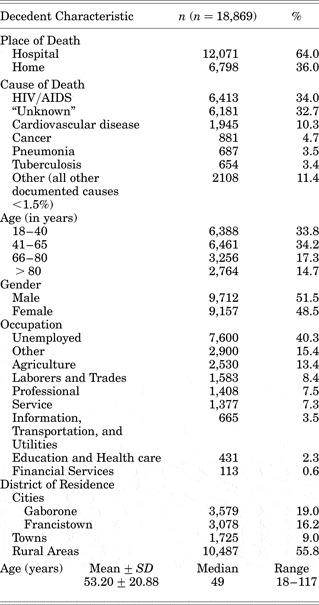
Six decedent-level variables were collected from death certificates. Shown in Table 1, they are place of death, cause of death, age, gender, occupation, and district of residence. Place of death was identified as either home or hospital.
Characteristics of adults who died in Botswana in 2005 and 2006 (excluding accident, trauma, pregnancy and missing stated cause of death)

It must be emphasized that what was listed as the cause of death on the death certificates was a mix of diseases and symptoms. They did not, in all cases, cohere with WHO ICD-9 diagnoses. Also, in most cases, secondary causes were not listed, and so it was not possible to conduct a panel review of them to place them into WHO ICD-9 diagnoses. Causes of death fell into 19 subcategories: HIV/AIDS, cardiovascular disease, cancer, pneumonia, tuberculosis, gastroenteritis, sepsis, respiratory disease, meningitis, renal failure, anemia, diabetes mellitus, encephalitis, dehydration, malaria, asthma, diarrhea, multi-system organ failure, and epilepsy, in order of frequency. For the purpose of analysis, we regrouped these into five main categories of causes of death: cancer, cardiovascular disease, HIV/AIDS, unknown, and other.
Age in years was collected and placed age into 4 categories: 18–40, >40–65, >65–80, >80 years. Gender was collected as male and female.
The U.S. Bureau of Labor Statistics (BLS) 2002 Occupational Classification system (BLS, 2002) was used to categorize occupation into the following nine categories: agriculture; education and health care; financial services industry; information, transportation, and utilities; laborers and trades; professional occupations; service industry; unemployed; and other.
The HTML printouts were organized by the RBD into 32 districts of residences. This organization was preserved in the data collection, but the deaths by district of residence were then further categorized as types identified by the ROB's Central Statistics Office's (CSO) 2001 census, namely, cities, towns, and rural areas (Central Statistics Office of the ROB [CSO], 2002).
Analysis
Data were organized and categorized in Microsoft Access 2007, exported into SPSS version 17, and analyzed. The sample was described using frequencies and measures of central tendency and dispersion, depending on the measurement level of the variable.
The data presented here are population data. However, to allow for the possibility that these data may not account for all the deaths that occurred in Botswana in 2005 and 2006, we performed tests for significance. Chi-square analysis was used to determine whether there existed an association between place of death, the dependent variable, which is nominal (home or hospital) and the independent variable of primary interest, cause of death, which is also nominal. Logistic regression was carried out to determine whether associations between the dependent variable and the independent variable of interest, cause of death, held in the presence of age, gender, occupation, and type of district of residence. For the logistic regression, the referent groups were based on the dummy variable that was thought least likely to predict home death. They were as follows: cardiovascular disease for cause of death; 18–40 for age; male for gender; the transportation, utilities, information category for occupations; and towns for categories of district of residence.
Ethical Considerations
Permission to conduct this study was obtained from the ROB's Research and Development Committee of the Ministry of Health, and from the Yale University School of Nursing Human Subjects Research Review Committee. To preserve anonymity, names were not collected, and addresses and death certificate numbers were not used in analysis. We assigned each death certificate a unique identifying number; and place of death for each certificate was listed as either home or hospital. Loss of decedents' confidentiality is the only identifiable risk, and, as this risk was reduced by not collecting names from the RBD, the benefit of knowing what influences place of death was far greater.
RESULTS
Sample Characteristics
Detailed in Table 1, the sample characteristics are as follows: of the 18,869 death records, 6,798 (36%) represented home deaths. The leading causes of death overall were HIV/AIDS (34%), cardiovascular disease (10.3%), and cancer (4.7%); however, for one third the cause of death was “Unknown” (32.7%). Men accounted for 9,712 (51.5%) of the sample. The average age of men at death was 53.7 years, with a standard deviation of 19.3 years. The average age of women at death was 52.7 years, with a standard deviation of 22.4 years. Most decedents were unemployed (40.3%). Agricultural workers comprised 13.4% of the sample. Most deaths (55.8%) occurred in rural areas; 35.2% occurred in cities. The average age at death was 53.2 years (SD = 20.9). Age at death ranged from 18 years to 117 years.
Bivariate Analysis
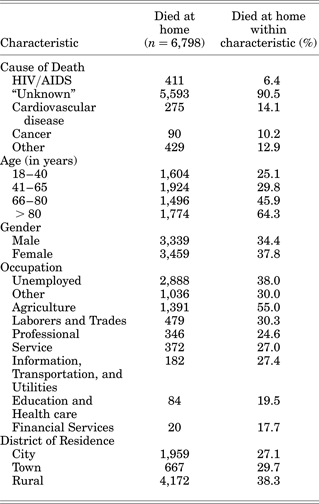
The bivariate analyses of associations are shown in Table 2.
Bivariate associations of decedent characteristics and dying at home for adults in Botswana 2005 and 2006 (p < .001)
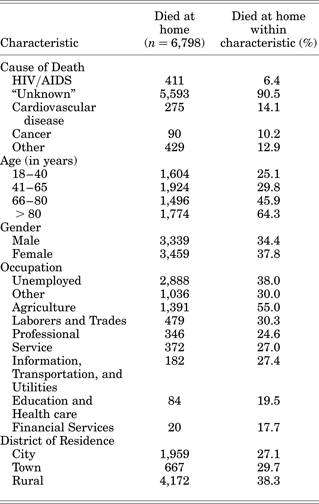
Over 90% of all those whose stated cause of death was listed as “Unknown” died at home, whereas only 14.1% of those who died of cardiovascular disease, 10.2% of those with cancer, and 6.4% of those with HIV/AIDS died at home.
A higher proportion of females died at home (37.8% vs. 34.4 % of males).
Almost two-thirds (64.3%) of those >80 years of age died at home. As the age group of decedents rose in years, so did the proportion that died at home.
Fifty-five percent of those whose occupation was agriculture died at home; and 38.0% of the unemployed died at home. Just over 30% of laborers and tradespeople died at home. Of those who died in rural areas, 38.3% died at home. Home deaths comprised 29.7% of deaths in towns. And in cities, only 27.1% of the deaths were at home.
Each decedent-level characteristic was found to be related to place of death at the p < 0.001 level, as noted in Table 2. Given this, logistic regression was carried out to determine independent predictors of dying at home.
Multivariate Analysis
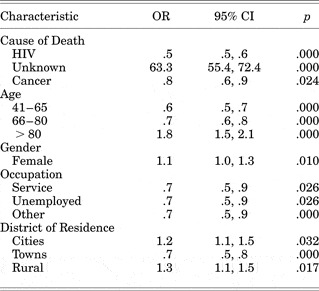
Table 3 highlights the results of logistic regression for the decedent-level characteristics that were significant related to dying at home at the p < 0.05 level. The only stated cause of death associated with home death was “Unknown” (OR = 63.3). However, cancer (OR = 0.8), HIV/AIDS (OR = 0.5), and the other category (OR = 0.01) were associated with hospital death. Being female was associated with home death (OR = 1.1), as was being >80 years of age (OR= 1.8). Ages categories 18–40, >40–65, and >65–80 predicted hospital death (OR = 0.5, 0.6, and 0.7, respectively). No occupation was associated with home death; but the service industry (OR = 0.7), unemployment (OR = 0.7) and other occupations (OR = 0.7) categories were associated with hospital death. Residing in cities (OR = 1.2) and in rural areas (OR = 1.3) were associated with dying at home. Living in towns (OR = 0.7) was significantly related to dying in hospital.
Independent predictors of dying at home for adults in Botswana 2005 and 2006 by logistic regression analysis

Summary of Results
The first question that motivated this study was whether a relationship exists between cause of death and place of death among adult Batswana. Most hospital deaths were recorded as caused by HIV/AIDS, cardiovascular disease, and cancer. It is not possible to say what most home deaths were caused by, as most home deaths were listed as having an unknown cause. Multivariate analysis confirmed that the odds of dying of cancer, HIV/AIDS and of other named causes lay with dying in hospital.
The second question that drove this research was whether decedents' age, gender, occupation, and district of residence influenced place of death. A 12-year difference in means of the ages of those who died at home from those who died in hospital was significant (p < 0.001). Results from the logistic regression show that all age categories with the exception of >80 years were associated with hospital death, while being older than 80 years old was associated with home death. Gender was nearly equally split by place of death; however, being female was associated with home death in the multivariate analysis. No occupation was associated with home as a place of death; but working in the service industry and in the category of “other occupations” and being unemployed predicted hospital death. While most hospital deaths occurred in cities, multivariate analysis suggested that decedents living in cities or rural areas had greater odds of dying at home; and decedents living in towns had greater odds of having died in hospital.
DISCUSSION
The burden of end-of-life-care weighs heavily on countries of the Global South. Those who are at the end of life and those who care for them may find that choosing the place of death gives them some control (Chochinov et al., Reference Chochinov, Hack and McClement2002; Tang et al., Reference Tang, Liu and Tsai2008; Tang et al., Reference Tang, Wu and Hung2009). To help those at the end of life and their caregivers gain this control, however, what influences where people die must be known.
These influences, and their association with where people die, are well known in the countries of the Global North (Weitzen, Reference Weitzen, Teno and Fennell2003; Wilson et al., Reference Wilson, Northcott and Truman2001). Three general groups of influences are identified in the literature: cause of death (Bruera et al., Reference Bruera, Sweeney and Russell2003; Bruera et al., Reference Bruera, Russell and Sweeney2002; Clifford et al., Reference Clifford, Jolley and Giles1991; Cohen et al., Reference Cohen, Bilsen and Hooft2006; Grunier et al., Reference Grunier, Mor and Weitzen2007; Pritchard et al., Reference Pritchard, Fisher and Teno1998; Tang et al., Reference Tang, Wu and Hung2009; Weitzen et al., Reference Weitzen, Teno and Fennell2003); socio-demographic factors (such as age, gender, and economic status), residence (for example, the degree of urbanization of the district of residence), and cultural factors (Bruera et al., Reference Bruera, Sweeney and Russell2003; Earle et al., Reference Earle, Park and Lai2003; Tang et al., Reference Tang, Wu and Hung2009; Cohen et al., Reference Cohen, Bilsen and Hooft2006); and finally, the availability of health care resources (Gallo et al., Reference Gallo, Baker and Bradley2001; Mor & Hiris, Reference Mor and Hiris1983; Pritchard et al., Reference Pritchard, Fisher and Teno1998; Virning et al., Reference Virning, McBean and King2002). However, little is known about what influences where people die in Sub-Saharan Africa (Collins & Harding, Reference Collins and Harding2007).
It is a well-known fact among countries of the Global North that an overwhelming majority of dying people wish to die at home (Tang et al., Reference Tang and McCorkle2001; Temkin-Greener & Mukamel, Reference Temkin-Greener and Mukamel2002), even though this wish is often not fulfilled in these countries (Cohen et al., Reference Cohen, Bilsen and Hooft2006; Grunier et al., Reference Grunier, Mor and Weitzen2007). In Botswana, 36% of deaths happened at home. Though not a majority, this is a full 10% greater than the rate of home deaths in Belgium, where in 2001 only a quarter of all deaths occurred at home (Cohen et al., Reference Cohen, Bilsen and Hooft2006), and in the United States, where in 1997, slightly over 23% of deaths occurred at home (Grunier et al., Reference Grunier, Mor and Weitzen2007).
In most countries, dying in cities is likely to predict hospital death (Bowling, Reference Bowling1983; Brown & Colton, Reference Brown and Colton2001; Cohen et al., Reference Cohen, Bilsen and Hooft2006), and in Botswana the proportion of hospital deaths is higher in cities than in rural areas. However, dying in a city or in a rural area in Botswana is more likely to predict home than hospital death, consistent with the findings of Cardenas-Turanzas et al. (Reference Cárdenas-Turanzas, Carrillo and Tovalín-Ahumada2007) in Mexico City. Long distances from (and hence, inaccessibility of) hospitals might result in rural dwellers dying at home.
Cohen et al. (Reference Cohen, Bilsen and Hooft2006) found that in Belgium most patients with cardiovascular disease, cancer, and respiratory diseases had a greater probability of dying at home (Cohen et al., Reference Cohen, Bilsen and Hooft2006). Unfortunately, it was not possible to say what Batswana who died at home were more likely to die of, as > 90% of all home deaths were listed as unknown. This use of “unknown” as a stated cause of death is not unique (Baiden, Reference Baiden, Bawah and Biai2007), as procedures for ensuring accurate statements of cause of death for home deaths have yet to be instituted in countries of the Global South (Setel, Whiting et al., Reference Setel, Whiting and Hemed2006).
Grunier et al. (Reference Grunier, Mor and Weitzen2007) and Cohen et al. (Reference Cohen, Bilsen and Hooft2006) found that in the United States and in Belgium being older is associated with hospital death. In Botswana, however, being older than 80 is associated with home death. While this may have something to do with the cultural view that the place for older adults is their home (Shaibu & Wallhagen, Reference Shaibu and Wallhagen2002), it is nonetheless a novel preliminary finding that warrants future in-depth study that takes into account the cultural value of older Batswana.
This study shows that females tend to die at home. Gender did not play a significant role in home or hospital death in the United States (Grunier et al., Reference Grunier, Mor and Weitzen2007). Perhaps the cultural norm of women caring for women (tradition of midwifery) explains this phenomenon in Botswana. While the percentages of home births is not known, the tradition of women caring for women has carried over into institutionalized health care, evidenced by nurse-midwives providing the full range of maternal and newborn health care, especially in rural areas (Akinsola & Ncube, Reference Akinsola and Ncube2000).
Death for Batswana is twice as likely to occur in hospital as at home. This is similar to findings in Belgium (Cohen et al., Reference Cohen, Bilsen and Hooft2006), the United Kingdom (Ahmad & O'Mahony, Reference Ahmad and O'Mahony2005), and the United States (Bruera et al., Reference Bruera, Sweeney and Russell2003; Grunier, et al., Reference Grunier, Mor and Weitzen2007), matching almost exactly what Yun et al. (Reference Yun, Lim and Choi2006) found in Korea. Grunier et al. (Reference Grunier, Mor and Weitzen2007) found that in the United States hospital deaths were correlated with hospital-bed density. Cardenas-Turanzas et al. (Reference Cárdenas-Turanzas, Carrillo and Tovalín-Ahumada2007), who considered only deaths from cancer in Mexico City, found that the type of cancer (lymphoma and leukemia) predicted hospital death, as did living outside Mexico City in more rural areas. It is possible that city hospitals in Botswana are overpopulated.
HIV/AIDS, cardiovascular disease, and cancer were documented as the causes of death in the hospital. The finding that > 90% of all who die of HIV/AIDS die in hospital coheres with findings of where people with HIV/AIDS die in the United States (Hellinger, Reference Hellinger2008). Moreover, the finding that cancer is predictive of a hospital death, when coupled with the finding that being younger than 80 years old predicts hospital death, coheres with the findings of Cardenas-Turanzas et al. (Reference Cárdenas-Turanzas, Carrillo and Tovalín-Ahumada2007) that, in the Mexico City metropolitan area, younger patients with cancer tended to die in hospital.
Limitations of the Study
The richness of the death certificate data from Botswana notwithstanding, using death certificates presents limitations. The records themselves, as we received them from the RBD, do not include primary and secondary causes of death. More generally, however, death certificates do not provide information about factors that have been found to be determinants of where people die, such as caregiver support and patient and caregiver wishes; nor do they allow for determination of preferred place of death or contain qualitative information about the dying process (Tang & McCorkle, Reference Tang and McCorkle2001; Tang et al., Reference Tang, Wu and Hung2009). In addition, death certificates do not usually contain quantitative information about the income of decedents or the wealth available in their households (Gallo et al., Reference Gallo, Baker and Bradley2001; Tang, Reference Tang2002).
Death certificate analyses are also limited in that the cause of death reported on a death certificate can differ from an actual cause of death as recorded on postmortem. This study was limited specifically, since the causes of death listed did not always follow ICD-9 diagnoses. Some of the listed causes of death were symptoms and not diagnoses per se (for example, sepsis due to HIV/AIDS). Lopez et al. (Reference Lopez, Mathers and Ezzati2006) noted this lack of stated causes of death in their analysis of global population data.
Another limitation for this research is the absence of data about social support; marital status and nationality were not available. Being married, regardless of one's age, is related to the availability of critical social support at the end of life. Receipt of end-of-life care by hospice in the home in the United States, for example, is possible only for those very ill patients who have family members at home to meet daily care needs. This is most often the spouse, except at very advanced ages (Angus et al., Reference Angus, Barnato and Linde-Zwirble2004; Stearns et al., Reference Stearns, Kovar and Hayes1996). Perhaps the death of older Batswana is less predictable, and so they end up dying at home, without the chance for loved ones to rush them to hospital. At the same time, however, older Batswana may have large social-support networks around them; this may explain the trend of older Batswana dying at home rather than in the hospital. These speculations notwithstanding, the absence of both quantitative and qualitative data about the social-supports is a significant impediment to drawing conclusions.
Race and ethnicity, in this case, measured by nationality (from Botswana or from another nearby country), represent a more complex social meaning that is often associated with both access to formal resources and an enculturation of attitudes toward and preferences for medical services. The nationality of the decedent was not in this study.
The robustness of each decedent-level variable in previous research on the determinants of site of death underscores the importance of social support in describing how different types of people will use medical resources at the end of life. Without access to the two decedent-level variables that indicate social support (marital status and nationality), whether social support exerts itself into the choice of place of death for those who died in Botswana in 2005 and 2006 will remain unknown.
The literature shows a clear increase in hospital deaths in areas with greater hospital-bed density. The health care system in Botswana is nationalized; no one is refused care. Health posts staffed by nurses exist in villages of at least 500 Batswana; towns have general hospitals; and the two cities have referral, teaching hospitals. The two cities may have lower hospital-bed density than the towns, in that the population in cities may have grown faster than health care infrastructure. Future research will examine available health care resources and rates of hospital and home deaths by district of residence.
The predominance of “unknown” as the stated cause of death for home deaths clouds the analysis vis-à-vis association of stated cause of death with home deaths.
Finally, and most important, this study is limited by its cross-sectional descriptive nature. To understand whether being infected with HIV/AIDS increases the likelihood of hospital death, and if it does, what unseen forces propel those infected to hospital to die, longitudinal qualitative research needs to be conducted.
Implications for Research and Practice
The next step in the analysis of these data is to determine whether there is association between hospital deaths and available health care resources. In addition, the phenomenon that older people die at home needs more in-depth analysis. Age stratifications need to be studied against ICD-9 diagnoses, district of residence, and available health care resources to look for associations with place of death.
There is need for future research vis-à-vis the finding that greater > 90% of home deaths are listed as cause “unknown.” Verbal autopsies, which are open-ended histories of the final illnesses in order to determine cause of death, could be used to that end. Setel, Whiting et al. (Reference Setel, Whiting and Hemed2006) have shown that, in Tanzania, verbal autopsies produce accurate estimations of cause-specific mortality. Setel, Rao et al. (Reference Setel, Rao and Hemed2006) confirmed this by comparing these Tanzanian results with results from verbal autopsies in China. They recommend validation studies when verbal autopsies are used in new settings, to account for the unique epidemiological milieu of each setting. Soleman et al. (Reference Soleman, Chandramohan and Shibuya2006) lay a map for how to do just that, as do Araya et al. (Reference Araya, Reniers and Schaap2004) and Baiden et al. (Reference Baiden, Bawah and Biai2007). Given that nurses are the primary face of health care in Botswana, especially in rural Botswana, nurses could be educated to conduct verbal autopsies. Moreover, instituting a process for collecting verbal autopsies would give the Ministry of Health of Botswana and the RBD the opportunity to institute a rule that all stated causes of death on death certificates and on death certificate registries accord with ICD-9 diagnoses.
There is a need for information on where Batswana with life-limiting illness want to die, as well as where their caregivers want them to die. Longitudinal descriptive research is indicated to assess whether decedents' wishes were fulfilled, and if not, what factors prevented them from being fulfilled, including the choices caregivers made on behalf of their loved ones. Such data would inform palliative care and hospice programs. Meeting the palliative care and hospice needs of the dying in the place they wish to die would help to restore a sense of control amid the high uncertainty that disease will cause mortality. It would go a long way toward preserving the dignity of dying people.