


%20--%3e%3c!DOCTYPE%20svg%20PUBLIC%20'-//W3C//DTD%20SVG%201.0//EN'%20'http://www.w3.org/TR/2001/REC-SVG-20010904/DTD/svg10.dtd'%3e%3csvg%20version='1.0'%20id='Layer_1'%20xmlns='http://www.w3.org/2000/svg'%20xmlns:xlink='http://www.w3.org/1999/xlink'%20x='0px'%20y='0px'%20width='64px'%20height='64px'%20viewBox='5.5%20-3.5%2064%2064'%20enable-background='new%205.5%20-3.5%2064%2064'%20xml:space='preserve'%3e%3cg%3e%3ccircle%20fill='%23FFFFFF'%20fill-opacity='0'%20cx='37.785'%20cy='28.501'%20r='28.836'/%3e%3cpath%20fill='%23595959'%20d='M37.441-3.5c8.951,0,16.572,3.125,22.857,9.372c3.008,3.009,5.295,6.448,6.857,10.314%20c1.561,3.867,2.344,7.971,2.344,12.314c0,4.381-0.773,8.486-2.314,12.313c-1.543,3.828-3.82,7.21-6.828,10.143%20c-3.123,3.085-6.666,5.448-10.629,7.086c-3.961,1.638-8.057,2.457-12.285,2.457s-8.276-0.808-12.143-2.429%20c-3.866-1.618-7.333-3.961-10.4-7.027c-3.067-3.066-5.4-6.524-7-10.372S5.5,32.767,5.5,28.5c0-4.229,0.809-8.295,2.428-12.2%20c1.619-3.905,3.972-7.4,7.057-10.486C21.08-0.394,28.565-3.5,37.441-3.5z%20M37.557,2.272c-7.314,0-13.467,2.553-18.458,7.657%20c-2.515,2.553-4.448,5.419-5.8,8.6c-1.354,3.181-2.029,6.505-2.029,9.972c0,3.429,0.675,6.734,2.029,9.913%20c1.353,3.183,3.285,6.021,5.8,8.516c2.514,2.496,5.351,4.399,8.515,5.715c3.161,1.314,6.476,1.971,9.943,1.971%20c3.428,0,6.75-0.665,9.973-1.999c3.219-1.335,6.121-3.257,8.713-5.771c4.99-4.876,7.484-10.99,7.484-18.344%20c0-3.543-0.648-6.895-1.943-10.057c-1.293-3.162-3.18-5.98-5.654-8.458C50.984,4.844,44.795,2.272,37.557,2.272z%20M37.156,23.187%20l-4.287,2.229c-0.458-0.951-1.019-1.619-1.685-2c-0.667-0.38-1.286-0.571-1.858-0.571c-2.856,0-4.286,1.885-4.286,5.657%20c0,1.714,0.362,3.084,1.085,4.113c0.724,1.029,1.791,1.544,3.201,1.544c1.867,0,3.181-0.915,3.944-2.743l3.942,2%20c-0.838,1.563-2,2.791-3.486,3.686c-1.484,0.896-3.123,1.343-4.914,1.343c-2.857,0-5.163-0.875-6.915-2.629%20c-1.752-1.752-2.628-4.19-2.628-7.313c0-3.048,0.886-5.466,2.657-7.257c1.771-1.79,4.009-2.686,6.715-2.686%20C32.604,18.558,35.441,20.101,37.156,23.187z%20M55.613,23.187l-4.229,2.229c-0.457-0.951-1.02-1.619-1.686-2%20c-0.668-0.38-1.307-0.571-1.914-0.571c-2.857,0-4.287,1.885-4.287,5.657c0,1.714,0.363,3.084,1.086,4.113%20c0.723,1.029,1.789,1.544,3.201,1.544c1.865,0,3.18-0.915,3.941-2.743l4,2c-0.875,1.563-2.057,2.791-3.541,3.686%20c-1.486,0.896-3.105,1.343-4.857,1.343c-2.896,0-5.209-0.875-6.941-2.629c-1.736-1.752-2.602-4.19-2.602-7.313%20c0-3.048,0.885-5.466,2.658-7.257c1.77-1.79,4.008-2.686,6.713-2.686C51.117,18.558,53.938,20.101,55.613,23.187z'/%3e%3c/g%3e%3c/svg%3e)
%20--%3e%3c!DOCTYPE%20svg%20PUBLIC%20'-//W3C//DTD%20SVG%201.0//EN'%20'http://www.w3.org/TR/2001/REC-SVG-20010904/DTD/svg10.dtd'%3e%3csvg%20version='1.0'%20id='Layer_1'%20xmlns='http://www.w3.org/2000/svg'%20xmlns:xlink='http://www.w3.org/1999/xlink'%20x='0px'%20y='0px'%20width='64px'%20height='64px'%20viewBox='5.5%20-3.5%2064%2064'%20enable-background='new%205.5%20-3.5%2064%2064'%20xml:space='preserve'%3e%3cg%3e%3ccircle%20fill='%23FFFFFF'%20fill-opacity='0'%20cx='37.637'%20cy='28.806'%20r='28.276'/%3e%3cg%3e%3cpath%20fill='%23595959'%20d='M37.443-3.5c8.988,0,16.57,3.085,22.742,9.257C66.393,11.967,69.5,19.548,69.5,28.5c0,8.991-3.049,16.476-9.145,22.456%20C53.879,57.319,46.242,60.5,37.443,60.5c-8.649,0-16.153-3.144-22.514-9.43C8.644,44.784,5.5,37.262,5.5,28.5%20c0-8.761,3.144-16.342,9.429-22.742C21.101-0.415,28.604-3.5,37.443-3.5z%20M37.557,2.272c-7.276,0-13.428,2.553-18.457,7.657%20c-5.22,5.334-7.829,11.525-7.829,18.572c0,7.086,2.59,13.22,7.77,18.398c5.181,5.182,11.352,7.771,18.514,7.771%20c7.123,0,13.334-2.607,18.629-7.828c5.029-4.838,7.543-10.952,7.543-18.343c0-7.276-2.553-13.465-7.656-18.571%20C50.967,4.824,44.795,2.272,37.557,2.272z%20M46.129,20.557v13.085h-3.656v15.542h-9.944V33.643h-3.656V20.557%20c0-0.572,0.2-1.057,0.599-1.457c0.401-0.399,0.887-0.6,1.457-0.6h13.144c0.533,0,1.01,0.2,1.428,0.6%20C45.918,19.5,46.129,19.986,46.129,20.557z%20M33.042,12.329c0-3.008,1.485-4.514,4.458-4.514s4.457,1.504,4.457,4.514%20c0,2.971-1.486,4.457-4.457,4.457S33.042,15.3,33.042,12.329z'/%3e%3c/g%3e%3c/g%3e%3c/svg%3e)
Introduction
Over its four funding periods, the University of Pittsburgh (Pitt) Clinical and Translational Science Institute (CTSI) has developed numerous educational initiatives for students, trainees, staff, and investigators at Pitt. However, we recognized an unmet need to address the ongoing shortage and turnover of research staff as well as the lack of diversity.
In parallel, CTSI has also been committed to embedding research reciprocity as a guiding core principle in translational research [Reference Trainor and Bouchard1]. We embarked on initiatives to actively integrate community members in all aspects of the research process, such as Community-Partnered Research Ethics Training [Reference Yonas, Jaime and Barone2] to allow community members to participate as coinvestigators in individual studies, but we had not specifically considered training and hiring community members into permanent research staff roles.
As part of CTSI 4.0, we developed a pathway through which members of local underrepresented communities can be trained and hired to work at Pitt as clinical research assistants, thus providing a durable bridge from community to academic research. This initiative arose out of a discussion at a CTSI External Advisory Board meeting during which Board member William E. Strickland, founder and then President of the nonprofit Manchester Bidwell Corporation, pointed out that graduates from his Bidwell Training Center programs could help fill research staff vacancies and help diversify clinical research teams.
For over 50 years, the Bidwell Training Center, an accredited, state-licensed, nonprofit job training center with established roots in a marginalized community, has provided career training at no cost to adults in transition. Bidwell receives funding from the Commonwealth of Pennsylvania, private foundations, and individual donors, making it possible for all students to receive full tuition, textbooks, uniforms, and supplies required for training at no cost to them. Bidwell offers career-oriented, tuition-free training in six majors, three of which are in allied health fields. All Bidwell trainees also complete a practical externship with potential employers.
We created the STricklAnd Research Training program, named in honor of Mr. Strickland, to provide Bidwell students a career path in clinical research through didactic training, externships, mentoring, job placement, and continuing education and professional development. This program is also part of our initiative to actively infuse inclusion, diversity, equity, and access (IDEA) into all aspects of the research process at Pitt, including research teams themselves. A major goal of our IDEA initiative centers on workforce diversification at all levels, and the START program will contribute to successful achievement of this goal.
STricklAnd Research Training (START) Program
Competency-Based Curriculum
Three of us (KC, LY, DS) worked with Bidwell Training Center to develop competency-based clinical research training to be incorporated within Bidwell’s Medical Assistant program. We chose the Medical Assistant program as the foundation for our START curriculum because students learn other skills during the 7-month program that are also essential for clinical research assistant positions, such as phlebotomy, electronic health records, vital signs, and patient interactions.
We drafted the START curriculum based on the main topics in four Collaborative Institutional Training Initiative (CITI) modules: Responsible Conduct of Research, Privacy and Information Security, Good Clinical Practice, and Human Subjects Research. Initially, the training comprised 2 weeks of pre-recorded presentations that the students watched, followed by the completion of homework assignments, and attending a remote meeting with the section presenters. Student were then asked to complete three CITI modules: Responsible Conduct of Research, Privacy and Information Security, and Human Subjects Research.
We received feedback from the students and the Medical Assistant Instructor at Bidwell Training Center that this was too time-consuming and dense. We therefore revised the didactic training for second cohort to cover eight sessions (Table 1) in six weekly classes, each lasting 2 hours. The students attended 1-hour remote lectures during which section presentations are delivered live, followed by questions and discussion. The program is currently delivered remotely using Google Classroom.
STricklAnd Research Training (START) program competencies

Instead of homework, short quizzes are given to check comprehension. Successful completion of the training is based on attendance, participation, quiz scores, a role-playing exercise, and – instead of CITI modules – completion of CIRTification Online: Community Involvement in Research Training [3], which is a free, interactive web-based human research protections training program tailored specifically for community research partners. This approach was better received by our second and third cohorts (Table 2) and will be continued going forward.
START program summary data
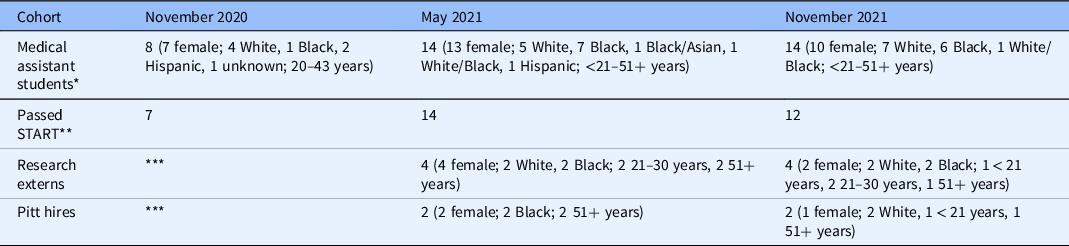
* Total number enrolled in Bidwell Training Center Medical Assistant program.
** Satisfactory completion of quizzes, role-playing, participation, CIRTification.
*** Externship agreement not yet executed at time of first cohort, no job opportunities as result.
Externship with mentoring and shadowing
A key component of all Bidwell programs is an externship, which must be unpaid per accreditation requirements. Students in the START program have the option of completing a clinical research-focused externship through the CTSI, during which students receive protocol-related training and mentorship. The importance of this type of hands-on externship for research staff is highlighted by recent findings that clinical research coordinators found experience, day-to-day practice, and observing colleagues and mentors an essential supplement to formal Good Clinical Practice training [Reference Mozersky, Antes, Baldwin, Jenkerson and DuBois4].
To enable START trainees to perform their externship at Pitt, an agreement was signed between the University of Pittsburgh on behalf of the CTSI and Bidwell Training Center. Externship experiences are study-specific and include shadowing in successful research programs and rotating through the CTSI Clinical and Translational Research Program sites, which provide specialized data collection and intervention services.
We also created a Memorandum of Understanding signed by CTSI and research groups interested in hiring a START program graduate as a research assistant. This Memorandum outlines expectations, including providing the START trainee with a hands-on externship opportunity, mentoring both through CTSI and the research program, and employment following successful completion of the externship. Although the externship is required to be unpaid, we were able to give START trainees vouchers for parking and bus fare.
We work with selected clinical research teams to create externships through which Bidwell students can learn and practice essential skills, such as recruiting patients for research studies, obtaining informed consent, and administering assessments. Because we specifically place students with research groups seeking to hire a clinical research assistant, the externship experience can also serve as initial job training and help ensure that the personnel fit is good. We plan to offer research teams participating in the externship bias reduction and other training in advance to ensure an inclusive, welcoming, and supportive culture and environment.
START externs must successfully complete CITI modules required for clinical research. Extern competencies are evaluated at weeks two and four of the externship, and, to date, all externs have passed their mid-review and final competency evaluations. Should a future extern have difficulty with one or more competencies tested, we would work with that START graduate and with Bidwell Training Center to adjust the externship to address the needed competency.
Transition to employment
As noted above, students are matched with a clinical investigator who has a research assistant job opening, with the intention that the externship will transition to full employment at Pitt. Working with the clinical study team as part of their formal training ensures START trainees are fully aware of what is expected of them when they are hired. At the same time, clinical investigators are briefed in advance about their expectations for START program students, since they do not come from an undergraduate background like most clinical research assistants.
A Workforce Development Career Counselor in Human Resources works with the START program students to help them prepare, submit, and track their job applications. The counselor can also help ensure the applications are reaching the research teams.
Career advancement
Research staff at all career stages have professional development opportunities through CTSI, and all employees at Pitt receive tuition benefits that would allow START graduate hires and their spouses and children to pursue college degrees. The Pitt College of General Studies offers a variety of learning options designed for adult and non-traditional students and includes flexible scheduling for those who work full-time.
Research teams who hire START graduates are specifically asked to give these research assistants time off to attend the CTSI Introduction to Research Workforce activities, which includes the 2-day Orientation to Research Fundamentals workshop offered semi-annually, as well as CTSI Diversity, Equity, and Inclusion trainings. In addition, we offer more advanced workshops and trainings throughout the year that START hires can complete to document new skills that could qualify them for salary increases. Following hire, the START program coordinator routinely checks in with the START graduate to provide mentoring and support as they transition into their new role as a clinical research assistant.
Program enrollment
Students enroll in the Bidwell Medical Assistant program and then learn about the START training. Since November 2020, three cohorts have completed the START program (Table 2). The first cohort had lower enrollment numbers than is typical for the Bidwell Training Center due to the COVID-19 pandemic; typical class size is 14–20. Due to a delay in executing the externship agreement, Pitt was not able to host the first cohort of externs after they completed their START training.
All 14 students in the second cohort successfully completed both the medical assistant and START training. All four students who chose to complete their externships through CTSI had the opportunity to apply to open research assistant positions at Pitt. Three out of the four applied and were offered positions, and one student accepted the job offer at Pitt; one of the other students initially decided not to accept the offer but later came back to apply again and has been hired. In the third cohort, four START trainees completed their externship through CTSI. Two pursued clinical research assistant jobs at Pitt, while the other two students decided to pursue other careers.
To date, START graduates hired at Pitt have been majority female and older (>51 years), and half (2/4) are Black. Table 3 provides quotes from START externs and hires on why they did or did not pursue a career in research and, for current hires, their experience.
Qualitative feedback on decision regarding research career

Future plans
We are evaluating the success of the program itself quantitatively and qualitatively. At the conclusion of the didactic training and again at the conclusion of the externship, Bidwell students complete an evaluation form, and their feedback is used to improve the START program.
For those hired at Pitt, we will monitor whether START graduates remain in research assistant positions at Pitt longer than more traditional hires with college backgrounds, since the START research assistants may be more likely to view their positions as career opportunities with room for advancement. We will also monitor whether they pursue a college degree on a career path to become a biomedical researcher.
We will similarly evaluate the quantitative (e.g., enrollment-retention of study participants from underrepresented backgrounds) and qualitative (e.g., team perspectives on inclusion and awareness of bias) impact of START graduates on the clinical studies and the research teams in which they are involved.
To enhance retention, we will create a near-peer mentoring program partnering START program hires with experienced research staff. The near-peer mentor will be trained by Master Facilitators at Pitt who are certified in teaching the Entering Mentoring curriculum [Reference House, McDaniels, Spencer, Utzerath and Pfund5]. The near-peer mentor will meet with their START mentee monthly or more frequently if needed.
To support career advancement, we are working closely with Human Resources and the Office of Diversity at Pitt to create a competency-based structure for research staff that can be used for hiring, promotion, and compensation. In collaboration with the Duke CTSA Hub, we are adapting for use at Pitt their REDCap tool to identify job classifications based on competencies. Duke’s tool enables faculty to identify potential staff and list the job responsibilities for that role, and then map the role to a job title [Reference Brouwer, Deeter and Hannah6,Reference Stroo and Deete7]. The program creates a professional pathway, identifies advancement opportunities, and defines objective assessments of competencies needed for advancement. In parallel, we will adapt our online Customized Career Development Platform to enable research staff to strategically plan their careers by identifying career goals and linking competency-based training that is available at Pitt or nationally to each goal. This competency-based pathway for career advancement will help START Program hires clearly understand what they need to learn or accomplish to be eligible for a step increase in salary within their job classification, and CTSI will be available to help them track progress and achieve these goals.
Discussion
The START program was created as a partnership between CTSI and the nonprofit Bidwell Training Center to expand the career opportunities of medical assistant trainees from disadvantaged backgrounds as clinical research assistants. The START program also serves to diversify Pitt’s translational research workforce in terms of background and lived experience, and our ultimate goal is for translational research at Pitt to be enriched at all stages – from the formation of research questions through dissemination of results back to the community – through the diversity of life perspectives brought by START graduates to study teams.
We have and will continue to learn from these students as we refine the START program. We launched START just prior to the COVID 19 pandemic, which both reduced the class size for each START cohort and guided our decision to deliver the clinical research training remotely. However, the remote training made continued engagement and rapport building with the students difficult. Once it was safe to do so, we began visiting the Bidwell Training Center in person after students completed the didactic training but before they indicated their choice for externship placement. We had a clinical research assistant from Pitt host a question and answer session at which they spoke about their background, what led them to research, and what their job entails and to answer Bidwell student questions. For the most recent cohort, we were able to have a START program graduate currently employed at Pitt return to Bidwell to talk with their peers.
In addition, we learned that it is imperative to talk with the students about job requirements and location. This could include whether the position is part-time or full-time, whether job-related travel is required, and whether the job location(s) are located on a bus line or have parking available. We also recognized the importance of confirming that each student’s experience and education fulfill job requirements to ensure that the student is a good fit for the position and vice versa.
A major challenge that arose is the pandemic-related staffing shortage in all areas of clinical care. Prior to COVID-19, research assistant salaries were similar if not slightly above typical medical assistant salaries. Starting in 2020, however, private employers began offering sign-on bonuses and higher wages, making academic positions less competitive. Our current approach in recruiting is to emphasize the benefits that academic institutions have to offer beyond salary, including good insurance and retirement plans, tuition benefits for employees and their families, and generous leave policy. We also emphasize the career advancement and continuing education opportunities that academic positions offer. We plan to keep in touch with START graduates to ensure they realize the door is always open at Pitt should they later become interested in a research assistant position. Indeed, one student who initially turned down a position at Pitt later returned and was hired.
Our implementation of the START program in three cohorts has allowed us to refine the didactic component, identify and address challenges, and set the stage for expansion. Our most important outcome is reflected in the percentage of students who successfully completed the START program as part of their Bidwell training (92%) and who will therefore carry with them a strong understanding of and comfort with clinical research, no matter where they work. Although not every trainee will choose to pursue a career in research, they can serve as ambassadors on behalf of clinical research and reinforce the importance and value of research participation to others in their communities. For those who accept research assistant positions at Pitt, we look forward to evaluating their impact on the research teams with whom they work and the research studies they help support.
Looking toward scaling the program and program replication, we will develop and disseminate an educational package with our eight training sessions, comprehension quizzes, and online CIRTification as an add-on to any standard medical assistant program. The parent nonprofit organization of Bidwell Training Center, the Manchester Bidwell Corporation, supports a network of similar training centers throughout the US, including 13 located near CTSA Hubs, which offers the opportunity for national dissemination of our program throughout the CTSA Consortium.
We are also exploring additional potential partners to determine if the START program can be adapted for use in other vocational program and community college settings, similar to the Clinical Research Coordination Certificate offered by Urban College of Boston [8]. In addition, we will consider developing community-based training programs for other critically needed research staff positions, including laboratory technicians, data entry and coding, and call centers.
In summary, the CTSI START Program addresses multiple needs simultaneously. First, there is the economic opportunity and new career option afforded to local residents seeking to advance their earning potential but for whom 2- or 4-year college is not an option, at least not initially. Second, filling research staff positions with locally trained community members advances biomedical research workforce diversification in terms of both demographics and personal and socioeconomic perspectives and backgrounds. Third, members of underrepresented communities hired into the Pitt research ecosystem will bring important new voices and experiences to diversity, equity, and inclusion initiatives at CTSI and across the university. Fourth, creating a career pathway and providing career planning and development support for locally trained community members may help reduce staff turn-over, which can significantly affect the ability of an investigator to efficiently complete a research study on time. Finally, hiring community members as research assistants further promotes our goals of both research reciprocity and research receptivity, which we believe will translate to improved recruitment and retention of participants from underrepresented backgrounds.
Acknowledgments
We wish to gratefully acknowledge the many individuals who helped make the START Program a success. At the Bidwell Training Center, we recognize the hard work and commitment of Jarene Barnes, Rachel Dille, Jodi Johnson, Karen Kollar, and Stephanie Viele. We have and continue to receive assistance and support from the Pitt Human Resources office, including Lisa Garland and Roland Woods. Several CTSI team members were instrumental in planning, developing, and implementing the START program, including Sue Clifton, Carrie Fascetti, Phil Gomez, RaNaja Kennedy, Travis Mateleska, Christina Nicassio, Teri Reiche, Doris Rubio, and Shannon Valenti.
The START Program was supported by the National Institutes of Health through grant number UL1TR001857.
Disclosures
The authors have no conflicts of interest to declare.


 Open access

