In 2018 U.S. producers harvested 58,440 ha of sweetpotato with a farm value of >$654 million (USDA-NASS 2019). Sweetpotato production is largely concentrated in California and in the southeastern states, with Louisiana, Mississippi, and North Carolina accounting for 78% of harvested hectares in 2018 (USDA-NASS 2019). Field preparation for commercial sweetpotato production begins with spring tillage and is followed by (fb) the formation of ridged planting rows. In the Southeast ridged planting rows may be established the same day as transplanting or weeks prior to the transplanting. Often, ridged rows formed days to weeks before transplanting are not treated with residual herbicides and weeds emerge in the time between row formation and transplanting. Although Coleman et al. (Reference Coleman, Chaudhari, Jennings, Schultheis, Meyers and Monks2016) documented effective weed control with flumioxazin as much as 45 d prior to transplanting in a stale bed production system, most producers rely on either additional tillage and/or the use of a burndown herbicide to control emerged weeds prior to transplanting. Currently, in sweetpotato, pretransplanting burndown applications consist of paraquat or glyphosate with a preference for paraquat because of its rapid herbicidal activity.
Paraquat is a widely used, restricted-use POST herbicide and desiccant/defoliant. In its concentrated form, paraquat is highly lethal. Ingestion of 20 to 40 mg paraquat kg−1 of body weight results in pulmonary fibroplasia, multiple organ damage, and death in most cases, whereas ingestion of >40 mg kg−1 results in expedited organ damage, ulceration of the oropharynx, and nearly 100% mortality within 7 d (Roberts and Reigart Reference Roberts and Reigart2013). The accidental ingestion of paraquat transferred to beverage containers has resulted in 17 deaths since 2000, and an additional 3 deaths and numerous severe injuries have been caused by dermal or ophthal exposure (EPA 2019). In 2019, the U.S. Environmental Protection Agency announced new restrictions on the use of paraquat that included changes to the pesticide label to highlight toxicity risks, required training for pesticide applicators, restricted use of paraquat to certified pesticide applicators only, and new closed-system packaging designed to prevent spills and the pouring of paraquat into other containers (EPA 2019). Given the new restrictions imposed on paraquat and the increased awareness of paraquat toxicity, diquat is now being considered as a replacement for paraquat in burndown applications.
Both paraquat and diquat are bipyridyls that inhibit photosynthesis at photosystem I, resulting in wilting and desiccation within several hours of exposure and complete foliar necrosis after 1 to 3 d (Shaner Reference Shaner2014). Both are highly water soluble, have a half-life of l,000 d, but are tightly bound to soil particles (Koc = 1,000,000 mL g−1; Shaner Reference Shaner2014). Diquat is most frequently used as a POST herbicide in ponds, lakes, and drainage ditches to control algae and aquatic weeds (Shaner Reference Shaner2014). It can also be used as a desiccant prior to harvesting seed crops and potatoes (Solanum tuberosum L.) or, in some states, after some fruiting vegetable crops and cucurbits have been harvested. Unlike paraquat, diquat is not a restricted-use pesticide, and because diquat is not concentrated in the lung tissue, pulmonary injury is less prominent than with paraquat (Roberts and Reigart Reference Roberts and Reigart2013). To support future registrations of diquat in sweetpotato, likely as a special local needs registration on a state-by-state basis, it was necessary to obtain crop tolerance data. The objective of this study was to determine sweetpotato tolerance to diquat applied preplant for the purposes of use as a burndown herbicide.
Materials and Methods
Field experiments were conducted at two locations in North Carolina in 2017 and a single location each in Mississippi and Louisiana in 2018. Consult Table 1 for information regarding cultivars grown, planting and harvest dates, and herbicide application information. Cultivars used in the trial represent the predominant rose-skinned, orange-fleshed, tablestock cultivar grown in each respective state. Consult Table 2 for herbicide manufacturer information. Due to slight differences in treatments, methods practiced in North Carolina will be presented and data analyzed separately from those in Louisiana and Mississippi.
Sweetpotato cultivars, planting dates, harvest dates, and herbicide application information for diquat tolerance trials conducted in North Carolina in 2017 and Louisiana and Mississippi in 2018.

a Beauregard, Covington, and Orleans are rose-skinned, orange-fleshed tablestock clones. The planting materials was nonrooted vine tip cuttings (slips).
b Abbreviation: DAP, days after transplanting.
c Source of materials: Spraying Systems Co., Wheaton, IL.
Product and manufacturer information for diquat tolerance trials conducted in North Carolina in 2017 and Louisiana and Mississippi in 2018.

North Carolina
Trials were conducted at the Horticultural Crops Research Station in Clinton, NC (35.0227°N, 78.2794°W) on a Norfolk loamy sand (fine-loamy, kaolinitic, thermic Typic Kandiudults) with pH 6.0 and 0.7% organic matter. Plots were two rows, each 6.1 m long with a between-row spacing of 106 cm and an in-row plant spacing of 23 cm to 30 cm. The first row was nontreated and served as border row buffer. The second row was treated. All plots received between-row cultivation just before row closure and were hand-weeded as needed all season. Treatments consisted of two rates of diquat (560 or 1,120 g ai ha−1) alone or mixed with 107 g ai ha−1 flumioxazin and applied 1 d before transplanting (DBP), sequential applications of diquat (560 or 1,120 g ha−1) 1 and 17 DBP, 107 g ha−1 flumioxazin alone (registered grower standard), and a nontreated check. Sethoxydim at 0.34 kg ai ha−1 plus 1% (v/v) crop oil concentrate was applied POST as needed to control goosegrass (Eleusine indica L. Gaertn) and large crabgrass [Digitaria sanguinalis (L.) scop.]. The experiment design was a randomized complete block with four replications.
Data collection included visual crop injury on a scale of 0% (no injury) to 100% (crop death; Frans et al. Reference Frans, Talbert, Marx, Crowley and Camper1986) 3, 13, and 27 d after transplanting (DAP) at Location 1; and 12, 19, and 23 DAP at Location 2. Sweetpotatoes were harvested using a tractor-mounted chain digger and then hand-graded using a modified version of USDA (2005) standards into jumbo (≥8.9 cm in diam), No. 1 (≥4.4 cm but <8.9 cm), and canner (≥2.5 cm but <4.4 cm). Misshapen roots of No. 1 size or greater were considered culls and were included with the canner grate to create an aggregate processing grade. Total yield was calculated as the sum of jumbo, No. 1, and processing grades.
Mississippi and Louisiana
Field trials were conducted at the Pontotoc Ridge-Flatwoods Branch Experiment Station in Pontotoc, MS (34.1331°N, 89.0063°W) and the Sweet Potato Research Station in Chase, LA. The soil in Mississippi was a Falkner silt loam (fine-silty, siliceous, thermic Aquic Paleudalfs) with pH 6.3 and 1.3% organic matter. The soil in Louisiana was a Gilbert silt loam (fine-silty, mixed, active, thermic Typic Glossaqualfs) with pH 5.9 and 1.6% organic matter. In Mississippi, plots consisted of three rows, each 9.4 m long and 1.0 m apart with an in-row plant spacing of 30 cm; all rows were treated. In Louisiana, plots consisted of three rows, each 7.6 m long and 1.0 m apart with an in-row planting spacing of 30 cm. The first row was nontreated and served as border row buffer, and the second and third rows were treated.
Treatments consisted of diquat (560 or 1,120 g ha−1) applied to preformed, ridged planting rows 1 DBP either alone or fb rehipping rows or application of 107 g ha−1 flumioxazin immediately prior to transplanting. Additional treatments included 546 g ha−1 paraquat applied 1 DBP (registered grower standard) and a nontreated check. All plots received 1,118 g ha−1 clomazone after transplanting and between-row cultivation fb 854 g ha−1 S-metolachlor at 2 wk after planting (WAP). The experiment design was a randomized complete block with four replications.
Data collection consisted of crop injury 2, 4, 6, 8, 10, and 15 (Mississippi) or 17 (Louisiana) WAP on the aforementioned scale of 0% to 100%. In Mississippi sweetpotatoes were harvested with a platform digger and graded using a Kerian L-30 Speed Sizer (Kerian Machines, Inc., Grafton, ND 58237) into jumbo, No. 1, and canner. Misshapen roots of No. 1 size or greater were separated and classified as culls. In Louisiana sweetpotatoes were harvested using a platform digger and hand-graded into jumbo, No. 1, and processing grade (canners plus culls). To harmonize grading methods, canner and cull yields from trials in Mississippi were combined and designated as processing grade.
Statistical Analysis
Due to differences in treatments, data for North Carolina were analyzed separately from those for Louisiana and Mississippi. In an effort to compare all treatments with the nontreated check and the grower standard, all data were subjected to ANOVA using the Proc GLM procedure in SAS 9.4 (SAS Institute Inc., Cary, NC) with the fixed effect of treatment and random effects of location and replication within location. Data were subjected to ANOVA a second time by the SAS Proc GLM procedure with the fixed effects of application method, diquat rate, and their interaction and random effects of location and replication within location to determine the influence of main effects of diquat application method and diquat rate. Application methods in North Carolina consisted of no diquat, single or sequential applications alone, and diquat mixed with flumioxazin. Application methods in both Louisiana and Mississippi consisted of no diquat, diquat alone, and diquat fb rehipping or flumioxazin. At all locations diquat rates consisted of 0, 560, or 1,120 g ha−1. Sweetpotato injury data were subjected to arcsin transformation. Data were back-transformed to facilitate interpretation of results. Means were separated by Fisherʼs protected LSD at P ≤ 0.05. Analysis of injury data did not include ratings from the nontreated check, which were 0% with a variance of 0.
Results and Discussions
North Carolina
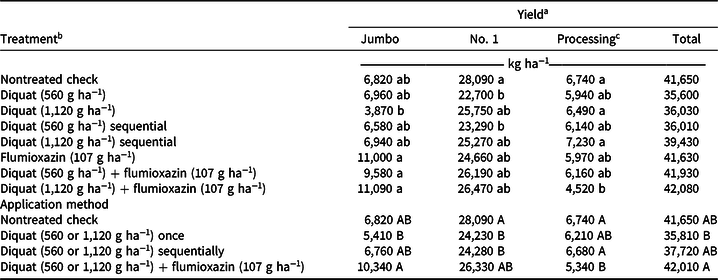
Due to a lack of location-by-treatment interaction, data for jumbo (P = 0.19), No. 1 (P = 0.28), processing (P = 0.59), and total (P = 0.39) sweetpotato yield were combined across locations. Injury was minimal and limited to ≤3% for all treatments through 23 DAP, and no injury was observed after 23 DAP (data not shown). Jumbo, No. 1, processing, and total yields of the nontreated check were 6,820, 28,090, 6,740, and 41,650 kg ha−1, respectively (Table 3). Jumbo yield of all herbicide-containing treatments was similar to that of the nontreated check. Compared with the nontreated check diquat at 560 g ha−1 applied singly or sequentially reduced No. 1 yield, and diquat at 1,120 g ha−1 plus flumioxazin reduced processing yield. Total yield did not differ by treatment (P = 0.28). In regards to the main effect of diquat application method, single and sequential diquat applications resulted in reduced No. 1 yield (24,230 and 24,280 kg ha−1, respectively) compared with the nontreated check; No. 1 yield when diquat plus flumioxazin (26,330 kg ha−1) was applied was similar to that of the nontreated check (Table 3). Conversely, compared with the nontreated check, processing yield was reduced by use of diquat plus flumioxazin (5,340 kg ha−1), but single and sequential applications of diquat resulted in a processing yield that was similar to that of the nontreated check (6,210 and 6,680 kg ha−1, respectively). Jumbo and total yields of herbicide-containing treatments were similar to those of the nontreated checks. In regards to the main effect of diquat rate, No. 1 yield was reduced by applications of diquat at 560 g ha−1 (24,060 kg ha−1), but yield with diquat at 1,120 g ha−1 (25,830 kg ha−1) was similar to yields of both the nontreated check and diquat used at 560 g ha−1 (data not shown). Jumbo, processing, and total yield did not differ among diquat rates (P = 0.77, 0.99, and 0.55, respectively).
Effect of pretransplanting herbicide treatments on sweetpotato injury and yield pooled across two locations at Clinton, NC, in 2017.

a Means within the same column and followed by the same upper- or lower-case letter do not differ statistically (P ≤ 0.05).
b Sequential diquat treatments were applied 1 and 17 d before transplanting (DBP). All other treatments were applied 1 DBP.
c Processing = canner + cull grades; Total = jumbo + No. 1 + processing grades.
The observed differences in No. 1 yield between treatments containing diquat alone and those containing flumioxazin is likely due to the residual weed control provided by flumioxazin. Despite efforts to maintain the entire trial weed-free, at Location 1 in North Carolina Palmer amaranth (Amaranthus palmeri S. Wats.) emerged between the 13 and 27 DAP ratings, with greater abundance in diquat-only plots. Palmer amaranth has been reported to greatly reduce sweetpotato yield (Basinger et al. Reference Basinger, Jennings, Monks, Jordan, Everman, Hestir, Waldschmidt, Smith and Brownie2019; Meyers et al. Reference Meyers, Jennings, Schultheis and Monks2010; Smith et al. Reference Smith, Jennings, Monks, Chaudhari, Schultheis and Reberg-Horton2020), and its timing of emergence in this study occurred during the critical period for weed control of 2 to 6 WAP (Seem et al. Reference Seem, Creamer and Monks2003; Smith et al. in press).
Mississippi and Louisiana
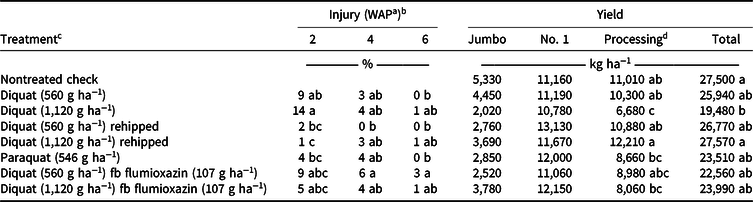
Due to a lack of treatment-by-location interaction, data for sweetpotato injury at 2 (P = 0.39), 4 (P = 0.12), and 6 WAP (P = 0.21) for jumbo (P = 0.88), No. 1 (P = 0.25), processing (P = 0.70), and total (P = 0.94) yield were combined across the Mississippi and Louisiana locations. Visual sweetpotato stunting ranged from 1% to 14%, 0% to 6%, and 0% to 3% at 2, 4, and 6 WAP, respectively (Table 4). No crop injury was observed after 6 WAP (data not shown). Diquat at 1,120 g ha−1 without rehipping resulted in greater injury (14%) 2 WAP than when the same rate was applied and fb rehipping 1 d later and immediately prior to transplanting (1%). Analysis of the main effect of diquat application method across diquat rates confirmed that overall, diquat applied 1 DBP and not followed by rehipping resulted in greater crop injury (12%) than comparable treatments that were rehipped (2%; data not shown). Although injury at 4 and 6 WAP differed statistically among treatments, differences were not biologically meaningful.
Effect of pretransplanting herbicide treatments on sweetpotato injury and yield pooled across Pontotoc, MS, and Chase, LA in 2018.

a Abbreviations: WAP, weeks after transplanting.
b Means within the same column and followed by the same letter do not differ statistically (P ≤ 0.05).
c Diquat and paraquat applications were made 1 d before transplanting. Rehipping and flumioxazin were applied immediately before transplanting.
d Processing = canner + cull grades; Total = jumbo + No. 1 + processing grades.
Jumbo, No. 1, processing, and total yields of nontreated checks were 5,330, 11,160, 11,010, and 27,500 kg ha−1, respectively. Jumbo and No. 1 yields did not differ by treatment. However, compared with the nontreated check, diquat used at 1,120 g ha−1 without rehipping resulted in reduced processing grade and total sweetpotato yields (6,680 and 19,480 kg ha−1, respectively). With regards to the main effect of diquat application method, rehipping resulted in greater processing sweetpotato yield (11,540 kg ha−1) than not rehipping (8,490 kg ha−1), however, both yields were statistically similar to that of the nontreated check (11,010 kg ha−1; data not shown). No other significant differences for crop injury or yield were observed for the main effects of diquat application method or rate (data not shown).
Diquat applied prior to sweetpotato transplanting as a burndown application appeared to have minimal effect on sweetpotato yield and quality across the four environments used in the present study. Diquat is strongly adsorbed to soil particles and organic matter and should not pose a threat to transplanted sweetpotato slips. Based on the present study, diquat may be a suitable replacement for paraquat in burndown applications to control small, emerged weeds prior to sweetpotato transplanting.
Acknowledgments
We thank the staffs of the Pontotoc Ridge-Flatwoods Branch Experiment Station, Sweet Potato Research Station and Horticultural Crop Research Station for their help in transplanting, maintaining, harvesting, and grading the sweetpotatoes used this study. This research was funded in part by the IR-4 Project (P11889). No conflicts of interest have been declared. This publication is a contribution of the Mississippi Agricultural and Forestry Experiment Station.