

Introduction
Many animal and human viruses are disseminated via semen, but there is little information on how to protect the male reproductive tract and semen from viral infection. It is important to investigate methods of preventing infection in the male reproductive tract, or at least shortening the shedding duration and lowering the viral load in semen to prevent widespread viral dissemination. These methods could include promoting ‘antiviral’ factors in semen such as cytokines, cells, antibodies, antimicrobial peptides, enzymes, hormones and growth factors. In addition, some vaccines are already available that appear to protect the male reproductive tract. It will be important to extract information on how these vaccines work for further vaccine development to protect against other viruses that infect semen. Even though ‘antiviral’ factors and vaccines may lower viral loads and therefore transmission risks, it is important to control ‘proviral’ factors in semen that may facilitate higher viral loads and subsequently, more efficient transmission (Quinn et al., Reference Quinn, Wawer, Sewankambo, Serwadda, Li, Wabwire-Mangen, Meehan and Lutalo2000). Therefore, the goals of this review are to describe factors that have antiviral or proviral effects in semen; discuss vaccine strategies for protection of the male reproductive tract; give examples of animal and virus models from the family Arterivirdae (e.g. porcine reproductive and respiratory syndrome (PRRSV) in boars and Equine arteritis virus (EAV) in stallions) that could be used in the studies of these factors and vaccines; and stimulate thought on the most beneficial methods to prevent viral dissemination through this mucosal route.
Viruses that infect the male reproductive tract and semen
Dejucq and Jégou (Reference Dejucq and Jégou2001) describe many human viruses found in semen such as human immunodeficiency virus (HIV), hepatitis B virus (HBV), cytomegalovirus (CMV), human T-lymphotrophic virus type I (HTLV-1), herpes simplex virus (HSV), papillomaviruses and adenoviruses which can result in infertility, sperm abnormalities and/or subsequent virus dissemination. In addition, there are viruses found in animal semen including bluetongue virus (BTV), bovine herpes virus 1 (BHV-1), foot and mouth disease virus (FMDV), bovine leukemia virus (BLV), bovine immunodeficiency virus (BIV), PRRSV, EAV, Rubulavirus, Parvovirus, feline immunodeficiency virus (FIV), encephalomyocarditis virus in mice and avian leucosis virus (ALV). Therefore, there are many viruses that infect semen and several animal models that could be used to study methods preventing viral introduction into semen. One animal model we have used are male, domestic pigs (e.g. boars) infected with PRRSV. Since this positive stranded, ssRNA virus is macrophage trophic, mutates readily, is shed intermittently in semen in both vasectomized and non-vasectomized boars, can be easily quantitated in semen and serum and is not necessarily shed in semen in correlation with viremia, it shares some characteristics with human viruses also found in semen (Christopher-Hennings et al., Reference Christopher-Hennings, Nelson, Nelson, Hines, Swenson, Hill, Zimmerman, Katz, Yaeger, Chase and Benfield1995a, Reference Christopher-Hennings, Nelson, Hines, Nelson, Swenson, Zimmerman, Chase, Yaeger and Benfieldb, Reference Christopher-Hennings, Nelson, Nelson and Benfield1997, Reference Christopher-Hennings, Nelson, Nelson, Rossow, Rowland, Yaeger, Chase, Garduno, Collins and Benfield1998, Reference Christopher-Hennings, Holler, Benfield and Nelson2001; Christopher-Hennings and Nelson, Reference Christopher-Hennings, Nelson and Meltzer1997; Wasilk et al., Reference Wasilk, Callahan, Christopher-Hennings, Gay, Fang, Dammen, Reos, Torremorell, Polson, Mellencamp, Nelson and Nelson2004; Guerin and Pozzi, Reference Guerin and Pozzi2005). PRRSV, however, may eventually be ‘cleared’ from semen in some boars, which differs from HIV or other viruses that may persist for the life of the host. In spite of this, PRRSV still presents a reasonable model of a ‘persistent’ virus where seminal shedding of virus continues even when viremia has ceased. This model also offers the potential to study vaccines and antiviral therapies that could prevent viral contamination of semen and reduce the seminal viral load. In addition, for many viruses, the exact site of replication in the male reproductive tract is still unknown, unlike some bacteria such as Brucella sp. where the testis are the primary site of infection due to the need for erythritol which is found there (Keppie et al., Reference Keppie, Williams, Witt and Smith1965). Since PRRSV is macrophage trophic and boars have the same accessory sex glands as in humans, sites of viral replication may be similar in both species which would warrant further investigation into viral reservoirs in the male reproductive tract.
The boar as a model for immune and reproductive studies
Swine have been used as a major mammalian model for human studies due to their similarity in size, physiology, organ development and disease progression (Schook and Tumbleson, Reference Schook and Tumbleson2004; Schook et al., Reference Schook, Beattie, Beever, Donovan, Jamison, Zuckermann, Niemi, Rothschild, Rutherford and Smith2005). They are an excellent model in studying human immune responses since the pathways regulating Th1 interferon (IFN)γ dominated and Th2, interleukin (IL)-4 and IL-13 dominated responses are similar to those in humans (Dawson et al., Reference Dawson, Beshah, Nishi, Solano-Aguilar, Morimoto, Zhao, Madden, Ledbetter, Dubey, Shea-Donohue, Lunney and Urban2005). The pig model also enables probing of the development of the cellular immune response (Butler et al., Reference Butler, Sinkora, Wertz, Holtmeier and Lemke2006).
The ability to deliberately time studies, image internal vessels and organs using standard human technologies and collect repeated peripheral samples enables pigs to be used as an excellent biomedical model for humans (Vodicka et al., Reference Vodicka, Smetana, Dvorankova, Emerick, Xu, Ourednik, Ourednik and Motlik2005). In addition, the ability to use pigs from the same litter, use cloned or transgenic pigs also facilitates genetic mapping. The pig has a high sequence and chromosome structure homology with humans and with the swine genome sequence now well advanced, there are continued and increasing improvements in genomic and proteomic tools available (see Porcine Genome Sequencing and Mapping Project at Sanger Institute; http://www.sanger.ac.uk/Projects/S_scrofa; Lunney, Reference Lunney2007).
For reproductive studies, among the omnivores, the human and boar share a remarkable number of similarities with respect to seminal plasma. Anatomically, both species have identical accessory sex glands (e.g. seminal vesicles, prostate and bulbourethral gland) which contribute fluids to the ejaculate. In both species, the seminal vesicles contribute the bulk volume and total protein content of the liquid portion of the ejaculate. This seminal vesicle fluid also interacts with prostatic and/or bulbourethral secretions to form a gelatinous coagulum present in both the boar and human ejaculate. Both species produce an alkaline ejaculate, and share similar non-protein components (e.g. citric acid, fructose and zinc). Most studies of comparative reproductive immunology to date have focused on rodent species. Anatomically, however, rodents such as rats have additional accessory sex glands and dissimilar ejaculate characteristics which are not present in man. Swine therefore, are a much closer alternative for comparative human reproductive studies. Comparisons will be described in the following sections.
Variation in the viral load and duration of viral shedding in semen
The viral load in semen does influence transmission of the virus and the viral level in the blood may not always be reflective of the level in semen (Fideli et al., Reference Fideli, Allen, Musonda, Trask, Hahn, Weiss, Mulenga, Kasolo, Vermund and Aldrovandi2001). This has been observed in both human HIV studies and boar PRRSV studies. An HIV model suggests that heterosexual transmission occurs 1 per 100 episodes of intercourse when semen contains 100,000 copies of RNA, whereas the transmission rate is 3 per 10,000 episodes if there are 1000 copies of RNA in semen. Transmission of PRRSV was documented in 7 of 7 gilts inseminated with PRRSV ‘spiked’ semen at doses ≥200,000 TCID50 per 50 ml of semen, 1 of 5 gilts at doses of 2000 and 20,000 TCID50 per 50 ml of semen, but no seroconversion in 14 gilts given less than 200 TCID50 per 50 ml of semen, indicating that viral load does affect transmissibility (Benfield et al., Reference Benfield, Nelson, Steffen and Rowland2000).
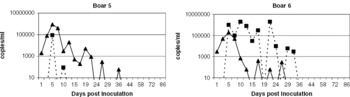
It is interesting that in some cases viruses are cleared quickly in semen whereas the duration of shedding of the same virus could be prolonged in other individuals within a species. However, there is limited information on what local factors within the reproductive tract and semen or systemic factors correlate with the duration of shedding. For example, in animal studies of Family Arteriviridae viruses, EAV in stallions may persist in semen either a short term (<3 months), intermediate (3–7 months), or long-term (>7 months) and could even result in life long carriers (MacLachlan and Balasuriya, Reference MacLachlan, Balasuriya, Pearlman and Holmes2006). This carrier state only occurs in non-castrated horses and is testosterone dependent. In fact, injections of GnRH vaccine which block testosterone production appear to prevent the carrier state (McCollum et al., Reference McCollum, Little, Timoney and Swerczek1994; van der Meer et al., Reference van der Meer, Turkstra, Knaap, Rotier, Meloen, Teerts, Stout and Colenbrander2001). It is unknown by what mechanism testosterone affects the presence of virus in the reproductive tract other than the possibility that cells within the reproductive tract that support viral replication may be less susceptible or less competent in supporting viral growth after testosterone blocking or castration (P. Timoney, personal communication). With PRRSV, it has been demonstrated that boars given the same viral isolate and dose and inoculated simultaneously could result in one boar shedding the virus in semen for up to 4 days post inoculation (DPI) and another for as long as 70 DPI (Christopher-Hennings et al., Reference Christopher-Hennings, Holler, Benfield and Nelson2001). Intermittent shedding of PRRSV in semen with variations in the duration and amount of virus shed and discordance with viremia has been observed (Fig. 1) (Wasilk et al., Reference Wasilk, Callahan, Christopher-Hennings, Gay, Fang, Dammen, Reos, Torremorell, Polson, Mellencamp, Nelson and Nelson2004). In human HIV infections, longitudinal studies conducted from 8 to 10 weeks have demonstrated that viral RNA could be detected continuously in 28–37% of seminal plasma samples, intermittently in 39–44% of samples and never in 24–28% of samples from HIV positive men which also indicates variability in viral shedding patterns in semen (Coombs et al., Reference Coombs, Speck, Hughes, Lee, Sampoleo, Ross, Dragavon, Peterson, Hooton, Collier, Corey, Koutsky and Krieger1998; Gupta et al., Reference Gupta, Leroux, Patterson, Kingsley, Rinaldo, Ding, Chen, Kulka, Buchanan, McKeon and Montelaroet2000).
Viral loads (number of RNA copies per ml), viremia and shedding patterns of two PRRSV inoculated boars. Dotted lines indicate detection of PRRSV and quantitation in semen and shedding patterns; solid lines indicate PRRSV detection and quantitation in serum. Reproduced from Wasilk et al. (Reference Wasilk, Callahan, Christopher-Hennings, Gay, Fang, Dammen, Reos, Torremorell, Polson, Mellencamp, Nelson and Nelson2004).

‘Immunocompetency’ and ‘immunosuppression’ in semen
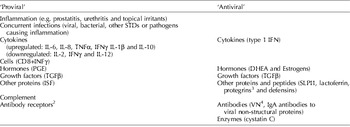
There have been over 100 protein and peptide components identified in normal human seminal plasma. Hence, a plethora of substances within semen exist that could have antiviral effects including antibodies, cytokines, cells, antimicrobial peptides, growth factors, enzymes and hormones (Haq et al., Reference Haq, Ramma, Al-Sedairy and Aboul-Enein1996; Fung et al., Reference Fung, Glode, Green and Duncan2004). Interestingly, the seminal environment has been shown to be ‘immunosuppressive’ since one of its functions is to protect sperm, which express immunogenic differentiation antigens from immune damage (James and Hargreave, Reference James and Hargreave1984). There would need to be a fine balance between ‘immunosuppression’ to protect sperm viability and ‘immunocompetency’ to prevent viral contamination and dissemination. Table 1 summarizes current ‘proviral’ and ‘antiviral’ factors that appear to influence the presence and quantity of virus in semen.
Summary of associations of substances in semen with ‘proviral’ and ‘antiviral’ effects by in vivo or in vitro studiesFootnote 1

1 See text for details and references.
2 Are found in semen, but not demonstrated whether they have antiviral effects within the semen.
3 Unknown if found in semen, but are in leukocytes which can be found in semen.
4 Unknown if found in semen, but antibodies are found in semen and virus-neutralizing antibodies are antiviral.
STDs=sexually transmitted diseases, PGE=prostaglandin E, DHEAS=dehydroepiandrosterone sulfate, SPI1=secretory leukocyte protease inhibitor 1, VN=virus neutralizing.
Seminal ‘proviral’ factors
Inflammation and concurrent infections
Some ‘proviral’ factors that appear to enhance viral load include an association between cellular inflammation and HIV replication in vitro and HIV shedding in vivo (Coombs et al., Reference Coombs, Speck, Hughes, Lee, Sampoleo, Ross, Dragavon, Peterson, Hooton, Collier, Corey, Koutsky and Krieger1998). In humans, concurrent infections producing inflammation such as prostatitis or gonococal and chlamydial urethritis appear to enhance viral load (Cohen, Reference Cohen1998). When these bacterial infections were treated with antibiotics, viral shedding in semen was reduced even though the viral levels in the blood were not affected (Coombs et al., Reference Coombs, Speck, Hughes, Lee, Sampoleo, Ross, Dragavon, Peterson, Hooton, Collier, Corey, Koutsky and Krieger1998; Kiessling, Reference Kiessling1999). This observation would indicate a local bacterial inflammatory response potentiated viral growth, but was resolvable through antibiotic treatment of the primary bacterial infection. Herpes simplex virus (HSV-2) seropositivity has also been associated with higher HIV viral loads (Gray et al., Reference Gray, Li, Wawer, Sewankambo, Wabwire-Mangen, Lutalo, Kiwanuka, Kigozi, Nalugoda, Meehan, Robb and Quinn2004). It is also thought that topical virucides may cause local irritation and inflammation and therefore increase susceptibility to HIV infection (Szabo and Short, Reference Szabo and Short2000). In general, local factors affecting the HIV virus load appear to be due to coinfection by bacterial, fungal or other viral pathogens associated with leukocytospermia and genital tract inflammation (Wolff and Anderson, Reference Wolff and Anderson1988). In the boar, the longest and continually recorded shedding duration of PRRSV in semen was 92 DPI (Christopher-Hennings et al., Reference Christopher-Hennings, Nelson, Hines, Nelson, Swenson, Zimmerman, Chase, Yaeger and Benfield1995b). It was notable that this boar also had a concurrent Arcanobacterium (Actinomyces) pyogenes abscess infection prior to PRRSV inoculation. It is uncertain whether inflammation and/or concurrent infections cause an increased viral load or are markers of a higher viral load. However, it is known that inflammatory conditions, such as those occurring during infection with other sexually transmitted pathogens or other pathogens in general, attract large numbers of lymphocytes and macrophages into the seminal compartment, and therefore there may be higher numbers of infected cells and infectious virus in semen (Xu et al., Reference Xu, Politch, Tucker, Mayer, Seage and Anderson1997).
Cytokines
High concentrations of IL-8 are detectable in human semen indicating factors contributing to innate immunity are present there (Anderson et al., Reference Anderson, Politch, Tucker, Fichorova, Haimovici, Tuomala and Mayer1998). However, in one study it was demonstrated that significantly high levels of proinflammatory cytokines, specifically IL-6, IL-8, tumor necrosis factor (TNF)α, and IFNγ were associated with higher levels of HIV shedding in semen. The authors stated that this does not necessarily demonstrate causation, but may reflect a concurrent inflammatory response with associated inflammatory cytokines and influx of CD3+ T cells, CD8 cytotoxic T-cells. Those studies demonstrated that despite an increase in virus-specific CD8+ IFNγ secreting cells, there was no corresponding reduction in HIV shedding. In fact, the absolute number of CD8+ INFγ secreting cells was correlated with increased levels of HIV shedding in semen (Sheth et al., Reference Sheth, Danesh, Shahabi, Rebbapragada, Kovacs, Dimayuga, Halpenny, MacDonald, Mazzulli, Kelvin, Ostrowski and Kaul2005). A second study also demonstrated a positive association between the inflammatory cytokine IL-1β and HIV-1 levels in semen of infected patients (Berlier et al., Reference Berlier, Bourlet, Levy, Lucht, Pozzetto and Delezay2006).
Specific cytokines are known to stimulate antiviral effects, specifically, IL-12 which stimulates T-cells and natural killer cells (NKC) which kill virus infected cells. When seminal plasma was added to blood cell cultures, even at a 1:100,000 dilution, an increase in IL-10 and a decrease in IL-12 was observed. This was a dose-dependent effect and it was also observed when seminal plasma was substituted with prostaglandin E and 19-OH PGE, the main prostaglandin in human semen (Kelly et al., Reference Kelly, Carr and Critchley1997). These findings point out the overall ‘immunosuppressive’ properties of human seminal plasma.
Growth factors
The specific growth factor, transforming growth factor (TGF) β has been found in high amounts in human, swine and mouse seminal plasma and may be a primary factor in inducing an inflammatory response in the female reproductive tract post-insemination (Pandya and Cohen, Reference Pandya and Cohen1985; Thompson et al. Reference Thompson, Barratt, Bolton and Cooke1992; Lessard et al., Reference Lessard, Lepine, Matte, Palin and Laforest2003; Gopichandran et al. Reference Gopichandran, Ekbote, Walker, Brooke and Orsi2006). TGFβ appears to have immunosuppressive properties by inhibiting DNA synthesis and killing activity of IL-2 stimulated lymphocytes. A decrease in the immunosuppression by treatment with a TGFβ neutralizing monoclonal antibody confirmed its specificity for these effects (Nocera and Chu, Reference Nocera and Chu1993). This TGFβ immunosuppressive activity has also been noted in African swine fever (ASF) infected macrophages whereby TGFβ was detected in virus infected cells and macrophage responses were also suppressed in response to INFγ and lipopolysaccharide (LPS) (Whittall and Parkhouse, Reference Whittall and Parkhouse1997).
Other proteins in semen
In boar seminal vesicle fluid, an ‘immunosuppressive fraction (ISF)’ is present in high concentration and is primarily made up of a complex of two major seminal plasma glycoproteins, PSPI and PSPII. In vitro studies determined that production of IL-2 and INFγ was lowered, but IL-4, IL-6 and IL-10 production was enhanced in Con A-stimulated murine spleen cells when treated with ISF (Veselsky et al., Reference Veselsky, Holan, Zajicova, Dostal and Zelezna2003). Therefore, a ‘favoring’ of Th2 type of cytokine response was observed, which is generally associated with down regulation of immune responses.
Complement was also found to enhance HIV-1 infection 2-fold in human epithelial cells when seminal plasma was added to culture prior to contact with cells. Blockage with mAbs against complement receptor type 3 and soluble CD16 inhibited this suppressive effect. It was thought that opsonization of HIV-1 by semen complement enhanced the uptake of HIV into the cells (Bouhlal et al., Reference Bouhlal, Chomont, Haeffner-Cavaillon, Kazatchkine, Belec and Hocini2002).
Antibodies and IgG receptor in seminal plasma
A soluble receptor for IgG has also been noted in human seminal plasma (e.g. Fcγ RIII (CD16)) which might have ‘active immunosuppressive’ functions within the semen. For example, it was found that there were lower amounts of this soluble receptor in men who had antisperm antibodies (ASA) due to antibody-receptor binding compared to men who were ASA negative (Sedor et al., Reference Sedor, Callahan, Perussia, Lattime and Hirsch1993). Whether higher amounts of this factor are associated with higher viral loads from any virus in semen is unknown.
In HIV infections, Mestecky et al. (Reference Mestecky, Jackson, Moldoveanu, Nesbit, Kulhavy, Prince, Sabbaj, Mulligan and Goepfert2004) reported high levels of IgG anti-HIV with limited IgA anti-HIV despite a high level of IgA in the semen. Moreover, an increased antibody level or antibody secreting cell number correlated with increased viral load, which also indicates an antibody response that is deficient in viral control.
Seminal ‘antiviral’ factors
Neutralizing antibodies
Viral neutralizing (VN) antibody protects against viral infection of host cells. Even though neutralizing antibodies are induced later in infection than innate immune responses, these antibodies may produce an important ‘sterilizing’ immunity if present prior to infection. For example, if multiple neutralizing antibodies were given prior to infection with a simian/HIV, viral loads at day 7 after challenge were reduced 700-fold from those of controls (P<0.0001) (Zhang et al., Reference Zhang, Ribeiro, Mascola, Lewis, Stiegler, Katinger, Perelson and Davenport2004). VN antibody response also appears to be correlated well with resistance to infection with PRRSV if given prior to infection. Osorio et al. (Reference Osorio, Galeota, Nelson, Brodersen, Doster, Wills, Zuckermann and Laegreid2002), conducted an experiment in which pregnant sows were injected with polyclonal-neutralizing antibodies and subsequently challenged with PRRSV. All sows receiving PRRSV-specific VN antibodies were fully protected from reproductive failure. Unfortunately, these VN antibodies are produced late in infection, so they need to be given passively prior to exposure to the virus. However, ongoing studies using infectious clones for PRRSV are attempting to determine how to stimulate VN antibody production earlier and allow for a ‘marker’ vaccine which would be distinguishable from field virus (Yoo et al., Reference Yoo, Welch, Lee and Calvert2004; Ansari et al., Reference Ansari, Kwon, Osorio and Pattnaik2006; Faaberg et al., Reference Faaberg, Hocker, Erdman, Harris, Nelson, Torremorell and Plagemann2006; Fang et al, Reference Fang, Rowland, Roof, Lunney, Christopher-Hennings and Nelson2006a, Reference Fang, Faaberg, Christopher-Hennings, Rowland, Pattnaik, Osorio, Nelson, Pearlman and Holmesb).
Whether neutralizing antibodies to any virus are found in semen is unclear, and it appears that more studies have focused on virus-specific VN antibodies within the female reproductive tract (Francois-Xavier et al., Reference Francois-Xavier, Bélec, Dalessio, Legoff, Grésenguet, Mayaud, Brown and Morrow2003). However, HIV-specific antibodies are present in semen as detected by Western blots and this suggests that cell-free HIV in semen may be associated with immune complexes. It is thought that this may explain a low sexual transmission rate of HIV and decreased infectivity of seminal plasma HIV-1 in vitro (Anderson et al., Reference Anderson, O'Brien, Politch, Martinez, Seage, Padian, Horsburgh and Mayer1992; Mayer and Anderson, Reference Mayer and Anderson1995).
Isotype of seminal antibodies
IgG and IgA are found in seminal fluids of healthy men, but the exact origin of secretory immunoglobulins in seminal plasma is not known. It is thought that monomeric IgG and IgA are derived from serum and polymeric IgA and IgM are locally produced. The dominant isotype in human semen does appear to be IgG (Mestecky, Reference Mestecky2006). In one study of HIV-1 seropositive men, 27 of 28 (96.4%) seminal plasma samples had anti-HIV-1 IgG antibodies, but no HIV-specific IgA or IgM antibodies (Sedor et al., Reference Sedor, Callahan, Perussia, Lattime and Hirsch1993). Even though these antibodies were present, a correlation between the presence of these antibodies and lack or shortening of viral shedding in semen was not observed. However, the predominance of transudated IgG from the systemic compartment to semen suggests possible protection through systemic vaccination routes if antibodies are present prior to infection. We have also documented the presence of IgG as the predominant isotype in boar seminal plasma (Kaiser et al., Reference Kaiser, Christopher-Hennings and Nelson2000). In a study involving a limited number of boars, a correlation was shown between the level of PRRSV-specific IgA antibodies to non-structural proteins and the duration of viral shedding in semen (Oleksiewicz et al., Reference Oleksiewicz, Bøtner and Normann2001). This may be an important finding requiring further study for the development of protective vaccines.
Cytokines
The peritubular and Sertoli cells that make up the ‘blood-testis’ barrier in the male reproductive tract of rodents have been found to produce high amounts of type 1 IFN when exposed to Sendai virus (Dejucq et al., Reference Dejucq, Chousterman and Jėgou1997). The antiviral activity induced by type 1 IFNs occurs with the induction of several IFN-induced proteins and this has also been demonstrated with stimulation of cultured seminiferous tubule cells in the presence of IFNα, IFNγ and Sendai virus.
Growth factors
As previously stated, the specific growth factor TGFβ has been noted in high amounts in human, swine and mouse seminal plasma and appears to be a primary factor in inducing a uterine inflammatory response after insemination (Pandya and Cohen, Reference Pandya and Cohen1985; Thompson et al., Reference Thompson, Barratt, Bolton and Cooke1992; Lessard et al., Reference Lessard, Lepine, Matte, Palin and Laforest2003; Gopichandran et al., Reference Gopichandran, Ekbote, Walker, Brooke and Orsi2006). It is possible that the uterine inflammatory response with an influx of neutrophils and other inflammatory cells and cytokines may inhibit the transfer of virus from the semen to the recipient.
Antimicrobial peptides
Antimicrobial peptides such as defensins have been found in semen and various parts of the male reproductive tract of rats, mice and humans (Com et al., Reference Com, Bourgeon, Evrard, Ganz, Colleu, Jegou and Pineau2003). There are over 80 different defensins produced by leukocytes and epithelial cells in birds and mammals. Three of these in particular, α, β and θ have been implicated in anti-HIV activity (Cole, Reference Cole2005). It was proposed that α defensins might be a component of the CD8 T-cell antiviral factor, β defensins downregulated the expression of co-receptors of HIV-1 entry into cells and θ defensins protected primary T-cells from in vitro infection of HIV by inhibiting viral fusion (Münk et al., Reference Münk, Ge Wei, Yang, Waring, Wang, Hong, Lehrer, Landau and Cole2003). Two different guinea pig defensins derived from neutrophils have been described previously (Selsted and Harwig Reference Selsted and Harwig1987; Yamashita and Saito, Reference Yamashita and Saito1989) and it has been proposed that defensins in semen deposited in the female genital tract kill some of the chlamydiae before they can infect their target cells and/or remain in the genital tract and interfere with subsequent generations of chlamydiae. Other antimicrobial peptides, such as protegrins, which are found in pig leukocytes and are similar to defensins, may also be potentially active inhibitors of HIV-1 (Cole, Reference Cole2005)
In people, secretory leukocyte protease inhibitor (SLPI) is a small non-glycosylated protein which has been found in many mucosal secretions including saliva, seminal plasma, breast milk and cerebral spinal fluid. Surprisingly, it appears that there are higher levels in semen (15–20-fold) compared with levels in saliva. The primary function of SLPI is to protect mucosal surfaces from attack by serine proteases that are released from leukocytes during inflammation. In vitro, it has shown inhibitory activity against Sendai and influenza A viruses, but not CMV, HSV or MLV. Its mechanism of action is not completely known, but it appears to bind specifically to receptors on monocytes therefore targeting a host cell molecule rather than the virus (Shugars, Reference Shugars1999). When seminal plasma was added to cells in a 3-day microtiter-based assay, a medium level of HIV-1 inhibitory activity was noted, although wide ranges of inhibition were observed between individuals. This inhibition was thought to be due primarily to human lactoferrin and SLP since blocking antibodies reduced the HIV-1 inhibiting ability significantly in saliva (Kazmi et al., Reference Kazmi, Naglik, Sweet, Evans, O'Shea, Banatvala and Challacombe2006). Lactoferrin was also found to inhibit virus-cell fusion and entry of the virus into cells (Swart et al., Reference Swart, Kuipers, Smit, Van Der Strate, Harmsen and Meijer1998).
In the boar, when PRRSV was incubated with boar seminal plasma, virus infection was completely inhibited on a continuous cell line (MARC-145 cells) at 1:80 dilution and suppression was still observed at a 1:320 dilution (Okinaga et al., Reference Okinaga, Reeves and Hurley2005). It is unknown what factor may have caused this suppression, other than a heat labile substance that did not appear to be complement (Okinaga et al., Reference Okinaga, Yoshii, Tsunemitsu and Hurley2006).
Hormones
There are relatively high levels (in μmol−1) of dehydroepiandrosterone sulfate (DHEAS) in human semen (Pohanka et al., Reference Pohanka, Hampl, Sterzl and Starka2002). DHEA appears to influence cytokines produced from lymphoid cells by preventing the immunosuppression caused by glucocorticoids. These effects were also observed in murine retrovirus infections where DHEA supplementation stimulated Th1 cells in both infected and non-infected mice. DHEA binding to its receptor has been shown to directly stimulate IL-2 production (Meikle et al., Reference Meikle, Dorchuck, Araneo, Stringham, Evans, Spruance and Daynes1992).
Estrogens are present in high concentrations in boar semen (up to 12 μg of estrogens per boar ejaculate), but may vary between boars and time of year (Claus, Reference Claus1990). It is unknown what effect estrogens may have on viral infections in semen, but estrogen treatment of intravaginally inoculated primates with pathogenic SIVmac prevented infection (Smith et al., Reference Marx, Smith and Baskin2000). When these same animals were inoculated with the virus via subvaginal epithelial or IV routes, the virus loads were equivalent to the non-treated groups (Marx et al., Reference Marx, Smith and Baskin2000). Therefore, it was thought that the virus could not penetrate the physical barrier of hypertrophied vaginal epithelia that resulted with estrogen treatment in the female recipient, thus providing an antiviral effect.
Enzymes
Many enzymes are present in seminal plasma which can have roles in the liquefaction of semen in species that produce a gelatinous portion of the ejaculate (e.g. boar, human and mouse) and the acrosomal reaction necessary for fertilization, to name a few of their functions (Lwaleed et al., Reference Lwaleed, Greenfield, Stewart, Birch and Cooper2004). Since many of these enzymes are proteases or protease inhibitors, it is suspected that they might have some antiviral effects. Of interest to research with PRRSV, which has replication strategies similar to coronaviruses, is the presence of cystatin C in semen which also has been demonstrated to have inhibitory effects on human coronaviruses (Collins and Grubb Reference Collins and Grubb1991) and HSV (Bjorck et al., Reference Bjorck, Grubb and Kjellen1990). The mechanism of action may be to inhibit papainlike proteases which are part of the polymerase complex of coronaviruses and arteriviruses. Cystatin C is also highly expressed in seminal vesicles, prostate gland and seminal fluid in men (Jiborn et al., Reference Jiborn, Abrahamson, Wallin, Malm, Lundwall, Gadaleanu, Abrahamsson and Bjartell2004).
Is the male reproductive tract part of the ‘common mucosal system’ so that mucosal routes of vaccination may be effective?
A recent paper has indicated that the mucosal immune system in the male reproductive tract is distinct from other mucosal tissues (Mestecky, Reference Mestecky2006). The distinction includes dominance of the IgG isotype, local plus pronounced systemic origin of antibodies, an absence of organized lymphoepithelial inductive sites and limited humoral responses elicited by local antigen administration. With HIV studies, it has also been demonstrated that whatever the route of infection, there is a detectable IgG, but not an IgA-specific antibody response in semen (Mestecky et al., Reference Mestecky, Jackson, Moldoveanu, Nesbit, Kulhavy, Prince, Sabbaj, Mulligan and Goepfert2004). It also appears there are more cellular mediators of immunity in the male reproductive tract than humoral (Anderson and Pudney, Reference Anderson, Pudney, Mestecky, Lamm, Strober, Bienenstock, McGhee and Mayer2005). This may indicate that ‘mucosal immunity’ as defined by antigen introduction that elicits a secretory IgA response at a distant and local site may not be as important in protecting the male reproductive tract as systemic vaccination in eliciting a protective antiviral response. There appear to be differences in the mucosal immune response between the male and female reproductive tract that also need to be taken into consideration for vaccination purposes. For example, induction of mucosal anti-HIV T-cell responses in mice differed between males and females since multiple mucosal boosting of the vaccine in male mice did not induce antigen-specific IFNγ responses in the genital tract. An intradermal (systemic) prime followed by an intradermal (systemic) boost, however, did produce a maximal level of IFNγ secreting cells locally in the male reproductive tract, compared to either a mucosal prime and systemic boost or multiple mucosal boosting. In contrast, a mucosal prime and a systemic boost appeared to give maximal IFNγ responses in female mice (Peacock et al., Reference Peacock, Nordone, Jackson, Liao, Letvin, Yafal, Gritz, Mazzara, Haynes and Staats2004). Systemic vaccination with influenza vaccine has also been shown to stimulate IgA responses in seminal plasma (Moldoveanu et al., Reference Moldoveanu, Huang, Kulhavy, Pate and Mestecky2005).
Protection of the reproductive tract and semen of the stallion from EAV is observed with systemic intramuscular (IM) vaccination. It is known that neutralizing antibody produced by infection appears to be protective and this can be elicited with a modified live (MLV) EAV vaccine given systemically. The vaccine does not cause any semen quality abnormalities and there is no evidence of stallions transmitting vaccine virus. Virus neutralizing antibody to vaccine has been noted within 5–8 days after systemic (IM) vaccination and persists for up to 2 years. These SN antibodies have been correlated with protection from disease, abortion and the development of persistent infection (Timoney et al., Reference Timoney, Mccollum, Roberts and McDonald1987, Glaser et al., Reference Glaser, Chirnside, Horzinek and de Vries1997). Since MLV EAV vaccinated horses cannot be distinguished from naturally infected horses, research using genetically engineered EAV vaccines has been performed using DNA vaccines with plasmid DNA expressing open reading frames (ORFs) 2, 5 and 7 which have neutralizing epitopes (Balasuriya and MacLachlan, Reference Balasuriya and MacLachlan2004).
Other vaccine protection studies have been performed by infecting vaccinated and non-vaccinated boars with different PRRSV strains and monitoring shedding of virus in semen (Christopher-Hennings et al., Reference Christopher-Hennings, Nelson, Nelson and Benfield1997; Nielsen et al., Reference Nielsen, Nielsen, Have, Bækbo, Hoff-Jøorgensen and Bøtner1997; Shin et al., Reference Shin, Torrison, Choi, Gonzalez, Crabo and Molitor1997). These studies demonstrated little or no shedding of virus in semen when challenged with different strains of PRRSV. Protection was more complete when using vaccine which was similar to the challenge field strain (homologous protection) and these findings are similar to other vaccine studies that do not use mature boars. This would indicate that if a more broadly reacting vaccine could be developed and given systemically to other swine, it may also protect boars from shedding the virus in semen. Parallels in vaccine development may be important to consider between PRRSV and HIV since multiple strain variation exists for both viruses, the immune correlates of protection are not completely defined and viral contamination of the male reproductive tract and semen are observed.
Summary and future directions
In conclusion, the primary purpose of the male reproductive tract and seminal environments are to produce and protect sperm for optimum fertility. This requires an immunotolerant milieu to prevent damage to sperm antigens. Alternatively, it is known that there are over 100 different proteins found in semen, along with steroid hormones, enzymes and other substances that could damage sperm, but may provide some protection from viral infections. Therefore, a delicate balance of these substances needs to be maintained. How to ‘harness’ these factors to prevent or contain viral contamination and subsequent dissemination requires further study. Table 2 summarizes some of the major areas that need to be addressed in future research. Prevention of viral contamination of semen through the use of vaccines should be a primary focus of research since it will most likely be easier to prevent contamination than to eliminate it once it is present in semen. Routes of administration of vaccines to protect the male reproductive tract and semen appear to be important in protection and may differ in the male versus female reproductive tracts. A large animal model, such as the boar is an ideal species candidate for such studies.
Challenges to eliciting protective anti-viral responses in semen