





Background
The Centers for Disease Control and Prevention estimate that roughly 30% of outpatient antibiotic prescriptions are unnecessary.Reference Fleming-Dutra, Hersh and Shapiro1 Inappropriate antibiotic prescriptions may contribute to antimicrobial resistance and adverse drug events, such as Clostridioides difficile infection.Reference Dantes, Mu and Hicks2,Reference Butler, Durkin, Keller, Ma, Powderly and Olsen3 Moreover, recent studies also suggest that inappropriate prescribing is associated with increased 90-day healthcare expenditures for both adult and pediatric populations.Reference Butler, Brown and Newland4,Reference Butler, Brown and Durkin5
Some public health expert groups have begun evaluating regional variation in prescribing practices, revealing substantial geographic differences across the country.Reference Fleming-Dutra, Hersh and Shapiro1 State level analyses have shown higher prescribing rates among Medicaid beneficiaries, particularly in rural areas.Reference Wattles, Jawad and Feygin6,Reference Wattles, Vidwan, Feygin, Jawad, Creel and Smith7 Similar findings have been observed in North CarolinaReference Moorthy, Young, Raman and Smith8 and Tennessee.Reference Staub, Ouedraogo and Evans9 However, most of these analyses are based on Medicaid data, which primarily represent underinsured populations.
The purpose of this analysis was to evaluate the appropriateness of outpatient antibiotic prescribing for common bacterial and viral conditions in Missouri and to assess regional variation in prescribing within a commercially insured population for several common conditions.
Methods
We identified children (6 months to 17 years old) and adults (aged 18 to 64 years old) diagnosed in an outpatient setting with a bacterial infection—suppurative otitis media, pharyngitis, or sinusitis—or a viral infection, such as influenza, viral upper respiratory tract infection, non-suppurative otitis media, bronchitis, bronchiolitis, or COVID-19, between April 1st, 2016 and September 30th, 2022. Cohorts were constructed for each infection type using previously described methods.Reference Butler, Brown and Durkin10 Our data was obtained from the Merative Health Analytics MarketScan Database.
Eligible individuals were required to have continuous medical and pharmacy insurance coverage for at least 6 months prior to the index date. We excluded individuals with evidence of skilled nursing facility admission within 3 months prior to the index date, as well as those with hospice care, mechanical ventilation, or serious medical conditions within 6 months prior to the index date. Serious medical condition examples include pregnancy, hematologic or solid organ malignancies, autoimmune conditions, and home mechanical ventilation. Index events associated with atypical antibiotic treatment durations (eg, <5 days or >14 days) were also excluded.
Because patients may have been diagnosed with both viral and bacterial infections during the same encounter, we applied a previously validated tiered algorithm to minimize misattribution of antibiotic prescribing to viral infections.Reference Butler, Brown and Durkin10
Antibiotic prescriptions were linked to outpatient infection encounters only if the prescription was filled on the day as the index diagnosis. Antibiotic agents were categorized as appropriate or inappropriate based on clinical practice guidelines based on dispensed agent and guideline concordant treatment duration (Supplement). For suppurative otitis media, amoxicillin was considered appropriate; for sinusitis, either amoxicillin or amoxicillin-clavulanate; and for pharyngitis, either amoxicillin or penicillin. For all viral conditions, any antibiotic prescription was classified as inappropriate.
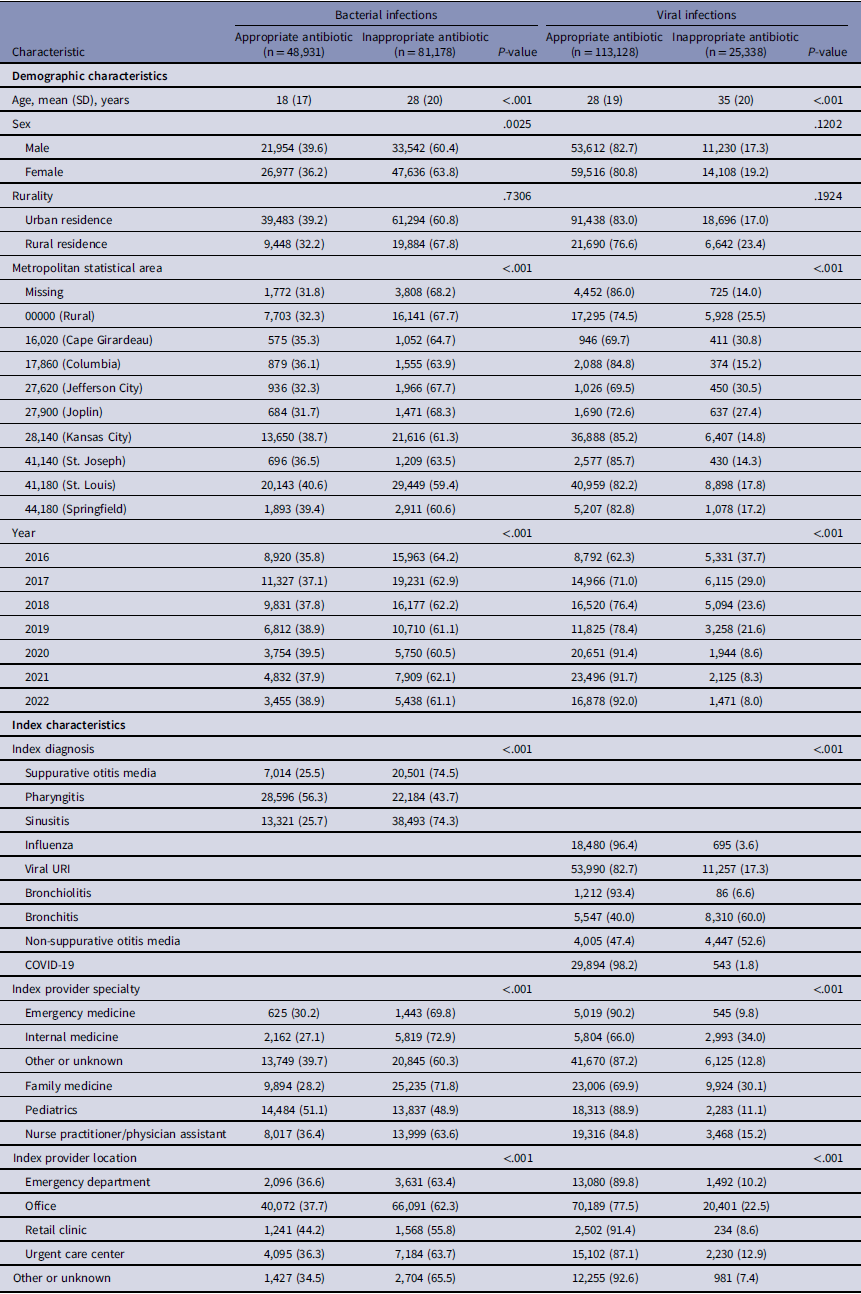
Multivariable logistic regression models using all variables in Table 1 were conducted separately for bacterial and viral infection cohorts to identify predictors of inappropriate antibiotic prescribing. Statistical significance was defined a priori as P < .05. All analyses were conducted using SAS version 9.4 (SAS Institute Inc, Cary, NC).
Demographic and index event characteristics stratified by bacterial and viral infections and by appropriate and inappropriate antibiotic prescribing. Bronchiolitis index diagnoses were only captured for pediatric patients (age > = 6 months and <18 years). COVID-19 diagnoses were captured beginning on 4/1/2020. P-values are from multivariable logistic regressions to predict inappropriate antibiotic prescribing in bacterial and viral infections

Table 1. Long description
The table presents demographic and index event characteristics for bacterial and viral infections, stratified by appropriate and inappropriate antibiotic prescribing. It includes data on age, sex, rurality, metropolitan statistical area, index diagnosis, index provider specialty, and index provider location. The table has 45 rows and 12 columns. Column headers include Characteristic, Bacterial infections Appropriate antibiotic, Bacterial infections Inappropriate antibiotic, P-value, Viral infections Appropriate antibiotic, Viral infections Inappropriate antibiotic, and P-value. Row labels include various demographic and index event characteristics. Notable trends include significant differences in age, rurality, metropolitan statistical area, index diagnosis, index provider specialty, and index provider location between appropriate and inappropriate antibiotic prescribing for both bacterial and viral infections. The table also includes specific data points for each characteristic, such as age in years, sex distribution, and various index diagnoses like suppurative otitis media, pharyngitis, sinusitis, influenza, viral URI, bronchiolitis, bronchitis, non-suppurative otitis media, and COVID-19. The data is presented row-wise, with each row providing specific values for each characteristic.
Results
A total of 130,109 bacterial and 138,466 viral outpatient infection encounters were identified in Missouri during the study period. Among these, 81,178 bacterial infections (62.4%) and 25,338 viral infections (18.3%) were associated with inappropriate prescribing. Covariates associated with inappropriate prescribing for both bacterial and viral infections included provider specialty, provider location, index diagnosis, patient age, metropolitan statistical area (MSA), and study year (Table 1). Patient sex was significantly associated with inappropriate prescribing in the bacterial infection cohort (P-value = .0025), but not in the viral infection cohort (P-value = .1202).
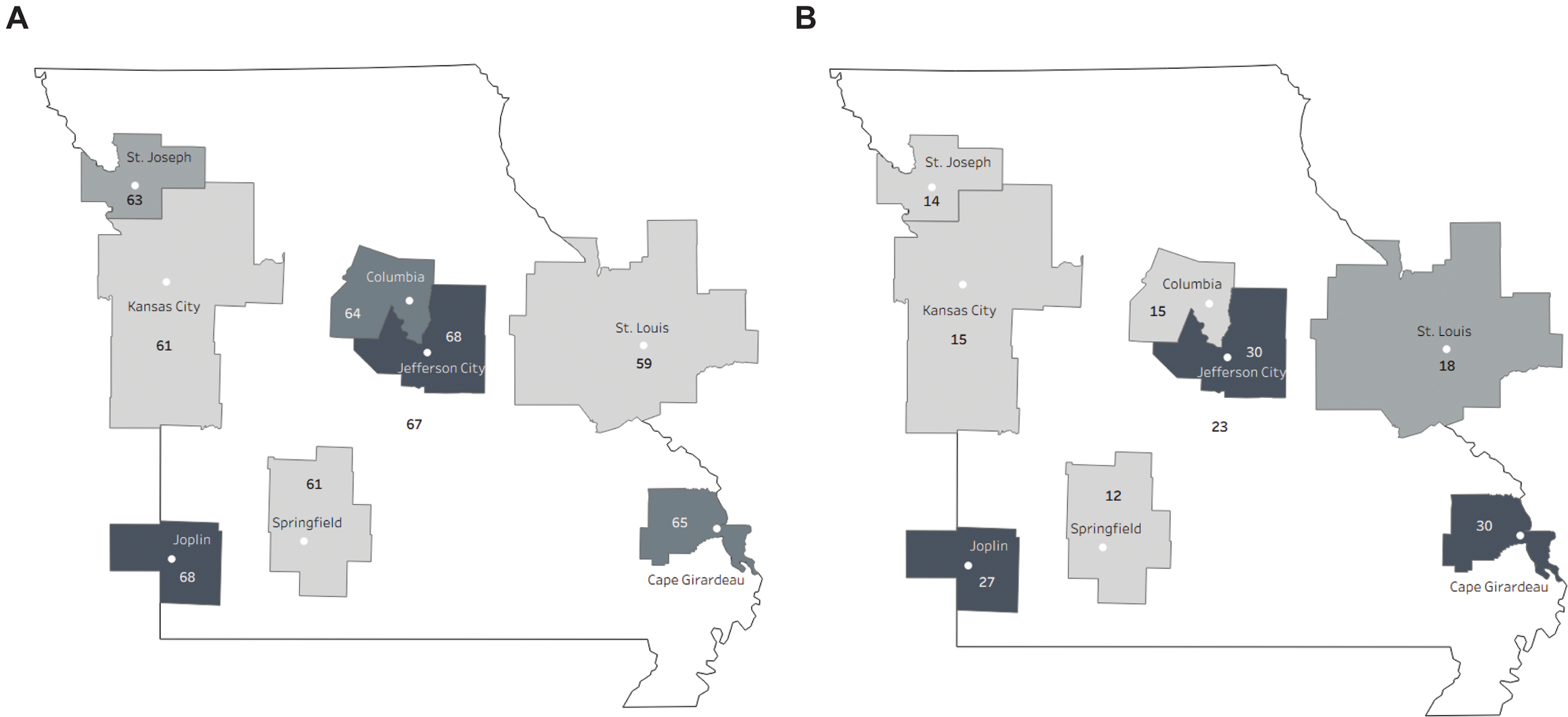
Notably, geographic mapping revealed substantial regional heterogeneity in the appropriateness of outpatient antibiotic prescribing. Larger urban centers were generally associated with lower rates of inappropriate prescribing for both bacterial and viral infections (Figure 1). However, some smaller urban areas, including the Cape Girardeau and Jefferson City regions, demonstrated higher rates of inappropriate prescribing compared to surrounding rural areas. These patterns were consistent across both pediatric and adult populations.
Map of inappropriate antibiotic prescribing percentages for bacterial infections (panel A) and viral infections (panel B) in Missouri by metropolitan statistical area (MSA) between 2016 and 2022. Any infections in patients that did not reside within an MSA were collapsed to a statewide percentage. Darker colors indicate higher percentages of inappropriate antibiotic prescribing.

Discussion
To our knowledge, this is the first study to evaluate the appropriateness of outpatient antibiotic prescribing for common infections in Missouri. Our findings indicate that prescribers in Missouri demonstrate rates of appropriate antibiotic selection for both bacterial and viral conditions that are comparable to national trends.
However, specific geographic areas were identified where targeted stewardship interventions may be particularly beneficial. Efforts to improve prescribing practices should prioritize regions with relatively limited access to medical education and training programs, such as Jefferson City and Cape Girardeau, followed by rural areas, and, to a lesser extent, larger urban centers with more established clinical training infrastructure.
Our findings differ slightly from those reported in prior studies. Previous research has commonly shown elevated antibiotic prescribing rates primarily in rural areas,Reference Wattles, Jawad and Feygin6,Reference Wattles, Vidwan, Feygin, Jawad, Creel and Smith7,Reference Staub, Ouedraogo and Evans9 whereas our analysis identified higher rates not only in rural regions but also in certain smaller urban centers. These differences may be attributable to variations in study populations and methodology. Many prior studies relied on state Medicaid data, focusing on underinsured populations, whereas our analysis used data from a commercially insured cohort. Additionally, earlier studies often reported data at the county level, whereas we used MSAs, which may reduce variability introduced by smaller sample sizes in rural counties with fewer prescribers. Although county-level analyses offer greater geographic granularity, they may also be more susceptible to statistical fluctuations due to small numbers of providers or patients.
This study has several limitations. Although we were able to quantify rates of inappropriate antibiotic prescribing, we were not able to assess the underlying drivers of these regional differences. It is possible that such provider-level factors are more prevalent in the regions we identified. We also did not conduct qualitative assessments or provider interviews to explore local contextual factors. Regional differences in access to care, healthcare infrastructure, or patient expectations may also contribute to variation in prescribing practices. Some metropolitan areas included in the analysis spanned state boundaries, which could introduce geographic misclassification in a small subset of cases. In addition, our estimates of antibiotic prescribing rates for viral conditions were lower than expected. This may reflect lower antibiotic prescribing during certain phases of the COVID-19 pandemic—which was part of our study period. By only assessing antibiotics on day 0, we are missing prescriptions using a—“watchful waiting” approach. Insurance claims data has limited ability to capture complete allergy information, so patient allergies could not be accounted for when assessing antibiotic appropriateness during this study.
Conclusions
Using commercial insurance claims data, we quantified inappropriate antibiotic prescriptions based on several common bacterial and viral indications and mapped these data in Missouri. These findings identified regions that may benefit from additional antibiotic stewardship guidance for several common conditions. This method spans beyond traditional assessments, focusing on antibiotics for both bacterial and viral upper respiratory tract infections.
Supplementary material
The supplementary material for this article can be found at https://doi.org/10.1017/ice.2026.10528.


 Open access

