More than two million endoscopic procedures are performed every year in France. Gastrointestinal (GI) endoscopes are fragile and thermosensitive and cannot be sterilized by autoclaving. National 1 , 2 and international 3 – 5 guidelines describe the reprocessing of flexible endoscopes; reprocessing using an automated endoscope reprocessor (AER) is now the rule.
The risk of infection after endoscopic procedure is low. Reviews of the literature by NelsonReference Nelson 6 in 2003 and by Nelson and MuscarellaReference Nelson and Muscarella 7 in 2006 concluded in a low incidence of cases declared. Since the emergence of highly drug-resistant bacteria, several epidemics of multidrug-resistant bacteria transmission have been reported following use of contaminated duodenoscopesReference Aumeran, Poincloux and Souweine 8 – Reference Wendorf, Kay and Baliga 11 caused by failures in AER devices or insufficient application of reprocessing procedures. 2 , Reference Aumeran, Poincloux and Souweine 8 – Reference Moses and Lee 13
A quality assurance policy (traceability, training of personnel, microbiological surveillance testing) has reduced the risk of infection.Reference Beilenhoff, Neumann and Rey 14 In March 2007, French guidelines on microbiological surveillance testing for endoscopes were published. 15 They directed healthcare institutions to perform microbiological surveillance for reprocessed endoscopes according to standardized practices, using a surfactant solution to remove microorganisms during sampling and respecting a time lag of at least 6 h between the last reprocessing and a new sampling procedure. These guidelines set the thresholds for interpreting the results and describe the procedures when these thresholds are exceeded.
The main objective of the study was to assess 99 months of microbiological surveillance testing on GI endoscopes in order to evaluate the quality of reprocessing. The secondary objective was to assess the value of such monitoring.
METHODS
This retrospective study was conducted from October 1, 2006, through December 31, 2014, in a teaching hospital (2,200 beds) where approximately 4,500 GI endoscopic procedures are performed each year. The study was conducted on 89 GI endoscopes including different brands (Olympus, Fujinon, Pentax).
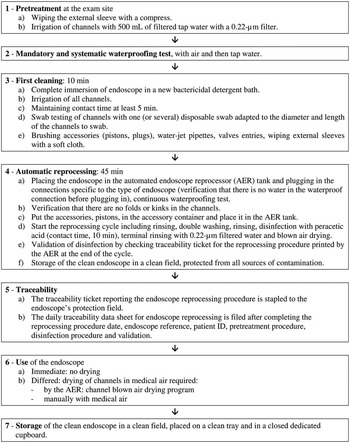
The endoscopes are reprocessed by 8 nurses trained in and dedicated to this task. Reprocessing was performed following a written procedure complying with the French guidelines. 1 , 16 The usual reprocessing steps are indicated in Figure 1 (standard reprocessing). The endoscopes are reprocessed in 3 identical AERs, operating with peracetic acid and filtered water (0.20 µm) in compliance with the European norms and following a regular schedule of preventive maintenance. For each cycle, the device emits a traceability ticket. The quality of the water in the AER is verified every month. If an endoscope is stocked more than 12 h after reprocessing, it is reprocessed in the AER before use. A quality assurance policy was set up with several aspects: written procedures, personnel training, regular evaluation of practices, microbiological surveillance testing of the endoscopes and water quality, preventive maintenance of the AER, and traceability.
Steps in the usual reprocessing of a flexible gastrointestinal endoscope (standard reprocessing).

Samples were taken in aseptic conditions by 2 members of the hygiene team. Samples taken in an emergency situation were excluded from the study.
From 2006 to 2007, the time between reprocessing and sampling was not homogeneous. Beginning in 2008, the new guidelines 15 recommended that the following sampling procedure be performed between 6 and 12 h after the last reprocessing.
Sampling consisted of a 300-mL injection of sampling solution distributed between the different channels using a sterile syringe and disinfected connections. This solution was aseptically collected in a sterile flask and then separated into 2 identical samples for bacteriological and mycological analyses in the institution’s laboratory. From 2006 to 2007, the sampling solution was sterile physiological saline solution (NaCl 0.9%). Following the 2007 guidelines, 15 a Tween 80-type solution (neutralizing diluent pharmacopeia [NDP] thiosulfate, bioMérieux) containing polysorbate 80 with surface-active properties was progressively used beginning in 2008.
At the bacteriology laboratory, 100 mL of liquid was filtered on a sterile membrane placed on trypticase soy agar incubated in aerobiosis at 30°C and read at 48 h and then 72 h and 5 days. The same filtration operation was performed with the remaining 50 mL, with the membrane placed on Drigalski agar to search for Enterobacteriaceae and Pseudomonas. The result included total flora count and the search for indicator microorganisms (IMOs) (Table 1). 15
Thresholds of Target/Alert/Action Levels 15 (CFU per Endoscope and IMOs)

note. Indicator microorganisms (IMOs) were Enterobacteriaceae, Pseudomonas aeruginosa and other Pseudomonas, Stenotrophomonas maltophilia, Staphylococcus aureus, Acinetobacter sp., Candida sp. CFU, colony-forming units.
The same procedure was applied for the mycologic analysis. Cultures were grown on Sabouraud-chloramphenicol agar, incubated for 7 days at 27°C to search for filamentous fungi and at 35°C to search for yeasts.
The results were interpreted according to the guidelines 15 and classified into 3 levels: target, alert, and action (Table 1). A sample was deemed to be compliant if it was classified at the target or alert level. If the alert level was reached, a second sampling procedure was planned for 2 weeks later. In the meantime, the device could be used after reinforced manual reprocessing (double cleaning followed by 30 min sporicide disinfection). A sample was deemed noncompliant if it reached the action level: in this case, the endoscope could not be used. It underwent reinforced manual reprocessing and then another sample was taken before it could be used again. If this second sample did not comply, the endoscope was sent for technical maintenance.
For each endoscope sampled, a written report was sent to the endoscopy department with recommendations and reminders of good practices.
Four sampling contexts were defined. First, standard sampling after usual reprocessing in AER (standard reprocessing): the objective was to check every endoscope at least once a year; the guidelines left the choice of the time of these sampling procedures to the discretion of the institution. The 3 other sampling contexts concerned endoscopes that had undergone reinforced manual reprocessing: after repairs, on new or loan devices, or for inspection after noncompliant standard sampling (control sample).
The results were expressed as compliance rates, corresponding to the ratio between the number of compliant samples (target and alert levels) to the total number of samples. The 99 months of the study were divided into 3 periods reflecting the modifications in practices following the 2007 publication of the French guidelines: 2006–2007 (sample taken with saline solution with no minimum delay after reprocessing), 2008–2009 (progressive implementation of the guidelines on the timing and use of a surfactant solution), and 2010–2014 (homogeneous application of the guidelines).
The following data were collected: sampling date, endoscope references, sampling context (standard, control sampling, return from repair/loan, new), age of the endoscope at sampling, sampling solution (NDP, saline solution), the time between reprocessing and sampling, the number of colony-forming units (CFU), the presence of IMOs, and compliance.
The data were recorded in an electronic spreadsheet (Excel; Microsoft). Statistical analysis (Stata software, StataCorp) was performed using a χ2 test or linear trend test for proportions, a Kruskal-Wallis test for medians, and logistic regression to identify the parameters independently related to compliance. The significance threshold was set at .05.
RESULTS
During the study period a total of 857 samples were collected, of which 11 were excluded owing to investigations of unproven suspicion of crossed or epidemic transmission. Finally 846 GI endoscope samples were taken: 381 standard samples, 305 after the endoscope was returned from maintenance or loan, 27 when a new endoscope was introduced, and 133 control samples.
The 89 GI endoscopes included 34 gastroscopes (median age at sampling time, 3.5 years), 24 colonoscopes (4.4 years), 10 duodenoscopes (4.5 years), and 21 echoendoscopes (4.0 years).
Each of the 89 endoscopes was sampled from 1 to 30 times (median, 8); 26 endoscopes were sampled a single time (new endoscope or short-term loan). The timing of the sampling was specified in 793 cases and ranged from 20 min to 25 h, with 85% of the samples taken at least 6 h after the last reprocessing.
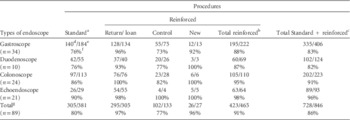
The compliance rates according to the sampling context are displayed in Table 2. The overall compliance rate was 86%. A significant difference (P<.001) was observed between the compliance rates after standard reprocessing (80%), after control sampling (77%), when endoscopes returned from repair or loan (97%), and on new endoscopes (96%); there was no significant change in the distribution of the sampling procedures per year. There was a significant difference (P=.001) between the compliance rates depending on the types of endoscope (gastroscopes, colonoscopes, duodenoscopes, and echoendoscopes) (Table 2). Compliance was significantly different depending on the cold season (October to March, 90%) or warm season (April to September, 82%) (P=.002). It did not vary significantly (P=.29) during the 3 study periods: 81% for the 2006–2007 period, 87% for the 2008–2009 period, and 86% for the 2010–2014 period although the sampling methods were modified. The median age of the endoscopes remained similar during the 3 periods: 3.8, 2.9, and 3.9 years, respectively. The logistical regression model including the study period by default (P=.36) showed that the sampling context (P<.001), the type of endoscope (P=.004), and the season (P=.009) were independently associated with compliance, excluding all other parameters (age of the endoscope, sampling timing, use of NDP, sampling year).
Compliance Rate by Type of Endoscope and Context, According to Current Recommendations 15

a Test of compliance differences between types of endoscope: P=.097.
b Test of compliance differences between types of endoscope: P=.012.
c Test of compliance differences between types of endoscope: P=.001.
d Number of compliant samples.
e Number of samples taken.
f Compliance rate.
g Test of compliance differences between types of endoscope: P<.001
One hundred eighteen endoscope samples were classified as noncompliant: 108 because 145 IMOs in total were present and 10 because a nonpathogenic flora greater than 25 CFU was present. These 118 samples involved 41 different endoscopes (nearly half of the endoscopes). Each of these 41 endoscopes generated from 1 (17 endoscopes) to 13 noncompliant samples (1 gastroscope). Four of the 41 noncompliant endoscopes (3 gastroscopes and 1 duodenoscope) totaled one-third of the noncompliant samples (n= 39). Noncompliance was found at least once in 48% of the gastroscopes and 70% of the duodenoscopes.
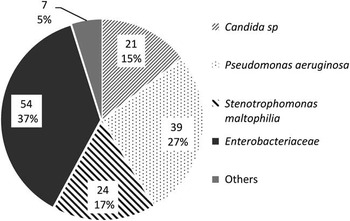
The IMOs identified are detailed in Figure 2 and Table 3. Independently of the IMOs, 33 samples classified as compliant had fewer than 25 CFU of filamentous fungi (genera: Alternaria, Aspergillus, Cladosporium, Conidiobolus, Curvularia, dematiaceous fungi, Paecilomyces, Penicillium, Ustilago) or fungi that are commensal to humans (Trichosporon sp. and most particularly Trichosporon asahii).
Distribution of bacteria and yeasts found in the noncompliant samples (n=145).

Indicator Microorganisms Found in Noncompliant Samples (n=145)

DISCUSSION
The results of microbiological surveillance testing of reprocessed GI endoscopes over 8 years showed an 86% compliance rate for all of the samples and 80% for samples taken after standard reprocessing in AER. During the study period, no detected cross-transmission related to the GI endoscopes was documented. The institution has an adverse reaction reporting system and each new identification of a highly drug-resistant bacterial strain (vancomycin-resistant Enterococcus, carbapenemase-producing Enterobacteriaceae) led to seeking a link with a recent endoscopic procedure. There was a significant difference in the compliance rates between the type of endoscope in all contexts combined, higher for colonoscopes and echoendoscopes. Four endoscopes had caused 33% of the noncompliant samples, essentially by repeated contamination by various microorganisms for 1 gastroscope and the duodenoscope. Sometimes consecutive contamination by the same microorganisms for 2 gastroscopes was found but without molecular typing realized. The age of endoscopes does not explain this difference. On the other hand, the frequent use of endoscopes seems to play a part, but this information could not be included in the multivariate analysis: the median number of procedures was less than 70 procedures/endoscope/year for colonoscopes and echoendoscopes and greater than 100 procedures/endoscope/year for gastroscopes and duodenoscopes.
Apart from the noncompliant samples (for the most part Enterobacteriaceae and gram-negative bacilli), the presence of results classified as target events should be emphasized, although they included filamentous fungi and yeasts. The question of the compliance of such results remains unanswered and could lengthen the list of IMOs—for example, to yeasts other than Candida sp. that are also commensal to humans.
It is difficult to compare these results with the literature because few studies have been published on this subject. An Australian study on 655 GI endoscope samples taken between 2002 and 2006Reference Gillespie, Kotsanas and Stuart 17 showed 6 instances of noncompliance; recalculating the compliance rates with the method used in the present study gives an estimated 83% compliance rate. Yet the comparison with this study is not relevant because the sampling method (10 mL of sterile water per channel in the Australian study) and the interpretation thresholds 5 differ greatly from the French guidelines. A French study on 332 GI endoscope samples between 2007 and 2009 indicated a 68% compliance rate, but the level of action retained was 100 CFU.Reference Saliou, Garlantézec and Baron 18
The compliance rate remained stable during the 3 periods. However, a deterioration was expected because, beginning in 2008, the sampling procedure could have increased the number of noncompliant samples through facilitating the bacterial multiplication by applying a 6 h delay and by better uncoupling of the microorganisms when using NDP. This stability within a more demanding context could have masked progress in the reprocessing. Despite good organization with a quality assurance system in place, respect of the guidelines, and regular assessments of practices without a significant gap demonstrated, it was not possible to rise beyond an 80% compliance rate in standard sampling, whereas cross-transmission of pathogenic microorganisms by poorly disinfected endoscopes has been documented.Reference Aumeran, Poincloux and Souweine 8 – Reference Carbonne, Thiolet and Fournier 9
To explain these results, a waterborne contamination was ruled out. The terminal rinse water of the AER is filtered on 0.20-µm filters and monthly monitoring of the water quality of the AER has never found Pseudomonas aeruginosa or Stenotrophomonas maltophilia.
Several other potential influent factors could contribute to the poor compliance rate.Reference Rutala and Weber 19 During the study, the AER did not present significant dysfunction, and the traceability tickets for all the endoscopes sampled showed no problems with the cycle function. However, the problems obtaining a compliance rate approaching 100% after standard reprocessing and the gain obtained after reinforced manual reprocessing suggest that it would be useful to improve the standard reprocessing steps. GI endoscopes are complex devices; their complexity and the variety of different features depend on the manufacturers, with many of the channels difficult to irrigate. The AER that we used complied with the current norms and had been validated before being put on the market. The qualification of the AER should remain systematic each time an endoscope is acquired. In the past, the qualification step was sometimes missing, which could decrease the effectiveness of reprocessing. Moreover, periodically renewing this qualification is one of the means of improvement.
The occasional audits of the first manual cleaning do not guarantee continuous observance of good practices. To improve the initial manual cleaning efficiency, the current detergent might be replaced by an enzymatic bactericidal detergent, and the need to respect the contact time of the detergent must be remembered. Drying remains a difficult operation after reprocessing in AER, and residual wetness can promote the multiplication of microorganisms not eliminated by reprocessing. Several countries recommend rinsing the endoscope with alcohol before storage to facilitate drying and limit bacterial proliferation. 5 , Reference Gillespie, Kotsanas and Stuart 17 , Reference Saliou, Garlantézec and Baron 18 , Reference Muscarella 20 Such recommendations do not currently exist in France. An endoscope storage cabinet could improve drying. However, we turn to a new process of irrigation with dilute hydrogen peroxide solution then storage under partial vacuum.
The compliance rate of the control samples was 77% despite the use of the reinforced manual reprocessing procedure with more efficient, prolonged, and systematic irrigation. In these cases we suspected wear, damaged sleeve, long-lasting biofilm, and so on, and the endoscopes were sent for technical maintenance. This hypothesis, suggested with the recurrence or persistence of noncompliant samples, is reinforced by the fact that endoscopes with recurrent contamination sent for curative maintenance return compliant: 97% of the endoscopes were compliant upon returning from repairs.
Improving the preventive maintenance must avoid having to track faulty endoscopes through microbiological sampling. Leasing with a maintenance contract is expected to provide both recent endoscopes and periodic maintenance. Other means of disinfection should be sought if a high noncompliance continues in these circumstances. Ethylene oxide is no longer used in French hospitals. The plasma sterilization with low-temperature hydrogen peroxide gas could be a prospect.
The microbiological surveillance testing of endoscopes does not meet with clear consensus in the North American guidelines. 5 The authors of the Australian study concluded that it was important to provide a quality assurance system rather than conduct an excessive number of sampling campaigns.Reference Gillespie, Kotsanas and Stuart 17 However, the sampling frequency was very high (monthly). In the present study, despite microbiological surveillance testing, the samples’ compliance rate did not rise. The return of noncompliant results is nonetheless the opportunity to review practices, to reinforce the healthcare teams’ vigilance, to screen endoscopes that might require repairs, and to renew the AER qualification. The assessment of the set of measures is planned: renewal of the older AERs and endoscopes, and improvement of preventive maintenance, replacement of detergent and the process of storage, and reinforcement of good practices. Despite the workload this requires, microbiological monitoring seems indispensable in view of the compliance rates obtained. The results encourage reducing sampling when endoscopes return from repairs in preference to sampling after standard reprocessing.
In conclusion, despite a rigorous and controlled organization and the use of AER devices, endoscope reprocessing control remains imperfect. Microbiological surveillance testing continues to be necessary to raise awareness in personnel responsible for reprocessing and guarantee that they respect good practices and detect endoscopes or AERs requiring technical maintenance.
Acknowledgments
We thank the team of nurses in GI endoscopy.
Financial support. None reported.
Potential conflicts of interest. All authors report no conflicts of interest relevant to this article.