INTRODUCTION
And the Lord said unto Cain, “Where is Abel thy brother?”
And he said, “I know not: Am I my brother's keeper?” (Genesis 4:9)
In the summer of 2014, Americans were introduced to the brutal tactics and coercive intentions of the Islamic State of Iraq and the Levant (ISIL). While ISIL's initial attacks began by targeting Muslims, Western media paid wider attention to the crisis after militants began systematically targeting Iraq's Yazedi and Assyrian minority communities. The plight of the Yazidis was especially salient to Western audiences, as tens of thousands of refugees were trapped by ISIL fighters atop Mount Sinjar on the border straddling Iraq and Syria. In response to these attacks, President Obama announced airstrikes against ISIL on August 7, 2014. President Obama justified the military intervention by emphasizing how ISIL militants “have been especially barbaric towards religious minorities, including Christian and Yezidis, a small and ancient religious sect” (Obama Reference Obama2014). By highlighting the religious identities of Iraq's minorities, the United States administration shifted positions from earlier speeches where President Obama had down-played the religious intentions behind the sectarian violence in Iraq.
President Obama's rhetorical shift presents an interesting puzzle: under what conditions do political leaders choose to emphasize — instead of downplay or outright ignore — the religious identities of foreign victims of humanitarian crises? To examine this phenomenon, we designed a survey experiment involving a scenario based on the ongoing civil war in the Central African Republic (CAR). The results reveal identifying foreign victims as Christians mobilizes otherwise lackluster United States public support for foreign military intervention. Generating what we call the Brother's Keeper effect, we find empirical evidence that religious cues increase overall public support for otherwise unknown foreign victims now perceived as co-religionists. Despite reservations about engaging in humanitarian interventions abroad, the American public is far more likely to come to the aid of religious minorities with whom they identify.
This study proceeds as follows. The first section examines the extant literature on religion and public opinion of United States foreign policy. We then describe the Brother's Keeper effect, explaining how religious predispositions and situational cues affect respondents’ foreign policy attitudes. This bridges the extant literature on religion and political behavior with studies of United States foreign policy public opinion by emphasizing a mechanism by which the power of religion has political effect. Following that, we outline the research design of our survey experiment and discuss our empirical findings. Finally, we conclude with a discussion of the external validity of our study as well as avenues for future research.
THE BROTHER'S KEEPER EFFECT
How does religion affect United States foreign policy? On the one hand, religion is a key factor since it explains “Americans’ sense of themselves as chosen people [and] their belief that they have a duty to spread their values throughout the world…Not all Americans believe such things [but] enough believe them that the ideas exercise profound influence over the country's behavior” (Mead Reference Mead, Shah, Stepan and Toft2012, 247). Though “religion acts as the conscience of American foreign relations” (Preston Reference Preston2012, 7), it is unclear when the idealism of religion trumps the realpolitik ethos of foreign policy. Without theorizing and empirical testing of religion's effects on foreign policy, it would be easy to make “broad assertions about the role of faith in United States foreign policy [which] must be treated with caution” (Wuthnow Reference Wuthnow2010, 189).
Though there may be different pathways through which the invocation of religion shapes foreign policy attitudes (Djupe and Calfano Reference Djupe and Calfano2013; Glazier Reference Glazier2012; Wu Reference Wu2015), this article tests one causal process by examining how religious cues affect public support for humanitarian intervention. Specifically, we argue religious cues that label foreign actors as Christians increase support for military intervention. While expecting to find Brother's Keeper effects across the full population, we also expect these effects are greater among Americans who already have strong religious predispositions. Our contribution to the growing analysis of religion and foreign policy is to empirically demonstrate how religious cues affect foreign policy attitudes in a specific foreign policy context.
The extant literature on religion and foreign policy has focused on how religious predispositions shape broad foreign policy worldviews such as militarism, containment, and isolationism. Some scholars examine how the faith of foreign policy elites such as the president (Bacevich and Prodromou Reference Bacevich and Prodromou2005; den Dulk and Rozell Reference den Dulk and Rozell2011; Lincoln Reference Lincoln2006; Smith Reference Smith2008) and members of Congress (Collins et al. Reference Collins, Wink, Guth and Livingston2011) shape their foreign policy. There are contradictory findings regarding the link between religious predispositions and foreign policy preferences. For example, while some scholars find Evangelicals have unique foreign policy attitudes different from that of other religious and secular Americans (Amstutz Reference Amstutz2013; Barker and Nelson Reference Barker, Hurwitz and Nelson2008; Baumgartner, Francia, and Morris Reference Baumgartner, Francia and Morris2008; Cavari Reference Cavari2012; Durham Reference Durham2004; Guth Reference Guth2009; Schafer Reference Schafer2012; Smidt Reference Smidt2005; Taydas, Kentmen and Olson Reference Taydas, Kentmen and Olson2012), others find that Evangelicals do not differ significantly, if at all, from other Americans in their foreign policy attitudes (Froese and Mencken Reference Froese and Mencken2009; Jelen Reference Jelen1994; Page and Bouton Reference Page and Bouton2006; Wuthnow and Lewis Reference Wuthnow and Lewis2008).
We conceptualize religion's effects within an interactionist foreign policy model, which describes how foreign policy attitudes are determined by the interactions between predispositions and situational cues (Herrmann, Tetlock, Visser Reference Herrmann, Tetlock and Visser1999). While acknowledging the insights of existing explanations of how religious beliefs and practices are determinative of foreign policy attitudes, we contend such arguments need to be complemented with explanations of how religious beliefs and practices are activated in the realm of foreign policy. We argue that a dual focus on predispositions and a dynamic activation mechanism better corresponds to scholarly understandings of how foreign policy attitudes are formed. In other words, Americans’ religious predispositions, beliefs, and identities have political effects only when activated by external situational cues. If even for the Puritans religion was sometimes “more ‘dormant’ than ‘active’” (Tiryakian, Reference Tiryakian1982, 356), so among modern Americans, religious predispositions only affect politics when activated by external religious stimuli.
In this study, we explore the power of religious cues to mobilize Americans to support foreign policy intervention. The humanitarian intervention foreign policy context is a difficult test given weak baseline public support for such types of foreign policy actions. While Americans will support foreign interventions that are eventually successful (Eichenberg Reference Eichenberg2005; Gelpi, Feaver, and Reifler Reference Gelpi, Feaver and Reifler2006), they are reticent to support foreign policy action where no clear national interests are at stake. Not only is there low initial support for humanitarian interventions (Jentleson and Britton Reference Jentleson and Britton1998), but domestic publics are also more sensitive to costs that arise during a military intervention (Larson and Savych Reference Larson and Savych2006). As Hildebrandt et al. (Reference Hildebrandt, Hillebrecht, Holm and Pevehouse2013, 250) explain, “although most people express concern over the human tragedies of famine, ethnic cleansing, and genocide, these crises are also often far removed from the everyday lives of American voters.” Moreover, driven by rational balancing of costs and benefits of a potential foreign policy action (Jentleson Reference Jentleson1992), Americans do not support humanitarian interventions that are perceived to have high risk and uncertain benefits (Eckles and Schaffner Reference Eckles and Schaffner2011). Indeed, even when Americans perceive intervention to be in the national interest, most are still reluctant to support it (Brancati Reference Brancati2013).
If religious cues are present in the situation — specifically when victims of violence are identified as Christians — Americans are more likely to mobilize in support of humanitarian intervention. We call this the Brother's Keeper effect. Empirically, we expect that religious cues that identify victims of foreign atrocities as members of a respondent's religious in-group will increase support for humanitarian intervention. These situational cues operate by providing an actor with a common heuristic method that reduces uncertain expectations (Hogg, Adelman, and Blagg Reference Hogg, Adelman and Blagg2010) and increases altruism toward the perceived co-religionist (Graham and Haidt Reference Graham and Haidt2010). This expectation builds on existing research that shows the identification of foreign actors as Christian leads to greater support for those actors. Lacina and Lee (Reference Lacina and Lee2013) find that identifying a foreign actor as Christian prompts respondents to have higher trust and lower perceptions of threat from that actor. Though America is increasingly religiously pluralistic (Putnam and Campbell Reference Putnam and Campbell2012), there remains a shared set of religious principles and themes that resonates among many Americans. The religious pluralism of Americans may even facilitate the political use of religion as “support for almost any conceivable foreign policy can be found somewhere [though] the balance of power among the different religious stands shift over time” (Mead Reference Mead, Shah, Stepan and Toft2012, 247).
H1 (Brother's Keeper effect):
There is higher support for intervention for intervention when victims are labeled as Christians.
While we expect the Brother's Keeper effect to operate at the population level, its influence should be greater among more religious Americans. In the presence of religious cues that identify victims that would be helped by American intervention as Christians, we expect more religious Americans to be more mobilized. This builds on the existing literature which finds that religious Americans respond more to religious cues and appeals (Albertson Reference Albertson2011; Calfano and Djupe Reference Calfano and Djupe2009; Chapp Reference Chapp2012). Moreover, given that religious Americans tend to support the use of military force at higher rates than their secular peers (Amstutz Reference Amstutz2013; Baumgartner, Francia, and Morris Reference Baumgartner, Francia and Morris2008; Guth Reference Guth2009; Smidt Reference Smidt2005), using religious cues to activate latent preferences for militarism should lead to greater support for foreign policy action.
H2:
Brother's Keeper mobilization effects are greater among more religious respondents.
While we expect Americans, and especially more religious Americans, are more likely to support intervention to help victims labeled as Christians, they are less likely to support foreign policy action when victims are also labeled as Muslims. Though part of a shared Abrahamic religious tradition with Christianity and Judaism, Muslims are perceived as religious outsiders (Jung Reference Jung2011; Kalkan, Layman, and Uslander Reference Kalkan, Layman and Uslander2009; Pew Research Center 2014a; Sides and Gross Reference Sides and Gross2013). Contrary to the parable of the Good Samaritan, we expect Americans will be unwilling to help foreign actors identified as Muslims. Given evidence of greater violence toward social groups holding incompatible religious values (Neuberg et al. Reference Neuberg, Warner, Mistler, Berlin, Hill, Johnson, Filip-Crawford, Millsap, Thomas, Winkelman, Broome, Taylor and Schober2014), and stronger support for military action against Islamic actors (Johns and Davies Reference Johns and Davies2012), we expect Americans’ response to religious cues that identify foreign actors as Muslim will be that of Cain's assertion that he is not his brother's keeper.
H3 (Not My Brother effects):
There is lower support for intervention to help victims labeled as Muslims.
Following our expectations that the Brother's Keeper effect is greater among more religious Americans, we also expect that “Not My Brother” effects are stronger among more religious respondents. Evidence exists supporting the argument that more religious Americans hold more negative views of Islam (Baumgartner, Francia, and Morris Reference Baumgartner, Francia and Morris2008; Froese and Mencken Reference Froese and Mencken2009; Jung Reference Jung2011; Smidt Reference Smidt2005).
H4:
Not My Brother effects are greater among more religious respondents.
EMPIRICAL EVIDENCE OF BROTHER'S KEEPER EFFECTS
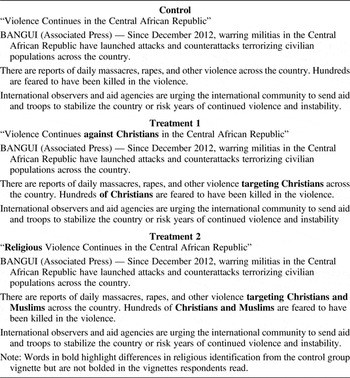
To test our hypotheses, we use a survey experiment where respondents read varying descriptions of events in the CARFootnote 1 and are asked how much they support different types of foreign policy intervention. Respondents first answer questions that measure their preexisting opinions about the situation in the CAR. They are then randomly assigned to one of three treatment groups that contain different Associated Press-style journalistic vignettes describing the violence occurring in the CAR. The first vignette serves as a control with no religious labeling; the second vignette identities the victims of violence as Christians; and the third vignette identities targets of violence as Christians and Muslims. We do not include a treatment vignette where victims are only addressed as Muslim because presidents rarely identify the Muslim identities of foreign actors who may be aided by United States intervention. Muslims are most often identified as such when they are one of many religious groups being persecuted. For example, during the 1999 Kosovo crisis, President Clinton frequently condemned Slobodan Milosevic's attempts to enflame religious tensions between Catholics, Orthodox Christians, and Muslims, but only emphasized the Muslim identities of victims when also mentioning the other religious minorities targeted during the crisis.
Table 1 summarizes the vignettes in each treatment group. After reading their randomly assigned news vignette, we measure respondents’ post-test support for United States military participation in a peacekeeping mission (Peacekeepers) and a unilateral troop deployment (Troops);Footnote 2 we measure support for both multi-lateral and uni-lateral intervention since domestic publics have different baseline willingness to support different types of interventions (Kreps Reference Kreps2007; Kull and Destler Reference Kull and Destler1999). We also construct a Do Something measure based on whether respondents support peacekeepers or the deployment of troops. Respondents then answer a manipulation check and a standard battery of demographic questions.
Experimental vignettes

We recruited 1064 respondents on Amazon's Mechanical Turk (MTurk) platform between June 19 and July 6, 2014 to take the survey experiment. While respondents recruited on MTurk are not a random representative sample of the American public, MTurk samples are appropriate and useful in testing causal mechanisms (Berinsky, Huber, and Lenz, Reference Berinsky, Huber and Lenz2012; Buhrmester, Kwang, and Gosling Reference Buhrmester, Kwang and Gosling2011; Christensen and Glick Reference Christensen and Glick2013; Lewis et al., Reference Lewis, Djupe, Mockabee and Wu2015). The average age of respondents in the opt-in sample is 32; 80% of respondents are white, 54% of respondents are male, and 68% of respondents have at least a two-year college education. Compared to a nationally representative sample, our respondent sample is more liberal with 18% identifying as Republican, 42% as Democrat, and 40% as Independent. Respondents are also more secular: 47% of respondents identify with no religious tradition (“None”), 18% identify as Protestant, 14% identify as Catholic, and 10% identify as Evangelicals. Furthermore, 66% of respondents do not consider religion an important part of their lives, 53% never attend religious services, 53% find religion divisive, and 71% do not believe religion should have a greater role in politics and public life. To test for covariate balance, we check if there are statistically significant correlations between treatment group assignment and respondents’ demographics; we find no statistically significant correlations.Footnote 3 This is evidence that the randomization mechanism was successful. Thus, comparisons of foreign policy support across vignette groups reveal robust estimates of treatment effects.
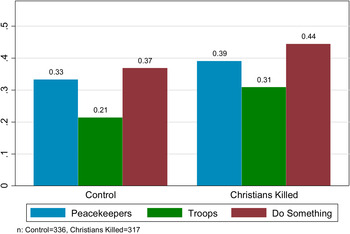
According to the Brother's Keeper hypothesis (H1), support for intervention should be higher among respondents who read the Christians Killed vignette (Treatment 1) compared to respondents who receive the Control vignette where the victims’ religious affiliation is left unidentified. To maximize the internal validity of our inference, we only compare respondents who correctly identify the religious identity of the victimized groups they read in the vignette; 92% of respondents pass this manipulation check. Following convention in the study of foreign policy attitudes, we dichotomize support for intervention across the three measures to aid interpretability.Footnote 4 Average support across these three measures is summarized in Figure 1. Among respondents who receive a vignette that does not contain information about the religious identity of victims, 33% support peacekeepers, 21% support sending troops, and 37% support the United States doing something (sending either peacekeepers or troops).
Evidence of brother's keeper effects.

By contrast, 39% of respondents in the Christians killed treatment group support peacekeepers, 31% support sending troops, and 44% support the United States doing something. Two-tailed t-tests reveal the six-point Christian cue effect on support for peacekeepers is not statistically significant (p = 0.12). However, the nine-point increase in support for troops (p = 0.01) and eight-point increase in support to do something (p = 0.05) are statistically significant. This is evidence of Brother's Keeper effects (H1) as there is greater support for military intervention when victims are identified as Christians.
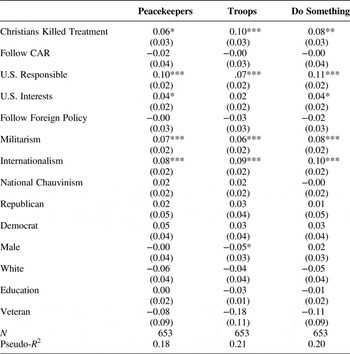
We also test treatment effects when factoring for respondents’ foreign policy predispositions and potential demographic factors that could shape their foreign policy attitudes. Specifically, we account for how much respondents have been following events in the Central African Republic (Follow CAR), their pre-test beliefs about how much the United States is responsible (United States Responsible) and has national interests in the CAR (United States Interests), how much they follow developments in United States foreign policy (Follow Foreign Policy), and respondents’ foreign policy predispositions about international engagement (Internationalism), the use of force (Militarism), and superiority of the United States compared to other countries (Chauvinism);Footnote 5 these measures are included because they have been shown to be significant predictors of foreign policy attitudes, especially support for the use of force (Aldrich et al. Reference Aldrich, Gelpi, Feaver, Reifler and Sharp2006; Althaus and Coe Reference Althaus and Coe2011; Gamson and Modigliani Reference Gamson and Modigliani1966; Herrmann, Tetlock, and Visser Reference Herrmann, Tetlock and Visser1999; Herrmann, Isernia, and Segatti Reference Herrmann, Isernia and Segatti2009; Peffley and Hurwitz Reference Peffley and Hurwitz1993). The models also factor for respondents’ party identification (Republican, Democrat), gender (Male), race (White), educational achievement (Education), and whether respondents served in the military (Veteran). Table 2 summarizes effects of each factor on support for intervention; predicted probabilities are calculated with the delta method from logit models.
Statistical evidence of brother's keeper effects

Reported values are effects on predicted probability; standard errors in parentheses. *p < 0.10; **p < 0.05; ***p < 0.01.
Factoring for respondents’ foreign policy predispositions and demographic profiles, informing respondents that victims of violence are Christians increases the predicted probability of support for troops by 10 points (p = 0.00) and doing something by eight points (p = 0.02); the six point increase in predicted support for peacekeepers is only statistically significant at the p = 0.07 level. Foreign policy predispositions also have expected effects on support for intervention. Respondents are more likely to support foreign intervention when they have higher initial beliefs that the United States has a responsibility to intervene in the CAR (United States Responsible), greater support for the use of force to resolve international problems (Militarism), and greater agreement with foreign policy leaders that the United States needs to be active in solving international conflicts (Internationalism). By contrast, respondents’ demographic profiles have no consistent effects on support for foreign policy intervention. These findings are robust across model specifications. As summarized in Table A1 in the Online Appendix, Brother's Keeper effects are consistent when estimated with ordinal logistic regression (where support for peacekeepers and troops are operationalized on a 1–5 scale) and ordinary least squares regression (where support for doing something is operationalized on a 2–10 scale).
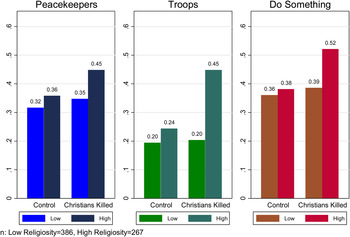
Next, we examine if Brother's Keeper effects are greater among more religious respondents (H2). We operationalize respondents’ religiosity in two ways by summing how important religion is in respondents’ daily lives, respondents’ church attendance, whether respondents believe religion is a divisive factor in politics, and whether respondents prefer religion to have a greater or smaller role in public life. The religiosity sample mean is 8.62, out of a maximum score of 20. We then sort respondents as either religious or not or low religious, with respondents scoring above the mean are classified as more religious, while respondents with scores below the mean are classified as less religious. In these two treatment groups, 59% of respondents are classified as less religious and 41% as more religious.
As summarized in Figure 2, there is greater support for intervention among more religious respondents. Among less religious respondents, receiving the Christians Killed cue has no significant effect on increasing support for intervention. Compared to similarly less religious respondents in the control group, support for Peacekeeper is three points higher, increasing from 32% to 35%, but the increase is not statistically significant (p = 0.52). The Christian killed treatment also has no statistically significant effects on support for Troops, increasing support by one point (p = 0.82) and support for Do Something by three points (p = 0.60). By contrast, the Christian Killed treatment has significant effects on more religious respondents. Though the nine-point increase in support for peacekeepers from 36% in the control group to 45% in the Christians Killed treatment group is not statistically significant (p = 0.14), the 21-point increase in support for troops from 24% to 45% (p = 0.00) and 14-point higher support for doing something from 38% to 52% (p = 0.02) are statistically significant.
Brother's keeper effects greater among more religious.

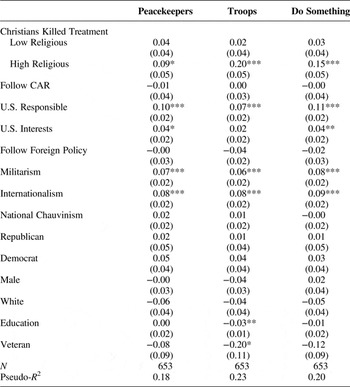
Divergent Brother's Keeper effects across respondent religiosity hold when factoring respondents’ demographic profile and foreign policy predispositions. In Table 3, we summarize effects on predicted probability when interacting the religious cue treatment variable with respondents’ religiosity. While less religious respondents are not more likely to support foreign intervention when receiving the Christians killed treatment, more religious respondents receiving the Christians killed treatment are more likely to support troops and doing something by 20 and 15 points, respectively. Respondents are more likely to support foreign intervention when they have higher initial belief that the United States has a responsibility to intervene in the CAR (United States Responsible), greater support for the use of force to resolve international problems (Militarism), and greater agreement that the United States needs to be active in solving international conflicts (Internationalism). However, respondents’ demographic profiles have no consistent effects on support for foreign policy intervention.
Statistical evidence of greater brother's keeper effects among more religious respondents

Reported values are effects on predicted probability. Standard errors in parentheses. *p < 0.10; **p < 0.05; ***p < 0.01.
To further test if Brother's Keeper effects are greater among more religious respondents (H2), we examine effects across five other parameterizations of religiosity; all results are summarized in Table A2 in the Online Appendix. First, instead of differentiating respondents by whether their religiosity score is above or below the mean, we classify respondents as having low, medium, or high religiosity; in the sample, 31% of respondents are coded as low religious, 34% are coded as medium religious, and 35% as high religious. Comparing Brother's Keeper effects across each of these categories, we find effects are statistically significant among high religious respondents; there are no effects in low religious respondents, and positive but not statistically significant effects among respondents with medium religiosity.
Next we decompose the religiosity score and compare Brother's Keeper effects by importance of religion in respondents’ lives, how frequently they attend religious services, and whether they believe religion is divisive. We find no Brother's Keeper effects among respondents who report religion is not important or has only some guidance on their daily lives, but statistically significant effects among respondents who report religion has significant guidance on their daily lives. Similarly, we find no Brother's Keepers effects among respondents who never attend religious services. Instead, Brother's Keeper effects are only statistically significant among infrequent attenders (more than never, less than weekly) and frequent attenders (at least once a week). Fourth, we find no Brother's Keeper effects among respondents who find religion divisive, and statistically significant effects among those who are unsure if religion is divisive as well as those who believe religion is not divisive.
Finally, we differentiate respondents by their religious identification as Mainline Protestants, Catholics, Evangelicals, Nones (no religious affiliation), or another religious tradition (Other Religion); given the low number of respondents who identify as non-Christian, we group them together to enable statistical inference. Given the low religiosity of unaffiliated Nones and high religiosity of Evangelicals, we find no Brother's Keepers among Nones and statistically significant Brother's Keeper effects among Evangelicals. There are also positive but not statistically significant Brother's Keeper effects among Protestants, Catholics, and respondents of other religions (Mormons, Jews, Muslims, Hindus, and other non-Christians).
The results of the survey experiment reveal evidence of the Brother's Keeper effects (H1). These findings are robust across different parameterizations of the dependent variable and model used to identify effects; they are also robust whether accounting for respondents’ demographic profile and foreign policy predispositions. We also find evidence of greater Brother's Keeper effects among more religious Americans (H2); these effects are robust across multiple parameterizations of religiosity. This is strong evidence that religious cues are effective in mobilizing support for foreign policy intervention, even in a far-flung conflict with no clear national or strategic interests. Moreover, the mobilization of support for foreign policy intervention is greater among more religious respondents.
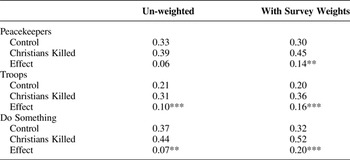
Since our sample of respondents is less religious and more liberal than the United States population, it likely underestimates religious mobilization effects. To estimate population effects, we use an iterative proportional fitting weights algorithm so that our sample replicates the gender, race, age, education, and religious demographics of a nationally representative sample.Footnote 6 Table A3 in the Online Appendix summarizes the demographic profiles of the original MTurk sample and the sample after applying survey weights. Table 4 compares empirical effects on the un-weighted and weighted sample. The results reveal Brother's Keeper effects are stronger as an estimated population effect than sample effect.
Brother's keeper effects stronger as population effect

*p < 0.10; **p < 0.05; ***p < 0.01.
In the un-weighted sample, there is greater support for Troops and Doing Something; however increased support for Peacekeepers is not statistically significant. By comparison, using the weighted sample, there are statistically significant increases of support for Troops, Doing Something, and Peacekeepers. Moreover, the magnitude of the effect is greater when extrapolating population effect. In the un-weighted sample with a dichotomous dependent variable, respondents who receive the religious cue treatment have higher support for peacekeepers, troops, and doing something by 6, 10, and 7 points, respectively. By contrast, in the weighted sample, there is an increase in support for peacekeepers of 15 points, higher support for troops of 16 points, and greater support to do something of 20 points.
THE LIMITS OF RELIGIOUS MOBILIZATION: NOT MY BROTHER'S KEEPER EFFECTS
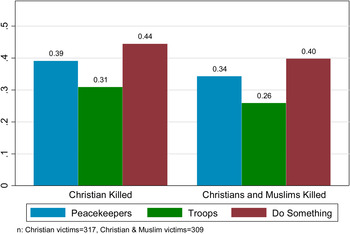
While we find respondents are more supportive of foreign intervention if victims are identified as Christians (H1, H2), we do not find the same willingness to support intervention when victims are identified as Muslims. In other words, there is a limit to the power of religious mobilization — while effective in increasing support to help religious co-partisans, it does not mobilize support to help religious outsiders. According to the Not My Brother hypothesis (H3), support for foreign intervention is lower when respondents receive the counter-vailing religious cue where respondents are also identified as Muslims who are not co-religionists but perceived as outsiders (Kalkan, Layman, and Uslander Reference Kalkan, Layman and Uslander2009). As Figure 3 summarizes, support for Peacekeeper decreases five points from 39% to 34% among respondents receiving the countervailing religious cue (p = 0.21), support for Troops decreases by five points from 31% to 26% (p = 0.16), and support to Do Something decreases four points from 44% to 40% (p = 0.24).Footnote 7 However, since none of these decreases are statistically significant, there is no evidence of Not My Brother effects (H3).
Not my brother effects.

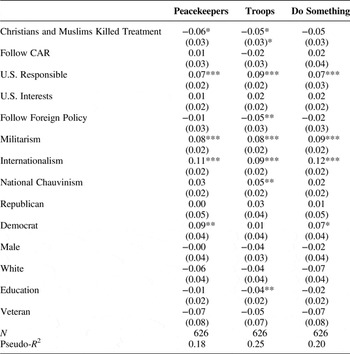
We also estimate Not My Brother Effects with models that factor for respondents’ foreign policy predispositions (Follow CAR, United States Responsible, United States Interests, Follow Foreign Policy, Internationalism, Militarism, and Chauvinism) and demographic profile (Republican, Democrat, Male, White, Education, Veteran). The models summarized in Table 5 report effects on predicted probability, specifically the difference in predicted support for intervention between respondents receiving the Christians killed vignette and respondents receiving the Christians and Muslims killed vignette. The results show that there is no statistically significant decrease in support for peacekeepers, troops, or doing something when receiving the Christians and Muslims killed treatment. This is further evidence against the hypothesis that there are Not My Brother's Keeper effects. The lack of evidence for Not My Brother's Keeper effects are largely consistent when estimated with ordinal logistic regression (where support for peacekeepers and troops are operationalized on a 1–5 scale) and ordinary least squares regression (where support for doing something is operationalized on a 2–10 scale). As the results in Table A4 in the Online Appendix show, while the Christian and Muslim cue decreases support for peacekeepers, troops, and doing something, only lower support for doing something is statistically significant.
No statistical evidence of not my brother's keeper effects

Reported values are effects on predicted probability. Standard errors in parentheses.
*p < 0.10; **p < 0.05; ***p < 0.01.
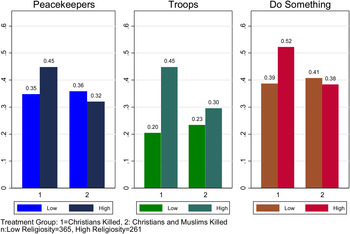
Finally, we test if Not My Brother's Keeper effects are greater among more religious Americans. When receiving counter-vailing religious cues, more religious respondents who have stronger identifications with the Christian religious in-group are more likely to perceive Muslims as religious outsiders and thus less willing to support intervention on their behalf, even at the expense of not helping their Christian brethren. The results summarized in Figure 4 reveal high-religious respondents who receive the counter-vailing religious cue have lower support for peacekeepers, troops, and doing something. Support for peacekeepers decreases by 13 points from 45% to 32% (p = 0.03), support for troops decreases by 15 points from 45% to 30% (p = 0.01), and support for doing something decreases by 14 points from 52% to 38% (p = 0.03). These findings suggest Not My Brother effects are greater among more religious respondents who are more likely to perceive Muslims as religious outsiders (H4).
Not my brother effects by religiosity.

Evidence of Not My Brother's Keeper effects among more religious respondents also holds when accounting for respondents’ demographic profiles and foreign policy predispositions.
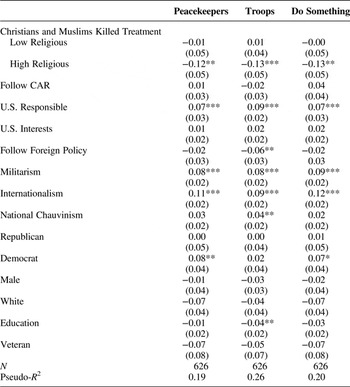
The results summarized in Table 6 reveal Not My Brother effects are statistically significant among more religious respondents but not less religious respondents. While less religious respondents’ support for intervention is not affected by whether victims of violence are portrayed as Christians or Christians and Muslims, among more religious respondents, there is lower probability of support for peacekeepers by 12 percentages points, troops by 12 points, and doing something by 12 percentage points when victims of are portrayed as Christians and Muslims.
Not my brother treatment effects greater among more religious

Reported values are effects on predicted probability. Standard errors in parentheses.
*p < 0.10; **p < 0.05; ***p < 0.01.
As a robustness test, we examine if Not My Brother's effects are greater among more religious respondents when religiosity is measured differently. The results, summarized in Table A5 in the Online Appendix, reveal inconsistent evidence that more religious respondents are less likely to support intervention to help Christian and Muslim victims. When classifying respondents into low, medium, or high religious categories, we find corroborating evidence of Not My Brother's Keeper effects among the most religious respondents. However, there is no consistent evidence of Not My Brother's Keeper effects among more religious respondents, when religiosity is measured by daily importance of religion, frequency of church attendance, belief that religion is divisive, and denominational identification. Thus, we conclude that there is some, but not conclusive, evidence that Not My Brother's keeper effects are greater among more religious respondents (H4).
Given many Americans consider Muslims religious outsiders, we expected respondents to be less likely to support intervention when victims are also identified as Muslims (H3). We also hypothesize Not My Brother's Keeper effects would be greater among more religious respondents who are likely to have stronger Christian in-group attitudes and more negative perceptions of Muslims (H4). However, the results reveal no evidence of Not My Brother's Keeper effects (H3) and inconsistent evidence that Not My Brother's Keeper effects are stronger among more religious respondents (H4).
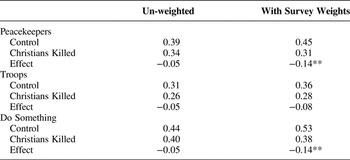
Finally, we estimate Not My Brother's Keeper effects as a population effect. Applying survey weights, we compare sample effects versus population effects in Table 7. The results reveal evidence of Not My Brother's Keeper population effects. With the un-weighted sample, we find no evidence of Not My Brother's Keeper effects. However, after applying survey weights, we find lower support for peacekeepers and doing something when victims are Christians and Muslims than if victims were Christians. We also find lower support for sending troops, but the difference is not statistically significant.
Not my brother's keeper effects as population effect

*p < 0.10; **p < 0.05; ***p < 0.01.
RELIGIOUS CUES AND FOREIGN POLICY SUPPORT
While Americans are reluctant to support foreign intervention in far-flung conflicts with no clear interests at stake, they can be mobilized to support an intervention if the victims of violence are identified as Christian co-religionists. To test our argument, we use a survey experiment that randomly assigns respondents to read different accounts of violence occurring in the CAR. The results reveal robust evidence of Brother's Keeper effects as respondents are more supportive of foreign military intervention when victims of violence are identified as Christians (H1).
Because our sample of respondents is less religious than a more nationally representative sample, we calculate and apply survey weights to estimate if our findings extrapolate to population effects. As expected, our experimental results under-estimate the likely population effects. The weighted results reveal that respondents are more likely to support peacekeepers, troops, and doing something when victims of violence are identified as Christians. By contrast, we do not find evidence of Not My Brother's Keeper effects (H3). Contrary to expectations, we do not find conclusive evidence of lower support for intervention when victims are identified as Christians and Muslims. While there is some evidence of Not My Brother's Keeper effects when extrapolated as a population effect, results are not robust across different specifications.
Since religious cues activate respondents’ religiosity, we expect stronger religious cue effects among more religious respondents. We find empirical evidence that My Brother's Keeper effects are greater among more religious (H2). These effects are robust across six other parameterizations of religiosity, increasing confidence that cues based on religious identity moderate mobilization effects. However, while we find that more religious respondents are less likely to support intervention when victims are also identified as Muslims (H4), Not My Brother effects are not robust across other parameterizations of religiosity. Further investigation is needed to determine which religious audiences are less likely to support intervention to aid Muslims.
Our results also reveal that religiosity only has moderating effects on foreign policy attitudes when respondents are exposed to religious cues. This is most evident when comparing respondents in the control group with respondents who receive the Christians killed treatment. In the control group where victims’ religious identities are not specified, there are no statistically significant differences in support for peacekeepers (p = 0.43), troops (p = 0.29), or doing something (p = 0.70) among low and high religious respondents. This suggests that there may not be intrinsic differences in the foreign policy attitudes between religious and less religious Americans. This is not an argument that religiosity has no effect on foreign policy attitudes. Rather, what the data indicate is that religiosity has significant effects on foreign policy attitudes when respondents are exposed to religious cues.
When comparing low and high religious respondents who both read vignettes where victims of violence are identified as Christians, support for peacekeepers, troops, and doing something is greater among high religious respondents than low religious respondents by 10 points (p = 0.07), 24 points (p = 0.00) and 14 points (p = 0.02), respectively. This follows expectations of the interactionist foreign policy model which predicts that situational cues activate latent predispositions, resulting in divergent foreign policy attitudes between respondents with different predispositions. Our results expand the interactionist insights to the realm of religious predispositions. Specifically, religious cues activate and have greater effects on more religious respondents with stronger religious predispositions.
IMPLICATIONS AND FUTURE RESEARCH
Under what conditions does an actor's religious identity affect his or her foreign policy attitudes? Is there a causal link between latent religious predispositions and support for specific foreign policy prescriptions? In this study, we introduce and find evidence of a Brother's Keeper effect where identifying the victims of foreign atrocities as Christians increases support for foreign intervention on the part of co-religionists. Despite reservations about engaging in humanitarian interventions abroad, the American public is far more likely to come to the aid of religious minorities with which they deeply identify.
Our findings reveal three significant implications that enrich our understanding of religion's effects on foreign policy. First, religious cues — especially explicitly Christian cues — can significantly affect foreign policy attitudes. Focusing on the hard test of support for foreign military intervention, identifying victims of violence as Christians increases respondents’ support for United States intervention. Brother's Keeper effects are especially strong among more religious respondents who support sending peacekeepers and American troops to stop violence against Christian victims in the CAR. Presidents are unlikely to mobilize reluctant publics to support foreign intervention when they do not explicitly identify the victims of violence as Christians. However, intervention framed as helping fellow co-religionists can mobilize public support for foreign policy intervention, especially among more religious Americans. Religious labels allow leaders to mobilize Americans around the idea of becoming a Brother's Keeper, thereby coming to the aid of a perceived co-religionist in a far-flung crisis.
Recent events show the external validity of Brother's Keeper effects we find in the experiment. Before President Obama's speech in August 2014, more Americans believed the United States had no responsibility to intervene in Iraq than supported intervention (55% versus 39%). However, after his speech highlighting how ISIL was targeting Yazidis and Assyrian Christians in Iraq, more Americans believed the United States had a responsibility to act than those who oppose intervention (44% versus 41%) (Pew Research Center 2014b). Consistent with our experimental findings, support for Assyrian Christians, in particular, is strongest among Evangelicals and highly religious Americans (Sisto Reference Sisto2014). Though there is strong evidence that Assyrian Christians differ significantly from American Christians in their theological beliefs and evangelical fervor (Merritt Reference Merritt2014), there was a significant increase in support for intervention, best embodied in the international “#WeAreN” social media campaign to increase awareness and support to Iraqi Christians threatened by ISIL (Sisto Reference Sisto2014).
A second implication of our study is that not all religious cues are effective in mobilizing support for foreign policy prescriptions. In other words, the invocation of religion is not a panacea that can overcome all domestic political resistance. While very effective among more religious Americans, religious cues are not effective among more secular Americans. Moreover, identifying victims as Muslims may even undermine support for intervention. While evidence of Not My Brother's Keeper effects is inconclusive, our findings do suggest there is greater unwillingness if not resistance to foreign policy intervention that aids Muslims, even when doing so also aids Christians. Thus, presidents and elites are likely to de-emphasize the Islamic identity of foreign actors aided by American foreign policy. For example, though almost all Kuwaitis are Muslims, President George Bush did not mention their religious belonging in the buildup and mobilization of support for the First Gulf War. Similarly, in describing the work of Sunni troops recruited to fight Shiite insurgents during massive civil unrest in Iraq in the mid-2000s, the Department of Defense took efforts to de-emphasize that they were Muslims, calling them instead “Concerned Local Citizens” (Mays Reference Mays2007) or “Sons of Iraq” (Mulrine Reference Mulrine2008). In short, when intended beneficiaries of United States foreign policy are Muslims, they are more likely to be identified with secular names or designations that de-emphasize their Muslim identities.
The third implication of this research is that religious predispositions are unlikely to have effects on foreign policy attitudes unless they are intentionally activated. Though Americans are very religious, religious belongings, beliefs, and identities are latent and do not easily translate into differentiated foreign policy attitudes. In our control group, there are no differences in support for intervention between religious and less religious respondents. Instead, differences in foreign policy attitudes between respondents by their religious predispositions only emerge among those who receive the religious cue treatment. This finding suggests that a more comprehensive approach that examines the interaction of situational cues and predispositions, such as the one modeled in this article, is needed to better identify the effects of religion on foreign policy attitudes.
Experimental studies are not a research panacea, but they can test causal mechanisms that activate religious predispositions and imbue otherwise secular politics with sacred significance. Future studies should examine how other religious cues in other foreign policy situations activate and shape actors’ religious world view into specific foreign policy attitudes. For example, do Brother's Keeper effects also increase support for other types of policy prescriptions, such as support for domestic welfare programs, international aid, crisis actors in civil war conflicts, or accepting refugees from foreign conflicts? Future research should also identify if explicit labeling of United States allies, such as Saudi Arabia or Indonesia, as Muslim generates Not My Brother effects, thereby reducing public support and approval of those actors. Such research will not only test the applicability of our arguments in new foreign policy arenas, but will also enrich scholars’ understanding of how religion affects the exercise of social, economic, and military power at the nexus of domestic and international politics.
Supplementary materials and methods
To view supplementary material for this article, please visit http://dx.doi.org/10.1017/S1755048316000390.