Introduction
Cognitive deficits are one of the key features of schizophrenia (Kraepelin, Reference Kraepelin1919). In particular, deficits in global measures of cognition, such as intelligence quotient (IQ) or general cognitive ability composite scores (g) are common in patients with schizophrenia (Keefe & Fenton, Reference Keefe and Fenton2007; Irani et al. Reference Irani, Kalkstein, Moberg and Moberg2011). IQ has been shown to be highly heritable in adulthood (Posthuma et al. Reference Posthuma, de Geus and Boomsma2001) and, interestingly, genes for schizophrenia partly overlap with genes for intelligence (Toulopoulou et al. Reference Toulopoulou, Picchioni, Rijsdijk, Hua-Hall, Ettinger, Sham and Murray2007).
Cross-sectional studies indicate that there is little evidence for change in IQ during the course of illness, suggesting that the lower IQ found in schizophrenia patients is a stable trait (Mockler et al. Reference Mockler, Riordan and Sharma1997; Hijman et al. Reference Hijman, Hulshoff Pol, Sitskoorn and Kahn2003). However, longitudinal studies are more informative as they provide the opportunity to compare the level of IQ within subjects over time. Unfortunately, many longitudinal studies did not include an unaffected control sample (Haywood & Moelis, Reference Haywood and Moelis1963; Smith, Reference Smith1964; Hamlin, Reference Hamlin1969; Klonoff et al. Reference Klonoff, Fibiger and Hutton1970; Russel et al. Reference Russel, Munro, Jones, Hemsley and Murray1997; Bedwell et al. Reference Bedwell, Keller, Smith, Hamburger, Kumra and Rapoport1999; Gold et al. Reference Gold, Arndt, Nopoulos, O'Leary and Andreasen1999; Sheitman et al. Reference Sheitman, Murray, Snyder, Silva, Goldman, Chakos, Volavka and Lieberman2000; Stirling et al. Reference Stirling, White, Lewis, Hopkins, Tantam, Huddy and Montague2003; Gochman et al. Reference Gochman, Greenstein, Sporn, Gogtay, Keller, Shaw and Rapoport2005; van Winkel et al. Reference van Winkel, Myin-Germeys, Delespaul, Peuskens, De Hert and van Os2006; Cervellione et al. Reference Cervellione, Birdick, Cottone, Rhinewine and Kumra2007; Zipparo et al. Reference Zipparo, Whitford, Redoblado Hodge, Lucas, Farrow, Brennan, Gomes, Williams and Harris2008; Carter et al. Reference Carter, Parnas, Urfer-Parnas, Watson and Mednick2010). In fact, some studies that have used healthy controls show that patients do not benefit from practice effects as much as controls do (Hoff et al. Reference Hoff, Svetina, Shields, Stewart and DeLisi2005; Jepsen et al. Reference Jepsen, Fagerlund, Pagsberg, Christensen, Hilker, Nordentoft and Mortensen2010; but see Hoff et al. Reference Hoff, Sakuma, Wieneke, Horon, Kushner and DeLisi1999; Heaton et al. Reference Heaton, Gladsjo, Palmer, Kuck, Marcotte and Jeste2001).
The aim of this study was to investigate the change in IQ over time in a twin sample with chronically ill schizophrenia patients and in unaffected co-twins of patients and to compare these IQ changes with those found in healthy control twins over a follow-up period of 5 years.
Method
Participants
From a large cohort of discordant twins and their control twins (Baaré et al. Reference Baaré, van Oel, Hulshoff Pol, Schnack, Durston, Sitskoorn and Kahn2001; Hulshoff Pol et al. Reference Hulshoff Pol, Brans, van Haren, Schnack, Langen, Baaré, van Oel and Kahn2004, Reference Hulshoff Pol, Schnack, Mandl, Brans, van Haren, Baaré, van Oel, Collins, Evans and Kahn2006) we included those individuals (n = 52; nine patients, 10 unaffected co-twins and 33 healthy controls) who were tested twice at a mean interval of approximately 5 years (Brans et al. Reference Brans, van Haren, van Baal, Schnack, Kahn and Hulshoff Pol2008) and had completed IQ tests at both measurements. Baseline IQ data were available in 21 patients, 18 co-twins and 53 control twins [patients: 108.67 (s.d. = 14.22), co-twins: 116.78 (s.d. = 13.46), healthy controls: 116.40 (s.d.= 13.17)]. When we compared those patients who did undergo a second Wechsler Adult Intelligence Scale (WAIS) measurement (and were included in the current study) with those patients who did not we did not find a significant difference between the two groups (109.78 and 107.83, respectively, p = 0.77). Thus, we conclude that IQ of the subgroup of patients whom we included in the present study was representative for the entire twin sample that we have been following over the past years.
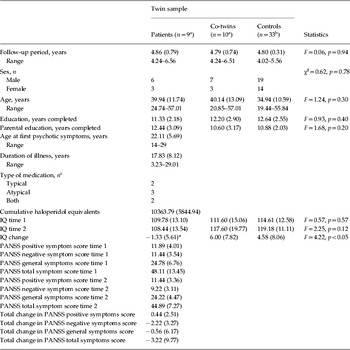
The discordant twin sample in this study consisted of two monozygotic (MZ) pairs and four dizygotic (DZ) pairs, one MZ patient, two DZ patients, one MZ unaffected co-twin and three DZ unaffected co-twins. The control twin sample consisted of six MZ pairs and five DZ pairs, nine MZ controls and two DZ controls. Data were collected between 1994 and 2006. No significant differences were found between the groups on age, sex, follow-up duration, education, parental education and baseline IQ. For demographic information see Table 1.
Demographics of the twins

Data are given as mean (standard deviation) unless otherwise indicated.
IQ, Intelligence quotient; PANSS, Positive and Negative Syndrome Scale.
a Two complete MZ discordant twin pairs and four complete discordant DZ twin pairs. One singleton MZ patient, and two singleton DZ patient. One singleton MZ co-twin and three singleton DZ co-twins.
b Six complete unaffected MZ twin pairs and five unaffected complete DZ twin pairs. Nine singleton MZ controls and two singleton DZ controls.
c Information on antipsychotic medication intake was missing in two patients.
* Patients differed significantly in IQ change compared with healthy controls (p < 0.05) and with the unaffected co-twins (p < 0.05), where patients slightly decreased and healthy controls and co-twins both increased.
Assessment of intelligence
Four subtests of the Dutch version of the WAIS (Stinissen et al. Reference Stinissen, Willems, Coetsier and Hulsman1970) were used as a proxy for IQ. Subtests that were administered were vocabulary, block design, picture arrangement and comprehension. To estimate a proxy for IQ we summarized the scaled scores corrected for age and sex from each subtest, divided by 4 and multiplied with 11 for the final total scaled score (for method, see Hijman et al. Reference Hijman, Hulshoff Pol, Sitskoorn and Kahn2003). Total IQ score can then be derived from the total scaled score in tables from the WAIS (Stinissen et al. Reference Stinissen, Willems, Coetsier and Hulsman1970).
Analyses
Repeated-measures analysis of variance was performed with measurement (IQ at baseline and at follow-up) as the within-subjects factor and dummy-coded variables with discordant twins (discordant twin pair = 1 or healthy control twin pair = 0), illness (patient = 1, co-twins and healthy control = 0) and zygosity (DZ = 0 and MZ = 1) as between-subjects factors, as applied before (Baaré et al. Reference Baaré, van Oel, Hulshoff Pol, Schnack, Durston, Sitskoorn and Kahn2001; Hulshoff Pol et al. Reference Hulshoff Pol, Brans, van Haren, Schnack, Langen, Baaré, van Oel and Kahn2004, Reference Hulshoff Pol, Schnack, Mandl, Brans, van Haren, Baaré, van Oel, Collins, Evans and Kahn2006).
Change in IQ was determined by subtracting the total IQ score on follow-up from the total IQ score at baseline. The IQ change scores were used to investigate the planned comparisons pairwise analyses using independent-samples t tests to detect the source of significance.
Pearson correlation analyses were used to investigate the association between change in IQ with cumulative medication in haloperidol equivalents during the interval, symptom level at baseline and follow-up measured with the Positive and Negative Syndrome Scale (PANSS; Kay et al. Reference Kay, Fiszbein and Opler1987), and change in symptom level measured with the PANSS.
Results
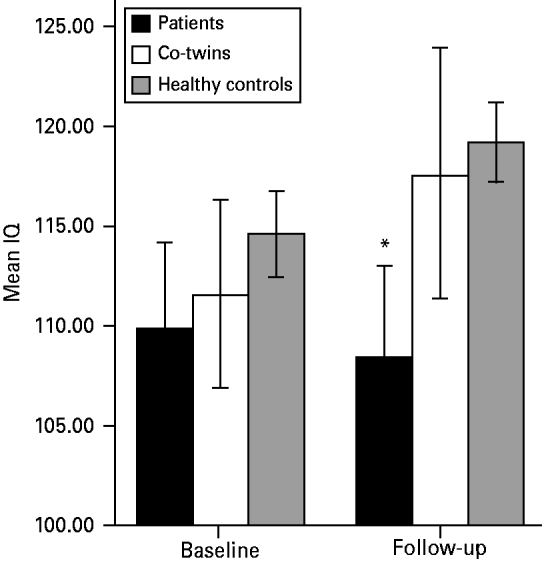
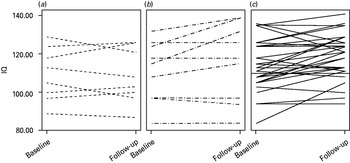
A significant interaction effect over time was found between IQ measurement and illness (F = 4.22, df = 1, p < 0.05), indicating that change in IQ over time is significantly different between the groups. Planned comparisons with independent-samples t tests indicated a stable course in IQ over time in patients relative to both the healthy control twins (t = 2.06, p < 0.05) and the unaffected co-twins (t = − 2.32, p < 0.05) who both showed a slight increase in IQ (Fig. 1). No significant difference was found between the unaffected co-twins and the healthy controls (t = − 0.49, p = 0.63). For individual IQ change over time for each group, see Fig. 2.
Intelligence quotient (IQ) at baseline and follow-up for schizophrenia patients, unaffected co-twins and healthy controls. Values are means, with standard errors represented by vertical bars. * At follow-up, patients had a significantly lower IQ than healthy controls (p < 0.05). Patients differed significantly from healthy controls and co-twins in IQ change (both p < 0.05) in that for co-twins and healthy controls there was an increase over time while for patients there was not.
Intelligence quotient (IQ) change over time in (a) individual schizophrenia patients, (b) unaffected co-twins and (c) healthy controls. There are two patients and two co-twins who had the same IQ at baseline and at follow-up; therefore only eight lines are visible for the patients and nine lines for the co-twins.

Cumulative antipsychotic medication intake during the follow-up period did not correlate with change in IQ (r = 0.06, p = 0.91). Change in IQ correlated significantly with PANSS total symptom score at follow-up (r = − 0.68, p < 0.05), indicating that those patients with a higher symptom load at follow-up showed the largest decline in IQ over time.
Change in IQ did not correlate significantly with PANSS scores at baseline, or change in PANSS scores during the interval.
Discussion
In this study we measured change in global intelligence over a 5-year interval in chronically ill patients with schizophrenia from discordant twin pairs (three MZ and six DZ individuals) and unaffected co-twins (three MZ and seven DZ individuals). We found that IQ in patients failed to increase over time whereas IQ in unaffected co-twins and matched healthy controls (21 MZ and 12 DZ individuals) did. Our results show that change in IQ in unaffected co-twins of patients with schizophrenia did not differ significantly from that of control twins. The mean IQ increase was even slightly higher in co-twins relative to control twins, although this difference did not reach significance. Since the lack of increase in IQ was limited to the patients, and not present in co-twins of patients, we could argue that the lack of changes in IQ found in patients with schizophrenia is associated with the illness or illness-related factors. Indeed, our findings suggest that in chronically ill patients environmental (non-genetic) factors implicated in the disease are most likely to be associated with the lack of IQ improvement over time.
Our results in patients are in line with other controlled longitudinal studies in early-onset schizophrenia (Jepsen et al. Reference Jepsen, Fagerlund, Pagsberg, Christensen, Hilker, Nordentoft and Mortensen2010) and first-episode schizophrenia (Hoff et al. Reference Hoff, Svetina, Shields, Stewart and DeLisi2005) where patients showed less increase in IQ over time as compared with healthy controls. A lack of increase in IQ might be explained by an abnormal slow acquisition of new skills and intellectual information in patients (Hoff et al. Reference Hoff, Svetina, Shields, Stewart and DeLisi2005; Jepsen et al. Reference Jepsen, Fagerlund, Pagsberg, Christensen, Hilker, Nordentoft and Mortensen2010). In addition, it might be that patients with schizophrenia do not benefit from practice effects, while both the unaffected co-twins and healthy control twins do (Salthouse, Reference Salthouse2010). Another explanation could be that the patients are not influenced by the Flynn effect (i.e. an increase in average scores on intelligence tests) (Hiscock, Reference Hiscock2007) in contrast to the unaffected co-twins and healthy controls. While interpreting the findings from our and the above-mentioned studies, it is important to keep in mind that the reported changes are small (i.e. a few IQ points) and are not necessarily clinically relevant.
Previously it was shown that intelligence is decreased in unaffected co-twins of patients, suggesting that a lower IQ in schizophrenia can to some extent be explained through common genes (Toulopoulou et al. Reference Toulopoulou, Picchioni, Rijsdijk, Hua-Hall, Ettinger, Sham and Murray2007). Our findings suggest that the subsequent lack of IQ increase on repeated testing in patients is more likely to be non-genetic since unaffected co-twins did not significantly differ from healthy control twins. However, it is important to note that we were not able to take zygosity into account, due to the small numbers in our study.
One of the disease-associated factors that could have influenced the lack of IQ change in the patients with schizophrenia is the intake of antipsychotic medication. However, we found no evidence for an influence of antipsychotic medication on IQ change. This could be due to the diversity in types of antipsychotic medication intake in our sample (typical n = 2, atypical n = 3, or both n = 2). The effect of antipsychotic medication on cognitive functioning is still debated, with the general consensus that both first- and second-generation antipsychotics provide small but positive effects on cognition (Keefe et al. Reference Keefe, Bilder, Davis, Harvey, Palmer, Gold, Meltzer, Green, Capuano, Stroup, McEvoy, Swartz, Rosenheck, Perkins, Davis, Hsiao and Lieberman2007; Davidson et al. Reference Davidson, Galderisi, Weiser, Werbeloff, Fleischhacker, Keefe, Boter, Keet, Prelipceanu, Rybakowski, Libiger, Hummer, Dollfus, López-Ibor, Hranov, Gaebel, Peuskens, Lindefors, Riecher-Rössler and Kahn2009). This has been shown in both short-term studies, i.e. 3 and 6 months of treatment (Rollnick et al. Reference Rollnik, Borsutzky, Huber, Mogk, Seifert, Emrich and Schneider2002; Davidson et al. Reference Davidson, Galderisi, Weiser, Werbeloff, Fleischhacker, Keefe, Boter, Keet, Prelipceanu, Rybakowski, Libiger, Hummer, Dollfus, López-Ibor, Hranov, Gaebel, Peuskens, Lindefors, Riecher-Rössler and Kahn2009), and long-term studies of more than 2 years (Green et al. Reference Green, Marder, Glynn, McGurk, Wirshing, Wirshing, Liberman and Mintz2002). Should a positive effect of antipsychotic medication on cognitive functioning indeed exist, then this could imply that without medication, patients would not show a lack of improvement but perhaps even a decline in IQ over time during the course of illness.
Research on the developmental course of specific cognitive functions in schizophrenia patients (i.e. using a longitudinal design) shows no differences between patients and controls, despite the lower performance in patients, on various neuropsychological domains such as abstraction, attention, verbal and spatial memory, language, initiation/preservation, spatial, sensory and motor abilities (Censits et al. Reference Censits, Ragland, Gur and Gur1997; Nayak Savla et al. Reference Nayak Savla, Moore, Roesch, Heaton, Jeste and Palmer2006) as well as in measures such as the Clinical Dementia Rating (CDR) scale and the Mini Mental State Examination (MMSE; Friedman et al. Reference Friedman, Harvey, Coleman, Moriarty, Bowie, Parrella, White, Adler and Davis2001). However, it might be that in chronically institutionalized older patients (>65 years of age) an excessive decline over time in cognitive functioning (i.e. CDR and MMSE) is present (Friedman et al. Reference Friedman, Harvey, Coleman, Moriarty, Bowie, Parrella, White, Adler and Davis2001). In addition, a higher incidence of developing dementia in older patients with schizophrenia compared with healthy controls has been reported (Brodaty et al. Reference Brodaty, Sachdev, Koschera, Monk and Cullen2003; Kørner et al. Reference Kørner, Lopez, Lauritzen, Andersen and Kessing2009). In first-episode schizophrenia significantly less improvement over time relative to that of healthy controls has been found in verbal memory (Hoff et al. Reference Hoff, Sakuma, Wieneke, Horon, Kushner and DeLisi1999).
This study has several limitations that have to be taken into consideration when interpreting its findings. First, this is a preliminary study and the results must be interpreted with caution given the small sample size. Because of the small sample size we were not able to measure effects of changes in IQ while taking zygosity into consideration – let alone do more advanced statistical analysis such as structural equation modelling to determine the extent to which the lack of IQ increase in schizophrenia was due to environmental and/or genetic influences. Second, our patients had a baseline IQ of on average 109.78, which was comparable with that in co-twins of patients and control twins. However, we cannot exclude that in particular our patient sample is at the high end of the IQ distribution (which is in line with the higher parental education of the parents of the patients). Therefore, we have to consider that the follow-up IQ assessment in patients was unchanged due to regression to the mean effects. In other words, patients were less likely to improve even further at follow-up as compared with co-twins and controls. However, considering that all three groups had comparable baseline IQ levels makes it unlikely that a regression to the mean explained the differences in change in IQ between our groups. Moreover, positive influences of a higher baseline IQ on follow-up IQ have also been suggested (i.e. the rich get richer) (Rapport et al. Reference Rapport, Brines, Axelrod and Theisen1997).
In conclusion, we suggest that a lack of increase in IQ over time in chronically ill patients relative to unaffected co-twins and healthy controls might be due to environmental (non-genetic) factors related to the disease.
Acknowledgements
This study was funded by a Netherlands Organization for Scientific Research (NWO) VIDI grant (no. 917-46-370) to H.H. and a European Twin Study Network on Schizophrenia (EUTwinsS) grant (no. MRTN-CT-2006-035987).
Declaration of Interest
None.