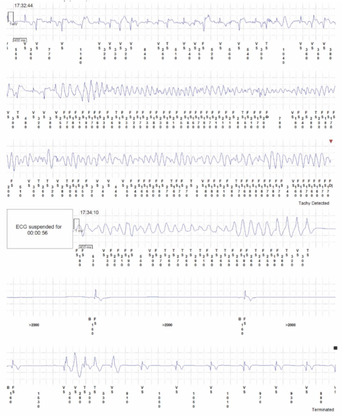
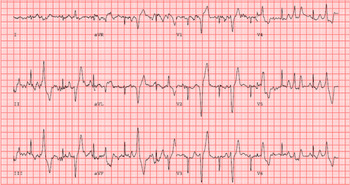
A 38-year-old cardiac nurse who presented to multiple cardiologists with more than 15 episodes of exercise-induced syncope received a diagnosis of vasovagal syncope because of documented bradycardia in the early recovery phase. During exercise stress-testing, frequent ventricular ectopy was observed, and a Holter monitor captured rare bidirectional pre-mature ventricular contractions at increased heart rate, highly suggestive of catecholaminergic polymorphic ventricular tachycardia. As a result, beta-blockade was initiated (bisoprolol 2.5 mg daily) as the patient was concerned about potential side effects of non-selective beta-blockers, and an implantable loop recorder was inserted to confirm the diagnosis and to provide an early alert system. The patient was advised to avoid adrenaline surging sports but was non-compliant. While bouldering, she had a sudden collapse and ventricular fibrillation with spontaneous conversion to sinus bradycardia (Fig 1). After this event, the patient received an implantable cardioverter defibrillator after a discussion regarding alternative options, risks, and benefits. After her syncopal event, she was started on maximally tolerated nadolol (40 mg twice daily), and flecainide (50 mg twice daily) was started shortly thereafter for persistent ventricular ectopy seen on a repeated exercise stress test (Fig 2). This effectively suppressed ventricular ectopy on repeat treadmill testing. She has not had any further syncopal events on this combination of medical therapy.”
Image captured from implantable loop recording during loss of consciousness. Images demonstrates the presence of ventricular fibrillation and subsequent return to sinus bradycardia.

This electrocardiogram (ECG) is from the patient’s exercise stress test prior to initiation of flecainide while on nadolol 40 mg twice daily. This is depicted at Stage 5 of the Bruce Protocol after 13:00 minutes at 5.0 miles per hour at 18.0% incline. This ECG demonstrates significant ventricular ectopy at maximum exercise.

Catecholaminergic polymorphic ventricular tachycardia is a rare inherited arrhythmia disorder characterised by the onset of polymorphic ventricular tachycardia (VT) in the setting of high adrenergic tone. Most often patients are diagnosed in young adolescence with exercise-induced syncope, while patients presenting after the age of 21 years are typically female, gene negative, and less likely to experience life-threatening arrhythmias.
Current guidelines recommend beta-blocker therapy first line for catecholaminergic polymorphic ventricular tachycardia. Combination medical therapy (non-selective beta-blocker and flecainide), sympathectomy, and/or implantable cardioverter defibrillator insertion is recommended for those with recurrent sustained VT or syncope. Reference Al-Khatib, Stevenson and Ackerman1 Combination medical therapy may be considered by some for initial therapy in high-risk patients. Implantable cardioverter defibrillator insertion must be carefully considered in patients with catecholaminergic polymorphic ventricular tachycardia who are at risk of implantable cardioverter defibrillator discharges precipitating adrenergically mediated storm and should be a part of comprehensive care that includes maximally tolerated medical therapy and/or sympathectomy. Reference Roston, Jones and Hawkins2,Reference Miyake, Webster and Czosek3 In this case, it was felt that the patient was high risk for further malignant arrhythmias given her recurrent syncope and ventricular fibrillation despite being on beta-blocker therapy. Therefore, shared decision-making resulted in a decision for implantable cardioverter defibrillator implantation.
Acknowledgements
None.
Financial support
ZL received support from the Cardiology Academic Practice Plan at the University of British Columbia.
Conflicts of interest
None.