INTRODUCTION
Over many years, research into visual word recognition with both children and adults has shown that reading a word is not a matter of mere association between the stimulus and its mental representation. Rather, there is support for a mediating process that involves the sublexical analysis of the presented letter-string. Depending on the characteristics of the particular language being processed, this sublexical orthographic analysis may or may not be phonologically based. In other words, the language in which a word is processed can determine the way the orthographic structure of a word is analyzed by the reader. Key factors appear to be orthographic transparency (i.e. the consistency of the relationship between graphemes and phonemes) and the nature of the different sublexical structures of each language (e.g. Seymour, Aro & Erskine, 2003; see Ziegler & Goswami, 2005). For instance, Spanish is a transparent or shallow language in which the grapheme to phoneme correspondences are almost always one to one. In addition, most words are polysyllabic, with almost no ambiguity existing as to where the syllable boundary falls.
Accordingly, a number of studies in languages with clear syllabic boundaries have robustly shown that syllables are processed as psychological units during adult word reading (e.g. Álvarez, Carreiras & Taft, Reference Taft2001; Carreiras, Álvarez & de Vega, 1993, in Spanish; Conrad, Grainger & Jacobs, 2007; Mathey & Zagar, Reference Mathey and Zagar2002, in French; Conrad & Jacobs, Reference Conrad and Jacobs2004, in German). Many of these studies manipulated syllable frequency and the typical result for adult readers was the so-called inhibitory effect. The more frequent the first syllable of a word, the longer it takes to recognize that word and the more errors made (Álvarez, Carreiras & de Vega, Reference Álvarez, Carreiras and de Vega2000; Carreiras et al., Reference Carreiras, Álvarez and de Vega1993). The theoretical account for this inhibitory effect centers on the number of lexical candidates activated by the first syllable. If this is of high frequency, more words will be activated and more word representations will compete for recognition. The co-activated words interfere with the recognition of the target word, and accurate lexical access depends on lateral inhibition of these candidates. This effect has also been demonstrated to have a phonological (and not a purely orthographic) origin (Álvarez, Carreiras & Perea, Reference Álvarez, Carreiras and Perea2004; Conrad et al., Reference Conrad, Grainger and Jacobs2007).
This combined mechanism (i.e. sublexical processing of syllables that activate competing lexical candidates) has also received support from studies using event-related potentials in both Spanish (Barber, Vergara & Carreiras, Reference Barber, Vergara and Carreiras2004) and German (Hutzler, Bergmann, Conrad, Kronbichler, Stenneken & Jacobs, Reference Hutzler, Bergmann, Conrad, Kronbichler, Stenneken and Jacobs2004). When comparing words with high- or low-frequency first syllables in a lexical decision task, both studies found differences in an early time-windows (about 200 ms) and in the later N400 component: words containing high-frequency syllables produce more negative amplitudes. On the other hand, facilitatory effects of syllable frequency (i.e. faster responses for words with high-frequency syllables) have been found when lexical competition is reduced or non-existent, as when naming words in a transparent language (Carreiras & Perea, Reference Carreiras and Perea2004), where participants rely on a purely sublexical-syllabic level of processing (Conrad, Carreiras & Jacobs, Reference Conrad, Carreiras and Jacobs2008), in a language with no clear phonological syllable boundaries (Macizo & Van Petten, Reference Macizo and Van Petten2007), or when orthographic redundancy influences lexical processing (Mahé, Bonnefond & Doignon-Camus, 2014; Mathey, Zagar, Doignon & Seigneuric, 2006).
In fact, it has been argued that orthographic redundancy (i.e. the frequency of letter co-occurrence) is another factor that affects the amount of lexical competition. Hence, it can influence or even fully explain the syllabic effects. Such an argument is based on the bigram trough pattern (Seidenberg, Reference Seidenberg and Coltheart1987), coming from the fact that bigram frequency is generally higher within syllables than between them. Although some studies have shown syllabic effects when controlling for the bigram trough (e.g. Carreiras et al., Reference Carreiras, Álvarez and de Vega1993; Rapp, Reference Rapp1992), others have shown that syllabic effects in French depend on orthographic statistical properties that confirm the bigram trough hypothesis (e.g. Chetail & Mathey, 2009; Doignon & Zagar, Reference Doignon and Zagar2005, Reference Doignon and Zagar2006; Mathey et al., Reference Mathey, Zagar, Doignon and Seigneuric2006; but see Maïonchi-Pino, de Cara, Écalle, and Magnan, Reference Maïonchi-Pino, de Cara, Écalle and Magnan2012a). We will come back to this issue later.
Relatively few studies, however, have addressed sublexical (syllabic) processing from a developmental and learning perspective, namely, during reading acquisition. Some research with children has found that aspects of reading performance depend on the orthographic transparency of the language, as mentioned above (e.g. Seymour et al., Reference Seymour, Aro and Erskine2003). Readers of transparent languages are, for instance, better at reading pseudo-words than are those of opaque orthographies. In addition, readers of transparent languages demonstrate earlier development of the different levels of phonological awareness (e.g. Carrillo, Reference Carrillo1994; Jiménez & Ortiz, Reference Jiménez and Ortiz2000; Goikoetxea, Reference Goikoetxea2005; Ziegler & Goswami, 2005) and knowledge of grapheme–phoneme conversion (GPC) rules (see, e.g. Carrillo, Reference Carrillo1994; Lander & Wimmer, Reference Lander and Wimmer2008). Moreover, they are more successful in the use of syllabic units when processing words (Jiménez, García, O´Shanahan & Rojas, 2010; Maïonchi-Pino, Magnan & Ecalle, 2010a). However, it is a matter of debate when these abilities related to the use of syllabic information appear, in terms of age or reading instruction. This is a central topic of the present study.
Research supports the reliance on sublexical, syllabic units in transparent languages with clear syllabic boundaries, even in pre-reading stages. For example, an early study by Cossu, Shankweiler, Liberman, Katz, and Tola (Reference Cossu, Shankweiler, Liberman, Katz and Tola1988) tested Italian children and asked them to tap according to the number of syllables in a spoken word. The preschoolers (aged 4 and 5 years) were very proficient (67% reaching criterion) and children already at school (7- and 8-year-olds) attained a 100% success rate. Ability to phonemically segment was much lower. Similar results for syllable segmentation were found in Spanish with preschoolers reaching a 70% level of success (Carrillo & Marín, Reference Carrillo and Marín1996). It seems clear that phonological awareness in relation to syllabic units appears early, even in pre-reading stages (see Ziegler and Goswami, Reference Ziegler and Goswami2005, for a review).
In French, Colé, Magnan, and Grainger (Reference Colé, Magnan and Grainger1999) made use of a paradigm very close to the one employed by Mehler, Dommergues, Frauenfelder, and Segui (Reference Mehler, Dommergues, Frauenfelder and Segui1981) in the field of speech perception. Forty French children in first grade (mean age 6;7) participated in the study and were tested after either six months or one year of reading instruction, including explicit training on GPC correspondences. The experiment consisted of visually presented words, and participants had to detect whether each began with a designated target. The targets were letter sequences that were either a CV (consonant–vowel, e.g. PA) or a CVC (e.g. PAL), and the words had either a CV first syllable (e.g. PALACE) or a CVC first syllable (e.g. PALMIER). Results showed that CV targets were detected faster than CVC targets by the younger participants regardless of the structure of the word, while the older group showed a cross-over interaction: CV targets (e.g. PA) were detected more quickly in words starting with that syllable (e.g. PALACE) than in those starting with a CVC syllable (e.g. PALMIER), and vice versa for CVC targets. In addition, the cross-over pattern depended on the level of reading ability attained as established using a standardized measure of speed and accuracy of reading words. The authors concluded that grapho-syllabic processing starts after a period of GPC instruction, a ‘grapho-phonemic’ period.
Using the paradigm of illusory conjunctions, also in French, Doignon and Zagar (Reference Doignon and Zagar2005, Reference Doignon and Zagar2006) found similar syllabic effects in young children between six and seven years old, just after the end of their first year of learning to read. Along the same lines, Maïonchi-Pino, de Cara, Écalle, and Magnan (Reference Maïonchi-Pino, de Cara, Écalle and Magnan2012b) employed a modified version of the same paradigm with French children, showing use of a syllable-based segmentation that improved with reading skills and age (from 7;4 to 11 years). According to the authors, their results supported the idea that “visual letter detection within pseudowords primarily and early relies on acoustic-phonetic cues within the syllable boundaries, whereas the syllable effect seems to be developmentally constrained by reading skills and age” (p. 550).
In Spanish, Jiménez et al. (Reference Jiménez, García, O'Shanahan and Rojas2010) used the same CV-CVC paradigm as Colé et al. (Reference Colé, Magnan and Grainger1999) with children from first and second grade (age range: 6;5–7;9) and found the syllable compatibility effect. However, the cross-over effect (i.e. CV targets are detected faster in CV words whereas CVC target are detected faster in CVC words) was not as robust as in previous studies, being modulated by the frequency of the structures: the syllable compatibility effects for both group of children was found only for CV syllables, the most common syllabic structure in Spanish.
Maïonchi-Pino et al. (Reference Maïonchi-Pino, Magnan and Écalle2010a) in French used a variant of the same sequence detection paradigm, manipulating syllable frequency and word frequency with children in first grade (mean age: 6;7), third grade (mean age: 8;6), and fifth grade (mean age: 10;6). They found that the compatibility effect was also modulated by syllable frequency and this influence depended on the degree of reading development. Readers from the first to third years of reading instruction seem to process frequent syllables as whole units, but low-frequency syllables are processed at the phoneme level (see also Maïonchi-Pino, Magnan & Écalle, 2010b). No trace of the inhibitory syllable frequency effect was found. In the same vein, Chetail and Mathey (Reference Chetail and Mathey2013) found the syllabic compatibility effect in fifth grade (age: 11), but only for those with lower phonemic ability.
However, the tasks used in the studies reviewed until now explicitly require sublexical processing, i.e. detecting a specific segment within the presented stimulus. What about research that has employed tasks requiring the actual identification and recognition of words, such as the lexical decision task where participants have to decide if a stimulus is a word or not?
Chetail and Mathey (Reference Chetail and Mathey2008), studying children in the second grade (mean age: 8) used a lexical decision with bisyllabic words presented in two colors that either coincided with the syllable boundaries or not. The data showed that the children were sensitive to syllable–color congruency and to syllable complexity. However, the advantage of a syllable–color match was greater for poor readers than good readers. A reliable syllable congruency effect was also found in a lexical decision task combined with masked priming in both sixth- (age: 11,9; Chetail & Mathey, Reference Chetail and Mathey2012) and fifth-graders (age: 11) (Chetail and Mathey, Reference Chetail and Mathey2013), but this effect was modulated by phonological abilities: a negative correlation was found between the syllabic effect and phonemic abilities.
In another study, manipulating syllable frequency, Chetail and Mathey (Reference Chetail and Mathey2009) found that the existence of the inhibitory effect in a lexical decision task required a certain level of reading ability with their French participants being relatively ‘old’: mean age = 10;10, fifth grade. Such a conclusion supports the idea of Seymour and Duncan (Reference Seymour and Duncan1997) that the developmental evolution of reading ability goes from smaller units (i.e. phonemes) to larger ones (syllables, for instance). However, Ecalle, Kleinsz, and Magnan (Reference Ecalle, Kleinsz and Magnan2013) found a superiority of grapho-syllabic training in comparison with grapho-phonemic training on the development of word recognition and reading comprehension in two groups of poor French readers (mean age = 6;7 and 7;6). This outcome suggests an earlier role for syllables.
In Spanish, Jiménez, Guzmán, and Artiles (Reference Jiménez, Guzmán and Artiles1997; see also Jiménez & Hernández, Reference Jiménez and Hernández2000), using both naming and lexical decision tasks, observed facilitatory effects of syllable frequency (but not the inhibitory pattern) with children at an early stage of reading acquisition (between 6 and 7 years old), but only in lexical decision to pseudo-words. In naming, the effect appeared only for short words. Jiménez and Rodrigo (Reference Jiménez and Rodrigo1994) employed a lexical decision task with children ranging from eight to fifteen (mean age: 9;2) and found the inhibitory effect for words. The facilitatory effect of syllable frequency is considered a purely sublexical phenomenon (i.e. access to more frequent syllables being faster, as mentioned earlier), whereas the inhibitory effect appears when a fast and functional connection between graphemes, phonemes, the first syllable, and the phonological lexicon is reached, something that is considered by Jiménez and colleagues to be reached only at a more advanced stage of reading acquisition.
By contrast, and also manipulating syllable frequency, Luque, López-Zamora, Álvarez, and Bordoy (Reference Luque, López-Zamora, Álvarez and Bordoy2013) found reliable inhibitory effects in normal school readers and dyslexics of both second (mean age: 7;8) and fourth grades (mean age: 9;7), using lexical decision, an outcome which contradicts the aforementioned studies in Spanish. According to Luque et al. (Reference Luque, López-Zamora, Álvarez and Bordoy2013), these results “also suggest that the functional connection between phonemes, syllables, and words in Spanish is acquired earlier than in French, since no inhibitory effect has been found until 10 years old in French samples (Maïonchi-Pino et al., Reference Maïonchi-Pino, Magnan and Écalle2010a, Reference Maïonchi-Pino, Magnan and Écalleb; Chetail & Mathey, 2009)” (p. 250).
Finally, Goikoetxea (Reference Goikoetxea2005), working with Spanish children as young as six, observed inhibition when the word to be recognized was preceded by the masked presentation of another word sharing the first syllable. Thus, it was concluded that readers use syllabic representations in lexical processing from the earliest stages of literacy. However, this study was limited by the fact that no item analyses were reported, and the number of incorrect responses was very high.
It can be seen, then, that even in languages with clear syllabic boundaries, there is some inconsistency in the empirical evidence for the role of processes involving sublexical syllabic units during reading acquisition. In particular, this discrepancy concerns the stage of development at which the beginning readers make use of syllabic information. Some studies point to a late stage (e.g. Jiménez et al., Reference Jiménez, Guzmán and Artiles1997; Maïonchi-Pino et al., Reference Maïonchi-Pino, Magnan and Écalle2012b), others find mixed effects in the same age groups of beginning readers depending on the particular syllabic structure (Chetail & Mathey, 2008; Jiménez et al., Reference Jiménez, García, O'Shanahan and Rojas2010; Maïonchi-Pino et al., Reference Maïonchi-Pino, Magnan and Écalle2010a), while others seem to indicate that it occurs at about age six (e.g. Goikoetxea, Reference Goikoetxea2005; Luque et al., Reference Luque, López-Zamora, Álvarez and Bordoy2013). One reason for this inconsistency in findings may be methodological and depend on the type of task that has been used to date. In sublexically oriented tasks, syllabic effects seem to appear early in the development of reading abilities (between six months and one year, though see Maïonchi-Pino et al., Reference Maïonchi-Pino, Magnan and Écalle2012b), but do not necessarily require standard lexically based reading (e.g. the CV-CVC sequence detection paradigm of Colé et al., Reference Colé, Magnan and Grainger1999, Jiménez et al., Reference Jiménez, García, O'Shanahan and Rojas2010, and Maïonchi-Pino et al., Reference Maïonchi-Pino, Magnan and Écalle2010a, or the illusory conjunction paradigm of Doignon & Zagar, Reference Doignon and Zagar2005, Reference Doignon and Zagar2006 and Maïonchi-Pino et al., Reference Maïonchi-Pino, Magnan and Écalle2012b). Other tasks, despite involving lexical access, might not be sensitive to at least some sublexical processes when employed with children who are only just beginning to automate the process of visual word recognition, such as the naming or lexical decision tasks (e.g. Jiménez et al., Reference Jiménez, Guzmán and Artiles1997; Jiménez & Hernández, Reference Jiménez and Hernández2000; Luque et al., Reference Luque, López-Zamora, Álvarez and Bordoy2013). In these more ‘lexical’ tasks, syllabic effects seem to arise later, though the studies of Goikoetxea (Reference Goikoetxea2005) and Luque et al. (Reference Luque, López-Zamora, Álvarez and Bordoy2013) are exceptions to this. The work by Goitkoetxea presents some limitations that were described above. However, Luque et al. (Reference Luque, López-Zamora, Álvarez and Bordoy2013), using a lexical decision task, showed inhibitory syllable-frequency effects in Spanish in children about eight years old. This is the only result in Spanish showing clear syllabic effects at that age using a task that requires word recognition. We consider that the finding of a syllabic effect at the same age with a task that clearly requires both sublexical obligatory processing and lexical access would constitute a stronger test of the development of syllabic processing.
The research reported in this paper attempts to solve the above-mentioned problems by using a further task. This is the word-spotting paradigm, a task that has been previously used in the field of speech perception (Cutler & Norris, Reference Cutler and Norris1988; see McQueen, Reference McQueen1996, for an overview) and recently employed with adults in the visual version adopted here (Taft & Álvarez, Reference Taft and Álvarez2014). Participants are asked to identify or detect a visually presented word embedded at the beginning of a pseudo-word. For example, participants should respond “yes” to the pseudo-word FINTO because FIN is a monosyllabic word (meaning ‘end’ in Spanish), whereas the answer should be “no” to the pseudo-word BIRTO, since neither BIR nor BIRT are Spanish words. The specific manipulation of interest was the boundary between the target word and the rest of the pseudo-word, which could either correspond to the syllable boundary or not. Thus, the syllable boundary of the pseudo-word FINTO is between the N and T, hence isolating the target word FIN, whereas the syllable boundary of the pseudo-word FINUS is between the I and N, which disrupts the identity of the target word FIN. According to Spanish phonotactics, only twelve combinations of obstruent and liquid phonemes can be well-formed complex onsets. In our stimuli, the clusters formed by the two consonant are not possible within a syllable or in initial position, and always mark a syllable boundary (i.e. the coda of the first syllable and the onset of the second one). It is important to highlight that phonotactic rules in Spanish lead to a syllabification without ambiguity.
As we have seen, some studies in Spanish using ‘lexical’ tasks such as lexical decision, have failed to find syllabic effects in Spanish in the early stages of reading acquisition (first or second year), and it seems that the probability of finding such early effects is greater when using sublexical tasks. However, the latter kind of task does not require reading or lexical access. In other words, whereas sublexical tasks allow an investigation of the connections between letters (or graphemes) and syllables, lexical tasks are concerned with the connections between syllables and words. The word-spotting task clearly requires the use of lexical information (i.e. to detect a real word or to recognize words) while, at the same time, it taps into sublexical processing, by manipulating whether the end of the target word coincides with a syllabic boundary or not. In addition, a syllabic advantage in the word-spotting task (i.e. faster latencies and fewer errors to detect FIN in FINTO than in FINUS) could not be attributed merely to strong connections between graphemes and phonemes, since the initial sequence is the same in the two experimental conditions, which only differ in their syllabic status.
Syllable frequency has been one of the factors used in several of the studies that show discrepancies in results, as described above (i.e. the opposite direction of effects: facilitation vs. inhibition). This factor by definition is a distributional property. The effects associated with this variable inevitably depend on learning and age, and it is likely that this fact is related to the inconsistency among different studies. The frequency of the syllables or their structures in terms of consonant and vowels will not be manipulated in the present research. Instead, we will opt for a more structural and clear-cut manipulation, comparing syllabic and non-syllabic structures (instead of syllables with different structures or frequencies). In this study, participants have to ‘search’ for words, but they will face two conditions associated with different sublexical strategies in order to perform successfully in the task. If the syllable is an important sublexical unit that is functional from the early stages of reading acquisition in processes related to lexical access in reading, young children would be expected to be faster and make fewer errors in identifying items like FIN in FINTO than in FINUS. Thus, it is hypothesized that the effect should be observed not only with older children who are reasonably well advanced in their reading acquisition (sixth grade; age: about 11), but even with those who have only learned to read recently (second year of primary school; age: about 7). However, no differences would be found in the younger group if syllables become functional only at a later stage of reading acquisition.
We decided to select the particular grade and age (ranging from 6 to 8 years in the younger group) because results in relation to syllabic effects are especially mixed and unclear at that stage. Some studies using sublexical tasks have found them only for readers older than seven years (Maïonchi-Pino et al., Reference Maïonchi-Pino, Magnan and Écalle2012b), while others have shown syllabic effects at this age only for a few frequent structures (Jiménez et al., Reference Jiménez, García, O'Shanahan and Rojas2010; Maïonchi-Pino et al., Reference Maïonchi-Pino, Magnan and Écalle2010a, in French). In lexical tasks, syllabic effects appear in some studies (Luque et al., Reference Luque, López-Zamora, Álvarez and Bordoy2013), but not in others (e.g. Jiménez et al., Reference Jiménez, Guzmán and Artiles1997). A clear advantage for the syllabic over the non-syllabic condition in the younger group would support those contemporary developmental models claiming that syllables are elementary phonological units represented very early, even before reading acquisition (e.g. Doignon-Camus & Zagar, 2009, 2014).
The selection of the older children in our study (ranging from 10 to 12) was motivated by the fact that the amount of reading instruction in this group is sufficient for syllabic effects to appear. The group serves as a comparison condition in order to establish the relative magnitude of the possible effect for the younger participants.
In addition, and independently of the possible grade effect in relation to the advantage of the syllabic condition over the non-syllabic condition, other studies have pointed out the existence of a relationship between reading ability and the use of the syllable as a sublexical processing unit in reading words (e.g. Colé et al., Reference Colé, Magnan and Grainger1999). With the objective of testing if the syllabic effect investigated here can vary depending on possible individual differences in that ability, a correlation will be undertaken between syllable effect size and reading ability. To that end, we will measure reading ability through both the speed and accuracy indexes of the first four subtests of the PROLEC-R (Cuetos, Rodríguez, Ruano & Arribas, 2009), those that tap into sublexical and lexical factors: letter identification (two subtests), word reading, and pseudo-word reading. No less importantly, these four subtests will allow us to check that the participants are in the normal range of the standardized sample.
METHOD
Participants
Fifty-six children from an urban elementary school in Tenerife (Spain) participated in the experiment after obtaining written consent from both the director of the center and the parents of the children.
Twenty-eight were in their second grade of primary education (mean age = 7;2, range 6–8, having received approximately one year of reading instruction) and twenty-eight were in sixth grade (mean age = 11;1, range 10–12). All of the children were native Spanish speakers, middle class, and attending the appropriate grade for their age. All had normal or corrected-to-normal vision and were right-handed. There were approximately the same number of boys and girls in each grade group. No boy or girl presented any learning disabilities or reading disorders and were considered by their teacher to be within the normal reading range for their age. To confirm this, though, the children completed four subtests of the PROLEC-R reading battery (Cuetos et al., Reference Cuetos, Rodríguez, Ruano and Arribas2009): Letter identification (names of letters and ‘same–different’ subtests, where children have to decide if pairs or words or pseudo-words, sharing all the letters but one in half of the pairs, are the same or not), word reading, and pseudo-word reading. Mean and standard deviations for the two groups in the four subtests can be found in Table 1. The scores are of the Main Index (efficiency) that takes into account the number of correct responses and speed. In Table 1 norms are also presented. According to these, all the participants were ‘normal’ or above the mean. In order to confirm the difference between the two groups, t-tests were carried out between the second-grade and sixth-grade groups in the PROLEC-R scores and they significantly differed in all four subtests (all p < ·001). Both groups were tested at the beginning of the second month of the teaching period in their respective course.
Means and standard deviations (in parentheses) of the scores (efficiency) of the two groups of participants in the four subtests of the PROLEC-R: letter identification (LI): names of letters and ‘same–different’ subtests, word reading, and pseudo-word reading. Below each value, in italics, are the norms for each subtest according to the standardizing sample (N = 920). ‘N’ = the minimum score to be considered normal. ‘R’ = range of mean value for that grade.

Materials and design
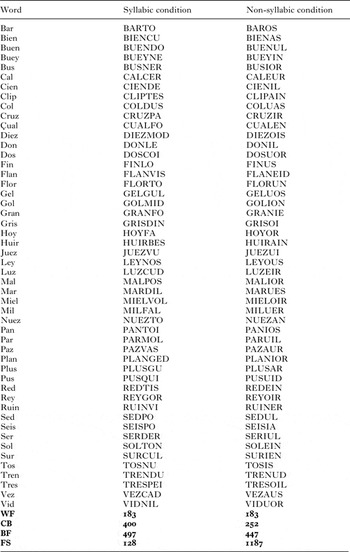
To ensure that all the children knew all of the target words in the word-spotting task, a list of seventy-five monosyllabic three- and four-letter Spanish words ending in a single consonant was presented to both groups of children two weeks prior to running the experiment. They were asked to describe the meaning of each word. From this list, fifty words for which every child verbally reported the correct meaning were selected as the targets (see ‘Appendix’).
Two or three letters were added at the end of the words in order to create two different experimental pseudo-words of the same length, with the same number of letters being added to each condition. In one case, the added letters started with a consonant (e.g. LO added to the Spanish word FIN resulting in FINLO). In this condition (the syllabic condition), the end of the word coincides with the syllable boundary. In the non-syllabic condition the additional cluster started with a vowel. For instance, US was added to FIN resulting in FINUS. In this case, the target word straddles the syllable boundary, with its final consonant forming the onset of the second syllable (all items are presented in the ‘Appendix’). In addition, fifty filler disyllabic pseudo-words were generated such that there was no initially embedded word. This was achieved by changing one or two letters in the experimental pseudo-words (e.g. BERNO or BEROS, where BER is not a Spanish word).
Two counterbalanced lists were generated within a Latin square design, such that half of the items were presented in the syllabic condition and the other half in the non-syllabic condition to half of the participants of each grade, while the reverse assignment to condition was used for the other half of the participants. This was done for the pseudo-word fillers as well, so that both subgroups received the same pseudo-word targets, but either as a syllable (BERNO) or not (BEROS).
Thus, a 2 × 2 mixed design was employed, with one between-participants factor (second vs. sixth grade) and one within-participants factor (syllabic vs. non-syllabic).
In addition, several statistical or distributional properties of the stimuli were measured in order to explore their possible impact on the effects of interest: frequency of the target word, mean bigram frequency of the pseudo-word (defined as mean token frequency of the bigrams composing each item), frequency of the critical bigram (the bigram corresponding to the transition between the word and the rest of the item), and token frequency of the first syllable of the stimuli. All of these were calculated from the program BUSCAPALABRAS (Davis & Perea, Reference Davis and Perea2005), with values being a per-million measure (see ‘Appendix’).
Procedure
Each pseudo-word was presented in lower-case letters in the center of a computer screen and the participants had to decide whether or not it began with a real monosyllabic word. Responses were to be made as quickly but as accurately as possible by pressing one of two keys; either colored green and labeled SÍ (‘yes’ in Spanish) or colored red and labeled NO (‘no’). Each trial consisted of a blank screen for 500 ms followed by a fixation point (*) for 1000 ms, another blank screen for other 500 ms, and then the stimulus, which remained on screen until the response was made. All items were presented in a different random order for each participant and reaction times (RTs) and error rate were measured. Each child received only one of the two lists required within the Latin square design. Prior to the test trials, ten practice items were presented, half with a word target and half without.
Both the stimulus presentation and the registered reaction times (and errors) were controlled by DMDX software (Forster & Forster, Reference Forster and Forster2003) using a Toshiba laptop. The font used was Times New Roman 20. The experimental session for each participant took about 15 minutes.
In another session, the children were given the ‘Batería de Evaluación de los Procesos Lectores’ PROLEC-R (Cuetos et al., Reference Cuetos, Rodríguez, Ruano and Arribas2009), comprising different reading subtests. Reading ability was then calculated on the basis of the two letter identification subtests and the word and pseudo-word reading subtests.
RESULTS
Mean RTs and error rates (see Table 2) were submitted to separate ANOVAs, both by participants and by items, including the between-group Grade factor (second vs. sixth), and the within-group Condition factor (syllabic vs. non-syllabic). Note also that the two sublists required for the Latin square design constituted another between-group factor, but the data for this factor are not reported because they are not informative.
Means of RTs for correct responses and percentage of errors (in parentheses) as a function of Group (second vs. sixth grade) and type of nonword (Syllabic condition vs. Non-Syllabic condition)

Analyses of RTs were carried out for correct responses only. Responses exceeding two standard deviations above or below the mean RT for any participant were removed from the analyses (2% of the data).
Performance of the sixth-graders was better than that of the second-graders both in terms of speed (F 1(1,54) = 8·53, p < ·001, η 2 = ·13; F 2(1,49) = 23·70, p < ·001, η 2 = ·33) and accuracy (F 1(1,54) = 4·63, p < ·05, η 2 = ·08; F 2(1,49) = 19,80, p < ·001, η 2 = ·28). In addition, it was easier to detect a target word when it coincided with the first syllable of the pseudo-word than when it did not (F 1(1,54) = 29·01, p < ·001, η 2 = ·35; F 2(1,49) = 22·04, p < ·001, η 2 = ·31 for the RT measure; and (F 1(1,54) = 21·20, p < ·001, η 2 = ·28; F 2(1,49) = 27·05, p < ·001, η 2 = ·35 for error rate). However, the interaction between this main effect and the Grade factor was not significant on either the RT measure (Fs < 1) or error rates (F 1(1,54) = 1·78, p > ·1; F 2(1,49) = 3·57, p = ·065).
In order to test the degree to which the RTs and error rate could be predicted by characteristics of the pseudo-words (i.e. word frequency or frequency of the first syllable) or by statistical properties of the items related to orthographic redundancy (i.e. frequency of the critical bigram or the bigram frequency of the whole stimulus), a simultaneous multiple regression analysis was carried out separately over RTs and error rate by items. The predictors that were included were word frequency, mean bigram frequency, frequency of the critical bigram (the transition between the word and the rest of the stimulus), and first syllable frequency.
Only the frequency of the critical bigram was significant in the RT data for the younger group (t(52) = 2·45, p < ·05 (r = ·30 and pr = ·32)). Thus, we decided to perform an Analysis of Covariance (ANCOVA) over RTs, entering the same factors as in the previous ANOVAs: Grade as a within-items factor and Condition (syllabic vs. non-syllabic) as a between-item factor, and including frequency of the critical bigram as a covariate. Both factors were again significant (Grade: F(1,96) = 13·2, p < ·001, η 2 = ·21; and type of pseudo-word: F(1,96) = 9·2, p < ·005, η 2 = ·08). Neither the interaction nor the frequency of the critical bigram yielded significance (both p > ·1).
Correlational analysis
The magnitude of the syllabic effect for each participant was entered into a correlation with the score on the different PROLEC_R subtests. To that end, and with the aim of working with comparable scores among different children, a standard score was generated for each child. The raw score from which this standard score was generated consisted of the difference between the syllabic and non-syllabic condition means (only for RTs) for each participant divided by the total mean (also for each participant). The z-scores mean were .09 for second grade and .07 for sixth grade.
These z-scores were then analyzed in relation to the scores in each of the four PROLEC-R subtests: letter identification, both names of letters (NL) and ‘same–different’ (SD) subtests), word reading (WR), and pseudo-word reading (PS). Since PROLEC-R provides a measure of accuracy (A) and speed (S), both indexes were tested, as well as the Main Indexes (accuracy/time × 100; MI). From these twelve bivariate correlations, none yielded significance for either the second- or sixth-graders (all ps > ·05). The correlations and P values for each index and subtest were (NL-A, 0·009, p > ·1; NL-S, 0·074, p > ·1; NL-MI, –0·077, p > ·1; SD-A, 0·162, p > ·1; SD-S, –0·060, p > ·1; SD-MI, 0·059, p > ·1; WR-A, 0·143, p > ·1; WR-S, 0·078, p > ·1; WR-MI, –0·058, p > ·1; PS-A, 0·059, p > ·1; PS-S, 0·097, p > ·1; PS-MI, –0·112, p > ·1).
DISCUSSION
The pattern of results can be summarized as follows: as predicted, when children had to detect a monosyllabic word embedded in a pseudo-word, they were considerably faster and more accurate when the end of that word coincided with the syllabic boundary of the pseudo-word than when it did not. What is particularly noteworthy is that this effect was observed for both the older and the younger children of the study (sixth and second grade). These conclusions were maintained even when four statistical or distributional properties of the stimuli (word frequency, mean bigram frequency, frequency of the critical bigram, frequency of the first syllable) were taken into account in post-hoc analyses.
In addition, the correlational analyses showed that the syllabic advantage was independent of reading ability, as measured by both the speed and accuracy indexes of the first four subtests of the PROLEC-R (Cuetos et al., Reference Cuetos, Rodríguez, Ruano and Arribas2009). These four subtests were mainly employed to check that all the participants were in the normal range in comparison to the standardized sample. The correlational analysis was carried out to examine if reading ability could be related to some extent to the syllabic effects in our study. Since no relationship was found, it is possible to affirm that the advantage of the syllabic segmentation is not related to a better (or worse) reading ability as measured by the subtests tapping into the sublexical (letters) and lexical processes of the test battery.
In the long-debated question about the nature and development of the processes involved in reading and visual word recognition, the existence of some type of sublexical processing (i.e. segmentation or parsing in the process of lexical access) seems clear. In addition, the orthographic transparency and/or clarity of syllabic boundaries of a particular language, such as Spanish, appear to be a key factor for the functionality of the syllable in this sublexical processing. Translation of Spanish graphemes into phonemes is highly regular and, more importantly, the syllable boundaries are clear-cut, with ample evidence for the role of syllables as processing units, at least in adults (e.g. Álvarez et al., Reference Álvarez, Carreiras and Taft2001; Carreiras et al., Reference Carreiras, Álvarez and de Vega1993). By contrast, neither of these two characteristics is present in languages such as English, where, in fact, the role of syllables or the existence of syllabic effects present in Spanish appear to be absent (e.g. Macizo & Van Petten, Reference Macizo and Van Petten2007; Taft & Álvarez, Reference Taft and Álvarez2014).
If we consider two languages differing in transparency, but both having relatively unambiguous syllable boundaries, like French and Spanish, it is possible to observe major inconsistencies amongst the empirical findings. In fact, the difference between the two languages in the transparency or consistency in the GPC rules is precisely the factor that could explain the differences between the French and Spanish results. Differences among languages in the way orthography represents phonology can produce differences in the reliance on phonological syllables. As seen in the ‘Introduction’, and contrary to Spanish, research in French has shown that orthographic redundancy or the bigram trough pattern can modulate syllabic effects due to a mismatch or discrepancy between phonological and orthographic forms (Chetail & Mathey, 2009; Doignon & Zagar, 2005; Mahé et al., Reference Mahé, Bonnefond and Doignon-Camus2014; Mathey et al., Reference Mathey, Zagar, Doignon and Seigneuric2006). Other studies in that language have found that reading and phonological abilities can modulate or eliminate syllabic effects (Chetail & Mathey, 2013; Maïonchi-Pino et al., Reference Maïonchi-Pino, Magnan and Écalle2010a). However, it is relevant to remember that Spanish is a language with an almost perfect one-to-one correspondence between letters and sounds, so it is not surprising that orthographic redundancy measures (such as bigram frequency or frequency of the critical bigram, in our experiment) do not contribute to the syllabic effects. This difference between the two languages might help to understand the different pattern of results observed in French and Spanish.
Thus, we consider that it is more relevant and useful to consider why the current study found robust evidence of syllabic processing in six- and eight-year-old Spanish-speaking children, while some previous studies in Spanish did not. On the one hand, there is evidence for the early use of the syllable as a processing unit (e.g. Goikoetxea, Reference Goikoetxea2005), including robust inhibitory effects of syllable frequency for both normal and dyslexic readers of Spanish words (Luque et al., Reference Luque, López-Zamora, Álvarez and Bordoy2013). On the other hand, several studies suggest that syllabic processing in Spanish appears relatively late in the reading acquisition period (Jiménez et al., Reference Jiménez, García, O'Shanahan and Rojas2010; Jiménez et al., Reference Jiménez, Guzmán and Artiles1997; Jiménez & Hernández, Reference Jiménez and Hernández2000). The studies by Jiménez and colleagues centered upon a manipulation of syllable frequency in lexical decision, as did the study by Luque et al. (Reference Luque, López-Zamora, Álvarez and Bordoy2013). Thus, where inconsistencies seem to arise is when syllable frequency is manipulated in a lexical task.
Our starting point for the present research was that the discrepancy in results might be due to important differences in the methodologies adopted. The procedures rank from tasks relying on pure sublexical processing (e.g. the detection of grapheme sequences in words) to those requiring decisions on whole words (e.g. the lexical decision task). As previously commented, whereas sublexical tasks allow for the investigation of the connections between letters or graphemes and syllables, lexical tasks are related to the connections between syllables and words, so that different tasks tap into different stages of processing.
For this investigation, we opted for a new task that taps into obligatory sublexical operations (i.e. participants have to ‘cut’ into the stimulus in order to perform the task), while also requiring lexical access in order to recognize the target. The advantage of this technique is that, in order to perform it, participants must activate connections between letters and syllables as well as connections between syllables (or whatever sublexical units are involved) and words. With this technique, we found a robust effect of syllable boundary (i.e. a clear advantage for the syllabic condition), even for second-graders who are in the first stages of literacy learning (approximately one year of reading instruction). Such a finding indicates that even young readers analyze words syllabically. In addition, this syllabic advantage could not be attributed to strong connections between graphemes and phonemes, since the initial sequence was the same in the two experimental conditions.
As shown, the syllable advantage extends to older children as well, and the absence of correlations with measures of reading ability in this study, together with clear-cut results with adults, further supports the generalized and widespread processing of syllabic units in recognizing words in Spanish. It seems that the clarity of syllable boundaries in the language is a key factor in determining the use of the internal structure of the word when reading and when beginning to read, also taking into account outcomes from other languages. Thus, our results align with previous findings that suggest an early acquisition of sublexical operations related to syllabic structures in the development of reading, at least in Spanish.
In general, our data stand in agreement with previously proposed frameworks of development, like that of Doignon-Camus and Zagar (Reference Doignon-Camus, Zagar, Marec-Breton, Besse, de La Haye, Bonneton and Bonjour2009, Reference Doignon-Camus and Zagar2014), where mapping letter clusters to phonological syllables is an early process in learning to read, one of the first steps. More concretely, “the first-ever connections between printed and spoken language are connections between letter groups and the available phonological syllables” (Doignon-Camus & Zagar, 2014, p. 1163). This idea has been called by the authors the ‘Syllabic Bridge Hypothesis’, and it argues for a mapping of phonological syllables with orthographic units even in pre-readers, as was demonstrated for children ranging in age from 5;0 to 6;2. Such a hypothesis has been supported in French, a language with clear syllabic boundaries like Spanish, but more opaque than Spanish in terms of GPC rules, as previously commented. Thus, we suggest that the idea of an early establishment of links between syllables and letters, or, in other words, the functionality of syllables as processing units in visual word recognition, can be even stronger in Spanish. In fact, we consider that, in the light of early studies like that of Cossu et al. (Reference Cossu, Shankweiler, Liberman, Katz and Tola1988), or more recent ones, like that of Doignon-Camus and Zagar (Reference Doignon-Camus and Zagar2014), there is now considerable converging evidence for a strong link between oral language development (i.e. pre-reading stages) and learning to read in terms of syllabic representations. The strong neural connections between the Visual Word Form Area (VWFA) and phonological segmental representations in the temporoparietal areas (Dehaene, Reference Dehaene2009) are an additional support for this idea. Ziegler and Goswami (Reference Ziegler and Goswami2005) have also suggested that the use of syllabic representations may be an emergent property of vocabulary, whereas the awareness of smaller units may require direct instruction (see also Metsala & Walley, Reference Metsala, Walley, Metsala and Ehri1998). What seems apparent from our data is the use of syllabic information by children of age seven, after a short period of reading instruction, in a task that requires explicit word recognition and not only sublexical, GPC, or just phonological processing.
It has been argued, however, that while early reading makes use of phonological recoding in order to gain access to meaning, such phonological mediation is superseded by a direct pathway from orthography to semantics for proficient adult English readers (e.g. Share, Reference Share1995; Taft & van Graan, Reference Taft and van Graan1998). The phonologically mediated pathway remains available as a back-up to the direct pathway, but is less efficient as a result of the inconsistent relationship between orthography and phonology at the sublexical level. In fact, dual-route accounts that include syllabic representations have been proposed (Conrad, Tamm, Carreiras & Jacobs, Reference Conrad, Tamm, Carreiras and Jacobs2010: Mathey et al., Reference Mathey, Zagar, Doignon and Seigneuric2006). In Spanish or other languages with similar properties, however, the situation may well be different, given that activation of phonology at the sublexical level is far more reliable. In such transparent languages, the phonologically mediated pathway to semantics that has been set up at the earliest stages of reading acquisition can be maintained into adulthood. According to such an account, then, readers at all stages of reading acquisition should show phonological effects. Results coming from research in Italian, a language with similar characteristics to Spanish, also support this notion of a ‘phonological reading’ (Orsolini, Fanari, Cerracchio & Famiglietti, Reference Orsolini, Fanari, Cerracchio and Famiglietti2009; Orsolini, Fanari , Tosi, De Nigris & Carrieri, Reference Orsolini, Fanari, Tosi, De Nigris and Carrieri2006). If we assume that syllabic effects in reading are phonological and not purely orthographic, as the evidence has shown (Álvarez et al., Reference Álvarez, Carreiras and Perea2004; Conrad et al., Reference Conrad, Grainger and Jacobs2007), the present results are fully in line with that prediction. In addition, and based on previous recent work (Luque et al., Reference Luque, López-Zamora, Álvarez and Bordoy2013), it appears that these properties of Spanish lead to young readers solving the problem of decoding visual input with relative ease, leading to an early acquisition of functional links between syllables and the words activated by them.
If a similar study were to be carried out with English speakers, the expectation would be that those at an early stage of reading acquisition would show a similar pattern of results to the Spanish children, but that a change would be observed with increasing proficiency over the years. That is, phonologically based units, such as the spoken syllable, should start to have less of an impact on reading as the direct orthographic pathway takes over. Certainly, there is evidence for the use of a more orthographically based strategy for proficient English readers in adulthood inasmuch as they prefer to use a structure that maximizes the informativeness of the first orthographic subunit in comparison with the first syllable (Taft, Reference Taft2001; Taft & Álvarez, Reference Taft and Álvarez2014; Taft, Álvarez & Carreiras, 2007). Moreover, Taft et al. (Reference Taft, Álvarez and Carreiras2007) demonstrated that this was not the case for adult Spanish readers, who showed a preference for using an orthographic structure corresponding to the spoken syllable. That is, the mechanism based on phonological syllables that seems to be developed early by Spanish readers in the present study appears to be preserved into adulthood.
In summary, the results of this study shed some light on the discussion about the moment when syllabic units come into play during reading development. Our results support the idea that the cognitive processes involved in reading cannot be understood without reference to sublexical processing based on syllabic structures, and that these processes arise from the very first stages of learning to read, at least in languages like Spanish. In addition, consideration of the characteristics of the tasks used in previous experiments is fundamental to understanding their contradictory outcomes.
APPENDIX
List of original words used in the experiment, followed by the syllabic and non-syllabic pseudo-words in which these words were embedded. At the bottom are the mean values (per million) of word frequency (WF), critical bigram frequency (CB), overall bigram frequency (BF), and syllable frequency (SF) for each condition.