Introduction
As with other legumes, both humans and animals consume the grains of Faba beans (Vicia faba) (Goyoaga et al., Reference Goyoaga, Burbano, Cuadrado, Romero, Guillamón, Varela, Pedrosa and Muzquiz2011; Hanafy et al., Reference Hanafy, Pickardt, Kiesecker and Jacobsen2005). They constitute an important nutritious food source (especially for people in low-income countries unable to afford animal proteins) (Daoui, Reference Daoui2007) and an amino acid source in animal feeds. Furthermore, their ability to fix atmospheric nitrogen and improve soil fertility provides significant benefits to farming systems and to the environment (Kaur et al., Reference Kaur, Pembleton, Ol Cogan, Savin, Leonforte, Paull, Materne and Forster2012). Like other crops, both abiotic (climate change, water deficiency and salinity) and biotic (pests and diseases, with insects being the most damaging) factors, constrain broad bean cultivation and storage (Maatougui, Reference Maatougui1996). Among these insects, the univoltine bruchid Bruchus rufimanus Boheman, 1833 (Coleoptera: Chrysomelidae: Bruchinae) infests fresh seeds in the field and causes significant damage. The adults mate and females lay eggs on young and fresh pods. After hatching, larvae feed on the growing fresh seeds. The average weight loss caused by the larva of B. rufimanus is approximately 2.88% dry weight (Boughdad and Laugé, Reference Boughdad and Laugé1997). These larvae cause qualitative changes of the reserves in the seeds and reduce their ability to germinate and their export value, as well as predispose them to diseases (Boughdad and Laugé, Reference Boughdad and Laugé1997).
Control methods used to limit the losses caused by bruchids consist mainly of the use of synthetic insecticides (Ezzahiri et al., Reference Ezzahiri, Bouhache and Mihi2014). Though effective, these insecticides pose health risks to humans, other animals and the environment (Barnard et al., Reference Barnard, Padgitt and Uri1997; Salamci et al., Reference Salamci, Kordali, Kotan, Cakir and Kaya2007). Furthermore, other control methods (such as the fumigant methyl bromide) deplete the ozone layer and affect the climate (WMO/UNEP/NOAA/NASA, 1995). Additionally, use of synthetic insecticides poses resistance risks that could reduce their effectiveness in the long term, depending on the intensity and frequency of exposure (Bell and Wilson, Reference Bell and Wilson1995; Benhalima et al., Reference Benhalima, Chaudhry, Mills and Price2004). Thus, it is necessary to seek for alternatives that are less prone to the above risks, and are environmentally benign and affordable.
Current research on the use of the essential oils of medicinal and aromatic plants as phyto-insecticides is gaining popularity. As Morocco has a diversity of potential medicinal and aromatic plants with an export market volume of ~33,000 tonnes annually, this sector holds huge commercial potential (Zrira, Reference Zrira2006). The effectiveness of several plant essential oils and extracts as insecticides has been well demonstrated (Bouchikhi Tani et al., Reference Bouchikhi Tani, Khelil, Bendahou and Juli2012; Ketoh et al., Reference Ketoh, Glitho and Koumaglo2004; Ngamo and Hance, Reference Ngamo and Hance2007; Regnault-Roger and Hamraoui, Reference Regnault-Roger and Hamraoui1993). As essential oils are volatile, they can act as fumigants and can be used against insect pests of stored grains (Don-Pedro, Reference Don-Pedro1996; Ketoh, Reference Ketoh1998; Ketoh et al., Reference Ketoh, Koumaglo, Glitho and Huignard2006).
Rosemary, Rosmarinus officinalis (Lamiaceae), is an evergreen shrub well distributed in the Mediterranean region. In Morocco, wild rosemary is common in the Rif, the Middle and High Atlas areas. It has been used as a pharmaceutical and in traditional medicine (Aqel, Reference Aqel1991; Haloui et al., Reference Haloui, Louedec, Michel and Lyoussi2000; Leung and Foster, Reference Leung and Foster1996), mainly due to its anti-cancer (Offord et al., Reference Offord, Macé, Ruffieux, Malnoë and Pfeifer1995), antifungal (Soylu et al., Reference Soylu, Kurt and Soylu2010), antibacterial (Fadili et al., Reference Fadili, Ayane, Hadic, Elhilali, Khabbal and Zair2014) and insecticidal (Zoubiri and Baaliouamer, Reference Zoubiri and Baaliouamer2011) properties.
The objectives of this study were to: (i) investigate and compare the chemical composition of R. officinalis essential oils from the Middle Atlas and Loukkos areas and (ii) screen them as fumigants against adults of the broad bean bruchid B. rufimanus under laboratory conditions.
Materials and methods
Plant materials
Rosmarinus officinalis (Lamiaceae) samples were collected in March 2013 from the Middle Atlas (Tizi n Telghemt, between Midelt and Imtghren) (32° 37' N, 4° 00' W, 1907 masl) and the Loukkos (Tatouft, a village near Ksar El Kebir) (35° 00' N, 5° 54' W, 16.7 m asl). The plants were dried in the laboratory at ambient temperature and their leaves separated from the stems and stored away from light. Plants were identified by morphology. Rosmarinus officinalis samples collected from the Middle Atlas and Loukkos regions, respectively, were deposited at the herbarium under the accession numbers RAB 082552 and RAB 082551.
Bruchus rufimanus
Colony starter stocks of B. rufimanus were collected from the wholesale market of grains in Meknes, Morocco. Weevil-infested seeds were placed in glass jars (15.5 cm × 8 cm), closed with perforated lids to ensure ventilation, and stored at room conditions of 28 ± 2 °C, 60 ± 5% relative humidity and a photoperiod of 12 h light/12 h dark. For toxicity testing, newly emerged adults of both sexes (<24 h old) were used.
Extraction of essential oils
Extraction of essential oils was carried out by hydrodistillation using a Clevenger type apparatus (Clevenger, Reference Clevenger1928). Three distillations per sample were obtained by boiling 100 g of the dried plant material with one litre of distilled water for 3 h. The collected essential oils were dried with anhydrous sodium sulphate and stored at 4 °C in the dark until further use. Oil yields were expressed in ml/100 g of the dry plant matter.
Analysis of the essential oils
Analysis of the chemical composition of essential oils was carried out by gas chromatography with an Agilent 6890N Network Gas Chromatograph (Agilent Technologies, USA), equipped with a non-polar HP 5 separating column (30 m long, 0.25 mm wide and 0.25 µm thickness) and with a split/splitless injector set at 250 °C, coupled to an Agilent 5975 Series Mass spectrometer. The carrier gas was helium with a flowrate of 1.2 ml/min with a split injection mode. The temperature of the oven was programmed to rise from 60 to 260 °C at 3 °C/min and then maintained at 260 °C for a further 30.03 min. The device was controlled by HP ChemStation software. Compound identification was done by comparison of generated mass spectra with spectral libraries of NIST 98 and Lopes and Adams (Adams et al., Reference Adams, Morris, Pandey and Schwarzbach2005; Lopes et al., Reference Lopes, Strobl and Kolodziejczyk2004) and by retention indices calculated using a standard mixture of C9–C30 alkanes analysed under similar conditions.
Toxicity bioassays
The fumigant toxicity assays were carried out in sealed and transparent one-litre plastic boxes. Four different concentrations (10, 20, 40 and 80 μl/l air volume) were used for these assays. Each concentration was applied on a Whatmann 4 (3 cm × 3 cm) filter paper that was placed in a box containing a Petri dish (5.5 cm in diameter). Each Petri dish contained 10 females and 10 males of newly emerged (<24-h-old) B. rufimanus. An identical lot, but without essential oils, was used as a control. Each concentration was repeated five times. In each lot, weevil mortality was recorded for both sexes at 24 h intervals until the death of all the fumigated insects.
Data analysis
Essential oil yields (expressed in ml/100 g of dry matter) of the two sample types based on their location of origin, was compared by ANOVA (analysis of variance of the quantitative raw data), followed by the Newman–Keuls test at a 5% error level using SPSS 20. Survival curves for each treatment and concentration were compared using the log-rank test (Kaplan and Meir, Reference Kaplan and Meier1958). The LC50 and LC99 were determined by probit analysis (Finney, Reference Finney1964) following correction by Abbott's formula (Abbott, Reference Abbott1925). The lethal times (LT50 and LT99) of adults exposed to different concentrations of the essential oil were calculated with regression equations that displayed adult mortality against the exposure duration to the essential oils.
Results
Yield and chemical composition of essential oils
The average yields of essential oils (expressed in ml/100 g of dry matter), extracted from the R. officinalis harvested in Loukkos area (2.73 ± 0.12 ml/100 g of dry matter) were significantly higher than those from the Middle Atlas (2.3 ± 0.17 ml/ 100 g of dry matter) (F = 13; df = 1, 5; P < 0.05).
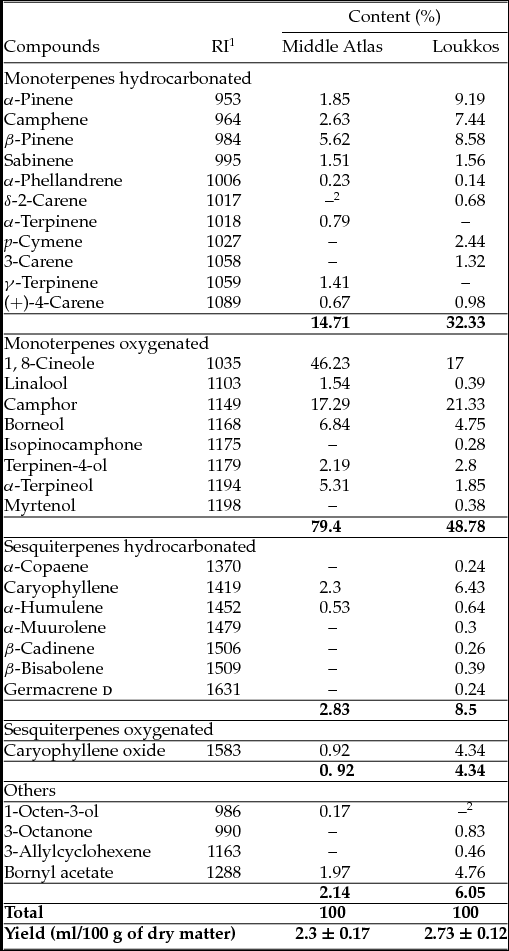
The chemical composition of the R. officinalis essential oils from the two regions is shown in Table 1. Essential oils from both regions differed in quantity and quality. A total of 28 and 19 compounds were identified in the essential oils of rosemary from the Loukkos and Middle Atlas regions, respectively. The essential oils from both regions were mainly composed of monoterpenes and sesquiterpenes, which represented 94–98% of the total oils from each region (Table 1). Oxygenated monoterpenes were the most abundant, accounting for about 79% and 49% of the essential oils of rosemary from the Middle Atlas and Loukkos regions, respectively. The major compounds in this chemical group were 1,8-cineole and camphor (Table 1). The second most abundant compounds were the hydrocarbon monoterpenes, which accounted for 15–33% of the total oil composition, and comprised mainly of α and β pinene and camphene. Sesquiterpenes and the other chemical groups represented 2–15% of the total oil constituents, with caryophyllene as their principal component. Among the other chemical groups, bornyl acetate was the most abundant (Table 1). Sixteen compounds were common to oils from both regions, while three (1-octen-3-ol, α-terpinene and γ-terpinene) were detected only in the oils of rosemary from Middle Atlas, and 12 (3-octanone, δ-2-carene, p-cymene, 3-carene, 3-allylcyclohexene, isopinocamphone, myrtenol, α-copaene, α-muurolene, β-cadinene, β-bisabolene and germacrene d) in the Loukkos rosemary oil samples (Table 1). Apart from the oxygenated monoterpenes, which were 1.6 times more abundant in the oils from the Middle Atlas region, the other chemical groups were 2- to 5-folds more abundant in the Loukkos oil samples (Table 1).
Chemical composition of essential oils of Rosmarinus officinalis collected from Middle Atlas and Loukkos regions in Morocco

1 Retention indices relative to n-alkane (C9–C30 analysed on a non-polar HP- 5 column). 2Not detected.
A significant difference was seen in the essential oil content between rosemary from the Middle Atlas and Loukkos regions in terms of their oxygenated monoterpenes content (χ² = 9.72; df = 1; P < 0.05). However, there was no significant difference in their hydrocarbon monoterpenes (χ² = 2.36; df = 1; P > 0.05), oxygenated sesquiterpenes (χ² = 0.134; df = 1; P > 0.05), hydrocarbon sesquiterpenes (χ² = 0.182; df = 1; P > 0.05) and that of others (χ² = 0.040; df = 1; P > 0.05).
Toxicity bioassays
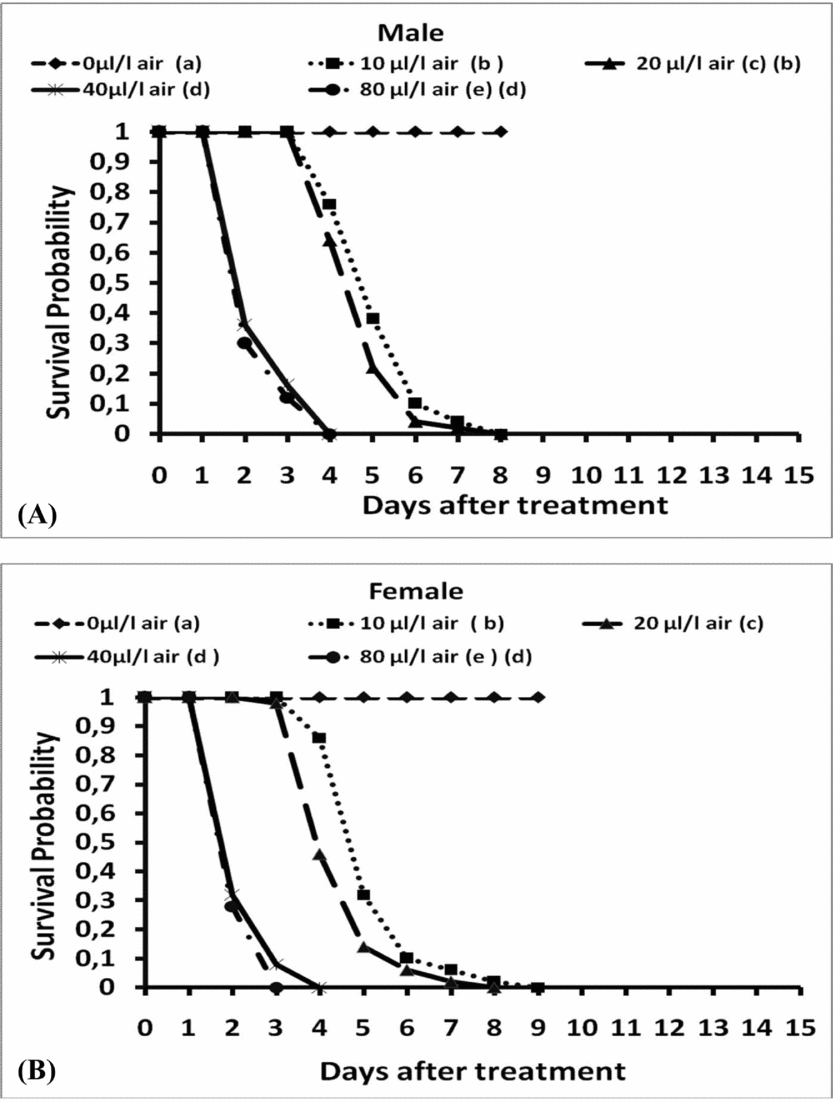
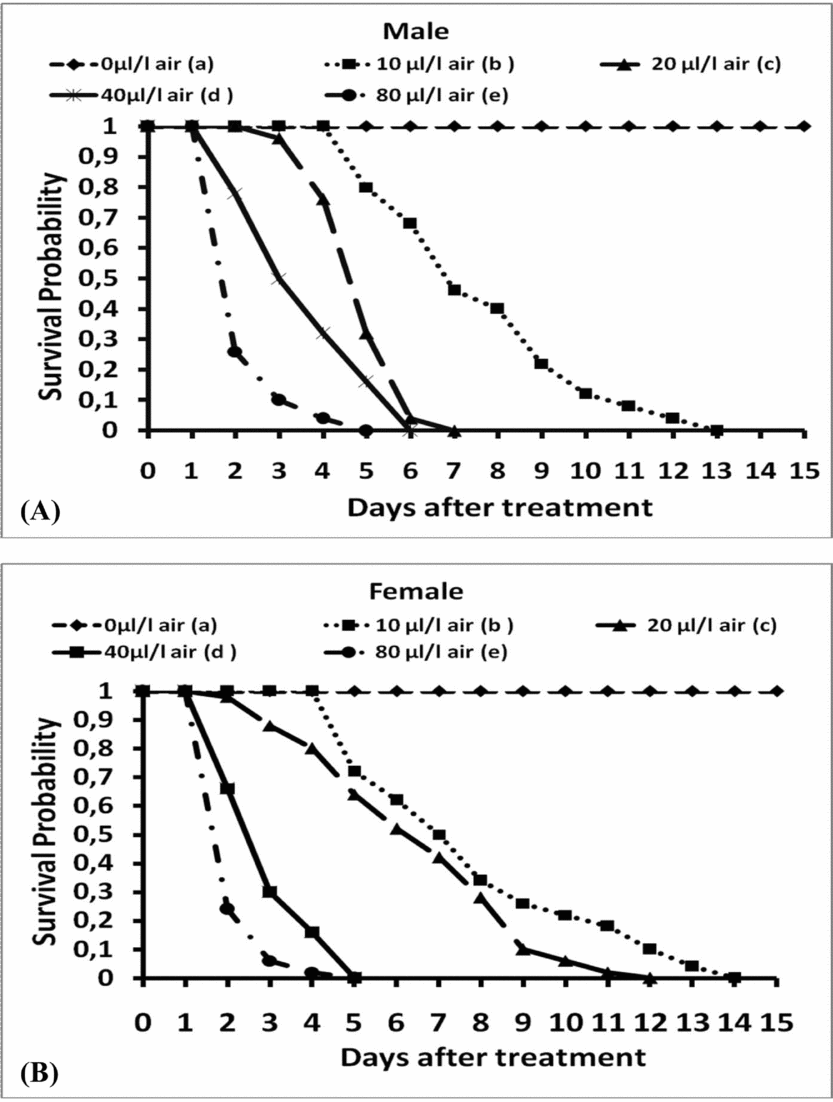
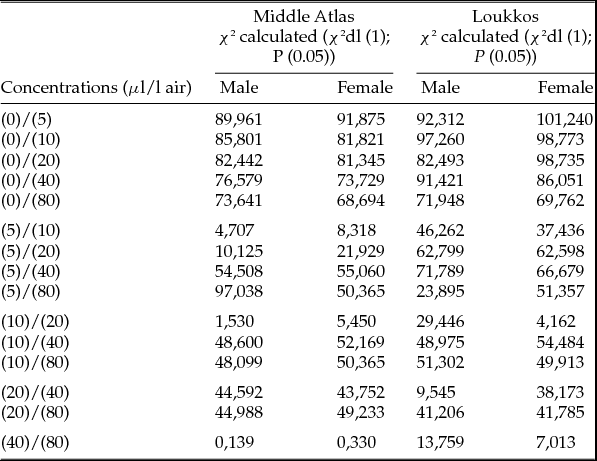
All the tested concentrations were toxic on the adults of B. rufimanus, with varying results. Adult survival decreased as the exposure duration and dose increased (Figs. 1 and 2). In the control group, no mortality was recorded. There were significant differences between treated and control groups and between the concentrations used. The values of the logrank varied from 4.162 to 98.773 (with chi square values χ² > 3.841; df = 1; P < 0.05) and treatments were significantly different from their controls. Essential oil of R. officinalis from the Middle Atlas exerted a similar effect on males (χ² = 1.530 <χ² = 3.841; df = 1; P <0.05) at concentrations 10 and 20 μl/l air. Similarly, at 40 and 80 μl/l air a comparable effect of this oil was recorded on males (χ² = 0.139 <χ² = 3.841, df = 1, P < 0.05) and on females (χ² = 0.330 <χ² = 3.841, df = 1, P < 0.05) of B. rufimanus (Table 2).
Survival curves of Bruchus rufimanus male (A) and female (B) adults fumigated with Rosmarinus officinalis essential oils from the Middle Atlas region, Morocco. Concentrations with the same letter do not differ statistically (log-rank test compared to the table Chi-square at 5% = 3.841).

Survival curves of Bruchus rufimanus adult male (A) and female (B) fumigated with Rosmarinus officinalis essential oils from the Loukkos region, Morocco.

Comparison between concentrations of Rosmarinus officinalis essential oils collected from Middle Atlas and Loukkos in Morocco against Bruchus rufimanus adults (Chi-square test at 5%; χ²table = 3841)

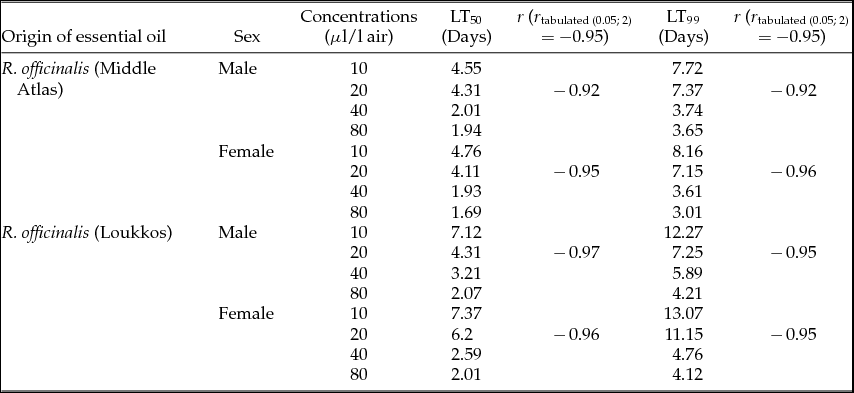
In addition, the lethal times LT50 and LT₉₉ for the adults of B. rufimanus varied with sex and treatment concentrations used. These lethal times ranged from 1–8 and from 2–13 days for Middle Atlas and Loukkos R. officinalis oils, respectively. They were negatively correlated to the concentrations of the tested essential oils (Table 3).
Lethal time (LT50 and LT₉₉) of Bruchus rufimanus adults exposed to essential oils of Rosmarinus officinalis from the Middle Atlas and Loukkos regions of Morocco

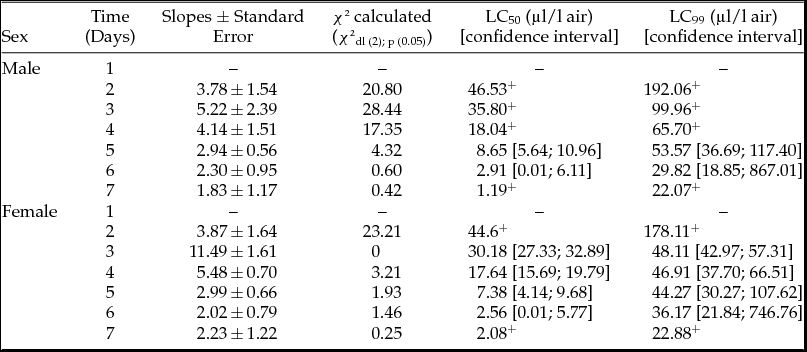
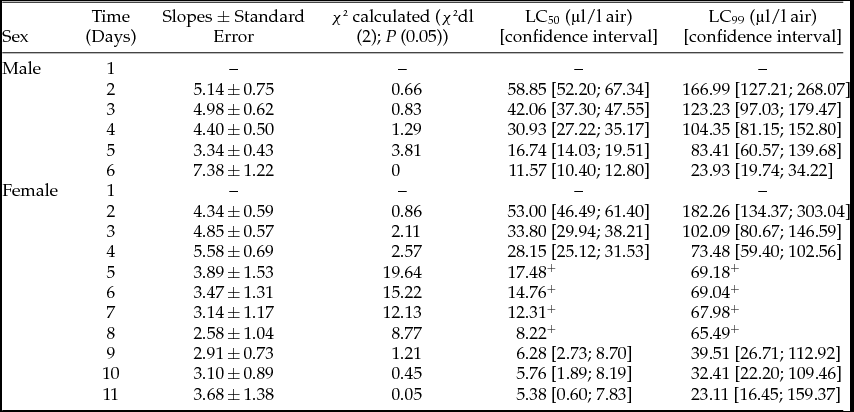
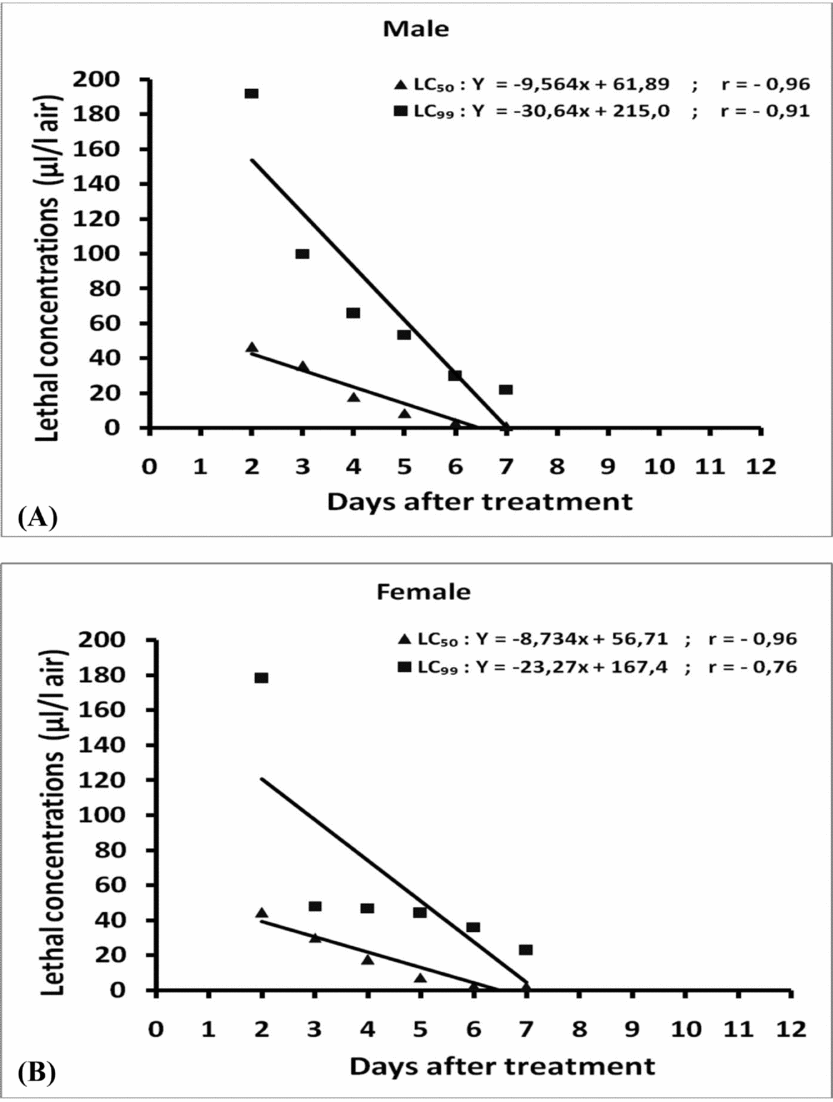
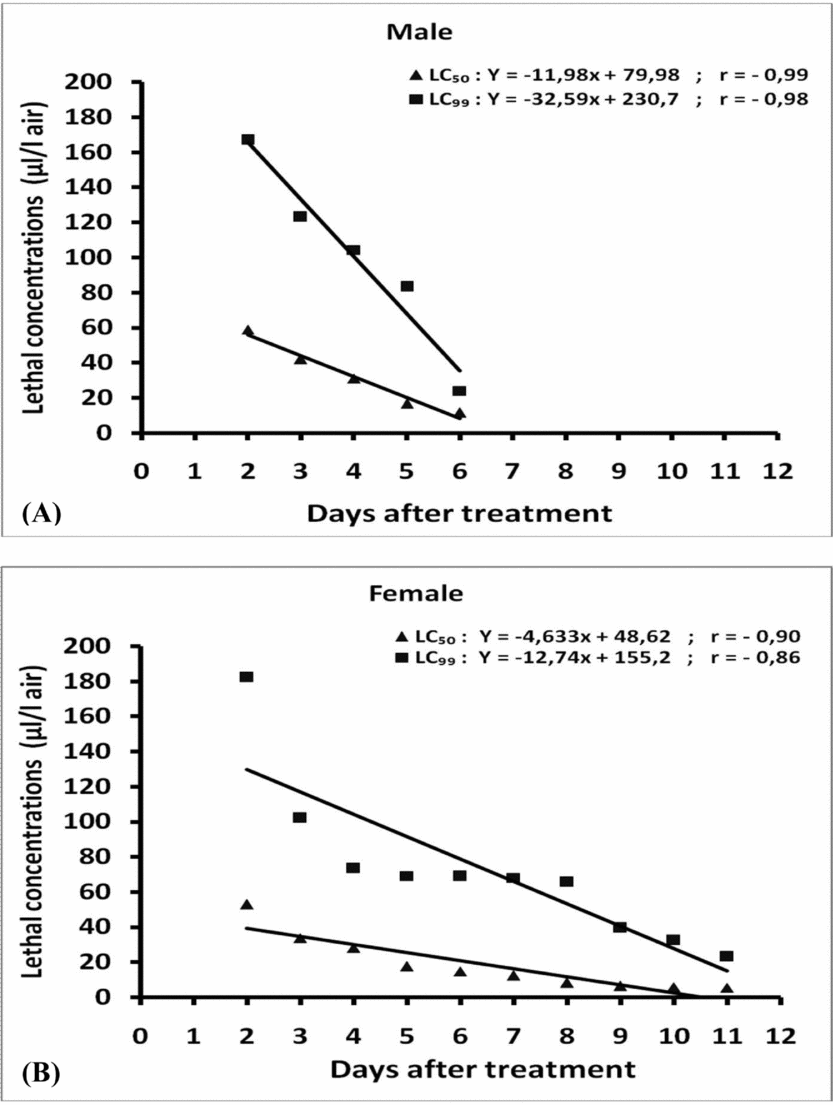
The toxicological parameters of the tested essential oils are summarized in Tables 4 and 5. With respect to the LC50 and LC99 values, the essential oils of rosemary from the Middle Atlas were more toxic than those from Loukkos. Also, the lethal concentrations (LC50 and LC₉₉) of both essential oils were negatively correlated to the exposure times (Figs. 3 and 4).
Toxicity parameters of Rosmarinus officinalis essential oils from the Middle Atlas region against Bruchus rufimanus adults

– No mortality was observed at this time.
+ The confidence intervals do not lend themselves to calculation, as they are too wide in relation to the concentrations tested.
Toxicity parameters of Rosmarinus officinalis essential oils from Loukkos region against Bruchus rufimanus adults

– No mortality was observed at this time.
+ The confidence intervals do not lend themselves to calculation, as they are too wide in relation to the concentrations tested.
Relationship between the lethal concentrations and the time of exposure of adult male (A) and female (B) Bruchus rufimanus fumigated with Rosmarinus officinalis essential oils from the Middle Atlas region.

Relationship between the lethal concentrations and the time of exposure of adult male (A) and female (B) of Bruchus rufimanus fumigated with Rosmarinus officinalis essential oils from the Loukkos region.

Discussion
Our findings on the insecticidal effect of essential oils extracted from rosemary plants originating from the Middle Atlas and Loukkos regions of Morrocco against the broad been weevil B. rufimanus in laboratory assays reveal significant qualitative and quantitative differences in oils from both regions, which appeared to affect the potency of their insecticidal activity. These findings represent the first record of screening rosemary essential oils as a fumigant for B. rufimanus.
Yields of essential oils extracted from rosemary of both Middle Atlas and Loukkos origins were different, likely due to varietal and geographic variations, which influences oil content. These yields were similar to those obtained by Douiri et al. (Reference Douiri, Boughdad, Alaoui and Moumni2014) and Fadili et al. (Reference Fadili, Ayane, Hadic, Elhilali, Khabbal and Zair2014) for Middle Atlas specimens and higher than those obtained by Atik Bekkara et al. (Reference Atik Bekkara, Bousmaha, Taleb Bendiab, Boti and Casanova2007) in Algeria (0.8%), Derwich et al. (Reference Derwich, Benziane and Chabir2011) in Morocco (0.54%) and Amri et al. (Reference Amri, Hamrouni, Hanana, Jamoussi and Lebdi2014) in Tunisia (0.71%). Outside the Mediterranean region, investigators obtained yields of 2.28–2.58% in Argentina (Ojeda-Sana et al., Reference Ojeda-Sana, van Baren, Elechosa, Juárez and Moreno2013); thus, these findings support biogeographical-based yield differences.
The chromatographic analysis of R. officinalis of Middle Atlas revealed two major groups: oxygenated monoterpenes and hydro-carbonated monoterpenes. The main constituents of these groups were 1,8-cineole followed by camphor, borneol and α- and β-pinene. The oxygenated and hydro-carbonated sesquiterpenes were composed mainly of caryophyllene and caryophyllene oxide. The oxygenated monoterpenes dominated in the essential oils of rosemary from the Middle Atlas, while all other compounds were more abundant in the oils of samples from the Loukkos. In comparison to similar studies conducted in different regions of Morocco, 1,8-cineole, camphor and α-pinene emerged as the major components of R. officinalis in Oujda region (Ait-Ouazzou et al., Reference Ait‐Ouazzou, Lorán, Bakkali, Laglaoui, Rota, Herrera, Pagán and Conchello2011) or Meknes-Tafilalet where the levels of 1,8-cineole and camphor were 50.42 and 17.73%, respectively (Douiri et al., Reference Douiri, Boughdad, Alaoui and Moumni2014). In contrast, Derwich et al. (Reference Derwich, Benziane and Chabir2011) found that the rosemary from the Fès-Boulemane region was rich in α-pinene, camphor, 1,8-cineole and camphene. In a similar study, the essential oil of R. officinalis from Spain was composed of camphor and α-pinene (Tomei et al., Reference Tomei, Cioni, Flamini and Stefani1995), whereas the essential oil of R. officinalis from Italy consisted mainly of verbanone, α-pinene, 1,8-cineole and camphor (Pintore et al., Reference Pintore, Usai, Bradesi, Juliano, Boatto, Tomi, Chessa, Cerri and Casanova2002). The essential oil of R. officinalis from Portugal consisted of verbanone, camphor and 1,8-cineole (Mata et al., Reference Mata, Proença, Ferreira, Serralheiro, Nogueira and Araújo2007). In Turkey, the oil obtained from R. officinalis was rich in 1,8-cineole, α-pinene and camphor (Celiktas et al., Reference Yesil Celiktas, Hames Kocabas, Bedir, Vardar Sukan, Ozek and Baser2007). Laiq-ur-Rahman et al. (Reference Laiq-ur-Rahman, Singh, Singh, Yadav and Khanuja2007) found that the rosemary cultivated in India was rich in camphor, 1,8-cineole and α-pinene. In Tunisia, the rosemary essential oils consisted primarily of 1,8-cineole, camphor, α-pinene and borneol (Amri et al., Reference Amri, Hamrouni, Hanana, Jamoussi and Lebdi2014). Our findings add to the growing literature that confirms and supports geographical, and possibly, varietal differences in essential oil composition. According to Napoli et al. (Reference Napoli, Curcuruto and Ruberto2010), essential oils of rosemary can be classified into three chemotypes: cineoliferum (high in 1,8-cineole), camphoriferum (camphor >20%) and verbenoniferum (verbenone >15%). According to this classification, the rosemary of the Middle Atlas is the cineoliferum chemotype and that of Loukkos is the camphoriferum chemotype.
We can attribute the variability of yields and chemical compositions of our samples to many factors, such as geographical origin, altitude, soil type and environmental conditions (temperature and pluviometry) (Bruneton, Reference Bruneton1993; Bennadja et al., Reference Bennadja, Kaki, Djahoudi, Hadef and Chefrour2013) and phenological stage of the plant (Ruberto and Baratta, Reference Ruberto and Baratta2000).
The two essential oils investigated in this study showed insecticidal effects on B. rufimanus adults. This effect varied with the origin of the plant material, the concentration of oils and duration of exposure. In regard to the lethal concentrations (LC50 and LC₉₉) and the lethal time (LC50 and LT₉₉), the essential oils of R. officinalis from both regions were toxic to the weevil. A similar study by Regnault-Roger and Hamraoui (Reference Regnault-Roger and Hamraoui1994) on the toxicity of essential oils extracted from 24 aromatic plants from several families against the bean weevil Acanthoscelides obtectus revealed that oils of seven plants in the family Lamiacae (Thymus serpyllum, Origanum vulgare, O. majorana, Satureja hortensis, Lavandula angustifolia, R. officinalis, and Ocimum basilicum), and Pisum sativum of the Apiaceae family were the most toxic, and caused mortalities of 100% after 1–4 days of exposure at dosages of 2 to 10 μl/l. Also, Bouchikhi Tani et al. (Reference Bouchikhi Tani, Khelil and Hassani2008, Reference Bouchikhi Tani, Bendahou and Khelil2010) showed that after 48 h, the essential oils extracted from Artemisia herba-alba (Asteraceae) were less toxic (LC50 = 1.69 μl/30 g seeds) on the adults of A. obtectus than that of R. officinalis (LC50 = 0.59 μl/30 g of seeds). Mahmoudvand et al. (Reference Mahmoudvand, Abbasipour, Hosseinpour, Rastegar and Basij2011) also observed that the essential oil of R. officinalis was highly toxic as a fumigant on Callosobruchus maculatus (LC50 = 46.81 μl/l air /24h). Similarly, Douiri et al. (Reference Douiri, Boughdad, Alaoui and Moumni2014) confirmed this insecticidal effect on C. maculatus with LC50 varying from 5.51 to 2.43 μl/l air and 6.80 to 3.04 μl/l air, respectively, for both males and females. The recorded insecticidal activity of the two tested essential oils in this study confirms previous findings, and suggests a greater broad-spectrum potency that may be a function of their chemical composition.
The insecticidal constituents of many extracts of plants and essential oils are mainly monoterpenoids (Ahn et al., Reference Ahn, Lee, Lee and Kim1998; Cosimi et al., Reference Cosimi, Rossi, Cioni and Canale2009). Analysis of the chemical composition of the essential oils of R. officinalis of Middle Atlas and Loukkos regions showed the presence of some compounds that are known for their insecticidal properties, such as α-terpineol, 1,8-cineole and camphor against Tribolium confusum (Prates et al., Reference Prates, Santos, Waquil, Fabris, Oliveira and Foster1998) and α-pinene (Ojimelukwe and Adler, Reference Ojimelukwe and Adler1999). Obeng-Ofori et al. (Reference Obeng-Ofori, Reichmuth, Bekele and Hassanali1998) reported that the camphor has insecticidal activity against a number of stored products pests. Similarly, Lee et al. (Reference Lee, Annis, Tumaalii and Choi2004) showed the fumigant effect of the essential oils rich in 1,8-cineole against Sitophilus oryzae. Thus, the insecticidal effect observed in this study is due to any of these compounds or their synergistic action on the bruchid. Several reports indicate that monoterpenes cause the death of insects by inhibiting the activity of the acetylcholinesterase enzyme (Houghton et al., Reference Houghton, Ren and Howes2006). Enan (Reference Enan2001) showed that the toxicity of the components of an essential oil was related to these octopaminergic neurotransmitters of insects. Some monoterpenes may also inhibit the monooxygenases in the dependent P450 cytochrome (De-Oliveira et al., Reference De-Oliveira, Ribeiro-Pinto and Paumgartten1997). Thus, it is likely that the more the oxygenated monoterpenes present in the essential oil of a plant, the higher its neurotoxicity, which is an idea well-supported by the findings of this study, where oil from the Middle Atlas region with more oxygenated monoterpenes was more toxic than oil from the Loukkos region.
Conclusions
The essential oils extracted from R. officinalis of Middle Atlas and Loukkos regions of Morocco were characterized by their high content of 1,8-cineole and camphor, which classifies them as cineoliform and camphoriform chemotypes, respectively. The essential oils demonstrated insecticidal activity against adult B. rufimanus. Their potential use in stored legume grain protection is a promising alternative to synthetic pesticides. Thus, we recommend further studies to assess their shelf life, efficacy under the various storage conditions, susceptibility to UV-radiation, mode of action and effect on non-target organisms.
Acknowledgements
We would like to thank the Department of Plant Protection and Environment and the Department of Agronomy in the National School of Agriculture of Meknes, Morocco, for laboratory materials support. We extend our sincere thanks to Professor Ibn Tattou, Scientific Institute of Rabat, Morocco, for identifying the Rosmarinus species studied.