




Crossref Citations

This article has been cited by the following publications. This list is generated based on data provided by Crossref.
Valizadeh, Leila
Zamanzadeh, Vahid
Dewar, Belinda
Rahmani, Azad
and
Ghafourifard, Mansour
2018.
Nurse’s perceptions of organisational barriers to delivering compassionate care: A qualitative study.
Nursing Ethics,
Vol. 25,
Issue. 5,
p.
580.
Ohu, Eugene
Laguda, Emem
and
Ogunyemi, Kemi
2018.
The Palgrave Handbook of Workplace Spirituality and Fulfillment.
p.
237.
Ohu, Eugene
Laguda, Emem
and
Ogunyemi, Kemi
2018.
The Palgrave Handbook of Workplace Spirituality and Fulfillment.
p.
1.
Pérez-Fuentes, María del Carmen
Gázquez Linares, José Jesús
Molero Jurado, María del Mar
Simón Márquez, María del Mar
and
Martos Martínez, África
2020.
The mediating role of cognitive and affective empathy in the relationship of mindfulness with engagement in nursing.
BMC Public Health,
Vol. 20,
Issue. 1,
Naseri, Sepideh
Ghafourifard, Mansour
and
Ghahramanian, Akram
2022.
The Impact of Work Environment on Nurses’ Compassion: A Multicenter Cross-Sectional Study.
SAGE Open Nursing,
Vol. 8,
Issue. ,
Thakadipuram, Thomas
2023.
Leadership Wholeness, Volume 1.
p.
187.
Hyland, Lee, and Mills (Reference Hyland, Lee and Mills2015) open a door for discussing the benefits, utility, and challenges of mindfulness at work. Although it is evident from Hyland and colleagues that mindfulness can minimize negative employee outcomes (such as the experience of stress, strain, and burnout) and promote cognitive functioning, there seems to be limited consideration of how mindfulness actively promotes employee growth, development, high performance, and engagement. In this commentary, we speak to how mindfulness can encourage positive well-being at work in a hospital context. Specifically, we consider how mindfulness programs are currently being used in the ongoing training and development of nurses to cultivate patient-centered compassionate care. We propose that mindfulness can encourage positive well-being and compassionate care via the cultivation of resources and the creation of resource gain spirals, and we provide preliminary evidence for the utility of mindfulness training in hospital care settings.
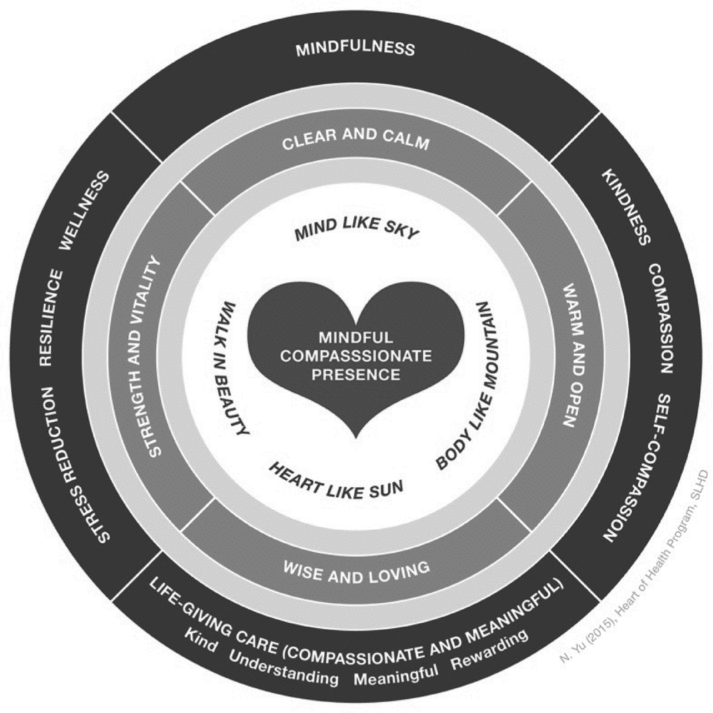
The provision of quality healthcare is a major international concern. There is increasing recognition that the treatment of a patient's underlying medical condition is not enough—health practitioners, such as nurses, also need to provide patients with emotional support, empathy, and compassion in order to cope with their treatment, fear, and anxieties (Goodrich & Cornwell, Reference Goodrich and Cornwell2008). The provision of compassionate care and the way that patients are cared for, looked after, and generally treated remains a key concern for the community, with good reason. Compassionate care is critical to patients’ experience of medical treatment, the quality of patient care, and patient outcomes. Compassionate care encourages patients to have honest and open conversations with health practitioners, which leads to better problem solving and accurate diagnosis (Epstein et al., Reference Epstein, Franks, Shields, Meldrum, Miller, Campbell and Fiscella2005). Compassionate treatment of patients also helps alleviate the fear and anxiety associated with illness, which assists recovery time (Cole-King & Harding, Reference Cole-King and Harding2001). As can be seen in Figure 1, compassionate care is a vital aspect of patient and family-centered care, which is an international healthcare priority.
The Sankalpa program
Although compassionate care is a cornerstone of nursing and quality healthcare, it is often difficult to practice. Being in the constant presence of pain, illness, and death is personally taxing, and a significant number of nurses cope with this distress by psychologically detaching from the suffering of their patients and from work (Nguyen, Groth, & Johnson, in press). This leads nurses to withdraw from their patients and engage in passive or reactionary care associated with the expression of pity rather than the practice of compassionate care, which is active, engaged, and empathetic. Mindfulness training, however, can assist nurses in developing the capacity to be open, resilient, and balanced when confronted with the suffering of others and to engage in compassionate care. In being focused on the present, mindfulness attunes nurses toward the current experiences and suffering of patients rather than being fearful of its impact. The sharing of suffering is difficult, but mindfulness enables nurses to become better aware and more comfortable with their own physical, cognitive, and emotional reactions to their patients and their patients’ suffering. Mindfulness also allows nurses to see and be with their own suffering and that of their patients while also being able to allow such suffering to pass through rather than remaining stuck. Further, there is a synergistic relationship between mindfulness and compassion in that the compassion we show toward others facilitates mindfulness of our own thoughts, feelings, and sensations (Kumar, Reference Kumar2003).
Theoretically, the reciprocal relationship between mindfulness and compassionate care can be explained in terms of resource theory (Fredrickson, Reference Fredrickson2001; Hobfoll, Reference Hobfoll2002). Engaging in high quality, compassionate behaviors at work requires individuals to have sufficient affective, cognitive, and motivational resources. We argue that mindfulness practice provides the resources necessary for individuals to provide compassionate care. By engendering a broadened state of awareness, mindfulness enables people to discover untapped resources. Mindfulness also limits the extent to which preoccupations and ruminations of past and future events consume resources. In addition, mindfulness practice creates additional resources by promoting relaxation, decreasing stress, and promoting positive affect. Gains in resources through mindfulness can foster “resource gain spirals,” as initial resource gains beget future gain (Hobfall, Reference Hobfoll2002). These gain cycles become possible because resources not required for everyday functioning encourage employees to invest surplus resources to create future gains (Hobfoll, Reference Hobfoll2002). That is, initial mindfulness experiences lead to a range of positive cognitive and affective experiences, in part by broadening cognition and promoting positive emotions. This provides the resources necessary for individuals to engage in compassionate behaviors at work. When positive emotions expand a person's mind, and heart, the positive effects of compassion may reciprocally increase the frequency and intensity of mindfulness. By engendering awareness of positive experiences and perspectives, positive emotions tend to accrete over time, leading to more frequent positive emotions in the future and a positive resource spiral.
A science-based meditation program called Sankalpa (a yoga word that means deep resolve), with the purpose of supporting compassionate care and staff wellness, is currently being used at every hospital in the Sydney Local Health District, Australia. The vision is for patients and staff to experience “life-giving care,” which involves patients experiencing kindness, understanding, and respect and staff experiencing care as being meaningful and rewarding. Participants learn and practice relaxation, mindfulness, compassion, and self-compassion skills that support the following attributes: mind like sky (clear and calm), heart like sun (warm, open, and vibrant), and body like mountain (strength and vitality; see Figure 1). The Sankalpa program consists of weekly, 1-hour workshops spread across 6 months, with staff attending whenever they can, taking into account clinical demands and rotating 24-hour work rosters. During training, skilled meditation facilitators help nurses develop mindful attention of sensations of the body, breath, feelings, and thoughts. This fosters self-awareness and empathy, which are key aspects of emotional intelligence, which enables compassionate care. Another core component of the Sankalpa program is the development of self-compassion. Sustainable and consistent compassionate behaviors toward others are made more possible when nurses are physically and mentally well. The magnitude and persistence of suffering in nursing is such that no nurse is untouched by the emotional demands of having to regularly process strong feelings. It is not uncommon for nurses to feel guilty that they could have “done more,” or to feel overcome by emotion, and to feel somewhat isolated in their suffering. That is why self-compassion practices aimed at supporting self-kindness, mindfulness, and common humanity (Germer & Neff, Reference Germer and Neff2013) are a key feature of the program.
We are currently undertaking a waitlist control, field experiment to investigate the dynamic within-person effects of the Sankalpa program on compassionate patient-centered care. Early data from the first cohort of 89 nurses participating in the Sankalpa program are promising. Consistent with prior research outlined by Hyland and colleagues, we found a negative relationship between mindfulness and stress (r = −.60, p = .01). We have also found a moderate positive association between mindfulness and compassionate patient-centered care (r = .44, p = .01). Mental (mind like sky), physical (body like mountain), and emotional (heart like sun) resources are also positively associated with mindfulness (r = .40, p = .01) and compassionate patient-centered care (r = .43, p = .01). Although we are in the early stages of collecting this data, our pattern of findings supports our theorizing.
Although mindfulness can promote beneficial outcomes, there remain some barriers to its practice in the workplace. Notably, the origins of mindfulness in Buddhist practice may be a deterrent to those of different religions. Within organizations, it is important to teach mindfulness in a secular context that is informed by empirical research and neuroscience. Another challenge affecting the utility of mindfulness programs concerns its practice by employees. The cultivation of mindfulness develops with practice, and its utility will be limited if it is only performed during brief workshops or formal training programs. That is why there is benefit in embedding mindfulness within organizational practices. It is important that organizational mindfulness programs include techniques that can be practiced “on the run” as part of everyday work life. Finally, mindfulness presents challenges to the practitioner. Mindfulness enables people to become more familiar with who they are, and over time, people are likely to come in contact with the full arc of human emotion and experience in doing so. The potential difficulty of such experiences should not be underestimated, hence the importance of skilled meditation facilitators and a supportive learning environment.
Providing compassionate care to others is often challenging, and it is not uncommon for nurses to require greater personal resources, techniques, and strategies to deliver the care that patients both want and need. Mindfulness programs like Sankalpa enable nurses to care in a way that engages patients and their families. Through the development of mindfulness, compassion, and self-compassion, nurses are able to meaningfully connect with patients and be good company on their journey.