1. The orthography of Modern Japanese
1.1 Semiotic awkwardness
For people learning Japanese as a foreign language, one of the most serious challenges is how to learn its orthography.Footnote 2 A cursory glance at the variety of Japanese textbooks and teaching material reveals that average learners need to make a very conscious, long-term effort to master Japanese orthography, and teachers need ingenuity and techniques that can help their students achieve this goal. This fact resonates with many linguists' characterisation of Japanese orthography as ‘cumbersome’ (Sampson Reference Sampson1985: 173), ‘one of the most intricate, most elegant, and yet most difficult writing systems in the modern world’ (Kess & Miyamoto Reference Kess and Miyamoto1999: 13), or ‘one of the most complex, or even the most complex, of all known [writing] systems’ (Labrune Reference Labrune2012: 9).
From a semiotic perspective, Japanese orthography is indeed perplexing, and to the extent that orthography is taken as a system of visual signs of sounds (as in phonographic writing) or sound–meaning connections (as in logographic writing) in a language, it may deserve the characterisations cited above. Specifically, the following two aspects of Japanese orthography cause semiotic difficulties: the simultaneous usage of logographic and phonographic scripts and the multi-faceted usage of the logographic script itself. Interestingly, these two aspects are exactly where ancient Japanese people gave a twist to the original Chinese orthography, the logographic writing system that provided the basis of literacy for civilisations within the Sinic cultural sphere.
First, Japanese orthography is what Sampson (Reference Sampson1985: Chapter 9) calls a mixed system, employing distinct types of script, kanji and kana. Kanji refers to (the system of) Chinese graphs used to write Japanese. Similar to its Chinese antecedents, it belongs to logographic writing (Lotz Reference Lotz, Kavanagh and Mattingly1972: 118; Sampson Reference Sampson1985: Chapters 8, 9; Frellesvig Reference Frellesvig2010: Section 1.1). Kana, on the other hand, is a syllable-based phonographic writing (Sampson Reference Sampson1985: Chapter 9; Coulmas Reference Coulmas2003: 78–81; Frellesvig Reference Frellesvig2010: Section 6.1).Footnote 3 It is an orthographic invention based on the kanji script in ancient Japan (Yamada Reference Yamada1937), so it has no counterpart in the parent Chinese orthography. Because of this mixed system, to write a lexeme, a writer has to make a choice between kanji and kana scripts. For example, to write the Japanese noun denoting a mountain, yama, one can write 山, using kanji, or やま, using kana. The Japanese mixed system forces a writer to make a similar choice for the majority of lexemes. Thus, the one-to-one mapping in writing is limited to items of grammatical categories (e.g. inflectional affixes and particles) and recent loanwords from European languages (see Section 3.1 below), both of which are written uniquely with kana.Footnote 4
The second semiotic difficulty, which concerns both reading and writing of Japanese, comes from another orthographic invention, namely, the dual pronunciation of a kanji graph.
Chinese graphs basically have just one reading (Sampson Reference Sampson1985: 177; Takashima Reference Takashima2001: 29–38; Yuzawa Reference Yuzawa, Maeda and Nomura2006; see also Chen Reference Chen2007), but kanji graphs often allow two distinct ways of reading, the Sino-Japanese (SJ henceforth) reading (called ‘on-reading’) and the native reading (‘kun-reading’). According to Sampson (Reference Sampson1985: 191), the following statistics are true of the 1,850 kanji graphs most commonly used in Modern Japanese: 844 (approximately 45.6%) of them have only SJ readings (they have 903 such sound values between them); 30 (approximately 1.6%) have only native readings (31 sound values); and the remaining 976 graphs (approximately 52.8%) each have SJ and native readings, having a total of 1,103 SJ sound values and 1,085 native sound values.Footnote 5 What we call dual pronunciation refers to a kanji graph having both SJ and native sound values. Though many have more than one SJ or native sound value,Footnote 6 we distinguish the multiplicity of the same type of reading from the duality of the type.
For example, the kanji  , which means ‘eye’, is read as /moku/ or /boku/ in the SJ reading and as /ma/ or /me/ in the native reading. The meaning associated with is constant, but its sound value varies greatly. The difference between /moku/ and /boku/ and the difference between /ma/ and /me/ might be analysed as instances of phonological allomorphy (Booij Reference Booij2010: 253),Footnote 7 but /moku, boku/ and /ma, me/ differ too greatly to allow for a similar analysis. The following additional examples also show that kanji's SJ/native sound variation cannot be explained phonologically, unlike the variation in each of the two types, and that each graph is associated with a constant meaning irrespective of the sound variation:
- (1)
(a) 山: associated with the meaning ‘mountain’, read as /san/ or /zan/ in the SJ reading or as /yama/ in the native reading
(b) 見: associated with the meaning ‘to look’, read as /ken/ or /gen/ in the SJ reading or as /mi/ (/-ru, -re, -yo, -nai/) in the native reading
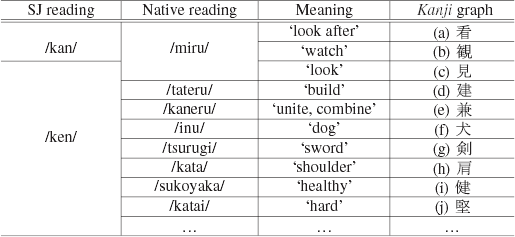
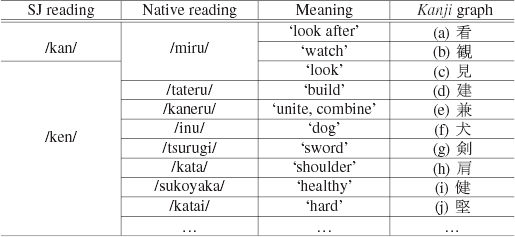
The dual pronunciation is onerous from a reader's perspective; one has to memorise unrelated sound pairs for each kanji graph to pronounce it correctly. This kanji characteristic, however, causes much greater difficulties for writers because the sound pairing is many-to-many; one SJ reading is found with kanji graphs with different native readings, while the same native reading is shared by those with different SJ readings. Crucially, to the extent that the pairing of SJ and native sounds, rather than individual sounds, defines a lexeme, writers have to know this mapping to choose a correct kanji for a given lexeme. Table 1 shows a part of the mappings that involve the SJ reading /ken/ and the native reading /miru/. When these two sounds are paired, we have the verb ‘look’, written as 見, as we saw in (1b) above. However, when /miru/ is paired with /kan/, it belongs to the verbs written as 観 and 看, each expressing ‘watch’ and ‘care, look after’. On the other hand, /ken/ is paired with a number of different native readings, only eight of which are given in Table 1. As the meaning indicates, this reading occurs cross-categorially, not only in verbs, but also in nouns and adjectives.
An illustration of the mapping between kanji's SJ and native readings.
1.2 A paradox
We have seen two ways in which Japanese orthography causes semiotic difficulties. The question is as follows: How can a writing system be so difficult and still serve in practice? Traditional answers to the first half of this question can be summarised as the ‘historical residue’ view, according to which Japanese orthography is complex because of its history as an adoption. The originally ‘perfect’ logographic writing system was adopted to write Japanese and underwent various changes to accommodate this typologically quite different language from Chinese. In this process, the complications arose as last resort. Thus, according to this view, the massive homophony on the part of the SJ reading, which is indicated by /ken/ in Table 1, is nothing but bad luck caused by the fundamental phonological differences between the two languages involved (Sampson Reference Sampson1985: 176–189; Takashima Reference Takashima2001: Chapters 1, 2). Because the anti-semiotic nature of Japanese orthography is a historical residue of the desperate bricolage to achieve literacy, these studies suggest one of the following two strategies for contemporary Japanese speakers (and learners): either tolerate the ‘imperfect’ state as it is (Sampson Reference Sampson1985; Takashima Reference Takashima2001: 240–246) or abandon the system totally or selectively (Nomura Reference Nomura2008).
Although the historical residue view might be descriptively correct, it leaves unexplained the latter half of the above question, how can such an ‘imperfect’ orthography serve in practice? In fact, the historical residue view seems to be contradicted by the very high literacy rate maintained in Japan for a long time and the status of orthography as an indispensable component of Japanese linguistics. Let us discuss these two factors in some detail.
First, according to Saito (Reference Saito2012), historical records indicate that in the closing years of the Edo period (1603–1868), the literacy rate of ordinary Japanese people was already relatively high, at 50–60% among adult males and 30% among adult females. After World War II, when the GHQ-CIEFootnote 8 criticised Japanese orthography as a sheer hindrance in education, a group at the National Educational Institute performed a large-scale, nation-wide investigation into the literacy rate. Table 2, adopted from Saito (Reference Saito2012: 59), shows the results of the investigation in 1948, in which complete illiterates are people who cannot read and write at all and kanji-illiterates are people who can read and write kana but cannot read and write kanji.
Contrary to the GHQ-CIE expectations, the results made it clear that Japan had no literacy problem, so much so that the GHQ-CIE let go their plan to terminate the kanji use (Saito Reference Saito2012: 60). This investigation illustrates the paradox that has manifested itself in our discussion. That is, Japanese orthography strikes linguists and second language learners as a source of inefficiency and a burden on memory, but it poses no serious problems whatsoever in its functioning as an orthography and in its acquisition by native speakers.
Age-specific illiteracy rates in Japan in 1948.

Next, it needs to be stressed that not only do Japanese native speakers learn the orthography relatively easily, given the elementary-school–level education (Makita Reference Makita1968),Footnote 9 they also use the knowledge very actively throughout their lives. The role of the kanji script as an active agent in ordinary Japanese people's use of the language has been highlighted most prominently by Takao Suzuki. In his numerous publications (Suzuki Reference Suzuki1963, Reference Suzuki and Peng1975a, Reference Suzukib, Reference Suzuki1977, Reference Suzuki1990), Suzuki consistently claims that Japanese orthography ‘is no longer a mere passive recipient of sound language, but a kind of formative agent exerting considerable power over language’ (Suzuki Reference Suzuki1977: 409). In one of his arguments, Suzuki (Reference Suzuki1975b: 68–79) observes that contemporary Japanese speakers productively produce homophonous pairs of compounds, which, contrary to the expectation from the homophony-avoidance principle (Gilliéron Reference Gilliéron1918), belong to the same semantic domain.Footnote 10 In fact, many of those pairs express meanings close enough to be taken as instances of polysemy rather than homophony. Witness the following homophonous compounds, taken from Suzuki (Reference Suzuki1975b: 78), where the bold-faced word is the locus of semantic distinction between the pair:
- (2)
(a) Homophonous compounds in the hyponymy relationship
shoo-shitsu vs. shoo-shitsu
disappear-lost burn-lost
‘disappear, vanish’ ‘disappear in fire’
 -失 -失
(b) Homophonous compounds expressing similar meanings
jyuu-shoo vs. jyuu-shoo
serious-illness serious-injury
‘a serious illness’ ‘a serious injury’
重-
重-(c) Homophonous compounds expressing opposite meanings
kou-ten vs. kou-ten
bad-weather good-weather
‘bad weather’ ‘good weather’
-天 -天
 -失
 -失
 重-

 -天
 -天
Crucially, these homophonous compounds are distinguished from each other by the use of distinct kanji graphs for the bold-faced words, as indicated by their kanji transcriptions. Suzuki argues that this type of word formation is possible (and productive even) in Japanese because the knowledge of kanji is actively employed in word production and comprehension; in his view, the compound pairs in (2a–c) are distinguished only by the kanji graphs.
In sum, Japanese orthography poses a type of paradox in that something that seems totally fortuitous and illogical to non-native speakers constitutes an indispensable facet of the native speakers' linguistic knowledge. In this paper, we propose that this paradox is explicable if one takes a lexeme-based morphological view. Our core hypothesis is that Japanese orthography is based on the working of lexeme-based morphology (in line with Aronoff Reference Aronoff1994, Reference Aronoff, Lapointe, Brentari and Farrell1998, Reference Aronoff2007, Reference Aronoff2012 and Maiden Reference Maiden1992, Reference Maiden2004, Reference Maiden, Booij and van Marle2005, Reference Maiden, Lepschy and Tosi2006, Reference Maiden and Eythórsson2008). If ‘[w]riting is a representation of language: elements of writing represent elements of language’ (Frellesvig Reference Frellesvig2010: 12), there can be a writing system that represents the morphological component of the grammar. If Japanese orthography is of that type, its semiotic awkwardness can be viewed as a reflection of the morphomic character of morphology, the defining characteristics of morphology as espoused by Aronoff and Maiden: morphology does not make sense in terms of the sound–meaning mapping. The many-to-many mapping is a prototype rather than a deviancy in morphology (Beard Reference Beard1995), justifying the postulation of what Aronoff (Reference Aronoff1994) terms a morphomic level in grammar, an autonomous level mediating between morphosyntax and phonological realisation. Under the present hypothesis, the paradox posed by Japanese orthography is the paradox posed by morphology in general. Morphology is the locus of language-specific properties and apparently anti-universal idiosyncrasies (Aronoff Reference Aronoff, Lapointe, Brentari and Farrell1998, Miyaoka Reference Miyaoka2002); it is a local set of rules that hardly make sense to outsiders yet that are deeply binding and profitable for insiders.
The aim of this paper is to substantiate the lexeme-based morphological view of Japanese orthography, placing special emphasis on the issue of the dual pronunciation of kanji. Concretely, we examine this phenomenon from the following perspectives:
• What is the underlying mechanism of the dual pronunciation of kanji? (Section 2)
• How did the mechanism emerge? (Section 3)
• What is the function of the mechanism? (Section 4)
• Is the mechanism possible independently of kanji? (Section 5)
Before proceeding, let us clarify the originality and limitations of this paper. Our discussion is indebted both to morphologists working within the framework of lexeme-based morphology and to specialists in Japanese linguistics and orthography. Our originality resides in revealing a hidden connection between these two domains, which we hope will bring to the former domain additional confirming evidence for the autonomous working of morphology and to the latter domain an entirely new perspective to make sense of the paradoxical nature of Japanese orthography. What we cannot do in this paper is examine the data from applied linguistic perspectives, although this phenomenon has been studied much more extensively in applied than theoretical linguistics.Footnote 11 In particular, we do not address the question of how the dual pronunciation of kanji develops and matures in the linguistic competence of one native speaker.
2. The underlying mechanism of the dual pronunciation of kanji
2.1 Lexeme-based morphology and stem alternation
One of the fundamental distinctions among morphological theories is whether they are lexeme-based or morpheme-based. This distinction concerns the basic, smallest unit of morphological analysis and ultimately the question of which of the two axes of grammar, syntagmatic or paradigmatic, is the most prominent one (Carstairs-McCarthy Reference Carstairs-McCarthy2010: Section 6.4). As discussed by Aronoff (Reference Aronoff1994: Section 1.2; Reference Aronoff2007, Reference Aronoff2012), whereas morpheme-based theories aim to reduce language to the concatenation of simple signs, each of which is a one-to-one arbitrary match between sound and meaning (i.e. morpheme), lexeme-based theories treat sound and meaning as separate systems and explore the working of an autonomous level mediating between the two, the purely morphological level called morphome (Aronoff Reference Aronoff1994: 25). Thus, although morpheme-based theories attempt to distribute lexical and grammatical meanings uniquely to particular segments of words, root (or lexical) morphemes and functional morphemes, respectively, in a lexeme-based theory, the lexical meaning resides in the abstract atom of lexeme (Matthews Reference Matthews1991; Aronoff Reference Aronoff1994, Reference Aronoff2007; Beard Reference Beard1995). A lexeme projects a paradigm in which a set of stems – pure sound forms bearing an index (Aronoff Reference Aronoff1994: 39; Beard Reference Beard1995: 48; Spencer Reference Spencer2012: 89) – are distributed to be used in the phonological realisation of the lexeme in specific grammatical contexts. Crucially, stems are not exponents of morphosyntactic properties but rather morphomes, mediators or functions that map between various morphosyntactic properties and various phonological word forms. Put simply, whereas morphemes are concrete sound–meaning combinations, lexemes are abstract units with a rich internal structure that binds form, grammar, and meaning together.
Among the wealth of preceding studies in the lexeme-based framework, this paper pays special attention to Martin Maiden's work because it encompasses both synchronic and diachronic aspects of stem allomorphy. Moreover, Maiden carefully examines the potential tension between the morphomic aspects of lexemes and the principle of iconicity, i.e. the universal predisposition to symmetrical form–meaning matching. Of particular importance to the understanding of Japanese orthography are the following three of Maiden's (Reference Maiden1992, Reference Maiden2004, Reference Maiden, Booij and van Marle2005, Reference Maiden, Lepschy and Tosi2006, Reference Maiden and Eythórsson2008) findings:
- (3)
(a) There are cases of stem allomorphy as a purely morphological phenomenon, namely, stem alternation patterns in which stems are distributed by strictly local (paradigm-specific) rules that cannot be explained away by syntactic, semantic, or phonological properties.
(b) Stem allomorphy often originates from the interactive accumulation of phonological changes, but once it is established as a morphomic alternation pattern in a grammar, it persists diachronically. Significantly, it is retained not as an inert residue of historical development but as an active, productive mechanism of the grammar.
(c) The development and retention of morphomic stem allomorphy is positively related to the principle of iconicity; it can be seen as the crystallisation of speakers' search for form–meaning regularity in the face of phonologically caused irregularity. In Maiden's (Reference Maiden and Eythórsson2008: 139) words, ‘there is in fact a seamless link between what seem to be erratically local morphomic phenomena and the fundamental and universal principles of iconicity’.
The following subsections of Section 2 show that the dual pronunciation of kanji can be seen as a case of stem allomorphy described in (3a). Specifically, it is a case of morphomic suppletion in which distinct stems are paradigmatically distributed according to a purely morphological property. Sections 3 and 4 show that the developmental and functional sides of this kanji suppletion can be understood in light of the views in (3b) and (3c).
2.2 Stems and their distribution in Japanese verbal and nominal morphology
In lexeme-based morphology, the logographic nature of kanji means that each kanji represents a lexeme. Then, its dual pronunciation can be seen as the case of a lexeme possessing phonologically unrelated stems, that is, suppletion.
The crucial fact for this view is that a kanji graph loses its dual pronunciation once it is given a grammatical context; kanji cannot be read in more than one way in one realisation of the lexeme it represents. Consider the data below, which show that the native and SJ readings of the graphs 見 from (1b) and 読 (‘to read’, SJ: /doku/, native: /yo(m)/) are complementarily distributed. Inflection in (4), derivation in (5), and native compounding in (6) involve the native reading, while SJ compounding in (7) involves the SJ reading.Footnote 12 The data also show that the lexemes represented by 見 and 読 are verbs.
(4) Inflection
(a) 見 (b) 読
Irrealis mi-ø yom-a
Adverbial mi-ø yom-i
Conclusive mi-ru yom-u
Attributive mi-ru yom-u
Hypothetical mi-re yom-e
Imperative mi-ro/yo yom-e
Cohortative mi-yo yom-o
(5) Derivation
(a) 見 (b) 読
Action nounFootnote 13 mi yomi
Agentive suffix -te mi-te yomi-te
Manner suffix -kata mi-kata yomi-kata
Honorification by o- Footnote 14 ?o-mi/goran o-yomi
(6) Native compounding
(a) 見 (b) 読
Occurring in mi-dokoro yomi-age(ru)
the left position look-place read-raise
‘merit’ ‘reading aloud’
mi-kiki yomi-mono
look-listen read-thing
‘observation’ ‘reading matter’
Occurring in too-mi boo-yomi
the right position far-look stick-read
‘distance viewing’ ‘reading monotonously’
tsuki-mi tachi-yomi
moon-look stand-read
‘moon-watching’ ‘browsing’
(7) SJ compounding
(a) 見 (b) 読
Occurring in ken-bun doku-sho
the left position look-listen read-book
‘observation’ ‘reading’
ken-butsu doku-ha
look-thing read-break
‘sightseeing’ ‘reading through’
Occurring in en-ken kai-doku
the right position far-look analyse-read
‘distance-viewing’ ‘decoding’
hai-ken soku-doku
worship-look fast-read
‘have the honour of looking’ ‘rapid reading’
Within the present framework, the data mean that verbal inflection, derivation, and native compounding on the one hand and SJ compounding on the other employ phonologically unrelated or suppletive stems. Because stems are purely phonological forms (as discussed in Section 2.1), we use P to represent stem types (Aronoff Reference Aronoff1994: 54–59).
In the basic seven inflected forms in (4) above, Japanese verbs take the word form [stem + inflectional suffix] using the same stem form, which is either vowel-final, as in (4a), or consonant-final, as in (4b) (Shibatani Reference Shibatani1990: 221–235). We call this stem type P Infl. In derivatives and native compounds, on the other hand, a verbal lexeme is realised in its adverbial form. In these cases, realisation rules use one of the seven inflected forms as the stem. In (5) and (6) above, we see that the lexemes represented by 見 and 読 are each realised with the same form as their adverbial form in (4) (the form in bold). There is no semantic or phonological reason for this choice; Japanese verbs have the stem type P Adv, which is a morphomic function whose output form is regularly determined by the inflectional adverbial realisation operating on P Infl.Footnote 15
The distribution of P Adv may, however, make ‘morphological’ sense when we consider the working of the purely morphological feature [± bound] (Montermini Reference Montermini, Scalise and Vogel2010; Carstairs-McCarthy Reference Carstairs-McCarthy, Tallerman and Gibson2012: 436). Cross-linguistic data such as Dixon & Aikhenvald (Reference Dixon and Aikhenvald2002) and Lieber & Štekauer (Reference Lieber and Pavol2009: Part II) make it clear that boundness is not a distinction between affixes and words because the latter can also take bound forms. Because lexemes are abstract units, the boundness of words must be a property of concrete word forms. Specifically, given that the boundness of words does not affect their syntactic or semantic behaviours (Carstairs-McCarthy Reference Carstairs-McCarthy2010: Section 2.5; Shimada & Nagano Reference Shimada and Nagano2011), it must be a property of P that defines each word form, that is, a property of stems. This is in accord with the traditional classification of realisation rules (affixation and compounding in particular) in terms of the boundness of their bases.
The Japanese realisation operations also differ in the boundness of their bases; derivational affixation and native compounding choose a [−bound] P of the base lexeme, while SJ compounding chooses a [+bound] P of the base lexeme (e.g. Itô Reference Itô1990; Kageyama Reference Kageyama1993: Section 1.3.2, Reference Kageyama, Lieber and Štekauer2009: 512–513). This fact accounts for the distribution of P Adv of verbal lexemes; it occurs in derivation and native compounding because it has the [−bound] feature. In verbs, P Infl is bound, but P Adv can occur freely in syntax by itself, as indicated by its use as an action noun in (5a, b) above (Shibatani Reference Shibatani1990: 218). On the other hand, SJ compounding employs a compounding stem (P Comp), a special form that a lexeme takes in compounds (Bloomfield Reference Bloomfield1933: 229–232; Aronoff Reference Aronoff1994: 44–45).Footnote 16 This stem is chosen because, as a form specific to compounding, P Comp necessarily has the [+bound] feature. Thus, in (7) above, 見 and 読 are spelt out with the bound forms ken and doku, respectively. Significantly, these forms cannot be formed regularly from the other stems the lexemes take in (4)–(6) (i.e. mi, yom/yomi), or vice versa. Thus, the formal relationship between P Comp and P Infl/P Adv in Japanese verbs is suppletion.
Note that the distinction between native and SJ compounding is not an etymological but a morphological distinction that concerns the [± bound] feature of the stem.Footnote 17 Stems based on SJ sound values of kanji can participate in native compounding once they acquire morphological freedom. In the following ‘hybrid’ compounds (Shibatani Reference Shibatani1990: 238), the bold-faced SJ forms can occur freely by themselves:
- (8)
(a) SJ-native: dai-dokoro ‘lit. stand-place; kitchen’
i-gusuri ‘lit. stomach-medicine; medicine for stomach’
sho-dana ‘lit. book-shelf; bookshelf’
(b) native-SJ: kesi-in ‘lit. erase-mark; postmark’
to-kei ‘lit. time-count; clock’
The distinction between free-stem–selecting and bound-stem–selecting compounding is observed cross-linguistically (see Chao Reference Chao1968, Sproat & Shih Reference Sproat and Shih1996, and Packard Reference Packard2000 for Mandarin Chinese; Moyna Reference Moyna2011 for Spanish; and Rio-Torto & Ribeiro Reference Rio-Torto and Ribeiro2009: Section 3 for Portuguese).
Note also that the boundness of P Comp in Japanese is an inherent primitive morphological property of P that cannot be reduced to phonology.Footnote 18 Montermini (Reference Montermini, Scalise and Vogel2010: 81–82) suggests that the following bold-faced SJ bases are bound to their compounding partners because they undergo phonological operations specific to the first element of SJ compounds, such as vowel deletion and consonant assimilation:
- (9)
(a) gaku (学: ‘learn’) + koo (校: ‘school’) → gakkoo ‘school’
(b) hatsu (発: ‘release’) + kaku (覚: ‘know’) → hakkaku ‘disclosure’
However, the forms gaku and hatsu, which are the SJ readings of the parenthesised graphs, are bound by themselves; they cannot occur independently in syntax. These forms need compounding even when they do not undergo any phonological change (e.g. gaku-hi ‘lit. learn-cost; tuition’, ken-gaku ‘lit. look-learn; visit’). The same is true of koo in (9a) and kaku in (9b). Thus, sound forms corresponding to SJ readings of kanji graphs are inherently bound; they have the [+bound] feature.
As for the validity of the [± bound] feature as a morphological property, let us note that word-level concatenation without semantic change is not so rare. Here, we mention two such cases. First, as discussed by Shimada (Reference Shimada2013), Japanese and Chinese have abundant examples of what Bauer (Reference Bauer2008: 10) calls co-synonymic dvandvas, i.e. compounds conjoining synonyms. Let us consider the following Japanese examples, cited in Shimada (Reference Shimada2013: 92):
- (10)
(a) N–N type: jyu-moku ‘lit. tree-tree; tree’, doo-ro ‘lit. road-road; road’
(b) V–V type: soo-zoo ‘lit. create-create; create’
gaku-shuu ‘lit. learn-learn; learn’
(c) A–A type: ei-kyuu ‘lit. long-long; long’
ki-myoo ‘lit. strange-strange; strange’
As these examples show, co-synonymic dvandvas express the same meaning as their constituent synonyms. Observing that constituents of co-synonymic dvandvas, including those in (10), are bound stems, Shimada (Reference Shimada2013) proposes that compounding can be used to make morphologically bound items syntactically independent. It is crucial for a bound stem to be coordinated with its synonym when boundness-switching is the only purpose of compounding.
Compounding is not the only operation that is used in this way. There exist what may be termed ‘freeing affixes’, namely, semantically vacuous or sparse affixes whose only function seems to be switching [+bound] to [−bound].Footnote 19 For example, what Packard (Reference Packard2000: Sections 3.4.3.1, 6.2.2) calls ‘word-forming affixes (WFAs)’ in Chinese produce derivatives with the same meaning and lexical category as their bases, the difference between their input and output being only in boundness.Footnote 20 Thus, the Chinese lexemes mào ‘hat’ and nao ‘brain’ need the affix -zi to be used independently in syntax, as in (11a), but do not when realised by compounding, as in (11b):
- (11)
(a) mào-zi ‘lit. hat-wfa; hat’, nao-zi ‘lit. brain-wfa; brain’
(b) mào-shé ‘lit. hat-tongue; visor’ (*màozi-shé)
căo-mào ’lit. straw-hat; straw hat’ (*căo-màozi)
nao-shuizhong ‘lit. brain-dropsy; hydrocephaly’ (*naozi-shuizhong)
hou-nao ‘lit. hind-brain; hindbrain’ (*hou-naozi) (Sproat & Shih Reference Sproat and Shih1996; Packard Reference Packard2000: 247)
We see in the next section a similar boundness-changing operation working in the formation of P Infl/P Comp from P Comp/P Infl in Japanese lexemes. In lexeme-based morphology, these facts can be captured by the operation Feature Value Switches in Beard (Reference Beard1995).Footnote 21
Finally, let us consider the distribution of stem types in nominal lexemes. Nominal lexemes differ from verbal lexemes in that their P Infl has the [−bound] feature. This is because Japanese does not have overt inflectional morphology for nouns. Hence, derivational and native compounding of nominal lexemes can employ P Infl. As predicted, the same free stem form is observed in inflection, derivation, and native compounding. SJ compounding, on the other hand, needs a bound stem, so it takes P Comp. Witness the realisations of the nominal lexeme represented by 山 (the data in (1a) above):
(12) Inflection
山
Nominative yama-ga
Accusative yama-o
Genitive yama-no
Dative yama-ni
Topic yama-wa
(13) Derivation
Honorification o-yama
hon-mountain
Prefix oo- ‘big’ oo-yama
‘big mountain’
Prefix ko- ‘small’ ko-yama
‘small mountain’
Suffix -darake ‘full of’ yama-darake
‘full of mountains’
(14) Native compounding
Occurring in yama-nobori yama-otoko
the left position mountain-climb mountain-man
‘mountain climbing’ ‘mountaineer’
Occurring in iwa-yama kare-yama
the right position rock-mountain wither-mountain
‘rocky mountain’ ‘mountain with withered trees’
(15) SJ compounding
Occurring in san-sai san-roku
the left position mountain-plant mountain-foot
‘wild plants’ ‘foot of a mountain’
Occurring in to-zan kin-zan
the right position climb-mountain gold-mountain
‘mountain climbing’ ‘gold mine’
In sum, verbal lexemes have three stem types, P Infl, P Adv, and P Comp, while nominal lexemes have two stem types, P Infl and P Comp. The distribution of the sound values of a kanji graph is aligned with the distribution of these stem types. Kanji's dual pronunciation is a reflection of the stem system of lexemes.
One might ask why a part of verbal P Infl and P Adv is sometimes spelt out with kana if kanji's readings correspond to stems. For example, the conclusive and action noun forms of the lexeme represented by 読 ((4b), (5b)) are each written as  and
 , where the last consonant of P Infl and the last syllable of P Adv are taken over by the following kana graphs. The kana escorting kanji is called okuri-gana ‘escorting kana’. The usage of escorting kana is notoriously complicated, being determined by various factors such as the nature of the kana script as a syllabary and its pragmatic function of disambiguating realisations of the lexeme (Sampson Reference Sampson1985: 184–190; Kondo Reference Kondo, Maeda and Nomura2005). Therefore, there are also cases where the kanji readings exactly correspond to the verbal P Infl and P Adv (e.g. conclusive in (4a):
 , action noun in (5a):
 ). Even 読 can be used without an escorting kana in the representation of P Adv; for example, the native compounds yomi-age(ru) and yomi-mono in (6b) are written not only as
 and
 but also as
 and
 , respectively.Footnote 22 Because these surface variations of the literal reading of a kanji graph arise from the system of escorting kana, we can maintain the view that sound values of a kanji graph correspond to stems of the lexeme that it represents.
2.3 Suppletion in compounding
The preceding section has claimed that dually pronounced kanji graphs represent lexemes whose P Infl/P Adv and P Comp are in a suppletive relationship. This section substantiates this claim.
First, compounding constitutes a valid morphological context for suppletion because stem allomorphy in compounding is prevalent cross-linguistically. If suppletion is a matter of degree (Melčuk Reference Melčuk1994), stems involved exhibiting various degrees of formal difference, the context for stem allomorphy should be the one for suppletion.
The following data from several European languages show that lexemes exhibit varying degrees of stem allomorphy in compounding, in the non-head position in particular:
(16) Compound elements forms identical with inflected forms
(a) English
lion-hunter (cf. *lions-hunter), toothpaste, teethridge; bondsman
(cf. bondholder), landsman (cf. landlord) (Bloomfield Reference Bloomfield1933: 224–232)
suggestions box, trouser-press (cf. *trousers-press) (Bauer Reference Bauer and Brown2006: 720)
(b) German
Männerfreund ‘man's man’, Mannsbild ‘fellow’, Mannesalter ‘manhood’, Manndecker ‘centre-half’ (Neef Reference Neef, Lieber and Štekauer2009: 393)
(c) Italian
portafoglio/portafogli (both as singulars) ‘lit. carry-sheet; wallet’,
marciapiede/marciapiedi (both as singulars) ‘lit. march-foot; sidewalk’(Montermini Reference Montermini, Scalise and Vogel2010: 88)
(d) French
essuie-mains ‘lit. wipe.2imp-hands; hand towel’,
porte-drapeau ‘lit. bear.2imp-standard; standard bearer’ (Fradin Reference Fradin, Lieber and Štekauer2009: 422)
(e) Danish
drikkevand ‘lit. drink.inf-water; drinking water’ (Bauer Reference Bauer, Lieber and Štekauer2009: 347)
(f) Russian
vertišejka ‘lit. turn.sg.imp-neck; wryneck’ (Benigni & Masini Reference Benigni and Masini2009: 172)
(g) Hungarian
fej-en-állás ‘lit. head-superessive-stand; headstand’ (Kiefer Reference Kiefer, Lieber and Štekauer2009: 539)
(h) Finnish
maa-lta-pako ‘lit. country-abl-flee.nom; rural depopulation’ (Bauer Reference Bauer and Brown2006: 720)
(i) Estonian
riisi-puder ‘lit. rice.gen-porridge; rice porridge’(Bauer Reference Bauer, Lieber and Štekauer2009: 346)
(17) Compound elements identical with inflectional stems
(a) German
Schwimm-bad (vs. schwimmeninf) ‘swimming pool’ (Montermini Reference Montermini, Scalise and Vogel2010: 81)
Lachkrampf ‘laughing-spasm’ (Bloomfield Reference Bloomfield1993: 225)
Trink-wasser ‘drinking water’ (Bauer Reference Bauer, Lieber and Štekauer2009: 347)
(b) Dutch
schuifdeur ‘slide door’, speelveld ‘play field’(Don Reference Don, Lieber and Štekauer2009: 374)
(18) Compound elements with compound markers or linking elements
(a) Greek
pag-o-vuno (vs. pag-os ‘ice’, vun-o ‘mountain’) ‘ice berg’(Booij Reference Booij2005: 88),
hippo-kantharos ‘horse-beetle’(Bloomfield Reference Bloomfield1993: 225)
(b) Polish
gwiazd-o-zbiór (vs. gwiazd-a ‘star’, zbiór ‘collection’) ‘constellation’(Szymanek Reference Szymanek, Lieber and Štekauer2009: 466)
(c) Czech
nov-o-stavba (vs. nov-ý ‘new’, stavba ‘construction’) ‘new construction’(Štichauer Reference Štichauer2009: 295)
(d) German
Liebesbrief (vs. Liebe ‘love’, Brief ‘letter’) ‘love letter’,
Arbeitsamt (vs. Arbeit ‘work’, Amt ‘office’) ‘employment office’(Neef Reference Neef, Lieber and Štekauer2009: 391)Footnote 23
(19) Compound elements by clipping
(a) Russian
gorsovet (<gorodskoij ‘cityA’ + sovet ‘council’) ‘city council’(Benigni & Masini Reference Benigni and Masini2009: 173)
(b) English
sci-fi (<science + fiction) ‘science fiction’(Plag Reference Plag2003: 122)
(20) Weakly suppletive compound elements
(a) Danish
jom-fru (vs. ung ‘young’) ‘virgin’(Montermini Reference Montermini, Scalise and Vogel2010: 80)
(b) French
col-porter (vs. cou ‘neck’) ‘peddle’(Montermini ibid.)
(21) Strongly suppletive compound elements
(a) English
anthropo-morph, morpho-logy, biblio-phile, philo-logy (ten Hacken Reference ten Hacken1994: Section 4.3), Sino-Japanese, Hispano-Portuguese
(b) Danish
småfed ‘lit. small-fat; plump’, smålyve ‘lit. small-lie; fib’ (<liten ‘small’ being inflected lille in the singular and små in the plural) (Börjars & Vincent Reference Börjars, Vincent, Galani, Hicks and Tsoulas2011: 258)
It is clear that lexemes are realised by various stems in compounding. They are realised with a stem formally identical to one of their inflected forms in (16), with the stem used in inflection in (17), with the stem made by the so-called compound marker or linking element in (18), and with the stem derived by clipping in (19). Given this cline of allomorphy, it is natural to locate at its edge or marginal points weakly and strongly suppletive compounding forms in (20) and (21). Shimada & Nagano (Reference Shimada and Nagano2011) provide substantial arguments for the suppletion analysis of so-called neoclassical compounding such as (21a). The example in (21b) shows that the Danish adjective liten ‘small’ takes its suppletive agreement form in the compound-first position (Börjars & Vincent Reference Börjars, Vincent, Galani, Hicks and Tsoulas2011).Footnote 24
Adopting the concept of stem space (Montermini & Boyé Reference Montermini and Boyé2012), let us suppose that the paradigm of a lexeme includes space to specify how it is realised in compounds (Shimada, Nagano & Okubo Reference Shimada, Nagano and Okubo2013). In the data at hand, the default stem in this space is inherited from the stem space of inflection, as in (16) and (17), but special stems for compounding, that is, compounding stems (Section 2.2), may be regularly formed, as in (18) and (19), or wholly stored, as in (20) and (21). The distribution of stems in this space does not (necessarily) have semantic or syntactic motivation; for example, there is no semantic or syntactic reason for French verbs to take the second-person imperative form in synthetic compounds, as in (16d) (Fradin Reference Fradin, Lieber and Štekauer2009: 422–428; Montermini Reference Montermini, Scalise and Vogel2010: 88). Indeed, the following data, where a lexeme employs distinct stems in morphosemantically very similar compounds, suggest that the stems can be distributed by minute and unfamiliar (that is, strictly language-specific) factors independent of syntax and semantics:Footnote 25
- (22)
(a) Spanish
ajoarriero ‘lit. garlic.nom.sg-muleteer; type of stew’ vs.
ajiaceite ‘lit. garlic-oil; type of sauce’(Moyna Reference Moyna2011: 27)
(b) Swedish
ortnam ‘lit. place.nom.sg-name; place name’ vs.
ort-s-nam ‘lit. place-linking element-name; place name’(S. Niemi Reference Niemi2009: 262)
(c) Finnish
aitamaalaus ‘lit. fence.nom.sg-painting; painting on a fence’ vs.
aitovieri ‘lit. fence-area beside; area close to fence’ (J. Niemi Reference Niemi2009: 248)
Ralli (Reference Ralli2013: Section 7.3) provides an interesting case study of the compounding stem space in Modern Greek, where the first constituent of a compound exhibits a compound-marker vowel. The majority of lexemes form this compounding stem by means of their consonant-final inflectional stem (e.g. somat-o-fílakas ‘lit. body-compound marker-guard; bodyguard’ < sómat-{os/a/on} ‘body {gen.sg/nom, acc, voc.pl/gen.pl}’), but neuter nouns in -i and borrowings in -is do so by truncating these final elements from the inflected form (e.g. spit-ó-γatos ‘lit. house-compound marker-cat; stay-at-home man’ < spíti ‘house.nom/acc/voc.sg’). This may be a case of phonologically conditioned stem allomorphy, but Modern Greek also has compounding stems distributed by the [± learned] property (e.g. γalatópita ‘kind of pie made with milk’ vs. γalaktokomía ‘dairy farming’ < γála ‘milk’).
In brief, given the a-semantic form alternation a lexeme shows in compounding and the distribution of alternants that can be purely morphological, it seems to be a valid move to posit a stem space for compounding within the paradigm of a lexeme, along with those for inflection and derivation. Stems in that space are inherited from the inflectional (or derivational) stem space, regularly formed in the stem formation component (Spencer Reference Spencer2012), or wholly listed.
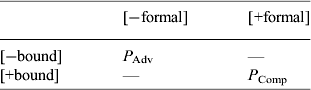
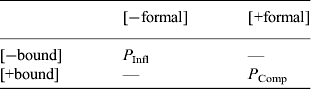
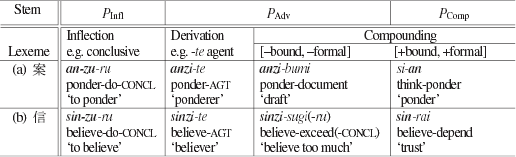
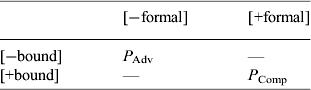
Let us now turn to Japanese cases. Our proposal is that the paradigms of Japanese verbs and nouns have compounding stem spaces defined by the morphological feature [± bound] and the pragmatic feature [± formal], as shown in Tables 3 and 4. Section 2.2 has already discussed the involvement of the [± bound] feature in the distribution of stems in compounding. The stems in compounding also differ in the stylistic formality of the realisations; the use of P Comp signals formality, whereas the use of P Adv/P Infl does not. This can be shown most explicitly by compounds that allow both native and SJ realisation:
(23) Compound Native realisation SJ realisation
(a) 山 ‘mountain’ + 道 ‘road’: yama-michi san-doo ‘mountain road’
(b) 父 ‘father’ + 母 ‘mother’: chichi-haha fu-bo ‘parents’
(c) 草 ‘grass’ + 原 ‘plain’: kusa-hara soo-gen ‘grassy plain’
Compounding stem space of Japanese verbs.
Compounding stem space of Japanese nouns.
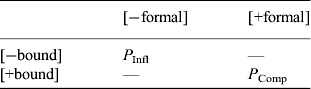
In (23a–c), the native and SJ compound forms express the same meaning as that given in the rightmost column, but they differ in formality. For example, san-doo is more formal than yama-michi. The same difference is true of the following native vs. SJ compound pairs in (6a) and (7a) and in (14) and (15): mi-kiki vs. ken-bun (both written  聞), too-mi vs. en-ken (both written 遠); and yama-nobori vs. to-zan.Footnote 26 Although the compounding stem spaces in Tables 3 and 4 are defective, lacking stems in the [−bound, +formal] and [+bound, −formal] slots, it is safe to keep the two features separate because the [± formal] feature is independently invoked in Expressive Derivations (Beard Reference Beard1995, Beard & Volpe Reference Beard, Volpe, Štekauer and Lieber2005), a type of derivational morphology that is employed extensively in Japanese. Significantly, it is in this type of morphology that Japanese high-frequency lexemes often take suppletive forms. For instance, the lexeme represented by 見 exhibits a suppletive honorific form in (5a) above. Dressler (Reference Dressler and Fisiak1985: 102–105) discusses how this pragmatic feature works in suppletion in European languages.Footnote 27
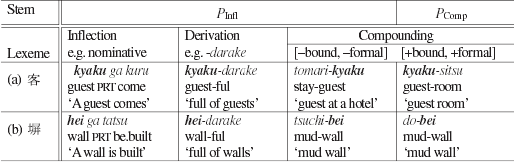
The previous section has shown that the relationship between P Infl/P Adv and P Comp in Tables 3 and 4 is suppletion in lexemes represented by dually pronounced kanji graphs. Crucially for this analysis, other lexemes exhibit regular formal relationships between the stems. Let us start with the nominal paradigm. The data of the nominal lexemes represented by 客 (‘visitor’, SJ: /kyaku/) and 塀 (‘wall’, native: /hei/) given in Table 5 show that the boundness/formality difference can be marked by conversion. The graphs 客 and 塀 are among those that do not exhibit the dual pronunciation (Section 1.1); the former has an SJ reading only, while the latter has a native reading only (Morioka Reference Morioka2004: Chapter 1).Footnote 28 The lexemes represented by these graphs, however, have both P Infl and P Comp, as shown by bold face in Table 5. Notably, the two stem types are formally identical: kyaku in (a) and hei in (b).Footnote 29 Because their compounding partners are either exclusively [–bound] (tomari and tsuchi) or [+bound] (shitsu and do), it is not the case that the lexemes represented by 客 and 塀 lack the distinction between P Infl and P Comp. Rather, the same form is functioning as the P Infl and P Comp of the nominal paradigm. This suggests that the stems in the compounding paradigm are regularly formed by the processes of conversion in (24), which belong to the Feature Value Switches proposed in Beard (Reference Beard1995), as mentioned in Section 2.2.Footnote 30
- (24)
(a) P Comp→P Infl
(b) P Infl →P Comp
Next, in the verbal paradigm, the formation of P Infl/P Adv from P Comp involves overt morphology, just like the Mandarin case discussed in (11a) above. Japanese uses the stems of the light verb suru ‘do’ (P Adv: si, P Infl: su) for this:
(25) P Comp + {si/su}→{P Adv/P Infl}
Paradigm of a noun represented by the kanji with a single pronunciation.

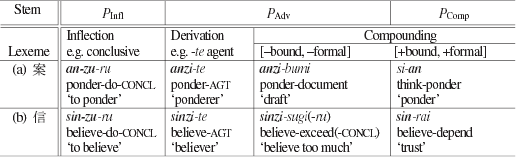
This stem-formation operation underlies the paradigms in Table 6 of the lexemes represented by 案 (‘to ponder’; SJ: /an/) and 信 (‘to believe’; SJ: /sin/), both of which have an SJ reading only (Morioka Reference Morioka2004: Chapter 1). The bold-faced stems in this table attests to the working of (25).Footnote 31
Paradigm of a verb represented by the kanji with a single pronunciation.
2.4 Interim summary
To summarise Section 2, we have shown that Japanese verbs and nouns project an inflectional, derivational, and compounding paradigm in which stems show morphomic distributions. The formal relationship between those stems can be regular, as in (24) and (25), or suppletive. We have claimed that Japanese kanji orthography visualises this lexeme-based morphology; kanji graphs with and without dual pronunciations correspond to the suppletive and regular relatedness between stems, respectively.
It is clear that Maiden's view on the nature of stem allomorphy given in (3a), his stem-as-morphome view in particular, is vital for capturing the dual pronunciation of kanji in theoretical terms. Here, it is worth mentioning Kenji Morioka's morpheme-based approach to this phenomenon (Morioka Reference Morioka1968, Reference Morioka2004). Since the publication of the 1968 paper, Morioka's analysis has been subject to criticism from notional (Miyajima Reference Miyajima1981) and semantic (Suzuki Reference Suzuki and Peng1975a; Nomura Reference Nomura2008: 102–104) viewpoints. In our view, however, the fundamental difficulty in pursuing his approach, which we believe is truly innovative in the long research history of kanji in Japanese linguistics, lies in the theory he chose. Because morpheme-based theories do not admit of the notion of morphomic stem, purely morphological stem alternation, including suppletion, must be reduced to morphosyntactic properties, as Aronoff (Reference Aronoff2012) discusses on the Distributed Morphology perspective on suppletion. We cannot take a morpheme-based approach because such reduction is unfeasible in the dual pronunciation of kanji.
3. The emergence and development of suppletion
This section examines the emergence and development of the suppletion proposed in the previous section. In the discussion, we follow the periodisation of Japanese adopted in Frellesvig (Reference Frellesvig2010: 1–3): Old Japanese 700–800, Early Middle Japanese 800–1200, Late Middle Japanese 1200–1600, and Modern Japanese 1600–present.
3.1 Language contact and lexical borrowing
The diachronically significant feature of the dual pronunciation of kanji is that it arose in an intensive arena of language contact. Japanese has had a very long and close contact with Chinese, the prestige language within the East-Asian Sinitic cultural sphere. According to Schmidt (Reference Schmidt, Haspelmath and Tadmor2009: Section 3.2), ‘[o]ver a period of over 1,600 years, Chinese has exerted an immense influence on Japanese, leading to an influx of a large number of vocabulary items in Japanese’. Of course, Chinese is not the only language that has enriched the vocabulary of Japanese through lexical borrowing, but it is the only language from which the borrowings constitute a separate stratum in the grammar of Modern Japanese. Chinese and non-Chinese borrowings are qualitatively distinguished in Japanese linguistics, where three lexical strata are posited traditionally: the Native Japanese stratum, the Sino-Japanese stratum, and the Non-Chinese Foreign stratum (Shibatani Reference Shibatani1990: Chapter 7; Itô & Mester Reference Itô, Mester and Tsujimura2002; Schmidt Reference Schmidt, Haspelmath and Tadmor2009: Section 4; Irwin Reference Irwin2011: Chapter 1; Labrune Reference Labrune2012: Section 1.6). The choice of the term ‘Sino-Japanese’ rather than ‘Chinese’ in this partition is due to linguists' general agreement that Chinese borrowings are fully integrated into Japanese and to ordinary speakers' intuition that they are not ‘loans’, such as European borrowings (Irwin Reference Irwin2011: 7).
Perhaps the simplest and strongest reason for the qualitative/grammatical difference between Chinese and non-Chinese borrowings lies in their ‘age’ difference, the age of a loanword measured by the time when it was borrowed (Haspelmath & Tadmor Reference Haspelmath, Tadmor, Haspelmath and Tadmor2009a: Section 5.4). Whereas the Non-Chinese Foreign stratum consists of relatively recent loanwords, mostly those borrowed from European languages after the mid-16th century, the history of the SJ stratum is as old as the written history of Japanese (Irwin Reference Irwin2011: Section 1.2). Ignoring the plausible prior existence of the chosen few who had some knowledge of spoken Chinese, it seems safe to assume that Chinese-to-Japanese lexical borrowing began when ‘writing as such, in the form of Chinese Classics, was introduced into Japan early in the fifth century’ (Frellesvig Reference Frellesvig2010: 11). Then, it also seems plausible to view the development of the kanji system as the basis of the development of the SJ lexical stratum.
Concretely, a massive number of Chinese lexemes were brought into Old and Middle Japanese through two complementary modes of interacting with Classical Chinese text (kanbun): (i) kanbun-kundoku and (ii) kanbun-ondoku. The former is a translation mode, in which a Chinese text was rendered into Japanese and vocalised as such. For example, ‘eye’ in a Chinese text was rendered into the Japanese synonym, i.e. me ‘eye’, and pronounced accordingly (Frellesvig Reference Frellesvig2010: 264). In the ondoku mode, on the other hand, a Chinese text was read and vocalised as a foreign language, with , for instance, being pronounced in sounds then considered the proper pronunciation of this Chinese lexeme. This situation could be construed as ancient Japanese people learning Chinese by the combination of two representative second-language learning methods: the Grammar Translation method and the Direct (Oral) method (Bhatia Reference Bhatia and Hogan2011: 843).
In the literature (Martin Reference Martin, Kavanagh and Mattingly1972; Seeley Reference Seeley1991; Morioka Reference Morioka2004: 161; Hayashi Reference Hayashi and Hayashi2005a; Inukai Reference Inukai and Hayashi2005; Oshima Reference Oshima2006: 76–90; Sasahara Reference Sasahara2008; Frellesvig Reference Frellesvig2010: Chapter 9), the dual pronunciation of kanji is unanimously attributed to the fact that Chinese lexemes were borrowed into Japanese in this way, through the medium of Chinese text. However, compared with the philological and socio-linguistic aspects of the kundoku and ondoku practices, the implications and consequences of these practices for the grammar itself have received much less attention. That is, there are a vast number of studies devoted to the questions of when individual kanji graphs acquired their dual pronunciations and what were the exact pronunciations that they exhibited in the acquisition process. Our concern, however, is how practices such as kundoku and ondoku affect grammar.
Highly relevant to this question are Maiden's perspectives in (3b, c). Language contact is potentially detrimental to the fundamental and universal principles of iconicity among lexemes, particularly the principles of lexemic antisynonymy and lexemic antihomophony. In a contact situation, etymologically distinct synonyms can compete with each other, while phonological distinctions between lexemes can be levelled out in the transfer process. When there is such a risk, the straightforward way to avoid synonymy or homophony is to discard all but one of the competitors, that is, potential synonyms or homophones. However, synonymy/homophony avoidance could be achieved by grammar-internal means, particularly by means of morphology, if we follow the perspectives in (3b, c). Below, we discuss the development of the suppletion underlying the dual pronunciation of kanji, in terms of how Old and Middle Japanese coped with the risks of massive synonymy and homophony among native and borrowed lexemes. Section 3.2 analyses the kanji suppletion as a morphological strategy of synonymy avoidance, and Sections 3.3 and 4.1 show that this strategy also serves as a way to avoid lexemic homophony.
3.2 Morphological strategy for synonymy avoidance
Maiden (Reference Maiden1992, Reference Maiden2004, Reference Maiden, Lepschy and Tosi2006) examines the genesis of suppletion as a case of paradigmatic morphology being activated as a strategy to circumvent the violation of the principle of iconicity. Two major methods of synonymy avoidance are simple replacement, one of the competitors ousting the other(s), and semantic differentiation between the competitors (Gilliéron Reference Gilliéron1918). What Maiden reveals in Romance languages, however, is that morphology provides a third way: paradigmatic differentiation. Distinct stems of a lexeme do not compete paradigmatically, occurring in mutually exclusive contexts; hence, if potential synonyms are forced into such a relation, the risk of one lexical meaning being expressed by different forms within the same context can be eliminated. In Maiden's (Reference Maiden2004: 248) words:
But another strategy [of synonymy avoidance] is to accommodate the tension between the semantic identity and the formal distinctness of the rival lexemes by integrating them into a single paradigm, mapping the formal distinction onto recurrent but also perfectly meaningless patterns in the morphological paradigm. In other words, an intraparadigmatic, ‘morphomic’, signatum is uniquely assigned to each rival, so that the competing forms end up in complementary distribution in the paradigm.
Maiden's hypothesis is that lexical suppletion emerges when speakers resort to this strategy to avoid lexical synonymy.Footnote 32
As for the sources of the lexical synonymy that diachronically feeds suppletion, Maiden identifies two cases in his survey of verbal suppletions in Romance languages: (i) when a linguistic system borrows lexemes from a system outside in a contact situation, and (ii) when lexemes are in a hyponymy–hyperonymy relationship, where the semantic distinction is inherently tenuous. Case (i) is of direct relevance to the kanji suppletion; its genesis can be attributed to the long-standing and intense contact between Japanese and Chinese. Case (ii) is relevant to the situation where the native and SJ synonyms were originally in the hyperonym–hyponym relation.
In the previous section, we saw that ancient Japanese people learned Chinese both in the translation mode (kundoku) and the oral mode (ondoku). Thus, each borrowed Chinese lexeme (e.g. san (山)) was systematically matched up with its Japanese synonym (e.g. yama) and the correspondences between the synonyms were consciously perceived by the learners. Our claim is that the paradigmatic distribution of the forms san and yama as stems of the same lexeme, which we saw in (12)–(15) above, developed as a way to observe the principle of lexemic antisynonymy. In this case, forcing san and yama into a suppletive relationship may be the only strategy to circumvent their synonymy because neither of these rivals can be discarded; the levelling strategy is unnatural when the language contact is a part of active language learning.
Maiden's Case (ii) indicates that substantial semantic overlap between rival forms is enough to disturb the synonymy-avoiding human mind. Perfect synonymy between lexemes is extremely rare, not only in one language, but also across languages, but exogenous words that strike speakers as semantically similar to their indigenous words are subject to synonymy-avoiding strategies. Briefly, the recognition of perfect synonymy is not a necessary condition for avoiding synonymy.Footnote 33
Of particular relevance here is that the semantic ‘grain-size’ of a particular lexical category often differs cross-linguistically. To use the term of lexical semantics, lexemes from different languages exhibit different lexicalisation patterns (Talmy Reference Talmy and Shopen2007). In this respect, Suzuki (Reference Suzuki1963, Reference Suzuki1975b, Reference Suzuki1977, Reference Suzuki1990) makes a significant observation that native Japanese lexemes characteristically exhibit very ‘rough and crude’ lexicalisation patterns, expressing fine-grained semantic distinctions syntactically. To cite one of Suzuki's (Reference Suzuki1963: 44) telling examples, the Japanese native verb naku is semantically so wide or sparse (Aronoff Reference Aronoff1980) as to allow the expression of sound emission by almost any type of living thing, semantic information that English lexically encodes (or ‘lexicalises’) in the verb itself, as shown below:
(26) The Japanese verb naku can be used for sound emission by:
man (weep, cry), bird (sing, chirp, twitter, call), owl (hoot), swan and goose (honk), snipe and plover (pipe, peep), pigeon (coo), crow (caw), duck (quack), cock (crow), dog (bark), cat (mew), cow (moo), horse (neigh), donkey and ass (bray), sheep (bleat, baa), pig (squeak), deer (call), locust and cricket (chirrup), cicada (sing), frog (croak), etc.
Naku expresses information on sound emitters and the specifics of their sounds via its subject and adverb, respectively. Japanese and English show a similar contrast in the ‘looking’ verb:
(27) The Japanese verb miru can be used for various eye-involving activities:
see, look, watch, observe, stare, gaze, glance, witness, examine, consult (a dictionary), judge, regard, take care of, look after, etc.
In this case, the English verbs lexicalise the manner of looking, which the semantically sparse miru distinguishes via the selection of the object or adverb.
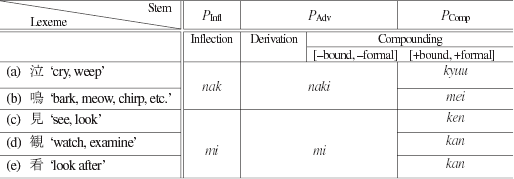
The translation data in (26) and (27) indicate that the semantic sparseness of native Japanese vocabulary can yield one-to-many lexical mappings between this and target languages. In fact, that is exactly what happened when Chinese lexemes were borrowed into Japanese. Despite the grain-size differences, the native verb naku was perceived to semantically rival (at least) two Chinese lexemes, kyuu (泣) denoting sound emission by human beings and mei (鳴) by non-human animals, while the verb miru was matched with (at least) three Chinese ‘looking’ verbs ken (見) ‘look, see’, kan (観) ‘watch, examine’, and kan (看) ‘look after, watch over, regard’. Then, the ‘synonymous’ pairings thus formed were each mapped to the relationship between P Infl/P Adv and P Comp in the verbal paradigm. As a result, we have suppletive paradigms which share the same P Infl/P Adv, such as the paradigms in (a) and (b) and those in (c)–(e) in Table 7.
Lexeme pairs that share the same P Infl/P Adv.
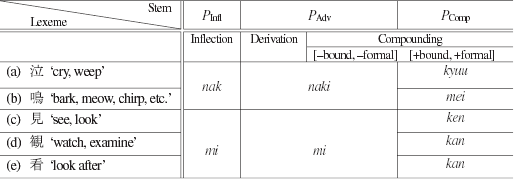
The crucial effect of this suppletive coalescence is what may be called the hyponymisation of native vocabulary. The coalescence with rival Chinese synonyms within the paradigm ‘degrades’ native lexemes into the status of stems, as a lexeme is (at least phonologically) defined by the set of stems (Beard Reference Beard1995: 46).Footnote 34Nak(u) and mi(ru), for instance, are now elements of the sets {P Infl, P Adv, P Comp}, which define the lexemes in the leftmost column (a)–(e) of Table 7. Thus, (a) {nak, naki, kyuu} and (b) {nak, naki, mei} represent different lexemes, which semantically inherit the finer lexicalisation patterns of the original Chinese lexemes kyuu ‘sound emission by human beings’ and mei ‘sound emission by non-human beings’. Notice that taking a synonymy-avoidance strategy means that ancient Japanese people practicing kundoku and ondoku were most likely unable to fully appreciate the lexical semantic distinctions absent from their native language; however, it is possible that it was the emergence of the formal distinction at the stem-set level that drove the hyponymisation of the originally sparse semantics of their vocabulary.
As for the empirical evidence for the development of the paradigms in Table 7 and the concomitant semantic hyponymisation of native vocabulary, let us note that it is not easy for contemporary Japanese speakers to notice that (i) naku alternating with kyuu and (ii) naku alternating with mei are historically the same lexeme (Suzuki Reference Suzuki1963: 52–57; Sampson Reference Sampson1985: 187–189). For ordinary Japanese speakers, the relationship between the two naku strongly ‘feels’ like one of homophony rather than polysemy. This observation indicates that an etymologically monolithic native lexeme with sparse semantics was decomposed into different lexemes through the matching with its Chinese hyponyms and that the resulting suppletive paradigms are now fully established in the grammar of the Modern Japanese lexicon.
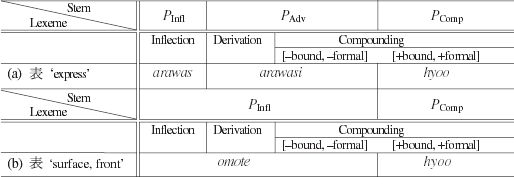
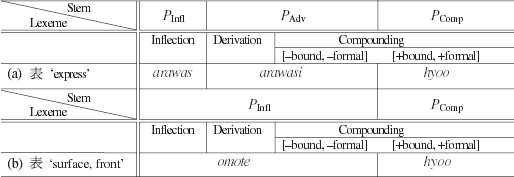
We have discussed cases of one-to-one and one-to-many semantic matchings between native and borrowed lexemes. Due to the sparse semantics of the native Japanese vocabulary, there are much fewer instances of many-to-one matchings. However, the two paradigms in Table 8, which share the same P Comp, are a case in point. These paradigms show that the borrowed polysemous lexeme hyoo (表) semantically rivaled (at least) two native lexemes, the noun omote ‘surface, front’ and the verb arawas(-u) ‘express (bring to the surface)’.
Lexeme pairs that share the same P Comp.
Finally, not all lexemes find semantic rivals in language contact, as lexemes are basically language-specific entities (Aronoff Reference Aronoff2007). When borrowed lexemes are difficult to translate into native lexemes, suppletion cannot occur. Instead, they give rise to non-suppletive paradigms such as those in Tables 5 and 6 above, via stem-forming operations such as those in (24) and (25) above.
3.3 Homophony avoidance
Let us now return to Table 1. The foregoing discussion has clarified how the one-to-many mapping between the native and SJ readings of the graphs in (a)–(c) of this table developed historically. The next subject is the many-to-one mapping between the native and SJ readings of the graphs in Table 1 (c)–(j). One might think that this type is based on paradigms such as in Table 8 above, which illustrates shared P Comp. However, there is a clear difference between the two cases: the many-to-one mapping underlying Table 8 developed as a result of the polysemy of the borrowed lexeme, while the many-to-one mapping in Table 1 (c)–(j) results from the homophony of the borrowed lexemes. The lexemes represented by the graphs in Table 1 (c)–(j) express meanings completely different from one another, unlike the two lexemes (a) and (b) of Table 8.
As mentioned in Section 3.1, language contact potentially increases the number of homophonous as well as synonymous pairs of lexemes in a language because the donor language's phonological distinctions are often levelled in the recipient language. According to Winford (Reference Winford and Hickey2010: 175–176), the borrowing of phonological elements, which might result in the introduction of new phonemes or new syllable patterns in the recipient language, is extremely rare.
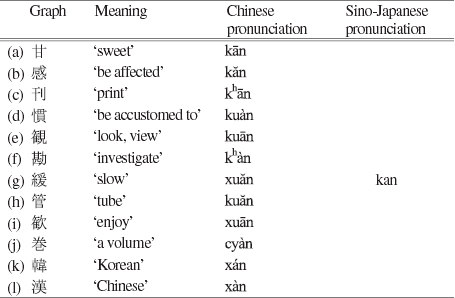
In the lexical borrowing from Chinese to Japanese, the homophonisation that borrowed Chinese lexemes underwent in Japanese was inevitable due to the fundamental difference between the phonological systems of the two languages (Sampson Reference Sampson1985: 173–182; Suzuki Reference Suzuki1990: 166–175; Takashima Reference Takashima2001: Chapter 1).Footnote 35 To use the instances at hand, the Chinese lexemes written with the graphs in Table 1 (c)–(j) were not homophonous in the donor language; their original phonological distinctions were nullified in the recipient language, which makes phonological distinctions quite differently from the donor. This is clearly illustrated by Table 9 above, Sampson's (Reference Sampson1985: 178) comparison of the Chinese and SJ pronunciations of the same graph. The graphs in this table are pronounced differently in Chinese, but the various syllabic phonological contrasts are lost in Japanese, where they all have the same SJ reading /kan/. This table does not exhaust the range of kanji that exhibit this homophony, as indicated by the graphs (a) and (b) in Table 1.Footnote 36
A sample of lexemes whose P Comp stems show fortuitous homophony.

We do not discuss the details of this homophonisation process or the questions of what types of phonological distinctions in ancient Chinese were levelled to what extent due to what types of phonological properties of Old and Middle Japanese. For these questions, we would like to refer readers to Sampson (Reference Sampson1985: Chapter 9), Takashima (Reference Takashima2001: Chapter 1), Ogura, Numamoto & Hizume (Reference Ogura, Numamoto, Hizume and Hayashi2005), Oshima (Reference Oshima2006: 170–197), Yuzawa (Reference Yuzawa, Maeda and Nomura2006), Irwin (Reference Irwin2009), and Frellesvig (Reference Frellesvig2010: Chapter 9). What concerns us are the results of the process: how did the grammar of Old and Middle Japanese address the inevitable massive homophony among Chinese borrowings?
Compared with the principle of lexemic antisynonymy, whose functioning is validated in language acquisition (Clark's Reference Clark1993Principle of Contrast)Footnote 37 and evolution (Carstairs-McCarthy Reference Carstairs-McCarthy2004, Reference Carstairs-McCarthy2010, Reference Carstairs-McCarthy, Tallerman and Gibson2012), the principle of lexemic antihomophony seems to be given less credit in the literature, as surveyed in Baerman (Reference Baerman2011: Section 1) and Sampson (Reference Sampson2013: Section 1). Sampson (Reference Sampson2013), for example, argues against the notion of homophony avoidance on the basis of the fact that Chinese tolerated the gradual increase of homophonous lexemes due to the working of certain phonological neutralising alternations. On the other hand, Baerman (Reference Baerman2011) argues for the effects of homophony avoidance as ‘a genuine, if non-deterministic, principle’ (Baerman Reference Baerman2011: 1) by revealing cases of gaps in inflectional paradigms that have to be reduced to homophony avoidance. Kaplan (Reference Kaplan2011), who experimentally shows that neutralising phonological rules in Korean create fewer homophones than expected, is much more positive about the working of this principle in the maintenance of lexical contrast.
The full evaluation of these researchers' findings is beyond our scope, but one thing that we notice is that their discussion focuses on the validity of one of several possible strategies to avoid homophony, namely, the ‘jettison-all-but-one’ remedy (Carstairs-McCarthy Reference Carstairs-McCarthy2010: 79). In the above studies, homophones are or are not avoided depending on the occurrence of expected forms. As in the case of synonymy avoidance, this strategy, the abandonment of one of the potential rivals from the system, is most likely the commonest way of circumventing the collision of homophones. However, given Maiden's insight in (3c), it may not be so far-fetched to assume that homophony can be avoided morphologically.
Let us suppose, following Carstairs-McCarthy's (Reference Carstairs-McCarthy2010: Chapters 3, 4) classification of modes of synonymy avoidance, that morphological strategies to avoid homophony consist of syntagmatic and paradigmatic modes. The notion of syntagmatic homophony avoidance, in fact, has been traditionally invoked in Chinese and Japanese linguistics to account for the strong tendency of Chinese lexemes and their borrowings to occur in morphologically complex forms, particularly compounds (e.g. Sampson Reference Sampson1985: 169–170, 2013: 583–584; Takashima Reference Takashima2001: 38–41). Recall the dvandvas of the co-synonymic type in (10) above and the derivatives by the freeing affix in (11). As discussed, compounding between synonyms and derivation with a semantically empty affix has the function of making bound elements syntactically free, while the traditional view is that these processes function to disambiguate homophonous lexemes syntagmatically. These two views are mutually non-exclusive and provide a new type of evidence for the view in (3c) that there is a seamless link between morphology and the semiotic principle of iconicity.
Thus, it is plausible that paradigmatic morphology can also serve as a means of homophony avoidance. Highly suggestive in this respect is Maiden's (Reference Maiden2004: Section 2.1.7) observation in Romance verbal inflection that the suppletive coalescence of originally distinct lexemes, which is generally driven by the synonymy between the lexemes, can be also facilitated by their chance phonological resemblances; in this case, the semantic resemblance is not necessary for the suppletive coalescence. Although he says nothing about homophony avoidance, its relevance could be taken into consideration given his perspective in (3c). In the next section, we will examine the view that the kanji suppletion functions not only to avoid synonymy between native and borrowed lexemes but also to mitigate the homophony that was inevitably accumulated on borrowed lexemes. Our claim is that the pairing of suppletive stems clearly disambiguates potential homophony.
To briefly summarise Section 3, we have shown that Old and Middle Japanese addressed the potential semantic collision with Chinese borrowings by mapping the synonymous native–Chinese pair to the stem distribution of a single paradigm. The SJ lexical stratum is now fully integrated into the grammar of Modern Japanese in the sense that its entries constitute the same lexical paradigm with the entries of the native lexical stratum.
4. Functions of the suppletion
The kanji suppletion has been retained through the very long history of Japanese. In this section, we consider what advantages this mechanism confers on the Japanese grammar, advantages that make the long retention of suppletion possible.
4.1 Maintenance of lexemic isomorphism
Section 3.2 has shown that the kanji suppletion functions as a morphological way to attend to the principle of lexemic antisynonymy. We claimed that this function is what led to the emergence of this morphological pattern in Japanese in the first place.
As suggested in Section 3.3, the kanji suppletion serves also as a morphological means of homophony avoidance, as least in Modern Japanese. The key to this view is the very definition of a lexeme in lexeme-based morphology; a lexeme is defined as a set of stems (Section 3.2). Under this definition, lexemes are homophonous if they possess the same set of stems. Thus, the massive homophony on the side of the SJ lexical stratum does not count as lexemic homophony if it is dissolved via the paradigmatic pairing with the native lexical stratum. A crucial empirical observation in this respect is that Modern Japanese has a number of kanji graphs that share the same SJ reading but very few of those that share the same pairing of SJ and native readings. If a lexeme is defined by the set of stems, this observation means that the kanji suppletion contributes to avoiding the phonological collision among the borrowings.
For example, the kanji graphs in Table 1 (c)–(j) share the same SJ reading /ken/, but their native readings show no overlapping; they are clearly distinguished from one another by their native readings. Although the kanji graphs in Table 1 (a) and (b) share not only the SJ reading but also the native reading, this is a rare exception.Footnote 38 Similarly, the twelve graphs in Table 9 share the same SJ reading /kan/, but no pair among them exhibits the same native reading. Note that the graphs (b) and (c) do not have a native reading, exhibiting the paradigm of the type in Table 6, so their /kan/ readings cannot be disambiguated from each other. However, this is not a counterexample to our present claim, which concerns kanji graphs that exhibit dual pronunciation. We are arguing for the function of kanji suppletion as a homophony-avoidance strategy; hence, kanji graphs representing a non-suppletive (i.e. regular) paradigm (such as Table 6) are outside the domain of our claim.
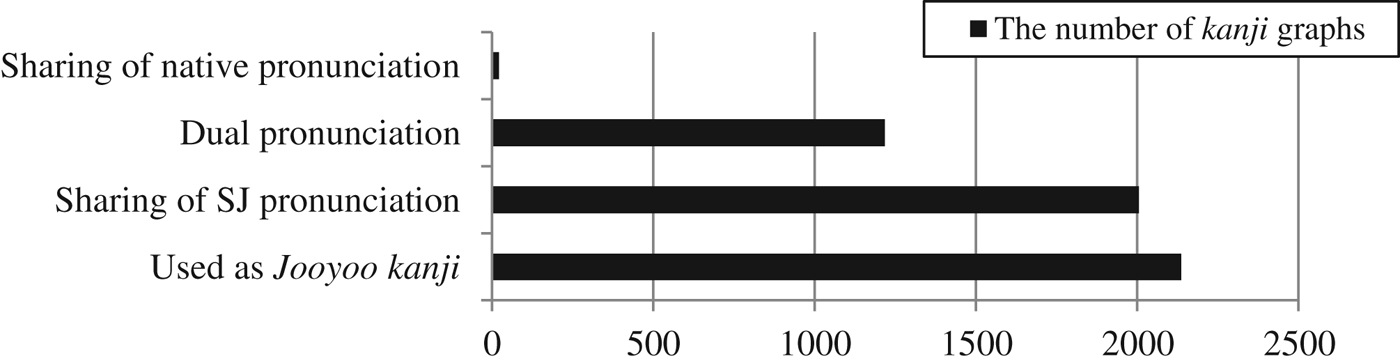
As more comprehensive data, we have examined all 2,136 kanji graphs in the Jooyoo kanji (‘kanji for daily use’) catalogue revised in 2010 by the Japan Agency for Cultural Affairs.Footnote 39 In this data set, we measured the extent to which the suppletion contributes to the disambiguation of the kanji graphs with the same SJ reading (or the lexemes with the same P Comp). Figure 1 schematically presents the results of this examination. Of the 2,136 Jooyoo kanji graphs, 2,005 (approximately 94%) exhibit the fortuitous sharing (or ‘chance homophony’) of the same SJ reading among themselves. The smallest or narrowest homophony is exhibited by pairings of two kanji graphs, as in (28a) below, but the larger or wider one is exhibited by groups of many kanji graphs (with the largest by the group of 63 graphs, ten of which are cited in (28b)).
- (28)
(a) /kitsu/ shared by 喫 and 詰, /zetsu/ shared by 絶 and 舌
(b) /koo/ shared by 口, 工, 公, 巧, 広, 交, 光, 向, 好, 考, and 53 other graphs
Homophony among Jooyoo kanji graphs.
Of these 2,005 graphs, 1,218 (approximately 61%) exhibit dual pronunciation. In this set, we have found only 11 pairs of graphs (22 graphs, approximately 2%) that possess the same native reading. That is, of all the Jooyoo kanji, only the following 11 pairs exhibit the same combination of native and SJ readings:
(29) 映 – 栄 華 – 花 窮 – 究 形 – 型 指 – 刺 収 – 修
振 – 震 仲 – 中 張 – 貼 鎮 – 沈 返 – 変
The above examination of the new Jooyoo kanji catalogue empirically confirms two characteristics of the kanji suppletion. First, the fact that approximately 94% of the data set show the fortuitous sharing of P Comp confirms that the phonological variation of this stem type is rather limited. The SJ stems do not make fully fledged phonological contrasts, such as those possible in ancient Chinese, with their syllable structure and the phonotactics therein highly constrained (Labrune Reference Labrune2012: Section 1.6.2). The wide SJ homophony illustrated in (28b) above strongly suggests that the SJ stems are empty morphs (Aronoff Reference Aronoff1994: Section 2.5) in Modern Japanese, corresponding to no specific lexical meaning. A similar claim is made by Takashima (Reference Takashima2001: 242–243), who says that each SJ reading corresponds to such wide and diversified lexical meanings as to be regarded as possessing virtually no semantic specifications. Compare the sharing of the SJ stem that we are discussing with the sharing of the native stem discussed in Section 3.2 (e.g. Table 7). The former is a fortuitous sound sharing, but the latter is the hyponymisation of the originally singular, semantically sparse lexeme. When these two sides are matched through suppletion, the SJ stem functions as an indicator of the hyponymised meaning of the native stem.
Second, the suppletion itself is shown to have the function of compensating for the tenuous phonological contrasts of the SJ stems. This type of stem cannot mark a lexical distinction alone, but their pairing with the native stem can. If a lexeme is the set of stems, the phonological indistinctiveness does not matter for the principle of antilexemic homophony as long as it is disambiguated by the pairing with the native stem. It has been revealed that 98% of the dually pronounced kanji graphs with potential homophony resort to this strategy for circumventing homophony on the lexeme level.
The hypothesis defended in this section, namely, the ‘suppletion against homophony’ view, is very natural in the sense that suppletion and homophony are semiotically opposite form–meaning matching patterns, suppletion being the many-to-one matching and homophony the one-to-many matching. Our results in this section can be understood as a case of two opposing antisemiotic forces cancelling each other out for the maintenance of lexemic isomorphism.
4.2 Lexical stock expansion
The kanji suppletion is beneficial for the grammar of Modern Japanese not only as a means to maintain lexemic isomorphism but also as a way to expand its lexical stock. Lexical stock expansion, or labelling a concept to add a new lexeme into the lexicon, is one of the main functions of word formation (Kastovsky Reference Kastovsky1986), which prototypically employs syntagmatic morphological processes such as affixation (e.g. make > remake, maker), compounding (e.g. apple + tree > apple tree), or shortening (e.g. burglar > burgle).Footnote 40 Modern Japanese also uses these processes to produce new lexemes synchronically. What is special about this language is that diachronically it has expanded its lexicon by means of suppletion. That is, the development of the kanji suppletion had an effect of the creation of new lexemes. This effect has been suggested in Section 3.2, but it is worth a closer examination as an additional function of the suppletion.
We have seen that the kanji suppletion is based on the paradigmatic coalescence of the semantically sparse native lexemes and the phonologically indistinctive borrowed lexemes. This type of suppletion is profitable because the matching between these two at the stem level increases the number of a lexeme very efficiently. To see this, let us compare the following three schematically represented patterns of suppletion, in which the capital and small letters stand for tokens of different stem types P 1 and P 2 and the leftmost column L 1–L x represents lexeme distinction:
(30)
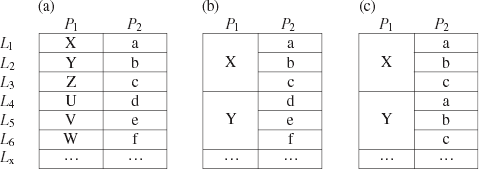
In the pattern in (30a), each stem type, P 1 and P 2, is realised by completely different sound forms across lexemes. The patterns in (30b) and (30c), on the other hand, show a type of syncretism (understood broadly) between lexemes in one or both stem types. In (30b), the P 1 of L 1–L 3 and that of L 4–L 6 are each realised by the same sound form, while (30c) exhibits the same realisation of P 1 and shows the sharing of the P 2 form in the pairs L 1/L 4, L 2/L 5, and L 3/L 6.
Most likely, the majority of attested cases of suppletion belong to the pattern in (30a), in which the lexemic distinction corresponds to the phonetic distinction of a single stem type. Take, for example, suppletion cases attested in European languages, the suppletion involving combining forms (Section 2.3 above) and the suppletion involving collateral adjectives (Koshiishi Reference Koshiishi2011):
(31)
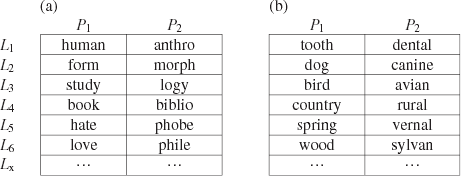
The P 2 of the suppletion in (31a) is employed when the lexeme occurs in neoclassical compounds such as (21a), while the P 2 in (31b) is used when the lexeme undergoes the derivation of relational adjectives (e.g. dentaldecay, caninetooth, ruralpoliceman; see Giegerich Reference Giegerich, Lieber and Štekauer2009). In both (31a) and (31b), neither of the two stem types shows formal overlap, so we can say that the lexeme distinction is expressed doubly, so to speak, via the formal distinctions of P 1 and P 2. Given that a lexeme is defined as the set of stems, the lexemes L 1–L 6 in (31a, b) are distinguished from one another in both stems in {P 1, P 2}. Crucially, the pairing of stems itself is not significant for making a lexemic articulation; P 1 and P 2 each make the distinction. In this sense, this type of suppletion is simply a reduplication of the pre-existing lexemic distinction and, thus, is not profitable as a way of lexical stock expansion.
Comparatively, the suppletion of the patterns in (30b) and (30c) is profitable in that the pairing of stems itself makes a difference in the lexemic articulation. Specifically, in (30b), the pairing is profitable for the stem type P 1, which alone makes a two-way phonological distinction and cannot distinguish among the lexemes L 1–L 3 or L 4–L 6. The six-way distinction is made possible by this stem type entering the same paradigm as the phonologically more informative stem type P 2. Without suppletion, X and Y, two tokens of P 1, would each count as a stem of one polysemous lexeme.
The pattern in (30c) is even more profitable than (30b) because the pairing is significant not only for the syncretism of P 1 but also for the syncretism of P 2. In (30c), P 1 makes a two-way phonological distinction, and P 2 makes a three-way distinction, but the combination between the two makes a six-way phonological distinction. Pattern (30c) makes a finer-grained lexemic articulation more efficiently than (30b) because, given the combinatorial logic, X and Y need not be matched with distinct sets of three P 2 tokens ({a, b, c} and {d, e, f}) to yield the six lexemes. As in (30c), one set of three P 2 tokens is enough to yield these results.
The kanji suppletion belongs to the type (30c). If the P 1 syncretism in (30c) represents the sparse semantics of the native lexemes, then the P 2 syncretism is the phonological indistinctiveness of the Chinese borrowings. Therefore, it is legitimate to conclude that Japanese has efficiently increased its lexemes by combining two relatively small sets of sound forms.
Now, we can go back to Suzuki's (Reference Suzuki1975b) data in (2) above. The foregoing discussion suggests that this type of compounding is based on the long-established function of the kanji suppletion as a lexical-stock expansion process. One or both bold-faced SJ elements in the homophonous compounds in (2a–c) possess a native counterpart; this pairing distinguishes the lexemes represented by the kanji graphs. At first sight, the production of compounds such as (2a–c) seems to increase ambiguity in the lexicon, but the truth is that it makes a finer distinction. This is why an apparently blurring compounding like (2) is productive in word formation.
In summary, Section 4 has clarified that the kanji suppletion fulfils (at least) two functions in Modern Japanese: the maintenance of lexemic isomorphism and the lexical stock expansion. Its emergence driven by the principle of lexemic antisynonymy, the kanji suppletion now plays an important role in not allowing lexemes to deviate from this principle or from the principle of lexemic antihomophony. Additionally, as a result of the matching between a semantically sparse data set and a phonologically indistinctive data set, the kanji suppletion has had a welcome effect of expanding the number of lexemes very efficiently. In our view, it is these advantages that have enabled the very long retention of the kanji suppletion in the history of Japanese.
5. Concluding remarks
Citing Edward Sapir, Osahito Miyaoka, a typologist and a specialist in the Inuit language, stresses that morphology is the field of cross-linguistic diversity and that morphological systems of different languages cannot be fruitfully reduced to the same set of primitives, and hence, each should be carefully studied on its own (Miyaoka Reference Miyaoka2002: Sections 2.4, 7.3). A similar recognition can be found in generative linguistics, in which language-specific properties or idiosyncrasies are often ascribed to the lexicon (e.g. Fukui Reference Fukui1986). This character of morphology, the locus of each language's own idiosyncrasies, can be adequately captured by the framework of lexeme-based morphology, particularly by its notion of lexeme as the atom of language (Aronoff Reference Aronoff2007). The morphomic stems of lexemes regulate the mapping between form and meaning in a way peculiar to the language in question, thus working as local rules or local systematicity (Maiden Reference Maiden, Booij and van Marle2005). What is especially interesting here is Maiden's insight that such local rules do not conflict with the predisposition of human languages to the lexemic isomorphism; rather, the locality responds to the universality in a ‘local’ manner.
In Section 1, we put forth a hypothesis that the peculiarity of Japanese orthography, the kanji system in particular, is a reflection of the peculiarity of Japanese morphology. Sections 2–4 substantiated this hypothesis by showing how the apparent awkwardness of Japanese orthography can be explained in lexeme-based morphological terms and how the kanji system responds to the universal semiotic principles in its own manner. Specifically, we put forth the following scenario: The dual pronunciation of kanji is based on the mechanism of suppletion. This mechanism emerged and developed as a reaction to the extensive lexical borrowing from Chinese. The suppletive mechanism thus emerged has been retained in the grammar of Japanese as a strategy to maintain lexemic isomorphism and as an efficient tool to expand its lexicon.
Although we could not go into detail, our hypothesis can also account for why Japanese orthography is so difficult for second-language learners. As a local set of rules, morphology has different significance for native and non-native speakers. Local rules are indispensable for insiders of the group, but often make no sense to outsiders. In contrast to the ‘unconscious’ learning by native speakers,Footnote 41 great concentration is required of second-language learners to master such type of knowledge of their target language.
Lastly, an anonymous referee has posed a fundamental question on the status of orthography in a grammar: to what extent does the lexeme-based suppletion analysis proposed in this paper depend on the orthography? Kanji graphs provide visual markers of the underlying sameness of distinct surface forms. Without this visual marking, for example, in the case of illiteracy, would it be possible for native speakers of Japanese to detect and establish the suppletive relationship between native and SJ synonyms purely on distributional grounds? Unfortunately, we cannot respond to this question directly because the acquisition and development of the kanji suppletion in one native speaker are outside the scope of this study. Instead, we attempt an indirect response, although we admit that it is still speculative.
The role of the kanji orthography in individual speakers' recognition of the hidden lexical relatedness has been strongly argued for by Suzuki (Reference Suzuki1963, Reference Suzuki and Peng1975a, Reference Suzukib, Reference Suzuki1977, Reference Suzuki1990) and Takashima (Reference Takashima2001). In fact, they suggest that the visual aid of kanji is a necessary condition for acquiring command of this lexical knowledge. True, it would be indisputable that the existence of the visual marker of the sameness helps the acquisition, given that ‘two fundamental functions of writing are memory support and communication’ (Coulmas Reference Coulmas and Hogan2011: 36). However, our discussion casts some doubt on the status of kanji orthography as a necessary condition for the acquisition. Recall the suppletive paradigms in English in (31a, b). In these cases, there is no visual aid, but native English speakers can learn the underlying lexeme-level sameness of the paired forms. Similarly, non-Chinese borrowings in the Foreign lexical stratum (Section 3.1) are written differently from their native or SJ synonyms (e.g. the English borrowing  ‘off’ vs. the native synonym やすみ), but there is room to entertain a parallel suppletion analysis between the synonymous pairs.Footnote 42 As long as these suppletive relationships are learnable by native speakers, the same degree of orthography-independent learnability should be conferred on the relationship between native and SJ synonyms.
Furthermore, Section 4 has shown that the kanji suppletion serves its own function in the grammar of Japanese. For example, the comparison among the three suppletive patterns in (30a–c) revealed that the kanji suppletion is profitable as a way to expand the lexical stock and that it does so very efficiently. This characteristic is not shared by the English suppletive patterns in (31a, b), which means that the kanji suppletion constitutes a much more vital part of grammar than, for example, the English counterparts. Therefore, we would like to conclude by suggesting that whereas the diachronic development process of the suppletion relies on the existence of the kanji orthography, the output suppletive relationships can be learned as part of the grammatical knowledge of Modern Japanese by native speakers, independently of the orthography.
 ) and in native compounds (e.g.
 ).