Introduction
The provision of competent care for patients with dementia remains a challenge for medical professionals internationally, both in hospital and in the community (Doyle, Reference Doyle2009; Pachana, Reference Pachana2010). There is current concern in the UK and elsewhere that “non-specialist” medical professionals (those working in subspecialties other than those specifically dedicated to dementia care) may not possess the knowledge, attitudes or skills to provide adequate care for patients with dementia (Department of Health, 2009; Rampitage et al., Reference Rampitage, Dunt, Doyle, Day and van Dort2009; Tsolaki et al., Reference Tsolaki2010). Doctors themselves appear to recognize this: a survey of more than 500 hospital and community physicians in the USA identified better understanding of dementia as the most commonly identified learning need in geriatric medicine (Robinson et al., Reference Robinson, Barry, Resnick, Bergen and Stratos2001) whilst surveys of general practioners (GPs) working in the UK, Ireland and Australia have highlighted a number of unmet learning needs with regard to dementia (Turner et al., Reference Turner2004; Cahill, et al. Reference Cahill, Clark, O'Connell, Lawlor, Coen and Walsh2008; Beer et al., Reference Beer2009). The changing epidemiology of the aging population means that the majority of doctors, in a range of “non-specialist” roles, are likely to spend more time caring for patients with dementia (Alzheimer's Disease International, 2009). It is therefore crucial that a robust foundation for education on dementia be established for medical students within the undergraduate curriculum before being carried through and translated into competent care in the postgraduate training environment. Moreover, it is essential that early clinical experience is complemented by clear learning outcomes relevant to the knowledge, skills and attitudes needed to care for patients with dementia
The variation in learning outcomes and the curricular models currently used by medical schools means that teaching on geriatrics, and specifically on dementia, is delivered very differently across the UK (Gordon et al., Reference Gordon, Blundell, Gladman and Masud2010) and Europe (Hasselbalch et al., Reference Hasselbalch2007; Tsolaki et al., Reference Tsolaki2010). A recent survey of UK medical schools showed that education about dementia varied greatly in terms of time dedicated to teaching, and which medical professionals were involved in delivering teaching (Tullo et al., Reference Tullo, Gordon, Blundell, Masud and Gladman2010a). Clearly, medical schools should retain some freedom in how they deliver teaching, but the existing lack of consistency risks the student experience of undergraduate teaching on dementia remaining patchy and disjointed. All graduating medical students in the UK and other developed countries with an aging population are likely to encounter patients with dementia on a regular basis. In the UK “old-age psychiatry” is the field considered responsible for “specialist” care of patients with dementia, although elsewhere this role may be fulfilled by other medical professionals such as neurologists or geriatricians (Hasselbalch et al., Reference Hasselbalch2007). However, professionals in the more general subspecialties of medicine, surgery and general practice should also be capable of caring for patients with dementia. Thus, postgraduate curricula used by doctors in these non-specialist roles must refer specifically to dementia as an important condition to understand. It is unclear whether the current non-specialist curricula contain sufficient guidance to help medical professionals to acquire the ability to care for patients with dementia that has hitherto been identified as lacking.
The purpose of this review is to draw together existing recommendations for UK undergraduate and postgraduate medical education on dementia, examine the international evidence base for successful teaching interventions on dementia, and suggest future directions for improving undergraduate education on dementia as a foundation for improving care for people with dementia in the UK and elsewhere.
Methods
A literature search of databases (PubMed, ERIC, EMBASE) was conducted using the MesH terms Education, Medical and Dementia or the closest possible set of terms within each database to identify relevant articles. Further relevant papers were obtained by manual searches, internet searches and from the references contained in studies from the database searches. Abstracts were reviewed to select the papers with the most relevant content for this narrative review.
Results
Current UK national recommendations
The 2009 Department of Health Report Living Well with Dementia made a number of recommendations for improving the education of medical professionals looking after patients with dementia and their carers (Department of Health, 2009). These are based on the identification of a lack of skills amongst non-specialists, particularly in the general hospital environment, in conjunction with the high proportion of inpatients who have some degree of cognitive impairment. The document refers specifically to both undergraduate education and continuing professional development, suggesting that dementia-specific modules should be available throughout training for all doctors working with patients with dementia. Although not specifically citing medical education, the 2007 document Dementia: A NICE-SCIE Guideline on Supporting People with Dementia and their Carers in Health and Social Care similarly recommends ongoing targeted multidisciplinary education for all healthcare professionals to reinforce effective care for patients with dementia including appropriate communication skills (National Collaborating Council for Mental Health, 2007). In terms of educational research, the 2009 Department of Health document Report from the Ministerial Summit on Dementia Research identified inadequate education for non-specialist healthcare professionals as a research barrier and proposed that research culture should move forward from the current focus on dementia diagnosis to include better care of patients in the hospital and care-home environment (Department of Health and the Medical Research Council, 2009). More explicitly, the Nuffield Council on Bioethics (2009) highlighted the need for better access to dementia-specific education for those caring for patients with dementia, and for further research into the most effective teaching methods.
With regard to the practicalities of delivering education on dementia, none of the three policy documents listed above commented on what proportion of undergraduate or postgraduate teaching time should be devoted to education on dementia, which methods of teaching were preferable, or details of who should deliver the teaching to trainees. However, one important theme emerging from NICE-SCIE and the Report from the Ministerial Summit was the potential benefit of involving patients and carers in research and teaching. NICE-SCIE highlighted qualitative evidence that involving informal carers in professional education can contribute to successful staff training on dementia, although currently there is no evidence as to the effect of involving patients with dementia in teaching for professionals.
Review of UK undergraduate curricula
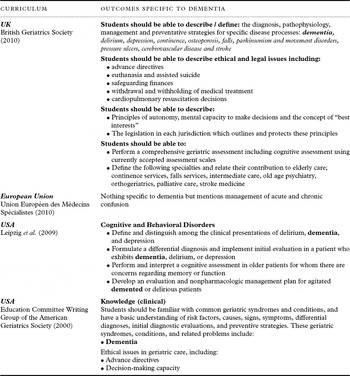
Although there is no nationally mandated undergraduate curriculum concerning geriatric medicine in the UK, a number of international organizations have produced curricula that make specific recommendations for undergraduate learning outcomes on dementia (Table 1). Although the majority of UK medical schools appear to devote some time to dementia-specific teaching (Tullo et al., Reference Tullo, Spencer and Allan2010a), it remains unclear how locally set content and learning outcomes relate to these national and international curricula. Moreover, there is variation in who delivers teaching on dementia in the UK – this seems to be largely carried out by clinicians specializing in geriatrics, old age psychiatry and neurology, with some medical schools also involving allied health professionals such as pharmacists and specialist nurses. It remains unclear how effective each of these professional groups is in terms of delivering teaching to students.
Dementia-specific learning outcomes from international undergraduate geriatrics curricula

The literature review also identified other topics pertinent to the care of patients with dementia that may be appropriate to include in an undergraduate medical curriculum. Given that care of patients living with dementia raises an abundance of ethical issues (Nuffield Council on Bioethics, 2009), curricula outlining medical ethics and law are highly relevant (Stirrat et al., Reference Stirrat, Johnston, Gillon and Boyd2010). Any undergraduate teaching program aiming to equip students to care competently for patients with dementia cannot afford to omit teaching on issues such as assessment of capacity, best-interest decision-making and end-of-life care. Although clinicians are likely to be able to make a substantive contribution to medical ethics teaching and the application to care of patients with dementia, it may be that other educators such as lawyers and ethicists also need to be involved to achieve breadth of understanding. Additionally, recent scholarship on dementia has highlighted other important holistic concepts that should be considered for inclusion in curricular outcomes on dementia; examples include alternative models of dementia care, and the importance of personhood, quality of life and communication with patients with dementia (Kitwood and Bredin, Reference Kitwood and Bredin1992; Murray and Boyd, Reference Murray and Boyd2009; Young and Manthorpe, Reference Young and Manthorp2009).
Review of UK postgraduate curricula
The current UK Foundation Programme Curriculum (2010), covering the first two years of postgraduate training, does not specifically highlight dementia as a concept, but does include a number of essential competencies that may be relevant to care of patients with dementia including knowledge of the assessment and management of patients with acute and chronic “confusion”, and the ability to identify vulnerable adults. However, specific conditions such as dementia and delirium are not included. Sections of the UKFPC concentrating on ethics and law also have particular relevance to dementia; foundation trainees are expected to understand the underlying principles of mental capacity law, and to be able to discuss the implications of a “living will” or advance directive.
As expected, the curricula guiding core medical training (CMT) and acute care common stem (ACCS) trainees in the UK (usually in years 3 and 4 of postgraduate training in internal medicine and emergency care) make detailed reference to more advanced skills required to care for patients with “cognitive impairment”, and specifically with dementia (Joint Royal Colleges Postgraduate Training Board, 2009). CMT and ACCS trainees are required to be able to assess patients with progressive memory loss in order to initiate appropriate investigation of suspected dementia and draw together a differential diagnosis. Moreover, the curriculum demands that trainees should be able to recognize situations in which a formal assessment of capacity may need to be made, respond sensitively to patients with cognitive impairment and their carers, and to involve multidisciplinary team members in the care of patients with dementia.
The extensive curriculum for general practice trainees (usually in years 3–5 of postgraduate training) also makes specific reference to dementia (Royal College of General Practitioners, 2007). GP trainees are expected to acquire knowledge of the assessment and management of patients with dementia in the community, and to be able to advise on accessing local integrated mental health services in order to support patients and their carers.
Surprisingly, the Core Surgical Training Syllabus used by surgical trainees (postgraduate years 3–4) makes no specific reference to cognitive impairment or dementia (Intercollegiate Surgical Curriculum Programme, 2010a), although the Professional Skills and Leadership Syllabus highlights generic communication skills and ability to recognize incapacity that are clearly relevant to care of patients with dementia (Intercollegiate Surgical Curriculum Programme, 2010b).
The delivery of teaching on dementia: existing interventions for medical students
Although there is evidence that undergraduate teaching interventions in geriatrics in general can improve the knowledge, skills and attitudes of medical students (Tullo et al., Reference Tullo, Spencer and Allan2010b), few of these interventions include specific learning outcomes relevant to dementia. A study by Goldstein et al. (Reference Goldstein, MaLossi, Kye and Young1999) evaluating the effect of a one-week course on dementia for US undergraduates did report greater self-confidence in some aspects of dementia care amongst intervention participants as compared with control; however, intervention participants were self-selected and practice outcomes were self-reported, limiting the significance of the findings.
A greater number of dementia-specific postgraduate teaching interventions have been evaluated internationally, most frequently in primary care (Pond et al., Reference Pond, Mant, Kehoe, Hewitt and Brodaty1994; Gifford et al., 1999; Byszewski et al., Reference Byszewski2003; Waldorff et al., Reference Waldorff, Almind, Marjukka, Møller and Waldemar2003; Cook et al., Reference Cook, Brauner, Baron and Sachs2004; Chodosh et al. Reference Chodosh2006; Downs et al., Reference Downs2006; Dalsgaard et al., Reference Dalsgaard, Kallerup and Rosendal2007; Robinson et al., Reference Robinson, Bamford, Briel, Spencer and Whitty2010). However, there exists significant heterogeneity in methodology with regards to both trial design and the outcome measures selected to evaluate the effect of each intervention, limiting the potential to draw meaningful conclusions. Studies evaluating change in participant knowledge or attitudes have not demonstrated a significant improvement following dementia-specific teaching interventions (Byszewski et al., Reference Byszewski2003; Chodosh et al., Reference Chodosh2006) although other studies have suggested that education may be effective in increasing dementia detection rates or adherence to clinical guidelines (Gifford et al., Reference Gifford1999; Downs et al., Reference Downs2006). Encouragingly, there is qualitative evidence that dementia-specific education has been positively received by participants who have reported high levels of satisfaction (Byszewski et al., Reference Byszewski2003; Dalsgaard et al., Reference Dalsgaard, Kallerup and Rosendal2007; Robinson et al., Reference Robinson, Bamford, Briel, Spencer and Whitty2010; Waldorff et al., Reference Waldorff, Almind, Marjukka, Møller and Waldemar2003). However, participant satisfaction does not guarantee meaningful changes in clinical practice that will go on to benefit patients. In contrast to teaching on delirium that can infer direct clinical benefit (Teodorczuk et al., Reference Teodorczuk, Welfare, Corbett and Mukaetova-Ladinska2010), there is a lack of evidence that this is the case with teaching on dementia. Whilst attempts have been made to detect changes in the clinical practice of old-age psychiatry trainees and consultants following a dementia-specific teaching intervention (Robinson et al., Reference Robinson, Bamford, Briel, Spencer and Whitty2010), changes in subsequent behavior were self-reported, thus limiting the objectivity of the findings.
Discussion
This review has presented evidence suggesting that there is a pressing need for an improvement in undergraduate medical education about dementia in order for students to provide competent care for patients with dementia once they graduate. Although UK medical schools do appear to include dementia within their curricula, the amount of teaching time devoted to dementia remains highly variable, and the methods of teaching delivery and the impact on students remain largely unknown. Although medical education on dementia needs to be improved, it remains largely unclear what and how we should be teaching our medical students about dementia. There is scope for a more detailed survey and evaluation of current medical education on dementia in the UK, and elsewhere, in order to identify both examples of good practice and areas for improvement. There is currently no recommended undergraduate curriculum specifically for dementia, although this analysis of international undergraduate geriatrics curricula has highlighted a sample of relevant learning outcomes in knowledge, clinical skills and ethical practice pertaining to the care of patients with dementia. Whilst medical schools should retain some flexibility to deliver teaching as they see fit, the development of a recommended curriculum on dementia, based on the input of a range of stakeholders (for example, people with dementia, carers, medical students and teachers), would help medical schools to determine whether their own curriculum includes adequate education about dementia.
The transition of students from the undergraduate stages to the clinical environment necessitates continuity in terms of topics chosen for ongoing clinical education. Competent care of patients with dementia should remain an educational priority for non-specialist trainees, with undergraduate learning outcomes mapped to and extended by curricula in the early years of professional practice. In later stages of clinical training in the UK – for example CMT, ACCS, GP and surgery – care of patients with dementia should remain a part of all subspecialty curricula rather than only the remit of “specialists”. Given the demographics of surgical inpatients, it is proposed that the UK surgical curriculum should be modified to refer specifically to care of patients with cognitive impairment, including dementia from the earliest stages of training.
UK policy relating to education of medical professionals about dementia appears pragmatic but, in general, is not evidence-based. There are currently few research studies to demonstrate that dementia-specific teaching improves the knowledge, skills or attitudes of participants, or improves care for patients, although a brief analysis of a small number of interventions in the postgraduate environment has shown promise in term of achieving participant satisfaction and improving adherence to clinical guidelines on dementia. Although a systematic review of teaching interventions on dementia in primary care has recently been published (Perry et al., Reference Perry, Draaskovic, Lucassen, Vernooij-Dassen, Van Achterberg and Rikkert2011), a further systematic review of interventions in other clinical environments may help to identify successful teaching models.
Despite the inherent difficulties in evaluating the impact of educational interventions, it is to be expected that improving medical education on dementia will ultimately result in benefit to patients and there is a need for further research into the most effective, evidence-based ways of delivering teaching. Using a modified Kirkpatrick hierarchy of outcomes (Hammick et al., Reference Hammick, Dornan and Steinert2011), the impact of dementia-specific teaching on student knowledge, skills and attitudes could be measured through formative and summative undergraduate assessment, for example multiple choice questions (MCQs) on dementia or case-based discussions involving example patients with dementia. Evaluating the impact on clinical outcomes is likely to be more difficult, but could begin with the assessment of the clinical skills of students in the Objective Structured Clinical Examination (OSCE) environment, including asking simulated patients for their evaluation of student peformance.
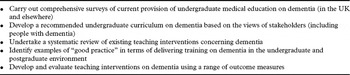
To conclude, this review has argued for the need to improve medical education about dementia in the UK and elsewhere by gathering together existing curricula and recommendations for dementia-specific teaching, and highlighting the current paucity of the evidence base for effective teaching interventions. A number of recommendations for curriculum development and future directions for evaluating dementia-specific teaching interventions have been made (summarized in Table 2) with a view to improving care for people with dementia.
Recommendations for steps towards improving medical education on dementia

Conflict of interest
None.
Description of authors' roles
E. Tullo collated and reviewed policy documents, curricula and educational interventions on dementia. E. Tullo and L. Allan drafted and refined the review.
Acknowledgment
E. Tullo is undertaking an academic clinical fellowship in geriatric medicine supported by the National Institute of Health Research.