Matthew Moore's survey and analysis reflect an enormous amount of work, for which all of us who study or teach political theory should be grateful. They offer us a fascinating snapshot of who is teaching political theory today, of how they understand and think about what they are doing, and of how they think others think about theory. Much that is included in his analysis (and especially in the longer paper from which the report here is selectedFootnote 1) is well worth further study and debate, as it opens a door to the ways political science in general (and not theory alone) is being taught around the country: what political scientists think they are doing when they/we teach their material, what training they/we have, and even what modal teaching loads are.
Nevertheless, it is important, especially with this sort of data, to be mindful of the fact that a good bit of what the survey—and the analysis—offer us is “reputational.” This is to say that, while the respondents provide information about their own views, they are, at the same time, effectively speculating about the views of others, with respect to who is influential, who is likely to be influential, how theory is viewed, etc. As a result, many of the findings (especially what appear to be very precise numerical rankings) need to be read and interpreted very cautiously.Footnote 2 At the same time, the survey offers some very interesting specific information about affiliations, teaching loads, understandings of what constitutes “political science,” the place of political science and of theory in curricula, etc. that is very valuable for an understanding of the discipline as a whole, and for the nature of both undergraduate and graduate education in political science in the U.S. today.
POLITICAL THEORY WITHIN THE DISCIPLINE OF POLITICAL SCIENCE
As someone who was trained in political theory, who teaches at a four-year liberal arts college, and whose teaching responsibilities include (but are not limited to) political theory, I was particularly struck by a number of findings. First—and most dramatically, for one whose department has long had a course in the history of political thought as the required introduction to the study of political science—40% of all four-year colleges and universities, and 20% of political science departments, teach no political theory at all. No doubt related to these numbers is what seems to me to be the declining place of theory within the discipline overall. I arrive at this determination from a number of pieces of data from Moore's survey (some of which have been left out of his essay due to space limitations):
• Theorists are a bit older, on average, than political scientists overall (almost 18% of those who identified as theorists are 60 years old or older, whereas that is true for only 12.4% of the profession as a whole) (Moore Reference Moore2009, 5).
• At the same time, theorists are somewhat less likely to be full professors (36% as compared to 42% for the profession as a whole) (Moore Reference Moore2009, 5).
• Although it is difficult to know how to interpret this information, theorists are also slightly more likely to be women than are political scientists overall. Nevertheless, it is important to point out that only about 26% of theorists who answered the survey question identified as women (Moore Reference Moore2010, 265).
• More significantly, substantial numbers of graduates of political science Ph.D. programs may have no background in theory at all! Two-thirds of Ph.D.-granting programs do not require that their students take any courses in political theory (Moore Reference Moore2010, 268).
• And within Ph.D.-granting institutions, the mean percentage of theorists in full-time tenured, or tenure-track, positions is 16.9, while the median is 11.7 (for respondent schools overall, percentages are 16.5 and 20) (Moore Reference Moore2010, 267). So it seems that political theory may be taken somewhat more seriously at non-Ph.D.-granting institutions than at Ph.D.-granting ones. This finding is related, no doubt, to the fact that roughly three-quarters of the survey's respondent-teachers of political theory are not located in Ph.D.-granting institutions (Moore Reference Moore2009, 4).
• A sense of the declining place of theory within the discipline is reflected, as well, in respondents' views on the place of theory within the discipline (Moore Reference Moore2010, 266). Here, in particular, the results are revealing:
◦ Fewer than one in four theorists feel that theory articles are given a fair chance at publication in major political science journals.
◦ Fewer than 15% believe that the number of articles published in those journals properly reflects the importance of theory to the discipline.
◦ Fewer than one in four believe that theory is respected by political scientists generally—although over 70% feel that “political theory is respected in my department.” There seems to be a significant disjuncture here, perhaps reflecting either respondents' own experiences in other departments at different points in their careers, or awareness of the experiences of friends and colleagues.
• Yet, interestingly enough (and this probably has to do with the strengths of the organized sections on Foundations of Political Theory, Normative Theory, and History of Political Theory, as well as receptivity in some other sections within APSA and WPSA), substantial numbers of respondents feel that paper and panel proposals on theory are given a fair shake at acceptance, and that there are reasonable numbers of theory panels at major conferences.
• Finally—and possibly somewhat surprisingly—very few respondents think that political theory manuscripts are not given a fair chance of publication by major presses. This finding probably reflects theorists' knowing which presses are most favorable to theory, and submitting to those presses.
Among all of these findings, I find the fact that substantial numbers of graduate students may be completing a Ph.D. in political science without having studied any political theory at all to be the most profoundly disturbing. My own studies, both as an undergraduate and as a graduate student, made clear to me the centrality of political thought to the construction and development of political science more generally. Personally, I find it hard to imagine what it would mean to study political science without knowing its roots in political philosophy, including an appreciation of the efforts of thinkers over the centuries to understand the nature and purposes of political community, what it means to exercise political power, what constitutes justice or equity, and a variety of other issues. The absence of attention to these issues within the political science curriculum (whether at the graduate or undergraduate level) would seem to leave the discipline with a hole at its center. But that is a larger question than can be addressed here. I return to it briefly at the conclusion of these reflections.
THE PLACE OF WOMEN (AND FEMINIST THEORY) WITHIN POLITICAL THEORY
As I reviewed the survey and analysis, I was also particularly interested in the place of women—and of female (or feminist, which is, of course, not the same) theorists—within the discipline. After all, as noted above, women constitute a slightly higher percentage of theorists than they do of political scientists overall. Theory, then, might seem to be a subfield that is somewhat more open to acknowledging work by women and, even, feminist work. My own sense, however, is that, although there has been a flowering of feminist work in political theory (as well as within political science more generally) over the past 25 years, much of that work is all-too-often ignored by mainstream (and male) political theorists. I was curious, then, about how women (and feminist theorists) fared within the reputational rankings (Moore Reference Moore2010, tables 4 and 5, 267–68). (These comments and rankings, of course, need to be considered with all the considerable caveats I raised earlier, and which were also raised at the panel and in this symposium's other essays.)
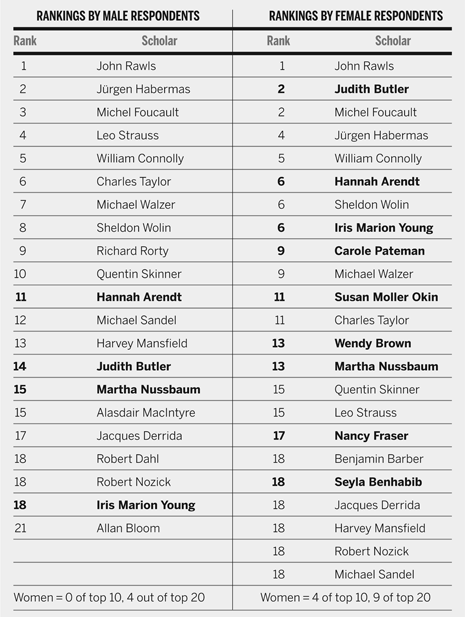
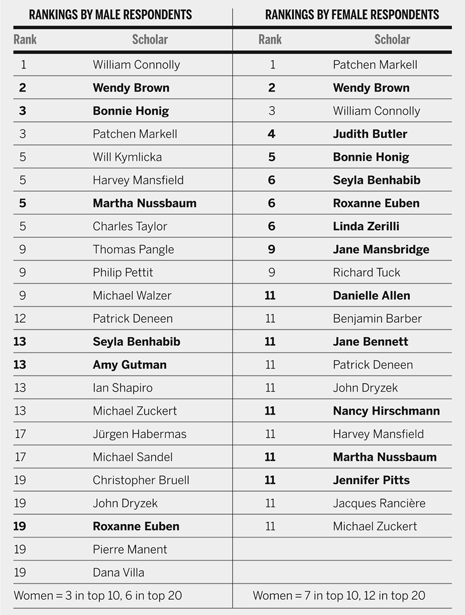
First, of those individuals listed by respondents in answer to the question “who has had the greatest impact on political theory in the past 20 years?” just over 20% were women. At the same time, it is worth noting that there were no women among the top eight. Respondents were also asked to think about those who are writing theory now, and to list five scholars whose work is likely to be influential over the next 20 years. Among these, about 27% of those ranked were women—and the women named were spread more evenly throughout the list. That last figure (27%) is roughly equal to the percentage of women in the survey respondent group. Nevertheless, I thought it would be interesting to look at the data on who was thought to be influential broken down by sex of respondent. I developed two additional tables, based on data supplied by Moore from his survey (see Tables 1 and 2).
Rank Ordering, by Gender of Respondents, of Scholars Who Have Had the Greatest Impact on Political Theory in the Past 20 Years

Note: Female theorists listed in boldface. Data courtesy of Matthew Moore.
Rank Ordering, by Gender of Respondents, of Scholars Doing Excellent Work Today Whose Work Will Be Influential during the Next 20 Years

Note: Female theorists listed in boldface. Data courtesy of Matthew Moore.
Before addressing the obvious differences between these lists, it is important to note that, although the rankings seem to have the legitimacy that accompanies quantitative data, they are potentially quite misleading. The very top-ranked theorist overall from the past 20 years (John Rawls) received only 279 votes from over 1,000 respondents. And the theorists ranked likely to be most influential over the next 20 years (Patchen Markell, Wendy Brown, and William Connolly) received only between 37 and 40 votes from that same pool of voters. Thus, what appear to be significant differences within the rankings may very well be based on very minor differences in perceived preferences. It is important, then, not to read too much into these data.
Nevertheless, I still think that the differences by gender are significant, or, at the very least, worthy of comment. For male respondents, no women ranked among the top 10 of scholars who had had the greatest impact over the past 20 years, and women made up only four of the top 20. The percentages were somewhat better when respondents were asked about theorists writing now who they expect to be influential over the next 20 years. In that group, women constituted three of the top 10, and six of the top 20. Among female respondents, on the other hand, we find four women ranked among the top 10 scholars who had had the greatest impact over the past 20 years, and nine women among the top 20. When those same respondents were asked about the scholars writing now whose work they expect to be influential over the next 20 years, we find seven women in the top 10, and 12 in the top 20.
Again, with the caveat of not wanting to read more into these data than the numbers can support, the separated lists do seem to suggest that female scholars of political theory (many, though not all, of whom do or did feminist theory) are taken more seriously by women than by men. The world of political theory is certainly changing; 20 or 30 years ago there would surely have been many fewer women ranked, by either women or men (and, no doubt, fewer women among those doing the rankings). Nevertheless, there seems still to be a considerable distance to go before the contributions of women to political theory are recognized by male scholars as relevant to the work they do, and to political theory as a whole, rather than as of interest only to women, or to scholars of feminist theory.
WHAT IS IT THAT THEORISTS DO?
For me, however, some of the most interesting, and compelling, data in the survey were not reported in the version being offered here, and they have to do with what theorists do, and how they understand what they are doing (Moore Reference Moore2009, 6–7). Overwhelmingly, political theorist respondents indicated that important among their goals in teaching political theory were the following: encouraging or enabling critical thinking, identifying normative principles to guide and evaluate politics, contributing to a “well-rounded education,” and encouraging moral self-examination. These are, of course, all activities and goals that are central to a liberal arts education. And, indeed, one might well argue that they are, and ought to be, central goals of any institutions of (higher) education in the twenty-first century.
Nevertheless, as cost-benefit analysis is increasingly being put into use in estimating the “value” of education, and as more and more institutions of higher education are being called on to justify their costs in terms of pre-professional training, a concern for these broader values of critical thinking, self-examination, and developing normative principles to guide a life and/or to evaluate policies seems to be relegated to the sidelines. More specifically, they may well be increasingly left to (or claimed as a special prerogative of) undergraduate-focused, liberal arts institutions. The consequences for political scientists specifically, and for developing informed citizens more generally, should be of no small concern. Indeed, if the data about the declining significance of political theory within graduate programs are predictive of future trends, we should be quite concerned about the future of critical thinking—and especially of efforts to explore questions of justice, equality, equity, etc.—not only within the academy, but among our citizenry more generally.
No wonder, then, that a high proportion of those who teach political theory are located in such institutions (or, at least, in non-Ph.D.-granting institutions). Nor, indeed, that most of these theorists do not teach a majority of their courses in political theory (Moore Reference Moore2010, 267). The reality of life for most scholar-teachers who are located in non-Ph.D.-granting institutions is that they/we are, of necessity, “Jacks (or “Jills”) of all trades”: very few have the luxury of teaching only narrowly within their fields of specialization. This realization may also help account for the fact that roughly one-quarter of those teaching political theory in undergraduate-focused institutions do not consider themselves “theorists” by training; and, conversely, about 14% of respondents consider themselves to be theorists, but teach less than one-quarter of their total course-load in that field (Moore Reference Moore2010, 270). If my own experience is any guide, these data may help explain why a substantial number of theorists (over 2/3, in fact) claim that political theory is “respected” in their own departments, even if they do not see it as having the same respect in the discipline overall (see above). At my institution (a “competitive liberal arts college”), for example, virtually every faculty member has taught our introductory theory course at some point in his or her career; indeed, participation in the course has been, until recently, an important component of a new colleague's socialization into the department. Everyone recognizes the importance of theory to the study of political science more generally; and, because we have all participated in the teaching of theory (at least in the introductory course), we can draw on it in our upper-level courses, integrating it rather seamlessly with more empirical studies, in ways that make those connections clear to our students.
Indeed, the findings from this survey could lead to the suggestion (and this would be an interesting question to follow up in further research) that it is in predominantly undergraduate institutions that future generations of political theorists—and, conceivably, of critical thinkers more generally—are most likely to be nurtured. Certainly, there would seem to be more space and legitimacy to explore normative political questions in undergraduate departments that offer courses in theory than in graduate departments that do not.
My focus on the value of undergraduate institutions might well, of course, be seen as a case of “special pleading,” an endorsement for the kinds of institutions in which (for reasons that are not immediately obvious) most of those who are contributing to this symposium find ourselves—and this despite our relative underrepresentation within the American Political Science Association (the membership of which overrepresents those who teach in graduate departments). But it might help to be aware of the fact that, although we can—and, indeed, I would argue, ought to—be concerned about the declining place of political theory in some of the major graduate programs in political science, we can also recognize, and work to sustain, those places—primarily, it seems, undergraduate institutions—where the place of theory is still significant, and where new generations may be nurtured. In such places where teacher-scholars must, of necessity, teach and write in ways that bridge some of the sub-fields of political science, we may begin to break down some of the barriers between the subfields that have hampered the development of the discipline as much as they have enabled it (see Monroe Reference Monroe2005, for example). In that way, I hope that further responses to this survey and what it reveals about the discipline may yet help to reinvigorate not only debate, but the study of political science more generally.