


%20--%3e%3c!DOCTYPE%20svg%20PUBLIC%20'-//W3C//DTD%20SVG%201.0//EN'%20'http://www.w3.org/TR/2001/REC-SVG-20010904/DTD/svg10.dtd'%3e%3csvg%20version='1.0'%20id='Layer_1'%20xmlns='http://www.w3.org/2000/svg'%20xmlns:xlink='http://www.w3.org/1999/xlink'%20x='0px'%20y='0px'%20width='64px'%20height='64px'%20viewBox='5.5%20-3.5%2064%2064'%20enable-background='new%205.5%20-3.5%2064%2064'%20xml:space='preserve'%3e%3cg%3e%3ccircle%20fill='%23FFFFFF'%20fill-opacity='0'%20cx='37.785'%20cy='28.501'%20r='28.836'/%3e%3cpath%20fill='%23595959'%20d='M37.441-3.5c8.951,0,16.572,3.125,22.857,9.372c3.008,3.009,5.295,6.448,6.857,10.314%20c1.561,3.867,2.344,7.971,2.344,12.314c0,4.381-0.773,8.486-2.314,12.313c-1.543,3.828-3.82,7.21-6.828,10.143%20c-3.123,3.085-6.666,5.448-10.629,7.086c-3.961,1.638-8.057,2.457-12.285,2.457s-8.276-0.808-12.143-2.429%20c-3.866-1.618-7.333-3.961-10.4-7.027c-3.067-3.066-5.4-6.524-7-10.372S5.5,32.767,5.5,28.5c0-4.229,0.809-8.295,2.428-12.2%20c1.619-3.905,3.972-7.4,7.057-10.486C21.08-0.394,28.565-3.5,37.441-3.5z%20M37.557,2.272c-7.314,0-13.467,2.553-18.458,7.657%20c-2.515,2.553-4.448,5.419-5.8,8.6c-1.354,3.181-2.029,6.505-2.029,9.972c0,3.429,0.675,6.734,2.029,9.913%20c1.353,3.183,3.285,6.021,5.8,8.516c2.514,2.496,5.351,4.399,8.515,5.715c3.161,1.314,6.476,1.971,9.943,1.971%20c3.428,0,6.75-0.665,9.973-1.999c3.219-1.335,6.121-3.257,8.713-5.771c4.99-4.876,7.484-10.99,7.484-18.344%20c0-3.543-0.648-6.895-1.943-10.057c-1.293-3.162-3.18-5.98-5.654-8.458C50.984,4.844,44.795,2.272,37.557,2.272z%20M37.156,23.187%20l-4.287,2.229c-0.458-0.951-1.019-1.619-1.685-2c-0.667-0.38-1.286-0.571-1.858-0.571c-2.856,0-4.286,1.885-4.286,5.657%20c0,1.714,0.362,3.084,1.085,4.113c0.724,1.029,1.791,1.544,3.201,1.544c1.867,0,3.181-0.915,3.944-2.743l3.942,2%20c-0.838,1.563-2,2.791-3.486,3.686c-1.484,0.896-3.123,1.343-4.914,1.343c-2.857,0-5.163-0.875-6.915-2.629%20c-1.752-1.752-2.628-4.19-2.628-7.313c0-3.048,0.886-5.466,2.657-7.257c1.771-1.79,4.009-2.686,6.715-2.686%20C32.604,18.558,35.441,20.101,37.156,23.187z%20M55.613,23.187l-4.229,2.229c-0.457-0.951-1.02-1.619-1.686-2%20c-0.668-0.38-1.307-0.571-1.914-0.571c-2.857,0-4.287,1.885-4.287,5.657c0,1.714,0.363,3.084,1.086,4.113%20c0.723,1.029,1.789,1.544,3.201,1.544c1.865,0,3.18-0.915,3.941-2.743l4,2c-0.875,1.563-2.057,2.791-3.541,3.686%20c-1.486,0.896-3.105,1.343-4.857,1.343c-2.896,0-5.209-0.875-6.941-2.629c-1.736-1.752-2.602-4.19-2.602-7.313%20c0-3.048,0.885-5.466,2.658-7.257c1.77-1.79,4.008-2.686,6.713-2.686C51.117,18.558,53.938,20.101,55.613,23.187z'/%3e%3c/g%3e%3c/svg%3e)
%20--%3e%3c!DOCTYPE%20svg%20PUBLIC%20'-//W3C//DTD%20SVG%201.0//EN'%20'http://www.w3.org/TR/2001/REC-SVG-20010904/DTD/svg10.dtd'%3e%3csvg%20version='1.0'%20id='Layer_1'%20xmlns='http://www.w3.org/2000/svg'%20xmlns:xlink='http://www.w3.org/1999/xlink'%20x='0px'%20y='0px'%20width='64px'%20height='64px'%20viewBox='5.5%20-3.5%2064%2064'%20enable-background='new%205.5%20-3.5%2064%2064'%20xml:space='preserve'%3e%3cg%3e%3ccircle%20fill='%23FFFFFF'%20fill-opacity='0'%20cx='37.637'%20cy='28.806'%20r='28.276'/%3e%3cg%3e%3cpath%20fill='%23595959'%20d='M37.443-3.5c8.988,0,16.57,3.085,22.742,9.257C66.393,11.967,69.5,19.548,69.5,28.5c0,8.991-3.049,16.476-9.145,22.456%20C53.879,57.319,46.242,60.5,37.443,60.5c-8.649,0-16.153-3.144-22.514-9.43C8.644,44.784,5.5,37.262,5.5,28.5%20c0-8.761,3.144-16.342,9.429-22.742C21.101-0.415,28.604-3.5,37.443-3.5z%20M37.557,2.272c-7.276,0-13.428,2.553-18.457,7.657%20c-5.22,5.334-7.829,11.525-7.829,18.572c0,7.086,2.59,13.22,7.77,18.398c5.181,5.182,11.352,7.771,18.514,7.771%20c7.123,0,13.334-2.607,18.629-7.828c5.029-4.838,7.543-10.952,7.543-18.343c0-7.276-2.553-13.465-7.656-18.571%20C50.967,4.824,44.795,2.272,37.557,2.272z%20M46.129,20.557v13.085h-3.656v15.542h-9.944V33.643h-3.656V20.557%20c0-0.572,0.2-1.057,0.599-1.457c0.401-0.399,0.887-0.6,1.457-0.6h13.144c0.533,0,1.01,0.2,1.428,0.6%20C45.918,19.5,46.129,19.986,46.129,20.557z%20M33.042,12.329c0-3.008,1.485-4.514,4.458-4.514s4.457,1.504,4.457,4.514%20c0,2.971-1.486,4.457-4.457,4.457S33.042,15.3,33.042,12.329z'/%3e%3c/g%3e%3c/g%3e%3c/svg%3e)
%20--%3e%3c!DOCTYPE%20svg%20PUBLIC%20'-//W3C//DTD%20SVG%201.0//EN'%20'http://www.w3.org/TR/2001/REC-SVG-20010904/DTD/svg10.dtd'%3e%3csvg%20version='1.0'%20id='Layer_1'%20xmlns='http://www.w3.org/2000/svg'%20xmlns:xlink='http://www.w3.org/1999/xlink'%20x='0px'%20y='0px'%20width='64px'%20height='64px'%20viewBox='5.5%20-3.5%2064%2064'%20enable-background='new%205.5%20-3.5%2064%2064'%20xml:space='preserve'%3e%3cg%3e%3ccircle%20fill='%23FFFFFF'%20fill-opacity='0'%20cx='36.924'%20cy='28.403'%20r='28.895'/%3e%3cpath%20fill='%23595959'%20d='M37.442-3.5c8.99,0,16.571,3.085,22.743,9.256C66.393,11.928,69.5,19.509,69.5,28.5c0,8.992-3.048,16.476-9.145,22.458%20C53.88,57.32,46.241,60.5,37.442,60.5c-8.686,0-16.19-3.162-22.513-9.485C8.644,44.728,5.5,37.225,5.5,28.5%20c0-8.762,3.144-16.343,9.429-22.743C21.1-0.414,28.604-3.5,37.442-3.5z%20M12.7,19.872c-0.952,2.628-1.429,5.505-1.429,8.629%20c0,7.086,2.59,13.22,7.77,18.4c5.219,5.144,11.391,7.715,18.514,7.715c7.201,0,13.409-2.608,18.63-7.829%20c1.867-1.79,3.332-3.657,4.398-5.602l-12.056-5.371c-0.421,2.02-1.439,3.667-3.057,4.942c-1.622,1.276-3.535,2.011-5.744,2.2%20v4.915h-3.714v-4.915c-3.543-0.036-6.782-1.312-9.714-3.827l4.4-4.457c2.094,1.942,4.476,2.913,7.143,2.913%20c1.104,0,2.048-0.246,2.83-0.743c0.78-0.494,1.172-1.312,1.172-2.457c0-0.801-0.287-1.448-0.858-1.943l-3.085-1.315l-3.771-1.715%20l-5.086-2.229L12.7,19.872z%20M37.557,2.214c-7.276,0-13.428,2.571-18.457,7.714c-1.258,1.258-2.439,2.686-3.543,4.287L27.786,19.7%20c0.533-1.676,1.542-3.019,3.029-4.028c1.484-1.009,3.218-1.571,5.2-1.686V9.071h3.715v4.915c2.934,0.153,5.6,1.143,8,2.971%20l-4.172,4.286c-1.793-1.257-3.619-1.885-5.486-1.885c-0.991,0-1.876,0.191-2.656,0.571c-0.781,0.381-1.172,1.029-1.172,1.943%20c0,0.267,0.095,0.533,0.285,0.8l4.057,1.83l2.8,1.257l5.144,2.285l16.397,7.314c0.535-2.248,0.801-4.533,0.801-6.857%20c0-7.353-2.552-13.543-7.656-18.573C51.005,4.785,44.831,2.214,37.557,2.214z'/%3e%3c/g%3e%3c/svg%3e)
%20--%3e%3c!DOCTYPE%20svg%20PUBLIC%20'-//W3C//DTD%20SVG%201.1//EN'%20'http://www.w3.org/Graphics/SVG/1.1/DTD/svg11.dtd'%3e%3csvg%20version='1.1'%20id='Layer_1'%20xmlns='http://www.w3.org/2000/svg'%20xmlns:xlink='http://www.w3.org/1999/xlink'%20x='0px'%20y='0px'%20width='64.000977px'%20height='64px'%20viewBox='0%200%2064.000977%2064'%20enable-background='new%200%200%2064.000977%2064'%20xml:space='preserve'%3e%3cg%3e%3ccircle%20fill='%23FFFFFF'%20fill-opacity='0'%20cx='32.064453'%20cy='31.788086'%20r='29.012695'/%3e%3cg%3e%3cpath%20fill='%23595959'%20d='M31.943848,0C40.896484,0,48.476562,3.105469,54.6875,9.314453C60.894531,15.486328,64.000977,23.045898,64.000977,32%20s-3.048828,16.457031-9.145508,22.513672C48.417969,60.837891,40.779297,64,31.942871,64%20c-8.648926,0-16.152832-3.142578-22.513672-9.429688C3.144043,48.286133,0,40.761719,0,32.000977%20c0-8.723633,3.144043-16.285156,9.429199-22.68457C15.640137,3.105469,23.14502,0,31.943848,0z%20M32.060547,5.771484%20c-7.275391,0-13.429688,2.570312-18.458496,7.714844C8.381836,18.783203,5.772949,24.954102,5.772949,32%20c0,7.125,2.589844,13.256836,7.77002,18.400391c5.181152,5.181641,11.352051,7.770508,18.515625,7.770508%20c7.123047,0,13.332031-2.608398,18.626953-7.828125C55.713867,45.466797,58.228516,39.353516,58.228516,32%20c0-7.3125-2.553711-13.484375-7.65625-18.513672C45.504883,8.341797,39.333984,5.771484,32.060547,5.771484z%20M44.117188,24.456055%20v5.485352H20.859863v-5.485352H44.117188z%20M44.117188,34.743164v5.481445H20.859863v-5.481445H44.117188z'/%3e%3c/g%3e%3c/g%3e%3c/svg%3e)
8.1 Introduction
Accelerating sustainability transitions is crucial for tackling wicked sustainability challenges. The urgency is underscored by the 2015 Paris Agreement to the United Nations Framework Convention on Climate Change, which set ambitious targets to reduce global greenhouse gas emissions and limit temperature rise. Specifically, it called for emissions to peak by 2020 – a deadline that has already passed – and for a reduction to zero emissions by 2050. These goals highlight the need for immediate action across energy systems, agriculture and manufacturing to address the climate crisis and achieve global sustainability effectively.
The benefits of accelerating sustainability transitions extend beyond climate action. They foster innovation in sustainable development, promote social equity and improve public health. Rapid shifts to cleaner energy, sustainable materials and efficient technologies are essential. Additionally, these transitions can enhance air quality, reduce environmental degradation and improve overall well-being. They can also stimulate economic growth by creating new jobs and opportunities in sustainable industries, thereby promoting economic resilience. Investments in renewable energy and green technologies can lead to long-term environmental and financial gains while encouraging global cooperation.
The concept of time in sustainability transitions – characterised by pace, speed and acceleration – requires careful consideration. While it serves as a benchmark for measuring success (Sovacool et al., Reference Sovacool, Hess, Amir, Geels, Hirsh, Medina and Yearley2020; Marquardt & Delina, Reference Marquardt and Delina2021), there is limited reflection on the implications of these timeframes (Marquardt & Delina, Reference Marquardt and Delina2021), including resource allocation and legitimacy, which can create winners and losers (Newell et al., Reference Newell, Geels and Sovacool2022; van Bommel & Höffken, Reference van Bommel and Höffken2023). Critical discussions about how to meet these time-bound targets, who will be responsible, and the impact on public engagement (Skjølsvold & Coenen, Reference Skjølsvold and Coenen2021) – particularly for vulnerable populations (van Bommel & Höffken, Reference van Bommel and Höffken2023) – are often overlooked (Ciplet & Harrison, Reference Ciplet and Harrison2020).
This chapter aims to explore these complexities, examining the relationship between time and socio-technical change in sustainability transitions. Time is a social construct (Stehr & Von Storch, Reference Stehr and Von Storch1995; cf. Marquardt and Delina, Reference Marquardt and Delina2021) that shapes how we organise our lives (Elder, Reference Elder1994; Kreitzmnan & Foster, Reference Kreitzman and Foster2011), and its meanings can vary widely (cf. Marquardt and Delina, Reference Marquardt and Delina2021). From the perspective of Science and Technology Studies (STS), time is co-produced with advancements in science and technology (Jasanoff, Reference Jasanoff and S. Jasanoff2004a; cf. Wyborn et al., Reference Wyborn, Datta, Montana, Ryan, Leith, Chaffin and Van Kerkhoff2019; Marquardt & Delina, Reference Marquardt and Delina2021) and influenced by social and political dynamics (Jasanoff, Reference Jasanoff and S. Jasanoff2004a, Reference Jasanoff and S. Jasanoff (Ed.)2004b). Making, remaking and unmaking time is intertwined with politics, technological advancements and epistemologies or knowledge-making (Jasanoff & Kim, Reference Jasanoff and Kim2015) in that this co-production could lead to the displacement of certain members of society (Jasanoff & Simmett, Reference Jasanoff and Simmet2021). This understanding allows for a critical examination of the often neutral framing of sustainability transitions, particularly in decarbonisation efforts.
When discussing accelerated sustainability transitions, it becomes clear that envisioning sustainable futures involves more than just setting deadlines. Achieving these transitions is inherently political and contested, involving various local and national stakeholders (Delina & Janetos, Reference Delina and Janetos2018). Different actors will advocate for their own timescales and technologies based on their interests and visions of sustainability (Delina & Janetos, Reference Delina and Janetos2018; Newell et al., Reference Newell, Geels and Sovacool2022). Therefore, a nuanced understanding of time in sustainability transitions is essential for fostering transparency, equity and justice (Delina & Janetos, Reference Delina and Janetos2018; Delina & Sovacool, Reference Delina and Sovacool2018; van Bommel & Höffken, Reference van Bommel and Höffken2023).
To further this discussion, Section 8.2 revisits the temporal dimensions in sustainability transition research and practice. Section 8.3 reviews past research on time construction and its political implications, emphasising the need for critical assessments of speed and acceleration. Finally, Section 8.4 concludes by raising guiding questions for future research.
8.2 Temporalities of Sustainability Transitions
Sustainability transition studies have explored how technological and societal changes occur at multiple scales – local, national and regional – over time, whether relatively quickly or gradually (Sovacool, Reference Sovacool2016). These studies also focus on the various technological disruptions accompanying these changes and their impacts on societies. In this context, the concept of time emerges as a crucial and multifaceted dimension, encompassing aspects such as speed, duration and acceleration. Speed refers to the rate at which societies and environments adopt sustainable practices and systems. The concepts of substitution and diffusion illustrate this, as discussed in Section 8.2.1. Duration, conversely, pertains to the length of time required for these transitions to become embedded in societal norms and structures. Acceleration signifies the increasing pace of change toward sustainability goals over time. Understanding these temporal aspects is essential, as they shape the dynamics, challenges and opportunities in transitioning towards sustainability. By examining the speed, duration and acceleration, researchers can identify bottlenecks, leverage points and critical junctures that influence the success or failure of sustainability transitions. This nuanced analysis allows for developing strategies and policies that facilitate smoother and more effective transitions towards a sustainable future.
8.2.1 Insights from Energy Transition Studies
Energy transition studies provide insights into how sequential events lead to shifts in energy generation and consumption patterns. Energy transitions involve changes in fuels and their associated technologies and systems (Hirsh & Jones, Reference Hirsh and Jones2014), including economic systems (Fouquet & Pearson, Reference Fouquet and Pearson2012) and their rise to claim substantial market shares (Smil, Reference Smil2010a,Reference Smilb). On average, energy transitions have been observed to progress from an initial share of 1%–10% of the energy consumption for a particular service in a specific sector, eventually reaching 50%, 90% and even 99% (Grubler et al., Reference Grubler, Wilson and Nemet2016). The duration from the invention of a critical technology to an 80% share of energy consumption averages around 95 years (Fouquet, Reference Fouquet2016), indicating a relatively slow pace. However, it is important to note that such state changes proceed non-linearly compared to typical technological diffusion and substitution (Grubler, Reference Grubler1996).
Historical energy transitions further illustrate the concepts of speed, duration and acceleration. The Netherlands’ transition to fossil gas, Ontario’s coal retirements and Denmark’s shift to heat and power systems occurred relatively quickly, demonstrating that rapid transitions are possible (Sovacool, Reference Sovacool, Hess, Amir, Geels, Hirsh, Medina and Yearley2020). Similarly, Indonesia’s shift from kerosene to gas for cooking was achieved in just 10 years (Thoday et al., Reference Thoday, Benjamin, Gan and Puzzolo2018). Additionally, the rapid transition from incandescent bulbs to LED lighting exemplifies swift changes in consumption patterns (International Energy Agency, 2020; Zissis et al., Reference Zissis, Bertoldi and Serrenho2021). The transportation sector also showcases accelerated sustainability transitions. The shift from horse-drawn transportation to railways in the 1850s occurred within a few decades (Geels, Reference Geels2005). More recently, the transition from internal combustion engines to electric vehicles is gaining momentum (Bloomberg NEF, 2021; Muratori et al., Reference Muratori, Alexander, Arent, Bazilian, Cazzola, Dede and Ward2021), driven by advances in battery technology, declining costs and increasing consumer demand for sustainable transportation (Muratori et al., Reference Muratori, Alexander, Arent, Bazilian, Cazzola, Dede and Ward2021).
8.2.2 Critiques and Considerations
Despite these examples of rapid transitions, some scholars argue that complex technological and economic factors can slow down rapid changes. For instance, Smil (Reference Smil2016) notes that historical global energy transitions have often taken considerable time, citing that coal took 60 years to provide half of the world’s energy supply. The global energy system remains heavily reliant on fossil fuels, with little evidence that the transition away from coal is accelerating. In response to scepticism about rapid transitions, Grubler et al. (Reference Grubler, Wilson and Nemet2016) offer a nuanced critique, suggesting that the speed of past transitions should be understood in light of factors such as the complexity of the technology, the length of the formative phases in technology development, spatial diffusion and market size. They argue that future sustainability transitions will differ significantly from historical ones. Rapid transitions are often characterised by substituting older technologies with established alternatives without significant disruption or the need for integration with existing infrastructures. Successful transitions also benefit from knowledge spillovers, smaller markets (e.g. Ontario’s transition to hydropower (Sovacool, Reference Sovacool2016; Rosenbloom et al., Reference Rosenbloom, Haley and Meadowcroft2018)) and tangible advantages for end-users, such as improved health outcomes (e.g. Indonesia’s switch to LPG cooking (Sovacool, Reference Sovacool2016; Thoday et al., Reference Thoday, Benjamin, Gan and Puzzolo2018)), convenience and well-coordinated public policies (e.g. France’s adoption of nuclear energy (Jasper, Reference Jasper2014)).
8.2.3 The Concept of Timescapes
While speed, duration and acceleration are key aspects of temporalities in sustainability transitions, another important dimension is timescapes, a concept that integrates various temporal dynamics. Derived from Appadurai’s (Reference Appadurai1996) notion of scapes, timescapes reflect the complex interplay of temporal rhythms and structures (Bornemann & Strassheim, Reference Bornemann and Strassheim2019). Scapes are dynamic constructs that encompass various dimensions of global cultural flows, interactions and imaginaries (Appadurai, Reference Appadurai1996). A timescape, therefore, refers to the intricate interplay of temporal dimensions within sustainability transitions, including the rhythms, sequencing and temporal structures that influence speed, duration and acceleration. Timescapes are not static; they are interconnected and constantly evolving networks shaped by global cultural processes, such as the Paris Agreement and visions of sustainable futures (cf. Bornemann & Strassheim, Reference Bornemann and Strassheim2019). This concept suggests the complexities and interconnections inherent in contemporary global dynamics, emphasising the role of culture, communication and power – akin to ‘landscape pressures’ in the Multilevel Perspective (see Chapter 2) – in shaping the trajectories of sustainability transitions in the modern world.
8.3 Intersections Between Temporality and the Multiple Dimensions of Sustainability Transitions
The analysis of the speed, duration and acceleration of sustainability transitions, coupled with the exploration of timescapes, has enriched the integration of temporal dimensions across the various aspects of sustainability transitions. This section delves into six critical elements: (1) technological choices and innovations, (2) income and consumption, (3) markets, (4) politics, institutions and policy, (5) end-users and the public and (6) just transitions. This chapter emphasises these factors and their pivotal roles in influencing and shaping the complex interactions within sustainability transitions.
8.3.1 Temporality, Technological Choices and Innovation
The field of sustainability transition research emphasises the importance of considering the timeline of socio-technical developments, which can range from long-term social and cultural shifts to short-term changes in practices and project implementations (Geels & Schot, Reference Geels and Schot2007). For example, Grubler et al. (Reference Grubler, Wilson and Nemet2016) highlight the relationship between the speed of transitions and the complexity of technological systems. They argue that complex transitions are slower because new, intricate socio-technical combinations require significant time to emerge (cf. Loorbach et al., Reference Loorbach, Rotmans, Kemp, de Roo and Hillier2016). The longevity of large-scale energy infrastructures and industries (Smil, Reference Smil2016) has resulted in significant carbon lock-ins and path-dependent futures within established socio-technical systems (Unruh, Reference Unruh2000).
Within the timescapes of sustainability transitions, it is crucial to distinguish between a ‘grand’ transition – characterised by pervasive changes in a socio-technical system that affect resources, carriers and end-use applications – and the concepts of substitution and diffusion (Grubler et al., Reference Grubler, Wilson and Nemet2016). Substitution involves replacing one technology with another without disrupting or needing to integrate existing institutions and infrastructures. In contrast, diffusion refers to the gradual adoption of technology over time. While substitution can occur rapidly, Grubler et al. (Reference Grubler, Wilson and Nemet2016) suggest that both diffusion and a ‘grand’ transition are inherently lengthy processes involving interrelated technologies, infrastructures and institutions. Consequently, these lengthy processes may contribute to a slower transition.
8.3.2 Temporality, Income and Consumption
Historical evidence indicates a strong correlation between the speed of sustainability transitions and shifts in resource consumption from one energy source to another. For example, the transition from biomass to coal in the late nineteenth century, followed by the shift from coal to oil after World War II (Fouquet, Reference Fouquet2016; Pearson, Reference Pearson, Webb, Wade and Tingey2021), highlights the close relationship between resource consumption patterns and sustainability transitions. As more individuals transition from fossil fuel-powered cars to electric vehicles (Sioshansi & Webb, Reference Sioshansi and Webb2019), a projected increase in energy demand is anticipated (Bogdanov et al., Reference Bogdanov, Ram, Aghahosseini, Gulagi, Oyewo, Child and Breyer2021). This rise in the adoption of new technologies, particularly as their costs decrease, can stimulate demand for sustainable alternatives and further accelerate the sustainability transition. Additionally, the growing utilisation of AI computing power and servers, expected to contribute to an uptick in electricity consumption, may also impact overall energy demand (Koot & Wijnhoven, Reference Koot and Wijnhoven2021).
Historically, rising incomes have led to increased energy demand, as seen in the UK (Fouquet, Reference Fouquet2016). This trend suggests that sustainability transitions can accelerate as energy consumption increases in industrialising economies, particularly in developing countries now and in the future (Delina, Reference Delina2017; Kober et al., Reference Kober, Schiffer, Densing and Panos2020). While heightened energy demand may incentivise continued reliance on fossil infrastructure, it also signals a growing market for sustainable energy alternatives. As energy demand rises, a critical opportunity exists to redirect investments and innovations towards sustainable energy solutions, thereby driving the acceleration and scaling up of energy transitions.
8.3.3 Temporality and Markets
Time and cost reductions are other critical factors for accelerating sustainability transitions. Prices are crucial in these rapid shifts, particularly regarding the willingness to invest in niche technologies (Geels et al., Reference Geels, Kern and Clark2023). A historical example is the transition from gas to electric lighting in the late nineteenth century, where theatres and restaurants adopted electric lighting despite the higher costs (Fouquet, Reference Fouquet2016). Although renewable technologies have proven their affordability and market readiness (IRENA, 2019; Timilsina, Reference Timilsina2021; Luderer et al., Reference Luderer, Madeddu, Merfort, Ueckerdt, Pehl, Pietzcker and Kriegler2022), many developing countries still need prices to decrease further to compete with fossil fuels (Delina, Reference Delina2017). Lowering these costs could facilitate a faster transition (Fouquet, Reference Fouquet2016). An illustrative example of a tipping point is the significant drop in solar and wind power costs over the past decade, making them increasingly competitive with conventional fossil fuels (IRENA, 2019; Luderer et al., Reference Luderer, Madeddu, Merfort, Ueckerdt, Pehl, Pietzcker and Kriegler2022). Furthermore, projections from the International Renewable Energy Agency (2020) indicate that these cost declines are expected to continue, further expediting the transition to renewable energy sources.
In addition to cost reductions, the time required to construct renewable energy infrastructure has also decreased (Luderer et al., Reference Luderer, Madeddu, Merfort, Ueckerdt, Pehl, Pietzcker and Kriegler2022). This reduction in both temporal and financial investments for establishing renewable energy systems enhances the feasibility of transitioning to sustainable energy sources, thereby fostering a swifter adoption of renewables (Bloomberg NEF, 2021; Luderer et al., Reference Luderer, Madeddu, Merfort, Ueckerdt, Pehl, Pietzcker and Kriegler2022). However, factors such as the stage of diffusion, the sequence of spatial diffusion and market size influence changes in market shares (Grubler et al., Reference Grubler, Wilson and Nemet2016). To accelerate sustainability transitions, sustainable technologies and systems must be implemented simultaneously, supported by appropriate policies and deployed across multiple market sizes (Way et al., Reference Way, Ives, Mealy and Farmer2022).
Policymakers must collaborate with influential actors, such as investors, to drive this change. However, partnering with established players can create tensions, especially when they control the technologies and intellectual property essential for rapid transitions (Ciplet and Harrison, Reference Ciplet and Harrison2020). This dynamic may result in large-scale transition pathways that neglect local and small-scale initiatives, which are crucial for ensuring just transitions (Newell et al., Reference Newell, Geels and Sovacool2022; van Bommel & Höffken, Reference van Bommel and Höffken2023). As a result, financial actors with the capital needed to accelerate transitions often prioritise large-scale investments, further sidelining smaller efforts.
8.3.4 Temporality, Politics, Institutions and Policy
Sustainability transitions involve various actors and institutions, including policymakers, government and the market (Sanderink & Nasiritousi, Reference Sanderink and Nasiritousi2020; Delina, Reference Delina2017; also see Chapters 3 and 14 in this book). Understanding the pace of these transitions requires considering factors like temporality, politics, institutions and policies. Supportive measures, such as subsidies, equitable market conditions and effective institutional arrangements, are crucial in facilitating sustainability transitions (Delina, Reference Delina2017).
Subsidies and other supportive policies can help bridge the cost gap between sustainable and traditional technologies, especially in developing countries where sustainable options remain expensive (Rentschler & Bazilian, Reference Rentschler and Bazilian2017; BNEF, 2020). Additionally, fostering a fair market landscape through policies that promote competition and prevent market distortions is integral to successful sustainability transitions (Rentschler & Bazilian, Reference Rentschler and Bazilian2017). Supportive institutional arrangements, including regulatory frameworks and development support, also create an enabling environment for accelerating sustainability transitions (IEA, 2020; Delina, Reference Delina2017; also see Chapters 5 and 14). However, political and institutional factors can significantly influence sustainability transitions. For instance, a concentrated nuclear industry with substantial political influence in France has likely slowed the country’s shift to renewables (Jasper, Reference Jasper2014). Similarly, in the United States, heavy lobbying by fossil fuel companies has likely obstructed climate policy and energy transition efforts (Downie, Reference Downie2019). Thus, the pace and timescapes of sustainability transitions are contingent upon evolving political dynamics and interests.
8.3.5 Temporality, End-Users and the Public
Sustainability transitions are socially complex, making it essential to understand the public’s role and the passage of time (Skjølsvold & Coenen, Reference Skjølsvold and Coenen2021; Küpers & Batel, Reference Küpers and Batel2023). The public significantly influences processes that ensure a just transition. Social movements, such as the climate action movement, have raised awareness and pressured governments to shift towards renewable energy sources (IPCC, 2018; Komendantova, Reference Komendantova2021). Community energy projects empower local communities to develop and own renewable energy sources, fostering public support for the transition (Bauwens, Reference Bauwens2019). Germany’s Energiewende, supported by public backing, has successfully increased the share of renewable energy in its energy mix (Heinrich, Reference Heinrich2018). Additionally, in-my-backyard movements focus on developing renewable energy sources locally while addressing community concerns (Sovacool, Reference Sovacool2019).
Understanding the diverse interests of the public (Skjølsvold & Coenen, Reference Skjølsvold and Coenen2021) is crucial for policymakers and researchers aiming to accelerate sustainability transitions. Policymakers must consider this diversity (see Chapter 12) when designing effective and just policies, while researchers should incorporate these factors in their analyses. The ability of end-users to adapt to their changing needs and desires (Grubler et al., Reference Grubler, Wilson and Nemet2016; Süsser et al., Reference Süsser, Gaschnig, Ceglarz, Stavrakas, Flamos and Lilliestam2022) also influences the speed of sustainability transitions. These varied end-user experiences inform technology development and promote broader sustainability innovations, including knowledge spillovers, entrepreneurialism and niche applications for pilots and demonstrations (Blanco et al., Reference Blanco, de Coninck, Agbemabiese, Anadon, Lim, Pengue and Winkler2022). However, addressing the tension between inclusive participation and the pace of sustainability transitions is vital, broadening the debate on transition speed. This is especially crucial for including often-excluded actors, groups and regions, recognising and analysing polycentric governance (Newell et al., Reference Newell, Geels and Sovacool2022; Skjølsvold & Coenen, Reference Skjølsvold and Coenen2021; see Chapters 9, 15 and 21 in this book), and considering justice issues, particularly human rights and environmental impacts, in sustainability transition policies (van Bommel & Höffken, Reference van Bommel and Höffken2023).
8.3.6 Temporality and Just Transitions
Accelerated sustainability transitions can negatively impact vulnerable populations facing resource access challenges and marginalisation. For instance, studies indicate that rural communities may be left behind in the energy transition if policymakers do not prioritise energy access (Clausen & Rudolph, Reference Clausen and Rudolph2020; Chan & Delina, Reference Chan and Delina2023). A historical example is the introduction of steam engines during the Industrial Revolution, which led to rapid urbanisation and increased urban consumption (Allen, Reference Allen2009), leaving rural areas underdeveloped and exacerbating poverty in remote areas (Acheampong et al., Reference Acheampong, Nghiem, Dzator and Rajaguru2023; see Chapter 23; cf. Chapter 22). Today, the most energy-poor members of society, often living in remote areas without electricity grid access, are also the poorest (Hanke et al., Reference Hanke, Grossmann and Sandmann2023; see Chapter 23). Although renewable energy projects in rural areas have the potential to provide electricity and create employment opportunities for those living in poverty, challenges such as lack of financing, technical expertise and supportive policies hinder these benefits (Sergi et al., Reference Sergi, Babcock, Williams, Thornburg, Loew and Ciez2018; Fathoni et al., Reference Fathoni, Setyowati and Prest2021; see Chapter 15). Furthermore, large-scale renewable energy projects in countries like Ghana and Mexico seem to have only minimally benefited rural communities (Bukhari et al., Reference Bukari, Kemausuor, Quansah and Adaramola2021; de Jesus Fernandez & Watson, Reference de Jesus Fernandez and Watson2022).
To prevent the marginalisation of rural populations in sustainability transitions, policymakers are well advised to prioritise resource access and design projects that consider the needs of local communities (Clausen & Rudolph, Reference Clausen and Rudolph2020). Successful community-led sustainability initiatives, such as the First Nations-led renewable energy projects in Canada (Stefanelli et al., Reference Stefanelli, Walker, Kornelsen, Lewis, Martin, Masuda and Castleden2019), highlight the importance of prioritising resource access for marginalised communities, potentially through subsidies for off-grid renewable energy systems (Gebreslassie et al., Reference Gebreslassie, Cuvilas, Zalengera, To, Baptista, Robin and Castán Broto2022). However, it is crucial to recognise that enhanced stakeholder engagement, such as through ‘energy democracy’, which aims to empower local communities in energy decision-making, may lead to uneven opportunities for participation when certain groups dominate the dialogue or when resources for engagement are inequitably distributed, perpetuating inequalities in access and representation (Newell et al., Reference Newell, Geels and Sovacool2022). This may result in place-related injustices, such as the exclusion of rural voices in decision-making processes, the prioritisation of urban over rural needs and the unequal distribution of environmental benefits and burdens (Skjølsvold & Coenen, Reference Skjølsvold and Coenen2021) (also see Chapter 16 in this book).
8.4 Future Research
Understanding the connection between time and the various aspects of sustainability transitions requires an interdisciplinary approach that incorporates diverse research methods and reflexivity (Delina & Janetos, Reference Delina and Janetos2018; see Chapter 27). It is essential to consider the interactions among different factors and actors, as fostering public participation is vital for ensuring just transitions (Newell et al., Reference Newell, Geels and Sovacool2022). Scholars can collaboratively and critically explore temporalities and their implications for pressing sustainability transition targets through interdisciplinary, multidisciplinary and transdisciplinary approaches. Additionally, multi- and mixed-methods research approaches serve as valuable tools for comprehensively understanding the timescapes of sustainability transitions.
8.4.1 Inter, Multi- and Trans-Disciplinary Research
Examining the temporal dimensions within sustainability transitions represents a significant area of research that warrants greater attention. Diverse temporal understandings and their connections to various aspects of sustainability transitions exist across different societies and contexts. Therefore, it is key for future research to explore the heterogeneous and global interpretations of competing timeframes (Delina & Janetos, Reference Delina2017). Furthermore, recognising that these temporalities are intertwined with power dynamics and politics is vital, similar to the role of technologies in transitions (Jasanoff, Reference Jasanoff, Jasanoff and Kim2015; Delina & Janetos, Reference Delina2017).
To investigate the political underpinnings of temporalities in sustainability transition research, future studies could examine broader conceptions of political and social structures encapsulated within temporal frameworks. It is also vital to consider whose voices are amplified and who is marginalised, as well as how temporal structures in sustainability transitions may exacerbate vulnerability or enhance resilience. By probing these issues, researchers can critically assess the political dimensions of pressing sustainability transition targets, such as deadlines for achieving net-zero economies (Marquardt & Delina, Reference Marquardt and Delina2021).
Interdisciplinary, multidisciplinary and transdisciplinary research approaches offer valuable avenues for comprehensively exploring temporalities within sustainability transition research (Kleinman, Reference Kleinman2018; Sovacool et al., Reference Sovacool, Hess, Amir, Geels, Hirsh, Medina and Yearley2020). By collaborating with scholars from diverse fields, researchers can better understand the intricate and evolving processes involved in sustainability transitions. Interdisciplinary research integrates insights and methodologies from various disciplines to address temporal research inquiries (Thompson Klein et al., Reference Thompson Klein2001). In contrast, multidisciplinary research employs different perspectives to tackle a shared research question. For instance, interdisciplinary studies on the temporal aspects of sustainability transitions may involve partnerships between economists, sociologists and environmental scientists to comprehend the economic, social and ecological ramifications of various sustainability transition scenarios. Transdisciplinary research combines knowledge and methodologies from multiple disciplines while actively engaging non-academic actors to address temporal issues in sustainability transition studies (Thompson Klein et al., Reference Thompson Klein2001).
8.4.2 Multi- and Mixed-Methods Research Approaches
Multi-method research approaches provide a valuable means to examine and study the temporalities of sustainability transitions (Shove & Walker, Reference Shove and Walker2014; Geels, Reference Geels2018; Sovacool et al., Reference Sovacool, Hess, Amir, Geels, Hirsh, Medina and Yearley2020). By combining qualitative and quantitative methods, researchers can better understand the complex and dynamic processes involved. Relying on a single method may fail to capture the full range of factors influencing sustainability transitions, as it can overlook critical perspectives and nuances that a multi-faceted approach can reveal.
Qualitative methods, such as interviews and focus groups, offer insights into the experiences, perspectives (see Chapter 19) and values of sustainability transition actors (see Chapters 12 and 17). Conversely, quantitative methods, including statistical analysis and modelling, help identify patterns and trends in resource use, technology acceptance and sustainability transitions over time. Moreover, multi- and mixed-methods research can help overcome the limitations of individual approaches (Sovacool et al., Reference Sovacool, Hess, Amir, Geels, Hirsh, Medina and Yearley2020). For instance, while small sample sizes may restrict qualitative methods, quantitative methods may only partially capture the nuances of social and cultural factors influencing sustainability transitions. By integrating different research methods, researchers can provide a more holistic view of the intricate processes involved in energy transitions, ultimately informing policy and practice (Strengers, Reference Strengers2018).
9.1 Introduction
Niches provide ‘protective space’ for people and organisations to innovate more radically compared to incremental innovation typical in socio-technical regimes (Chapter 5; see also Kemp, Schot, & Hoogma, Reference Kemp, Schot and Hoogma1998; Smith & Raven, Reference Smith and Raven2012). Niches foster experiments using diverse organisational forms and novel technological arrangements that typically seek to be path-breaking. Indeed, experiments often pursue alternative norms or rules for what it means to be sustainable. Sustainability in regimes, for example, is seen synonymously with green growth to be pursued through ecological modernisation and eco-efficiency. Path-breaking innovations in niches can be informed by radically different visions for sustainability. Experiments might, for example, emphasise post-growth ideas for human well-being and ecological flourishing instead of endlessly increasing production and consumption (Fitzpatrick, Reference Fitzpatrick2022; Pansera & Fressoli, Reference Pansera and Fressoli2021).
Niche–regime interactions are a key process in sustainability transitions: interactions lead to a reconfigured structure and operations in the regime (Chapter 2). In this chapter, niche–regime interaction is defined as those processes by which enduring relationships are built between path-breaking niche spaces and incumbent socio-technical regimes. Interactions can include alignments, exchanges and conflicts between niches and regimes and can result in changes to one or the other or both. Differences between conceptions of sustainability in niches and regimes will affect the way they interact. Differences can build tensions as well as synergies into the kinds of interaction that arise as a result. Research into niche–regime interaction is vital for understanding reconfiguration processes and the kinds of sustainability realised (Smith, Reference Smith2007).
Niche–regime interactions are illustrated in this chapter with an example that contrasts sustainability strategies in the automation regime of the Fourth Industrial Revolution (4IR), with a niche space that we call post-automation. The latter subverts ostensibly automating technologies for purposes radically different to the rules of the regime. Where sustainability under the automation regime follows green growth rules for renewing capital accumulation, boosting labour productivity, and enhancing managerial control in production and consumption, experiments in the post-automation niche spaces practice diverse kinds of sustainability through technological activity based in creativity, care and conviviality.
Section 9.2 provides a short review of key themes in niche–regime interaction. Interactions are illustrated for the post-automation case in section three. Section four considers debates about appropriate analytical perspectives and policy approaches towards niche–regime interactions. Section five concludes with observations relevant for further research.
9.2 Historical and Thematic Development
The multi-level perspective on sustainability transitions conceives potentially path-breaking innovation originating in niche spaces (Chapter 5). Opportunities open for niche innovations to scale-up and exert wider influence whenever and wherever regimes find themselves under concerted pressure to become more sustainable. Pressure arises through a combination of the regime’s own ecological and social contradictions and developments in the wider landscape. Under such circumstances, niche innovations become more prominent and contribute to a socio-technical reconfiguration of the technologies, actors and institutions that constitute the structure and operation of regimes: a sustainability transition (see Chapter 2). Research into niche regime interaction tries to understand this reconfiguration process and improve strategies for niche development and influence (Smith, Reference Smith2007).
In thinking about interaction, it is important to keep in mind the reason why the niche concept developed. It was intended to push the attention of innovation studies and policy beyond the economic diffusion of cleaner technologies in conventional innovation systems, and move analysis into real-world experiments already exploring fundamentally different approaches to sustainability (Hoogma, Kemp, Schot, & Truffer, Reference Hoogma, Kemp, Schot and Truffer2002). Niches were conceived as protective spaces where experimentation for sustainability could be both radical and diverse. The idea was to reframe analysis beyond the economic diffusion of cleaner technologies and study instead the development of path-breaking socio-technical configurations across an expanding network of experimentation (Rip & Kemp, Reference Rip, Kemp, Rayner and Malone1998). The aim was that sociologically richer research would help unlock fundamentally genuinely transformative sustainability transitions (cf. incremental eco-efficiency in regimes) (Kemp et al., Reference Kemp, Schot and Hoogma1998).
Emphasising protective niche spaces was important for transitions because promising ecological and social initiatives tend to perform poorly relative to economic criteria institutionalised in regimes (Smith & Raven, Reference Smith and Raven2012). Regimes consist of criteria for technological success whose historical evolution has had little concern for environmental sustainability and social justice. Regimes tend to lock out sustainability and instead lock in unsustainability. Today, as more regimes integrate environmental considerations into their operations, the challenge shifts to the form and depth of sustainability at stake (Section 9.3 and 9.4).
In strategic niche management, a degree of niche compatibility with regimes is recommended. Niche developments need to make sense and appear promising for those entrepreneurs, businesses, investors and policymakers in the regime open to green reforms. Niches must offer reasonable, sustainable solutions and be easy to interact with (Schot & Geels, Reference Schot and Geels2008; Weber, Hoogman, Lane, & Schot, Reference Weber, Hoogman, Lane and Schot1999). This poses a paradox for niche–regime interactions (Smith, Reference Smith2006). Interaction will be easiest when there is already good alignment between niche and regime, but such alignment will by definition not demand very great changes in the regime. Conversely, more radical sustainability alternatives cannot develop beyond the protective niche space when their configurations place too many demands upon powerfully institutionalised regimes.
A key research question arises: how can niche spaces at radical odds with incumbent regimes interact with them productively and help induce deeper sustainability transitions? Empirical research into niche–regime interactions identifies four broad types of interaction that permit a more dynamic and nuanced way of understanding the reconfigurations involved in transitions (Meijer, Schipper, & Huijben, Reference Meijer, Schipper and Huijben2019; Mylan, Morris, Beech, & Geels, Reference Mylan, Morris, Beech and Geels2019; Smith, Reference Smith2007; van Summeren, Wieczorek, Verbong, & Bombaerts, Reference van Summeren, Wieczorek, Verbong and Bombaerts2023). These four interactions help answer the key question above and are summarised below.
9.2.1 Interaction 1: Differentiation
Niches protect, nurture and empower experimentation in sustainability in ways that regimes either ignore or address only superficially. In other words, a founding interaction between niche and regime is one of opposition and differentiation. Niches try to do things in profoundly different ways and there is a clear aspiration to stretch and transform regimes in fundamental ways. Niches reject the regime ways of innovating and seek alternatives. Niche spaces contain antagonistic features in relation to regimes.
9.2.2 Interaction 2: Appropriation
Whilst niches are defined through differentiation, it is often the case that specific elements of their socio-technical configuring activities offer readily appropriable innovations for regimes. Those elements can be specific technological or organisational innovations that can be inserted into regimes without too much disruption. This involves processes for diffusing that innovation out of the supportive context of the niche and adapting and embedding it within the regime. A fit-and-conform dynamic dominates this interaction (Smith & Raven, Reference Smith and Raven2012). The regime is more eco-efficient as a result, but is not fundamentally changed.
9.2.3 Interaction 3: Hybridisation
Hybridisation involves interactions that generate stretch-and-transform reconfiguration processes in the regime. Elements of the novel technologies, organisational forms and norms experimented with in niches are not simply appropriated into regimes but retain the capacity to alter some broader dimension of the regime in a quite fundamental way. A new technology design becomes dominant, for example, or the organisation of actors in the regime becomes more decentralised, say, or some regime rules are rewritten. Policy advocacy and intermediary support are important enablers of hybridisation (Chapter 20). Both serve as bridges between, on the one hand, adaptations to niche practices so that these can influence the regime which, and on the other hand, supports accommodating changes in the regime that makes it receptive to the niche innovation.
9.2.4 Interaction 4: Criticism
Even when hybridisation leads to regime transformation, the results can be disappointing when compared to niche aspirations. More radical experiments remain stuck in the niche space. However, this does not necessarily equate to a lack of interaction. Niche experiments can embody radical ideas, values and practices that are vital to the deeper politics of sustainability transitions (Smith, Hargreaves, Hielscher, Martiskainen, & Seyfang, Reference Smith, Hargreaves, Hielscher, Martiskainen and Seyfang2016). Radical alternatives in niche spaces confront the compromises of hybridisation by maintaining radical difference and resisting co-option. Experiments are seen as demonstrative of the political and economic power relations that need changing (e.g. the way capital is invested, the ideology of the state, the quality of democracy), and thus experiments are emblematic anticipations of deeper sustainability transformations. Critical niches are important for keeping political and economic transformations in view and in debate.
Even this simple list of four interactions makes it difficult to talk about reconfiguration as a single process originating in niches and transforming regimes. Interactions take different forms, work in both directions simultaneously, and they are likely to have varying consequences.
9.3 Empirical Application
We illustrate niche–regime interactions in the case of regime of automation and its role simultaneously as a key technology, organisational form and rule in the Fourth Industrial Revolution. Automation is also central to sustainability in this so-called revolution. After describing the automation regime and its contradictory approach to sustainability, the post-automation niche space is introduced, and four niche–regime interactions are illustrated. We refer readers to Smith and Fressoli (Reference Smith and Fressoli2021) for full analysis and references.
9.3.1 Automating Sustainability
The automation regime is an important enabler of sustainability in the Fourth Industrial Revolution. As Klaus Schwab, Executive Chairman of the World Economic Forum puts it:
The fourth industrial revolution creates a world in which physical and virtual systems of manufacturing globally co-operate with each other in a flexible way. This enables the absolute customization of products and the creation of new operating models. The fourth industrial revolution, however, is not only about smart and connected machines and systems. Its scope is much wider. Occurring simultaneously are waves of further breakthroughs in areas ranging from gene sequencing to nanotechnology, from renewables to quantum computing. It is the fusion of these technologies and their interaction across physical, digital and biological domains that make the fourth industrial revolution fundamentally different from previous revolutions.
Management consultants, research institutes, governments, investors, industrialists and politicians argue that advanced deployments of cloud computing, the Internet of Things, robotics, 3D printing, big data, machine learning, synthetic biology, and smart materials will enable the automated control over sustainable systems of production and consumption. This activity constitutes the automation regime and its sustainability. A proponent of an earlier wave of automation provided a useful definition that is still relevant:
A concept through which a machine-system is caused to operate with maximum efficiency by means of adequate measurement, observation, and control of its behaviour. It involves a detailed and continuous knowledge of the functioning of the system, so that the best corrective actions can be applied immediately when they become necessary. Automation in this true sense is brought to full fruition only through a thorough exploitation of its three major elements, communication, computation, and control – the three ‘C’s.
The automation regime today encompasses vastly more complex systems. The kinds of feedback and interactions are more sophisticated, and the scope of application is more ambitious. Automation spreads beyond established workplace and household settings and is applied to the control of urban systems, farming and food, health services, energy grids, policing and warfare, mobility and logistics, social welfare and public affairs.
Sustainability will be achieved through the automated engineering insertion of the environment into cyber-physical systems of production and consumption. The integration of computation into physical processes in real time is being developed through the widespread use of embedded sensors and control exerted over digital platforms and data centres. Environmental sustainability is seen in terms of an automation regime that uses natural resources, controls waste sinks and manages ecosystem services efficiently and productively within these systems (Dauvergne, Reference Dauvergne2020).
Political leadership, institutional power and economic investment is committed to the automation regime. Everyone and everything are expected to integrate and conform to the new cyber-physical systems. The way the technologies of automation are deployed and actors organised is framed by the promise and drivers of the Fourth Industrial Revolution, which is capitalism’s fundamental need for renewed capital accumulation, increased labour productivity and enhanced managerial control for green growth. And yet, empirical analysis of the automation regime questions the wisdom of this pathway to sustainability.
9.3.2 Automated Unsustainability
There are deep uncertainties and widely debated concerns about the social impact of automation – notably its consequences for employment, equality and inclusion. Automation has already taken jobs, stoked divisions and undermined communities. However, the precise picture is much more complicated. Empirical analysis finds firms can, for example, find it easier and more profitable to deploy the 3Cs for micro-managing workers and intensifying human tasks. Labour becomes controlled like robots rather than being replaced by robots. Even within automated systems, their smooth operation requires human operatives undertaking ‘ghost work’ (usually exploitative), such as cleaning data, training algorithms, overseeing platforms, and tending to uncertain interfaces with society. In contrast to the workerless factories, fields, infrastructures and even cities promoted by management consultants, automation has historically led to the emergence of new classes of human tasks and occupations. However, even the higher-skilled jobs can be alienating, undignified and increasingly precarious (cf. Sustainable Development Goal Eight).
In terms of environmental sustainability, it is questionable whether and how the improved efficiency and controls afforded by cyber-physical systems will offset the resources and contamination required to build the automation regime and its seemingly limitless expansion of production. Observations of the rebound effect in cleaner technologies beg questions about whether and how aggregate increases in production and consumption risks outstripping the relative eco-efficiencies of individual system components. Moreover, escalating upgrades typical in digital systems can draw into ever faster cycles of obsolescence the material components of cyber-physical systems. Green growth, upon which the automation regime is founded, shows few signs globally of decoupling economic growth from ecological collapse (Hickel & Kallis, Reference Hickel and Kallis2020).
Faced with sustainability questions, advocates and investors of the Fourth Industrial Revolution redouble their automation strategies by extending controls further and deeper into ecological and social systems. Environments continue to be perceived instrumentally, as mixtures of raw materials, waste sinks, and ecosystem services. Complex and uncertain environments appear as objects within cyber-physical systems and over which managers have synoptic control. Similarly, people and societies are presumed to comply with the system behaviours envisaged by designers. Empirical research problematises these assumptions. Feminist research reminds us how automation’s objectification of natures and people must eventually confront realities in which systems are only ever partially comprehensive of the situations in which they are entangled. The automation regime tries to objectify into its operations a diversity of sometimes troublesome and lively subjects. The automated race into the Fourth Industrial Revolution overwhelms reasonable questions about repair, care and sufficiency of systems towards these subjects. Why do sustainability transitions have to follow this path? Just how essential is automation for our futures?
9.3.3 A Post-Automation Niche Space
The post-automation niche is constituted globally by very different protagonists compared to the research organisations, venture capitalists, management consultancies, governments and businesses promoting the Fourth Industrial Revolution. Post-automation experiments are cultivated by hackers, citizen scientists, coders, free culture activists and artists, grassroots innovators, social entrepreneurs, and informal petty-producers occupying what sociologist Adam Arvidsson calls an industrious (cf. industrial) space (Allen & Potts, Reference Allen and Potts2016; Arvidsson, Reference Arvidsson2019; Benkler, Reference Benkler2016; Smith, Fressoli, Abrol, Arond, & Ely, Reference Smith, Fressoli, Abrol, Arond and Ely2017). This space provides our example for niche–regime interactions. The niche uses ostensibly automating technologies in radically different organisational arrangements, and based on very different norms, compared to the regime.
9.3.3.1 Subverting the Foundations of Automation
In the post-automation niche, digital design and fabrication technologies (and other tools), arising originally in industrial automation, are used in pursuit of informal economic livelihoods, social activism, artistic work, community building, popular education, and simply for fun and recreation. Design software, digital fabrication, social marketing tools, code, online repositories and guides, video, computer numerical controlled machine tools, 3D printing, and so on, are all put to collaborative work by entrepreneurs, activists and artists. A commons of skills, know-how, tools, creativity, instructions, code, activism, designs and experiments is shared globally through online platforms. The creativity in this diverse activity is astonishing, but marginalised by industrial power. The label post-automation is applied in an attempt to make visible the collective significance of diverse experimentation in this niche space. Post-automation is used in a social theoretical sense of phenomena that unsettle foundational assumptions and grand historical narratives, such as the Fourth Industrial Revolution and the automation regime.
An emblematic post-automation phenomenon is the proliferation globally of hackerspaces, makerspaces and fablabs since the turn of the century. These community-based workshops open popular access to digital design and fabrication technologies, as well as traditional tools, and provide inclusive spaces for training and skills acquisition, as well as facilitating whatever creative initiatives participants wish to pursue. Emphasis rests in learning-by-doing and learning-through-collaboration. Workshops combine, for example, small-scale prototyping and manufacturing with wood-working facilities, spaces for ceramics and machines for sewing and fabrics, and in some cases, even studios for video and music production and labs for biohacking and citizen science. There is an ethos of peer-to-peer collaboration, sharing ideas, openness, design and knowledge as a common good. Whilst rooted in neighbourhoods and cities around the world, these workshops also network and collaborate internationally in shared online projects. Design global, manufacture local has become a guiding aspiration.
In some cases, workshops receive institutional support. Some libraries are reinventing themselves through the provision of makerspaces, enabling popular participation in twenty-first-century material culture in ways analogous to their historical role in mass participation in literary culture. Business development agencies invest in workshops as part of their commitments to cultivating entrepreneurship and start-ups. Schools and universities adopt workshops as new forms of pedagogy, research and training. Even large corporations have opened workshops as part of their strategies for open innovation.
However, it is important to remember that underlying all this activity are radically different norms for organising ostensibly automating technologies. A striking difference with the automation regime, for example, is the commitment to commons-based approaches to technology in direct confrontation with the intellectual property that remains central to the Fourth Industrial Revolution. Another contrast is the emphasis upon creative openness and widespread participation. Post-automation is driven by human creativity, collaboration, and care for a people-centred material culture.
9.3.3.2 Post-Automation and Sustainability
Whilst sustainability is not inherent to the post-automation, it nevertheless is of considerable interest to many niche participants. Examples include:
Prototyping sustainable designs and systems for a wide variety of goods and services from cargo bikes to urban food
Popularising issues of sustainable energy through hacking solar panels and building DIY smart energy systems
Incubating upcycling businesses, for example in furniture and clothing, and creating local hubs for closed loop materials use
Hosting Repair Cafés and Restart Parties that empower people to fix and maintain their devices and explore what a less wasteful, more caring material culture could mean in practice
Critical making projects whose activities reveal the political and economic issues behind the artefacts they consume, such as product tear downs or speculative prototyping that explores alternative futures
Citizen science initiatives using open hardware and operated by communities
Hosting workshops and events that make visible a global commons of sustainable design know-how and the sustainability possibilities of local production and technological sufficiency
Running technology outreach activities locally that connect with sustainability groups, and encounters that mobilise new thinking and action about innovation, sustainability and people
Cultivating post-consumer subjectivities, social innovations and new material cultures through tool libraries and the above activities.
Different kinds of sustainability possibilities open up through such experiments. Technology and sustainability are seen differently compared to sustainability in the automation regime. Where the automation regime emphasises computation, communication and control as techniques for controlling and exploiting environments for green growth, post-automation innovations rest in well-being and care that put is values closer to those in post-growth (Pansera & Fressoli, Reference Pansera and Fressoli2021).
9.3.4 Niche–Regime Interactions
How can a marginal post-automation niche space, radically different to automation in conception and practice, interact with such a powerful regime? What kinds of transformations might emerge, and with what implications for sustainability transitions?
9.3.4.1 Differentiation
Participants in the post-automation niche feel less compelled to follow the rules of the automation regime, and are less compelled to use technology to accumulate, control and produce. Niche participants are freer to build innovations on a radically different basis, including for sustainability. This is most pronounced amongst hacking and free culture activists in the niche space, but even informal entrepreneurs and petty producers follow a technological ethic based in norms of collaboration, creativity and care that is self-consciously not the automation regime. Participants make use of hacks shared online and open discussion fora; they collaborate and contribute to a vast technological commons. One must not romanticise this situation. Niche participation and niche initiatives are often precarious and involve struggle. Differentiation (and exclusion) from the regime rules out access to even a fraction of the economic investment and political will committed to the automation regime.
9.3.4.2 Appropriation
Despite these differences, some niche innovations arising from difference are appropriable by the regime (notably prototype designs and organisational innovations). The popularisation of entry-level 3D printers is one example. An initiative started amongst commons-based peer-producers in 2005 is RepRap. A global network of participants has developed open-source 3D printers and their uses in prototyping and decentralised manufacture. A fundamental idea is that each RepRap printer can manufacture (and adapt) further printers (RepRap is a contraction of self-replicating rapid prototyping machine). Consistent with principles of commons-based peer-production (in free software and open hardware), users are free to make use of designs so long as they similarly share their own modifications. As a result, the RepRap has evolved quickly in terms of versatility and application.
Participants in RepRap began selling kits. The MakerBot 3D printer was an example, with developers contributing designs to the RepRap community. However, the founders decided to commercialise MakerBot as an affordable entry-level 3D printer by introducing (controversially) innovations protected as intellectual property. They attracted over $11 million in venture capital funding in 2011. By 2013, over 40,000 MakerBots had been sold. Useful aspects of the RepRap ethos were retained – starting and running the ‘Thingiverse’ online community for share printing projects and file repositories – but the contradictions became stark as the MakerBot became increasingly commodified. The business was sold to industrial 3D printer manufacturers Stratasys for $403 million in 2015. They merged the business with competitors at Ultimaker, and MakerBot is now marketed to the education sector.
One aspect of this appropriation example is the organisational innovations through which the printer developed. Hackathons and other collaborative practices pioneered in the niche are being appropriated by open innovation business strategies. Organisational processes similar to commons-based peer-production are orchestrated by firms as a means of gathering design ideas and creative inputs, but in open innovation the firm retains rights for their eventual enclosure and appropriation as intellectual property. Whilst some participants gain – hackathon winners are compensated or even hired, for example – there is little investment in the wider niche community generating the original ideas and, specifically, the social reproduction of the commons that enabled such innovation originally.
9.3.4.3 Hybridisation
Whilst appropriation reinvests little into the niche conditions that nurture post-automation, differences between post-automation ideals and regime realities can sometimes open to hybridisation. The ‘design global, manufacture local’ ethos pioneered amongst makerspaces is illustrative. In the manufacture of furniture, for example, industrial businesses are investing in commercial platforms that connect international designers with local manufacturing workshops close to customers. Inspired by commons-based peer-production, this innovation allows customers to buy their favourite designs on the platform, which sends production files to a local digital fabrication workshop contracted to manufacture it in a locality close to the customer. In time, local maintenance and repair could be integrated into this furniture product-service model, or designs adapted so that local and reclaimed materials can be included and upcycled. The platform owner profits and the designers and manufacturers take a share in this hybrid arrangement. Added value circulates more widely. Employment is distributed. Shipping is reduced. Technical and organisational knowledge pioneered in the post-automation niche attracts venture capital – although now interested in the asset-based possibilities for profit of a centralised platform for controlling distributed furniture making. Even mass retailers of flat-pack furniture have shown interest in hybrids that convert some of their network of retail warehouses into local (re)manufacturing facilities.
Given the continuing dominance of the automation regime, these hybridisations could easily morph into a cyber-physical system of global design and local (re)manufacture that concentrates ownership and automates processes. As Klaus Schwab noted in his advocacy for the Fourth Industrial Revolution, the ‘great beneficiaries … are the providers of intellectual or physical capital – the innovators, the investors, and the shareholders, which explains the rising gap in wealth between those who depend on their labour and those who own capital’ (Schwab, Reference Schwab2017, p. 251). The risk is that power and wealth will be further concentrated to even less socially sustainable degrees than today.
9.3.4.4 Criticism
The final interaction involves a critical reiteration of niche–regime difference. Critical niches challenge the constraints on transformative sustainability transitions. Such critique is an essential ingredient in change because it holds open alternative problem framings and challenging experiments in sustainability. A practical illustration of this are environmental digital sensing initiatives in the post-automation niche space. Digital sensing involves citizens, artists, activists and technologists in collaborative explorations of the environments they care about. Sensors, code, communication and platform technologies are used to make data about local environments sensible, visible and measurable to communities. Co-designed activity brings people together in workshops and through in person and online events. The activity makes use of open designs, software, hardware, and collaborative methods shared online. The data and experiences are also shared through online platforms. These platforms circulate information and support local capacity building for making sensible that which is otherwise overlooked, invisible or under-appreciated.
Educational and science policies have caught on to these participatory sensing practices and begun supporting hybrid initiatives. However, what imbues post-automation with its critical edge is the way sensing activities seek not only to popularise awareness of environmental phenomena but also to re-signify these phenomena, by building caring relationships and mobilising activism. Citizen sensing generates data and awareness of situations that official monitoring ignores, fails to reach, or approaches quite differently: from noise and pollution, through to animal species and radiation; from mapping cycle routes, to sensors for food growing; and from overlooked histories of places, to imaginative augmentations that envision those places from the perspective of other species. There is a critical politics to mobilising activity around these matters of concern and to seek transformative social relations with what is being sensed. More caring and less exploitative connections are made compared to the controlling resource imperatives typical of sensors in the automation regime. Digital sensing technologies in the niche criticise the objectification of natures in the regime.
In sum, enabling the exploration of alternative material cultures and different political and economic arrangements, post-automation makes subversive use of ostensibly automating technologies. Critical interactions insist upon reconceiving (and redistributing) the capacities these technologies bring for experimenting radically with what sustainability means in society and democratising social choices over how this technology is deployed. Niche interactions with the regime become agonistic and confrontational.
9.4 Ongoing Debates
Researchers are increasingly recognising how important it is to analyse the interdependent relationships between these varied interactions and their consequences in sustainability transitions (e.g. Meijer, Schipper, & Huijben, Reference Meijer, Schipper and Huijben2019; Mylan et al., Reference Mylan, Morris, Beech and Geels2019; Smith, Reference Smith2007; van Summeren et al., Reference van Summeren, Wieczorek, Verbong and Bombaerts2023). Often niche–regime interactions result in reconfigurations in which narrowed-down innovations are appropriated into regimes. Disappointment in the thinner and shallower sustainability that results can frustrate some, but it can also reinvigorate radical niche alternatives. Critical reflection about initial differentiation and subsequent hybridisation opens debates about building more transformative strategies. Debates can mobilise strategic action for more promising hybridisations in future.
Ongoing debates turn on the analytical perspective one adopts towards these interactions and hence recommendations for policy (Smith et al., Reference Smith, Hargreaves, Hielscher, Martiskainen and Seyfang2016). A strategic niche management perspective emphasises appropriation interactions. In the absence of analysis and strategies for addressing niche–regime power imbalances (Shove & Walker, Reference Shove and Walker2007), a fit-and-conform strategy prevails that pragmatically aligns niche experiments to given regime possibilities. Interaction policies recommend improving the performance of technological and organisational innovations in the niche in ways that make them compelling and appropriable to a wider constituency of regime actors and the mix of conventional market criteria and sustainability reforms to which they are committed.
A niche policy advocacy perspective emphasises stretch-and-transform strategies. The most significant interaction is considered to be hybridisations that help institutionalise in regimes some of the norms demonstrated in niche innovations. Policies that reset the regime context for interaction are recommended. Improving technical and organisational innovations remains important, but it is the task of transforming the criteria through which performance is understood and innovation develops that is decisive for this perspective. Niche policy advocacy emphasises the political work needed to build alliances, gather evidence and construct persuasive narratives for realigning regime institutions with niche norms. Whether interactions lead to stretch-and-transform reconfiguration depends upon the success of niche advocacy negotiating favourable institutional changes.
Ultimately, only if power relations shift radically and permanently in ways favourable to niche norms will the latter unsettle incumbent regimes fundamentally (Smith & Raven, Reference Smith and Raven2012). A critical niche perspective emphasises this political reality. Hands-on experimentation can raise awareness about the concrete ways that wider social structures inhibit the full flourishing of niche alternatives. A critical niche perspective addresses directly and practically the distribution of power that favours regimes over niches, and which constrains transformational hybridisations. For example: Why must scaling-up always be market-based? Why not scale-down and decentralise institutions and empower local innovation capabilities instead? Why should historic access to capital privilege some positions over others? Niche experiments address in very material ways the reasonableness of political and economic questions like these. The interactions that matter for critical niches are differentiation and criticism.
We see in the post-automation example appropriation and hybridisation interactions of interest to the above perspectives. But post-automation should not be reduced to a curious generator of commercially promising innovations or entrepreneurial policy ideas. Critical interactions exist that anticipate and insist upon more radical transformations (e.g. political and economic institutions that prioritise co-operative work and the democratisation of technology). There is a dialectical relationship here through which niches are formed as the antithesis of problematic regimes and later become sources of innovation for appropriation or selective hybridisation (synthesis). A dynamic is created which generates a renewed round of differentiation and critical transformative effort (Smith, Reference Smith2007). In practice, niche–regime interactions are far more complex and dynamic than this dialectic suggests, and debate turns on how to simplify matters and where to focus policy attention.
9.5 Emerging Research and Further Needs
In sustainability transitions research, niche spaces are conceived as being fundamentally different to regimes but needing to provide valuable innovations amenable to mainstream reforms. Given power asymmetries between niches and regimes, hybridisations are likely to be partial and skewed towards regime. Only when counter-veiling pressures arise, for example when niches become emblematic for social movements demanding political and economic transformation, can the really radical sustainabilities in niches break through and exert wider influence (Chapter 20). Which niche–regime interactions count and prove influential depends upon wider social movement dynamics and the ability of niches to exploit those dynamics favourably.
Sustainability transitions research is (after considerable effort) beginning to inform innovation policymaking (Chapter 3). However, experience to date suggests policy supports appropriable alignments with regimes more than policy simultaneously empowers critical niches. Democratic public policy is an especially important counter to power relations in hybridisation. Organised progressively, policies can provide recognition and resources for niche alternatives that help push hybridisations further, and policies can use regulatory pressures to push the regime further than would otherwise happen.
The experience of post-automation reminds us that it is not only policymakers and business leaders who are interested in technological futures. Social activists are too, but in deliberately different ways. However, building institutions that align with activist norms in the post-automation niche requires much more ambitious and concerted political programmes. Dismantling intellectual property arrangements and creating commons-based technology policies, for example, or inserting the right to repair into manufacturing requires powerful political programmes and alliances (Lloveras, Pansera, & Smith, Reference Lloveras, Pansera and Smith2024; Chapter 12).
In becoming more attentive to niche–regime interactions in terms of contexts, consequences and perspectives, the politics of technology and sustainability becomes more evident. Future research engagement needs to help turn technological innovation from an easily dismissed fix and distraction for social movements and into a vital stage for conducting their genuinely transformative sustainability politics.
10.1 Introduction
For many years, scholarship in transition studies has primarily focused on the emergence of innovations and the associated transformation of a socio-technical system such as electricity, transport or agri-food. This is reflected in key conceptual frameworks such as the multi-level perspective (Geels, Reference Geels2019) and technological innovation systems (Markard, Reference Markard2020) that typically portray transitions as unfolding around a specific set of technologies in a focal socio-technical system. Influences from outside the focal system were treated as landscape developments, or context factors.
However, many real-world transitions are increasingly characterised by change processes that span across multiple systems. The net-zero energy transition, for example, involves transitions in heating, industry and transport, which again rely on low-carbon electricity and the transition of the electricity system (Andersen, Geels, Coenen, et al., Reference Andersen, Geels, Coenen, Hanson, Korsnes, Linnerud, Makitie, Nordholm, Ryghaug, Skjolsvold, Steen and Wiebe2023; Markard & Rosenbloom, Reference Markard, Rosenbloom, Rogge, Kern and Meadowcroft2022). Similarly, multi-purpose technologies such as ICT, batteries or carbon capture affect many different socio-technical systems (creating new interdependencies), and the circular economy transition could transform entire value chains across different sectors (Decourt, Reference Decourt2019; Finstad & Andersen, Reference Finstad and Andersen2023; John et al., Reference John, Wesseling, Worrell and Hekkert2022; Kern et al., Reference Kern, Sharp and Hachmann2020).
Transition scholars have worked on multi-system interactions in the past (Konrad et al., Reference Konrad, Truffer and Voß2008; Papachristos et al., Reference Papachristos, Sofianos and Adamides2013; Raven & Verbong, Reference Raven and Verbong2007; Sutherland et al., Reference Sutherland, Peter and Zagata2015). This early wave of multi-system interaction analysis generated first ideas about how to approach the topic but also left many questions open (Andersen & Geels, Reference Andersen and Geels2023; Bakhuis et al., Reference Bakhuis, Kamp, Barbour and Chappin2024; Rosenbloom, Reference Rosenbloom2020). Our existing knowledge about multi-system phenomenaFootnote 1 thus needs to be widened in a new wave of conceptual developments and empirical studies to meaningfully grasp currently unfolding multi-system dynamics (Andersen et al., Reference Andersen, Steen, Mäkitie, Hanson, Thune and Soppe2020; Kanger et al., Reference Kanger, Schot, Sovacool, van der Vleuten, Ghosh, Keller, Kivimaa, Pahker and Steinmueller2021; Rosenbloom, Reference Rosenbloom2020).
To provide an overview and orientation, we review existing work on multi-system interactions in transition studies. We look into three strands of the transitions literature: technological innovation systems (TIS), multi-level perspective (MLP) and deep transitions (DT). We discuss phenomena of interest, types of systems and interactions analysed, and main insights from each framework, see Table 10.1. Subsequently, we discuss differences, similarities and open issues across the frameworks to articulate a research agenda, see Table 10.2.
| Multi-system dynamics phenomena of interest | |
|---|---|
| TIS |
|
| MLP |
|
| DT |
|
| Main types of systems considered in multi-system dynamics | |
| TIS |
|
| MLP |
|
| DT |
|
| Types of interactions studied | |
| TIS |
|
| MLP |
|
| DT |
|
| Main insights | |
| TIS |
|
| MLP |
|
| DT |
|
| Observation | Key learnings | Research needs | |
|---|---|---|---|
| Systems | Many types | Different types of systems and boundaries required for different research questions |
|
| Interactions | High diversity of concepts Analysis often descriptive and abstract | Couplings as a shared concept but more synthesis work required Better understanding of coupling processes needed |
|
| Phenomena | Most focus on ‘bilateral’ multi-system dynamics | Exploration of processes of change in multi-system settings is central, especially when studying complexes of systems |
|
We focus on interactions between socio-technical systems in different domains (e.g. energy, transport), whereas we mention interactions between systems in different places (e.g. national, global), or between socio-technical and e.g. political, financial or educational systems only in passing. Socio-technical systems include interrelated actors, institutions and technologies (Rip & Kemp, Reference Rip, Kemp, Rayner and Malone1998) and they typically provide key societal functions such as energy, transport or food (Konrad et al., Reference Konrad, Truffer and Voß2008). Note that readers should have a good understanding of transition studies, and the individual frameworks discussed in this chapter to fully comprehend the text. An obvious starting point would be chapters on MLP, DT and innovation systems in this book (Davies & Schot, Reference Davies, Schot, Wesche and Hendriks2024; Geels, Reference Geels and Hendriks2024; van der Loos, Reference van der Loos, Wesche and Hendriks2024). Also note that multi-system dynamics as a research topic and related concepts are rapidly evolving which implies that our review and discussions merely reflect how we currently perceive the topic.
10.2 Brief Literature Review
We distinguish four generic settings of increasing complexity for multi-system interactions to occur, see Figure 10.1. The first Figure 10.1(a) is about interactions between two or more stable systems, e.g. through the exchange of resources (input–output relations). For instance, the supply of gasoline (oil and gas system) and conventional cars (vehicle manufacturing system) in the past to the transport system (focal system on the left). This reminds us that multi-system interactions are ubiquitous in modern economies because systems exchange resources all the time. Second Figure 10.1(b), a focal system is in transition (circular arrow) with interactions to one or more stable systems. For example, the electrification of car-based personal transport in Norway (left) by connecting to an electricity system that was already fully renewable.
Different settings for multi-system interactions. Interactions of two systems in transition. An example is the electrification of road transport in places where both the electricity and the transport system were originally based on fossil fuels. Fourth (Figure 1(d)), interactions of several socio-technical systems in transition that together make up a complex of systems. For example, net-zero, digital or circular economy transitions affecting multiple systems through a shared directionality and interdependent resource exchanges. While multi-system analysis in the second and third setting typically has a focal system as the main unit of analysis, the fourth setting may also come with a shift in the unit of analysis from a focal system towards sets or complexes of interdependent systems
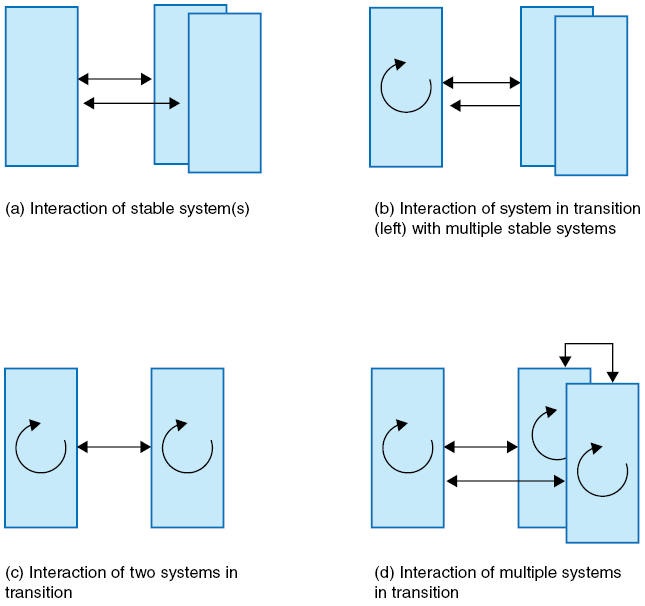
We further distinguish between multi-system interactions, referring to different types of couplings and resource flows between systems, and multi-system dynamics, which refer to socio-technical change processes (of varying depth) significantly influenced by other systems (i.e. Figure 10.1(b)–(d)). Although interactions and dynamics obviously are closely related, we make the distinction to emphasise that zooming in on the interactions and couplings (e.g. how to design or create them) is only one part of the broader research topic of multi-system dynamics. The distinction also highlights that different multi-system dynamics phenomena may involve similar types of multi-system interactions.
10.2.1 Technological Innovation System Perspective
The technological innovation system (TIS) perspective places a selected technology center stage with the idea to analyse its prospects, often including drivers and barriers (Bergek et al., Reference Bergek, Jacobsson, Carlsson, Lindmark and Rickne2008; Hekkert et al., Reference Hekkert, Suurs, Negro, Kuhlmann and Smits2007). The focus is typically not only on early stages of innovation but also diffusion of innovations from small to mass markets as well as mature technologies and those in decline have been studied (Andersen & Gulbrandsen, Reference Andersen and Gulbrandsen2020; Carlsson & Jacobsson, Reference Carlsson and Jacobsson1994; Markard et al., Reference Markard2020).
Types of systems: From the outset, it was acknowledged that TIS necessarily interact with other systems in its context (Carlsson & Stankiewicz, Reference Carlsson and Stankiewicz1991; Edquist, Reference Edquist and Edquist1997; Markard & Truffer, Reference Markard and Truffer2008). These systems include other technological innovation systems (Bergek, Hekkert, Jacobsson, Markard, Sanden, & Truffer, Reference Bergek, Hekkert, Jacobsson, Markard, Sandén and Truffer2015), established socio-technical systems (Markard et al., Reference Markard, Wirth and Truffer2016) different systems in a technology value chain (Andersen & Markard, Reference Andersen and Markard2020; Mäkitie et al., Reference Mäkitie, Hanson, Steen, Hansen and Andersen2022; Stephan et al., Reference Stephan, Schmidt, Bening and Hoffmann2017) and systems at other spatial scales (Binz & Truffer, Reference Binz and Truffer2017). This shows that there is a broad range of systems whose interactions we can study. We will get back to this in Section 10.3.
Types of interactions: Bergek et al. (Reference Bergek, Hekkert, Jacobsson, Markard, Sandén and Truffer2015) distinguished two types of interactions between a focal TIS with systems in its context: links and structural couplings (Bergek, Hekkert, Jacobsson, Markard, Sanden, & Truffer, Reference Bergek, Hekkert, Jacobsson, Markard, Sandén and Truffer2015). The former capture uni-lateral influences (i.e. context systems affecting the TIS but not vice versa), whereas the latter capture bi-lateral interdependencies. Structural couplings are understood as elements (e.g. actors, networks, institutions, technologies) shared by the focal TIS and context systems. The same actors, for instance, may operate in multiple systems, technologies may be used in multiple systems and systems may also have similar institutions (e.g. mass production logic) (Bergek, Hekkert, Jacobsson, Markard, Sandén, & Truffer, Reference Bergek, Hekkert, Jacobsson, Markard, Sandén and Truffer2015). For example, some oil companies diversified into offshore wind creating new structural couplings between the oil and gas system and the offshore wind TIS (Mäkitie et al., Reference Mäkitie, Andersen, Hanson, Normann and Thune2018). Scholars have also referred to functional couplings (see below) between the systems involved in a TIS value chain to describe the flows of material resources between them (Gong & Andersen, Reference Gong and Andersen2024). A TIS may also have linkages to context systems as finance, education or science (Fontes et al., Reference Fontes, Bento and Andersen2021; Malhotra et al., Reference Malhotra, Schmidt and Huenteler2019).
Main insights: In our reading, TIS studies have made at least three contributions to multi-system dynamics. First, novel technologies need to be embedded into a wider context of existing systems and structures: to obtain resources, to benefit from complementary innovations, to attract firms, to receive policy support or to create legitimacy (Binz et al., Reference Binz, Harris-Lovett, Kiparsky, Sedlak and Truffer2016; Binz & Truffer, Reference Binz and Truffer2017; Karltorp et al., Reference Karltorp, Guo and Sandén2017; Wirth & Markard, Reference Wirth and Markard2011). For this embedding, an emerging TIS must adapt (to a certain extent) to the structures of existing systems in its context, e.g. by addressing context problems. For our review, it is important to note that there can be a wide range of different systems to interact with, plus a wide range of interactions.
Second, the interactions between systems change over time. As a technology matures and the associated TIS grows, it starts to increasingly influence context systems, potentially also creating conflicts (Markard, Reference Markard2020; Markard et al., Reference Markard, Wirth and Truffer2016). The result is a shift from dependence to interdependence (or integration) between focal TIS and context systems. Also, resource flows change. While knowledge flows across systems might dominate in early stages of TIS development (Malhotra et al., Reference Malhotra, Schmidt and Huenteler2019), later stages increasingly demand additional flows of resources such as materials (e.g. minerals for batteries), skilled labor and capital for upscaling (Jacobsson & Karltorp, Reference Jacobsson and Karltorp2013). The new demand for resources might be a source of competition and conflict with other systems (Wirth & Markard, Reference Wirth and Markard2011). For our review, we note that system interactions and interdependencies may change as systems transform.
Third, TIS studies have highlighted the relevance of a technology value chain perspective, which widens the focus from a selected part of an innovation to broader up- and down-stream developments (Andersen & Markard, Reference Andersen and Markard2020; Sandén & Hillman, Reference Sandén and Hillman2011; Stephan et al., Reference Stephan, Schmidt, Bening and Hoffmann2017). The value chain approach therefore divides a TIS into various subsystems corresponding to different parts of the value chain including upstream (produce important materials and components of the technology), midstream (integration of components and manufacturing of technology units) and downstream (where technology is used). Each subsystem is embedded in different institutional environments and actor-networks. For example, for electric vehicles, the subsystem related to raw materials (e.g. lithium or graphite) is embedded in the mining system, the subsystem related to integration and manufacturing is embedded in the automotive industrial system, the utilisation subsystem is embedded in the wider transportation system and subsystem related to recycling is embedded in the waste management system (Gong & Andersen, Reference Gong and Andersen2024). A key issue for TIS value chain performance is to achieve sufficient institutional alignment and actor coordination across the heterogeneous systems involved to avoid bottlenecks (Malhotra et al., Reference Malhotra, Schmidt and Huenteler2019; Stephan et al., Reference Stephan, Schmidt, Bening and Hoffmann2017). This perspective is particularly helpful for grasping widespread diffusion of a focal technology where establishing and upscaling a value chain is important (Markard, Reference Markard2020). For multi-system dynamics, we note that heterogeneity of sectoral systems in the value chain can complicate actor collaborations and lead to bottlenecks in resource flows in the TIS.
10.2.2 Multi-level Perspective
The multi-level perspective (MLP) was developed to study transitions of socio-technical systems, juxtaposing the emergence of novelty in niches and the persistence of existing structures in regimes, both affected by exogenous developments at the so-called landscape level (Geels, Reference Geels2002, Reference Geels2006, Reference Geels and Hendriks2024).
Multi-system interactions in the MLP have played some role early on. Examples include niche innovations such as combined heat and power plants or biorefineries: they affect, interact with and potentially bridge different socio-technical systems (Raven & Verbong, Reference Raven and Verbong2007; Sutherland et al., Reference Sutherland, Peter and Zagata2015). Similarly, landscape developments such as market liberalisation affect multiple socio-technical systems, creating similarities across systems (Konrad et al., Reference Konrad, Truffer and Voß2008).
Types of systems: The MLP literature focuses on socio-technical systems. Recent MLP split up socio-technical systems into production, distribution and consumption subsystems, which means that also the relationships between these subsystems can be studied as multi-system interactions (Bauknecht et al., Reference Bauknecht, Andersen and Dunne2020; McMeekin et al., Reference McMeekin, Geels and Hodson2019). Others differentiate subsystems according to technologies (e.g. car, train and airplane regimes and car-sharing, mobility as a service and electric vehicle niches within the whole system of transportation) and study interactions between these (Geels, Reference Geels2018; van Welie et al., Reference van Welie, Cherunya, Truffer and Murphy2018). The most common approach is to study regime–regime interaction (e.g. oil and gas with internal combustion engine vehicles), regime–niche interactions (e.g. hydropower regime and electric vehicle niche) and niche–niche interactions (e.g. electric vehicles and roof-top solar), for niches and regimes located in different socio-technical systems (Haley, Reference Haley2015; Papachristos et al., Reference Papachristos, Sofianos and Adamides2013; Raven & Verbong, Reference Raven and Verbong2007).
Types of interactions: Konrad et al. (Reference Konrad, Truffer and Voß2008) distinguishes between functional and structural couplings as main types of multi-system interactions. Functional couplings refer to flows of resources across systems (e.g. materials, energy, financial resources) that create functional interdependencies. Structural couplings refer to overlaps in the elements of two or more socio-technical systems, i.e. actors, technology or institutions (Konrad et al., Reference Konrad, Truffer and Voß2008; Sutherland et al., Reference Sutherland, Peter and Zagata2015; van der Vleuten, Reference van der Vleuten2019). Another distinction is about modes of system interactions where scholars have suggested various types: (1) competition, (2) symbiosis, where systems develop functional relationships (Nykamp et al., Reference Nykamp, Andersen and Geels2023), (3) integration, where separate systems become integrated via a new innovation (Bakhuis et al., Reference Bakhuis, Kamp, Barbour and Chappin2024), (4) spillover, where elements from one systems are taken up within another (Konrad et al., Reference Konrad, Truffer and Voß2008; Mäkitie et al., Reference Mäkitie, Hanson, Steen, Hansen and Andersen2022) and (5) niche interference, in which niche-innovations in different systems interact and co-evolve (Papachristos et al., Reference Papachristos, Sofianos and Adamides2013; Verbong et al., Reference Verbong, Geels and Raven2007).
Main insights: The MLP holds three main insights for understanding multi-system dynamics. First, transitions in one system can be constrained by inertia in other systems, thereby making transition processes more complex (Bakhuis et al., Reference Bakhuis, Kamp, Barbour and Chappin2024). Required changes in other systems may be a mix of minor (e.g. expanding biomass production in agriculture) or major changes (e.g. shifting to renewables in electricity supply for low-carbon electric vehicles) that can result in coupled transitions across multiple systems (Nykamp et al., Reference Nykamp, Andersen and Geels2023).
A second insight is that inherent differences between socio-technical systems (e.g. system architecture, regulations, culture, business models, user practices) may complicate creating new interactions and halt unfolding multi-system dynamics. Even when new interactions could benefit both systems, we might see disagreements, misunderstanding and conflicts between central actors (Andersen, Geels, Steen, & Bugge, Reference Andersen, Geels, Steen and Bugge2023; Ertelt & Kask, Reference Ertelt and Kask2024; Raven & Verbong, Reference Raven and Verbong2007; Sutherland et al., Reference Sutherland, Peter and Zagata2015).
Third, multi-system interactions may be uneven or asymmetric. For example, systems may differ in terms of resources and power, or exposure to external pressure to change. Such asymmetries can result in one-sided solutions, or disruptions (e.g. new electrifying sectoral systems critical depend on grid access but grid actors are not dependent on new users reflecting markedly different incentive structures) (Nykamp et al., Reference Nykamp, Andersen and Geels2023; Rosenbloom, Reference Rosenbloom2019). The challenges from system differences often surface once a focal innovation starts to diffuse widely and incumbent actors rather than pioneers need to change (Andersen, Geels, Steen, & Bugge, Reference Andersen, Geels, Steen and Bugge2023; Geels, Reference Geels2021). Multi-system interactions are thus also about power and politics.
10.2.3 Deep Transitions Perspective
The DT perspective looks at large-scale, fundamental and long-term socio-economic transformations (Schot & Kanger, Reference Schot and Kanger2018). A central concept is surges of development which refers to major transformations such as the age of Steel, Electricity and Heavy Engineering (Perez, Reference Perez2009). Each surge involves transitions in individual socio-technical systems and the emergence of a new ‘multi-system complex’ (i.e. a novel configuration of multiple systems that interact in a coordinated manner). DT suggests that surges typically share common directionality because they are guided by a macro-level selection environment creating between-surges continuity (Davies & Schot, Reference Davies, Schot, Wesche and Hendriks2024).
A deep transition is viewed as a series of connected and fundamental transitions in multiple socio-technical systems in a similar direction that involves discontinuity in the macro-level selection environment (Schot & Kanger, Reference Schot and Kanger2018). The DT framework builds on the multi-level perspective and on the techno-economic paradigm framework (Davies & Schot, Reference Davies, Schot, Wesche and Hendriks2024; Perez, Reference Perez2009). The idea is to better understand the larger context (or landscape), in which contemporary transitions unfold, and how this context changes. The perspective is particularly interested in the emergence of overarching structures (e.g. production and consumption practices) that guide and affect multiple socio-technical systems (Kanger & Schot, Reference Kanger and Schot2019). Key concepts include meta-rules (norms and institutions that span multiple systems) and meta-regimes (sets of rules that span multiple systems) (Kanger, Reference Kanger2022).
The process of DT involves several steps. New rules emerge in niches in individual socio-technical systems in response to (meta-)regime problems. The new rules compete with incumbent rules, and eventually, they replace existing rules and create a new regime. New rules increasingly cross system boundaries, thereby turning into meta-rules. They might lead to cross-system alignments although variety and contestations may still occur. Subsequently, new meta-rules combine in a new meta-regime which spreads across different socio-technical systems. Finally, the new meta-regime acts as a selection environment for new niches and diffuses to more and more systems, ultimately changing the landscape (Kanger & Schot, Reference Kanger and Schot2019; Schot & Kanger, Reference Schot and Kanger2018). Industrial mass-production, digitalisation or servitisation can serve as examples here.
Types of systems: The DT perspective looks at socio-technical systems. Its primary interest is in the diffusion of meta-rules and meta-regimes across different socio-technical systems and how these systems become aligned and connected in a complex of systems as a consequence.
Types of interactions: A key form of interaction in the DT perspective is that socio-technical systems develop common features over time through the presence and workings of meta-rules and meta-regimes – similar to the idea of isomorphism in institutional theory (DiMaggio & Powell, Reference DiMaggio and Powell1983). As underlying mechanisms, DT also mentions functional and structural couplings. They are regarded both as transmission channels of and as means for consolidating meta-rules. DT also discusses the role of organisations (e.g. consultancies, international organisations) in creating and shaping couplings between meta-regimes (Schot & Kanger, Reference Schot and Kanger2018; van der Vleuten, Reference van der Vleuten2019). To emphasise flows of ideas or legitimacy, the notion of rhetorical couplings is used. It refers to cross-system discourses, i.e. referring to an activity/rule in one system to legitimise an activity in another system (Kanger & Sillak, Reference Kanger and Sillak2020).
Main Insights: First, the DT perspective broadens the scope of analysis to a broad range of interconnected socio-technical systems. In fact, the framework theorises the interplay of transition processes at the level of individual socio-technical systems and larger complexes of systems (Kanger & Schot, Reference Kanger and Schot2019; Schot & Kanger, Reference Schot and Kanger2018). In MLP terms, it can be viewed as a theory of landscape changes, which is mindful about the directionality of multi-system dynamics.
Second, DT is concerned with similarities across systems and how they emerge. It shows how transformations of individual systems may generate new meta-rules (or change existing ones) and how these may combine into meta-regimes and diffuse across multiple systems (Kanger, Reference Kanger2022).
Third, the framework points to agency and the role different kinds of actors play in the creation and diffusion of meta-rules (Kanger et al., Reference Kanger, Schot, Sovacool, van der Vleuten, Ghosh, Keller, Kivimaa, Pahker and Steinmueller2021; van der Vleuten, Reference van der Vleuten2019). However, this aspect has not been elaborated systematically yet and empirical studies are required here.
Finally, the DT perspective highlights the importance of directionality (and potential lock-ins) created by meta-rules. As such the perspective enables transition scholars to examine issues around deep-rooted societal values, conventions and practices associated with capitalism, equality, our relationship with nature or the exploitation of resources (Kanger et al., Reference Kanger2022).
10.3 Discussion and Outlook
A general feature of multi-system perspectives is that elements, which were treated as context or landscape before, are now integrated into the analysis (endogenised). This allows for more encompassing analyses of (new) multi-system phenomena, but it also makes the conceptual frameworks more complex. Our review shows that there is so far not one dominant approach to study multi-system interaction phenomena. Instead, multi-system dynamics have been analysed with different frameworks and at different levels of aggregation. Multiple systems are at the core of the DT framework and have also gained more attention recently for TIS and MLP. There are some conceptual overlaps among the frameworks but also many differences. In this section, we share reflections and discuss future research needs that can aid cross-framework synthesis and advance our knowledge about multi-system dynamics. We focus on three topics: (i) systems, (ii) interactions and (iii) phenomena, see Table 10.2.
10.3.1 Systems
Our review revealed that scholars have analysed interactions between a broad range of different systems. So, a key task for future studies will be to be explicit about the type of systems studied, about which analytical boundaries were set and why, and what multi-system phenomena are in the focus. On this basis, we can start to analyse why, how, when and where interactions take place or change.
In the review, we observed four ways of delineating a socio-technical system: (a) complexes of systems comprised of various socio-technical systems that are functionally interdependent, exchange resources and may be coordinated by shared (meta) rules such as the complex made up by oil and gas, oil-based transport, fossil-based energy and petrochemical systems emerging in the early twentieth century, (b) socio-technical systems in the traditional sense, providing societal services such as energy, water or transport and covering production, distribution and consumption domains. (c) sub-systems of socio-technical systems or sectors (e.g. power supply, distribution systems, chemicals or mining) and (d) systems associated with specific technologies e.g. windmills or electric vehicles which are applied in yet other systems/sectors to generate their key service.Footnote 2 Reminiscent of this, we note a tendency to narrow system boundaries for analysing multi-system dynamics, e.g. focusing on production, distribution or consumption sub-systems rather than the larger socio-technical system as one. Splitting up ‘whole systems’ to better characterise subsystems and technologies as well as how they differ and interact is one way of handling the growing complexity of multi-system dynamics and real-world transitions. Regardless of these different system delineations, it is worthwhile to remember that some flexibility in boundary setting remains and that different research questions require different system boundaries.
We also observe that multi-system dynamics may unfold ‘horizontally’ or ‘vertically’ (also see Bergek et al., Reference Bergek, Hekkert, Jacobsson, Markard, Sandén and Truffer2015 for similar observation). Horizontal multi-system dynamics may refer to relationships between production, distribution and consumption domains in the provision of a societal service or between distinct systems of provision (e.g. water, energy, transport) (McMeekin et al., Reference McMeekin, Geels and Hodson2019). Vertical multi-system dynamics may refer to the systems connected via value chains covering mining, materials, manufacturing and use of a particular technology or product (Andersen et al., Reference Andersen, Steen, Mäkitie, Hanson, Thune and Soppe2020; Stephan et al., Reference Stephan, Schmidt, Bening and Hoffmann2017). These types of multi-system dynamics are rarely considered in an integrated way which arguably obscures some aspects of transitions. Think of how limited critical minerals and underwhelming manufacturing capacity in Europe influence further developments in production (renewable energy diffusion), distribution (power cables, transformers and battery systems) and consumption (batteries and electric vehicles) (Andersen et al., Reference Andersen, Mäkitie, Steen and Wanzenböck2024; Edler et al., Reference Edler, Blind, Kroll and Schubert2023).
In addition, there is so far limited attention to describing and analysing system differences (e.g. structures or business cultures) and how these influence system interactions (Miörner et al., Reference Miörner, Binz and Fuenfschilling2021; Nykamp et al., Reference Nykamp, Andersen and Geels2023). Indeed, understanding the combination of cross-system (inter)dependencies and system differences is a basic rationale for multi-system analysis.
We also observe that although interacting systems can be spatially delineated (e.g. local vs. global) and multi-system interactions unfold across different places (e.g. electricity systems in Germany and Denmark), that area of multi-system analysis merits more attention to connect the geography of transitions (Binz et al., Reference Binz, Coenen, Murphy and Truffer2020).
10.3.2 Interactions
In terms of types of interactions, we noted a significant variety in the literature (modes and types), but also that the concept of structural couplings has received attention in all three perspectives, and it might be promising to study and develop further.
As also noted by Rosenbloom (Reference Rosenbloom2020), interaction concepts are, across the three frameworks, mostly applied descriptively and in an abstract and macroscopic manner which leads to a limited understanding of local, micro-level accounts of how system interactions are created and changed in practice (Andersen & Geels, Reference Andersen and Geels2023; Breitschopf et al., Reference Breitschopf, Grimm, Billerbeck, Wydra and Köhler2023; Rosenbloom, Reference Rosenbloom2020). This is important because the emergence and scaling of new low-carbon value chains, sustainable transitions of systems and of complexes of systems all involve the creation of many new interactions.
We acknowledged that transition scholars have recently made efforts to address this issue by identifying structural coupling mechanisms related to the dimensions of technology (technological complementarities such as the need for particular inputs or complementary innovations), actors (e.g. company diversification across systems creates organisational couplings and capability or value changes in multi-system consumers can transmit these across systems) and institutions (e.g. actors can build cross-system institutional couplings to overcome system differences, and similar changes in cultural conventions in distinct systems can lead to new institutional couplings) (Andersen & Geels, Reference Andersen and Geels2023; Andersen, Geels, Steen, & Bugge, Reference Andersen, Geels, Steen and Bugge2023; Ertelt & Kask, Reference Ertelt and Kask2024; Käsbohrer et al., Reference Käsbohrer, Hansen and Zademach2024; Löhr & Chlebna, Reference Löhr and Chlebna2023; van der Vleuten, Reference van der Vleuten2019).Footnote 3 A related proposal is to shift analytical focus from individual couplings to multi-system sites or interfaces that encompass multiple different couplings and their interrelations (Andersen, Geels, Steen, & Bugge, Reference Andersen, Geels, Steen and Bugge2023; Löhr & Chlebna, Reference Löhr and Chlebna2023; Rosenbloom, Reference Rosenbloom2020). An interface approach draws attention to how inter-system domains are created and associated tensions and conflicts. Despite these suggestions, the analysis of multi-system interactions and multi-system dynamics more broadly would benefit from more attention to the role of actor strategies and of politics, i.e. how actors and coalitions work to influence the pace and directionality of multi-system dynamics (see Löhr et al., Reference Löhr, Markard and Ohlendorf2024; Ohlendorf et al., Reference Ohlendorf, Löhr and Markard2023).
In terms of the content of interactions, we note that for TIS and MLP, multi-system interactions are often about flows of (tangible and intangible) resources across system boundaries (e.g. electricity, fuels, data, materials, finances). DT, however, focus on diffusion of rules, ideas and principles which often is a precursor to tangible resource flows that, in turn, require new structural couplings to consolidate. While resource flows are facilitated by specific structural couplings (Andersen & Geels, Reference Andersen and Geels2023), our understanding of how meta-rules travel across systems is less clear. DT suggests rhetorical couplings as transmission mechanism, but this concept remains rather unexplored, e.g. how are they created and how do they relate to structural couplings.
Lastly, we note that multi-system interactions are almost exclusively studied in relation to the emergence or diffusion of new technologies or practices. However, as highlighted by DT, existing, unsustainable systems are already connected via bundles of functional and structural couplings. Such couplings may imply greater resilience to external pressures for change and suggest that incumbency is inherently a multi-system phenomenon (Andersen & Gulbrandsen, Reference Andersen and Gulbrandsen2020; Johnstone et al., Reference Johnstone, Stirling and Sovacool2017). It is therefore important for future studies to explore the role of multi-system interactions in destabilisation and decline of systems or complexes of systems.
10.3.3 New Multi-system Dynamics Phenomena
From our review, we note that TIS and MLP studies largely focus on ‘bilateral’ multi-system dynamics, i.e. between a focal technology or system, and context systems (Figure 10.1(b) or (c)). DT, however, considers deep transitions across most if not all socio-technical systems in the economy (Figure 10.1(d)). DT does apply the notion of a complex of systems which is used to describe clusters of co-evolving systems (or surges) around particular impactful technologies or energy carriers which is seen as a mechanism for bringing about DT. However, from a sustainability transitions perspective, the emergence of complexes is an important phenomenon in its own right. While DT does provide an abstract account of how such complexes emerge and transform, it remains quite ’broad-brushed’ and insufficient with respect to e.g. diffusion and coupling mechanisms, actor strategies, system properties, tensions and conflicts as well as governance issues (Kemp et al., Reference Kemp, Pel, Scholl and Boons2022).
Many currently unfolding multi-system transition processes such as net-zero, circular economy or digitalisation resemble multi-system complexes ‘in the making’. To better grasp such multi-system dynamics, we need more conceptual exploration of the emergence and transformation of system complexes as this currently escapes existing frameworks.
Contemplating the example of low-carbon electrification reveals some of the limitation of existing frameworks. While there are several studies of low-carbon electrification, these tend to focus on a focal innovation and/or bi-lateral multi-system dynamics (see e.g. Andersen, Geels, Steen, & Bugge, Reference Andersen, Geels, Steen and Bugge2023; Käsbohrer et al., Reference Käsbohrer, Hansen and Zademach2024; Löhr & Chlebna, Reference Löhr and Chlebna2023). However, low-carbon electrification as phenomenon exhibits dynamics that merit a multi-system complex approach (see e.g. Markard & Rosenbloom, Reference Markard, Rosenbloom, Rogge, Kern and Meadowcroft2022; Nykamp et al., Reference Nykamp, Andersen and Geels2023; Ryghaug & Skjølsvold, Reference Ryghaug and Skjølsvold2023), see Text Box 10.1.
Low-carbon electrification involves interdependent changes in production (decarbonise electricity generation), consumption (use clean electricity where possible) and distribution domains (adapt the grid system to facilitate generation and consumption changes). Some also include the production, distribution and consumption of green hydrogen in (indirect) low-carbon electrification which further expands the complex of involved systems (BNEF, 2020; ETC, 2021).
Systems: In Norway, for example, low-carbon electrification is established in the electricity production system which is fully decarbonised. In terms of consumption, low-carbon electrification is already well-established in personal car transportation (EVs). Driven by climate policy, direct electrification has in recent years continued to spread to maritime transport, buses, heavy transport, construction, industry and oil and gas systems. Indirect electrification via green hydrogen, ammonia and other e-fuels is also receiving increasing interest in systems as chemicals and shipping (Hansen et al., Reference Hansen, Andersson, Finstad, Hanson, Hellsmark, Mäkitie, Nordholm and Steen2024). To stimulate economic development around the electrification efforts, policymakers and companies try to build new upstream sectors within strategic technology value chains including battery manufacturing, low-carbon mining for critical materials, electric vessels, smartgrid systems and manufacturing electrolysers (Bugge et al., Reference Bugge, Andersen and Steen2021; Ryghaug & Skjølsvold, Reference Ryghaug and Skjølsvold2023). The scope of the complex thus covers an array of different systems and sectors, and thus include both horizontal and vertical multi-system dynamics.
Interactions: Key resource flows between these systems include electricity, fuels, materials and technology components. However, the success of electrification in personal transport spurred electrification of other systems – legitimacy around the idea of ‘electrify everything’ diffused across multiple systems and applications (Mäkitie et al., Reference Mäkitie, Hanson, Steen, Hansen and Andersen2022; Ryghaug & Skjølsvold, Reference Ryghaug and Skjølsvold2023). In the process, several new interface actors and roles emerged to connect these new systems and sectors via structural couplings and help mitigate inherent institutional differences and outlooks. For example, electric utilities developed new electrification divisions, start-ups provided mobile battery systems for temporary use in construction, port organisations did intermediation between maritime and land-based transport as well as energy and industrial systems, and environmental NGOs created new cross-system meeting places (Andersen, Geels, Steen, & Bugge, Reference Andersen, Geels, Steen and Bugge2023; Bjerkan et al., Reference Bjerkan, Ryghaug and Skjølsvold2021).
Several tensions and bottlenecks in the complex were also observed. For example, growing new consumption requires that generation capacity must expand significantly which, especially for wind power, is challenged by low social acceptance (Korsnes et al., Reference Korsnes, Loewen, Dale, Steen and Skjølsvold2023). Also, the speed and scale of planned new electricity production and consumption (e.g. energy-intensive processing sectors, oil and gas, hydrogen and data centers) overwhelmed actors in the electricity grid system resulting in major interconnection queues (Nykamp et al., Reference Nykamp, Andersen and Geels2024). In this context, new tensions emerge about who should get priority access to low-carbon electricity (oil and gas or green hydrogen projects?). Tensions and delays also created new uncertainty about the boundary between electrification versus other options such as carbon capture and storage in industry, blue hydrogen or even bioenergy (Inderberg et al., Reference Inderberg, Nykamp, Olkkonen, Rosenberg and Taranger2024).
Our general understanding of the processual aspects of how multi-system complexes change (emerge, contract/expand or decline) is still limited. More knowledge is needed e.g. about how new systems become included, whether and how complexes can build momentum (e.g. successful electrification in one system creates resources and support for electrification in other systems), the relation between horizontal and vertical multi-system dynamics within complexes, to what extent new meta-rules and -regimes are critical to complex development (in the electrification example it was not immediate clear) or which strategies actors pursue to navigate or expand complexes.
The questions raised above, will also be relevant for related phenomena. One example is about transitions from linear technology value chains to a circular economy, which depends on institutional alignments across interdependent actors and systems that often lead to tensions and conflicts (Kuhlmann et al., Reference Kuhlmann, Meuer and Bening2023), as well as changes in functional and structural couplings (Gong & Andersen, Reference Gong and Andersen2024; Magnusson et al., Reference Magnusson, Zanatta, Larsson, Kanda and Hjelm2022). The complex of systems perspective can also be useful for thinking about the challenges of multi-purpose technologies such as mobile phones, carbon capture or batteries. Such technologies take part in the transitions of multiple systems at the same time and connect them in a complex (see e.g. Decourt, Reference Decourt2019; Finstad & Andersen, Reference Finstad and Andersen2023). Next to these, phenomena as digitalisation (Andersen et al., Reference Andersen, Frenken, Galaz, Kern, Klerkx, Mouthaan, Piscicelli, Schor and Vaskelainen2021; John et al., Reference John, Wesseling, Worrell and Hekkert2022) or the bio-economy (Wirth & Markard, Reference Wirth and Markard2011) also seem to exhibit multi-system complex dynamics. Surely each of these evolving complexes have their own particularities that are waiting to be explored.
10.4 Conclusions
In this chapter, we have reviewed how three central transition studies frameworks conceptualise and analyse multi-system interactions and dynamics in transitions and discussed similarities and differences. We also outlined a research agenda for multi-system dynamics in transition studies building on opportunities for synthesising insights across the reviewed frameworks to better address new and emerging empirical multi-system dynamics phenomena.
An important omission from our chapter is methods for studying multi-system dynamics. It is easy to be fascinated by the interconnectedness a multi-system perspective reveals, but one should always critically ask what value-added to answering a specific question or understanding transition phenomena such a perspective brings. We noted the need to be careful about system boundaries but also the discussion about methods is still immature. Another omission from our review is policy and governance in relation to multi-system dynamics. Despite recent advances (Kanger et al., Reference Kanger, Sovacool and Noorkõiv2020; Rogge & Goedeking, Reference Rogge and Goedeking2024), the topic is rather novel, and we hope that our discussion of systems, interactions and phenomena can support future work on policy and governance (Rogge et al., Reference Rogge, Goedeking, Girones, Wesche and Hendriks2024).
Despite its limitations, our review aims to provide a starting point and an introduction to multi-system analysis in transition studies that we hope will inspire more scholars to engage with this rapidly emerging topic.
11.1 Introduction
This chapter examines how the concept of disruption has been used and defined in the context of sustainability transition studies. Sustainability transitions have often been described to involve ‘disruptions’. However, many writings in this field have been rather imprecise about what disruption means in the context of transitions, beyond the disruption of status quo. In the literature, references to disruptions have ranged from a discourse on disruptive niche innovations (Wilson & Tyfield Reference Wilson and Tyfield2018) to disruptive landscape influences (Geels & Schot Reference Geels and Schot2007). A systematic literature review conducted in 2020 revealed that the conceptualisation of disruption was often imprecise and empirical studies were oriented to the energy sector (Kivimaa et al. Reference Kivimaa, Laakso, Lonkila and Kaljonen2021). In the review, we defined disruption as a ‘high-intensity effect in the structure of the socio-technical system(s), demonstrated as long-term change in more than one dimension or element, unlocking the stability and operation of incumbent technology and infrastructure, markets and business models, regulations and policy, actors, networks and ownership structures, and/or practices, behaviour and cultural models’ (Kivimaa et al. Reference Kivimaa, Laakso, Lonkila and Kaljonen2021: p. 119).
In this chapter, we build on this definition of disruption and complement the understanding by reviewing the most recent literature on disruption, adding to the initial review comprising 47 articles. While disruption as a concept originates from the literature on disruptive innovation, we can see its recent expansion in transitions studies encompassing whole socio-technical systems. This chapter provides much-needed clarity on the conceptual confusion that has ensued and evaluates the links between the concept of disruption, and the ways in which mainstream technologies, practices and business models in socio-technical regimes need to be phased-out (Johnstone & Hielscher Reference Johnstone and Hielscher2017; Koretsky & van Lente Reference Koretsky and van Lente2020), destabilised (Karltorp & Sandén Reference Karltorp and Sandén2012; Turnheim & Geels Reference Turnheim and Geels2013; Turnheim Reference Turnheim, Koretsky, Stegmaier, Turnheim and van Lente2022) or decline (Koretsky et al. Reference Koretsky, Stegmaier, Turnheim and Lente2022; Novalia et al. Reference Novalia, McGrail, Rogers, Raven, Brown and Loorbach2022; Rosenbloom and Rinscheid Reference Rosenbloom and Rinscheid2020). We end by examining the relevance of the concept of disruption to emerging scholarly and societal debate on just transitions.
11.2 Conceptualising Disruption in Transition Studies
Disruptive innovation emerged in the 1980s and 1990s innovation management literature, which described it as innovation which has industry-changing effects (Christensen Reference Christensen1997; Tushman & Anderson Reference Tushman and Anderson1986). Early definitions also described disruptive innovations to constitute products and services which may perform worse than mainstream products but result in other benefits to customers (Christensen Reference Christensen1997; Christensen & Rayner Reference Christensen and Rayner2003). These were described to contrast sustaining innovations which incrementally improved existing products or processes (Christensen & Rayner Reference Christensen and Rayner2003). Later literature has critiqued early literature of too simplistic arguments but agreed with the interpretation that disruption is related to the activities of incumbent actors (Markides Reference Markides2006) in a way that may force them to change their actions. Disruption, therefore, also connects to how incumbency has often been framed in the transitions literature as something that needs changing (Stirling Reference Stirling2019).
The literature on disruptive innovation has developed since then to a more nuanced direction. For example, more recent argumentation increasingly emphasised that disruption does not mean the loss of all competencies for incumbent firms (Ho & Chen Reference Ho and Chen2018) – as indicated by Abernathy and Clark (Reference Abernathy and Clark1985). Instead, incumbent actors are diverse and are not only passive targets of disruption, destabilisation or regime decline. Therefore, disruptive innovation and broader disruptive influences alike rather create a reason for incumbents to change. This can occur, for instance, in the form of repurposing assets, reconfiguring products or reskilling workforce (Kivimaa & Sivonen Reference Kivimaa and Sivonen2023; Lonkila & Kaljonen Reference Lonkila and Kaljonen2021; Mäkitie Reference Mäkitie2020). Disruption can, in effect, lead to more substantial shifts in the practices of incumbents than more incremental change processes.
Figure 11.1 shows development in the use of the concept of disruption in innovation and transition studies from the 1980s until 2019. In both fields, one can see branching out to different uses and understandings.
Illustration of the evolution of the concept of disruption in innovation management and transition literatures.

One of the core arguments in the literature on disruption in sustainability transitions is that disruption can happen regarding different system dimensions (Johnstone et al. Reference Johnstone, Rogge, Kivimaa, Fratini, Primmer and Stirling2020). In the Kivimaa et al. (Reference Kivimaa, Laakso, Lonkila and Kaljonen2021) literature review, in addition to (1) technology, we identified four other dimensions regarding where disruptions may take place: (2) markets and business models, (3) regulations, policies and formal institutions, (4) actors and networks, as well as (5) behaviour, practices and cultural models. Table 11.1 provides some explanations regarding what disruption can mean in each of these categories.
| Dimension of disruption | Explanation |
|---|---|
| Technology |
|
| Markets and business models |
|
| Regulations, policies and formal institutions |
|
| Actors and networks |
|
| Practices, behaviour and cultural models |
|
A second argument is that disruption can be characterised in terms of magnitude and speed of change. The most typical association of disruption, perhaps, is an initially small magnitude of change in the form of disruptive innovation. Examples include e-bikes and solar thermal water tanks and potentially electric vehicles (Wilson Reference Wilson2018). Introduction of plant-based proteins into food systems (Bulah et al. Reference Bulah, Negro, Beumer and Hekkert2023) is an example of gradual small magnitude of change that has not changed the power structures in the food chain. A larger magnitude of change would require major shifts in the relations between farmers, food industry and retail (Lonkila & Kaljonen Reference Lonkila and Kaljonen2021). In a transitions context, large magnitude of change covers multiple elements of systems (see Table 11.2). Such change can be gradual or rapid, the latter more frequently associated with discontinuity, breakdown and replacement. For instance, a large magnitude gradual change can be exemplified by the ways in which the diffusion of wind and solar power have substantially altered the electricity system in many countries (Johnstone et al. Reference Johnstone, Rogge, Kivimaa, Fratini, Primmer and Stirling2020). In turn, more rapid large changes can result from ‘landscape shocks’, such as the COVID-19 pandemic and wars (see Chapter 7). Examples include the rapid and persistent change to telework and hybrid work (Newbold et al. Reference Newbold, Rudnicka, Cook, Cecchinato, Gould and Cox2022; Verma et al. Reference Verma, Venkatesan, Kumar and Verma2022). Harnessing such disruptive landscape events for large changes has also been called for (Markard & Rosenbloom Reference Markard and Rosenbloom2020). The Kivimaa et al. (Reference Kivimaa, Laakso, Lonkila and Kaljonen2021) review argued that it is not only rapid changes which should be accounted for as disruption but also gradual changes of large magnitude that result in whole system reconfigurations.
| Gradual change | Rapid change | |
|---|---|---|
| Large magnitude of change, covering multiple system elements or dimensions of disruption | Disruption associated with gradual transformation and subtle reconfiguration of the whole system | Disruption characterised by discontinuity, breakdown and replacement, stretch-and-transform of the whole system |
| Small magnitude of change, covering a single system element or dimension of disruption | Non-disruptive incremental change, sustaining existing system configurations | Disruption associated with disruptive innovation, fit-and-conform, survival and return |
Overall, in Kivimaa et al. (Reference Kivimaa, Laakso, Lonkila and Kaljonen2021), we emphasised that a multi-dimensional understanding of disruption is important, and it needs to go beyond technological change and high-tech innovation. Moreover, disruption in one system dimension can lead to a cascade of disruptions where, for instance, a technological disruption leads to business model disruption and a disruption in practices. For instance, technological advances in data sharing and programming created new business models around mobility-as-a-service with potential for broader transport transitions (Carbonara et al. Reference Carbonara, Messeni Petruzzelli, Panniello and De Vita2024; Kivimaa & Rogge Reference Kivimaa and Rogge2022). Or, alternatively, a disruption in actor-networks can create a regulatory or technological disruption. This is not, however, always the case. A technological disruption can also support established practices, such as in the case of biofuels or electric vehicles that maintain established private car-based mobility practices. There are many ways in which disruption in transitions unfold. In essence, disruption as a phenomenon is unpredictable and unruly, and, for instance, technological disruption can lead to changes to more unsustainable practices (Kivimaa et al. Reference Kivimaa, Laakso, Lonkila and Kaljonen2021).
11.3 New Understandings and Specifications
The research on disruption in transitions has expanded since late 2020, when the Kivimaa et al. (Reference Kivimaa, Laakso, Lonkila and Kaljonen2021) review was conducted. In 2020, a search of terms ‘disrupt*’ AND ‘sustainability transition*’ OR ‘socio-technical transition*’ OR ‘socio-technical transition*’ OR ‘societal transition*’ resulted in 47 relevant articles (Kivimaa et al. Reference Kivimaa, Laakso, Lonkila and Kaljonen2021: p. 112). In September 2023, the same search on Web of Science, for the years 2021–2023 resulted in 36 articles published as scientific articles (excluding our review article). The articles were published in a wide variety of sources, in 30 academic journals and over a dozen empirical contexts. The energy sector dominated with about a quarter of articles, followed by agriculture and food, COVID-19, urban development and circular economy. About a third did not have a specific country focus, while Germany was most often mentioned.
As an overview, it can be stated that no coherent interpretation of disruption still exists in the sustainability transitions’ literature. In general, the term ‘disruption’ or ‘disruptive’ are often used as regular descriptive words. In our updated light review, 20 articles out of the 36 articles found were discarded due to only using disruptive as descriptive term. A few discussed disruptions as transition phenomena but did not delve deeper into it empirically or conceptually. We analysed the remaining 13 articles more closely for the purposes of this book chapter to update the insights derived from the Kivimaa et al. (Reference Kivimaa, Laakso, Lonkila and Kaljonen2021) literature review. We identified how recent uses of the concept of disruption link to our previous categorisation in terms of technology, markets and business models, regulations, policies and formal institutions, actors and networks and practices, behaviour and cultural models (Table 11.1). The new articles especially addressed disruption in relation to niche or incumbent actors, the COVID-19 pandemic as a landscape disruption and the nature of disruption. We will sum up these insights below.
11.3.1 Actors and Disruption
Several of the new articles strengthen the understanding of niche actors in altering and disrupting existing practices and cultural models. For example, analysing institutional work related to plant-based protein innovations, Bulah et al. (Reference Bulah, Negro, Beumer and Hekkert2023) show that niche actors actively work to disrupt cultural norms and values upholding the meat regime. Disruptive actors also work to undermine the institutions upholding the regime and work to disrupt, for example, policy or monetary support to dominant regime technologies and practices. Also, Bobbins et al. (Reference Bobbins, Caprotti, de Groot, Pailman, Moorlach, Schloemann and Siwali2023) highlight the role of practices, community dynamics and lived experience of actors in enabling the disruptiveness of innovations, underlining that disrupting innovations never exist beyond and ‘apart from’ existing socio-technical systems and cultural dynamics but as integral parts of them.
Looking at the role of prosumers in the energy transition, Weigelt et al. (Reference Weigelt, Lu and Verhaal2021) show the active role of disruptive actors by illustrating that disruption emerges not only from disruptive technologies but also their application by actors. They found that prosumers applied niche innovations in a novel and disruptive manner, especially in relation to incumbent actors’ business models, showcasing an example of a ‘stretch-and-transform’ process (see Smith & Raven Reference Smith and Raven2012). Thus, recent research using the concept of disruption strengthens the understanding of disruptions as forces undermining regime institutions and their practices, and potentially accelerating transition to more sustainable practices. This is in accordance with the understanding of transition strategies by Smith and Raven (Reference Smith and Raven2012) and shows that niche actors can deploy innovations in disruptive or conforming ways in relation to the existing socio-technical regime.
In contrast to our earlier review of disruption (Kivimaa et al. Reference Kivimaa, Laakso, Lonkila and Kaljonen2021), recent work has paid more attention to the increasingly complex role of incumbents as agents in both promoting and resisting transition. While the traditional take on disruption regarding incumbent actors has been the reduced value of (i.e. a disruption to) existing skills and resources held by the incumbents (e.g. Abernathy & Clark Reference Abernathy and Clark1985; Turnheim & Geels Reference Turnheim and Geels2013), new research has revealed the opportunities for incumbents to repurpose their skills and resources in response to disruptions (Mäkitie Reference Mäkitie2020; Nemes et al. Reference Nemes, Chiffoleau, Zollet, Collison, Benedek, Colantuono and Dulsrud2021). Kivimaa and Sivonen (Reference Kivimaa and Sivonen2023) have interpreted this as a process of ‘disruption to and repurposing skills and assets’ in the context of regime decline (see chapter 11.4 on decline). While facing disruption of skills and assets, incumbents are in a rather passive position, repurposing them shows a more active reaction to the ongoing transition.
There are other possible actions too. In this vein, two papers highlight the multifaceted role of disruptive incumbent actors. Interestingly, Galvan et al. (Reference Galvan, Cuppen and Taanman2020) show, by analysing grid operators, that incumbent regime actors can engage in both disruptive and maintaining practices simultaneously. Incumbents’ work in disrupting institutions that create barriers for their interests may also open space for the growth of niches. In turn, Loehr et al. (Reference Loehr, Chlebna and Mattes2022) foreground that along disruptive actions of incumbents, it is also crucial to analyse defensive institutional work that aims to resist and prevent transition. Defensive work resists disruptions and is geared at maintaining existing practices of the regime. It can take the shape of delegitimising novel practices, rules and technologies (Lehmann et al. Reference Lehmann, Graf-Vlachy and Koenig2019; Loehr et al. Reference Loehr, Chlebna and Mattes2022). Defensive work may in its turn have a disruptive effect towards the transition process (Loehr et al. Reference Loehr, Chlebna and Mattes2022), in other words a disruption of disruption. This understanding of disruption as impeding ongoing developments towards sustainability offers a novel perspective on the dimensions of disruptive actors and disruptive behaviour and practices. We suggest that a more nuanced understanding of disruptive incumbency can open avenues for harnessing the role of incumbency in accelerating transition, while also offering conceptual tools for navigating the various forms of regime resistance as well as disruption.
11.3.2 The COVID-19 Pandemic and Disruption
Recent articles on disruptive landscape events, especially on the COVID-19 pandemic, highlight the usefulness of categorising different dimensions of disruption and a detailed analysis of what is being disrupted and by whom. While landscape-level shocks open an opportunity for rapid change on a large scale, recent research underlines the complexities and resistances faced by such disruptive processes. Nemes et al. (Reference Nemes, Chiffoleau, Zollet, Collison, Benedek, Colantuono and Dulsrud2021) emphasise how the COVID-19 pandemic is exceptional in its large-scale influence on all-encompassing disruption on supply chains, so essentially a substantial landscape shock (see Kanda & Kivimaa Reference Kanda and Kivimaa2020). They note that the pandemic revealed the need to develop more resilient socio-technical systems against future disruptions.
Markard and Rosenbloom (Reference Markard and Rosenbloom2020) argue that the disruptive power of landscape-level shocks, such as the COVID-19 pandemic, must be actively harnessed to accelerate the decline of carbon-intensive technologies, industries and practices. Disruptive landscape events have potential to break ‘carbon lock-ins’ and open and accelerate low-carbon pathways, but this must be coupled with long-term processes of destabilisation and phase-out, to prevent a return to the preceding status quo once the initial landscape disruption has passed. This indicates that disruption on the level of institutions and regulations is needed to realise the disruptive potential of landscape shocks, again pointing out the interrelatedness of different spheres of disruption and the limits of one dimension alone. Indeed, Hirth et al. (Reference Hirth, Oncini, Boons and Doherty2022) have criticised the expectation that disruptive events kick-start systemic change towards sustainability. They showed that the COVID-19 pandemic did not disrupt regime practices in the context of different food provision sectors, because routinised and non-deliberative practices hindered transformation. This underlines that, other disruptions, influencing practices and behaviour, are needed to realise the disruptive potential of landscape shocks. Landscape disruption alone seems insufficient to stimulate sustainability transitions.
11.3.3 Nature of Disruption: Outcome Versus Process
Novel work on disruption continues to address the debate on whether disruption should be understood as a transition process or its outcome. For instance, Lazarevic et al. (Reference Lazarevic, Salo and Kautto2022: p.5) present dealignment and destabilisation as processes within the sustainability transition that facilitate “the development of disruptive policy frameworks and governance arrangements that challenge existing systems”. Hence, they indicate, too, that destabilisation is the process and disruption the outcome and the means to achieve transitions. This matches the definition presented above (and in Kivimaa et al. Reference Kivimaa, Laakso, Lonkila and Kaljonen2021) that portrays disruption as transition-related change. Also, Simoens et al. (Reference Simoens, Fuenfschilling and Leipold2022) associate disruption as an outcome, describing disruptive discursive change that can unlock previously unchallenged values and beliefs, creating openings for alternative discourse.
Contrary to this understanding, Blomsma et al. (Reference Blomsma, Bauwens, Weissbrod and Kirchherr2023) regard disruption as a process with three phases: release, reorganisation and eruption. They associate ‘circular disruption’ to a formation of a new paradigm which differs from the linear model of innovation and economy and which refers to systemic, widespread and fast change. This understanding is in partial contradiction to our previous proposal (Table 11.2), where certain types of disruptions are also associated with gradual transformative change and reconfiguration. Blomsma et al. (Reference Blomsma, Bauwens, Weissbrod and Kirchherr2023) also call for increased reflexivity among the transition studies community, to move from describing historic disruptions to outlining the conditions necessary for accelerating systemic change in close collaboration with other actors. On the other hand, Heiges and O’Neill (Reference Heiges and O’Neill2022) highlight the value of descriptive policy analysis when evaluating the impacts of past and existing disruptive or destabilising policies. They show that in the case of plastics recycling in the US, existing niches were not mature enough to become dominant regime actors when a major policy event took place. This opened space for the emergence of multiple co-existing regimes as a novel transition pathway, which can create further understanding for transition dynamics and governance. In other words, examining past and ongoing policy developments can reveal unexpected transition dynamics and add to existing understanding of potential transition pathways (Heiges & O’Neill Reference Heiges and O’Neill2022).
11.4 Disruption in Relation to Destablisation, Decline, Phase-out and Just Transition
Destabilisation, decline and phase-out are closely linked concepts to that of disruption in sustainability transition studies. In this literature, the concepts of disruption and destabilisation share some similar characteristics but differ in their origin (Kivimaa et al. Reference Kivimaa, Laakso, Lonkila and Kaljonen2021). While the concept of disruption originates from innovation and management studies as something contrary to incremental innovation (see Christensen Reference Christensen1997), the concept of destabilisation originates from the changes affected by or initiating from the socio-technical regime (see Turnheim & Geels Reference Turnheim and Geels2012, Reference Turnheim and Geels2013). Therefore, destabilisation is an original concept of transition studies, whereas disruption is an ‘imported’ one. Moreover, destabilisation is mostly used in the context of the Multi-level perspective (MLP) (see Chapter 2), while disruption is used more broadly in transition studies (Kivimaa et al. Reference Kivimaa, Laakso, Lonkila and Kaljonen2021). As the understanding of disruption has expanded from radical niche innovations to landscape events and regime changes in different dimensions, the two concepts have clearly moved closer to one another. Their intertwining is needed to understand the broader societal processes linked to disruptions.
Turnheim (Reference Turnheim, Koretsky, Stegmaier, Turnheim and van Lente2022: p. 45) defines destabilisation as “a longitudinal process by which otherwise relatively stable and coherent socio-technical forms (systems, regimes, institutional arrangements, sets of practices and networks) become exposed to challenges significant enough to threaten their continued existence and their “normal” functioning, triggering strategic responses of core actors within the frame of existing commitments (preservation) and in some circumstances away from such commitments (transformation).” Also, Ghosh et al. (Reference Ghosh, Kivimaa, Ramirez, Schot and Torrens2021: p. 17) define destabilisation as reducing alignment between the different system elements “resulting in a process in which regime actors abandon behaviors, beliefs and values constituting the [socio-technical] regime”. Destabilisation is hence mostly understood as a process (Martínez Arranz Reference Martínez Arranz2017; Turnheim & Geels Reference Turnheim and Geels2013), which is caused by rapid or gradual disruption(s). One could argue that the process of destabilisation that creates disalignment between system elements may then be followed by disruptive changes within these system elements, leading to disruptive outcomes.
Decline, in contrast, relates to often a more objectifiable or quantifiable degradation of system performance (e.g. size, economic viability, population, hegemonic power, legitimacy), which can (but rarely does) lead to total decline (Turnheim Reference Turnheim, Koretsky, Stegmaier, Turnheim and van Lente2022: p. 45). In this sense, it comes closer to understanding of disruption as an outcome. Deliberate decline (Rosenbloom & Rinscheid Reference Rosenbloom and Rinscheid2020) and phase-out (Johnstone & Hielscher Reference Johnstone and Hielscher2017; Koretsky & van Lente Reference Koretsky and van Lente2020), in turn, relate to deliberate interventions seeking partial or total discontinuation of a socio-technical form that is deemed undesirable (Turnheim Reference Turnheim, Koretsky, Stegmaier, Turnheim and van Lente2022). This perspective also relates to disruption in terms of regulations, policies and institutions. Deliberate decline and phase-out, hence, are best understood as governance objectives, forms of intervention and as processes including several temporal phases. Lonkila et al. (Reference Lonkila, Lukkarinen, van Oers, Feola and Kaljonen2024) talk also of deliberate destabilisation (see also Kivimaa & Kern Reference Kivimaa and Kern2016; van Oers et al. Reference van Oers, Feola, Moors and Runhaar2021). However, similarly to how the concept of disruption is understood, there are also different interpretations of decline and phase out. For instance, Koretsky & van Lente (Reference Koretsky and van Lente2020) describe phase-out as a disruption, or unravelling, of the linkages between materials, competencies and meaning (see Shove et al. Reference Shove, Pantzar and Watson2012). Since phasing out implies the disruption of links between the materials-meanings-competences triad, they underline that losing one of them would not be enough (Koretsky & van Lente Reference Koretsky and van Lente2020). Most often, however, phaseout has been a narrower concept than disruption, destabilisation or decline. It has mainly focused on technology (Andersen & Gulbrandsen Reference Andersen and Gulbrandsen2020; Koretsky & van Lente Reference Koretsky and van Lente2020) or discourses (Rosenbloom Reference Rosenbloom2018; Trencher et al. Reference Trencher, Healy, Hasegawa and Asuka2019).
Turnheim (Reference Turnheim, Koretsky, Stegmaier, Turnheim and van Lente2022) underlines destabilisation as a dynamic context of action, involving pressures, strategic responses, varying commitments to prevailing commitments and for navigating the changing opportunities. In this way, the concept of destabilisation aims to capture the political dynamics related to transitions in a much more thorough way than the literature concerning disruptions. As also van Oers et al. (Reference van Oers, Feola, Moors and Runhaar2021) and Lonkila et al. (Reference Lonkila, Lukkarinen, van Oers, Feola and Kaljonen2024) highlight the way in which destabilisation challenges the positions of those in power; the political nature of destabilisation cannot be escaped. Incumbent responses to destabilisation may focus on resisting, hindering and slowing down phase-out policies because they not only pose a threat for their vested interests (van der Ploeg Reference van der Ploeg2020) but also more change-oriented responses are possible as illustrated by empirical studies (e.g. Mäkitie Reference Mäkitie2020). Furthermore, the strategic defensive work of incumbents can in turn be disruptive in a negative manner (Lehmann et al. Reference Lehmann, Graf-Vlachy and Koenig2019; Loehr et al. Reference Loehr, Chlebna and Mattes2022), as noted above. Resistance-oriented responses have been shown to emerge within the processes that unsettle technical competency, but are likely to be even more poignant when they touch upon regionally embedded livelihoods, practices, behaviours and cultural models of people (Cha Reference Cha2020; Janssen et al. Reference Janssen, Beers and van Mierlo2022; Lonkila et al. Reference Lonkila, Lukkarinen, van Oers, Feola and Kaljonen2024).
Recent research on destabilisation has called attention to a more plural understanding of incumbency beyond the focus on the most powerful (Andersen & Gulbrandsen Reference Andersen and Gulbrandsen2020; Stirling Reference Stirling2019; Turnheim & Sovacool Reference Turnheim and Sovacool2020). Local communities, workers and civil society organisations also embody attributes of incumbency with strong cultural, material and financial ties to existing regimes. Deliberate destabilisation and disruption should recognise such plurality and complexity of the incumbent ties, from which the different incumbent groups benefit. Addressing the existing injustices within the regime can assist in finding alternative pathways forward (Kuhmonen & Siltaoja Reference Kuhmonen and Siltaoja2022; Lonkila et al. Reference Lonkila, Lukkarinen, van Oers, Feola and Kaljonen2024). Andersen & Gulbrandsen (Reference Andersen and Gulbrandsen2020) show how realising the potential of recombinations and diversification of diverse incumbent firms and actors may dampen the possible negative effects of transitions such as loss of jobs and bankruptcy of firms.
The recent political and academic discussion on just transition also aims to capture and navigate the repercussions caused by destabilisation, decline, phase out or disruption (Kaljonen et al. Reference Kaljonen, Kortetmäki, Tribaldos, Huttunen, Karttunen, Maluf and Niemi2021; Newell et al. Reference Newell, Geels and Sovacool2022; Williams & Doyon Reference Williams and Doyon2019). In this literature, however, disruption as a concept is seldom referred to. The recent developments within this realm are nevertheless helpful for capturing and navigating the broader societal effects and tensions arising from disruption and/or destabilisation (Turnheim Reference Turnheim, Koretsky, Stegmaier, Turnheim and van Lente2022). We want to especially highlight two lines of conceptual development, where the first concerns navigating the inherent tensions between rapid and just transitions (Newell et al. Reference Newell, Geels and Sovacool2022) and environmentally and socially just transitions (Ciplet & Harrison Reference Ciplet and Harrison2020; Heffron & McCauley Reference Heffron and McCauley2022; Huttunen et al. Reference Huttunen, Tykkyläinen, Kaljonen, Kortetmäki and Paloviita2024; Stevis & Felli Reference Stevis and Felli2020). The second line of development aims to bring together the recent understanding on deliberate destabilisation and transformative policy mixes (see Chapter 14) together for finding ways forward, towards more active and emancipatory just transition policies, in contrast to policy measures focusing solely on distributive outcomes (Kaljonen et al. Reference Kaljonen, Paloviita, Huttunen and Kortetmäki2024). This debate emphasises issues of interest for managing disruptive outcomes: as transitions embody winners and losers, how should the effects of disruption be lessened or compensated and to whom and how should the resulting benefits and disadvantages be assessed and valued, across different scales (from local to global) and between different socio-economic and cultural groups of societies.
As the discussion on disruption moves gradually closer to the debates on regime destabilisation, decline and phaseout, a more nuanced understanding of incumbents, niche actors and just transitions are important for broadening the discussion. Importantly, it can open novel avenues for addressing the existing injustices and power relations within the regime. Here the perspective on restorative justice can be helpful as a counterforce for disruption. Restorative justice gives attention to the management of severe injustices that have already occurred and examines avenues for mitigating those harms, both on individual and communal levels (McCauley & Heffron Reference McCauley and Heffron2018). Restorative justice introduces a historical and anticipatory temporal dimension to destabilisation and assists in moving away from sole reactive approaches to more emancipatory approaches in addressing existing injustices and creating just alternative future pathways (Hazrati & Heffron Reference Hazrati and Heffron2021; Kuhmonen & Siltaoja Reference Kuhmonen and Siltaoja2022; Lonkila et al. Reference Lonkila, Lukkarinen, van Oers, Feola and Kaljonen2024).
11.5 Conclusions and Future Research Needs
Disruption is a term often used in sustainability transition studies but with differing meanings from a more descriptive approach to an analytical concept increasingly related to conceptualisations of regime decline, destabilisation and phaseout. Whereas the concept originated from studies of disruptive innovation, it has broadened its use in transition studies covering niche innovations, regime dynamics and a descriptor of landscape influence. This chapter highlighted the definition and dimensions of disruption presented in an earlier review (Kivimaa et al. Reference Kivimaa, Laakso, Lonkila and Kaljonen2021) and added new discussion from more recent literature and in relation destabilisation, decline and just transitions.
Disruption can be defined as a high-intensity outcome in the structure of the socio-technical system, which includes more than one system dimension. These dimensions include technology; actors and networks; markets and business models; regulations, policies and formal institutions; behaviour, practices and cultural models. Whereas the first studies addressed mainly technological disruption, more research has oriented to disruption in the context of actors (niche actors and incumbency) and in policy and institutional interventions as well as the role of the COVID-19 pandemic as a landscape-level disruption. As noted above, when the disruption concept has expanded from disruptive innovation to deal with system-level transitions, it has become more closely associated with other concepts oriented to socio-technical regime transformation: destabilisation, decline and phase out. This perhaps means that the added value of the concept of disruption is becoming reduced. However, whereas, for instance, phaseout has oriented mainly to technologies and discourses, disruption is attempting a broader coverage of different system dimensions affecting whole socio-technical systems. In addition, whereas destabilisation places focus on process, disruption is often oriented to the magnitude of change as an outcome of transition-related processes.
The definition of disruption provided in Kivimaa et al. (Reference Kivimaa, Laakso, Lonkila and Kaljonen2021), hence, still holds its place. In the future, the processual, and political, understanding of destabilisation can strengthen the understanding of large and small magnitude of disruptions further. Here, especially the more nuanced understanding of incumbents is critical in understanding their varying roles in disruptions, which may also be positive. Moreover, as the urgency of achieving a system-wide sustainability transition increases, it is critical to link the concept of disruptions to the understanding of the ‘flipside’ transitions and its strategic resistances in order to accelerate the needed just transitions. Likewise, the ability to survive and quickly recover from extreme and unexpected disruptions deserves further attention in transitions studies. Although resilience is closely related to disruptions, in particular in the current era of large landscape disruptions, resilience as a concept did not feature prominently in our literature review. Hence, connections between disruptions and resilience in transition processes should be a focus of future research (Jasiūnas et al. Reference Jasiūnas, Lund and Mikkola2021). Paying deliberate attention to restorative justice (Hazrati & Heffron Reference Hazrati and Heffron2021) can also provide a counterforce to disruptions. In a turbulent world, with many overlapping disruptive developments, transition studies should start to analyse more carefully what are the technologies, actors and networks, business models, regulations and policies, practices and cultural models that we want to save from disruption – and what require rapid disruption to address the increasing environmental sustainability challenges.
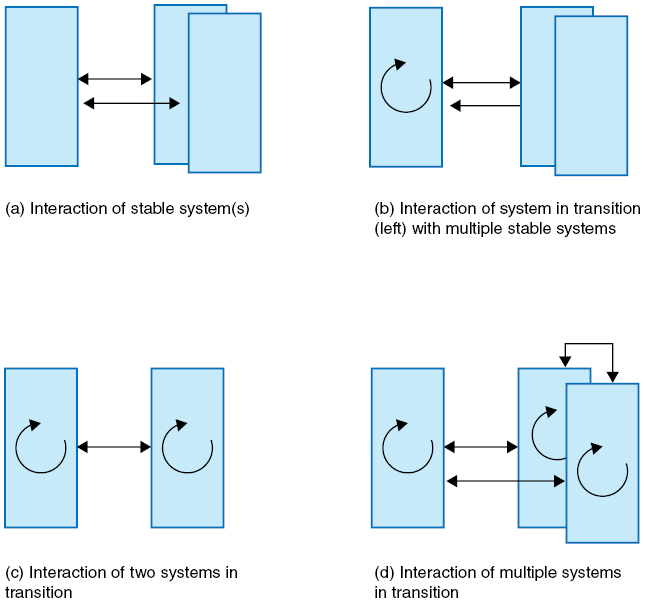
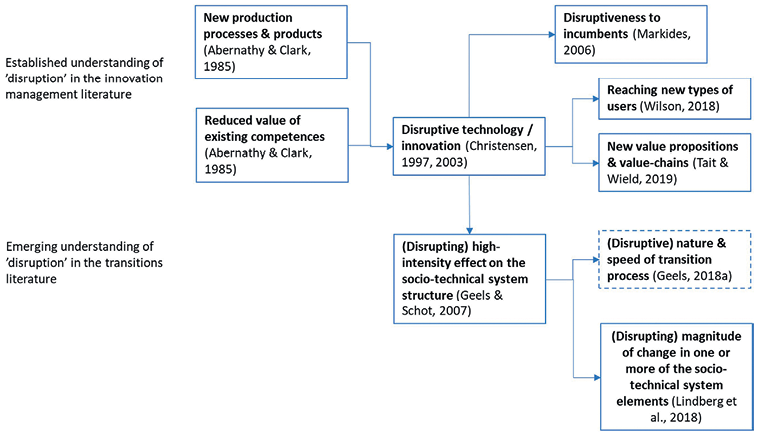

 Open access