Introduction
One of the most widely distributed, long-ranging, and distinctive blastozoan echinoderms in the Paleozoic fossil record is the hemicosmitid rhombiferan Caryocrinites Say, Reference Say1825. This taxon is a particularly conspicuous component of numerous carbonate and mudrock deposits in the middle Silurian of eastern and midcontinental North America and is the dominant echinoderm in some assemblages (Frest et al., Reference Frest, Brett, Witzke, Boucot and Lawson1999). Despite the abundance and long history of study of Caryocrinites, it is noteworthy that no specimens containing symbiotic pits have hitherto been described in detail. Stalked echinoderms displaying a paleopathological response to symbiotic (possibly parasitic) infestation are quite common in the Silurian (e.g., Franzén, Reference Franzén1974; Brett, Reference Brett1978b; Eckert, Reference Eckert1988; Eckert and Brett, Reference Eckert and Brett2001; Widdison, Reference Widdison and Barker2001; Donovan, Reference Donovan2015; Vinn et al., Reference Vinn, Wilson, Ausich and Toom2015), and the supposed absence of such structures in Caryocrinites is particularly surprising given the common co-occurrence of this genus with stalked echinoderms that display high frequencies of symbiotic pits. Such infested associated echinoderms include cladid, camerate, and flexible crinoids from the Rochester Shale of western New York and Ontario (Brett, Reference Brett1978c, Reference Brett1985) and diploporitan ‘cystoids’ from the Massie Formation of southeastern Indiana (Paul, Reference Paul1971; Frest et al., Reference Frest, Mikulic and Paul1977, Reference Frest, Strimple and Paul2011; Thomka and Brett, Reference Thomka and Brett2014b).
Herein we describe symbiotic embedment structures in thecae of Caryocrinites from the middle Silurian of the Cincinnati Arch region of eastern midcontinental Laurentia. Hence, pits are present in three Silurian pelmatozoan classes. Moreover, aspects of echinoderm host specificity and paleoecology (of both host and pit-forming organism) are indicated by this occurrence.
Materials and methods
Locality and stratigraphy
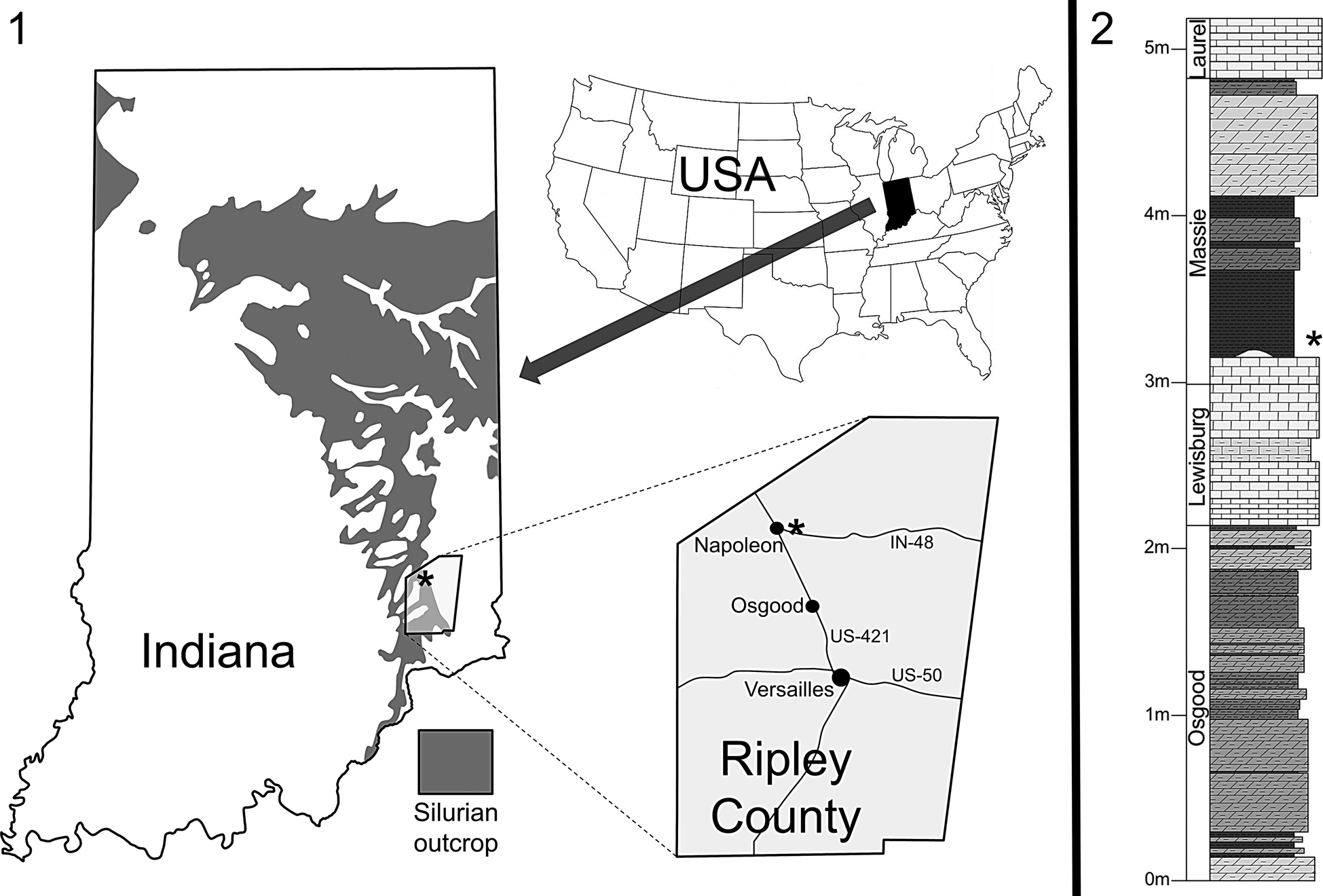
Specimens described here were recovered from the lower decimeter of the mudstone lithofacies of the Massie Formation at the New Point Stone quarry just east of Napoleon, Ripley County, southeastern Indiana, USA (39°12′31.39″N, 85°18′53.74″W; Fig. 1). Before the lithostratigraphic revisions of Brett et al. (Reference Brett, Cramer, McLaughlin, Kleffner, Showers and Thomka2012), this interval was known as the base of the ‘upper shale’ of the Osgood Formation (Foerste, Reference Foerste1897). It represents the most productive horizon for collection of articulated echinoderms and trilobites (e.g., Paul, Reference Paul1971; Frest et al., Reference Frest, Brett, Witzke, Boucot and Lawson1999, Reference Frest, Strimple and Paul2011; Thomka and Brett, Reference Thomka and Brett2015b; Thomka et al., Reference Thomka, Brett, Bantel, Young and Bissett2016). An abundant and diverse echinoderm fauna has been collected from this interval, and articulated and partial thecae, isolated thecal plates, and pluricolumnals and columnals of Caryocrinites are abundant within the poorly indurated mudstone and thin wackestone interbeds (Frest et al., Reference Frest, Brett, Witzke, Boucot and Lawson1999; Thomka and Brett, Reference Thomka and Brett2015b).
Locality and stratigraphy of the site from which the studied specimens were collected. (1) Location of the New Point Stone quarry (marked by asterisk) to the east of Napoleon, northern Ripley County, southeastern Indiana. (2) Stratigraphy of a portion of the Silurian section exposed at the study site, with the approximate position of the studied specimens marked by the asterisk. Note that this interval corresponds to the base of the ‘upper Osgood shale’ of Foerste (Reference Foerste1897), a famous echinoderm-bearing unit. Figures modified from Thomka and Brett (Reference Thomka and Brett2014a).

Exhaustive field collection of the Massie Formation at the Napoleon quarry over more than three decades by one of us (DLB) has thus far produced an estimated total of several hundred intact Caryocrinites thecae, a number far lower than that of the prolific diploporitan assemblage from this locality (Frest et al., Reference Frest, Strimple and Paul2011; Thomka et al., Reference Thomka, Brett, Bantel, Young and Bissett2016). A representative sample of 106 Caryocrinites thecae, including C. ornatus and C. sp. indet. A, a diminutive species that is distinct from C. ornatus, was collected and analyzed for this study. Differentiation between C. ornatus and C. sp. indet. A is based on the absence of granular sculpturing, characteristic of C. ornatus, on thecal plates of C. sp. indet. A; although C. sp. indet. A is smaller (with respect to thecal height) than C. ornatus, recognition of these as separate entities is based on thecal ossicle properties rather than the size difference. Each specimen was identified as precisely as possible, measured with respect to thecal height, and carefully inspected for embedment structures; if any pits were present, the number, location, and size(s) were documented.
Repository and institutional abbreviation
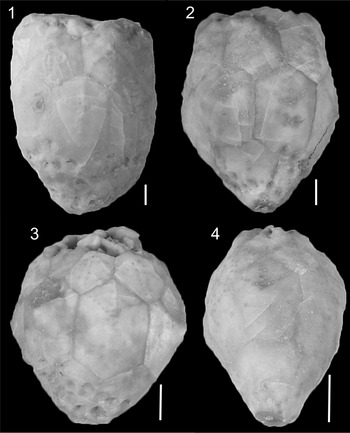
A total of six specimens were discovered with symbiotic embedment structures, all in thecae belonging to C. sp. indet. A (Fig. 2). These specimens, reposited at the Cincinnati Museum Center (Cincinnati, Ohio, USA) under specimen numbers CMC IP 87833–87838 (relevant specimen numbers beginning with CMC are also provided in the figure captions), are the basis for this study and are described and interpreted below.
Examples of Caryocrinites sp. indet. A with symbiotic embedment structures (pits). These are representative of all pit-bearing specimens recovered from the Massie Formation of the Napoleon quarry. Note that pits are restricted to the lower hemisphere of thecae, in most instances being present only in the lowest one or two plate circlets. (1) CMC IP 87833 with numerous overlapping pits on the lower third of theca. (2) CMC IP 87834 with multiple relatively large pits, many of which occur along sutures between basal plates. (3) CMC IP 87835 with numerous prominent pits in the basal plates. (4) CMC 87836 with small number of less conspicuous pits present along the very base of the theca. Note that swelling in association with pits has resulted in some asymmetrical deformation at the site of columnal articulation to the theca. Scale bars = 5 mm.

Description of symbiotic pits
Pits are circular in outline and oriented perpendicular to thecal plates. There is no evidence that any structures penetrated completely through the affected ossicle(s) to reach the interior of thecae, and there is no visible damage to stereom at the bottom of pits. Pit width is greater than depth. There are no discrete raised rims or concentric structures surrounding pits, and swelling due to precipitation of secondary stereom in the vicinity of pits is amorphous and minor, grading into unaffected portions of the theca (Fig. 2). Pits are smoothly parabolic in cross section, and there is no evidence for regrowth of pore structures or other fine surficial details of plates within excavated pits. The pit size is consistent, with a diameter of approximately 1 mm for all specimens (Fig. 2).
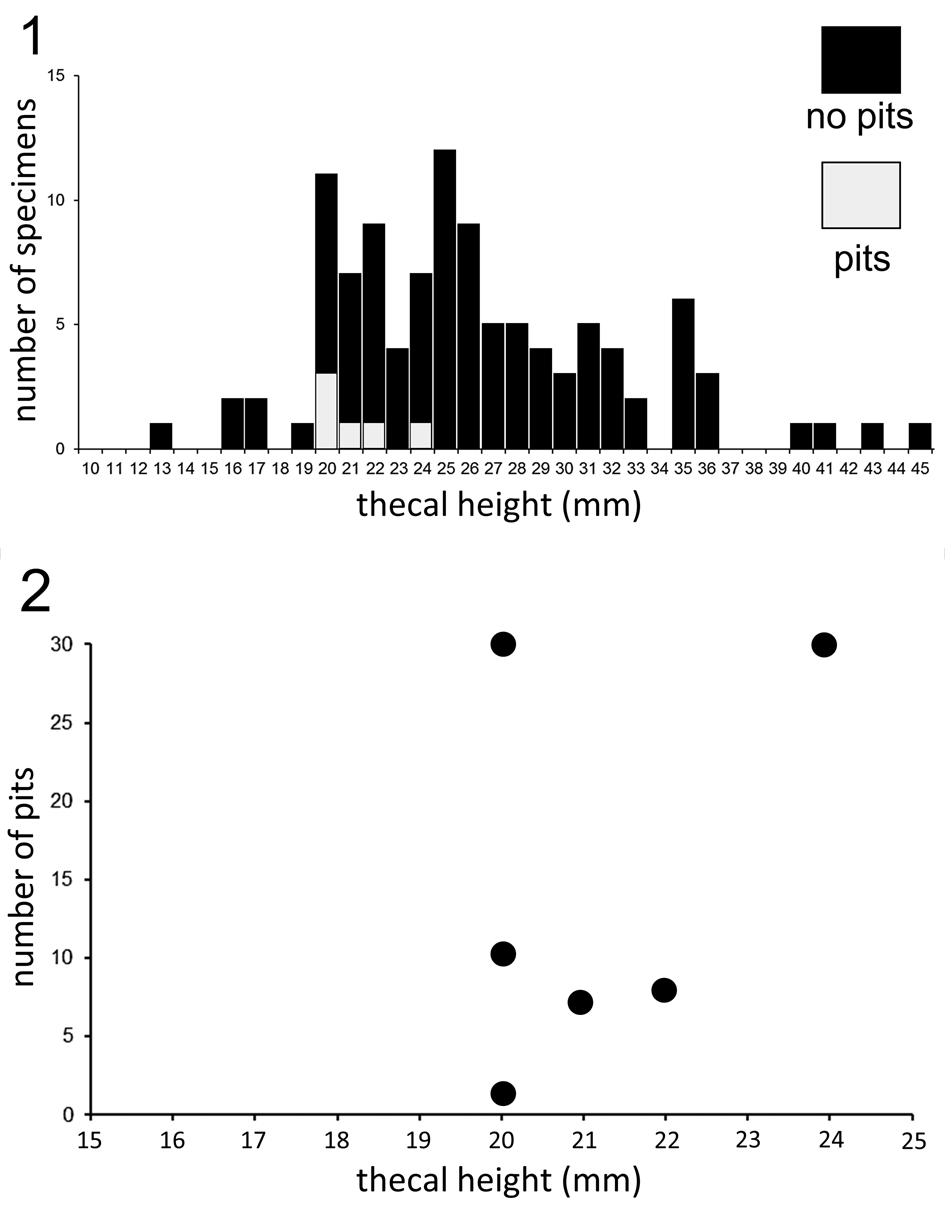
The number of pits on a single theca ranges from 1 to 30 with an average of 14 pits per individual (Figs. 2, 3). Pits are found both at plate sutures and in the central portions of plates, with no detectable preference for pit development as pits commonly occur in both locations on the same theca. No linear arrangements or prominent clusters of pits are discernable, aside from all being found in the lower hemispheres of thecae (further discussion follows). In thecae displaying numerous pits, closely spaced pits display overlapping borders (Fig. 2), which can sometimes complicate determining the precise number of pits on certain thecae.
Data on the relationship between thecal size and the presence and number of pits. Caryocrinites ornatus and Caryocrinites sp. indet. A are pooled together in this master dataset. (1) Histogram showing Caryocrinites thecal heights, which range from 13 to 45 mm and display a roughly bell-shaped distribution. The average thecal height for all specimens is 26.1 mm. Specimens with pits are restricted to a range between 20 and 24 mm, with an average of 21.1 mm in thecal height. (2) Scatterplot showing the number of pits on each theca relative to thecal height. Note that there is no discernable relationship between the size of pitted thecae and the number of pits.
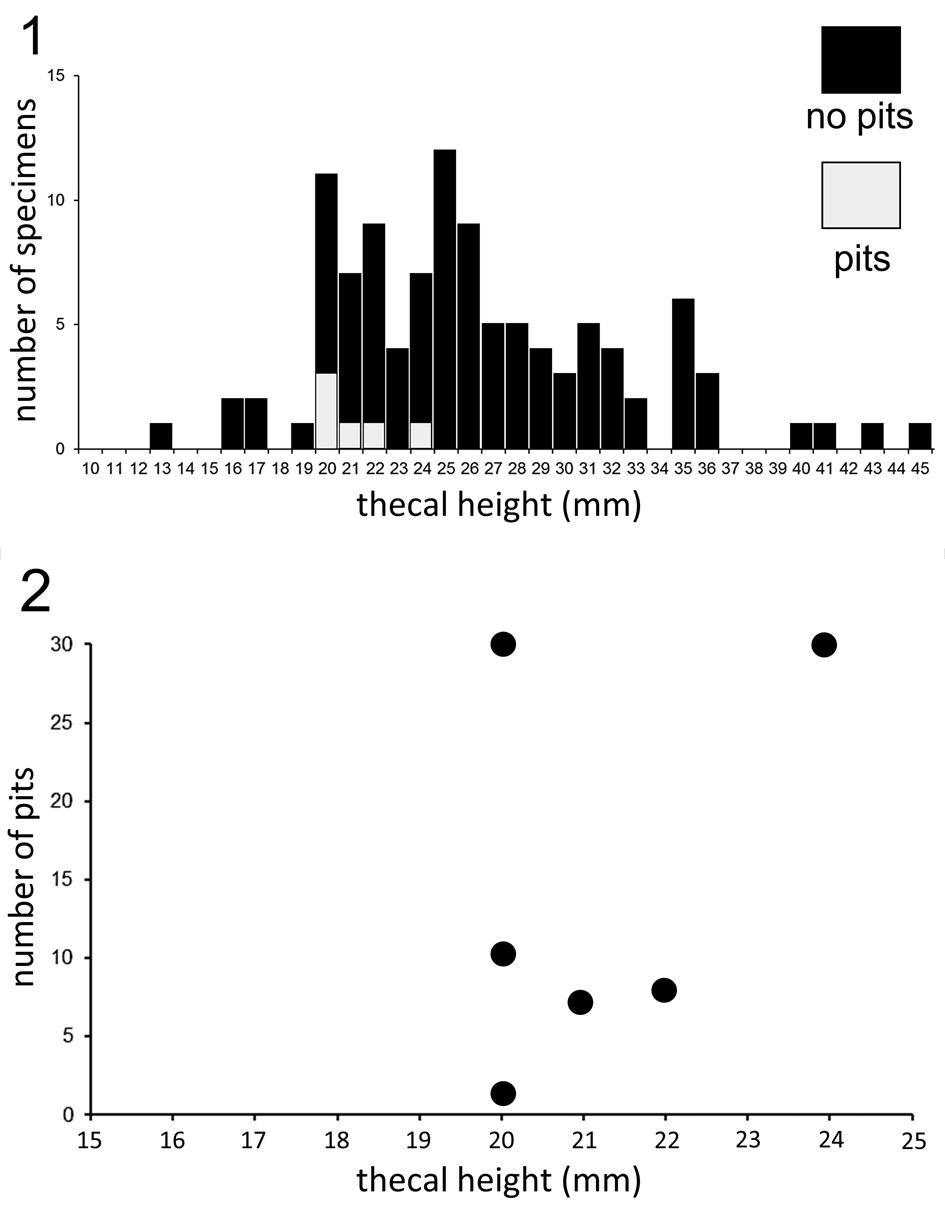
All embedment structures are present in the lower (proximal) portion of articulated Caryocrinites sp. indet. A thecae (Fig. 2). In specimens with numerous pits, they are distributed around the entire basal region rather than being concentrated on one side of the theca. A narrow size range of individuals shows evidence of infestation as all specimens fall between 20 and 24 mm in thecal height (Fig. 3), with an average thecal height of 21.1 mm (compared with an average thecal height of 26.1 mm for all individuals and an average thecal height of 28.2 mm for uninfested individuals).
Discussion
Paleoecological implications
To date, symbiotic embedment structures have been documented in the skeletons of Paleozoic crinoids (e.g., Franzén, Reference Franzén1974; Brett, Reference Brett1978b, Reference Brett1985; Eckert, Reference Eckert1988; Donovan, Reference Donovan2015), eocrinoids (Rozhnov, Reference Rozhnov and Semenova1989), and diploporitans (Paul, Reference Paul1971; Frest et al., Reference Frest, Mikulic and Paul1977, Reference Frest, Strimple and Paul2011; Thomka and Brett, Reference Thomka and Brett2014b). This account represents the first published description of symbiotic pits in rhombiferan echinoderms. Hence, four Paleozoic pelmatozoan classes are known to be hosts to pit-forming organisms; it is also noteworthy that the Massie Formation of southeastern Indiana is the only known interval to contain three different classes of infested echinoderms (crinoids, diploporitans, and rhombiferans).
Two paleoecological aspects of this occurrence are particularly worthy of discussion: the abundance and consistent location of pits on the proximal (lower) portion of thecae and the decreased average thecal height of pit-bearing specimens relative to those lacking pits. The presence of numerous pits exclusively on the lower hemisphere of Caryocrinites is similar to an infested Mississippian camerate crinoid described by Donovan et al. (Reference Donovan, Lewis and Kabrna2006). The absence of pits on the distal (upper) portion of the crinoid calyx was attributed to the sweeping activity of podia, which may have removed settling organisms (Donovan et al., Reference Donovan, Lewis and Kabrna2006); however, the likely absence of podia in blastozoans (Sprinkle, Reference Sprinkle1973) precludes this interpretation as an explanation for the nearly identical distribution of pits on Silurian specimens described here. Although the exact reason for the restriction of pits to the lower hemisphere of Caryocrinites remains unclear, a more likely factor is the orientation of the host theca relative to current direction. If the long axis of the theca was oriented parallel to current flow, with the distal theca pointed toward the down-current direction as is the typical feeding posture for Paleozoic pelmatozoans (e.g., Brett, Reference Brett, Bassett and Lawson1984), then the basal theca would have been exposed to stronger or more persistent currents, which may have been preferable to suspension-feeding symbiotic organisms. This concept is supported by the radial distribution of pits around the proximal region being even (Fig. 2) rather than being concentrated on a single side of the theca.
Nature of the biotic interaction
Although multiple potential interpretations for the origin of embedment structures such as those described herein can be supported (see Donovan, Reference Donovan2015), we submit that parasitism by pit-forming organisms on echinoderm hosts is most logical. This follows some of the earliest interpretations of pitted Paleozoic echinoderms (Moodie, Reference Moodie1918), which were expanded upon by later researchers (e.g., Franzén, Reference Franzén1974; Brett, Reference Brett1985). Despite an absence of evidence that pit-forming symbionts penetrated thecal plates to access and directly feed upon viscera within thecae, a net adverse effect on pelmatozoan hosts can be recognized. First, there is abundant evidence that the pit-forming organisms were primarily immobile suspension feeders (see Brett, Reference Brett1978b, Reference Brett1985; Donovan, Reference Donovan2015). The presence of suspension-feeding organisms in the vicinity of pelmatozoan thecae may have resulted in the diversion of potential food away from hosts and toward embedded symbionts, as argued by Donovan (Reference Donovan1991, Reference Donovan2015). In addition to the possible stealing of food, the pathological response of echinoderm hosts—resulting in swelling by secondarily precipitated calcite surrounding pits—would have added weight to the host skeleton and required expenditure of energy to produce the secondary skeletal material. Further, and perhaps most important, some evidence for true boring (i.e., removal of pre-existing stereom) in association with pits has been reported by Brett (Reference Brett1985; see also Paul, Reference Paul1971). Finally, it is important to consider the fact that Caryocrinites, as well as other blastozoan echinoderms, were characterized by the presence of exothecal respiratory structures on the exterior of thecal plates. Symbionts present on the surface of blastozoan thecae for extended intervals likely interfered with the development of respiratory structures, as indicated by damage to, and reorientation of, humatipores in pit-bearing diploporitans from the Massie Formation (Paul, Reference Paul1971) and similar interference with, and modified growth of, ambulacra in younger pit-bearing echinoid tests (Donovan, Reference Donovan2015).
Hence, utilization of stalked echinoderms, including the Caryocrinites thecae described here, provided benefits to the enigmatic pit-forming, suspension-feeding symbiotic organisms, and the host echinoderms most likely experienced negative effects as consequences of this prolonged interaction. Although this relationship between echinoderm hosts and embedment-structure-producing organism(s) may not meet the most traditional definition of parasitism (see discussions in Zapalski, Reference Zapalski2011; Donovan, Reference Donovan2015), it nevertheless seems more appropriate to view the nature of this biotic association as parasitic rather than commensalistic.
An additional aspect potentially of interest to the discussion of the nature of the relationship between pits and pitted caryocrinitids involves the decreased size of infested versus uninfested host specimens (average thecal heights of 21.1 and 26.1 mm, respectively), which may attest to the detrimental effects of this relationship on Caryocrinites. A statistically significant difference in calyx size was documented between populations of Paleozoic crinoids that were hosts to parasitic platyceratid gastropods (smaller) and those devoid of parasites (larger) in several studies (e.g., Rollins and Brezinski, Reference Rollins and Brezinski1988; Baumiller and Gahn, Reference Baumiller and Gahn2002; Baumiller, Reference Baumiller2003; but see Baumiller and Gahn, Reference Baumiller and Gahn2018). The small sample size of pit-bearing Caryocrinites limits the application of statistical tests on this assemblage, but these data nevertheless provide suggestive evidence that symbiosis (possibly reflecting a form of parasitism) of rhombiferans can result in decreased size. However, it must be noted that without larger pit-bearing specimens of C. sp. indet. A, the consistently smaller thecal size may reflect a taxonomic difference rather than an ecological effect of infestation.
Hemicosmitid paleobiology and evolution
The rhombiferan Caryocrinites has long been recognized as a relatively unusual blastozoan, primarily because of this taxon's morphological similarities to camerate crinoids. Distinctly crinoid-like features include: (1) a dendritic radicular attachment structure (Brett, Reference Brett1978c) that is more complex than that of most Silurian blastozoans and more similar to that of the monobathrid camerate Eucalyptocrinites (Brett, Reference Brett1981, Reference Brett, Bassett and Lawson1984; Thomka and Brett, Reference Thomka and Brett2015a, Reference Thomka and Brettb); (2) a relatively long column compared with those of most Silurian blastozoans (Brett, Reference Brett, Bassett and Lawson1984); (3) a theca composed of large plates arranged into organized circlets rather than a mosaic pattern and an oral region resembling the tegmen of a camerate crinoid (Kluessendorf, Reference Kluessendorf1983; Brett, Reference Brett, Bassett and Lawson1984); and (4) relatively long, branching brachioles similar to pinnulate crinoid arms (Sprinkle, Reference Sprinkle1975). These skeletal features resulted in a number of paleoecological interactions that are unique or rare among coeval blastozoans. Caryocrinites is the only noncrinoid echinoderm in the middle Paleozoic that serves as a host to commensalistic/parasitic platyceratid gastropods (Kluessendorf, Reference Kluessendorf1983; Brett, Reference Brett, Bassett and Lawson1984), presumably because of morphological similarities and/or ecological convergence with the more commonly infested camerate crinoids. The data presented here indicate that Caryocrinites is also the only Silurian rhombiferan that was infested by the pit-forming organism(s) that also produced traces on several types of crinoids in the Massie Formation and coeval deposits (Brett, Reference Brett1978b, Reference Brett1985; Frest et al., Reference Frest, Brett, Witzke, Boucot and Lawson1999; Brett et al., Reference Brett, Thomka and Bissett2018). This suggests an additional component to the distinctiveness of Caryocrinites among Silurian blastozoans as this is the only taxon to serve as host to both of the common potentially parasitic organisms infesting pelmatozoans. The morphology of the pits on Caryocrinites is quite similar to that of pits found on certain middle Silurian crinoids (e.g., ichthyocrinids; Brett, Reference Brett1985), including some from the Massie Formation (Frest et al., Reference Frest, Brett, Witzke, Boucot and Lawson1999, Reference Frest, Strimple and Paul2011), but differs substantially from pits found on other crinoid hosts (e.g., dendrocrinids, eucalyptocrinitids; Brett, Reference Brett1978b; Brett et al., Reference Brett, Thomka and Bissett2018).
Brett (Reference Brett1978b) initially documented strong host specificity among pit-forming organisms in the crinoid fauna of the Rochester Shale of western New York and Ontario, with later data indicating that host lineages continued to show infestation over long spans of geologic time (Brett, Reference Brett1985), suggesting strong evolutionary linkage between symbionts and their preferred echinoderm host(s). The data presented here indicate that host specificity is also apparent in the record of infestation of rhombiferans. The presence of symbiotic pits exclusively on the smaller species of Caryocrinites (C. sp. indet. A) rather than C. ornatus is not expected given the much greater abundance and increased size of C. ornatus. Nonselective settling by pit-forming organisms would have favored development of pits on the host taxa that were most prevalent and/or capable of providing the greatest area for settlement. The preference for other Caryocrinites species over C. ornatus seemingly explains the total absence of pits in the more than 700 thecae analyzed from the Rochester Shale of western New York and Ontario by Brett (Reference Brett1978a). Although the Rochester Shale is roughly correlative to the Massie Formation (McLaughlin et al., Reference McLaughlin, Cramer, Brett, Kleffner, Maria and Counts2008; Thomka and Brett, Reference Thomka and Brett2015a), the former contains a hemicosmitid assemblage consisting entirely of C. ornatus (Brett, Reference Brett1978a; Frest et al., Reference Frest, Brett, Witzke, Boucot and Lawson1999), which was evidently avoided despite an abundance of pits in some contemporary crinoids in the Rochester Shale.
Glyptocystitid rhombiferans are not yet known to have served as hosts to pit-forming symbiotic organisms, even in communities where they outnumber hemicosmitids or are the only rhombiferans present (e.g., Frest et al., Reference Frest, Brett, Witzke, Boucot and Lawson1999). However, specimens of Hemicosmites von Buch, Reference von Buch1840 from Middle Ordovician (Darriwilian) strata of the St. Petersburg region of Russia that currently await detailed description (S. Nikolay, personal communication, 2017) have been discovered with multiple pits of a similar morphology to those on Caryocrinites. The Hemicosmites thecae containing symbiotic embedment structures show that hemicosmitid rhombiferans were utilized as hosts for potentially parasitic symbiosis by pit-forming organisms, with this relationship persisting at least from Middle Ordovician to middle Silurian time. Further attention should be devoted to searching for pits in lower Paleozoic rhombiferan assemblages to determine the degree to which hemicosmitids were selectively infested relative to other pelmatozoans and the specific hemicosmitid taxa that served as hosts. If it can be determined that hemicosmitids were the only rhombiferans to contain symbiotic pits (as opposed to taphonomic biases favoring preservation of articulated hemicosmitid thecae, for example), then the taxa that were preferentially infested through time may reflect co-evolutionary linking between symbiont and host lineages and can therefore provide a potential paleoecological test of systematic hypotheses.
Ichnotaxonomy
Description of embedment or bioerosion structures in skeletal substrates is most accurate when ichnotaxonomic nomenclature is applied (Donovan, Reference Donovan2017). The ichnogenus Tremichnus Brett, Reference Brett1985 was initially established to describe circular-parabolic pits, sometimes associated with swelling, in stalked echinoderm endoskeletons (Brett, Reference Brett1978b, Reference Brett1985). The pits present on Silurian Caryocrinites specimens are typical examples of T. paraboloides Brett, Reference Brett1985, the type ichnospecies (Brett, Reference Brett1985). Diagnostic features include a circular outline that is gradational with the surrounding, unaffected skeletal material of the host echinoderm plate(s); pit dimensions indicating significantly greater width than depth; and a lack of total penetration through plates (Brett, Reference Brett1985; Wisshak et al., Reference Wisshak, Kroh, Bertling, Knaust, Nielsen, Jagt, Neumann and Nielsen2015). Additional noteworthy, though not ichnotaxonomically diagnostic, features that are relatively consistently associated with T. paraboloides include the presence of multiple pits on individual host thecae and pit margins that are slightly swollen by precipitation of secondary stereom (Brett, Reference Brett1978b, Reference Brett1985).
However, recent and ongoing debate has centered around the validity of Tremichnus as an ichnogenus, with some researchers arguing that Tremichnus should be synonymized with either Sedilichnus Müller, Reference Müller1977 (Bromley, Reference Bromley and McIlroy2004; Zonneveld and Gingras, Reference Zonneveld and Gingras2014) or Oichnus Bromley, Reference Bromley1981 (Pickerill and Donovan, Reference Pickerill and Donovan1998; Donovan and Pickerill, Reference Donovan and Pickerill2002, Reference Donovan and Pickerill2017), while others have presented strong evidence that Tremichnus is a valid ichnogenus and should be retained (Vinn et al., Reference Vinn, Wilson, Ausich and Toom2015; Wisshak et al., Reference Wisshak, Kroh, Bertling, Knaust, Nielsen, Jagt, Neumann and Nielsen2015). Fully resolving this ichnotaxonomic issue is beyond the scope of the present study and is best treated elsewhere; in fact, the use of an ichnogenus name has purposefully been avoided thus far in favor of the generalized term ‘pits.’ The primary foci of this paper are the description of this new occurrence and paleoecological interpretation of the nature of this biotic interaction; ichnotaxonomy is a secondary aspect here. However, we feel that it is worth noting our support for retaining Tremichnus as the proper ichnogenus (and T. paraboloides as the proper ichnospecies) for these symbiotic embedment structures, as initially outlined by Brett (Reference Brett1985) and more recently modified and redefined by Wisshak et al. (Reference Wisshak, Kroh, Bertling, Knaust, Nielsen, Jagt, Neumann and Nielsen2015).
Conclusions
Symbiotic embedment structures (pits) are herein reported on rhombiferan echinoderms for the first time. Thecae of the hemicosmitid rhombiferan Caryocrinites from the middle Silurian (Wenlock, Sheinwoodian) Massie Formation generally contain multiple pits per specimen (average of 14; range of one to 30), with pits restricted exclusively to the lower portion of thecae. Pits are morphologically identical to structures found in crinoids and diploporitans from this unit and are attributable to Tremichnus paraboloides. The restriction of pits to the basal region of thecae likely reflects the living posture of Caryocrinites, with the feeding appendages pointed downstream and the basal region exposed to currents. Thecae with pits are smaller than uninfested thecae, potentially reflecting the detrimental effects of infestation; however, the small sample size of infested specimens limits the robustness of statistical analyses.
This occurrence represents the first formal description of symbiotic pits on rhombiferans and indicates that at least four pelmatozoan classes (Crinoidea, Diploporita, Eocrinoidea, Rhombifera) were infested by pit-forming organisms. Symbiotic pits are thus far known only from hemicosmitid rhombiferans, suggesting host specificity evolving in the Middle Ordovician and persisting through the middle Silurian. Caryocrinites is characterized by multiple physical attributes that more closely resemble camerate crinoids than they do other rhombiferans; this likely contributed to the infestation of this blastozoan, providing an additional ecological consequence of morphological convergence on crinoids.
Acknowledgments
Access to the collecting locality was made possible by the Wanstrath family (New Point Stone Company). T. Bantel (Dry Dredgers) and T. Paton (University of Tennessee) assisted with specimen collection and photography. S. Nikolay (St. Petersburg, Russia) drew our attention to the infested Middle Ordovician rhombiferans in Russia. A Dry Dredgers Paleontological Research Award to JRT partially funded this research. Comments provided by two anonymous reviewers and the editor improved an earlier version of this contribution.