The spectrum of congenital cardiac disease refers to structural or functional heart defects present at birth. Such lesions are found in from 8 to 10 of each 1000 live births,Reference Fyler, Buckley, Hellenbrand and Cohn1 this incidence being relatively constant throughout the world. It has been estimated that the prevalence of diagnosed congenital cardiac malformations in India, based on studies performed in hospitals, is roughly from 2.25 to 5.2 instances for every 1000 live-births. Every year in our country, 180,000 children are born with congenitally malformed hearts.Reference Saxena2 We believe these figures also to be representative of other developing countries. An important advancement associated with care of these children is the growing realization that “children are not small adults”. Rather, they have distinct physiologic differences, and require special care.Reference Bickler and Rode3 Furthermore, the consequences of most congenital cardiac malformations, and their management, are life-long. Needless to say, providing special care to these sick children places an enormous economic burden on the providers of health care, the patients themselves, and their families. With current technology, nearly all malformations can be successfully palliated or corrected,Reference Joffs and Sade4 but the associated costs are often enormous, so much so that, despite heavy subsidies, a majority of patients in our country are unable to afford even the diagnosis, let alone the treatment of these defects. In this situation, it is imperative for all of those involved in the care of these patients to develop methods, and evolve strategies, to achieve early diagnosis and management of the congenital cardiac malformations in the most cost-effective manner. Most of the steps we suggest in our review are based on established practices worldwide, and are meant to reduce the costs, without affecting the quality, of care. Our aim is to initiate a dialogue on reduction of costs. Differences of opinion may occur regarding some of our suggestions, but if a debate ensues, it may be to the betterment of our patients.
Problems of funding and economics
In India, and other developing countries, surgery for congenital cardiac disease does not hold a position of priority, with communicable diseases, infectious diseases, nutritional disorders, and acquired immune deficiency syndrome attracting the major thrust. In consequence, there are few, if any, government sponsored paediatric cardiac centres. The paediatric programmes are mostly “add-ons” to programmes for adult cardiology, sharing their facilities and funds. Performing operations free of cost is not a viable proposition in the long run, as the invested resources rapidly get exhausted, and programmes run the risk of cutting down their work, or even closing down. The only way to sustain a quality programme for congenital cardiac surgery, and to reduce costs, is to have subsidy from the government, from charitable organizations, or from a busy programme specializing in adults, and then gradually to evolve methods and protocols which are self-sustaining.Reference Rao5–Reference Ungerleider, Bengur and Kessenich8
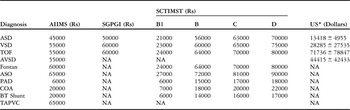
In Table 1, we show the approximate costs for the most commonly performed surgical procedures for congenital cardiac disease. This data was generated from government, or government funded, institutions in India after securing their feedback. These are the costs incurred by the patients. The costs to the hospital are often several times more than these, but because of subsidies from the government and the health sector, surgical treatment is offered at these prices. We compare this data with that from a representative centre in the United States of America.Reference Ungerleider, Bengur and Kessenich8 The data from the United States is nearly a decade old, but is probably the best, and the most commonly quoted, data on this subject. It should be noted that the data does not include private hospitals in India, where the costs are much higher. Similar methods of reduction of costs as discussed in this review, nonetheless, apply also to these centres. The clear message from this data is that the cost of the most commonly performed procedures at most centres exceeds the annual family income of the larger part of the Indian population. In India and in most developing countries, health insurance provided by the State does not exist, and many private companies providing insurance exclude congenital cardiac malformations, so the burden of cost has to be borne either by the government or charitable organizations, or mostly by the family of the patients themselves. A large majority are able to arrange the necessary funds only by obtaining charitable support, securing donations, or by other means. Often the parents of the critically ill child with congenital cardiac disease prefer not to seek surgery, choosing to have another child rather than resort to these measures required to generate the necessary finances. This is even truer when the patient is a female child. Against this backdrop, we have seriously to consider measures to make surgery for congenital cardiac disease more affordable to the most underprivileged.
Approximate costs of surgery for common surgical procedures for congenitally malformed hearts.

ASD = atrial septal defect; VSD = ventricular septal defect; TOF = tetralogy of Fallot; AVSD = atrioventricular septal defect; ASO = arterial switch operation; PAD = patency of arterial duct; CoA = Co-arctation of aorta; BT = Blalock-Taussig; TAPVC = Totally anomalous pulmonary venous connection.
AIIMS = All India Institute of Medical Sciences, New Delhi, India; SGPGI = Sanjay Gandhi Post-graduate Institute of Medical Sciences, Lucknow, India; SCTIMST = Sree Chitra Tirunal Institute of Medical Sciences, Thiruvananthapuram, Kerala, India.
*Data from Duke’s University Medical center, Durham, North Carolina, USReference Tomatis, Schlosser, Riahi, Stockinger and Kanten7. One US dollar = Rupees 40 approximately.
NA = Data not available.
At SCTIMST, patients are categorized depending on their monthly income (Rs) as A = Less than 400, B1 = 400 to 700, B = 701 to 1300, C = 1301 to 2000 & D = above 2000. No charges for category A, but only 20% such procedures are allowed annually.
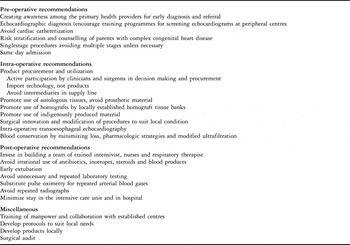
The issue of containment of costs involves not only savings in the costs of medical and surgical items or the performance of the surgical procedures. It encompasses a wide range of interventions designed to reduce the costs from the time the patient is first seen by the primary physician. Accordingly, we have divided our discussion into measures designed to reduce costs before, during, and after the surgical procedure (Table 2).
Summary of recommendations for containment of costs in surgery for congenital cardiac disease.

Interventions prior to surgery
Timely referral, and adequate selection of the procedure for any given patient, is important. A large number of patients are either managed conservatively by the primary physicians, or not counselled about the need for early correction of the congenitally malformed heart. As a result, many of them seek surgery in adolescence and adulthood, when the disease and its consequences increase the morbidity and mortality. Patients with septal defects may become inoperable or have severe pulmonary arterial hypertension. They may then require prolonged ventilation, extra drugs, and even treatment with nitric oxide, all of which lead to substantial increase in the costs. Many adult cyanotic patients present with severe polycythaemia, a high haematocrit, and associated complications such as cerebral abscesses, stroke, and infective endocarditis. Timely referral can be achieved by creating awareness among the local physicians and paediatricians, especially in rural and semi-urban areas, by organizing seminars and symposiums and by involving the electronic media and voluntary organizations. More emphasis is required on congenital cardiac disease, and its timely management, in the medical, nursing, and surgical curriculum, so that awareness among all medical personnel is instilled early in their careers.Reference Airan9
Pre-operative evaluation and stratification of riskReference Tomatis, Schlosser, Riahi, Stockinger and Kanten7, Reference Ungerleider, Bengur and Kessenich8
A correct preoperative diagnosis and assessment of risk is mandatory when choosing the correct surgical procedure for any patient. With better equipment and better training, most congenitally malformed hearts can now be diagnosed correctly using transthoracic echocardiography, which is inexpensive, noninvasive, and can be performed everywhere without the need for hospitalization. Screening echocardiograms can conveniently be carried out by trained paramedical echocardiographers using portable echocardiographic machines. These results can be verified by paediatric cardiologists at institutions with greater experience. Short-term courses can be started at these major hospitals to train the paramedical staff to perform the initial screening echocardiographic studies. There is now ample evidence to show that, by following this strategy, it is possible almost completely to eliminate the need for cardiac catheterization, and lead to substantial savings.Reference Tworetzky, Mcelhinney, Brook, Reddy, Hanley and Silverman10 The introduction of magnetic resonance imaging,Reference Kellenberger, Yoo and Buchel11 and computerized axial tomographic angiography,Reference Kawano, Ishii and Maeno12 has also helped to achieve a correct diagnosis at a reasonable cost without the need for hospitalization.
In the hospital setting, it is useful to identify the risk factors for higher cost preoperatively so that appropriate resources can be arranged for these patients in a cost-effective manner. It is also important to identify that subset of patients who are at a very high risk of surgery, and are probably unlikely to benefit from multiple complex procedures without prolonging survival or improving their functional state. Examples include conditions like tetralogy of Fallot with pulmonary atresia and major multiple aortopulmonary collateral arteries, and hypoplastic left heart syndrome. In these patients, multiple repeated procedures are required, apart from the likely high initial mortality, which may be as high as 20%. The survival at 10 years for the latter condition is currently less than 80% in the best centres.Reference Hagemo, Skarbo, Rasmussen, Fredriksen and Schage13 Apart from this, the survivors have significant neuropsychological and haemodynamic abnormalities, and may lead an unproductive life.Reference Hagemo, Skarbo, Rasmussen, Fredriksen and Schage13 Whether surgery should be undertaken in this subset of patients is a matter of debate, as it only inflates the costs, and is a drain on the resources available. This approach is certainly against the published guidelines, and against the current practice in developed countries, but consideration must be given to the fact that, for the same costs, it is possible to repair a large number of patients with simple diagnoses and predictable long-term results.14 In this respect, the needs of those working in the developing world are different from those faced in the developed world. Hence, it may not be practical for our population to follow all the clinical and ethical guidelines established from the developed world. It is in this context that pre-operative counselling of the parents assumes significance. The parents require a clear explanation about the need for multiple and staged procedures, the palliative nature of some operations, and the possibility for limited survival and long-term morbidity. The parents may somehow manage to arrange finances for the first, or maybe a second, procedure, but may be left with no resources for a future re-operation. Should this occur, the child may have an incomplete palliation, and may still die. Consideration should also be given to the subsets of patients with, for example, Down’s syndrome or other anomalies involving multiple systems. Such patients may not be able to lead productive and independent lives even after multiple re-operations. Such implications should be discussed with parents, who will require extra resources without the promise of an optimal outcome. Treating cardiac disease extends beyond treating the heart. It is important to treat and manage the entire family, and also to consider the social implications.
Some may go so far as to suggest that paediatric cardiac surgery should not be performed in developing countries, as the available resources could better be used to tackle commoner problems, like malnutrition and infectious diseases. The commonest congenital defects seen, even in developing countries, are the patent arterial duct, atrial and ventricular septal defects and tetralogy of Fallot. All of these lesions are eminently correctable. Their early repair offers the only ray of hope for these children and their families. We cannot deny surgery to these children with simple lesions, as they not only survive, but they also contribute to the society like any other member. Failure to develop programmes that offer surgical treatment of congenitally malformed hearts would be a reterograde step for any developing nation.
Rationalization of expenses
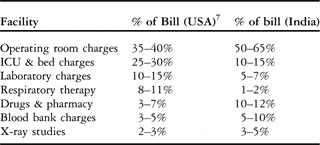
Once it has been decided to go ahead with a surgical procedure, its costs need to be estimated and rationalized so that appropriate measures may be undertaken to cut down the costs. In Table 3, we show the approximate apportionment of costs for a patient undergoing surgery. We base this data on information that is almost three decades old,Reference Tomatis, Schlosser, Riahi, Stockinger and Kanten7 but the data retains its value in this field. The practice of cardiac surgery and the management in the intensive care unit, nonetheless, has evolved dramatically since then, so this data can at best give us a rough estimate of the present distribution of costs.
Approximate distribution of charges incurred by patients undergoing cardiac surgery*.

The data for India is derived from feedback from various centres (see acknowledgements).
* These charges do not take into account the salaries of manpower involved in these facilities.
Charges in the operating room
These account for the major component of the total expenses. Every step and material involved should be thoroughly and critically reviewed every year by the operating room supervisor, the nurse-in-charge, the scrub nurse, and the surgeons. Cardiac surgery is expensive, and the costs of suture materials and disposable medical and surgical items are enormous, especially if these are procured from other countries and not produced locally. We believe that active participation of clinicians and surgeons in decision-making and procurement of stores is required to select the most appropriate and inexpensive material. Another important step is to reduce the number of intermediaries in the supply line. With the addition of each intermediary, their handling costs and profits get added to the cost of the item. By minimizing intermediaries in the supply line, substantial savings can be made.
We believe that perhaps the best way to economize in this area is by following strict protocols and meticulous surgical technique so that repeated procedures are avoided. The choice of the material used to close septal defects depends upon individual preference. Use of autologous tissues, such as the pericardium or even a patch of the atrial wall,Reference Talwar, Choudhary, Mathur and Kumar15 is more cost-effective than using commercially available Dacron or Goretex patches. Besides being inexpensive, autologous tissues may be associated with a reduction in the incidence of post-operative infection. Autologous pericardial conduits may be used for reconstruction of the right ventricular outflow tract in selected patients as an alternative to commercially available prosthetic grafts.Reference Koh, Yagihara and Uemura16 It may be cheaper to use a homograft pulmonary valve for this purpose, especially if the homograft is procured and preserved by the hospital staff itself rather than by commercial firms. The aortic homograft may be used for replacement of the aortic valveReference Talwar, Mohapatra, Saxena, Singh and Kumar17 and the homograft pulmonary valve for the reconstruction of the right ventricular outflow tract following the Ross procedure. The Ross procedure itself is an important cost-cutting surgical procedure, as it uses living tissue, and provides the potential for growth.Reference Kumar, Talwar, Mohapatra, Saxena and Singh18 In addition to being cost-effective, homografts have acceptable durability, relative freedom from infection, and do not require long-term anticoagulation. Such avoidance of anticoagulation further reduces the costs to the patient and improves the quality of life. The patient’s own pericardium is also a suitable material for use in some instances when autologous tissue is not available. Segments of homograft arteries and veins are also suitable for use as shunts instead of the prosthetic grafts in selected patients. Setting up a homograft tissue bank for this purpose is very useful and cost-effective, ensuring a supply of homografts which are procured and preserved by the hospital staff itself rather than by commercial firms.Reference Choudhary, Srivastava, Chaner, Dogra, Venugopal and Kumar19
We believe that satisfactory haemostasis can substantially reduce the need for suture material. Further reduction in the costs of surgery can be achieved if indigenously produced suture materials, chest tubes, drainage systems, and other disposable items are used instead of the more expensive imported items. In some centres, epicardial pacing wires are no longer placed routinely if patients undergoing relatively simple procedures are in normal sinus rhythm at the completion of surgery.Reference Johnson, Brown and Alligwood20 In developing countries, the surgeons seeking to reduce costs are many times forced to use re-sterilized arterial and venous cannulas. We neither recommend nor practice this approach.
In the operating room, modified ultrafiltration can be used as an alternative to the use of cell savers for haemoconcentration and conservation of blood. Besides minimizing the need for allogenic blood transfusion, it also improves the haemodynamics, removes extravascular water from the lungs, promotes early extubation, and reduces the length of stay in the intensive care unit.Reference Gaynor21 Simplified and indigenously designed circuits for modified ultrafiltration make this very simple and inexpensive.Reference Choudhary, Talwar, Airan, Yadav and Venugopal22
Modification of the existing surgical procedures by surgical innovation can help to cut down costs significantly. In older children and adults with congenital heart disease, an interlocking lazy “S” shaped sternotomy instead of the conventional straight sternotomy might improve the post-operative respiratory recovery and reduce the hospital stay and costs of respiratory physiotherapy.Reference Madan, Gupta and Singh23 Other examples include the performance of bidirectional superior cavopulmonary anastomosis without cardiopulmonary bypass,24, Reference Hussain, Bhan, Sapra, Juneja, Das and Sharma25 preferring repair rather than repair of heart valves whenever feasible,Reference Talwar, Rajesh, Saxena, Subramaniam and Kumar26 using autologous tissues rather than prosthetic tubes or patches,Reference Koh, Yagihara and Uemura16, Reference Airan, Choudhary and Reddy27 and developing techniques such as bypass of the right heart for procedures in selected patients.Reference Shivaprakasha, Rameshkumar and Kumar28 The latter technique was found to reduce the costs of the bidirectional superior cavopulmonary anastomosis by as much as two-fifths.Reference Shivaprakasha, Rameshkumar and Kumar28 At our centre, by performing the bidirectional superior cavopulmonary anastomosis without cardiopulmonary bypass, we have been able to reduce the costs by more than half.24, Reference Hussain, Bhan, Sapra, Juneja, Das and Sharma25 Similarly, we have developed a simple and inexpensive technique for banding of the pulmonary arteries which can be adjusted percutaneously. This has not only improved the outcomes, but has also significantly reduced the costs, as most of the commercially available devices for this purpose cost thousands of dollars in developed countries.Reference Choudhary, Talwar and Airan29
Charges in the intensive care unit
These comprise up to one-third of the cost in developed countries like the United States of America, whereas in India, because of subsidies, the total for care in the intensive care unit and thereafter makes up from one-tenth to one-sixth of the costs. Costs incurred by care on the wards can be reduced by minimizing the duration of hospitalization. Patients can be completely evaluated on an outpatient basis, and admitted to the wards on the night prior to surgery, and then discharged as early as possible after surgery. Whenever feasible, further savings may be achieved by following the policy of “same day admission” when the patients can be admitted on the morning of surgery. The old fashioned concept that the patient must remain in the hospital for 7 to 10 days after open heart surgery no longer holds good. Most patients with uncomplicated septal defects, or patency of the arterial duct, can be discharged on the third post operative day, having the stitches removed later in the outpatient clinic.
Usual causes of overstays in the hospital are sepsis, neurological problems, lung and pulmonary hypertensive issues, phrenic palsies, mediastinitis, renal failure and residual lesions.Reference Rao6 Every effort should be made to prevent these complications. Investment in control of infection, which reduces the use of expensive antibiotics, pays good long-term dividends.Reference Rao6 In general, these charges can be minimized by strict adherence to a uniform protocol for management by trained personnel. Fast tracking to extubation is desirable if it does not compromise safety. A change in attitude combined with appropriate anaesthetic and surgical techniques can permit safe and early extubation in a large number of patients. Populations can vary between institutions, nonetheless, and early extubation is not always possible. For those patients in whom it is feasible, the benefits include simplified postoperative care, increased satisfaction for both the patient and the family, and when combined with guidelines for clinical practice, it can result in a significant reduction of costs.Reference Neirotti, Jones, Hackbarth and Paxson Fosse30
Decreasing the use of expensive gases like nitric oxide can significantly cut down the costs. Although there was lot of initial enthusiasm about the role of inhaled nitric oxide, it has been proved in studies from the developing world that the efficacy of this gas in the setting of advanced pulmonary hypertension is questionable, and confers no added advantage.Reference Sharma, Raizada and Choudhary31
Investment and training of manpower is very important, as availability of trained intensivist, respiratory therapist, and nursing staff should reduce the intensive care unit stay and resource consumption. Many centres in India, Argentina and in Latin America adopted these principles as an ingenious multi-principle adaptive work, the so-called KISS approach, meaning “Keep It Simple and Safe,”Reference Victor, Kabeer and Nayak32 to help more patients with the available funds, equipment, and manpower, with significant reduction in the costs.
Laboratory charges
Laboratory costs comprise up to one-eighth of total costs. Most of the pre- operative laboratory tests would have been done prior to admission, making repetition unnecessary unless essential. The optimal frequency and cost-effectiveness of post-operative laboratory tests is a matter of constant debate.Reference Roberts, Loewene and Ostryzniuk33 Arterial blood gases and electrolytes are usually measured on arrival in the intensive care unit, and can be repeated at 4 hourly intervals till extubation, 1 hour after extubation, and then 6 hourly. Blood sugar and urea are measured early morning on the first postoperative day, and other tests like those assessing hepatic function, blood, and cultures from the tip of the endotracheal catheter, are omitted unless necessary. Instead of repeated estimation of blood sugar in the laboratory, it can be performed in the intensive care unit itself by using strips.
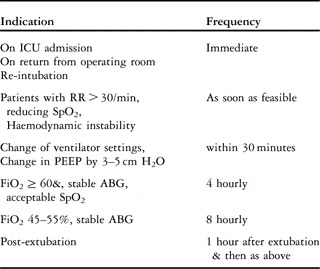
Apart from savings in costs, the other benefits of less frequent/un-necessary laboratory testing are less loss of blood,Reference Crow, Conrad, Chaney-Rowell and King34 less contamination of the arterial line, and a better ratio of nurses to patients. Taking these items into account, we suggest a possible schedule for laboratory testing in Table 4. Alternate strategies, like continuous measurement of end-tidal carbon dioxide, and online measurement of the haematocrit and blood gases, may be used wherever the equipment is available. Continuous monitoring of saturation using pulse oximetry is also useful and, when used in combination with the above, may further minimize the need for measurements of arterial blood gases. The procurement of equipment for these entails only one time cost but can reduce the need for repeated laboratory testing.
A suggested protocol for monitoring arterial blood gases.

ICU = Intensive care unit; RR = respiratory rate; SpO2 = oxygen saturation; PEEP = positive end expiratory pressure; FiO2 = inspired oxygen concentration.
(Adapted from: Mehrari SH, Havill JH, Montgomery C. A written guideline implementation can lead to reduction in laboratory testing in an intensive care unit. Anaest Intensive Care 1997; 25: 33–37.)
Respiratory therapy
In general, the cost of respiratory therapy can be cut down by early extubation and good respiratory physiotherapy. Uncomplicated patients with simple lesions can be extubated in the operating room. or early on arrival in the intensive care unit. Administration of oxygen by nasal prongs is more effective and cheaper than by mask.Reference Tomatis, Schlosser, Riahi, Stockinger and Kanten7 For neonates, we use indigenously produced oxygen hoods. In those patients on mechanical ventilation disposable ventilator tubings are replaced by a set of tubings that can be resterilized. Measures designed to reduce infection in the intensive care unit can substantially decrease the duration of mechanical ventilation and the costs of respiratory therapy.
Drugs and pharmacy
The costs of drugs and pharmacy can be cut down by reducing unnecessary use. Protocol-based therapy helps to discourage erratic and often idiosyncratic decision-making. Cardiac surgery is clean surgery, and routine use of antibiotics for many days is not essential.Reference Alphonso, Anagnostopoulos, Scarpace, Weintrub, Azakie, Raff and Karl35 The unnecessary and prolonged use of antibiotics often leads to drug resistance, and development of muti-drug resistant micro-organisms, which increase the risk of infection, prolong the stay in the hospital, besides increasing the costs. According to present guidelines, most patients require one dose of antibiotics on induction in the operating room. Thereafter, the antibiotics can be stopped as soon as invasive lines are removed, or sometimes even as early as 48 hours even if the invasive lines and chest tubes have not been removed.Reference Alphonso, Anagnostopoulos, Scarpace, Weintrub, Azakie, Raff and Karl35 The use of inotropes also needs to be rationalized to those patients who need them, rather than starting a battery of inotropes on an empirical prophylactic basis. Preparation of these drugs can also be rationalized and small volumes of the drug can be prepared to avoid wastage. Routine use of steroids to avoid pulmonary stagnation is probably unnecessary, and only adds to the costs.Reference Robertson-Malt, Afrane and El Barbary36
Charges for the blood bank
The costs of processing of blood products can only be reduced by minimizing the use of blood. Such decreasing use of allogenic blood products, besides being cost-effective, eliminates the risk of allergic reactions, and also prevents accidental transmission of diseases like hepatitis, malaria and human immunodeficiency virus infection.Reference Blumberg and Heal37 Uncomplicated and simple cases do not require blood unless absolutely necessary. Building up levels of haemoglobin preoperatively is one way of avoiding homologous transfusion of blood later on.Reference Bickler and Rode3 As nutritional anaemia is the commonest type of anaemia in developing countries, the parents of the patient are counselled about the appropriate dietary modifications, and prophylactic supplements of iron and vitamins are prescribed to build up the haemoglobin prior to surgery if it is not indicated on an emergency basis. Autologous donation of blood prior to surgery, followed by transfusion of this blood post-operatively, especially in adults with congenital cardiac disease, is cost-effective and reduces the need for transfusion of allogenic blood, with its attendant risks.Reference Dietrich, Thuermal, Heyde, Busley and Berger38 During surgery, use of ultrafiltration and cell savers can avoid later transfusion. Re-infusion of shed mediastinal blood has been practised in adult patients to reduce the costs. The role of this technique in paediatric cardiac surgery is not yet well defined. The use of modified ultrafiltration during surgery further produces haemoconcentration and the need for post-operative transfusion.Reference Gaynor21 Besides this, other pharmacologic strategies such as using Epsilon-aminocxaproic acid, Tranexamic acid, or aprotinin for blood conservation have been proposed and may be adopted depending upon the local conditions.Reference Sharma, Talwar, Choudhary, Lakshmy, Kale and Kumar39
X-ray studies
In some centres, it has been the general trend to obtain radiographs for each patient at least twice a day in the intensive care unit. This is unnecessary. Films are required only at admission, upon arrival in the intensive care unit, prior to extubation, and one after extubation. Another radiograph is then required prior to discharge.
Single stage versus staged operations
Palliative procedures have long been the initial procedure for a wide variety of congenital cardiac defects. With advances in our understanding of the physiology of the defects, coupled with better expertise and surgical technique, a wide variety of defects can now be corrected at one operation. This not only improves the outcome by reducing the morbidity and mortality associated with palliative surgery, but in addition cuts down costs of repetitive surgical procedures. Due to the initial clinical benefit, palliative procedures sometimes make the parents feel that the child does not need another surgery early. This can delay the corrective procedure to a time when the morbidity associated with correction may be higher and the long-term results may be poorer. A common example is delay in complete repair of tetralogy of Fallot after an initial systemic-to-pulmonary arterial shunting procedure.
Intraoperative transoesophageal echocardiography
Transoesophageal echocardiography is a useful tool to confirm the pre-operative diagnosis, plan surgery, and to assess the adequacy of the surgical procedure in the operating room. It helps avoid re-operations for residual surgical defects. Worldwide, its use has increased, thus improving outcomes and reducing costs.Reference Murphy40 The technique, nonetheless, demands time and commitment from the members of the cardiology team, who may find it very difficult to be available in the operating room at odd times. Training surgeons and anaesthesiologists to perform the technique is important, and they can safely be trained to perform routine interrogations.Reference Marymont and Murphy41 If there is any doubt, it is best to seek the help from an experienced paediatric cardiologist, thus avoiding the danger of a residual defect.
Need for developing products locally
Currently, the majority of disposables required for open heart surgery are imported from developed countries. This is evident in the higher total proportion of costs incurred in the operating room in our country (Table 3). Our motto should be “Import technology, not products”. The trend to manufacture these items is gradually on the rise, and is gaining popularity. Currently, intravenous catheters, urinary catheters and bags, chest tubes, and tubing for extracorporeal circuits are being manufactured in India. The Chitra heart valve was designed, and is manufactured, in India. With its implantation in patients requiring heart valves, a reduction in costs has been achieved without compromising long term results.Reference Sankarkumar, Bhuvaneshwar and Magotra42 Locally produced cannulas for delivery of cardioplegia are available at less than 5% of the costs of the imported counterparts.Reference Joshi and Kumar43 There is need to develop and manufacture the arterial and venous cannulas, oxygenators, the heart-lung machine, and other components of the extra-corporeal circuit locally further to cut down the costs. Brazil, not that well developed, has shown the way in this field. By locally producing a large number of components, they have reduced costs significantly.Reference Moraes44
Training of manpower and collaboration
This is the most important factor to deliver quality care and reduce the costs, as trained manpower is required for interventions at all levels. Trained medical and paramedical staff and economists reach the crux of the problem, and try to solve it in a scientific and acceptable manner, which helps to reduce the costs. The emphasis should be on building a cohesive team of surgeons, cardiologists, anesthesiologists and intensivists for better care and reduction of costs.
It was pointed out elegantly in a recent reviewReference Mavroudis and Backer45 that “Perhaps nowhere in modern medicine do medical, surgical and industrial colleagues collaborate as extensively as in the discipline of pediatric cardiology and pediatric cardiac surgery. Hence we should endeavour to empower others to act on our behalf, based on their expertise and training. We should try and impart skills in solving problems and avoid micromanagement.Reference Mavroudis and Backer45” Every member of the team should be encouraged to develop protocols and take part in multi-institutional studies to enhance his or her own skills, and to contribute to the specialty by adapting them to the local condition.
Audit
The role of surgical audit cannot be overemphasized.Reference Jacobs, Mavroudis and Jacobs46, Reference Jacobs, Wernowsky and Elliott47 Only careful audit identifies the surgical teams delivering the best results at minimal cost. Attempts must be made to follow and learn from that team.
Conclusion
Containment of costs in congenital cardiac surgery requires a multipronged approach, which begins with timely referral, early performance of the correct surgical procedure, and adequate postoperative care in a scientific manner. Indigenization, innovation, training of manpower, and team building are essential if we are to cut the costs and improve the quality of care.
Acknowledgements
We thank several colleagues for their feedback about the costs of surgery for congenital heart disease at their respective institutes. Specifically, Dr Krishna Manohar Sr, Professor of Paediatric & Congenital heart surgery, Sree Chitra Tirunal Institute of Medical Sciences, Thiruvananthapuram, Kerala, India; Dr Kona Samba Murthy, Formerly Senior Consultant Pediatric Cardiac Surgeon, Apollo Hospital, Hyderabad, India; and Dr Surendra Kumar Agarwal, Associate Professor of CVTS, Sanjay Gandhi Post-graduate Institute of Medical Sciences, Lucknow, India.