1. Introduction
Development economists have long been exploring the question of why there is such a disparity in how the benefits of resource wealth are maximized in resource-rich countries. Particularly among resource-rich developing economies, some have been able to achieve long-term macroeconomic stability and growth while others have been locked in a cycle of exploitation of resource rents, a phenomenon termed the ‘resource curse’. This paper aims to explore the intersection between resource governance and macroeconomic stability through the channel of investor expectations in the sovereign debt market. We examine the effectiveness of the Extractive Industries Transparency Initiative (EITI) as a signalling mechanism to investors on a government's commitment to manage its resource revenues in the long run. This study uses two different model specifications in an attempt to determine the extent to which government signalling of a commitment to transparency in resource revenue management could influence public investors' expectations of resource wealth management.
The EITI is a set of voluntary guidelines and systems that promotes transparency and accountability in the extractives sector. Upon announcing its intention to join EITI, a country becomes an ‘EITI candidate’. A multi-stakeholder group is appointed, which is comprised of representatives from government, civil society, and the private sector, as outlined in the EITI Standard. The multi-stakeholder group is charged with overseeing EITI implementation in the candidate country and is responsible for coordinating and facilitating dialogue among the stakeholders to move implementation of the initiative forward (Extractive Industries Transparency Initiative, 2019b). Most significantly, a candidate country must implement an accountability mechanism wherein all monetary transfers between government entities and private extractives sector companies are made transparently available. Reported payments are then reconciled by an independent auditor. The auditor submits a report to the EITI secretariat, which judges the country's progress against the EITI guidelines outlined in the EITI Standard. If progress in implementing the accountability mechanisms is found to be satisfactory, the EITI secretariat may grant the country the status of ‘EITI compliant’ (Extractive Industries Transparency Initiative, 2019b). It is important to note that the EITI Standard defines targets but does not provide strict guidelines on exactly how the accountability mechanism and reporting must be set up, other than to define the involvement of the multi-stakeholder group. Thus, the structure and mechanisms for how EITI operates vary widely between implementing countries dependent on the pre-existing legal and political frameworks.
Studies to date have provided mixed results on whether or not the EITI has been successful in achieving its stated goal of improving accountability and transparency in the extractives sector. In this study, we ask whether investors view EITI membership as a credible commitment to long-term responsible management of natural resource revenues. First, an overview of the literature is provided in section 2. Next, in section 3 we present the methodological framework and data used in the study and in section 4 we summarize our main results. Section 5 provides a discussion on how the EITI can influence investor expectations on resource revenue management and section 6 concludes.
2. Literature review
Resource dependence can be economically damaging because of uncertainty surrounding price volatility of natural resources (Van der Ploeg and Poelhekke, Reference Van der Ploeg and Poelhekke2009). High price volatility increases uncertainty about future revenue streams (Zhang et al., Reference Zhang, Garcia-Quiles and Thelen2015) and resource dependence can exacerbate these effects. Volatility in resource prices further generates uncertainty around the sustainability of fiscal policies (Tanner and Samake, Reference Tanner and Samake2006). Research has shown that a careful balance of saving and investment of resource revenues can help stabilise long-term fiscal spending and diversify the economy (Van der Ploeg and Venables, Reference Van der Ploeg and Venables2012). However, success of a resource management strategy is highly dependent on the strength of institutions and their ability to limit revenues from being co-opted by special interests (Van der Ploeg and Venables, Reference Van der Ploeg and Venables2012). These studies show that resource governance and macroeconomic outcomes are inextricably linked.
It follows that a government's management of resource revenues has a direct impact on investor expectations on macroeconomic outcomes. Uncertainty over a government's ability to implement a stable fiscal policy can increase the risk of default and affect borrowing rates (Penalver and Thwaites, Reference Penalver and Thwaites2006). Sovereign debt rates also act as a signal for how markets assess a country's economic and political health (Sy, Reference Sy2002). There is evidence that elections in developing countries, a time of greater uncertainty over government stability, significantly increase sovereign borrowing costs over the global risk-free rate (Block and Vaaler, Reference Block and Vaaler2004). An increase in the interest rate on sovereign debt (a decrease in the default price) is a reflection of heightened risk of default in the eyes of investors, who demand a higher return to compensate for the increase in risk. Conversely, a decrease in the interest rate (an increase in the default price) is indicative of a decreased risk of default. Many factors can influence whether investors perceive a decrease in the risk of default. For example, better fiscal management or greater government stability and institutional strength could both be reasons for investors to expect a lower risk of default and thus drive down the borrowing rate.
Many studies have examined the impact of EITI membership on political outcomes, such as measures of corruption or accountability. Several scholars have performed case studies that further contextualize the impact of EITI in a range of adopting countries. Sovacool and Andrews (Reference Sovacool and Andrews2015) demonstrate a correlation between membership in the EITI and an increase in information disclosures in the extractives industries in Azerbaijan and Liberia. Some studies find that EITI membership increases transparency (Öge, Reference Öge2016b) and decreases corruption (Villar and Papyrakis, Reference Villar and Papyrakis2017), while others find the opposite (Ocheje, Reference Ocheje2006; Kasekende et al., Reference Kasekende, Abuka and Sarr2016; Sequeira et al., Reference Sequeira, McHenry, Morrison-Saunders, Mtegha and Doepel2016; Sovacool et al., Reference Sovacool, Walter, van de Graaf and Andrews2016).
Finally, some studies have examined the direct link between EITI membership and macroeconomic outcomes. There is evidence that EITI implementation acts as a credible signalling mechanism for a government's credibility and can therefore attract investment (David-Barrett and Okamura, Reference David-Barrett and Okamura2013; Schmaljohann, Reference Schmaljohann2013; Malden, Reference Malden2017) or have a positive impact on economic development (Corrigan, Reference Corrigan2017). Alternatively, some evidence shows that EITI implementation may distort economic incentives (Sturesson and Zobel, Reference Sturesson and Zobel2015), or that its success at attracting investment may be due to the fact that countries more dependent on FDI are more likely to join (Öge, Reference Öge2016a). One must also note that the correlation between EITI implementation and transparency may be caused by other underlying factors, such as the strength of civil society to enforce government commitments to begin with (Furstenberg, Reference Furstenberg2015; Öge, Reference Öge2017). Recent research has analysed the effectiveness of public-private partnerships more generally in achieving desired social outcomes (Andonova et al., Reference Andonova, Faul and Piselliin press).
The EITI brands itself as a powerful signalling mechanism of a government's commitment to transparency. This study aims to systematically analyse whether the EITI does indeed act as a credible signalling mechanism to investors by decreasing the risk associated with mismanagement of resource revenues. Further, this paper argues that membership in EITI may be an indicator of government commitment to better fiscal management by pushing for more effective use of natural resource revenues. We aim to establish a causal relationship between EITI membership and an increase in the default price of sovereign debt for an implementing country. If this is the case, then EITI membership could be beneficial to any resource-rich developing country.
3. Methodology and data
3.1 Data
Data availability poses a significant challenge for this study. The dataset takes into account all 59 current and former EITI-affiliated countries over the time period of 2000–2017. However, of these 59 countries, data on the price of publicly traded sovereign debt, priced in US dollars and thus reflective of pure default risk, is only available for 32. This study does not include sovereign debt priced in other currencies because this price would also capture inflation risk, and the global risk-free rate utilised is that of the price of 10-year US government debt. We also do not include the high-income countries,Footnote 1 as classified by the World Bank, because the theoretical mechanisms developed here apply to resource-rich developing countries only. This further restricts our dataset to 27 EITI-affiliated countries.
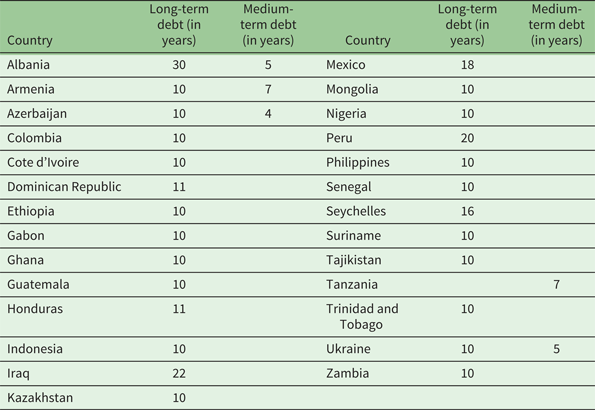
We examine two different lengths of sovereign debt: medium-term, defined as between 4 and 7 years, and long-term, defined as 10 years or longer. Table A1 in the appendix lists the countries with available sovereign debt data and the bond length. Twenty-six countries in our dataset have long-term debt data available and five have medium-term debt data available. Sovereign debt data is taken from the Thomson Reuters DataStream database for the years 2000–2017. However, the data obtained is reflective of the default price of sovereign bonds issued by the government on the international market. We use the default price as an acceptable proxy for the interest rate on sovereign debt because it represents the discount investors pay for sovereign debt that matures after a certain time period. The lower the default price, the more likely that investors expect default. The default price of sovereign debt captures investor expectations on a government's long-term fiscal performance by pricing in the perceived risk of default.
This study analyses the effect of EITI membership on the price of both medium- and long-term sovereign debt. For those countries with multiple long-term bond series, the series used for this study is the one closest to 10 years. We do not include an analysis of the effect of EITI membership on short-term bond prices because this study is interested in how EITI affects long-term structural macroeconomic outcomes, which cannot be sufficiently captured by short-term debt prices. For this analysis, we obtain the spread of the default price by taking the difference between the default price for the country in question and the global risk-free rate. We consider the global risk-free rate to be the default price of 10-year US government bonds, also taken from the Thomson Reuters DataStream database for the years 2000–2017.
We construct an ordinal variable for EITI membership status based on the timeline of membership for each country in our dataset. Timeline data was compiled from media announcements and documents available publicly on the EITI website (Extractive Industries Transparency Initiative, 2019a). The timeline consists of the month and year the change was publicly announced for each stage. The timeline variable is numbered 1 to 5 and consists of the date of EITI candidacy, EITI compliant designation, suspension, lifted suspension, and withdrawal. Most countries have not been suspended or withdrawn from the EITI. All 27 countries in our dataset have achieved at least candidate status. Fourteen have also achieved EITI compliant status. Guatemala, Indonesia, Iraq, Suriname, Tajikistan and Tanzania have at some point been suspended, although Guatemala, Indonesia, Tajikistan and Tanzania have since had their suspension lifted. No country in our dataset has withdrawn. We use monthly data for this study because several countries only had the month in which they were declared compliant available in the historical record.
3.2 Methodology
3.2.1 Interrupted time series analysis
We begin the analysis by performing an interrupted time series analysis (ITSA), to analyse whether there is a significant causal impact on the sovereign debt time series by the change in EITI status. Specifically, ITSA determines if there has been a statistically significant change in the trajectory of the dependent variable before and after an intervention point, in this case a change in EITI membership status. This methodology was similarly utilized in Öge (Reference Öge2016b) to estimate the impact of EITI membership status on government transparency. For this part of the analysis, we use a dummy variable to denote EITI membership status, rather than the timeline constructed as described in the previous section. First, the analysis is performed with a dummy variable denoting EITI candidate status. Second, we repeat the analysis replacing the dummy variable with one denoting EITI compliant status. The ITSA is run for each country individually. Here, we use only the long-term sovereign debt data, because this analysis requires a long time period of data, and the medium-term debt series contains too little data to complete the analysis.
Three additional variables of interest are included. First, EITI membership has been considered in certain cases a prerequisite for loans from major multilateral institution. Membership in EITI is seen as a commitment by the government to the principles of transparency and thus better management of resource revenues. For this reason, we include a variable denoting the total external debt burden a country holds (World Bank Indicators, 2020b). This is similar to other studies on EITI that have taken foreign aid into account (Kasekende et al., Reference Kasekende, Abuka and Sarr2016). Essentially, debt forgiveness can be seen as a form of foreign aid, particularly when this debt is held by the major multilateral institutions.
Second, country dependence on resource revenues is often seen as a catalysing factor for pursuing EITI membership. We propose that investor expectations are more heavily determined by EITI membership if the country derives a greater share of its total income from natural resources because EITI governance mechanisms would affect a larger share of government revenue. This study thus includes a variable denoting the percentage of GDP derived from natural resource rents (World Bank Indicators, 2019b). Previous studies have also taken resource dependence into account (Corrigan, Reference Corrigan2017) when analysing the effect of EITI membership on specific country outcomes.
Finally, this paper includes a variable denoting corruption perception (Transparency International, 2019) as a potential influence on EITI membership status in adopting countries. There are several studies on the link between EITI membership and corruption perception and controls for some measure of corruption or democratic participation is used in the literature (Öge, Reference Öge2016a). In addition, control variables for short-term debt burden (World Bank Indicators, 2020c), current account balance (World Bank Indicators, 2020a), GDP per capita (World Bank Indicators, 2020d), inflation (World Bank Indicators, 2020e), GDP growth per capita (World Bank Indicators, 2019a) and sovereign credit ratings (S&P Global Market Intelligence, 2018) and a year fixed effect are included, as is standard in the literature on sovereign debt.
3.2.2 Panel regressions
To attempt to establish causality, this study draws upon previous studies on EITI for its methodological approach. Several studies have used panel data regression analysis (Öge, Reference Öge2016b; Corrigan, Reference Corrigan2017) with treatment effects (Kasekende et al., Reference Kasekende, Abuka and Sarr2016) to control for the fact that the decision to join EITI may not be exogenous. As observed in Kasekende et al. (Reference Kasekende, Abuka and Sarr2016), countries that chose to join EITI are likely a self-selected group, which would imply our sample is systematically skewed by resource-rich developing countries that have some unobserved characteristic that pushes them to join EITI, whereas other resource-rich developing countries may not. We perform a fixed effects regression on the panel-level data, to obtain the cross-country significance of EITI membership status in determining the spread in the price of sovereign debt. The same variables of interest and controls are included.
4. Results
4.1 Interrupted time series
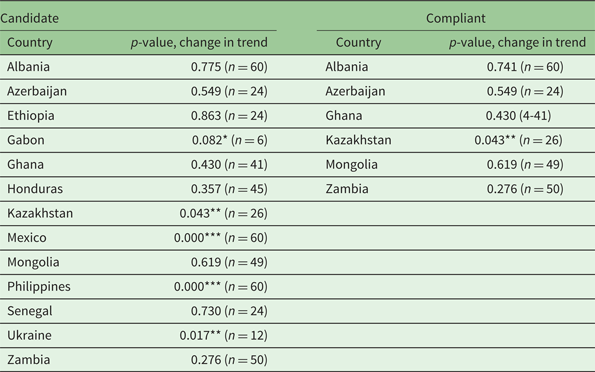
The ITSA is performed twice for each EITI-affiliated country. In some cases, there are not enough data points around the date of EITI membership to generate an estimate. These countries are dropped from the analysis. The ITSA is run first using the date of EITI candidacy announcement as the intervention date, and second using the date of EITI compliance announcement as the date of intervention. The results reported in table 1 show the p-value of the post-intervention change in the trend for the countries where data is available. A significant result indicates that there is a statistically significant difference in the trend before and after the intervention date.
Interrupted time series results

Note: *, ** and *** denote significance at the 10%, 5% and 1% levels, respectively.
Results of the ITSA show that several countries indeed demonstrate a statistically significant difference in the trend before and after the intervention tested. Gabon, Kazakhstan, Mexico, the Philippines and Ukraine show a significant change after EITI candidacy is announced, while Kazakhstan has a significant change after EITI compliance is announced.
4.2 Treatment effects
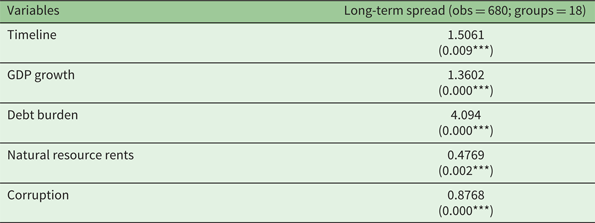
We use a fixed effects model to determine if the timeline of EITI membership status is significant in determining a change in the spread of the default price of sovereign debt from the global risk-free rate. The results reported in table 2 support the theoretical mechanism developed here that EITI membership status is indeed significant in determining the spread of the default price of long-term sovereign debt. The table indicates the coefficient for each variable and the p-value is shown in parentheses.
Fixed effects model

Notes: *** denotes significance at the 1% level. The p-value is shown in parentheses.
Results from the long-term spread of the default price of sovereign debt indicate that there is a significant positive impact of a change in EITI membership on the spread in the default price of long-term debt. The positive coefficient does not indicate that achieving EITI membership necessarily increases the spread in the default price, because of how the timeline variable is constructed. This issue will be addressed in the robustness checks below. Here, the fact that the timeline variable is statistically significant is in line with what we expected to find. We do not obtain any results for the effect on medium-term spreads due to insufficient data.
The analysis also finds that the debt burden, resource rents and corruption variables are all statistically significant in the long run. Although the coefficient for debt burden is significant, the effect is very small. However, the effect of resource rents and corruption both support the theoretical mechanism developed here, showing that an increased reliance on natural resource rents and/or an increase in corruption levels are both associated with a statistically significant increase in the spread of the default price of sovereign debt relative to the global risk-free rate.
4.3 Robustness checks: countries with high resource dependence
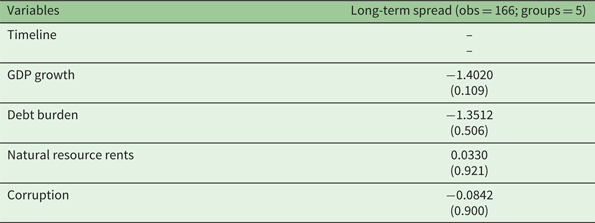
As detailed in the methodology section, the purpose of the event study is to determine if there is significant deviation in how the debt series reacts to the announcement of EITI candidacy or EITI compliant status from what would be expected otherwise. We check the results obtained in our initial fixed effect regression by performing the analysis again, including only countries that derive greater than 15 per cent of their GDP on average from natural resource rents. The results are shown in table 3.
Fixed effects model, countries with natural resource rents >15% of GDP

Note: The p-value is shown in parentheses.
Surprisingly, we obtain the opposite result as in the original fixed effect regression. Here, EITI membership status is insignificant in determining the spread in the default price of long-term sovereign debt. While this is a significant finding, interpretation again is convoluted by the method of construction for the timeline variable. Further, this could be due to the challenges of a limited dataset. Details of these issues area discussed further below.
4.4 Robustness checks: fixed effects model, only compliant countries
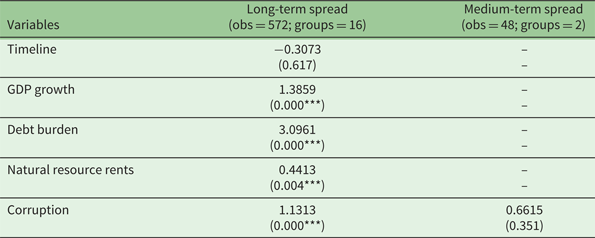
Finally, to address issues with the construction of the timeline variable, we re-run the fixed effects regressions using only the countries that have never been suspended or withdrawn, leaving only countries that have achieved candidacy or compliant status. This approach will allow for a clearer interpretation of the direction of the effect, by not obscuring the directions of the coefficient on the timeline variable. The results are presented in table 4.
Fixed effects model, only compliant countries

Notes: *** denotes significance at the 1% level. The p-value is shown in parentheses.
We can see that when countries that have been suspended or withdrawn are dropped, the spread of the default price of sovereign debt from the global risk-free rate is insignificant. This refutes the theoretical mechanism developed in this paper, which would predict a significant decrease in the spread between the EITI-affiliated country and the global risk-free rate as investor perception on the risk associated with long-term resource revenue management decreases.
Altogether, this study identifies evidence that EITI membership status is indeed significant in determining the spread in the default price of sovereign debt, which indicates that EITI membership is significant in influencing the perceptions of investors. However, it is possible that a significant relationship is some countries may be influencing the aggregate results, given that the country-level analysis demonstrates that the relationship is not significant in all countries. This indicates that there may be country-specific conditions that determine if EITI membership status behaves as a credible signalling mechanism to investors. The next section of this paper explores the mechanisms causing these reactions and why investors take EITI membership to be positive in some cases but negative or insignificant in others.
Several constraints must be taken into account when interpreting these results in context. First, due to data limitations, this study has an extremely restricted dataset. EITI-affiliated countries are largely low-income, resource-rich developing nations. In many cases, they do not issue publicly traded sovereign debt or have not issued publicly traded sovereign debt for long enough to have the needed data covering the time period around their EITI candidacy. It is also possible that abrupt price fluctuations in commodities markets can affect risk perception in bonds issued by exporting countries. However, this increase in risk would be captured by credit ratings. Further, it would likely affect countries more that derive a higher proportion of their GDP from natural resources, which was addressed by the robustness checks.
Further, in many cases the date used for changes in EITI membership status was the date of official public announcement. This does not take into account the possibility that a government's intention to pursue EITI membership could have been public knowledge before the specified date, or that reform mechanisms were put in place to align with EITI requirements before the date of announcement. Further, for many resource-rich developing countries, the market for long-term debt is very thin. Market size could potentially have an impact on how investor expectations are channelled.
5. Does EITI membership affect investor expectations on a country's long-term fiscal management position?
The link between EITI membership and investor expectations on how a government can manage its resource revenues in the long run is a topic that has not been explored in other studies on the impact of EITI. As outlined in the literature section of this paper, the links between the EITI and corruption, investment, and transparency measures have been topics of interest. However, given that the goal of the EITI is to ultimately facilitate further development of a country's extractives sector, it is important to ascertain whether EITI indeed is as credible of a signalling mechanism as it aims to be.
One factor that determines how investors perceive resource revenue management is the strength of institutions at the time of resource discovery (Frankel, Reference Frankel2012). Stronger institutions may be seen as more able to effectively manage resource revenues without those revenues being co-opted by interest groups or taken advantage of by corrupt activities. States with weak institutions are less capable of enforcing checks on spending, and resource revenues are thus left vulnerable to rent-seeking behaviour from special interest groups (Tornell and Lane, Reference Tornell and Lane1999). However, no single institutional arrangement can achieve the goal of effective resource revenue management in all contexts (Gelb et al., Reference Gelb, Eifery and Tallroth2002).
If the governments most in need of a structure to effectively manage their resource revenues (resource-rich developing economies) are also those most likely to join EITI, is EITI then destined to fail? This would not be because of any inherent fault of the EITI itself, but rather that those countries most likely to pursue EITI candidacy or compliance are those that are predisposed to corruption of resource revenues to begin with. Our results show that EITI can be effective in some cases. Although broad econometric analyses are hindered by lack of data, results from the ITSA show that there are indeed cases in which achieving EITI candidacy or compliant status can have a significant effect on the spread of the default price of sovereign debt, which may also be indicative of a broader economic shift. This analysis also demonstrates that the impact of EITI membership on investor expectations may be heavily influenced by country-specific conditions that a broader econometric analysis cannot account for.
This section of the paper presents two detailed case studies of EITI implementation and the impact on investor expectations, to provide more context on how EITI implementation occurs in practice and explore the potential hindrances that exist to achieving its stated goals. Further, case studies are necessary as we attempt to explain why the significant coefficient on the timeline variable is positive rather than negative as predicted in the theoretical mechanism of this paper. Based on results obtained, we select Kazakhstan and Senegal to examine in more detail. These countries are chosen based on the outcomes of the ITSA as well as consideration of data availability. Senegal does not demonstrate any significant change before and after EITI candidacy announcement, while Kazakhstan is the only country that exhibits a significant change in the trend of the spread of sovereign debt rates in response to both EITI candidacy and EITI compliant announcement. To provide context to the results obtained, we chose to consider countries where lack of data may prevent a quantitative analysis of the impact of EITI membership on the market for sovereign debt.
5.1 EITI in Kazakhstan
Results of the ITSA show that Kazakhstan may be an interesting country case because we show that there is a significant change in the spread of the sovereign debt rate in response to both announcement of EITI candidacy and EITI compliance. EITI implementation in Kazakhstan has a long history and a closer examination could provide some understanding of how EITI in Kazakhstan has affected investors. Significantly, a deeper understanding of how EITI implementation in Kazakhstan may have influenced investor expectations could provide context for EITI implementation in other countries. This case study proceeds first with a brief outline of EITI implementation in Kazakhstan, followed by a discussion of how EITI implementation could have been viewed in the eyes of investors.
Kazakhstan announced its candidacy and intention to pursue EITI implementation in September 2007 and was granted EITI compliant status in November 2014. A major catalyst for its decision to pursue EITI candidacy could be that Kazakhstan has large deposits of minerals and other raw materials, and exports comprise a significant portion of GDP. Between the years 2000 and 2016, natural resource rents comprised on average 22.99 per cent of total GDP for Kazakhstan (World Bank Indicators, 2019b). Despite being an apparently ideal EITI candidate country, the Kazakh government has been criticized for its EITI implementation. Öge (Reference Öge2017) performs an in-depth case study of EITI implementation in Kazakhstan and the role of different actors in how EITI behaves in Kazakhstan. The study finds that despite clear regulations on the involvement of civil society in EITI implementation, in practice EITI in Kazakhstan does not allow for independent civil society organizations to exercise influence in the EITI process (Öge, Reference Öge2017). The author further finds that EITI implementation in authoritarian countries like Kazakhstan does not foster higher levels of civil liberties (Öge, Reference Öge2017: 7). Thus, the question is: if EITI implementation in Kazakhstan does not deliver on the increased transparency or accountability mechanisms as promised, why then do investors appear to take EITI to be a credible signalling mechanism on resource revenue management?
There are a few possible explanations for why investor expectations could be affected by EITI implementation in Kazakhstan. First, investors could be convinced that announcement of EITI compliant status is satisfactory to ensure that EITI mechanisms are powerful enough to keep all actors within the extractive industry adherent to the transparency principles. In short, they may assume that reputational risk of being stripped of EITI compliant status is enough incentive to keep all actors, particularly those affiliated with the Kazakh government, adhering to their commitments.
Alternatively, investors may assess that EITI implementation in Kazakhstan is too heavily skewed toward government control, with civil society having little influence over how EITI implementation is handled. Investors may thus perceive that the mechanisms and changes to regulatory procedure that the EITI fosters have provided sufficient checks and balances to ensure compliance among government agencies and private sector actors. This study examines corruption perception as a variable of interest; however, it does not explicitly control for regime type. One potential avenue for further research is to examine how authoritarian government structures could contextualize EITI implementation and affect its success.
5.2 EITI in Senegal
The case of Senegal is interesting to explore in depth because it is one of the countries where the ITSA did not show a statistically significant change in trajectory before and after the announcement of EITI candidacy. We first explore the development of EITI mechanisms in Senegal, then analyse why EITI implementation in Senegal does not appear to act as a credible signalling mechanism to investors.
Senegal announced its EITI candidacy in July 2013. The first EITI report produced by Senegal covered the year 2013. Its main conclusion was that EITI implementation in Senegal suffered from a significant lack of transparency, which lead to an information vacuum that significantly hindered the EITI evaluation process in Senegal. Reconcilers, those charged with evaluating the status of EITI implementation in affiliated countries, noted that they were not able to establish basic information regarding the extractives sector in Senegal, nor its contribution to the state budget (ITIE du Sénégal, 2013). The primary recommendation of these evaluators was that it was imperative for the Steering Committee for the EITI in Senegal to act aggressively to increase awareness and build public and industry buy-in for the EITI, and to advocate among all actors on the importance of transparency.
How did this dearth of information impact investor expectations on what the EITI would be able to achieve in Senegal? The World Bank, in its report on the economic climate in Senegal in 2013 noted that the 2013 EITI report for Senegal showed a USD21 million discrepancy between tax payments declared by extractive industry actors and tax revenues as reported by government entities (World Bank Group, 2016). Few additional details on what may have contributed to this discrepancy were noted. Most surprising, however, was the context in which this data vacuum occurred. In 2013, Senegal had strong macroeconomic fundamentals and a relatively strong and stable government (World Bank Group, 2016). Strong economic and political institutions are often cited as factors that can mitigate investors' concerns, but any positive effect this could have generated could have been cancelled out by the severe lack of basic data and an apparent lack of commitment to the fundamentals of transparency by several of the major actors involved.
One potential explanation for the lack of demonstrated significant response from investors is because the government of Senegal made public its intention to seek EITI candidacy status one full year before the official initiation of EITI candidature (World Bank Group, 2016). In this scenario, it is plausible that any investor expectations on what EITI candidacy could mean for long-term resource revenue management in Senegal could have already been priced into the sovereign debt market. Because there was no new information to react to when the official announcement was made, no change would be seen in the default price of sovereign debt. Further, it is possible that the lack of information available on how EITI was being implemented in the country simply did not provide investors with any recognition one way or the other, even before the official announcement was made.
6. Conclusion
This study is the first of its kind to establish a statistically significant relationship between EITI affiliation and investor expectations on a government's ability to effectively manage its resource revenue in the long run. Results demonstrate that the linkages between EITI and sovereign debt markets provide significant insight into how investors may perceive macroeconomic stability and resource governance.
The primary finding of this study is that although it does appear that EITI membership status is significant in determining changes to the sovereign debt markets of implementing countries, these results are dependent on country-specific context. In this way, the EITI does indeed behave as a credible signalling mechanism to investors, but only if they believe that the way in which EITI is implemented and the interaction EITI has with existing political and economic institutions is sufficient. It follows that EITI affiliation alone is not enough to change investors' expectations on how a government will manage its resource revenues.
We introduce several additional explanatory variables, in line with the findings of other studies on EITI effectiveness. Even when these variables – debt burden, resource reliance and corruption perception – are introduced, we still find that EITI is significant in inducing a change in the spread of the default price of sovereign debt from the global risk-free rate only in certain cases. These findings reinforce the idea that success of EITI implementation is due in large part to country-specific circumstances, which may encompass anything from institutional strength to the enforcement power of EITI mechanisms. This could prove consequential for policy making, because it highlights the possibility that EITI will only be successful in achieving its stated goals if the foundational political and economic institutions in a country are set up in such a way that it allows EITI to flourish.
This finding is compounded by cases studies of EITI implementation in Kazakhstan and Senegal. These cases were chosen specifically to demonstrate how country-specific conditions may lead to very different outcomes for how EITI may impact the sovereign debt market. Specifically, these cases show that pre-existing conditions in an implementing country can be extremely important in determining how EITI will be implemented, and whether or not it will be able to effectively increase transparency in the extractives sector. In particular, the relative position of the government and the broader information environment may be significant factors in determining investor expectations on how EITI will be implemented. Essentially, how the EITI is implemented is far more important to investors than whether it is implemented.
In sum, this study shows that the impact of EITI may rely on country-specific contexts far more than previous econometric studies have shown. Further, the way investors perceive how effective EITI will be in promoting transparency and accountability in the extractives sector is highly dependent on country-specific conditions and how the EITI interacts with pre-existing economic and political structures. Further research in this area could be particularly fruitful. In particular, research on this topic could be extended using a quantile-based approach along the lines of Atsalakis et al. (Reference Atsalakis, Bouri and Pasiouras2020). As governance regimes like the EITI expand their activities into more countries, it is increasingly vital that we have a solid understanding as to whether these mechanisms are effective in achieving their goals, so that resource-rich developing nations can take full advantage of the strategic implications that the EITI presents.
Countries with available sovereign debt data, and lengths