Soka Gakkai voting
The lay Buddhist organization Soka Gakkai remains a gap in our knowledge of Japanese politics. We can see its presence in Komeito, the political party it founded in 1967, and speculate about its influence over the Liberal Democratic Party (Yamada, 2003; Sado, Reference Sado2005) but its political activity remains unclear. Researchers (Metraux, Reference Metraux1988, 2003; Seager, Reference Seager2006) have shared their interviews with top leaders in the Gakkai and Komeito, but there has been no systematic study of rank-and-file Soka Gakkai members in Japan since the late 1960s (Thomsen, Reference Thomsen1963; McFarland, Reference McFarland1967; White, Reference White1970; Dator, Reference Dator1969; Azumi, Reference Azumi1971), in spite of Komeito's pivotal role in the balance of parliamentary power.Footnote 1
This article is the product of rare fieldwork in the Soka Gakkai, and makes two claims redefining how we think about Komeito voters. This study's first claim is that the Gakkai relies on policy claims more than social identity to justify members' support for Komeito. Second, Komeito partisans in the Gakkai repeat the same policy appeals to recruit floating voters, rather than relying on social ties to motivate independent voters.
Currently, scholars assert that Gakkai members support Komeito solely because of their social identity (Baerwald, Reference Baerwald1986; Curtis, Reference Curtis1999; Mulgan, Reference Mulgan2000; Hrebenar, Reference Hrebenar2000). Some qualify that assertion (Stockwin, Reference Stockwin, Ishida and Krauss1989; Richardson, Reference Richardson1998), but they all explain the party's support by linking political activity to Gakkai member identity. Put simply, Gakkai members vote Komeito because they think that's what Gakkai members do, and independents vote Komeito to please a friend or relative in the Gakkai. The standard portrayal of Gakkai members – typically citing survey data from the 1960s – is that members join the Gakkai in search of a social identity (and its attendant connections) that they lost moving to urban areas for low wage jobs. This new identity ties them to Komeito through the figure of (former President) Daisaku Ikeda, spiritual leader of the Gakkai and founder of Komeito. When I talked to Japanese non-members about my research, for example, I heard a single common response, from professors to politicians, ‘They vote that way because Ikeda tells them to.’
This model of Komeito partisanship closely parallels the literature on partisanship in America. In The American Voter, Campbell et al. (Reference Campbell, Converse, Miller and Stokes1960) postulate that voters' partisanship stems from their social identity, not policy preferences, the way Southern conservatives voted Democrat because that was part of what it meant to be a white Southerner. More recently, Green et al. (Reference Green, Palmquist and Shickler2002) have renewed this view of American voters.
In The Japanese Voter, Flanagan et al. (Reference Flanagan, Kohei, Miyake and Richardson1991) find that this theory held true in Japan, too. Voters were not concerned about political issues – they became partisans as part of a social group. Reed (Reference Reed2003) updates this theory and specifically applies it to the Soka Gakkai, implying that members vote for Komeito as an expression of their membership in the Gakkai, not out of support for Komeito's policies.
While the conventional wisdom about Komeito may have been true in the 1960s, I find that its supporters have changed along with the rest of Japan's voters. Past research does show that this social identity effect dominated post-war partisanship, but de-alignment among Japanese voters has forced scholars to confront the weakening role of social identity in partisanship (Richardson, Reference Richardson1998). Based on direct observation of Gakkai practice, I argue that today, policy appeals are central to the organization's political justification and campaign outreach. Social ties remain important, but they function as enablers – membership brings people to meetings, where they hear policy messages, and social networks offer pathways for partisans to transmit policy messages to a larger audience. Ultimately, though, the messages are about policy.
In support of these arguments, I offer direct evidence – ethnographic reporting and new primary sources from Gakkai socialization efforts – and indirect evidence, testing the model's implications. In this case, the conventional model implies that: (a) Komeito and the Gakkai organization will not waste limited time at meetings justifying their policy positions to members, since members will vote Komeito regardless, and (b) references to Komeito that occur within the Gakkai context will emphasize social identity, not policy. By contrast, my model implies the opposite: the two organizations will spend time justifying their policy positions, and limit social identity-based appeals.
Since forming a ruling coalition with the LDP, Komeito has come under fire for pursuing policies contrary to its stated ideology (e.g. Yamada, 2003; Eto and Hichiri, Reference Eto and Hichiri2003; Sado, Reference Sado2005). If the current model of social identity voting is correct, then Komeito's voter support should remain unaffected, leading those authors to assert that Komeito's leadership has nearly unlimited freedom to change policies. On the other hand, if Komeito partisans justify their support by agreeing with Komeito policies, then contradictory policies are likely to create dissonance among voters and reduce the party's electoral support.
This produces a second testable implication of the article's theory. The conventional model implies that Komeito support should remain constant (paralleling Gakkai membership). By contrast, my model suggests that Komeito support should be high when the party supported a government that echoed the themes in Gakkai policy messages – during the Koizumi era – and decline when the coalition moved away from those policies – during the Abe era.
The bulk of this article, coming after a description of my research methodology, is divided into testing these two implications, looking at the content of political messages first, and the timing of electoral support second.
Fieldwork in the Soka Gakkai
The first phase of my research investigated why Gakkai members become Komeito partisans. As Koellner (Reference Koellner2002) notes, we know that organizational membership has a significant affect on Japanese voting, but we have few empirical descriptions of why. The ethnographic technique used here is more useful for that than large-N statistical analysis because it focuses on process rather than outcomes (Bayard de Volo and Schatz, Reference Bayard de Volo and Schatz2004).Footnote 2 It involves close observation of social practices, giving them meaning by putting them in context, especially in situations like this where little is known about the subject (Fenno, Reference Fenno1990; Leblanc, Reference Leblanc1999; Silverman, Reference Silverman2006).
I conducted fieldwork in Japan during the second half of 2007. After securing the cooperation of the Gakkai public relations office, I attended approximately 30 regular meetings as an observer, usually with an escort from the organization. I supplemented this with individual discussions with organization officials, local district leaders, and rank-and-file members (without organizational escorts). We chose these meetings to present a diverse cross-section of the membership: weekly division (men's and women's) meetings of 10–30 people, zadankai monthly meetings were the divisions come together with 20–50 people, and occasional special events. Geographically, they were divided among three primary sites: Moriguchi, Hirakata, and Tanba. The first two are industrial suburbs north of Osaka. Moriguchi is home to Panasonic's headquarters and the meetings I visited were in blue-collar areas; Hirakata is less dense and the meetings I attended suggested a higher income level. Tamba is in Hyogo prefecture, divided into dormitory towns at the southern end to small farming communities at the northern end. Gakkai membership is not uncommon in these areas – Hirakata even hosts one of the Gakkai's two elementary schools. To provide contrast, I also attended meetings in eastern Gifu prefecture, where membership is said to be less common.Footnote 3 This wide range of meetings, I believe, provides enough leverage to make generalizations about the Gakkai membership.
In this article, I analyze messages that appeared in district-level Gakkai leaders' (chikubucho, shibucho) speeches, Komeito political videos, and organizational publications, comparing the relative prominence of group membership and policy preference. Messages that emphasize the personal connections between Gakkai and Komeito, or the breadth of Komeito support among Gakkai members, are group membership oriented. Possible examples of this include: insistence that ‘we [Gakkai members] are all in this together’, reminding listeners that Komeito politicians are Gakkai members, mentioning the Komeito in Gakkai publications, or juxtaposing symbols of party and religion. On the other hand, policy oriented messages are likely to: present information current political concerns, stress the Komeito's role in making policy, or deliberately avoid Gakkai symbolism. The relative frequency of these message categories provides evidence for their relative importance in member mobilization, telling us what moves Gakkai members to become Komeito partisans.
The second phase of my research investigated outreach to floating voters. Ideally I would have liked to observe outreach directly, but I was not allowed to attend meetings during an actual election campaign. When I pressed officials on the subject, they said it was a precaution to ‘prevent misunderstandings’, which I suspect is a legacy of the election law violation trials of the 1960s. I was able to attend meetings immediately after the July 2007 Upper House campaign ended, meetings during the run-up to 2008 campaigning, and meetings where members discussed outreach for elections in neighboring cities' elections, and I supplemented these observations with a written questionnaire in December of 2007. The instrument asked them to describe the arguments they used in voter outreach, coding their answers into three categories: (1) expressions connecting organization and party, which would only make sense if addressed to other Gakkai members, (2) references to their own support for Komeito, which suggests they are appealing to people who will be swayed by ties of friendship or blood, and (3) references to policy issues, which appeal independently of Gakkai membership or personal ties.
While this research challenges the conventional wisdom about Komeito and the Soka Gakkai, it is important to acknowledge the handicaps that scholars have labored under. The Gakkai's reputation for secrecy is deserved (Kawanishi, Reference Kawanishi1996; Shimada, Reference Shimada2007); my own research began after more than two months of negotiations with organizational representatives in Central and Western Japan before I finally secured permission to attend regular meetings, and even then I was excluded during election campaigns. Personally, I believe that this secrecy is a response to the Japanese tabloid press's relentless criticism, and I hope that my research will encourage the Gakkai and other scholars to cooperate in producing a more accurate picture of the organization and its members.
Justifying partisanship
Gakkai members' tendency to support Komeito is well established. In my own survey of 82 active members, every single one admitted to being a Komeito partisan. In the Japan Election Study (JES III) dataset, there is no question about Gakkai membership, but we can infer it from respondents' answer to the question of whether they belong to a religious group whose members support Komeito – every one who answered ‘yes’ to that question also supported Komeito. Whatever measure one cares to use, the power of Gakkai membership is clear. The reason for that partisanship, however, is not.
The Soka Gakkai has three primary channels for justifying Komeito partisanship to active members: direct appeals from local Gakkai leaders, Komeito outreach at Gakkai meetings, and printed publications.Footnote 4 During my fieldwork I was able to observe all three, and each message I witnessed followed a similar pattern: (1) present a social problem, (2) describe where different parties stand in relation to that problem, and (3) explain why the Komeito's stand on the problem is best – for the country, not for the Gakkai. In this section, I discuss each of these channels in turn.
Leadership speeches
The format for Gakkai meetings varies, but they always end with a speech by the ranking member present (kanbu aisatsu). These resemble Christian sermons, recounting a personal experience and drawing spiritual lessons from it. As talk of a snap election in the spring 2008 spread in December 2007, the speeches began to carry political messages. While each leader's speech was different, they had the same basic message.
Politics is corrupt. Most politicians look out for themselves, or for a narrow group of constituents. But this isn't what politics should be like, and those aren't the kind of politicians we should elect. Politicians should work for the people's [Gakkai members use the term minshu – which has overtones of common people – instead of kokumin – which refers to citizens] happiness. Out of all the political parties, Komeito is the only party that works for everyone, not just for the private gain of one group. Komeito works for the people.
And work it does. Since the last election, the Komeito has achieved 90% of the goals on its platform, more than any other party. Komeito politicians don't just listen to their constituents, they take immediate action to solve their problems. They don't always succeed, but they always try.Footnote 5
These speeches followed a common template. First, the speaker insisted that something is wrong with politics; the precise content varied, but most connected the pursuit of (collective) self-interest with bad governance. Some speakers made specific references to specific opponents, either the Democratic Party or Tanaka-style machine boss politicians, but most kept their accusations general. Finally, they conclude that Komeito is different because it works for the people, so it deserves the audience's support. This is a policy-based appeal – ‘support Komeito because it will make life better for the Japanese people’ – not one to group identity.
The timing of these speeches is worth mentioning, because they began in December of 2007, when the next election was at least three months and possibly as long as three years away. Political socialization in the Gakkai is not automatic; it is produced in a deliberate commitment of time by both organization and members. The next form of justification I witnessed is party videos.
Party videos
When I asked members what happens at political study meetings, the first item many respondents mentioned was watching videos. These 15 minute-long messages are produced by the Komeito and screened in divisional Gakkai meetings. As can be expected, these videos are essentially campaign commercials that all active members watch. During actual campaigns they are followed by discussion, occasionally with a visiting Komeito politician, but unfortunately I was unable to witness this. Still, it was easy to see how the videos followed the same model as leadership speeches.
Consider the two videos I saw – one for the 2007 Upper House elections and one for the upcoming Lower House elections. The 2007 election turned on the pension issue, and the video recognized this, starting with a variety of figures testifying to the LDP-Komeito coalition's claims about the pension system's financial stability. The video doesn't feature Gakkai members, which would emphasize a common social identity, it features non-Gakkai public figures, such as professor-turned-cabinet minister Heizo Takenaka, to emphasize policy expertise instead. Then it moves on to say that the real source of a pension system's strength is having enough young workers paying in, and this is the party's specialty. Komeito politicians talked about their signature achievement – monthly payments to anyone raising small children (jidoteate). There was nothing about the lost 50 million pension accounts, nothing about security issues, nothing about Prime Minister Shinzo Abe's controversial nationalist agenda. These omissions show that the Gakkai's political education program is not an objective attempt to make members better informed, it is designed to do so in a way that leads members to support Komeito. Nevertheless, we must recognize that this motivation taps members policy concerns, not their sense of belonging to the organization.
The 2008 video was similar, but focused on medical care rather than pensions. It took its cue from recent cases where patients died after hours in an ambulance looking for a hospital that would admit them, plugging Komeito's policy goal of replicating Tokyo's emergency information center in every prefecture. The subject differed, but the message was the same as 2007 video, the Komeito helps people in concrete ways, especially people in need, like those bearing the cost of raising children or who can't afford private clinics.
There was nothing in either video that connected Komeito to Gakkai members' group identity. Observers of American politics know that an ostensible separation of Church and State doesn't prevent political actors from drawing on religious symbols to mobilize voters, nor does it overly inhibit some European political parties. Given that these videos were scripted for viewing at Gakkai meetings, it would have been trivial to include subtle references, such as a quote from Ikeda, a testimonial from a celebrity known to be a Gakkai member, or including a Gakkai building in the visual background, but none of these appeared. Nor was there mention of Gakkai-specific issues, like freedom of religion, which could serve as code words for a Gakkai social identity.
Organizational publications
The Gakkai also reaches out to its members through an array of publications, whose flagship vehicle is the daily Seikyo Shinbun. The paper avoids politics, touching lightly on non-Gakkai news, and Komeito only appears in brief statements of election results. Nevertheless, it does connect the two organizations occasionally. For example, Komeito rose to prominence in Osaka in the late 1950s, during a membership drive that Ikeda led personally. Among members in Kansai, this episode is a ‘founding story’, like that of Washington at Valley Forge, and it appeared in print repeatedly while I was there. The articles (and discussions of the event at meetings) seldom mention Komeito, but it is important to recognize that the ‘Osaka Struggle’ was simultaneously a membership drive and a political campaign. Proselytizing door to door, some Gakkai members were arrested because they combined a religious message with an electoral appeal. This gives the story an additional meaning connecting the Komeito and Gakkai, even if the editors never explicitly mention the party.
Beyond that, the Gakkai also publishes magazines, such as Ushio, which strives to be a non-partisan policy journal, and Daisanbunmei, which explicitly presents a Gakkai perspective on politics. Consider the following example of election literature that appeared in the August 2007 issue, just before that year's Upper House election.Footnote 6 The headline article was a dialogue between Ikeda and astronomer Ronald Moran, which clearly establishes the magazine as a Gakkai message, and it included an editorial about the ‘two-party system’ that parallels the Gakkai's political messages elsewhere. The editorial begins by describing an LDP flyer claiming Democratic Party (DPJ) leader Naoto Kan is responsible for the disastrous state of Japan's public pension system, then it describes a proposed DPJ flyer claiming the LDP wants to steal pension money. The editorial insists the DPJ went overboard in its counterattack, portraying the two major parties as doing little more than mud-slinging for votes, losing track of the real issues. In particular, the article continues, the real guilty party here is DPJ leader Ichiro Ozawa. If this continues, the editors argue, Japanese politics will be swayed by words and performances, not policy. At the very end they ask: ‘What party is carrying out politics that is responsible to the Japanese people?’
The editor is doing everything short of screaming ‘vote Komeito’. In standard Japanese prose style, the main point doesn't emerge until the end. First, the article repeats the ‘politics is corrupt’ theme, and uses it to cover the pension accountability issue – replacing a problem for the Komeito with a standard pro-Komeito trope. Then it raises a red flag about Ozawa, in language about politics as winning elections instead of helping people that pushes the same Gakkai member buttons as the speeches described earlier. Almost a quarter of the article attacks Ozawa for the way he attacks other people. Finally, it asks which party is ‘responsible’ – knowing full well that the Komeito election slogan that year was ‘the responsible party’. There is no mention of the party at all, not even once, but no Gakkai reader could come away from the editorial without hearing a message of Komeito support from a Gakkai publication.
Still the lack of explicit references in the Seikyo Shinbun is significant, since the paper would offer an ideal vehicle for associating Komeito with Gakkai membership. For example, currently the Seikyo Shinbun includes notifications of Komeito victories in local elections across the country (typically a one paragraph factual statement) – the editors could expand this coverage somewhat to include Komeito personnel changes as they do for Gakkai personnel news. Doing so would blur the line between organizations and excite outside suspicion, but Gakkai viewers would associate the two without any direct assertion of the relationship. When I asked a member about subscribing to the Komei Shinbun, I was told that I would have to ask the party directly, unlike the Seikyo Shinbun, which members sell. This disconnect reinforces the observation that political mobilization stems from insistence that members learn about contemporary political problems, not from declarations of solidarity.
The role of group identity in partisan socialization
None of this primary source evidence denies a role for group identity; it simply shows that Komeito and Gakkai justify their support with policy appeals, not group identity. Nevertheless, it would be a mistake to discount the role of group identity completely. Close examination of communication inside the Gakkai reveals that where policy appeals convert members to Komeito partisanship, group identity appeals motivate them to be active campaigners.
No one with friends in the Gakkai will deny that their level of political activity is exceptional (to the extent that Yamada (Reference Yamada2004) calls the Gakkai a ‘vote-gathering machine’), and my survey confirms this. Among respondents, 36% claimed they were ‘very (taihen) active’ during campaigns and another 42% claimed they were ‘fairly (kanari) active’, suggesting that nine out of ten regular meeting attendees are committed to campaigning. By comparison, only 2.5% of respondents in the JEDS 2000 data set reported having ever participated in campaigning.
Where the content of political messages convinces listeners that the Komeito is the right party to support, group identity messages insist that listeners take action. For example, Gifu leaders insisted after the August 2007 Upper House election that ‘they [Komeito politicians] work hard, so we [Gakkai members] have to work hard to support them’. One women's division leader claimed that ‘the LDP leadership said they can't hold elections soon because we [Gakkai women] are tired, but we know how to tighten up and get to work’ in December 2007. Nor are leadership speeches the only source.
When I asked permission to attend meetings during an election campaign, officials insisted that the meetings would be boring; members would just announce how many people they had contacted, and encourage each other to redouble their efforts. One group I visited posted a large sheet where members would record who they contacted, much like car dealers post graphs of who has sold the most cars. These practices apply peer pressure on reluctant members to ‘work hard like everyone else’.
In summary, where previous research assumed that Komeito partisanship and campaigning were the result of an amorphous sense of group identity, analysis of actual Gakkai practice reveals that there are two processes occurring simultaneously. Members are drawn to Komeito with claims about policy, both vague assertions and concrete policy proposals. Once primed for Komeito partisanship, they are encouraged to take action out of a sense of group identity.
Outreach and the floating voter
This analysis would be incomplete without examining how Komeito partisans in the Gakkai reach out to independent voters. In spite of how many authors reiterate the 1960s-era image of Komeito as a party of Gakkai members only (e.g. Baerwald, Reference Baerwald1986; Stockwin, Reference Stockwin, Ishida and Krauss1989; Richardson, Reference Richardson1998; Curtis, Reference Curtis1999; Yoshikawa, Reference Yoshikawa1999; Sado, Reference Sado2005), scholars who look more closely at the Gakkai and Komeito know that the popular image of the party's exclusivity is wrong. Komeito partisans only account for about half of the party's electoral support.
In 1992 – before the Komeito began Upper House electoral cooperation with other parties – it won 6.4 million votes, but a survey conducted by the Yomiuri Shinbun on 1 May 1991 found that only 3% of approximately 100 million voters are Komeito partisans (this figure also includes those who lean toward Komeito rather than supporting it).Footnote 7 Data from the 2000 JEDS study suggest that today 3% of voters identify themselves as Komeito partisans, but the party received 7.6 million votes in the 2000 upper house election. Past research documents the existence of Komeito support among non-partisan voters as well: White (Reference White1970) included similar data from the 1960s in an appendix, Richardson (Reference Richardson1974) alludes to them in a footnote, and Watanuki (Reference Watanuki and Flanagan1991) and Reed (Reference Reed2003) also cite them. Subtracting the 2 million or so ballots that we can attribute to strategic voting by LDP members, that leaves more than 2 million ‘friends’, who vote Komeito without declaring themselves partisans.
Among Gakkai members, the act of recruiting a Komeito voter is referred to as f-tori, which literally means ‘gathering friends’, and in practice means they contact acquaintances and urge them to vote Komeito. Unfortunately, while this practice is well known, little research has been done on it, though we do know that members of the women's division are the most vigorous campaigners (Soka Gakkai Problem Research Center, 2001), and that the outreach does not target inactive Gakkai members (Harada and Murayama, Reference Harada, Murayama and Igami1995).Footnote 8
Here again, we see social ties playing an enabler role. Members do not cold-call random voters, they reach out to people with whom they have prior relationships. Superficially, it is easy to imagine that these relationships motivate independent voters to support Komeito. For example, I heard some female members fret that they were the only believer in the family, and a husband in a labor union might decide that it is easier to lie to his boss about voting Socialist than it is to lie to his Gakkai wife about voting Komeito. Alternatively, an employee might vote Komeito if the company owner makes his Gakkai affiliation public.
Nevertheless, we must recognize that this practice does not confirm that independent voters choose Komeito because of their social ties. Consider the common refrain from non-believers that ‘they [Gakkai members] only become my friends at election time’, or that a member of one group I attended saved his high school yearbook so he could remember who to call. A report on the women's division campaign practices includes a photocopy of a social network diagram, designed to help members remember all the possible connections they might have, from pre-school classmates to workers at the local dry cleaners (Soka Gakkai Problem Research Center, 2001: 83). These are thin ties at best, and it stretches credulity to imagine they can carry the weight of political partisanship.
The policy-driven model in this paper suggests an alternative hypothesis. Social ties are the message carrier, policy appeals provide the message content. This is similar to the partisan socialization process discussed in the previous section: policy messages provide the content for converting members, social ties provide the impetus to carry that message among the electorate. To see how this works, consider this account from a woman who talked about reaching out to an elderly co-worker during the July 2007 election. Her testimonial centered on listening to him, and being there to help when his children were far away – politics only entered as an aside, a brief comment that the man appreciated her claims that the Komeito works to help people in his position. She did not say ‘vote Komeito because I would appreciate it’, she pointed out how Komeito's plan to lower insurance payments for elderly citizens would benefit him. Her social tie to the man gave her an opportunity to present a Komeito policy message, to which he responded positively. This is just one anecdote, but it echoes the results from a larger study of Komeito outreach.
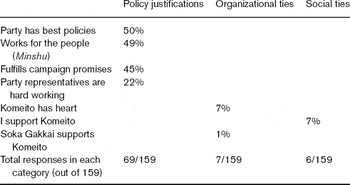
To gather data, my questionnaire asked respondents what they say when a potential target asks: ‘Why should I vote Komeito?’ This was an open-ended question, and the replies were coded into categories, with the results shown in Table 1, where each cell indicates the percentage of respondents who used to that category of argument.Footnote 9 The first category (column 1) is policy-based appeals, like that of the woman mentioned above. The second category is claims about group identity, which might be used to persuade inactive Gakkai members to vote Komeito. The third category of responses relies on personal ties, which the conventional wisdom suggests should predominate.
Arguments used to recruit floating voters

Notes: Total respondents: 82.
The percentages add up to more than one because respondents provided up to three arguments apiece.
Contrary to the conventional wisdom, these survey results provide strong support for a model of policy-based electoral support instead of one based on personal ties. Almost all respondents make policy-based appeals. The most common pattern was to insist that Komeito works for the common people first (49%), as suggested by this quote from an older man:
Komeito is the party of the people (minshu), the party that can bring voices from regular people (genba no koe) to the Diet.
After describing how the party uses its position in government to bring real change, a young member sounds the same theme:
more than anything else, because Komieto is closer to the average citizen's perspective than any other party.
Others flesh that claim out with assertions about specific Komeito policies (combined to 50%), like this response from a college student, addressing his peers more pressing concern:
I'd explain about its promotion of ‘job cafes’ and trial employment systems. Komeito focuses on ensuring employment for young people.
An older women emphasizes issues that her peers are likely to be more interested in:
Komeito has been a friend of the people since it formed. It has worked on problems close to home, things like women's cars [on commuter trains], helicopter ambulances, and so on. If you're having trouble with something, you can go talk to a Komeito representative.
As these few examples suggest, Komeito appeal is focused on the party's concrete policy successes. It is apparent how closely the respondents' outreach strategies match the Gakkai's partisan socialization strategies. Members learn to support Komeito by hearing about the party's work on behalf of regular people, and the specific policies it proposes. Once they internalize that message, they repeat it to a larger audience of non-partisans during political campaigns.
The third most common response was to point out how hard Komeito representatives work. On occasion, these respondents fall back on a generic ‘they're working hard, so please support them (gambatteimasukara, yoroshiku onegaishimasu)’ strategy, but more commonly they say they'd tell listeners about the party's ‘achievements’ (jisseki).
On the other hand, very few people relied on personal ties. For example, only 7% of respondents used personal ties to justify asking friends to vote Komeito, just six out of 82 people. These few respondents did made it clear that they were making a personal request of their listeners, like this college student division leader does:
Because I support Komeito. I'm a Gakkai member, and I'd like your support too.
One more person (seven out of 159) based their appeals on group membership, confirming my anecdotal evidence that Harada and Murayama (1995) are right about campaigning not being aimed at inactive Gakkai members.
Earlier in the section, I described how members use social ties as opportunities rather than as justifications, and one final quote from the survey shows this in action. The respondent, an unmarried woman, says:
First I'd say that ‘Well, I support Komeito’, and then I would introduce the party's policies.
She reconfirms that the listener has enough of a personal connection to care what she thinks, and then she uses that opportunity to present the Komeito's policy appeal.
Electoral support
Without access to evidence of this emphasis on policy, contemporary authors overestimate Komeito leaders' freedom to choose their policy agenda, even labeling Gakkai members as mind controlled (Eto and Hichiri, Reference Eto and Hichiri2003), ensorcelled (Yamada, Reference Yamada2004), and deceived (Sado, Reference Sado2005), incapable of making independent political choices. The normally staid Japan Times says that Komeito is ‘addicted to ruling power’ and unwilling to pursue its promised agenda in the face of LDP opposition.Footnote 10 Even among academics, the belief that Komeito voters will continue to support the party regardless of its policies, that the party is ‘unfettered’ by policy constraints (Reed, Reference Reed2003) is a fixture in the literature; it appears in my own earlier work as well (Ehrhardt, Reference Ehrhardt2008). Only Metraux (2003) and Shimada (Reference Shimada2007) suggest otherwise, and they limit themselves to pointing out that small-scale dissension within the Gakkai may potentially pose constraints.
Mitchell Killian's (Reference Killian2007) work on abortion policy in the United States proposes that the strength of policy constraints depends on how a party mobilizes supporters. Parties that rely on social appeals are likely to have more leeway, because policy divergence doesn't impact members' central beliefs. Parties that rely on policy appeals to gather votes are more constrained, since hypocrisy is readily apparent and strikes directly at members' expressed rationale for voting.
Applying this to the Japanese context predicts that Komeito leaders operate under constraint, given that their electoral support comes from policy appeals. To test this prediction, I show how it helps us understand the fluctuation in Komeito votes over the last decade, which increased from 2001 to 2005, then dropped in 2007.
Constraints in practice during the LDP coalition
Critics (Yamada, Reference Yamada2004; Sado, Reference Sado2005; Eto and Hichiri, Reference Eto and Hichiri2003) cite this period as proof Komeito leaders are unrestrained, arguing that post-2001 coalition policies contradict core Gakkai principles. If members cared about policy, the authors maintain, they should have defected like Socialist Party supporters did in the 1990s after it formed a coalition with the LDP. This conventional view argues that the limited size of the 2005–2007 fluctuations shows how Komeito's electoral support is based on social appeals, not policy appeals. Their argument is superficially persuasive – in fact, I shared this view until part way through my fieldwork with the Gakkai. In-depth exposure to past and present Gakkai political messages, however, reveals that the argument is based on false assumptions about policy preferences.
Critics associate post-2001 coalition policies with the Bush Administration, which does seem to contradict the Gakkai's rhetoric about peace and benevolent socialism. Most notably, the LDP−Komeito government approved sending Japanese troops to Iraq and naval units to the Indian Ocean to support operations in Afghanistan. In the eyes of the war's academic opponents, this implies support for the American invasion, contradicting the Gakkai's stand on peace. Moreover, the Komeito did not leave the coalition when Koizumi paid his respects to the war criminals enshrined at Yasukuni. Domestically, Japanese writers have tagged the Komeito with supporting neo-liberal policies that punished the weaker elements of society (Yamada, Reference Yamada2004; Eto and Hichiri, Reference Eto and Hichiri2003). From the inside, however, the picture looks quite different.
The Koizumi administration's goals and rhetoric matched those used by the Gakkai for decades.Footnote 11 Space prevents full documentation, but a few quotations may point out how Gakkai readers had been primed for Koizumi's platform of opposing bureaucrats and factionalism. Anti-bureaucrat rhetoric becomes prominent in Daisanbunmei in the mid-1970s, after LDP−Komeito rapprochement made criticizing the LDP unwise. The July 1980 issue, for example, ran articles entitled:
‘Bureaucrats are hurrying to bury the country’
‘Bear children that can stand up to government officials (okami)’
‘Has the Environment Agency died?’
This antipathy towards bureaucracy continues. Three years before Koizumi's election, the magazine featured the connection between unmonitored public works bureaucrats and special interest politicians in a lead article.
Behind the unlimited swelling of public works is a structure of bureaucratic organizations, general contractors that profit from public works with their 550,000 builders, and the Dietmembers and local parliamentarians that benefit from their vote gathering machine, all continuing useless public works projects to preserve their structure. (p. 4)
The ease with which a reader could support Koizumi's attacks against quasi-public corporations that ensure this flow of public works money is obvious. The article even features stories about roads that more animals travel on than cars, like the well-known ‘bear highway’ in Hokkaido that Koizumi's reformers made an issue of.
The issue of factionalism is less prominent, but still visible. Sympathetic readers of this quote from November 1991 would have appreciated Koizumi's promise to end LDP factionalism:
One thing Japanese people can't understand is how the same party that dealt with political reform can, immediately afterwards, turn around and blow away the idea with a factional battle inside the party. (p. 12)
These quotes only scratch the surface, but they begin to document how the issues in Koizumi's platform had been part of the Gakkai's political socialization messages well before he emerged as prime minister. To investigate how deep this connection between reform and Komeito support ran, I asked survey respondents to give the first word that came to mind with the prompt ‘No sacred cows’, and similar proportions of respondents thought of Komeito as thought of Koizumi.
By 2007, the media had re-interpreted Koizumi's policies into a neo-liberal agenda that promoted kakusa – urban/rural disparities, but – as it was contemporaneously presented – was a fight between Koizumi and the ‘resistance forces’ (teikyo seiryoku) over special interests, like road construction.
This explains increased Komeito support from 2001 to 2005, prior to the decline in 2007. Consider the massive anti-coalition swing that occurred between the 2005 and 2007 elections. In 2005, the key issue was postal privatization, the centerpiece of Koizumi's fight to tear down special interests and something Gakkai members could support. In 2007, the key issues were government mismanagement of pensions, kakusa, and Abe's nationalistic agenda, and a policy-based understanding of Komeito voting would have correctly predicted the party's electoral disaster.
Gakkai members' responses to military deployments are worth considering in more detail, since they have provoked more dissent, especially among younger members and women (Metraux, Reference Metraux, Machacek and Wilson2001; Shinoda, Reference Shinoda2006). The crucial point to members, as Kisala (Reference Kisala1999) lays out, is how pacifists respond to their own responsibility. For the first 30 years of its existence, the Komeito had no responsibility for governance, and was free to espouse idealistic positions, but once it entered government, it was forced to make more difficult choices. One of my informants was a student at Soka University during the controversy, and he described how a Komeito diet member came to his school to give a talk on the party's decision to support a military mission in Iraq. The diet member claimed that he opposed the war, but that wasn't the issue – whatever had happened in the past, abandoning Afghanistan and Iraq would only lead to more suffering and terrorism. Unilateral American occupation was no solution either. The only alternative lay with an international reconstruction effort. If Japan refused to contribute, it would be betraying the Gakkai's principled stand for peace, not living up to it. In the end, my informant said, the diet member's policy-based argument proved persuasive, cooling opposition among Soka University students. This is similar to Komeito leader Takenori Kanzaki's visit to Iraq before the deployment was approved, which let him explain to Gakkai members that the JSDF would be in a safe area (Shinoda, Reference Shinoda2006). Moreover, Komeito could point to how it had increased policy transparency in the deployment. Given the Gakkai's faith in Nichiren's calls for worldly activism rather than withdrawal (Metraux, Reference Metraux1988), a policy of active cooperation with international reconstruction efforts must have been appealing.
This understanding of Komeito voters' policy agendas provides a better understanding of the party's electoral support. The conventional connection between social ties and Komeito voting cannot explain the increase in support from 2001 to 2005 and the dramatic decline in 2007. On the other hand, seeing Komeito electoral support as based on policy preferences explains the shifts perfectly. When LDP policies appeared to support Gakkai views, members supported the coalition, when it diverged, their support dropped. Indeed, local leaders I questioned about the elections confirmed these statistics with statements that low Gakkai turnout in the 2007 election was a cause of the coalition's defeat.
Conclusion
Opening up the Gakkai's support for Komeito reveals that members become partisans through a process of education about policy issues that highlights Komeito's contributions to Japanese society. Subsequently, independent voters become Komeito supporters through policy-based appeals from partisan acquaintances. Social ties are important at both stages, because they bring listeners into contact with the policy-based messages. Nevertheless, this research shows that we must not mistake the messenger (social ties) for the message (policy content).
To show the accuracy of this model, I consider two of its implications. First, that the two organizations spend time and resources persuading listeners that the party's policy activity is worth supporting. Second, that Komeito electoral support should increase when the party pursues policies that match those in its socialization messages and decline when it strays from them. As this article lays out, both implications turn out to be correct.
Assessing implications about policy-based socialization
It is time for the authors of Japanese politics textbooks to re-think their treatment of the Soka Gakkai's politics. It is no longer a collection of atomized blue-collar workers and bar hostesses, as texts like Curtis (Reference Curtis1999), Hrebenar (Reference Hrebenar2000) still depict it. Nor are its members tied to Komeito with simple messages of group identity or authoritative instructions from a religious hierarchy as Japanese critics like Sado (Reference Sado2005) or Yamada (Reference Yamada2004) depict. Other research (e.g. Igami, Reference Igami1995) documents the changing demographics of the Gakkai; this research shows that Gakkai members come to support Komeito in a process of political education through arguments about policy issues and good governance.
Two problematic issues linger, however. First, we need more research to identify the origin of member policy preferences. Critics in the Japanese media argue that member preferences are a recitation of Ikeda's preferences, and members value them because they are his beliefs, not because of the beliefs' intrinsic values.
Second, we cannot ignore the occasional sign that voting remains tied to social identity in some way. Take the term ‘f-tori’, for example. The initial draft of my survey referred to Gakkai political activity as hyo-tori (vote gathering), but Gakkai members I discussed it with resisted the term, insisting hyo-tori was what other parties did – Gakkai members practiced f-tori instead. Komeito partisans, they seemed to be saying, make friends, not gather votes. My personal interpretation of this is a latent belief that the Gakkai and Komeito are institutional outgrowths of a shared community identity; voting Komeito establishes one as a friend, a member of that community. On the other hand, officials at Gakkai headquarters who read a version of this paper insisted that the term f-tori has no special meaning, so I may be wrong. Nevertheless, this lingering connection between community and voting suggests that the current emphasis on social identity in Gakkai voting is still valuable.
It may be possible to connect the two models of voting in a story of change over time. Theories that connect social identity to political partisanship rely on path dependency to explain particular events. Whites in the American south identified with the Democratic Party because of historical events, not because they agreed with the party's ideas. In time, though, the immediacy of those events faded, making it possible for the Republican Party to convert them in the 1970s with policy appeals (e.g. states' rights). Similarly, Komeito was born out of Gakkai proselytization, and older members still connect the act of joining the Gakkai to the heady political activism of the 1960s (McLaughlin, Reference McLaughlin2008). Similarly, a member told me how his gratitude to ex-president Ikeda strengthens his support for Komeito. The Gakkai keeps this identification alive with stories about the Osaka Struggle, but time passes and that generation has given way to new members who did not experience it. Eventually Ikeda will pass on as well, removing that personal connection between the two organizations.
As the connection between Gakkai and Komeito becomes more ritualized and less visceral, the organization seems to be replacing social identity with policy arguments about Komeito governance in their quest to win the support of Gakkai members. The sense of community identity remains – hence member preference for the term f-tori – but the organization is switching away from it – hence the official line that the term has no special meaning. If true, this story would explain both the social identity focus of current research, since it relies so much on evidence from the 1960s, and the policy focus that I found in my fieldwork. It would also question old assumptions about Komeito policy flexibility.
Assessing implications about policy-based electoral support
Replacing assumptions about elite manipulation with micro-foundations for Komeito voting allows us to explain events in Japanese politics that were previously ignored or misunderstood. For example, Komeito votes dipped after a major scandal in 1969, which makes sense in terms of floating voters moving away, but not in terms of unchanging Gakkai social identification.
Pragmatically, this suggests that the LDP-Komeito coalition votes may not be as guaranteed as they appeared during the Koizumi era. It is hard to tell how this will play out in the future, but Prime Minister Fukuda's behavior suggests that he, at least, agrees with this analysis. Since taking the reins of government, he has consistently accepted Komeito policy positions, even against internal LDP opposition. He accepted the Komeito's demand that diet members be accountable for all campaign receipts, however small; he made every effort to improve relations with China; he accepted government responsibility for the Hepatitis-C victims; he turned away from making tax policy at the prime minister's office, turning to a inter-party committee with equal LDP and Komeito representation; he dropped Abe's nationalism like a rock. All of these decisions fell in line with Komieto preferences. Undoubtedly, Komeito support is not the only reason for his choices, but it is hard to come away from Gakkai political messages and not see members responding positively in the next election.
Acknowledgement
The author thanks Steve Reed, Axel Klein, commenters on an earlier version presented at the 2008 Association for Asian Studies meeting in Atlanta, and especially Masaaki Otake, without whose tireless assistance this project would have never even gotten started. The Fulbright-Hayes foundation generously provided funding for fieldwork.