Introduction
Protoporphyrinogen oxidase (PPO) is the last common enzyme that oxidizes protoporphyrinogen IX (Protogen) to protoporphyrin IX (Protox) in the tetrapyrrole pathway in higher plants (Beale and Weinstein Reference Beale, Weinstein and Dailey1990). The tetrapyrrole pathway produces important precursor molecules for the biosynthesis of chlorophyll and heme, which are needed for photosynthesis and electron transfer chains, respectively (Grimm Reference Grimm1998; Heinemann et al. Reference Heinemann, Jahn and Jahn2008; von Wettstein et al. Reference von Wettstein, Gough and Kannangara1995). Inhibition of PPO by herbicides leads to the accumulation and leakage of the PPO substrates into the cytoplasm; the resulting reactive oxygen species disintegrate lipids and protein membranes, leading to plant death (Duke et al. Reference Duke, Lydon, Becerril, Sherman, Lehnen and Matsumoto1991; Jacobs and Jacobs Reference Jacobs and Jacobs1993; Lee and Duke Reference Lee and Duke1994). First introduced to the market in the 1960s, PPO inhibitors now have been classified into four major chemistry families: (1) diphenylether (e.g., fomesafen, lactofen); (2) N-phenylphthalimide (e.g., flumioxazin); (3) aryl triazinone (e.g., sulfentrazone, carfentrazone); and (4) pyrimidinedione (e.g., saflufenacil). PPO inhibitors, applied both PRE and POST (Grossmann et al. Reference Grossmann, Niggeweg, Christiansen, Looser and Ehrhardt2010; Harder et al. Reference Harder, Nelson and Smeda2012; Wuerffel et al. Reference Wuerffel, Young, Matthews and Young2015b), mainly control broadleaf weeds, with some exceptions that are active on grasses (Larue et al. Reference Larue, Ream, Zhou, Moshiri, Howe, Goley, Sparks, Voss, Hall and Ellis2019; Selby et al. Reference Selby, Ruggiero, Hong, Travis, Satterfield and Ding2015).
The evolution and spread of weed resistance to this herbicide group was relatively slow. However, the use of PPO inhibitors increased dramatically due to the widespread occurrence of weeds resistant to glyphosate and acetolactate synthase (ALS) inhibitors (Dayan et al. Reference Dayan, Barker and Tranel2017). Resistance to PPO inhibitor was first documented in 2001 in Kansas in a common waterhemp (Amaranthus tuberculatus var. rudis) biotype that was also resistant to ALS inhibitors (Heap Reference Heap2019). So far, 10 broadleaf and 3 grass weed species have been reported to have evolved resistance to PPO inhibitors globally (Heap Reference Heap2019). PPO-inhibitor resistance in key weed species such as A. tuberculatus var. rudis and Palmer amaranth (Amaranthus palmeri S. Watson), have been documented in eight and three U.S. states, respectively (Heap Reference Heap2019; Salas-Perez et al. Reference Salas-Perez, Burgos, Rangani, Singh, Refatti, Pivetam, Tranel, Mauromoustakos and Scott2017; Varanasi et al. Reference Varanasi, Brabham, Norsworthy, Nie, Young, Houston, Barber and Scott2018b). More problematically, both weed species are well known for their dioecious nature, which enables pollen-mediated movement and facilitates rapid spread of the resistance genes. As a result, Amaranthus spp. have a higher propensity for stacking multiple resistance traits, leaving farmers very limited control options (Evans et al. Reference Evans, Strom, Riechers, Davis, Tranel and Hager2019; Shergill et al. Reference Shergill, Barlow, Bish and Bradley2018).
PPO enzyme isoforms are localized in two cellular compartments, one in the chloroplast (encoded by PPX1) and one in the mitochondria (encoded by PPX2) (Lermontova et al. Reference Lermontova, Kruse, Mock and Grimm1997). PPX2 sometimes can be dual-targeting, which might be an important attribute that facilitates the evolution of resistance (Watanabe et al. Reference Watanabe, Che, Iwano, Takayama, Yoshida and Isogai2001). Although chloroplastic isoform PPX1 is the primary target of PPO inhibitors, weeds appear to favor PPX2 as their resistance evolutionary pathway (Dayan et al. Reference Dayan, Barker and Tranel2017). The first elucidated resistance mechanism for PPO inhibitors was target-site resistance (TSR) via an unusual codon deletion at the 210 position (ΔGly-210) in the PPX2 gene in A. tuberculatus var. rudis (Patzoldt et al. Reference Patzoldt, Hager, McCormick and Tranel2006). Since then, other PPX2 mutations have been found to confer PPO-inhibitor resistance in common ragweed (Ambrosia artemisiifolia L.) (Arg-98-Leu) and A. palmeri (Arg-98-Gly, Arg-98-Met, Gly-399-Ala) (Giacomini et al. Reference Giacomini, Umphres, Nie, Mueller, Steckel, Young, Scott and Tranel2017; Rangani et al. Reference Rangani, Salas-Perez, Aponte, Knapp, Craig, Mietzner, Langaro, Noguera, Porri and Roma-Burgos2019; Rousonelos et al. Reference Rousonelos, Lee, Moreira, VanGessel and Tranel2012). Most recently, a resistance-endowing mutation was reported in goosegrass [Eleusine indica (L.) Gaertn.] (Bi et al. Reference Bi, Wang, Coleman, McElroy, Peppers and Hall2019). Furthermore, overexpression of PPX2 enzyme, although not yet found in any weed species, was used to generate transgenic crops with PPO-inhibitor resistance and thus could be another potential resistance mechanism that could evolve in weeds (Choi et al. Reference Choi, Han, Lee, Yun, Moon, Kim, Kuk, Han and Guh1998; Lee et al. Reference Lee, Lee, Chung, Han, Han, Guh, Jeon, An and Back2000; Watanabe et al. Reference Watanabe, Takayama, Yoshida, Isogai and Che2002). Even though target-site mutations are the primary resistance mechanism in many species, there are indeed some PPO resistant weeds that do not contain PPX1 or PPX2 mutations, indicating the possibility of non–target site based resistance mechanisms (NTSR) in these biotypes (Copeland et al. Reference Copeland, Giacomini, Tranel, Montgomery and Steckel2018; Varanasi et al. Reference Varanasi, Brabham and Norsworthy2018a, Reference Varanasi, Brabham, Korres and Norsworthy2019). Real-time knowledge on the spread and the genetic basis of herbicide resistance is critical to design effective resistance mitigation strategies that sustain the efficacy and durability of a limited set of currently effective herbicides, including PPO inhibitors. In this paper, we surveyed 134 A. palmeri populations from Mississippi and Arkansas for resistance to fomesafen, a commonly used PPO inhibitor. In addition, we characterized 10 representative populations to understand the genetic basis of resistance, focusing on the roles of three known PPX2 mutations in conferring PPO-inhibitor resistance in A. palmeri. Efficacy and resistance basis for two commonly used PPO inhibitors, fomesafen and saflufenacil, were investigated through DNA sequencing, protein modeling, and in planta bioassay in the greenhouse. The goal of this investigation was to address the following key questions: (1) Do different PPO inhibitors select for different PPX2 mutations? (2) Are PPX2 mutations equally effective in conferring resistance against PPO inhibitors with different potencies? 3) Do different PPO inhibitors differ in their interactions with the wild-type or mutated target protein?
Materials and Methods
Survey of Fomesafen Resistance on 134 Amaranthus palmeri Populations
A total of 134 A. palmeri populations were collected from Mississippi and Arkansas states along the Mississippi River during 2016. Eight plants from each population were grown at the Bayer CropScience greenhouse facility at Chesterfield, MO, under standard conditions (14-h photoperiod, 29 C day/ 26 C night, 30% to 85% relative humidity). Plants at 10 to 15 cm in height were sprayed with fomesafen (Flexstar® herbicide, Syngenta Crop Protection, P.O.Box 18300, Greensboro, NC 27419, USA) at 420 g ai ha−1 with 1% v/v crop oil concentrate (COC). Herbicide application was made using a research track sprayer equipped with a TTI spray nozzle (TeeJet® spray nozzles, SpraySmarter.com, 455 Merriman Road, Mooresville, IN 46158, USA) calibrated to deliver 140 L ha−1 of herbicide solution at 276 kPa, moving at 2.57 km h−1. Plants were evaluated for visual injury at 21 d after treatment (DAT) on a scale of 0% (no visual injury) to 100% (complete plant mortality). Plant responses to fomesafen were categorized into four groups based on resistance levels: sensitive (>95% control), low resistance (85% to 95% control), moderate resistance (50% to 85% control), and high resistance (<50% control). Data were plotted onto Arkansas and Mississippi state maps in RStudio (v. 3.5.1, RStudio, Boston, MA 02210, USA) using the packages ggplot2, ggmap, and maps.
Genotype–Phenotype Association Analysis on 10 Selected Populations
To further characterize the resistance basis of the A. palmeri populations screened, seven representative subsets from the 134 populations, along with three reference populations (two highly PPO inhibitor–resistant populations and one PPO inhibitor–sensitive population) were used for the study (Table 1). Eight plants from these 10 populations at 10 to 15 cm in height were sprayed with fomesafen at the labeled rate of 420 g ai ha−1 with 1% v/v COC, or saflufenacil (Sharpen®, BASF, 26 Davis Drive, P.O. Box 13528, Research Triangle Park, NC 27709, USA) at the labeled rate of 50 g ai ha−1 with 1% v/v methylated seed oil (MSO). Herbicide treatments were applied using a research track sprayer equipped with a TTI spray nozzle as described earlier. Plants were evaluated for visual injury at 21 DAT using the 0% to 100% scale, and visual injury data were then correlated with genotype data from sequencing.
Location and GPS coordinates for the 10 Amaranthus palmeri populations selected for further greenhouse and molecular characterization.

a R, resistant; S, sensitive.
One day before herbicide application, a whole young leaf from the meristem of each individual plant was sampled into 96-well plates (prefilled with metal balls) over dry ice and stored at −80°C until use. Plant tissues were ground in the presence of the Trizol® reagent using a tissue homogenizer and a large paint-shaker. Total RNA was isolated using Direct-zol™ RNA MiniPrep Kits (Zymo Research, 17062 Murphy Avenue, Irvine, CA 92614, USA) following the manufacturer’s instructions. Plant RNA was converted to cDNA using a High-Capacity cDNA Reverse Transcription Kit (Applied Biosystems, Thermo Fisher Scientific, 5781 Van Allen Way Carlsbad, CA 92008, USA, cat. no. 4368814) using random primers (20 µl reactions + 200 ng total RNA). The full coding sequence of the PPX2 gene (1,580 bp) was amplified using the following primers: AMAPA-TU.PPX2S-ATG-F; ATGGGCAACATTTCTGAGCGG and AMAPA-TU.PPX2-TAA-R; TTAYGCGGTCTTCTCATCCATCTTCAC in a 20-µl PCR reaction that contained: 2 µl of random primed cDNA template, 0.5 µM each primer concentration, 10 µl of Phusion Flash High-Fidelity PCR Master Mix (Thermo Fisher Scientific, cat. no. F-548S), and 16 µl of nuclease-free H2O. The thermal cycling condition was 98 C for 10 s; 35 cycles of 98 C for 1 s, 68 C for 5 s, 72 C for 30 s; followed by a final extension for 2 min at 72 C. PCR products were fragmented using the Illumina Nextera XT Library Preparation Kit (Illumina, 5200 Illumina Way, San Diego, CA 92122, USA, cat. no. FC-131-1096) to build a 300-bp cDNA library. The prepared cDNA samples were sequenced using Illumina MiSeq sequencing at the Bayer CropScience facility in Chesterfield, MO. The resulting overlapping sequence reads from all individual R and S plants were assembled into the reference PPX2 sequence (GenBank accession nos.: DQ386114.1 and MF583744.1). Quality and adaptor trimming were done in CLC Bio Genomics Cloud Engine 1.1.1. Heterozygous and homozygous calls for each single-nucleotide polymorphism were exported from CLC Bio Genomics and used for genotype–phenotype association analysis.
To determine whether PPX2 overexpression contributes to resistance in these populations, a TaqMan® Gene Expression Assay (Thermo Fisher Scientific) to detect PPX2 transcript expression level was designed. The sequences for the fluorescent probe, forward and reverse primers, respectively, were: PPX2_800P: ACTGACCAATTCCC; PPX2-800F: GAGGTGCTGTCCTTGTCATACA; PPX2-800R: CAGCATCATAAGATTGATCTTCACTGGTA. The translocon of the outer chloroplastic membrane (Toc75) was used as one copy reference gene (Shauck Reference Shauck2014). The Toc75 sequences for the fluorescent probe, forward and reverse primers, respectively, were: Toc75_3-2 P: 6FAM-AGCAGCCATATTGC-MGB; Toc75_3-2 F: TGTGAAGAGATTACAACACGGGATG; Toc75_3-2 R: TGGCAAAATCCTCTGGCCAGTAG). Each 10-µl reaction volume contained 5 µl of TaqMan® Universal 2X Master Mix (Applied Biosystems, Thermo Fisher Scientific, cat. no. 4304437), 1 µl of 10X TaqMan® Gene Expression Assay, 2.6 µl of nuclease -free H2O, 0.2 µl of each of the 25 µM forward and reverse primers, and 1 µl of gDNA or cDNA of all the survivors (~10 ng µl−1). The TaqMan® assay was conducted using three technical replicates. Relative expression of PPX2 to Toc75 was determined using the 2−ΔΔCt method (Livak and Schmittgen Reference Livak and Schmittgen2001), where Ct is the threshold cycle and ΔCt is Ct of Toc75 – Ct of PPX2.
Herbicide Dose–Response Studies to Compare the Efficacy of Fomesafen and Saflufenacil
To compare the efficacy of fomesafen and saflufenacil, a more comprehensive herbicide dose–response study was conducted on two highly PPO inhibitor–resistant (R) lines, P1 and P2, and the sensitive (S) line P10. Eight plants from each population at 10 to 15 cm in height were sprayed with fomesafen at 0, 105, 210, 420, 840, 1,680, 3,360, or 6,720 g ai ha−1 with 1% v/v COC or saflufenacil at 0, 6.25, 12.5, 25, 50, 100, 200, or 400 g ai ha−1 with 1% v/v MSO. Herbicide treatments were applied and injury rating was taken as described earlier. Dose–response curves were fit using the four-parameter log-logistic model (Ritz et al. Reference Ritz, Baty, Streibig and Gerhard2016) through the drc package in RStudio (v. 3.5.1):
 $$Y = c + {{\;d - c} \over {1 + \exp \left( {b\left( {\log \left( x \right) - \log \left( e \right)} \right)} \right)}}$$
where Y is the visual injury, the upper limit d and the lower limit c are fixed (e.g., 100 and 0), b is the slope, and e is the I50 (50% growth inhibition) for each population. The resistant/susceptible (R/S) ratio was calculated by dividing the GR50 (50% growth inhibition) values of the resistant line by that of the sensitive line. Analysis on model fit, parameter estimates, and SE were done through the drc package in RStudio.
PPX2 Protein Homology Modeling and Computational Docking
All modeling (homology modeling, docking, and ensemble inhibitor–substrate overlap volumes) were calculated using the Molecular Operating Environment (MOE 2018.0101, Chemical Computing Group, Montreal, QC H3A 2R7, Canada). In-house protein sequences for A. palmeri PPX2 were used along with the crystal structure PDB ID: 1SEZ (Nicotiana tabacum) template for homology modeling, with a final model minimized using default constraints, and average structure optimized using the AMBER10:EHT force-field and charge model (Cornell et al. Reference Cornell, Cieplak, Bayly, Gould, Merz, Ferguson, Spellmeyer, Fox, Caldwell and Kollman1995). The final protein was subsequently adjusted to the pH 8 charge state using Protonate3D in MOE, and the FAD cofactor was charge corrected to better represent the high-pH milieu of the mitochondria (Labute Reference Labute2009). All docking was performed using rigid-receptor docking and the GBVI/WSA scoring function (Labute Reference Labute2008). All mutants were built with direct mutation using the protein builder, except for the ΔGly-210 deletion, which was built using the homology modeler. All docking poses of each inhibitor or substrate within a 1 kcal mol−1 window were simultaneously loaded as an ensemble, and the intercept volumes between inhibitor–substrate ensemble volumes (ligand–ligand overlap volumes) were calculated using a custom CCG support SVL code, with units in Å3.
Results and Discussion
Spread of Fomesafen Resistance in Amaranthus palmeri populations from Arkansas and Mississippi
Plant bioassay results showed that, of the 134 populations screened (90 from Arkansas and 44 from Mississippi), 58% were sensitive to the labeled (1X) rate of fomesafen; 8%, 24%, and 10% of the populations showed low, moderate, and high resistance to fomesafen, respectively (Figure 1). Our resistance frequency is similar to what has been reported in other surveys (Varanasi et al. Reference Varanasi, Brabham, Norsworthy, Nie, Young, Houston, Barber and Scott2018b). Resistant populations were generally confined to the upper region of the Mississippi River within the two states, close to the borders of the neighboring states Missouri and Tennessee, where widespread occurrence of PPO inhibitor–resistant weeds has been documented (Copeland et al. Reference Copeland, Giacomini, Tranel, Montgomery and Steckel2018; Heap Reference Heap2019; Schultz et al. Reference Schultz, Chatham, Riggins, Tranel and Bradley2015). Costea et al. (Reference Costea, Weaver and Tardif2004) mentioned that Amaranthus seeds float easily and can be dispersed by rain, surface irrigation, and watercourses. Therefore, it would be interesting to investigate whether this resistance distribution pattern is partially due to long-distance water dispersal via the Mississippi River or is solely a result of different herbicide usage or agronomic practice history among the sampling sites.
Survey of resistance to fomesafen on 134 Amaranthus palmeri populations from Arkansas and Mississippi. Plants were sprayed with fomesafen at 420 g ha−1, and herbicide response was calculated as means of viusal control (%) of eight plants from each population, and categorized into four resistance levels: red, high resistance, <50% of control;yellow, moderate resistance, 50%−85% of control; light green, 85%−95% of control, low resistance; and dark green, >95% of control, sensitive.

Three Known PPX2 Mutations Accounted for 90% of the Resistance in the Representative Amaranthus palmeri Populations
Analysis of PPX2 gene expression levels in the plants that survived fomesafen and saflufenacil application at the labeled rate suggests that the resistance mechanism in these plants was likely not due to increased PPX2 copy numbers. Similar results were observed in previous studies on resistance to PPO inhibitors in A. palmeri surveyed in Arkansas (Salas-Perez et al. Reference Salas-Perez, Burgos, Rangani, Singh, Refatti, Pivetam, Tranel, Mauromoustakos and Scott2017; Varanasi et al. Reference Varanasi, Brabham, Norsworthy, Nie, Young, Houston, Barber and Scott2018b). Genotype–phenotype correlation analysis was conducted only with the three known mutations. We found at least one survivor in 7 out of the 10 populations we sprayed (Table 1). At least one known PPX2 mutation was present in the seven resistant (R) populations and three known mutations together accounted for resistance in 90% of the survivors (Figure 2).
Distribution of different PPX2 mutations in the survivors across different populations. N is the number of survivors for each population; the solid black bar represents ΔGly-210; the solid gray bar represents Arg-128-Gly; the dotted white bar represents Gly-399-Ala; the solid white bar represents a double mutation of ΔGly-210 + Arg-128-Gly; and the dashed bar represents unknown mechanisms.

Among the three mutations, ΔGly-210 was the most prevalent and was present in four out of seven R populations, followed by Arg-128-Gly and Gly-399-Ala, which were present in three and two populations, respectively. The distribution of the mutations varied among the seven R populations. For three of the seven populations, all the survivors had the same mutation (ΔGly-210 or Gly-399-Ala) indicating that mutation is likely the most prominent or the sole resistance mechanism in those populations. For two populations, both Arg-128-Gly and ΔGly-210 mutations were present, in a few cases as double mutations in an individual plant. We did not find any survivors that harbored all three mutations at the same time. There were three populations that had survivors with no known mutations, indicating unknown mutations or a metabolism-based mechanism might be involved, as have been reported in other PPO inhibitor–resistant Amaranthus populations (Obenland et al. Reference Obenland, Ma, O’Brien, Lygin and Riechers2019; Varanasi et al. Reference Varanasi, Brabham, Korres and Norsworthy2019).
Overall our results suggested that each field might be an independent evolutionary event and that different PPO mutations might be differentially favored during selection. Furthermore, mutations may not account for all resistance to PPO inhibitors. These findings generally agree with previous studies on PPO resistance in A. palmeri. In resistant populations collected from Tennessee, ΔGly-210, and Arg-128-Gly/Met were equally prevalent (~40% frequency), and the two mutations together accounted for 90% of the resistance (Copeland et al. Reference Copeland, Giacomini, Tranel, Montgomery and Steckel2018). In resistant populations from Arkansas, ΔGly-210 (50% frequency) was more prevalent than Arg-128-Gly, and the two mutations were widespread across and dominated different geographical locations (Salas-Perez et al. Reference Salas-Perez, Burgos, Rangani, Singh, Refatti, Pivetam, Tranel, Mauromoustakos and Scott2017; Varanasi et al. Reference Varanasi, Brabham, Norsworthy, Nie, Young, Houston, Barber and Scott2018b).
While looking at the spread of resistance at the landscape level, the outcrossing nature of A. palmeri posts another layer of concern, especially surrounding the coevolution of resistance (Lillie et al. Reference Lillie, Giacomini, Green and Tranel2019). Many Amaranthus species are dioecious, and interspecies hybridization among the Amaranthus family is known to facilitate the transfer of herbicide-resistance mechanisms (Franssen et al. Reference Franssen, Skinner, Al-Khatib, Horak and Kulakow2001; Gaines et al. Reference Gaines, Ward, Bukun, Preston, Leach and Westra2012; Nandula et al. Reference Nandula, Wright, Bond, Ray, Eubank and Molin2014; Trucco et al. Reference Trucco, Jeschke, Rayburn and Tranel2005). In A. tuberculatus var. rudis, a species closely related specie to A. palmeri, ΔGly-210 was the only known mutation at the target site conferring resistance to PPO inhibitors (Lee et al. Reference Lee, Hager and Tranel2008; Patzoldt et al. Reference Patzoldt, Hager, McCormick and Tranel2006; Thinglum et al. Reference Thinglum, Riggins, Davis, Bradley, Al-Khatib and Tranel2011; Wuerffel et al. Reference Wuerffel, Young, Lee, Tranel, Lightfoot and Young2015a). Recently, a novel mutation, Arg-128-Gly/Ile, was reported; and the spreading of resistance-endowing mutations through gene flow between A. tuberculatus var. rudis and other Amaranthus species (e.g., tumble pigweed [Amaranthus albus L.]) and A. palmeri has been observed (Nie et al. Reference Nie, Mansfield, Harre, Young, Steppig and Young2019). These studies suggest that controlling weeds before they reproduce will be very critical to restraining the spread of PPO-inhibitor resistance.
Dose–Response Studies on Highly Resistant Populations
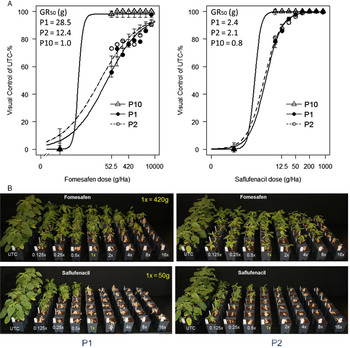
The dose–response study on the two highly resistant populations (P1 and P2) showed that saflufenacil was more potent than fomesafen. The I50 values for fomesafen were 28.5 and 12.4 g for the two resistant populations P1 and P2, respectively, and 1.0 g for the susceptible population P10. The I50 values for saflufenacil were 2.4, 2.1, and 0.8 g for P1, P2, and P10, respectively (Figure 3A and B). This is consistent with Salas-Perez et al. (Reference Salas-Perez, Burgos, Rangani, Singh, Refatti, Pivetam, Tranel, Mauromoustakos and Scott2017), who also observed higher weed efficacy for saflufenacil than fomesafen. The resulting R/S ratios of P1 and P2 were 28 and 12 for fomesafen and 3 and 2.6 for saflufenacil. The higher potency of saflufenacil might be due to its unique physical and chemical properties (e.g., “systemic” attribute, higher dissipation rate) that facilitate the uptake and translocation of the herbicides by weeds (Ashigh and Hall Reference Ashigh and Hall2010; Mueller et al. Reference Mueller, Boswell, Mueller and Steckel2014).
Dose−response studies of fomesafen and saflufenacil on two highly resistant and one susceptible Amaranthus palmeri populations. (A) Dose−response curves fit on visual injuiry of two herbicides on the three A. palmeri populations; (B) photos of the dose−response study taken at 21 DAT. UTC, untreated control.

The spray results for the 10 representative populations also confirmed the higher potency of salfufenacil. Of the 80 plants sprayed for each herbicide, 39% survived fomesafen, while only 8% survived saflufencail (Figure 4). Furthermore, fomesafen survivors were more robust than saflufenacil survivors, with 18% of the survivors being highly resistant (<50% control). In contrast, saflufenaicl had only a few moderate- (50% to 85% control) and low-resistance (85% to 95% control) survivors (Figure 4A and B). The higher potency of saflufenacil might be related to its unique physical/chemical properties that enable phloem mobility and facilitate herbicide translocation within the weeds, which other PPO inhibitors such as fomesafen typically lack (Ashigh and Hall Reference Ashigh and Hall2010).
Comparison of herbicide efficacy and resistance genetic basis for the two protoporphyrinogen oxidase (PPO) herbicides. The left panels (A and B) shows distributions of resistance levels in the survivors of each herbicide out of 80 sprayed plants (fomesafen: N = 31; saflufenacil: N = 6); the right panels (C and D) show the distribution of three PPX2 mutations among the survivors.

When looking at the genetic basis of the survivors for each herbicide (Figure 4C and D), fomesafen selected for diverse mutations: 58%, 5%, and 13% of the fomesafen survivors harbored ΔGly-210, Arg-128-Gly, and Gly-399-Ala, respectively. Of the survivors, 16% appeared to have none of the known PPX2 mutations. In contrast, in the 6 saflufenacil survivors out of the 80 sprayed plants, only ΔGly-210 was found. These results suggest that saflufenacil is likely less sensitive to known PPX2 mutations. Multiple factors might contribute to different resistance-endowing mutations for fomesafen and saflufenacil, First, saflufenacil has unique phloem mobility (Ashigh and Hall Reference Ashigh and Hall2010), faster degradation rates (Mueller et al. Reference Mueller, Boswell, Mueller and Steckel2014) and higher potencies, as discussed earlier, which together might subject weeds to different magnitudes and duration of selection pressure. Second, saflufenacil is a relatively newer herbicide, commercially introduced in 2010 (Grossmann et al. Reference Grossmann, Niggeweg, Christiansen, Looser and Ehrhardt2010); thus, weed populations might have been subjected to a shorter period of selection pressure for saflufenacil than fomesafen.
Differential Binding Affinities and Sensitivities of the Two PPO Inhibitors to the Known PPX2 Mutations
Our protein/small-molecule modeling was based on the crystal structure of protoporphyrinogen IX oxidase (1SEZ) of Nicotiana tabacum (Koch et al. Reference Koch, Breithaupt, Kiefersauer, Freigang, Huber and Messerschmidt2004). Our modeling work shows that three known naturally occurring herbicide-resistant mutations all sit at the binding pocket of the herbicide target protein PPO (specifically PPX2) and are within a 6.5-Å radius of the docked protoporphyrinogen substrate as shown in ligand-interaction maps (Figure 5). Simple 3D and 2D descriptors for volume and hydrophobic accessible surface area for both inhibitors suggest that the larger the volume of the inhibitor, the greater chance it would be able to fill the active site and competitively inhibit or block the substrate (Table 2, entries 1–3). In addition, changes to the protein binding site microstructure and electrostatics based on in silico mutagenesis reduce herbicide binding affinity to different extents. Docking pose scores (a measure of complementarity and surrogate for affinity, in kcal mol−1 using the GBVI/WSA scoring function) for the substrate and two PPO inhibitors studied suggested the binding order was substrate > saflufenacil > fomesafen, in line with experimental findings, although the differential binding affinity is within 1 kcal mol−1 of the substrate, which is within the noise of the method (Table 2, entries 4–7,12–15). One way of interpreting these binding scores is that although fomesefan binds equivalent to or more weakly than saflufenacil relative to the natural substrate (protoporphyrinogen), certain mutations (such as Arg-128-Gly) pose a significant advantage relative to the natural substrate. Another way of interpreting similar ranges in binding affinity is that it is not only how well an inhibitor binds relative to the substrate in the wild-type and mutant forms, but also how well it physically competes or overlaps with the natural substrate’s ability to adopt a catalytically competent geometry; this raises the importance of inhibitor/substrate overlap volume.
Ligand interaction diagram of substrate within the active site (6.5 Å). Ligand interaction map of Amaranthus palmeri PPX2 homology model with bound protoporphyrinogen substrate showing all residues within 6.5 Å from the substrate. Other prospective mutants could, in theory, be modeled in silico and tested using the same protocol.

Protein modeling work on different PPO inhibitors.

One should also note from datum point 14 (Table 2) that the natural substrate binds substantially better to ΔGly-210 than to wild type or other mutations (i.e., approaching 2 kcal mol−1 difference), suggesting another plausible reason for the prevalence of this mutation in the field and a possible energetic basis for a fitness benefit conferred by this mutation or, more accurately, this deletion. However, further pose analysis to understand not only how well the inhibitors bind, but how they compete with the volume of the substrate was quantified by calculating the analytical volume for the pose ensemble. Saflufenacil has greater volume coverage and intercept volume with the substrate than fomesafen (Figure 6; Table 2, entries 8–11) for wild type, ΔGly-210, and Gly-399-Ala, but not for Arg-128-Gly. In the case of the Arg-128-Gly mutation the energy of saflufenacil is still substantially lower than that of fomesafen.
Protein modeling of PPX2 and deletion effects on overlap. (a) Chemical structure of the protoporphyrinogen oxidase (PPO) substrate protoporphyrinogen and two inhibitors; (b) pose analysis to show the competition for the volume with the substrate; (c) volume coverage and intercept volume.

Our protein modeling results suggest that true competitive inhibition, and ultimately efficacy/potency, is a function of both (1) active site binding affinity or how well the inhibitor binds to the active site and (2) better physical “blocking” of the substrate (better inhibitor overlap volume with the substrate). Our results showed that fomesafen had much smaller ensemble volume and overlap volume with the substrate relative to saflufenacil in the “herbicide-resistant” binding pocket, indicating that even minor changes on the protein could be sufficient to confer resistance to the former over the latter. This computational characterization of resistance-forming potential of fomesafen and PPO protein interaction modeling appears to support our genotype–phenotype association analysis, as well as other field surveys showing widespread fomesafen resistance (Salas-Perez et al. Reference Salas-Perez, Burgos, Rangani, Singh, Refatti, Pivetam, Tranel, Mauromoustakos and Scott2017; Varanasi et al. Reference Varanasi, Brabham, Norsworthy, Nie, Young, Houston, Barber and Scott2018b). To reiterate, our protein work also demonstrated that true competitive inhibition will be a function of (1) preferential binding to the pocket while (2) maximally overlapping with the substrate so that catalytically competent substrate poses are no longer accessible. From a herbicide discovery perspective, using these computational strategies to evaluate prospective inhibitor/target-site (homology models) interactions should hold promise in a rational agrochemical design strategy to identify better inhibitors with greater resistance-breaking potential. This modeling approach may also hold value in understanding and prioritizing the resistance-breaking potential of current herbicides for novel target-site mutations yet to be observed in the field, as well as for computationally assisted herbicide-tolerant trait selection.
Three Known PPX2 Mutations Do Not Always Lead to Resistance
To determine whether different mutations are equally effective and sufficient in conferring resistance, we compared the presence of mutations in both resistant and sensitive plants (Figure 7). This type of investigation has not been done very often, as there is generally more interest on the resistance phenotypes. In the 80 plants sprayed with fomesafen, 21, 7, and 6 plants had ΔGly-210, Arg-128-Gly, and Gly-399-Ala mutations, respectively, 70% to 80% of which were associated with a resistance phenotype. This indicates the three mutations are mostly sufficient to confer resistance to fomesafen. In the 80 plants sprayed with saflufenacil, 16, 8, and 4 plants had ΔGly-210, Arg-128-Gly, and Gly-399-Ala mutations, respectively. However, only 38% of the plants having ΔGly-210 turned out to be resistant. None of the plants that harbored Arg-128-Gly or Gly-399-Ala were resistant to saflufenacil (Figure 7).
Distribution of three PPX2 mutations in both resistant and sensitive plants for fomesafen and salfufenacil. N is the total number of all three PPX2 mutations found among 80 total plants; the black bar represents resistant plants and the white bar represents sensitive plants.

Our findings were somewhat unexpected, as previous studies indicate that ΔGly-210, Arg-128-Gly, and Gly-399-Ala can confer similar magnitude(s) of resistance (Dayan et al. Reference Dayan, Barker and Tranel2017; Rangani et al. Reference Rangani, Salas-Perez, Aponte, Knapp, Craig, Mietzner, Langaro, Noguera, Porri and Roma-Burgos2019). The fact that plants with Gly-399-Ala and Arg-128-Gly failed to survive saflufenacil indicates the magnitude of resistance might be population dependent and the roles of different mutations in resistance evolution might be more complex than we thought. Another indication from this observation is that changes to the binding site geometry (volume) and charges (electrostatics) conferred by Arg-128-Gly and Gly-399-Ala mutations might have a difference fitness cost relative to ΔGly-210 (Dayan et al. Reference Dayan, Daga, Duke, Lee, Tranel and Doerksen2010) to combat PPO inhibitors with higher potencies like saflufenacil. As a result, weeds might need to evolve a stronger mutation or multiple mechanisms to gain robust resistance. On the other hand, because the efficacy of PPO inhibitors is dependent on plant size (Dayan et al. Reference Dayan, Barker and Tranel2017; Wuerffel et al. Reference Wuerffel, Young, Lee, Tranel, Lightfoot and Young2015a, Reference Wuerffel, Young, Matthews and Young2015b) and can be affected by different environmental and physiological conditions (Matzenbacher et al. Reference Matzenbacher, Vidal, Merotto and Trezzi2014), it is also possible that bigger plants with known PPX2 mutations could still survive saflufenacil. Therefore, it is strongly recommended that farmers always spray weeds at smaller sizes to avoid reduced activities and potential risk of resistance development.
Bridging Weed Resistance Knowledge with Management Programs
In this paper, we compared the efficacy and prominent TSR mechanisms for two PPO inhibitors. Our findings showed that, although resistance to some PPO inhibitors such as fomesafen is widespread, certain PPO inhibitors such as saflufenacil are still very effective in killing those resistant weeds. The genetic basis of resistance might vary with different PPO inhibitors and geographic origins. From a weed management perspective, understanding the genetic basis of resistance in a field could potentially allow farmers to switch to other more potent PPO inhibitors that are less affected by the mutations that are present, with the condition that herbicides with different mode of actions are also incorporated.
Furthermore, our protein modeling efforts provide seemingly obvious, yet nontrivial findings that suggest some PPO-inhibitor chemistries can be more sensitive to mutations and protein structure changes than others and that computational modeling approaches could be used to design new chemistries or reprioritize old chemistries for resistance-breaking potential for PPO inhibitors. The current study demonstrated the potential of this valuable tool in the modern agriculture repertoire for providing more robust herbicide/trait combinations to farmers.
Finally, NTSR for PPO inhibitors has been reported and can potentially be reversed by application of metabolism inhibitors (Obenland et al. Reference Obenland, Ma, O’Brien, Lygin and Riechers2019; Varanasi et al. Reference Varanasi, Brabham, Korres and Norsworthy2019). Furthermore, NTSR and TSR mechanisms can act together simultaneously, endowing weeds with higher levels of resistance to PPO inhibitors, as has been reported in weeds that are resistant to other herbicide groups (Alcántara-de la Cruz et al. Reference Alcántara-de la Cruz, Fernández-Moreno, Ozuna, Rojano-Delgado, Cruz-Hipolito, Domínguez-Valenzuela, Barro and De Prado2017; Fang et al. Reference Fang, Zhang, Liu, Yan, Li and Dong2019).Therefore, future research should aim at uncoupling NTSR mechanisms for PPO inhibitors from TSR mechanisms and at elucidating the concerted roles of these two types of resistance mechanisms in a single weed population.
Acknowledgments
The authors would like to thank Brandi Chiapelli for valuable help with total RNA extraction and cDNA preparation for Illumina sequencing; Brian Eads for assistance with upstream sequencing analysis; Jenny Krebel, Megan Gilley, and Jeff Haines for plant propagation and herbicide application; Chris Williams for CCG’s SVL support code for ligand-ligand volume overlap and Chandra Aradhya for proofreading the manuscript. No conflicts of interest have been declared.