The number of children being raised in bilingual homes is large and growing, yet the course of language development in children from bilingual homes is not well described or understood (McCardle & Hoff, Reference Hoff2006). On the one hand, it is clear that children exposed to two languages can learn them. A large body of research has refuted the once-held view that dual language input confuses children (see Hakuta, Reference Hakuta1986, for history). To the contrary, children exposed to two languages can distinguish those languages from infancy, and they can learn two phonological systems, two vocabularies and two grammars (Kovács & Mehler, Reference Kovács and Mehler2009a; Petitto, Katerelos, Levy, Gauna, Tetrealt & Ferraroi, Reference Petitto, Katerelos, Levy, Gauna, Tetrealt and Ferraroi2001; Petitto & Kovelman, Reference Petitto and Kovelman2003; Werker & Byers-Heinlein, Reference Werker and Byers-Heinlein2008). On the other hand, it is not clear whether children exposed to two languages typically acquire them at the same rate as monolingual children learn one. The extant literature is inadequate to address the question of what is normative in bilingual development (Genesee, Reference Genesee, McCardle and Hoff2006; Marchman, Fernald & Hurtado, Reference Marchman, Fernald and Hurtado2010).
Evidence of what is normative would address the still open and debated question of the degree to which language acquisition is paced by biology versus experience (Lidz, Reference Lidz, Hoff and Shatz2007; Tomasello, Reference Tomasello, Kuhn, Siegler, Damon and Lerner2006). On the logic that children exposed to two languages must hear less of each than children exposed to one, the apparent rapidity and ease with which children acquire two languages has been cited in recent publications as evidence for the innateness of language – particularly grammar – and the independence of language acquisition from effects of variation in input (Gleitman & Newport, Reference Gleitman, Newport and Osherson1995; Petitto & Kovelman, Reference Petitto and Kovelman2003). The remarkable skill of children at acquiring multiple languages could, however, obscure the extent to which language acquisition results from a process of learning from information provided in language experience. If despite their prodigious abilities, children typically require more time to acquire two languages than one, this would suggest a more input-based account of language acquisition (Gathercole & Hoff, Reference Gathercole, Hoff, Hoff and Shatz2007; Oller & Eilers, Reference Oller and Eilers2002).
Evidence regarding the normative rate of bilingual development would also inform educators and policy makers who seek to serve the many children from bilingual homes entering the school system each year. Statistically, bilingualism is a risk factor for poor academic outcomes in the US (Snow, Burns & Griffin, Reference Snow, Burns and Griffin1998; Federal Interagency Forum on Child and Family Statistics, 2002). This is surprising in the context of other evidence that bilingualism is associated with cognitive advantages from infancy through old age (Bialystok, Reference Bialystok, Kroll and de Groot2005; Reference Bialystok2007; Kovács & Mehler, Reference Kovács and Mehler2009b) and that adolescents who are proficient in their family's heritage languages enjoy psychosocial and academic benefits as a result (Tseng & Fuligni, Reference Tseng and Fuligni2000; Wong Fillmore, Reference Wong Fillmore, Slobin, Gerhardt, Kyratzis and Guo1996). It could be that the statistical risk associated with bilingualism actually reflects effects of other correlated variables; socioeconomic status is a likely contender. Or, it could be that children learning two languages have a constellation of skills at school entry that differs from the skills of monolingual children and that is not well met by the educational system. To begin to understand the sources of difficulty that place children from bilingual homes at risk and in order to design appropriate curricula for such children, it is necessary to identify the effects of early dual language exposure – apart from the other factors that are typically confounded with bilingualism at the societal level.
The extant literature does not provide a normative description of early bilingual development because the number of studies that directly compare the first stages of bilingual to monolingual development is still few, and the number of bilingual children in these studies is often small. The first studies of bilingual development were not designed to provide normative data but to ask theory-based questions about the human capacity to learn two languages. These studies reported that bilingual children are comparable to monolingual children in the age at which they achieve basic milestones of language development, including production of first word, production of first two-word combination, achievement of a 50-word vocabulary (Petitto et al., Reference Petitto, Katerelos, Levy, Gauna, Tetrealt and Ferraroi2001; Petitto & Kovelman, Reference Petitto and Kovelman2003), and in grammatical properties of their utterances, including use of finite verb forms, negation and pronominal subjects (Paradis & Genesee, Reference Paradis and Genesee1996). Even the vocabulary development in each language of bilingual children has been reported to be within the normal range of variation for monolingual children (Pearson, Fernández & Oller, Reference Pearson, Fernández and Oller1993). While such findings make it clear that bilingualism is well within the capacity of the human language faculty, they have been cited in support of stronger claims – for example, in the scientific literature, that “the speed of acquisition is comparable in monolinguals and bilinguals” (Kovács & Mehler, Reference Kovács and Mehler2009a: 611) and, in expert advice to parents, pediatricians and educators, that “no empirical evidence links bilingualism to language delay of any sort” (King & Fogle, Reference King and Fogle2006).
These recent assertions are based on the early literature in which sample sizes were either so small that no statistical comparisons were made (Pearson et al., Reference Pearson, Fernández and Oller1993; Petitto & Kovelman, Reference Petitto and Kovelman2003) or sufficiently small (ns=7 and 13) that the power to detect differences was quite low (Pearson et al., Reference Pearson, Fernández and Oller1993). These early studies typically made claims only about the achievement of major milestones within the normal range of variability, but that is not always noted when their null findings with respect to effects of bilingualism are cited. Furthermore, the conclusion that there is no effect of bilingualism on vocabulary development conflicts with the outcome of a reanalysis of the original data in Pearson and Fernández (Reference Pearson and Fernández1994) (Bialystok, Reference Bialystok2001; Bialystok & Feng, Reference Bialystok, Feng, Durgunoglu and Goldenberg2011) and with the results of more recent, larger-sample studies which have found that bilingual children have smaller English vocabularies than same-aged monolingual children (Bialystok & Feng, Reference Bialystok, Feng, Durgunoglu and Goldenberg2011; Bialystok, Luk, Peets & Yang, Reference Bialystok, Luk, Peets and Yang2010; Marchman et al., Reference Marchman, Fernald and Hurtado2010; Vagh, Pan & Mancilla-Martinez, Reference Vagh, Pan and Mancilla-Martinez2009; Thordardottir, Rothenberg, Rivard & Naves, Reference Thordardottir, Rothenberg, Rivard and Naves2006). Although there is not recent, large-sample work comparing bilingual to monolingual grammatical development, three studies have found that vocabulary and grammatical development in young bilingual children are correlated within languages though not across languages (Conboy & Thal, Reference Conboy and Thal2006; Marchman, Martínez-Sussmann & Dale, Reference Marchman, Martínez-Sussmann and Dale2004; Parra, Hoff & Core, Reference Parra, Hoff and Core2011). Thus, it is likely that grammatical development is slower in early bilingual development as well. There is direct evidence of differences between school-aged monolingual and bilingual children on measures of grammatical development, and there is evidence that the degree of difference between monolinguals and bilinguals on these grammatical measures is related to the amount of English exposure the children have (Gathercole, Reference Gathercole, Oller and Eilers2002a; Reference Gathercole, Oller and Eilers2002b; Reference Gathercole, Oller and Eilers2002c; Gathercole & Thomas, Reference Gathercole and Thomas2009; Pearson, Fernández, Lewedeg & Oller, Reference Pearson, Fernández, Lewedeg and Oller1997; Oller & Eilers, Reference Oller and Eilers2002).
It is important to point out that there is no serious current claim that bilingual children are confused or slowed in their ability to learn language. In studies that have used measures of bilingual children's combined vocabularies, the bilingually developing children look very similar to the monolingually developing children (Patterson, Reference Patterson2004; Patterson & Pearson, Reference Patterson, Pearson and Goldstein2004; Pearson & Fernández, Reference Pearson and Fernández1994). There are, however, conflicting reports as to whether bilingual children proceed at the same pace as monolingual children in acquiring the vocabulary and, particularly, the grammar of each of their languages. Some studies report that bilingual children achieve basic milestones at the same age as monolingual children, and other studies report that bilingual children score below norms for their age when assessed in only one of their languages.
There is substantial evidence from the study of monolingually developing children that the amount of speech children hear is related to their rate of language development, supporting the view that language development is paced by children's access to input (Hoff, Reference Hoff2006). The range of variability in how much speech young children hear is enormous (Hoff, Reference Hoff2006; Hart & Risley, Reference Hart and Risley1995), and some children exposed to two languages may well hear as much speech in each language as some monolingual children hear in only one (De Houwer, Reference De Houwer2009). On average, however, children whose daily language exposure is divided between two languages are likely to hear less of each language than children whose daily language exposure is in only a single language – unless bilingualism in the home doubles the amount of talk addressed to young children. This assumption that bilingually developing children's single-language input is reduced compared to monolingual children and the theoretical position that language development is paced by input yield two predictions tested in the present study: (1) that the average rate of language development in children learning only one language will be more rapid than the rate of language development in children who are simultaneously learning two languages; and (2) that in children exposed to two languages, the rate of development of each language will vary as a function of the children's relative amount of exposure.
To test these predictions, the present study compared 47 Spanish–English bilingually developing children to 56 English-learning monolingual children in terms of their vocabulary and grammatical development at the ages of 1 ; 10, 2 ; 1 and 2 ; 6. The socioeconomic status of both samples was high and equivalent, allowing an unconfounded test of the effect of dual language exposure in supportive language learning environments. Two types of analyses investigated the relation of the relative amount of exposure to English and Spanish on the bilingual children's development of each language: In one, children were categorized according to whether their input was English-dominant, balanced or Spanish-dominant and between-group comparisons of their English and Spanish development were made. In another, dominance in input was treated as a continuous variable, and its relation to measures of vocabulary and grammatical development in each language was assessed.
METHOD
Participants
The participants were 25 male and 22 female children exposed to both Spanish and English from birth and 30 male and 26 female children exposed only to English. All families resided in South Florida, in the US. All children were full term and healthy at birth, with normal hearing. All children were screened for evidence of communicative delay at 1 ; 10 (Squires, Potter & Bricker, Reference Squires, Potter and Bricker1999). Participants were recruited through advertisements in local magazines, at programs for parents with young children and through word of mouth. Because the goal was to investigate the effects of dual language exposure across the full range of naturally occurring bilingual environments, the criterion for bilingual exposure was inclusive: children were required to hear at least 10 percent of their total input in the less-frequently-heard language, according to caregiver report. The sample included children who represented the full range of possible proportions of English and Spanish. Based on caregiver estimates of their children's home language exposure at study entry, 15 of the bilingually exposed children heard more Spanish than English, 18 children heard more English than Spanish and 14 children heard equal portions of Spanish and English. The average proportion of English in input for the sample of bilingually exposed children was 51 percent. All the bilingually exposed children were producing some words in both languages at 1 ; 10.
All the children were born in the US. Thirteen of the 47 bilingually developing children came from households in which both parents described themselves as native Spanish speakers, 25 came from households in which one parent was a native Spanish speaker and one was a native speaker of English and 9 came from other household configurations including those in which one or both parents described themselves as native bilinguals. Of the 61 parents (mothers and fathers) who described themselves as native Spanish speakers, 54 were immigrants from Spanish-speaking countries in Latin America and the Caribbean, and 7 were born in the US. All but 1 mother and 2 fathers of the monolingual children were native English speakers. Among parents in bilingual households, 87% of mothers and 60% of fathers had at least a college (4-year) degree; among parents in monolingual households, 75% of mothers and 61% of fathers had at least a college (4-year) degree. There was no difference between the bilingual and monolingual households in the distribution of mothers or fathers across five levels of educational achievement – less than high school, high school, 2-year degree, 4-year degree and advanced degree. The bilingually developing children included 28 first-born and only children and 19 later-born children. The monolingual children included 37 first-born and only children and 19 later-born children. All but 3 of the bilingually developing children and 5 of the monolingual children lived with both parents.
Procedure
Measures of the children's language development were collected at 1 ; 10, 2 ; 1 and 2 ; 6 using the English MacArthur-Bates Communicative Development Inventory: Words and Sentences (CDI) (Fenson et al., Reference Fenson, Dale, Reznick, Thal, Bates, Hartung, Pethick and Reilly1993) and its Spanish counterpart, El Inventario del Desarrollo de Habilidades Comunicativas (IDHC) (Jackson-Maldonado, Thal, Fenson, Marchman, Newton & Conboy, Reference Jackson-Maldonado, Thal, Fenson, Marchman, Newton and Conboy2003). (The mean ages in months at each measurement point for monolingual children were 22.75 [SD=0·32], 25·79 [SD=0·30] and 30·99 [SD=0·38]; for bilingually developing children they were 22·75 [SD=0·32], 25·80 [SD=0·33] and 31·00 [SD=0·34].) The MacArthur-Bates inventories are caregiver-report instruments with established reliability and validity for monolingual and bilingual populations (Fenson et al., Reference Fenson, Dale, Reznick, Thal, Bates, Hartung, Pethick and Reilly1993; Jackson-Maldonado et al., Reference Jackson-Maldonado, Thal, Fenson, Marchman, Newton and Conboy2003, Marchman & Martínez-Sussmann, Reference Marchman and Martínez-Sussmann2002). Each yields a raw vocabulary score based on words the child has been heard to produce and three measures of grammatical development: (1) a dichotomous measure of whether or not the child has produced word combinations; (2) a grammatical complexity score based on 37 items in which a pair of utterances is presented, one grammatically more advanced than the other, and the caregiver indicates which sounds more like the child's speech; and (3) the mean length of the longest three utterances the child has produced (MLU3). The bilingually developing children's total vocabularies (their raw English+raw Spanish vocabulary scores) were also calculated to index their total language knowledge (Patterson & Pearson, Reference Patterson, Pearson and Goldstein2004).
Estimates of the English proportion of home language use were obtained as part of an extensive interview with all caregivers when the children were 1 ; 10 and 2 ; 6 and with a subsample of 29 participants at 2 ; 1. The mean proportion of English in home language input was 51·17 (SD=28·78), 58·93 (SD=29·92) and 54·68 (SD=31·30) at the three measurement points respectively. At all points the range of English use in the home was from 0–100%, but all children heard at least 10% of their total language exposure in a second language – although not necessarily in the home. The validity of caregiver estimates was established in the subsample whose language environments were studied at 2 ; 1. Caregivers kept diaries of the children's language exposure, recording which language was addressed to the child for every 30-minute period the child was awake over the course of seven days (Place & Hoff, in press). The correlations between caregiver estimates of the English proportion of children's home language experience and the diary measure of English-only experience was r (n=29)=0·71 and with Spanish-only experience was r (n=29)=−0·84.
RESULTS
Comparisons of monolingually and bilingually developing children
Single-language vocabulary
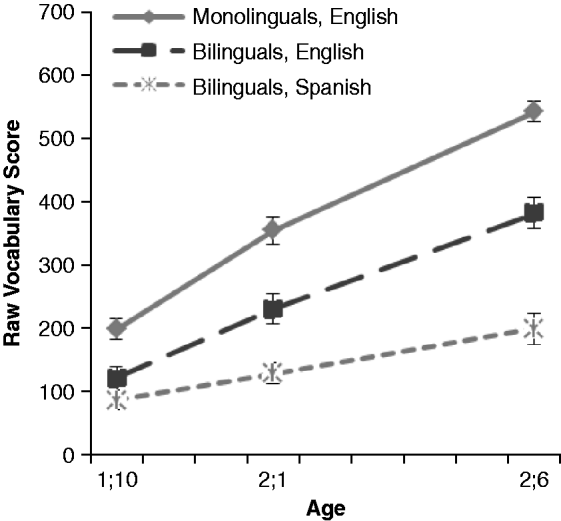
Mean raw vocabulary scores in English for both groups and in Spanish for the bilingually developing children are plotted in Figure 1. The English vocabulary scores of the monolingually and bilingually developing children were compared in a 3 (age)×2 (language group) mixed ANOVA. There was a significant effect of age (F(2, 202)=438·47, p<0·001, ηp2=0·81); a significant effect of language group (F(1, 101)=21·34, p<0·001, ηp2=0·17); and a significant age×language group interaction (F(2, 202)=8·41, p<0·001, ηp2=0·08). On average, the children's English vocabulary scores increased with age; the monolingually developing children's vocabulary scores were significantly larger than the bilingually developing children's, and their English vocabulary gains over time were larger.
English vocabulary scores for monolingually developing children and English and Spanish vocabulary scores for bilingually developing children at 1 ; 10, 2 ; 1 and 2 ; 6. Error bars represent standard errors of the means.

A separate 3 (age)×2 (language) repeated measures ANOVA compared the English and Spanish vocabularies of the bilingually developing children. On average, the bilingually developing children's vocabulary scores increased with age (F(2, 92)=125·72, p<0·001, ηp2=0·73); their English vocabularies were larger than their Spanish vocabularies (F(1, 46)=13·82, p=0·001, ηp2=0·23); and their English vocabularies increased more over time than did their Spanish vocabularies (F(2, 92)=34·27, p<0·001, ηp2=0·43).
Total vocabulary
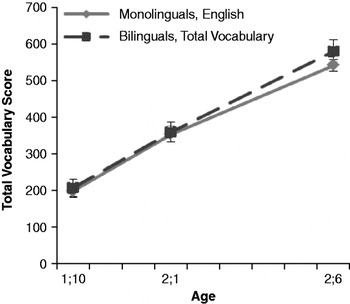
The monolingually developing children's English vocabulary scores are plotted with the bilingually developing children's total (Spanish+English) vocabulary scores in Figure 2. The groups were compared on these measures in a 3 (age)×2 (language group) ANOVA. The only significant effect was of age (F(2, 202)=373·18, p<0·001, ηp2=0·79). There was no difference between the monolingually and bilingually developing children in total vocabulary size or total vocabulary gains from 1 ; 10 to 2 ; 6 (ps=0·54 and 0·39, respectively).
English vocabulary scores for monolingually developing children and total vocabulary scores (English+Spanish) for bilingually developing children at 1 ; 10, 2 ; 1 and 2 ; 6. Error bars represent standard errors of the means.

The onset of combinatorial speech
The percent of monolingual and bilingually developing children producing word combinations in English are presented in Figure 3; the percent of bilingually developing children producing word combinations in Spanish is also presented. Chi-square tests assessed the association between language group and the achievement of the milestone of producing word combinations in English at each measurement point. The association was significant at 1 ; 10; more of the monolingual children than bilingual children were combining words in English (χ2[1]=8·28, p=0·004). At 2 ; 1 and 2 ; 6, there was no significant association – essentially all the children in both groups were combining words.
The percent of monolingual and bilingually developing children combining words in English, and percent of bilingually developing children combining words in Spanish at 1 ; 10, 2 ; 1 and 2 ; 6.

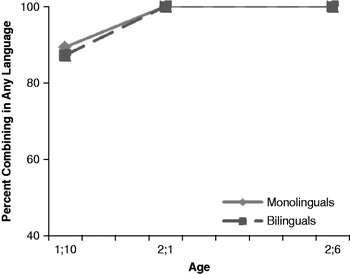
Figure 4 presents the same data for the monolingual children, along with the percent of bilingual children who were combining words in either language. Using this across-language measure of the achievement of combinatorial speech, Chi-square tests of the association between language status and the production of word combinations revealed no association at any age.
The percent of monolingual and bilingually developing children combining words in any language (English for monolinguals, English or Spanish or both for bilinguals) at 1 ; 10, 2 ; 1 and 2 ; 6.

Grammatical complexity and utterance length
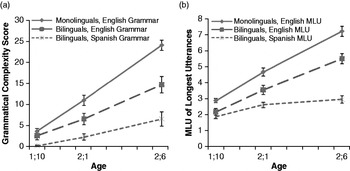
Mean grammatical complexity scores and mean MLU of the longest three utterances produced are plotted in Figures 5a and 5b. The measures of grammatical development for the bilingually developing children's Spanish are plotted for descriptive purposes only; no statistical comparisons of English to Spanish development were made because the instruments were not calibrated to create directly comparable scores in both languages.Footnote 1 Statistical comparison of the monolingual and bilingual children was made for all measures of English grammatical development. Grammatical complexity scores were compared in a 3 (age)×2 (language group) mixed ANOVA. There was a significant main effect of age (F(2, 202)=204·96, p<0·001, ηp2=0·67); a significant main effect of language group (F(1, 101)=10·74, p=0·004, ηp2=0·10); and a significant age×language group interaction (F(2, 202)=13·27, p<0·001, ηp2=0·12). On average, the grammatical complexity of the children's English productions increased with age. On average, across ages, the monolingually developing children were more advanced in English than the bilingually developing children, and they made larger gains in the grammatical complexity of their English productions over time than did the bilingually developing children. A separate ANOVA revealed a parallel pattern of effects with MLU3 as the measure of grammatical development: MLU3 increased with age (F(2, 202)=260·60, p<0·001, ηp2=0·72); was higher for the monolingually developing than for the bilingually developing children (F(1, 101)=14·54, p<0·001, ηp2=0·13); and showed larger increases with age in the monolingually developing children than in the bilingually developing children (F(2, 202)=4·60, p=0·011, ηp2=0·04).
Measures of grammatical development in English for monolingually developing children and bilingually developing children and in Spanish for bilingually developing children at 1 ; 10, 2 ; 1 and 2 ; 6: (a) grammatical complexity scores, and (b) mean length of the three longest utterances. Error bars represent standard errors of the means.

The size of the effect of bilingualism on single language development
The previous analyses revealed no difference between the monolingual and the bilingually developing children when the bilingual children's accomplishments in both languages were considered, but they also revealed a consistent pattern of statistically significant differences when monolingual and bilingual children were compared on their single-language accomplishments. To provide additional indicators of the size of the effect of bilingualism, we report the children's percentile scores on the measures of vocabulary size, grammatical complexity and MLU3 in English for the monolinguals and in English and Spanish for the bilingually developing children in Table 1. The percentile scores for English were assigned with reference to the monolingual English norms for the CDI, and the percentile scores for Spanish were assigned with reference to the monolingual Spanish norms for the IDHC. Transforming raw scores into percentile introduces additional error because each percentile score encompasses a range of raw scores and because percentile scores are particularly insensitive to individual differences in the tails of any distribution. However, we present them because they provide an accessible gauge of the size of the difference between groups and because percentile scores are often used for educational and clinical purposes. What these percentile scores indicate is that the monolingual children were performing as would be expected based on the norms. The mean percentiles on all measures at all measurement points were between the 40th and the 62nd percentile. The bilingual children's mean percentiles, when their performance in each language was compared to monolingual norms, ranged from the 20th to the 28th percentile on vocabulary and from the 23rd to the 63rd percentiles on the measures of grammatical development.
Mean percentile scores (and standard deviations) for measures of vocabulary, grammatical complexity, and MLU of children's longest three utterances (MLU3) for monolingual and bilingually developing children at 1 ; 10, 2 ; 2 and 2 ; 6

Table 2 presents three effect size estimates: partial eta squared, which was also reported with each analysis of variance, Cohen's d, and the difference between the average percentile scores for the monolingually and bilingually developing children. These were calculated on the data averaged across all three observations points and thus are estimates of the size of the effect of dual language exposure on English language development during the period from 1 ; 10 to 2 ; 6. Using Cohen's guidelines for interpreting d, the effect of dual language input on vocabulary size was large, and the effect on grammatical complexity and MLU3 was medium to large (Cohen, Reference Cohen1988).
Estimates of the size of the effect of dual language exposure on English language development from the comparison of monolingual to bilingual children from 1 ; 10 to 2 ; 6

Comparison of bilingually developing children with Spanish-dominant, balanced and English-dominant language exposure
To ask how differences between bilingually developing children and monolingually developing children are affected by the degree to which one language is dominant in the bilingually developing children's experience, the bilingually developing children were divided into three groups based on the balance of dual language exposure in the home at 1 ; 10. (In this sample, the measure of home language exposure was relatively stable from 1 ; 10 to 2 ; 6. The correlation between the estimates that were collected for all participants at the first and last measurement points was r (n=47)=0·74.) The Spanish-dominant exposure group included 15 children for whom the percent English addressed to them at home was 30% or less (Mean English exposure=15%, SD=9·82). The balanced exposure group included 14 children for whom the percent English addressed to them at home was between 50% and 60% (Mean English exposure=52·86%, SD=4·69). (There were no children whose caregivers reported 40% English input.) The English-dominant exposure group included 18 children for whom English was 70% or more of their home input (Mean English exposure=80%, SD=10·43).
Vocabulary
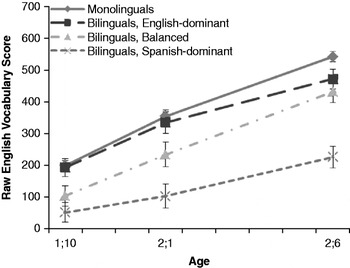
Figure 6 reproduces the plot of mean English vocabulary scores for the monolinguals, which was also presented in Figure 1, and presents the mean English vocabulary scores for the three groups of bilingually developing children. All four groups were compared in a 3 (age)×4 (language group) mixed ANOVA. There was a significant main effect of age (F(2, 198)=305·27, p<0·001, ηp2=0·76); a significant main effect of language exposure group (F(3, 99)=116·96, p<0·001, ηp2=0·34); and a significant age×language exposure group interaction (F(6, 198)=6·44, p<0·001, ηp2=0·16). On average, the children's English vocabulary scores increased with age. Descriptively, the monolingual children had the highest English vocabulary scores, the English exposure-dominant bilinguals had the next-highest English vocabulary scores, and they were followed by the balanced exposure bilinguals and the Spanish exposure-dominant bilinguals, in that order. Bonferroni paired comparisons within the language group effect (that is, averaged across age) revealed that the Spanish exposure-dominant children differed from all other groups, the balanced exposure bilingual children differed from the monolingual children, and the English exposure-dominant children did not differ from the monolingual children (all significant p-values ⩽0·01, one-tailed).
Mean English vocabulary scores for monolingual and for three groups of bilingually developing children at 1 ; 10, 2 ; 1 and 2 ; 6. Error bars represent standard errors of the means.

Mean Spanish vocabulary scores for the three groups of bilingually developing children are presented in Figure 7. The effects of age and exposure group among the bilingually developing children were assessed in a 3 (age)×3 (exposure group) mixed ANOVA. There was a significant main effect of age (F(2, 88)=38·51, p<0·001, ηp2=0·47); a significant main effect of exposure group (F(2, 44)=10·17, p<0·001, ηp2=0·32); and a significant age×exposure group interaction (F(4, 88)=4·64, p=0·002, ηp2=0·17). On average the children's Spanish vocabularies grew from 1 ; 10 to 2 ; 6. Descriptively, the Spanish exposure-dominant children had the largest Spanish vocabularies, the balanced exposure bilingual children had the next largest, and the English exposure-dominant children had the lowest Spanish vocabulary scores. Bonferroni paired comparisons of language groups revealed that the Spanish exposure-dominant children differed from both other groups (p<0·01), who were not different from each other.
Mean Spanish vocabulary scores for three groups of bilingually developing children at 1 ; 10, 2 ; 1 and 2 ; 6. Error bars represent standard errors of the means.

The onset of combinatorial speech
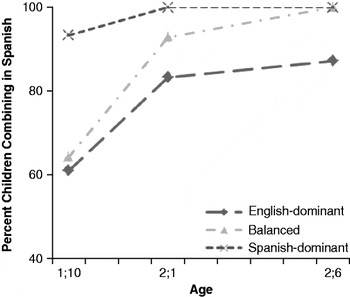
The percent of children producing word combinations in English at each age are plotted for the three groups of bilingually developing children and the monolingual children in Figure 8. Chi-square tests revealed a significant association between language group and the achievement of combinatorial speech in English at 1 ; 10 (χ2[3]=13·35, p=0·004) and 2 ; 1 (χ2[3]=11·97, p=0·008), with the monolingual group showing the highest frequency of combinatorial speech and the Spanish exposure-dominant group showing the lowest. At 2 ; 6, the association was not significant – all children in all groups were combining words in English with exception of one bilingual child in the Spanish-dominant exposure group. Within the bilingually developing children, the association between language exposure group and the achievement of combinatorial speech in English did not reach statistical significance at any age. Figure 9 presents the percent of bilingually developing children in each group producing word combinations in Spanish. Chi-square analyses revealed a significant association between exposure group and the achievement of combinatorial speech at the age of 2 ; 6 only (χ2[2]=11·08, p=0·004). At 2 ; 6, 100% of the Spanish exposure-dominant and balanced exposure bilingual groups were producing word combinations in Spanish; 67% of the English-dominant exposure group were producing word combinations in Spanish.
The percent of children producing word combinations in English for monolingually developing children and three groups of bilingually developing children at 1 ; 10, 2 ; 1 and 2 ; 6.

The percent of Spanish-dominant, balanced and English-dominant bilingually developing children producing word combinations in Spanish at 1 ; 10, 2 ; 1 and 2 ; 6.

Grammatical complexity and utterance length
Mean English grammatical complexity scores and mean English MLU3 are plotted for the three groups of bilingually developing children and the monolingual children in Figures 10a and 10b. Grammatical complexity scores were compared in a 3 (age)×4 (language exposure group) mixed ANOVA. There was a significant main effect of age (F(2, 198)=123·29, p<0·001, ηp2=0·56); a significant main effect of language exposure group (F(3, 99)=11·29, p<0·001, ηp2=0·25); and a significant age×language exposure group interaction (F(6, 198)=8·56, p<0·001, ηp2=0·21). Descriptively, the monolingual children and the English exposure-dominant bilingual children had the highest scores, followed by the balanced exposure bilinguals and the Spanish exposure-dominant bilinguals in that order. Bonferroni paired comparisons of language groups revealed that Spanish exposure-dominant children differed from both other groups (p<0·05, one-tailed), who were not different from each other.
Measures of grammatical development in English for monolingually developing children and three groups of bilingually developing children at 1 ; 10, 2 ; 1 and 2 ; 6: (a) grammatical complexity scores, and (b) mean length of the three longest utterances. Error bars represent standard errors of the means.

A parallel ANOVA procedure was applied to English MLU3, with similar findings. There was a significant main effect of age (F(2, 198)=166·97, p<0·001, ηp2=0·63); a significant main effect of language exposure group (F(3, 99)=11·85, p<0·001, ηp2=0·26); and a significant age×language exposure group interaction (F(6, 198)=2·34, p=0·03, ηp2=0·07). Descriptively, the monolingual children and the English exposure-dominant bilingual children produced the longest utterances, followed by the balanced exposure bilinguals and the Spanish exposure-dominant bilinguals in that order. Bonferroni paired comparisons of language groups revealed that the Spanish exposure-dominant children differed from all other groups and that the balanced exposure bilingual children differed from the monolingual children (ps <0·05, one-tailed).
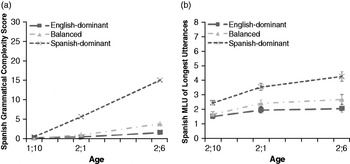
Mean Spanish grammatical complexity scores and mean Spanish MLU3 are plotted for the three groups of bilingually developing children in Figures 11a and 11b. The effects of age and language exposure balance on the grammatical complexity of children's Spanish utterances among the bilingually developing children were assessed in a 3 (age)×3 (exposure balance) mixed ANOVA. There was a significant main effect of age (F(2, 88)=17·49, p<0·001, ηp2=0·28); a significant main effect of exposure balance (F(2, 44)=8·17, p<0·001, ηp2=0·27); and a significant age×exposure balance interaction (F(4, 88)=6·63, p<0·001, ηp2=0·23). On average the grammatical complexity of the children's Spanish grew from 1 ; 10 to 2 ; 6. Descriptively, the Spanish exposure-dominant children produced the most complex utterances and the complexity of their utterances grew most over the time period of the study, followed by the balanced exposure bilingual children and the English exposure-dominant bilinguals in that order. Bonferroni paired comparisons of language groups revealed that the Spanish exposure-dominant children differed from both other groups (p<·01), who were not different from each other.
Measures of grammatical development in Spanish for three groups of bilingually developing children at 1 ; 10, 2 ; 1 and 2 ; 6: (a) grammatical complexity scores, and (b) mean length of the three longest utterances. Error bars represent standard errors of the means.

A parallel ANOVA procedure tested the effects of age and language dominance among the bilingual children on the mean length of their longest three utterances in Spanish. There was a significant main effect of age (F(2, 88)=26·47, p<0·001, ηp2=0·38); a significant main effect of exposure balance (F(2, 44)=18·61, p<0·001, ηp2=0·46); and a significant age×exposure balance interaction (F(4, 88)=2·87, p=0·03, ηp2=0·12). On average the length of the children's Spanish utterances grew from 1 ; 10 to 2 ; 6. Descriptively, the Spanish exposure-dominant children produced the longest utterances and the length of their utterances grew most over the time period of the study, followed by the balanced exposure bilingual children and the English exposure-dominant bilinguals in that order. Bonferroni paired comparisons of exposure groups revealed that the Spanish exposure-dominant children differed from both other groups (p<·01), who were not different from each other.
Correlations between relative exposure and development in two languages
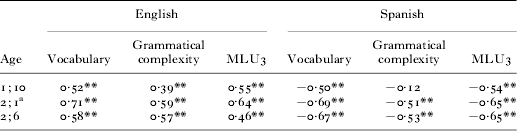
The effects of the balance of English and Spanish in children's language exposure on their English and Spanish development were also assessed treating dominance in language exposure as a continuous, rather than categorical variable. Correlations between the children's relative amount of in-home exposure to English and measures of their English and Spanish language development are presented in Table 3. The percent of home language input in English was positively and significantly related to every measure of English development at every time point and negatively related to every measure of Spanish development at every time point, with the single exception of no relation to grammatical complexity at 1 ; 10, when many children were at zero. The relation of input to the onset of word combinations was tested by comparing the children who were and were not combining words in each language at 1 ; 10. The 31 children who were combining words in English heard proportionately more English than the 16 children who were not (t(45)=2·09, p=0·02, one-tailed); the 34 children who were combining words in Spanish heard proportionately less English (and thus more Spanish) than the 13 who were not (t(45)=−2·38, p=0·01, one-tailed).
Correlations between English proportion of home language use and measures of bilingually developing children's English and Spanish development at 1 ; 10, 2 ; 1 and 2 ; 6

a The measure of home language use was obtained for only 28 of the participants at the 2 ; 1 language assessment.
** p<0·01, one-tailed.
DISCUSSION
The present analyses tested two hypotheses: (1) that children exposed to only one language will acquire that language more rapidly than children exposed to two languages will acquire each of those languages; and (2) that in children exposed to two languages, the rate of development of each language will vary as a function of the children's relative amount of exposure. Both hypotheses were supported in the data.
One set of analyses compared a group of bilingually exposed children (whose balance of English to Spanish exposure was on average equal but with a range from 10% English to 90% English) to a group of children exposed only to English. Using measures of the children's English and Spanish language development from the MacArthur-Bates inventories at the ages of 1 ; 10, 2 ; 1 and 2 ; 6, comparisons revealed that the English language skills of monolingual English-learning children were more advanced and improved more rapidly during this period than the English language skills of bilingual Spanish- and English-learning children – even though the bilingually developing children were more advanced in English than they were in Spanish, where comparison was possible. The effect was seen for every measure of language development, including measures of vocabulary and grammar and including the timing of the achievement of the basic milestone of combining words.
The findings of this analysis provide a clear answer to the practical question of whether children exposed to two languages typically acquire each at the same rate as monolinguals: they do not. These findings do not contradict the findings from earlier studies that bilingual children acquire each language within the normal range of variation for monolingual children (Paradis & Genesee, Reference Paradis and Genesee1996; Petitto et al., Reference Petitto, Katerelos, Levy, Gauna, Tetrealt and Ferraroi2001; Petitto & Kovelman, Reference Petitto and Kovelman2003); the normal range of variation in the rate of language development is large (Bialystok, Reference Bialystok2001), and the distributions of single-language skill levels in monolingual and bilingual groups overlap. However, the present findings of mean between-group differences contradict the assertion that children acquire two languages as the same pace as one. Importantly for the theoretical implications of this study, not only vocabulary but also grammatical development, including the timing of the achievement of the major milestone of producing word combinations, was affected by dual language input.
These findings also address the size of the effect of bilingualism. In the present data, bilingualism accounted for between 10 and 22 percent of the variance in English language skill, depending on outcome measure. In terms of Cohen's d, the size of the effects ranged from moderate to large (Cohen, Reference Cohen1988). In terms of percentile scores, the average difference between the monolinguals and bilinguals as groups across this developmental period ranged from 10 to 21 percentile points, again depending on the measure. These children were, on average, more advanced in English than in Spanish. Thus, the size of the effect of bilingualism on their English language skills provides a conservative estimate of the size of the effect on the acquisition of one language associated with the simultaneous acquisition of another.
Visual inspection of the figures provides another way to gauge the size of the effect of bilingualism. In terms of English vocabulary size, the bilingually developing children at 2 ; 1 were at essentially the same level as the monolingual children at 1 ; 10. With respect to the percent of children producing word combinations in English, the gap between the monolingual and bilingually developing children that was observable at 1 ; 10 had closed by 2 ; 1. In terms of the grammatical complexity score and MLU of the longest utterances in English, the bilingual children at 2 ; 1 were more advanced than the monolingual children at 1 ; 10. Thus, one could describe the data as showing that the lag associated with bilingualism at this very early stage is less than three months. Thus, while these data show that it takes longer to acquire two languages than one, these data also show that it does not take twice as long – at least to reach the level of monolingual children at two years. The size of the lag increases with age, however, because the rate of English language development in the monolingual group is faster than the rate of development in the bilingual group.
These findings of differences between monolingual and bilingual children in their rates of single language development must be considered in the context of two other findings from the present study. The first is that the bilingual children were not different from the monolingual children on two measures that took into account their skill in both languages. The second is that the size of the difference between monolingual and bilingual children was smaller and often not statistically significant when only English-dominant bilinguals were considered.
Two measures that considered the bilingual children's accomplishments in both languages were analyzed. A measure of total vocabulary, which summed the bilingual children's English and Spanish scores, revealed the bilingual and monolingual groups to be virtually identical, consistent with findings from other studies (e.g. Junker & Stockman, Reference Junker and Stockman2002; Pearson et al., Reference Pearson, Fernández and Oller1993; Thordardottir et al., Reference Thordardottir, Rothenberg, Rivard and Naves2006). The bilingually developing children were learning words at the same rate as monolingual children, but their word learning was, like their language exposure, divided between two languages. A measure of achieving combinatorial speech, which counted the achievement if it occurred in either language, also revealed the bilingually developing children as not different from the monolingual children. Thus, bilingual children appear to acquire lexical knowledge at the same rate as monolingual children, albeit distributed across two languages, and bilingual children acquire the basic ability to combine words in at least one language on a timetable not discernibly different from that of monolingual children. We note, however, that this measure of combining words in either language is not a grammatical parallel to the total vocabulary measure. If achievement of this milestone in a language depends on exposure to that particular language, then bilingually developing children with balanced exposure might well achieve that milestone later than monolingual children. That was not the case in the present data, but comparison of children at an earlier age might reveal such an effect. In the present samples, the achievement of producing combinatorial speech in English was significant later in bilinguals than monolinguals, but the achievement of producing combinatorial speech in any language was not.
The finding that language balance attenuated the effect of bilingualism was revealed in analyses in which the bilingually developing children were categorized according to whether their language exposure was English dominant, balanced or Spanish dominant, and these three groups were compared to each other and to the monolingual children. The size of the difference between the monolingual group and the English-dominant bilingual group was always less than the size of the difference between the monolinguals and all the bilingually developing children combined, and in many cases the difference between monolinguals and English-dominant bilinguals was not significant. Thus, on at least some measures of language development, bilingually developing children are not discernibly different from monolingual children – in their stronger language.
The results of these analyses by subgroup also address two related hypotheses that have been proposed regarding the effects of bilingual exposure: (1) that the cost of bilingual exposure is mitigated in circumstances of balanced input. That is, if most of a child's language exposure is in Spanish, then his or her English language development will of course be delayed, but if language exposure is roughly balanced, then, perhaps, both languages could develop at the same rate as one develops in monolingual children. And (2) that there is a threshold of 20% of input required for language learning. There is some evidence for the view that balanced input confers a particular advantage for phonological development in infancy (Werker, Weikum & Yoshida, Reference Werker, Weikum, Yoshida, McCardle and Hoff2006), but the hypothesis that balanced input has unique effects has not been explicitly tested in other domains. The 20% threshold hypothesis appears to have originated in Pearson et al.'s (Reference Pearson, Fernández, Lewedeg and Oller1997) observation that children who hear less than 20% of their input in one language are often reluctant to speak that language. It is worth noting that Pearson et al. explicitly did not claim that children with less than 20% exposure will not acquire the language – only that it is difficult to obtain speech samples from these children in the less-frequently-used language.
The present findings are not consistent with the hypothesis that balanced language exposure results in bilingual development in which the vocabulary or grammar of both languages are acquired at the same rate as monolingual development. The balanced bilingual group differed from the monolingual group in English vocabulary and in utterance length in English utterances, although not on the percent of children combining words at 1 ; 10 and not on the grammatical complexity measure. Taken as a whole, the pattern of findings in the comparisons of the three groups of bilinguals to monolinguals in English and the comparisons among the three bilingually developing groups with respect to their development of English and Spanish are entirely consistent with the argument that language development is a function of the relative amount of exposure. Across all measures of English skill, the English exposure-dominant bilinguals looked most like the monolinguals, followed by the balanced exposure bilinguals and the Spanish exposure-dominant bilinguals, in that order. Furthermore, within the bilinguals, looking at Spanish skill as the outcome, the balanced exposure bilinguals were between the English exposure-dominant and Spanish exposure-dominant groups. In some cases, the between-group differences failed to reach statistical significance because subcategorizing the bilinguals in terms of the balance of their language exposure reduced both the size of between-group difference and the statistical power of the analysis.
The effect of relative amount of input on the rate of English and Spanish development within the bilinguals was also revealed in analyses that treated relative exposure to English as a continuous variable. Within the bilingually developing children, the proportion of their input that was in English was positively related to every continuous measure of English development and negatively related to every measure of Spanish development, except where the measure suffered from a floor effect. The relative amount of input in English was also related to the timing of the achievement of the milestone of producing word combinations in each language. At 1 ; 10, the children who were combining words in English had relatively more exposure to English than those who were not, and those who were combining words in Spanish had relatively more exposure to Spanish. It is also consistent with this evidence of input effects that the children were on average more advanced in English than Spanish. Their home language exposure was almost equally balanced between English and Spanish (51·17% English (SD=28·78) at 1 ; 10 and 54·68% English (SD=31·30) at 2 ; 6), but other data on this sample show that the children heard more English in out-of-home activities than they did at home (Place & Hoff, in press).
The finding that language exposure predicts vocabulary development in bilingual children is not new and does not contradict any theory of language development. All accounts of language acquisition describe children as learning words from input. The finding that grammatical development in bilingual children is also a function of language exposure is new, and the finding that the timing of the achievement of the major milestone of producing word combinations is a function of input does contradict theoretical positions that posit a more maturational basis to the development of grammar and concomitant robustness in circumstances of dual language input (e.g., Petitto et al., Reference Petitto, Katerelos, Levy, Gauna, Tetrealt and Ferraroi2001). Consistent with findings of input effects in monolingual children (Hoff, Reference Hoff2006), the effects on bilingually developing children's grammatical development often appeared to be smaller than the effects on vocabulary development. To understand how input influences the rate of grammatical development will require further research. The effects on vocabulary and grammar observed here may reflect direct effects of access to input on both vocabulary and grammatical development or indirect effects on grammar via the dependence of grammatical on lexical development (Marchman et al., Reference Marchman, Martínez-Sussmann and Dale2004) and/or a necessary synchrony between the acquisition of vocabulary and grammar that arises from the nature of the language learning process (Snedeker, Geren & Shafto, Reference Snedeker, Geren and Shafto2007).
These results have some practical implications. Although they do not explain why bilingualism is a risk factor with respect to academic success, they do demonstrate a real effect of dual language input apart from the frequently confounded factor of low socioeconomic status. They make the case that it is perfectly normal for bilingually developing children to lag behind monolingual children in the rate at which they acquire each of their languages. These results also contribute to the ongoing discussion about assessing and educating bilingual children by showing that skill level in a single language is not the same indicator of ability for bilingual children that it is for monolingual children. A bilingual child is cognitively more able than his single-language skills reflect.
There are limitations to the present study. Children's language skills were assessed with only a single instrument, and only production was assessed. Bilingual children may well have different patterns of language competence, and these will require multiple instruments to adequately describe them (see, for example, Oller, Pearson & Cobo-Lewis, Reference Oller, Pearson and Cobo-Lewis2007). Also, only a small window of development – from 1 ; 10 to 2 ; 6 – was described. It will be important for future research to describe the continuing trajectories of these foundational oral language skills as children approach school entry.
CONCLUSIONS
The present findings demonstrate that, on average, children acquiring two languages will lag behind children acquiring only one – when the bilingual children's skills in only one of their languages are assessed. Although evidence in the previous literature suggested this conclusion, the present findings are the first to clearly demonstrate that this effect of bilingualism is observed in high socioeconomic status samples and is observed for measures of grammatical development, as well as for vocabulary. The present findings also demonstrate that the size of the difference between monolingual and bilingual children's skills in any language depends on how much of that language the bilingual child hears. Because the range of variation in both monolingual and bilingual development is large and because most bilingual children hear more of one language than the other, many bilingual children have single-language skills within the normal range of variation for monolinguals, particularly in their stronger language.