Implications
This study investigates the effects of two feeding systems and two dairy cow breeds on milk yield and composition, physical and sensorial properties of Camembert and Pont-l’Evêque cheeses. The differences of feeding system and breed on the technical and sensory properties are more marked in the case of Camembert than Pont-l’Evêque cheeses. Cheese-making technology is likely to moderate the effects of stock-breeding factors on the composition of milk.
Introduction
In Normandy, as in the whole of the West of France, maize silage has replaced herbage (hay or silage) in the winter feed of dairy herds, so that the majority of protected designation of origin (PDO) cheeses manufactured in winter in this region is nowadays produced from dairy cows fed with a diet containing maize silage. Compared to this type of diet, conserved grass leads to a reduction in the milk production and in protein and fat contents (Hoden et al., Reference Hoden, Coulon and Dulphy1985), probably associated with a worsening of the cheese-making capacity of milks (Hurtaud et al., Reference Hurtaud, Buchin, Martin, Verdier-Metz, Peyraud and Noël2001). On the other hand, conserved grass decreases the saturated fatty acid (FA) contents with a higher melting point in favour of the mono- and poly-unsaturated FA, including the FA of nutritional interest such as C18:3 or c9,t11 conjugated linoleic acid (CLA) (Chilliard et al., Reference Chilliard, Ferlay and Doreau2001). Finally, the conserved grass intake is often associated with an energy deficit which is difficult to dissociate from the pure effect of grass alone, since the two effects are additive (Couvreur et al., Reference Couvreur, Hurtaud, Delaby and Peyraud2004).
In addition, in French dairy herds, the Holstein (Ho) cow has often replaced the less productive Normande (No) cow, but whose milk is richer in solid content (Lawless et al., Reference Lawless, Stanton, L’Escop, Devery, Dillon and Murphy1999; Piacère and Douguet, Reference Piacère and Douguet2008). The effect of No breed in terms of the quality of dairy products has never been clearly demonstrated, even if the milk from No appears to have a better coagulation capacity (Vertès et al., Reference Vertès, Hoden and Gallard1989).
Cheese-making technology is also an important parameter that interacts with the composition of the milk. In Normandy, several types of PDO cheeses are manufactured with raw milk. Camembert is a soft-ripened cheese with a flowered rind, which is ripened for 2 to 6 weeks. Pont-l’Evêque cheese is also a soft cheese, but with a washed or simply brushed rind, which is ripened for a minimum of 2 weeks.
Thus, it was particularly interesting to study the combination of these three factors (feeding system, breed and type of cheese). Indeed, little is known at present about the impact of the effects of feed crossed with breed on the properties of cheeses as a function of type of forage. Verdier-Metz et al. (Reference Verdier-Metz, Martin, Pradel, Albouy, Hulin, Montel and Coulon2005) are the only authors reporting different effects from conserved grass in the form of silage or hay according to the type of cheese.
The objective of our trial was thus to compare the characteristics of two cheeses produced in Normandy based on low input grass-based systems compared with maize silage-based systems, in interaction with the breed of cows (Ho v. No). This study was carried out at early lactation, when the frequently negative energy balances are subject to greater variability.
Material and methods
This experiment comes under a programme of more than one year of studies on the cross effects of two feeding systems and breed of dairy cows, with the overall results being reported by Delaby et al. (Reference Delaby, Faverdin, Michel, Disenhaus and Peyraud2009).
Animals
The experiment was carried out, at the INRA (Institut National de la Recherche Agronomique) experimental farm of the Le Pin-au-Haras (Orne, France), on dairy cows at the beginning of lactation. A total of 68 dairy cows, belonging to Ho and No breeds and made up of 40 multiparous and 28 primiparous cows, at 45 days of lactation on average, were divided into two groups of 34 cows. For primiparous cows, the grouping was carried out based on the following criteria: the breed (Ho or No), sire, future date of calving, live weight at age of one or two years, gain in average live weight over the last three months and condition score at the beginning of November. Moreover, when available, the first lactation performances of the dam were included as criteria for grouping of the daughters.
For the multiparous cows, the grouping was carried out using the average results of the first 36 weeks of the preceding lactation, eventually corrected for the effects of the treatments applied during this lactation and any health incidents. The criteria adopted for the grouping were: breed, future date of calving, milk yield, fat and protein contents averaged over 36 weeks, average live weight, body condition at the beginning of November and cell counts of milk observed over the last three controls of the preceding lactation.
In the end, each group comprised 34 cows, with 17 Ho and 17 No, including 20 multiparous and 14 primiparous cows. The distribution of genetic variants, evaluated after the grouping, was relatively homogeneous between groups and in conformity with the data for both breeds (respectively for Ho and No breed: κ-casein AA, 65.5% and 0%; κ-casein BB, 0% and 93.9%; β-casein A1A1, A2A2 and A1A2, 74% and 41.9%; β-lactoglobulin AA, 17.0% and 3.1%; β-lactoglobulin BB, 43.1% and 42.3%).
Treatments, experimental design and feeding
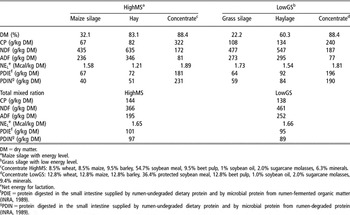
Two feeding systems were compared for the winter period, from December 2002 to March 2003. The first aimed at maximizing the individual performances with an ingestible diet rich in energy consisting of maize silage supplemented by 30% concentrate (8.5% wheat, 8.5% maize, 9.5% barley, 54.7 soybean meal, 9.5% beet pulp, 1% soya oil, 2.0% sugar cane molasses, 6.3% minerals) (HighMS treatment) (Table 1). The second aimed to develop conserved grass in the form of silage (harvested by fine chop after drying) or big bale silage (long semi-wilted bits) while reducing the inputs of concentrate (12.8% wheat, 12.8% maize, 12.8% barley, 36.4% formaldehyde-treated soybean meal, 12.8% beet pulp, 1.0% soya oil, 2.0% sugar cane molasses, 9.4% minerals) to 15% of the diet, without expressing the potential of the animals (LowGS treatment) (Table 1). Cows were fed ad libitum with 10% of daily refusals. Thirty-four Ho dairy cows (2 × 17) and 34 No (2 × 17) received one of the two diets for a period of 6 weeks (from 10 February until 30 March 2003): Ho-HighMS, Ho-LowGS, No-HighMS and No-LowGS. The experimental design was a continuous design.
Chemical composition and nutritional value of feeds and diets

DM = dry matter.
aMaize silage with energy level.
bGrass silage with low energy level.
cConcentrate HighMS: 8.5% wheat, 8.5% maize, 9.5% barley, 54.7% soybean meal, 9.5% beet pulp, 1% soybean oil, 2.0% sugarcane molasses, 6.3% minerals.
dConcentrate LowGS: 12.8% wheat, 12.8% maize, 12.8% barley, 36.4% protected soybean meal, 12.8% beet pulp, 1.0% soybean oil, 2.0% sugarcane molasses, 9.4% minerals.
eNet energy for lactation.
fPDIE = protein digested in the small intestine supplied by rumen-undegraded dietary protein and by microbial protein from rumen-fermented organic matter (INRA, 1989).
gPDIN = protein digested in the small intestine supplied by rumen-undegraded dietary protein and by microbial protein from rumen-degraded protein (INRA, 1989).
Manufacture of cheeses
Sampling and transfer of milk
Each sampling related to a particular group of cows: Ho-HighMS, Ho-LowGS, No-HighMS or No-LowGS. Each week, two groups were taken for the manufacture of Camembert and two other groups for the manufacture of Pont-l’Evêque. The milk of two successive milkings was transferred into specific tanks, which were then collected by the dairy. Milk was delivered to the dairy the day before manufacture of the cheeses. Finally, three series of manufacture by treatment were carried out for the two types of cheeses.
Camembert cheese
Manufacture of Camembert cheese took place at the Vallée Cheese dairy (group Lactalis, Laval, France) two times per week, on Tuesdays and Wednesdays for 6 weeks. Milk was stored in a tank at 12°C. Lactic ferments (mixture from group Lactalis, Laval, France), Geotrichum penicillium, curd yeasts and CaCl2 (0.31 ml/l) were added to the milk, which was left to mature until the following day. The first day, the cream on the top of the milk was skimmed off by hand to standardize the milk (fat/protein ratio = 0.9). Milk was heated to 20°C to 23°C, then to 35°C in five 80-l basins. The milk was then renneted (mixture of chymosin and trypsin, 20 ml/100 l). After 1 h to 1 h 10 min of coagulation, the curd was cut out and then moulded. The moulding took place using five curd ladles, with an interval of one hour between each passage, each ladle coming from a different basin every time. The cheeses were placed in a room at 30°C. They were turned over, 10 h after moulding. The following day, the cheeses were removed from the mould, sprayed with P. candidum at a temperature of 23°C to 24°C and salted at 18°C. Ripening took place in a cheese-drying room for a minimum of 6 days. The Camembert cheeses were then packed and ripened at 4°C to 6°C.
Pont-l’Evêque cheese
Pont-l’Evêque cheese was manufactured at the Pont-l’Evêque cheese dairy (group Graindorge, Livarot, France) once per week, on Thursdays for 6 weeks. Milk of two successive milkings was delivered the day before to the cheese dairy. It was stored in a tank at 10°C. Lactic ferments (mixture from Graindorge, Livarot, France), G. penicillium, curd yeasts and CaCl2 were added to the milk, which was left in maturation until the following day. Full-cream milk was used without any standardization. It was heated to 38°C, renneted (38 ml/100 l), and then curdled in 140-l basins. The curd was cut out, left at rest and then regularly stirred five times during approximately 1 h 15 min. The curd was moulded only once. During drying, the cheeses were turned over three times. They were then removed from the mould, turned over two times at a temperature of 16°C to 18°C, salted and dried. Ripening took place in a cheese-drying room for 7 days with brushing and reversal per week. The cheeses were packed and refined in a cellar for 15 to 25 days at 8°C.
Measurements
The quantities of feed offered and the refusals were weighed every day. The individual milk yield was measured at each milking. Fat and protein contents were determined three times per week (i.e. on six milkings) by infrared analysis (Milkoscan; Foss Electric, Hillerød, Denmark). Once a week for the six weeks, a detailed analysis of milk samples (1 l) was performed from a mixture of evening and morning milkings of the groups of cows whose milk was collected for cheese making (two samples per week). Total nitrogen content (TN), non-protein nitrogen matter (NPN), non-casein nitrogen (NCN), casein and urea were determined according to the methods described by Hurtaud et al. (Reference Hurtaud, Lemosquet and Rulquin2000). Total and soluble calcium were analysed by atomic spectrophotometry absorption on milk and milk ultrafiltrate, respectively. The FA composition was determined by extracting the lipids from a 1-ml sample of milk fat according to the method described by Bauchart and Duboisset (Reference Bauchart and Duboisset1983) using 0.5 ml of an ethanol/HCl (4 : 1 vol) solution followed by 0.5 ml of hexane. Milk FAs were esterified with 1 ml of a butanol/HCl (100 : 5) solution followed by 2 ml of hexane (butyl esters). These esters were injected into a gas chromatograph (Varian 3400; Varian, Inc., Les Ulis, France) equipped with an electron ionization detector. The separation of butyl esters was performed on an OV-1- fused silica capillary column (25 m × 0.32 mm i.d.). The oven temperature was programmed to rise from 70°C to 220°C at 100°C/min. Injector and detector were at 220°C and 250°C, respectively. Helium was used as gas vector.
The size of the milk fat globules was measured with a Coulter Multisizer II (Coulter Electronics Limited, Luton, UK). The coagulation capacity of these milks was measured with a Formagraph instrument (Foss Electric, Hillerød, Denmark). The parameters were measured on milk at standardized pH (6.5) per addition of lactic acid. The parameters measured at the standardized pH were the time of coagulation (R), the firming time (k20), firmness 30 min after the onset of coagulation (a30) and firmness at twice the time taken to set (a2r) (Hurtaud et al., Reference Hurtaud, Buchin, Martin, Verdier-Metz, Peyraud and Noël2001).
Total nitrogen content, NPN, NCN and casein were measured on both cheeses, Camembert and Pont-l’Evêque, after 6 weeks storage. Compression measurements were performed on slices of cheeses after 6 weeks of storage with a universal testing machine (model 4501; Instron, Norwood, MA, USA) with IX series software (Instron, Norwood, MA, USA), equipped with a strip of metal (nine measurement points per cheese: three under the rind, three in the centre of the cheese and three at the top of the lower rind) (M. H. Famelart, personal communication). Cheese colour was measured by reflectance method using a MINOLTA chromameter (Minolta, Carrières-sur Seine, France) (six measurement points per cheese) (Michalski et al., Reference Michalski, Camier, Briard, Leconte, Gassi, Goudédranche, Michel and Fauquant2004). Trained members of the PDO cheese-tasting panel of a Normandy firm assessed the Camembert and the Pont-l’Evêque cheeses for flavour, odour and texture. Each type of cheese had a different scale of scoring adapted to its particular characteristics.
Statistical analysis
The statistical analysis was carried out according to the Proc Mixed of SAS (2005).
We carried out a variance–covariance analysis for the parameters of milk yield as well as the fat and protein contents measured on individuals. The included covariables were the 36-week milk production on the previous year for multiparous cows, or the production of the dam’s first lactation. Owing to the differences in the milk composition and body weight values between breeds, these covariables were centred within breed and parity before inclusion. The statistical model is as follows:

where μ is the mean, ni the effect of parity (1 d.f.), rj the breed effect (1 d.f.), sk the feeding system effect (1 d.f.), ni * rj the interaction between parity and breed, rj * sk the interaction between breed and the feeding system, ni * sk the interaction between parity and feeding system and eijk the residual error.
For the detailed composition parameters measured on group milks, the statistical model is as follows:

where μ is the mean, pi the period effect (5 d.f.), rj the breed effect (1 d.f.), sk the feeding system effect (1 d.f.), rj * sk the interaction between the breed and feeding system and eijk the residual error.
For the parameters of cheese-making manufacture and composition of cheeses, the statistical model is as follows:

where μ is the mean, pi the period effect (5 d.f.), rj the breed effect (1 d.f.), sk the feeding system effect (1 d.f.), tl the effect of type of cheese (Camembert or Pont-l’Evêque), rj * sk the interaction between breed and feeding system, rj * tl the interaction between breed and the type of cheese, sk * tl the interaction between feeding system and type of cheese, rj * sk * tl the interaction between breed, feeding system and type of cheese and eijkl the residual error.
Sensory assessment scores were analysed according to the CATMOD procedure of SAS (2005). The model only tests the effects of breed and feeding system, along with the effect of interaction between breed and feeding system.
Results
Feed intake, milk yield and milk composition
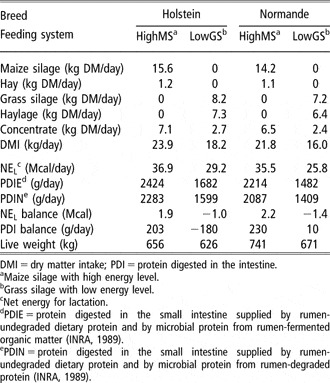
With the LowGS treatment, the dry matter intake (DMI) of dairy cows was 17.1 kg, including 2.5 kg of concentrate, as against 22.8 kg DMI including 6.8 kg of concentrate with the HighMS treatment. The feed intakes were also different between the two breeds: the amount of DMI by No cows was 2.1 kg less than that by Ho cows. These differences were reflected in variations of net energy and protein intake: −8.7 Mcal/day, −737 g of PDIE and −681 g of PDIN with the LowGS treatment compared with HighMS and −2.4 Mcal/day, −205 g of PDIE and −193 g of PDIN for No compared with Ho cows. The net energy and protein balances were in excess for the HighMS treatment and in deficit for the LowGS treatment. The live weights at the end of the trial were lower for the LowGS treatment (−50 kg, P < 0.001), but higher with No (65 kg, P < 0.001), with No cows showing a greater loss of weight with the LowGS treatment (−70 kg v. −30 kg, P = 0.024) (Table 2).
Dry matter (DM) intake, energy and protein balances and live weight of dairy cows of the four groups (Ho-HighMS, Ho-LowGS, No-HighMS and No-LowGS )

DMI = dry matter intake; PDI = protein digested in the intestine.
aMaize silage with high energy level.
bGrass silage with low energy level.
cNet energy for lactation.
dPDIE = protein digested in the small intestine supplied by rumen-undegraded dietary protein and by microbial protein from rumen-fermented organic matter (INRA, 1989).
ePDIN = protein digested in the small intestine supplied by rumen-undegraded dietary protein and by microbial protein from rumen-degraded protein (INRA, 1989).
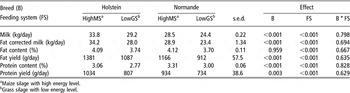
No significant interaction was detected between the feeding systems and the breed of the dairy cow on milk yield and composition. The LowGS treatment led to a reduction in milk yield (−4.3 kg/day, P < 0.001), with lower fat corrected milk (−5.8 kg/day, P < 0.001), lower fat and protein contents (−3.8 g/kg, P < 0.001 and −3.0 g/kg, P < 0.001, respectively) as well as lower fat and proteins yields (−274 g/day, P < 0.001 and −213 g/day, P < 0.001, respectively). The No cows produced less milk (−5.0 kg/day, P < 0.001), lower fat corrected milk (−4.9 kg/day, P < 0.001), with a higher protein content (2.4 g/kg, P < 0.001) and a similar fat content. Yields of fat (−195 g/day, P < 0.001) and proteins (−86 g/day, P = 0.003) were lower (Table 3).
Milk production and composition during the whole experiment (6 weeks) of the four groups (Ho-HighMS, Ho-LowGS, No-HighMS and No-LowGS)

aMaize silage with high energy level.
bGrass silage with low energy level.
Composition of milks used for cheese manufacture
No significant interaction was detected between the feeding systems and breed of dairy cows, except in the case of some FA.
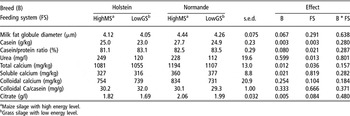
The LowGS treatment led to a reduction in the casein content of milks (−2.4 g/kg, P = 0.003), while increasing the casein/protein ratio (1.5 percent units, P = 0.021) and reducing the total calcium content (−56 mg/kg, P = 0.036), but did not have any effect on the distribution of calcium between the colloidal and the soluble phases. It decreased the urea content (−12.2 mg/100 ml, P = 0.013) and tended to decrease the citrate content (−0.10 g/l, P = 0.084). The diameter of the milk fat globules was unaffected by the feeding system (Table 4).
Milk composition of the four groups (Ho-HighMS, Ho-LowGS, No-HighMS and No-LowGS)

aMaize silage with high energy level.
bGrass silage with low energy level.
The No cows produced milk richer in caseins (2.3 g/kg, P = 0.003), with a casein/protein ratio that tended to be higher (0.9 percent units, P = 0.080). Their milk was also richer in total and soluble calcium (82 mg/kg, P = 0.012 and 47 mg/kg, P = 0.02, respectively) as well as in citrate (0.27 g/l, P = 0.005). The urea content of the milk was not modified by the breed of the dairy cows. The milk from No cows tended to have fat globules of a larger average diameter than the milk from Ho cows (0.26 μm, P = 0.067) (Table 4).
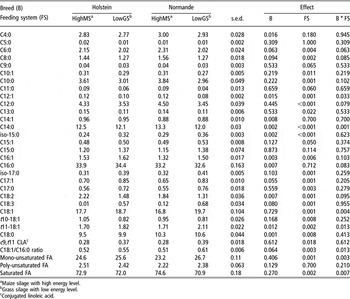
The LowGS treatment reduced the proportions in saturated FA (−2.3 percent units, P = 0.002), primarily in favour of the mono-unsaturated FA (P = 0.001). Among the saturated FA, the short- and medium-chain FA showed the greatest decrease (C6:0, C8:0, C10:0, C12:0 and C14:0), while C18:0 increased. Among the unsaturated FA of nutritional interest, C18:3, t11-C18:1 and c9,t11 CLA exhibited a significant increase. While there was an increase in the C16:1, C17:1 and C18:1 FA, C18:2 and t10-C18:1 decreased. The spreadability index C18:1/C16:0 significantly increased (Table 5).
Milk fatty acid (FA) composition (%) of the four groups (Ho-HighMS, Ho-LowGS, No-HighMS and No-LowGS)

aMaize silage with high energy level.
bGrass silage with low energy level.
cConjugated linoleic acid.
The effect of breed was less marked on the profile of FA. The milk from No cows was richer in short chain FA (C4:0 and C6:0, only slightly for C8:0), as well as C14:0, iso-C15:0 and C18:0, but lower in C14:1, C16:1, C16:0 and C18:2 compared with the milk from Ho cows. The No cows produced milk slightly richer in t11-C18:1, but not in c9,t11 CLA. C18:3 tended to increase (+0.11 percent units, P = 0.08). The C18:1/C16:0 ratio related to spreadability, tended to be higher for the No cows (+0.03; P = 0.064).
Some effects of the feeding system are accentuated with the No breed (interaction B * FS, P < 0.05). In particular, with the LowGS treatment, the No cows showed an accentuated reduction in the FA C12:1 and C14:0, globally in the sum of saturated FA. On the other hand, the LowGS treatment led to a more important increase in the C18:1, t11-C18:1 FA, and generally in the sum of unsaturated FA with the No breed (Table 5).
Coagulating properties of milks, composition and properties of Camembert and Pont-l’Evêque cheeses
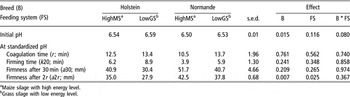
The feeding system did not have a significant effect on the pH of milks. The milk of the No cows had a pH lower than that of the Ho cows. The coagulation parameters are little affected by the feeding system or breed of the dairy cows. Only the firmness of the curd measured at twice the coagulation time (a2r) was decreased by the LowGS treatment (−5.9 mm), but was increased when using the milk from No cows (8.7 mm) (Table 6).
Coagulation properties of milk of the four groups (Ho-HighMS, Ho-LowGS, No-HighMS and No-LowGS)

aMaize silage with high energy level.
bGrass silage with low energy level.
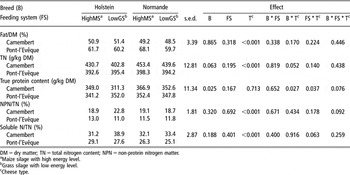
The breed and the feeding system had different effects on the chemical composition of the cheese according to the type of cheese. The protein content of cheeses manufactured with milk from No cows was always higher, whatever the type of cheese. Feeding system did not have a systematic effect on the cheese composition. Cheeses of the Pont-l’Evêque type were characterized by a much higher fat/DM ratio (+12.4 percent units, P < 0.001), a lower TN content (−36.5 g/kg, P < 0.001) as well as a smaller proportion of NPN/TN and lower soluble N/TN (−8.0 and −6.9 percent units, respectively; P < 0.001). The effects of breed and feeding system on the protein content of cheeses were more marked on Camembert than on Pont-l’Evêque cheese. In fact, the Camembert cheese associated with Ho-LowGS was characterized by a lower content of proteins (311.3 g/kg), and higher ratios of NPN/TN and soluble N/TN (22.8% and 38.9%, respectively) (Table 7).
Composition of Camembert and Pont-l’Evêque cheeses made from milk of the four groups (Ho-HighMS, Ho-LowGS, No-HighMS and No-LowGS)

DM = dry matter; TN = total nitrogen content; NPN = non-protein nitrogen matter.
aMaize silage with high energy level.
bGrass silage with low energy level.
cCheese type.
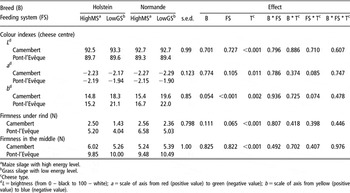
In terms of colour measured in the centre of the cheese, the LowGS treatment led to more yellow cheeses (4.72, P < 0.001) than the HighMS treatment. With the same diet, the milk from No cows tended to produce more yellow cheeses (1.07, P = 0.054). The type of cheese had a significant effect on all the colour parameters. The Camembert cheeses were brighter than the Pont-l’Evêque cheeses (3.3), with less red (−0.19) and yellow (−1.72) indexes. This effect of type of cheese tended to be more accentuated with the grass feeding system: the difference in colour between the LowGS and HighMS treatments tended to be more marked for Pont-l’Evêque than for Camembert (for the parameter a, P = 0.085 and for the parameter b, P = 0.074) (Table 8).
Colour and texture of Camembert and Pont-l’Evêque cheeses made from milk of the four groups (Ho-HighMS, Ho-LowGS, No-HighMS and No-LowGS)

aMaize silage with high energy level.
bGrass silage with low energy level.
cCheese type.
dL = brightness (from 0 – black to 100 – white); a = scale of axis from red (positive value) to green (negative value); b = scale of axis from yellow (positive value) to blue (negative value).
No interaction between treatments appeared for the firmness of cheeses. The LowGS feeding system tended to decrease the firmness of cheeses measured under the rind (−1 N, P = 0.065). Breed did not have any effect on the firmness of cheeses. There was a significant effect due to the type of cheese: Pont-l’Evêque cheeses were always firmer than Camembert cheeses (Table 8).
Overall, there were few effects of the feeding system or breed on the sensory properties of Camembert cheeses. The LowGS treatment produced Camembert cheeses with a more intense bitter flavour (2.99 v. 2.60, P = 0.018) and tending to have a more marked putrid taste (1.99 v. 1.66, P = 0.065). The Camembert cheeses resulting from the LowGS treatment also have a more sticky texture (2.79 v. 2.47, P = 0.019) and a more melting texture (3.13 v. 2.76, P = 0.004). Camembert cheeses produced from the milk of No texture tended to be less sticky (2.51 v. 2.74, P = 0.088), and the aspect of the rind was judged better (3.54 v. 3.25, P = 0.005). The most noteworthy result was seen with Camembert cheese from Ho-LowGS, which had a much more marked aromatic intensity than the other three Camembert cheeses (3.59 v. 2.86, P < 0.001). This was linked to a bitter flavour (3.30 v. 2.63, P < 0.001) and a more marked spicy taste (2.77 v. 2.31, P = 0.010).
Feeding system did not have a significant effect on the sensory analysis parameters of the Pont-l’Evêque cheese. The effect of breed was also very slight for this cheese. The Pont-l’Evêque cheese manufactured with No cow’s milk was a little firmer (2.81 v. 2.50, P = 0.13) and tended to have a less intense total aromatic intensity (2.40 v. 2.72, P = 0.074). But in fact, the effect of breed was modulated by the feeding system. The HighMS treatment tended to generate more intensely flavoured Pont-l’Evêque cheese when using the milk from Ho compared with the No cows (2.87 v. 2.25, P = 0.086).
Discussion
The feeding systems and breed deeply affect the dairy cow performances
Our study showed a strong decrease in milk yield, a reduction in the milk protein content and a greater weight loss with the LowGS feeding system. These results are in agreement with the literature data and are to be expected. The reduction in milk yield due to the decrease in the level of energy intake is consistent with the results of Coulon and Rémond (Reference Coulon and Rémond1991). A reduction in the protein content has been observed in many trials (Rémond, Reference Rémond1985; Hoden and Coulon, Reference Hoden and Coulon1991). It is noteworthy that this decrease in milk protein content is very marked and higher than that observed by Coulon and Rémond (Reference Coulon and Rémond1991) and Rémond (Reference Rémond1985) (0.038% by extra Mcal v. 0.023% and 0.029%, respectively). This leads to milks that are very low in proteins in the case of Ho cows. Journet and Chilliard (Reference Journet and Chilliard1985) have also shown that a reduction of the energy intake results in a reduction in the quantity of milk and a mobilization of the body reserves. Diets containing grass silage reduce the fat content of the milk from 0.3% to 0.4% compared with diets containing maize silage, when all other conditions are equal (Hoden et al., Reference Hoden, Coulon and Dulphy1985). This effect of the maize silage is probably correlated with the increased production of butyrate in the rumen and with the maize lipids content (Journet and Chilliard, Reference Journet and Chilliard1985).
Under the same feeding system, the lower milk yield and higher protein contents derived from the No cows are in agreement with the results of Dillon et al. (Reference Dillon, Buckley, O’Connor, Hegarty and Rath2003), Froc et al. (Reference Froc, Gilibert, Daliphar and Durand1988) and Vertès et al. (Reference Vertès, Hoden and Gallard1989). On the other hand, the above-mentioned studies failed to confirm the relative stability of the fat content with the breed. This can perhaps be attributed to the fact that the cows were at the beginning of lactation, when the milk solid contents are at a minimum, to the differences in nutritive intake between the various diets, to body mobilization of the animals as a function of the systems or to the particular characteristics of the herd used. Indeed, the No cows of the Pin-au-Haras farm have a relatively low milk fat content, with 4.07% as against 4.27% on average for the breed (Piacère and Douguet, Reference Piacère and Douguet2008).
The weight loss was highly variable according to the breed. We can assume that No cows draw on their body reserves only when the energy intake is insufficient. If not, they adapt the milk production to the feed intake, whereas Ho cows always mobilize their body reserves to a greater or lesser extent.
The composition of milks and their coagulation properties are affected by feeding systems and breed
The low energy intakes with the LowGS diet led to significant modifications of the composition of milks and their coagulation properties, which followed the same trends in both breeds. LowGS treatment produced a reduction in milk casein and protein contents. Coulon and Rémond (Reference Coulon and Rémond1991) and Macheboeuf et al. (Reference Macheboeuf, Coulon and D’Hour1993) already noted the negative effect of a restriction of the energy intake on these criteria. The LowGS treatment, on the other hand, caused an increase in the casein/protein ratio. This result is in contradiction with Rémond (Reference Rémond1985) and Coulon et al. (Reference Coulon, Hurtaud, Rémond and Vérité1998), who did not detect any effect of the energy level on the casein/protein ratio. The reduction in the firmness of the curd measured at twice the coagulation time associated with the LowGS feeding system is a direct consequence of the reduction in the casein content of milks. Indeed, Colin et al. (Reference Colin, Laurent and Vignon1992) and Hurtaud et al. (Reference Hurtaud, Buchin, Martin, Verdier-Metz, Peyraud and Noël2001) showed that there was a close relationship between the protein or casein content of milk and the firming time.
The LowGS feeding system led to a decreased percentage of long-chain and unsaturated FA at the expense of short- and medium-chain and saturated FA. The effect of diet on the FA profile is consistent with the literature (Chilliard et al., Reference Chilliard, Ferlay and Doreau2001; Hurtaud et al., Reference Hurtaud, Delaby and Peyraud2002; Schroeder et al., Reference Schroeder, Delahoy, Vidaurreta, Bargo, Gagliostro and Muller2003; Couvreur et al., Reference Couvreur, Hurtaud, Lopez, Delaby and Peyraud2006a and Reference Couvreur, Hurtaud, Marnet, Faverdin and Peyraud2007). The large increase in C18:1 is probably due to a greater mobilization of the lipidic reserves with the LowGS diet (Chilliard et al., Reference Chilliard, Ferlay and Doreau2001). This system increases the contents of FA of nutritional value in milk (linolenic and rumenic acids). It is probable that the LowGS diet has the same effect on the FA of the cheeses (Lucas et al., Reference Lucas, Rock, Chamba, Verdier-Metz, Brachet and Coulon2006).
Compared to the Ho milk, the No milk had higher TN and casein contents and a higher casein/protein ratio. The increase in the casein content is consistent with the literature (Vertès et al., Reference Vertès, Hoden and Gallard1989). This appears to be related to the presence of casein variants, in particular the variant B of κ-casein, which is much more frequent in our population of No cows, accounting for almost 95% of the variants, whereas it is lacking in Ho cows. According to Delacroix-Buchet et al. (Reference Delacroix-Buchet, Lefier and Nuyts-Petit1993), cows having the allele B of κ-casein produce milk with higher contents of TN and total casein. The effect of No breed on the casein/protein ratio is more surprising. According to Froc et al. (Reference Froc, Gilibert, Daliphar and Durand1988), the casein/protein ratio shows no difference between the Pie-Noire and No breeds. In the same way, Coulon et al. (Reference Coulon, Hurtaud, Rémond and Vérité1998) did not find any significant difference in the casein/protein ratio between the three breeds (Ho, Montbéliarde and Tarentaise), but noted a tendency to a reduction with the Ho breed (−0.6). The favourable effect of the No breed on this ratio could be linked to the B variants of κ-casein. The improvement of the coagulation capacity with the milk from No cows results from its high content in coagulable proteins (cf. diet effect). Froc et al. (Reference Froc, Gilibert, Daliphar and Durand1988) also showed that the milk of No cow decreases the firming time by 72% and increases the firmness of curds by 20%. This improvement in coagulation capacity could also be linked to the polymorphism of proteins, in particular κ-casein. According to Grosclaude (Reference Grosclaude1988) and Schaar (Reference Schaar1984), the milk of the homozygote κ-casein BB (very prevalent in the No breed) has a shorter time of coagulation and a shorter firming time, as well as a firmer curd than the milk of the homozygote κ-casein AA (very prevalent in the Ho breed), with the heterozygote having intermediate values. Contrary to the effect of the feeding system, the breed has little effect on the FA profile of milks. The No cows had less C16:0 and C18:2, but more C18:0 and C18:1 than Ho cows, in accordance with Couvreur et al. (Reference Couvreur, Hurtaud and Peyraud2006b) and Lawless et al. (Reference Lawless, Stanton, L’Escop, Devery, Dillon and Murphy1999). The milk fat globules are larger in the case of No cow, with an average increase of 0.27 μm compatible with the preliminary data of Couvreur et al. (Reference Couvreur, Hurtaud and Peyraud2006b), that could result in a better butter-making capacity of the creams.
Feeding system and breed affect the composition and sensory properties of cheeses
The two types of cheese-making technology led to products that were different in terms of chemical composition. The Pont-l’Evêque cheese was characterized by a higher fat/DM ratio, a lower proportion of NPN and soluble nitrogen in TN and a more yellow colour. The difference in the fat/DM ratio is directly related to the manufacturing process: the Camembert cheese was manufactured with milk whose fat/protein ratio is normalized to 0.9, whereas Pont-l’Evêque was made with full-cream milk. While this generated Camembert cheeses that were entirely comparable in terms of fat/DM ratio, this criterion showed a high variability among the Pont-l’Evêque cheeses. This difference in cheese making was also reflected on the TN contents of cheeses. The ratios NPN/TN and soluble N/TN are indicators of the intensity of proteolysis, which is far more accentuated for Camembert than for Pont-l’Evêque. The surface microbial flora associated with a rather long ripening time (6 weeks in our trial) is probably responsible for this phenomenon (Choisy et al., Reference Choisy, Desmazeaud, Gripon, Lamberet and Lenoir1997). Thus, the smaller the size of the cheese (standard Camembert), the higher is the relative abundance of the surface flora and the faster is the ripening. Lastly, the Pont-l’Evêque cheeses were more yellow than Camembert cheeses. This difference is probably related to a greater enrichment of fat content in Pont-l’Evêque cheeses, carotenoid being lipophilic molecules (Nozière et al., Reference Nozière, Graulet, Lucas, Martin, Grolier and Doreau2006). Pont-l’Evêque cheeses were also firmer probably because of the lower degree of proteolysis and less advanced ripening.
The effects of feeding system on the characteristics of the products begin to be better known (Martin et al., Reference Martin, Verdier-Metz, Buchin, Hurtaud and Coulon2005) but not well in the case of Normandy PDO cheeses. Our work clearly demonstrated that the diet can affect the properties of cheeses. The present results showed, in particular, that the LowGS treatment led to cheeses much more yellow than those produced with the HighMS treatment. This result, already observed in the case of cheeses produced in other regions of France (Verdier-Metz et al., Reference Verdier-Metz, Coulon, Pradel, Viallon and Berdagué1998; Houssin et al., Reference Houssin, Forêt and Chesnais2002; Coulon et al., Reference Coulon, Delacroix-Buchet, Martin and Pirisi2004), is related to a larger intake of carotenoid-type pigments with a diet containing preserved grass (Nozière et al., Reference Nozière, Graulet, Lucas, Martin, Grolier and Doreau2006). Calderon et al. (Reference Calderon, Chauveau-Duriot, Martin, Graulet, Doreau and Nozière2007), Coulon (Reference Coulon1997), Hurtaud et al. (Reference Hurtaud, Buchin, Martin, Verdier-Metz, Peyraud and Noël2001), Nozière et al. (Reference Nozière, Graulet, Lucas, Martin, Grolier and Doreau2006) and Verdier-Metz et al. (Reference Verdier-Metz, Martin, Pradel and Coulon2002) have shown that milks are more yellow when associated with grass silage diets. Moreover, such milks produce cheeses that are more yellow than those obtained with maize silage very poor in carotenes, which leads to whiter cheeses. The LowGS treatment also tended to produce less hard and more melting cheeses, which is clearly a result of the modification in the FA profile of the milk, and in particular the C18:1/C16:0 ratio (Hurtaud et al., Reference Hurtaud, Buchin, Martin, Verdier-Metz, Peyraud and Noël2001; Bugaud et al., Reference Bugaud, Buchin, Hauwuy and Coulon2002; Coulon et al., Reference Coulon, Delacroix-Buchet, Martin and Pirisi2004). The presence of these FA increases the fluidity of the fat content and thus leads to softer cheeses (Hurtaud et al., Reference Hurtaud, Buchin, Martin, Verdier-Metz, Peyraud and Noël2001; Bugaud et al., Reference Bugaud, Buchin, Hauwuy and Coulon2002).
Very few authors have studied the effect of breed on the properties of dairy products in interaction with the feeding system (Chiofalo et al., Reference Chiofalo, Maldonato, Martin, Dupont and Coulon2000; Ferlay et al., Reference Ferlay, Martin, Pradel, Coulon and Chilliard2006). We showed that the No cows produced more yellow cheeses. This result could be a consequence of the size of the fat globules. Indeed, according to Michalski et al. (Reference Michalski, Gassi, Famelart, Leconte, Camier, Michel and Briard2003), milks with large fat globules appear to produce more yellow cheeses. This difference in colour could also be related to a difference in the metabolism of carotenoids between the No and Ho breeds (Nozière et al., Reference Nozière, Graulet, Lucas, Martin, Grolier and Doreau2006). Some key steps could control carotenoid transfer from the diet to the milk in dairy cows. Specificity occurs in the digestive tract due to mechanisms of rumen outflow, to the composition of duodenal lipophilic nutrients and to enterohepatic recycling. On the other hand, breed did not affect the firmness of cheeses measured by penetrometry, even if No cows tended to produce cheeses slightly harder under the rind. Coulon et al. (Reference Coulon, Delacroix-Buchet, Martin and Pirisi2004) reported that the differences between breeds would only be perceptible when the cheeses are made from full-cream milk (like the Pont-l’Evêque cheese in our trial).
We showed that the effects of breed and feeding system could interact on the sensory properties of Camembert cheeses. In particular, the aromatic intensity of Camembert cheeses measured by trained panellists was increased with the Ho breed fed on a LowGS system. This result is probably due to a more advanced ripening. This aromatic intensity is largely composed of an ammoniacal aroma. The stronger ammoniacal aroma of the Camembert cheeses with the LowGS treatment is possibly related to a greater degree of proteolysis (higher than the threshold values, which appear to be 34% and 22% for the ratios of soluble N/TN and NPN/TN, respectively) (Choisy et al., Reference Choisy, Desmazeaud, Gripon, Lamberet and Lenoir1997). Ammoniacal aroma is an important component of traditional Camembert flavour and arises from the desamination action of P. camembertii, G. candidum and Brevibacterium linens (Choisy et al., Reference Choisy, Desmazeaud, Gripon, Lamberet and Lenoir1997).
Effects of feeding system and breed on cheese characteristics are modulated according to the type of cheese
This trial showed that the effects of feeding practices on the quality of cheeses are not systematic for all the types of cheeses manufactured. Only the work of Verdier-Metz et al. (Reference Verdier-Metz, Martin, Pradel, Albouy, Hulin, Montel and Coulon2005) has shown that the same cow diet could be expressed differently according to the type of cheese.
The protein contents of cheeses are closely related to milk composition in the case of the Camembert cheeses (cheese protein content = 9 × milk protein content + 67.7, R 2 = 0.67), whereas they do not vary with Pont-l’Evêque. Thus, in particular, the Camembert cheeses derived from milk of No cows are richer in protein than those from the Ho cows in both systems. There could have been fewer losses during drying with No cow’s milk because of a more cohesive curd (Remeuf et al., Reference Remeuf, Cassin, Dervin, Lenoir and Tomassone1991).
Similarly, the differences of diet and breed have a more marked effect on sensory properties in the case of Camembert than Pont-l’Evêque cheeses. The Pont-l’Evêque cheese appeared to have been tasted at a too early stage of ripening.
These results appear to confirm the conclusions of Martin and Coulon (Reference Martin and Coulon1995): the variations in the sensory qualities are initially controlled by the cheese-making technology and especially the kinetics of acidification during manufacture. Hence, it is only when the manufacture is well controlled that the factors related to the animals and the feeding can be expressed. Moreover, time of ripening could be adapted to the type of cheese associated with a breed or a feeding system.
Conclusion
In view of these results, the feeding systems and breed of dairy cow have no determinant effect on PDO Camembert and Pont-l’Evêque cheeses, especially regarding taste. In this kind of trial, despite the great effects of feeding systems and breed on milk composition, the role of cheese ripening and microbiology appears to be of considerable importance. Hence, there is a need for further studies on the interactions between cheese technology and feeding systems or dairy cow breed.
Acknowledgements
We gratefully acknowledge the Vallée dairy in Bernières d’Ailly (Lactalis group), the dairy ‘Atelier Fromager’ in Pont-l’Evêque (Graindorge group) and the Interprofessional Union of Farmers and Producers of PDO Cheeses of Normandy, in particular Mr F. Michel, its secretary. The authors wish to thank the team of the INRA Experimental Farm at Le Pin-au-Haras for their contribution to animal care. They also thank A. Brasseur, I. Jicquel, N. Huchet, T. Le Mouël and M. Vérité from the INRA-Agrocampus Ouest UMR 1080 Production du Lait for their technical assistance, as well as M.-H. Famelart from the UMR INRA-Agrocampus Ouest Science and Technology of Milk and Egg department in Rennes, for her advice on the rheological measurements. The authors also extend their gratitude to M. S. N. Carpenter for the English translation.