INTRODUCTION
Nanoparticles are widely investigated in many fields as a consequence of their relevant physical, optical, electronic, and chemical properties for many applications (Nuclear Physics, Biomedicine, Microelectronics, Engineering materials). One of their applications consists in the increment of the laser absorption if these nanostructures are embedded or are on the surface of different materials (Torrisi et al., Reference Torrisi, Caridi and Giuffrida2011). Particularly, Cu nanoparticles are interesting because they are simple to be prepared simply by using different physical and chemical methods, moreover Cu is ductile and has very high thermal and electrical conductivity, is soft and malleable and it is cheap to produce (Goodfellow, 2012).
Resonance absorption of electromagnetic waves in unmagnetized, inhomogeneous plasma has been of considerable interest for a long time. Generally, resonance absorption is due to the fact that laser light obliquely engraving on a plasma density gradient can excite resonant plasma oscillations at the critical density surface (Giulietti et al., Reference Giulietti and Gizzi1998). Resonance absorption is the collisionless absorption of p-polarized radiation in plasma with a finite scale length. Some experiments show that it plays an important role even for plasmas with a scale length considerably shorter than the laser wavelength. Physically, an electron plasma wave is resonantly excited near the critical density. When this plasma wave is damped, the energy is transferred to the plasma (Giulietti et al., Reference Giulietti and Gizzi1998).
Furthermore, vacuum heating is an effect related to the classical resonance absorption in that the laser electric field drives the electrons across a density gradient. This work is devoted to the enhanced plasma heating in vacuum and to the increase of the ion acceleration along the normal to the target surface. In special manner, to the enhanced heating when the target surface contains microstructures with dimensions comparable with the laser wavelength, so that possible resonant effects may increase the laser energy transferred to the plasma and consequently the kinetic energy of the ion accelerated from the non–equilibrium involved processes.
EXPERIMENTAL SETUP
A Nd:YAG laser, 1064 nm wavelength, 300 mJ pulse energy, 3 ns pulse duration, 1–10 Hz repetition rate, is employed to irradiate target placed in air (20°C, 1 atm, 30% humidity) or in high vacuum (10−6 mbar). The laser spot is 0.7 mm2, thus the corresponding pulse intensity is: I = 200 mJ/3 ns 1 mm2 = 1010 W/cm2.
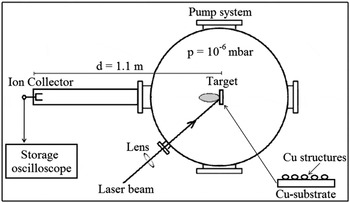
Commercial Cu foils with 1 mm in thickness were used in the experiments. Appropriate specimens 10 mm × 20 mm were cut from these foils. The Cu targets were prepared by using six different techniques that permit to modify the surface morphology in order to create micrometric and sub-micrometric particles enhancing the absorption coefficient at the used wavelength. The investigated techniques are as follows: (1) Laser etching of Cu targets in air without laser focalization (10 mm spot diameter) using a different number of laser shots at 25 mJ pulse energy. Three different areas of about 1 cm in diameter and with 1, 5, and 10 laser shots, respectively, were obtained on the Cu target surface. The etched zone was successively laser irradiated in vacuum, according to literature (Torrisi et al., Reference Torrisi, Andò, Ciavola, Gammino and Barnà2001). (2) Cu nanospheres deposition on Cu substrates. Nanospheres were prepared though laser ablation of Cu targets in distilled water (2.5 mL) using a focalized laser beam (1 mm2 spot size) and different irradiation times (generally 10 min) at 10 Hz and 180 mJ pulse energy, according to literature (Tsuji et al., Reference Tsuji, Nakanishi, Mizuki, Tsuji, Doi, Yahiro and Yamaki2009). Successively, the liquid containing nanoparticles was deposited, in different quantity, uniformly with a microsyringe on the Cu surface. It had been left to dry at room temperature and successively laser irradiated in vacuum. (3) Pulse laser deposition of Cu target, at 45° incidence angle, was realized in vacuum (10−6 mbar pressure) using 180 mJ at 10 Hz for different irradiation times, according to literature (Mezzasalma et al., Reference Mezzasalma, Mondio, Serafino, Caridi and Torrisi2009). A very thin film (discontinuous) was deposited on a Cu substrate place at 2.5 cm distance. This last was used for the successive laser irradiation. (4) Chemical etching of Cu surface by using nitric acid (32%). It is corrosive and the reactive molecules from the etching break the bond at the Cu surface and form Cu oxides (Cu(NO3)2). The reaction, at room temperature, was maintained for different times from 1 up to 100 s and was stopped by a fast distilled water shower, according to literature (Zhuang et al., Reference Zhuang and Edgar2005). (5) Roller burnishing of a thin Cu foil, from 1 mm up to 1 µm thickness by using repetitive rolling with a pressure of 105 Pa. The process produces increase of near-surface dislocation density and produces macroscopic residual stresses and interruptions of the reticular structure, according to literature (Hassan, Reference Hassan1977). The treated rolled sheets, as a function of the final thickness, were finally laser irradiated in vacuum. (6) 1 keV Ar+ sputtering was employed to sputter Cu surfaces using different doses up to about 1017/cm2. Ion sputtering removes atoms from the surface modifying the nanostructure morphology, specially enhancing the grain contours, according to literature (Ghose, Reference Ghose, Brinkmann and Hippler1997). (7) Surface sand-blasting by using micrometric (100–500 µm) SiO2 spherical grains. The specks of sand are launched at high speeds (80–100 m/s) on the Cu surface at room temperature. (8) Mechanical abrasion with abrasive paper from F100 (100 micron grains size) up to F2000 (1 micron grains size). The laser absorption effect for the different Cu treated targets was monitored through the Cu ion detection emitted from the laser-generated plasma. Time-of-flight (TOF) technique was employed by using a classical ion collector fixed at 1.101 m from the target, as in previous measurements (Torrisi et al., Reference Torrisi, Caridi, Visco and Campo2011).
The IC detector is placed along the normal to the target surface, as indicated in the experimental setup, it has 2 cm2 useful surface. Thus the corresponding solid angle subtended by the detector is ΔΩ = 2 cm2/1.1 m2 = 0.17 mstr. The ion yield, given in mV scale can be calibrated in number of emitted ions, as reported in our previously papers. Due to the 50 Ω input resistance of the fast storage oscilloscope and to the fast ion duration, on the order of 10 µs, a Cu signal of 10 mV and 20 µs duration, for example, assumed the mean charge state to be 2+, corresponds to a detection of 1.3 × 10¹⁰ ions. Laser irradiation was used with a 45° incident angle and ion detection was performed along the normal to the target surface. Figure 1 shows a sketch of the experimental setup. Each prepared target has been investigated by scanning electron microscope (SEM) using 20–30 keV electron probe and a magnification of about x 5000.
Scheme of the experimental setup for TOF measurements.

RESULTS
In the present work, the characteristics of the laser radiation absorption and consequent production of ion acceleration have been investigated with regard to the different technique of surface treatment in order to generate microstructures resonant with the laser wavelength. The results have been analyzed following the different technique of target preparation.
Laser Etching in Air
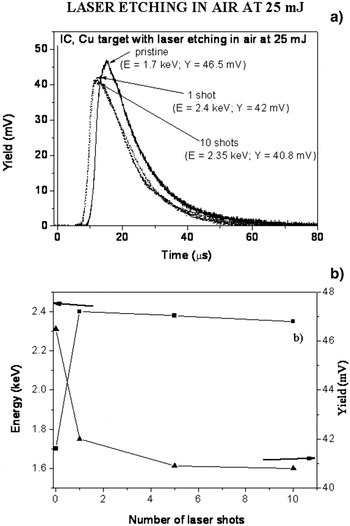
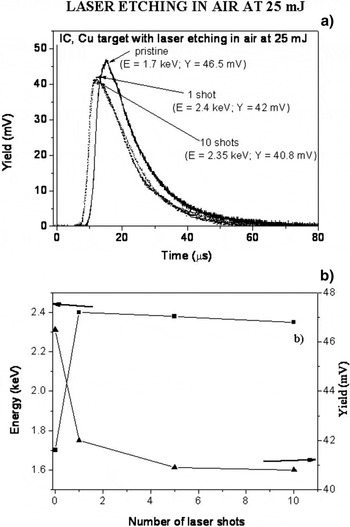
The results obtained with the laser etching in air are presented in Figure 2. A TOF spectra comparison is reported in Figure 2a for the pristine and laser etching surface with 1 and 10 shots. Figure 2b reports the measurement of the Cu ion energy and Cu ion yield vs. the number of laser etching shots. The Cu ion energy, in pristine corresponding to 1.7 keV, increases up to about 2.4 keV just after the first laser etching shot and remains at this value also increasing the number of the laser etching shots. Along the normal to the target surface, the Cu ion yield, of about 46 mV in pristine target, decreases down to about 41 mV after about five laser etching shots. Thus a little increment of the energy, corresponding to +41%, occurs due probably to a stronger absorption of Cu oxide particles or to microstructures produced on the surface, but the emission yield, along this peculiar direction, decreases of about −30% with respect to the pristine case. Thus, in this case, the electric field generated in the non-equilibrium plasma along the normal direction increases and the decreasing of the ion yield in such direction probably is due to an enlargement of the ion spread with the emission angle.
Comparison of typical TOF spectra for laser etching in air of Cu targets (a) and Cu ion energy and yield vs. number of laser etching shots (b).

Laser Ablation of Nanospheres in Liquid
The results obtained with the laser ablation in distilled water in order to generate micrometric Cu spheres and the successive laser irradiation of the structures deposited on a Cu substrate are presented in Figure 3. A typical TOF spectra comparison is reported in Figure 3a for the pristine and the laser irradiation of the structured surface (0.5 mL solution). Figure 3b reports the measurement of the Cu ion energy and Cu ion yield vs. the solution quantity deposited on the Cu substrate to be irradiated. The Cu ion energy in pristine increases up to about 2.6 keV just after the minimum deposition of 0.1 mL solution and remains at this values also increasing the solution quantity deposited on the Cu substrate. The Cu ion yield from the pristine value increases up to about 53 mV after about 0.4 mL solution was placed on. Thus a little increment of the energy, corresponding to +58%, occurs probably due to a stronger absorption of Cu oxide particles and to the nanostructures deposited on the Cu surface. Moreover, the Cu ion yield increases of about +14% with respect to the pristine case, demonstrating, indirectly, that an enhancing of the plasma temperature and density occurs. Thus in this case the electric field generated in the non-equilibrium plasma and the ion yields in normal direction increase both.
Comparison of typical TOF spectra for laser irradiation of microspheres produced by laser ablation of Cu targets in water (a) and Cu ion energy and yield vs. solution quantity deposited on the Cu substrate (b).

Pulse Laser Deposition
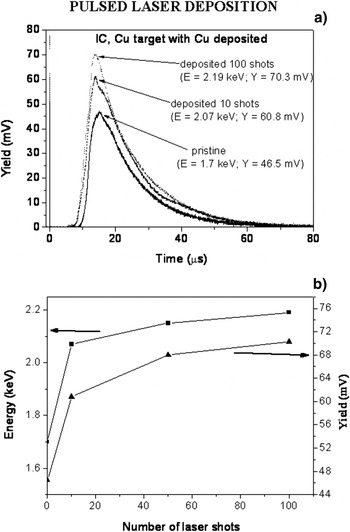
The results obtained with the pulse laser deposition of Cu on to Cu substrate demonstrated that micrometric and nano microstructures of Cu are evident before the deposition of uniform thin film. Such precursors clusters were laser irradiated and results are presented in Figure 4. A typical TOF spectra comparison is reported in Figure 4a for the pristine and the pulse laser deposition by using 10 and 100 shots. Figure 4b reports the measurement of the Cu ion energy and Cu ion yield vs. the number of deposition laser shots. The Cu ion energy in pristine increases up to about 2.2 keV after 100 deposition pulses, which remain about constant for successive shots. The Cu ion yield, from the pristine value, increases up to about 70 mV, due to deposition achieved after 100 laser shots. A little increment of the energy, corresponding to +29%, occurs due probably to a stronger absorption in the under vacuum deposited nanostructures on the Cu surface. In addend, the Cu ion yield increases about +52% with respect to the pristine case, demonstrating, indirectly, that an enhancing of the plasma temperature and density occurs. Thus also in this case the electric field generated in the non-equilibrium plasma and the ion yields in normal direction increase both.
Comparison of typical TOF spectra for Cu nanostructures obtained by pulse laser deposition (a) and Cu ion energy and yield vs. number of laser deposition shots (b).

Chemical Etching
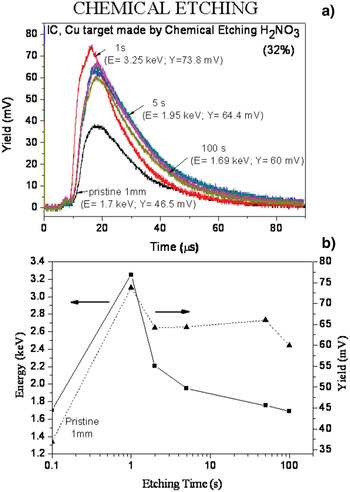
The results obtained by irradiating Cu surface after the chemical etching in H2NO3, generating micrometric and nano-microstructures of Cu and Cu oxides, are presented in Figure 5. A typical TOF spectra comparison is reported in Figure 5a for the pristine and the different times (1–100 s) chemical etching of the Cu surface. Figure 5b reports the measurement of the Cu ion energy and Cu ion yield vs. the chemical etching time. The Cu ion energy in pristine increases up to +92% reaching about 3.2 keV for the surface etched only for 1 s. Higher etching times decrease the Cu ion energy. The Cu ion yield increases with the etching time and reaches a maximum value just after 1 s etching. The maximum yield increment is roughly +100 % with respect to the pristine value. The increment of the etching time doesn't increase the ion yield. Thus a high increment of the energy and of the yield occurs probably due to a stronger absorption in the chemical etched surface after 1s etching. Further etching time decreases the microstructures and the consequent resonant absorption effect. Results demonstrated that the chemical etching is useful in order to increase the laser absorption and consequently the plasma temperature and density.
Comparison of typical TOF spectra for laser irradiation of H2NO3 chemical etched Cu surface (a) and Cu ion energy and yield vs. etching time (b).

Roller Burnishing
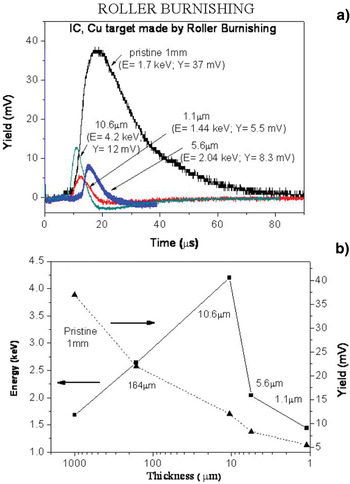
The roller treatment decreases the thickness of the initial sheet progressively for each roller step. In the case related to the roller burnished process (obtained reducing the initial 1 mm thickness to different final thicknesses up to 1 micron final value of the foil), it was observed that the value of the Cu ion energy depends on the final thickness and that the ion yield decreases with the target thickness decreasing. Figure 6a shows a comparison of TOF spectra for different thicknesses of the Cu film obtained via roller burnishing. Figure 6b shows the plot of the Cu ion energy and Cu ion yield vs. the final thickness of the rolled Cu sheet. The Cu ion energy in pristine (1 mm thickness) increases up to +140%, reaching about 4 keV for the rolled to 10 µm final thickness. Successive roll ring with thickness decreasing reduces the Cu ion energy. The Cu ion yield decreases with the thickness decreasing and at 10 micron thickness the decrement is of about −67%.
Comparison of typical TOF spectra for laser irradiation of roller burnishing Cu sheets (a) and Cu ion energy and yield vs. final thickness of rolled target (b).

The increment of the kinetic Cu energy is significant and it can be due to the micro-defects produced by the mechanical stresses at the target surface. Such structures have dimensions similar to the laser wavelength and permit to obtain a high resonant absorption with consequent increment of the plasma temperature. However, the Cu ion yield decreases, probably due to clusters detachment and fractures. Thus, final results demonstrated that the rolling process can be employed up to a final thickness on the order of 10 microns at which high density of micrometric fractures can be generated. In this case, the electric field generated in the non-equilibrium plasma along the normal direction increases up to 10 microns but the ion yield decreases in normal direction, probably due to an enlargement of the ion spread with the emission angle.
Ion Sputtering
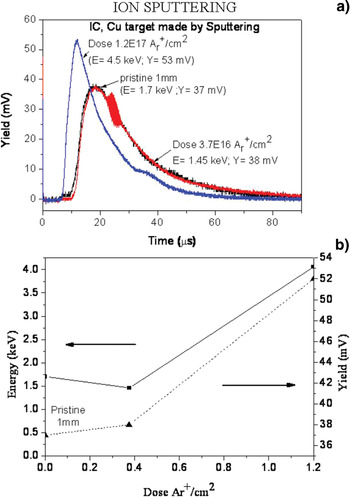
Sputtering is the effect of bombardment of the target surface with keV ions in regime of nuclear stopping power. This process produces atomic emission of surface atoms modifying the nanometric structure of the surface. Figure 7a shows typical TOF spectra comparison between the pristine and the sputtered surface at different ion doses using 1 keV Ar+ and 15–20 µA/cm2 current density. By increasing the sputtering ion dose, the Cu ion energy and yield increase. It can be observed that the increment for ion energy results to be +135% and that of the yield of about +40% related to a dose of 1.2 × 10¹⁷ Ar+/cm2.
Comparison of typical TOF spectra for laser irradiation of Ar ion sputtered Cu surfaces (a) and Cu ion energy and yield vs. Ar ion doses (b).

Thus, the modified Cu targets due to ion sputtering process produces high energy increments due to high resonant absorption effect with nanometric structures at doses of the order of 1017/cm2, at which the Cu ions increase from about 1.7 keV in pristine surface up to about 5.2 keV in high sputtered surfaces. This last result confirms that the plasma temperature and density increases significantly. Thus in this case the electric field generated in the non-equilibrium plasma and the ion yields in normal direction increase both.
Surface Sand-Blasting
No significant increment of the Cu ion energy and yield was measured for the performed treatments with respect to the pristine case. The SiO2 grains and velocities were changed in the range 100–500 microns and 10–100 m/s, respectively. This negative result probably is due to the high dimensions of the morphological modifications produced by the sand-blasting on the Cu surface.
Mechanical Abrasion with Abrasive Paper
A decrement of the Cu ion energy and yield was measured for the performed treatments with respect to the pristine case. Abrasion movement directions and applied force (on the order of 100 mg/cm2) were changed. This negative result probably is due to the reduction of the micro-defects on Cu surface instead of an increment.
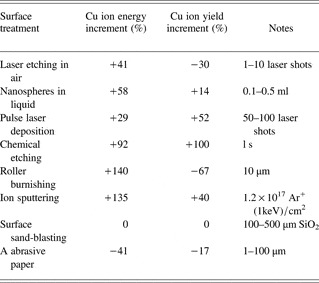
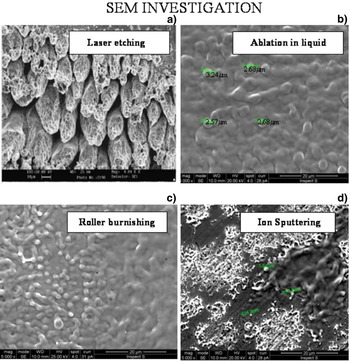
Presented results are compared in terms of Cu ion energy and yield increment as a function of the surface treatment according to the experimental data reported in Table 1. The treated surfaces were investigated in morphology by a SEM in order to show evidence the size of the micrometric and nanometric structures responsible of the resonant absorption enhancement. Generally the higher Cu ion energies and yields were obtained when the structures on the Cu substrate were produced with dimensions comparable with the laser wavelength, i.e., on the order of 1 micron.
Comparison of maximum Cu ion energy and yield variations with respect to the pristine case for the different surface treatments employed in this work

As an example, Figure 8 shows four typical SEM images of the structured surfaces in the case of ablation of laser etched Cu surfaces (1), for microspheres produced in liquid (2), roller burnishing (3), and ion sputtering (4). In these cases, the morphology indicated that the surface structure contains structures with a Gaussian distribution having average dimensions of the order of 10 microns, 4–2 µm, 2–1 µm and 1–0.5 µm in the four cases, respectively. The distributions were obtained separately by counting the number of micro-structures for each 100 mm2 area. The micro-structures are generated randomly in the Cu surface and their presence seems to follow a Gaussian distribution.
Comparison of typical SEM images of the microstructures observable in Cu surfaces after process of laser etching (a), nanospheres deposition in water (b), roller burnishing (c) and ion sputtering (d).

DISCUSSION
Different surface treatments have been investigated in order to increase effects of resonant absorption in laser-generated Cu plasmas.
The plasma critical density is: n cr = m eω2/4πe 2 = 1.07 × 10²¹/cm3, a value obtainable with the used Nd:YAg laser intensity. The obtained results, consisting in the increment of the Cu ion kinetic energy and yield, can be explained on the base of the obtainable effect of resonance absorption. At oblique incidence, the laser pulse cannot propagate up the critical surface but rather up to the density known as the turning point, given by: n turn = n cr cos2θ where it is symmetrically reflected. Thus in our experiment, at 45° incidence angle will be: n turn = 5 × 10²⁰/cm3.
The best results have been obtained by using Ar ion sputtering, rolling burnishing and chemical etching that permitted to increase the Cu ion energy up to about 135%, 140%, and 92%, respectively, according to the data reported in Table 1.
Such results probably are due to the formation of structures with dimensions comparable with the laser wavelength and to the possibility to induce resonance plasma waves at the 45° incidence angle employed in the experiment. SEM investigation, in fact, demonstrated that in the case of ion sputtering micrometric structures with an average dimension of 1 µm occurs more than in other cases.
The increment of Cu ion energy should be correlated to the increment of the plasma temperature and density. The resonant absorption effect increases the laser absorption and thus the energy transferred to the plasma. Thus, as a consequence it may produce increment of the temperature and density that can be responsible of the final Cu ion energy. More electrons are produced, more ions also and more Coulombian accelerations may take place along the normal direction to the target surface along which is generated the acceleration electric field (Torrisi et al., Reference Torrisi, Caridi, Visco and Campo2011). The plasma increment in temperature increases the Cu ion velocity. The increment in density permits both to increase the Cu ion Coulomb acceleration, by the charge separation effects increasing the electric field developed in plasma.
Results demonstrated that, although the plasma temperature and the density can be increased by the resonant absorption effect, the ion emission yield along the normal to the target surface seems not be influenced so as the most energetic ions. Probably the ion yield increases with the increment of plasma density and temperature but the ion evolution along the normal direction may be different with respect the ion energy. Many ions, or example, can be emitted at large angles and can be constituted by different species so as dimers, CuO and CuN composites and little clusters. These different angular distributions and ion specie emissions can be responsible of the different yield trend, with respect to the Cu ion kinetic energy one, due to different Cu surface treatments. Probably also effects of ion recombination my influence the ion yields emission for the different treatment cases along the normal direction.
Further investigations should be performed to correlate such yield emissions, at larger angle distributions, with the resonant absorption effects. At this stage more investigations should be done by using different laser intensities and different angular ion detections in order to understand better the investigated phenomena.
CONCLUSION
The plasma ion emission energy and yield depends on the pre-treatment of the Cu surface before to be submitted to the laser irradiations. In particular some treatments, such as that of Ar ion sputtering, rolling burnishing and chemical etching permit to increase significantly the Cu ion energy along the normal to the target surface up to about 140%. The chemical etching, the pulse laser deposition and the ion sputtering permit also to increase the ion yield emission along this direction. The measurements put in evidence that the increment of the laser absorption, due to resonance with micro and nanostructures generated at the target surface, may be responsible of the plasma temperature and density due to the increase of energy transferred from the laser pulse to the non-equilibrium plasma. The obtained charge separation, due to fast electrons and slowly ions emission, increases specially in direction normal to the target surface producing higher ion acceleration. The yield of the produced ions was measured only in the normal direction but not angular distribution was investigated. Moreover, the neutral emission was not measured vs. the Cu surface treatment.
To this, of course the results are not definitive but they should be improved increasing the number of investigations and of experiments. For example it should be very interesting to increase the laser intensity in order to increase the effect of laser absorption resonance, and to vary the laser wavelength, in order to change the critical density, in order to understanding better the obtained results and the non-equilibrium phenomena involved in the laser-generated plasmas.