Introduction
The genus Peltigera Willd. includes c. 90 species in the Peltigeraceae, which typically have a large foliose thallus and a worldwide distribution in moist habitats (Kirk et al. Reference Kirk, Cannon, Minter and Stalpers2008). In modern lichen taxonomy, molecular techniques were first used to delimit species within the genus (Sérusiaux et al. Reference Sérusiaux, Goffinet, Miądlikowska and Vitikainen2009). Goffinet & Miądlikowska (Reference Goffinet and Miądlikowska1999) described a new species P. phyllidiosa, from SE United States, using ITS sequences of nrDNA to distinguish it from the related P. collina and P. neckeri; Goward & Goffinet (Reference Goward and Goffinet2000) followed a similar approach for the new P. chionophila, a representative of the P. aphthosa-group. Goffinet et al. (Reference Goffinet, Miądlikowska and Goward2003) constructed a robust phylogeny of the P. didactyla-group using nrDNA sequences and described the new species, P. castanea. Based on the data of 38 described species and 8 putative undescribed taxa examined in great detail, Miądlikowska & Lutzoni (Reference Miądlikowska and Lutzoni2000) carried out a phylogenetic analysis by combining morphological and chemical characters and LSU nrDNA sequences. Their results led to an infrageneric reorganization of the whole genus. Miądlikowska et al. (Reference Miądlikowska, Lutzoni, Goward, Zoller and Posada2003) examined patterns in morphological variation in the P. canina-complex against phylogenetic inferences in both ITS and LSU nrDNA sequences. Recently, Sérusiaux et al. (Reference Sérusiaux, Goffinet, Miądlikowska and Vitikainen2009) described six new species from tropical Papua New Guinea with the sequence data of ITS nrDNA, and discussed their biogeography. A study on gene flow or hybridization between species of Peltigera based on the three loci (β-tubulin, ITS of nrDNA, RPB1) sequence data indicated that the genus Peltigera is more diverse in western North America than originally perceived, and that morphological variability is due largely to the presence of undescribed species rather than hybridization or intraspecific variation (O'Brien et al. Reference O'Brien, Miądlikowska and Lutzoni2009). Martínez et al. (Reference Martínez, Buggazo, Vitikainen and Escudero2003) studied the distribution of 66 Peltigera species in six Kingdoms (Holarctic, Neotropical, Paleotropical, Australian, Halantarctic and Cape) and six continents (North America, South America, Europe, Africa, Asia and Australia).
Peltigera has been relatively well studied in the Northern Hemisphere and many important collections are available in herbaria. Approximately 35 species of Peltigera have been reported from Asia (Martínez et al. Reference Martínez, Buggazo, Vitikainen and Escudero2003), with 26 species being recorded in China (Chen Reference Chen1986; Vitikainen Reference Vitikainen1986; Wei Reference Wei1991; Stenroos et al. Reference Stenroos, Vitikainen and Koponen1994; Wu & Liu Reference Wu and Liu2012); however, only one species, P. dolichospora (D. A. Lu) Vitik. (≡P. polydactyla var. dolichospora D. A. Lu), was described with the type locality in China (Vitikainen Reference Vitikainen1986: Mt. Emei Shan, Sichuan province). Accordingly, it is inferred that the diversity of the genus in China has been underestimated and overlooked.
An additional Peltigera species has recently been collected by the first author in north China and is described here as P. wulingensis. The present study provides the first taxonomic account of the new species based on morphological characters. We further sequenced the ITS region of nrDNA for 5 specimens with 7 samples, and complemented these with sequences available in GenBank to assess the monophyletic nature and phylogenetic affinities of the new species.
Materials and Methods
The present paper is based on collections from the Herbarium Mycologicum Academiae Sinicae-Lichenes (HMAS-L) and the Lichen Section of Botanical Herbarium, Hebei Normal University (HBNU). All the specimens were examined and measured under a dissecting microscope (Motic SMZ-140) and compound microscope (Olympus CH). For the descriptions and use of terminology, we follow Vitikainen (Reference Vitikainen1994, Reference Vitikainen, Nash, Ryan, Diederich, Gries and Bungartz2004). Thin-layer chromatography (TLC) was performed for all specimens studied, following Orange et al. (Reference Orange, James and White2010) and using solvent systems C & G.
DNA extraction, amplification, and sequencing
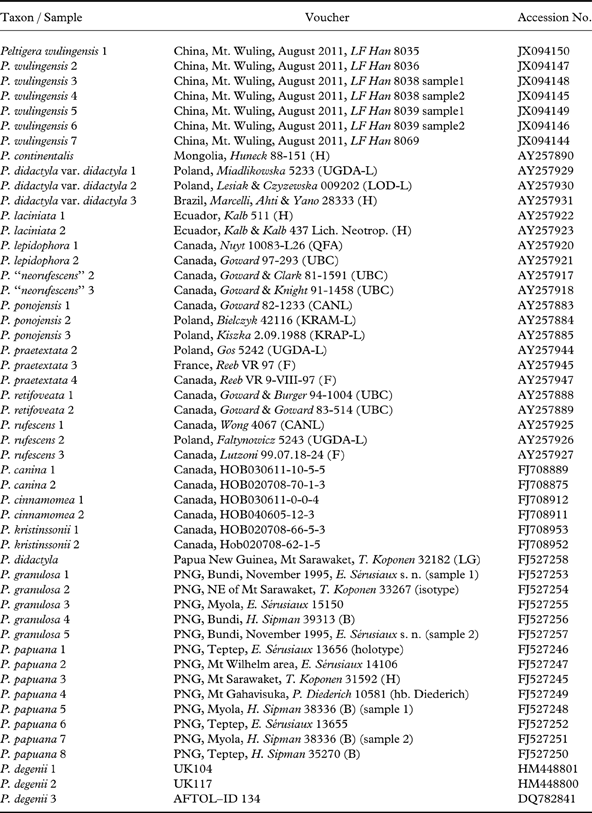
Lobe tips were removed from the specimens selected for DNA extraction (Table 1). DNA was extracted using the DNAsecure Plant DNA Kit (Tiangen, China) following the manufacturer's protocol. Amplification of the ITS region followed the methods described by Goffinet & Miądlikowska (Reference Goffinet and Miądlikowska1999), and with modification. The whole ITS region (ITS1, 5.8S and ITS2) of the nrDNA repeat tandem was targeted with the Polymerase Chain Reaction using the primers ITS1 (5′TCCGTAGGTGAACCTGCGG3′) with ITS4 (5′TCCTCCGCTTATTGATATGC3′, White et al. Reference White, Bruns, Lee, Taylor, Innis, Gelfand, Sninsky and White1990) directly. The amplification reaction was performed in a 25 µl volume containing 0·75 units of TransStart Taq Polymerase (Tiangen, China), 2·5 µl of its buffer, 0·5 µl of a 5 µM solution of the primers, 2·5 mM of each dNTP solution, and 1 µl of genomic DNA. PCR products were screened on 1% agarose gels stained with ethidium bromide. The qualified PCR products were sequenced by the Genewiz Inc. (Beijing).
GenBank accession numbers and voucher information for samples of Peltigera wulingensis and 44 Peltigera specimens downloaded from GenBank
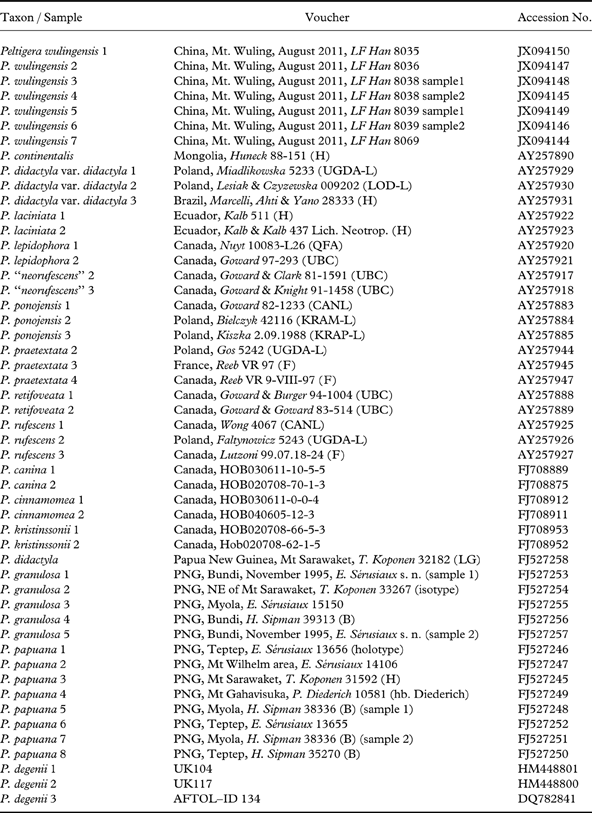
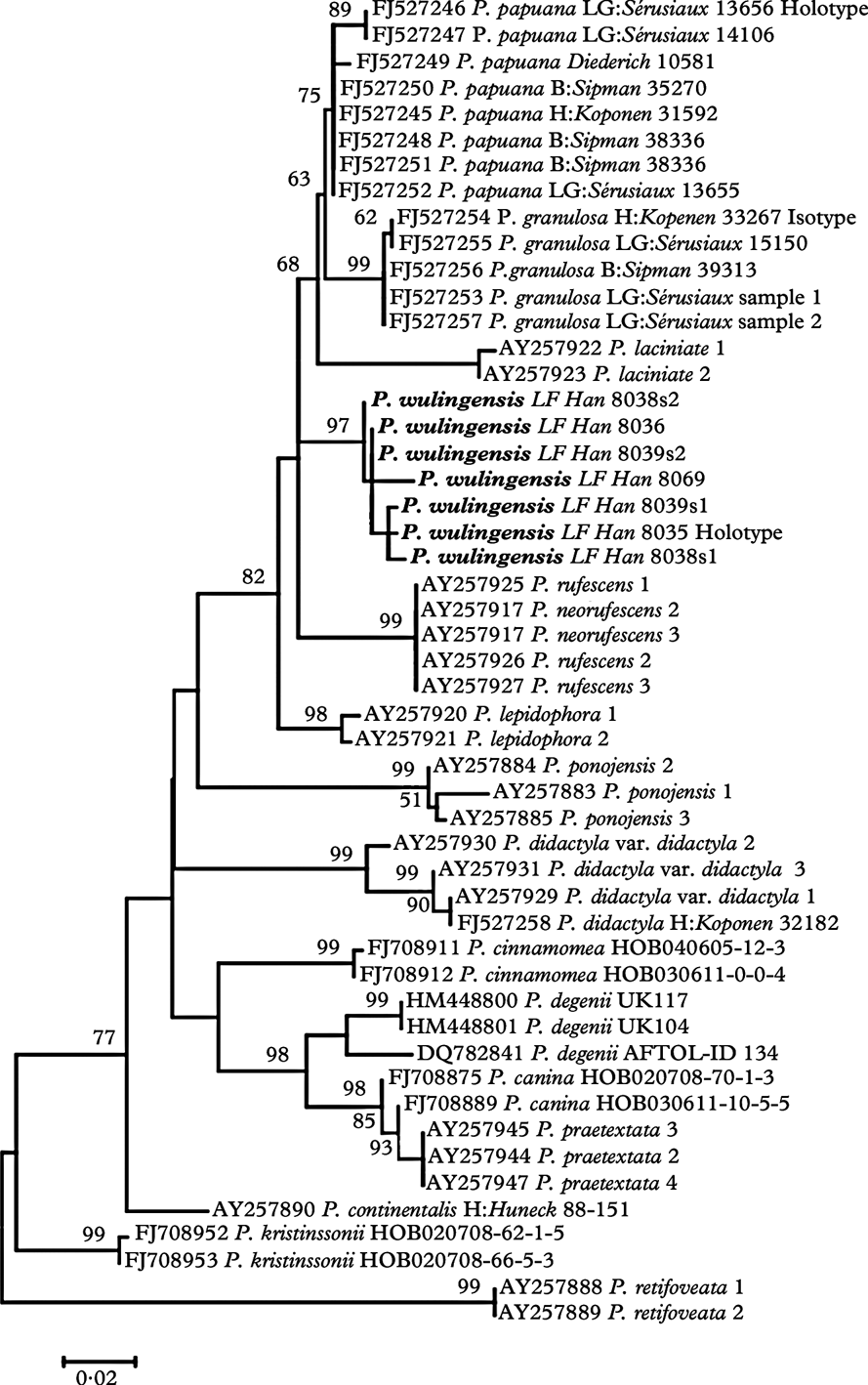
All newly obtained sequences were submitted to GenBank (see Table 1 for accession numbers). The beginning and end of the ITS1 and ITS2 spacers were determined by comparison with sequences available from GenBank. We excluded the 3′ end of the 18S gene, and the 5′ end of the 26S gene from the analyses. Sequences for specimens of new species were complemented with representatives of the most similar taxa, for which ITS sequences were available from GenBank; their accession number is provided in the figure (Fig. 1, Table 1). The representatives of taxa were selected mainly according to the morphological characters, Blast results of sequence data, and the references Miądlikowska & Lutzoni (Reference Miądlikowska and Lutzoni2000), Miądlikowska et al. (Reference Miądlikowska, Lutzoni, Goward, Zoller and Posada2003) and Sérusiaux et al. (Reference Sérusiaux, Goffinet, Miądlikowska and Vitikainen2009).
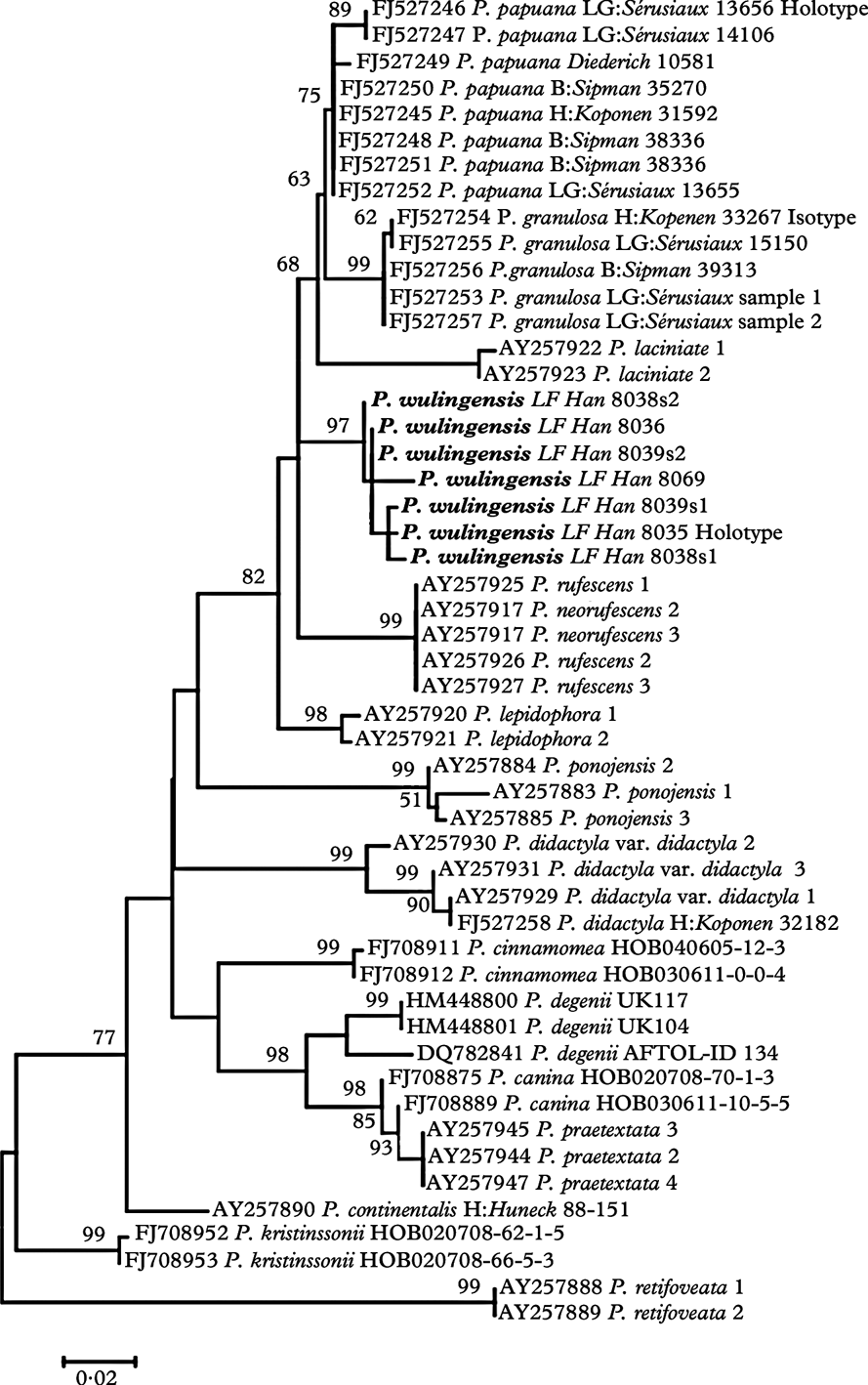
Phylogenetic relationships of some species in the Peltigera rufescens-clade (i.e., Peltigera Sect. Peltigera sensu Miądlikowska & Lutzoni, Reference Miądlikowska and Lutzoni2000) sharing the high similarity with P. wulingensis inferred from ITS sequences. Support is indicated for branches characterized by bootstrap frequencies exceeding 50% under the Maximum Likelihood method. The tree with the highest log likelihood (−2375·3589) is shown. The tree is drawn to scale, with branch lengths measured in the number of substitutions per site. Evolutionary analyses were conducted in MEGA5.
Phylogenetic analysis and sequence comparison
The whole ITS sequences of the 7 samples examined and the 44 representatives selected were aligned both by ClustalW and Muscle implemented in MEGA 5 (Tamura et al. Reference Tamura, Peterson, Peterson, Stecher, Nei and Kumar2011). The alignment matrix was realigned by StatAlign for reliable measurement of the accuracy of the results (Novák et al. Reference Novák, Miklós, Lyngsø and Hein2008). The final matrix was submitted to TreeBase with accession number S13650 and can be obtained from the corresponding author.
The evolutionary history was inferred using the Maximum Likelihood method in MEGA5. A discrete Gamma distribution was used to model evolutionary rate differences among sites [5 categories (+G, parameter=0·6018)]. The bootstrap test with 1000 replicates was carried out and the percentage of replicate trees in which the associated taxa clustered together was shown next to the branches. The analysis involved 51 nucleotide sequences and there was a total of 522 positions in the final dataset. Absolute distances using the number of base differences per sequence from between sequences for alignment sequences were also conducted in MEGA5. All ambiguous positions were removed for each sequence pair.
Results and Discussion
ITS sequences and the phylogenetic analysis
The whole ITS region was successfully sequenced for seven samples of the collections from Mt. Wuling, North China (Table 1). The length of sequences has the constant 567 bp in the whole ITS (ITS1+5.8S+ITS2) region, but varies from 604 bp to 631 bp, which usually includes the partial sequence of the 3′ end in SSU region and of the 5′ end in LSU region, respectively.
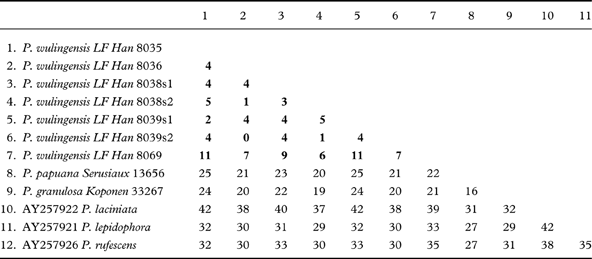
ITS sequences of representative collections show that P. wulingensis likely belongs to the P. rufescens-group (sensu Miądlikowska et al., Reference Miądlikowska, Lutzoni, Goward, Zoller and Posada2003) with close affinities to the newly described P. granulosa, P. papuana from Papua New Guinea and the South American P. laciniata (Table 2, Fig. 1). In the phylogenetic analysis, support for the monophyly of this taxon is very strong (Bootstrap 97%).
Absolute distances for alignment sequences of the ITS region between related species selected*
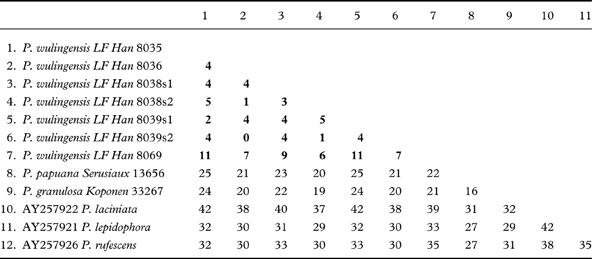
* Absolute distances for alignment sequences of the ITS region (gaps ignored in pairwise comparisons) between the population of Peltigera wulingensis and the representatives of P. granulosa, P. laciniata, P. lepidophora, P. papuana and P. rufescens. Types were selected for P. granulosa and P. papuana.
The Species
Peltigera wulingensis L. F. Han & S. Y. Guo sp. nov.
MycoBank No.: MB800472
Species Peltigera praetextata affinis. Thallus superne tomentosus, lobi 0·3–0·8 cm lati, tinnulo extrema, phyllidiati margine. Apothecia ignota.
Typus: China, Hebei province, Wuling Mountain, 40°33′N, 117°26′E, on ground, 1820 m alt., 14 August 2011, Liu-Fu Han 8035 (HMAS-L—holotypus).
(Fig. 2)
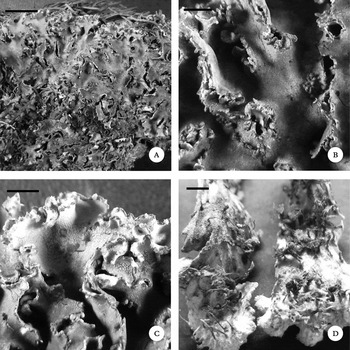
Peltigera wulingensis (holotype). A, general habit; B, marginal phyllidia; C, tufts of hair on lobe extremities; D, lower surface and rhizines. Scales: A=1 cm; B–D=2 mm.

Thallus foliose, thin, fragile, approximately circular in outline, large, 5–10 cm diam. Lobes flattened and elongate (0·3–0·8 cm wide and up to 3 cm long), imbricate or separate, some specimens with cracks. Lateral margins always becoming lacerated, with isidioid to flattened phyllidia. Lobe extremities rounded or subtruncate, distinctly ascending and involute; often with tufts of tiny grey-whitish to pale brown hairs. Upper surface pale grey, grey to dark grey or greyish brown when dry, blackish green when wet, dull, scabrose, epruinose, thin and fine white-grey tomentose on the end of lobes, often glabrescent towards centre, with more or less phyllidiate along lacerated margin and cracks. Phyllidia scattered to dense, corticate, warty to squamulose, 0·3–1·5 mm wide. Medulla white, loosely interwoven. Photobiont Nostoc. Lower surface white or pale to dark grey or medium brown, white-tomentose, with anastomosing slightly raised flattened veins. Rhizines abundant, white to dark grey or brown, irregular, simple, very rarely branched, often less than 0·5 cm long.
Apothecia not seen.
Pycnidia rare, as small swollen brownish dots on the margins of lateral lobes; conidia not seen.
Chemistry
TLC: no substances detected by solvent system C. However, two unknown substances of terpenoids were detected in solvent system G from the new species, corresponding to substances 14 and 17 in Orange et al. (Reference Orange, James and White2010: 61, fig. 10).
Etymology
This species has so far only been collected from Wuling Mountain, and is thus named after the mountain. Wuling Mountain is located c. 110 km north-east of Beijing. At 2118 m above sea-level, its main peak is also the main peak of the Yanshan Mountain range. Wuling Mountain is cloudy and foggy all year round. The complexity of terrains and landforms influences its variety of climate and vegetation. The forest coverage of Wuling Mountain is high, up to 93%, and it maintains a complete, temperate zone forest ecological system, earning the reputation of “Gene Bank of Species in North China𠇍 (Zhou et al. Reference Zhou, Guo, Huang and Wei2006; (Zhou et al. Reference Zhou, Guo, Huang and Wei2006; Zhang et al. Reference Zhang, Li, Han and Zhang2008).
Ecology and distribution
At present, Peltigera wulingensis is known only from the type locality in China. It grows on moss or soil in the temperate forest dominated by Betula platyphylla, Larix principis-rupprechtii and Populus davidiana (Zhang et al. Reference Zhang, Li, Han and Zhang2008). It sometimes grows with Cladonia sp.
Notes
Peltigera wulingensis is readily distinguished by its phyllidia along the margin or laminal cracks, scabrose upper surface, lobe extremities with tufts of tiny grey-whitish to pale brown hairs, and its slender, scattered and simple rhizines. The species is close to P. praetextata in having marginal and laminal phyllidia, but the latter is distinguished by lobes often over 1 cm wide (up to 3 cm wide), a smooth upper surface, without tufts of tiny grey-whitish hairs at lobe extremities. Chemically, P. wulingensis contains two unknown terpenoids but lacks zeorin, while P. praetextata contains zeorin but lacks the terpenoids occurring in the new species.
The species sometimes may resemble P. continentalis in the tomentose upper surface, but the latter is recognized by lobes over 1 cm wide, having coralloid isidia and lacking tufts of tiny grey-whitish hairs (Wu & Liu Reference Wu and Liu2012). The species agrees with P. collina in its scabrous and dark upper surface; however, P. collina is readily distinguished by its marginal linear soralia and etomentose upper surface. The ITS sequence data show that P. wulingensis is very different to the three species mentioned above (Fig. 1). They belong to different clades sensu Miądlikowska & Lutzoni (Reference Miądlikowska and Lutzoni2000); P. continentalis and P. praetextata belong to the same clade with P. papuana and P. wulingensis, while P. collina belongs to Sect. Horizontales.
The new species resembles P. papuana in morphology and absence of common chemical compounds. However, P. papuana can be easily recognized by its smooth to scabrose upper surface, usually with pruina near lobe margins, small lobes with raised and crenate margins, presence of marginal phyllidia, and horizontal apothecia developed on small lobes (Sérusiaux et al. Reference Sérusiaux, Goffinet, Miądlikowska and Vitikainen2009).
Previous studies that have used DNA sequence data for species recognition in Peltigera required monophyly both in single-locus ITS phylogenies and diagnosable morphological differences (Goffinet & Miądlikowska Reference Goffinet and Miądlikowska1999; Goward & Goffinet Reference Goward and Goffinet2000; Goffinet et al. Reference Goffinet, Miądlikowska and Goward2003; Miądlikowska et al. Reference Miądlikowska, Lutzoni, Goward, Zoller and Posada2003). The divergent lineages in the ITS phylogenies that received high bootstrap support were found to be reproductively isolated with pairwise ITS sequence similarity values >99% within species (O'Brien et al. Reference O'Brien, Miądlikowska and Lutzoni2009). Thus, our data for Peltigera wulingensis match the requirement for accurate species delimitation.
Selected specimens examined. China: Hebei: Mt. Wulingshan, 40°33′N, 117°26′E, on ground among moss, alt. 1820 m, 2011, Liu-Fu Han 8036, 8038, 8039, 8069 (HMAS-L, HBNU).
S. Y. Guo received a grant from the National Natural Science Foundation of China (30770012), L. F. Han received a grant from the Natural Science Foundation of Hebei Province (C2012205009) and Doctoral Fund of Hebei Normal University (L2009B11). The valuable assistance given by colleagues is gratefully acknowledged.