Introduction
Depression is a common and debilitating illness globally, accounting for 4.4% of the total disability-adjusted life years (DALYs) in 2000 and projected to become the second most burdensome disorder by 2020 (Murray & Lopez, Reference Murray and Lopez1996; Ustun et al. Reference Ustun, Ayuso-Mateos, Chatterji, Mathers and Murray2004). Depression is also common among the elderly (Beekman et al. Reference Beekman, Copeland and Prince1999; Baiyewu et al. Reference Baiyewu, Smith Gamble, Lane, Gureje, Gas, Ogunniyi, Unverzagt, Hall and Hendrie2007). In a previous study, we reported that the rate of major depressive disorder (MDD) in elderly Nigerians was much higher than that in the general adult population (Gureje et al. Reference Gureje, Kola and Afolabi2007). Our rate was also much higher than has been reported in several large studies of elderly persons or among elderly groups within general adult surveys (Kramer et al. Reference Kramer, German, Anthony, Von Korff and Skinner1985; Weissman et al. Reference Weissman, Leaf, Tischler, Blazer, Karno, Bruce and Florio1988; Kessler et al. Reference Kessler, Zhao, Blazer and Swartz1997). For example, we found 12-month and lifetime estimates to be 7.1% and 26.2% respectively whereas an earlier report from the USA in which the diagnosis of major depression was also made using DSM-IV criteria (APA, 1994) gave corresponding estimates of 3.8% and 15.8% (Steffens et al. Reference Steffens, Skoog, Norton, Hart, Tschanz, Plassman, Wyse, Welsh-Bohmer and Breitner2000). The prevalence of depression in the elderly has been associated with high mortality, recurrence and chronicity (Reynolds et al. Reference Reynolds, Dew, Frank, Begley, Miller, Cornes, Mazumdar, Perel and Kupfer1998; Pennix et al. Reference Pennix, Geerlings, Deeg, van Eijk, van Tilburg and Beekman1999). In our previous report we showed a substantial level of chronicity in the sample studied, with a ratio of 12-month prevalence to lifetime prevalence of about 30% (Gureje et al. Reference Gureje, Kola and Afolabi2007). Even so, it seemed unlikely that the high prevalence estimate that we reported was a result of long duration of illness alone. A study of incidence should provide a better picture of the occurrence of depression in elderly Nigerians and also help to elucidate some of the correlates of the disorder found in the prevalence study. For example, it could clarify further the influence of gender, age, marital status and residence on the occurrence of depression in this population. As earlier noted by Norton et al. (Reference Norton, Skoog, Toone, Corcoran, Tschanz, Lisota, Hart, Zandi, Breitner, Welsh-Bohmer and Steffens2006), accurate estimates of depression incidence could help to generate new biological and social hypotheses about the onset of depression.
Incidence studies of depression in the elderly are relatively rare and, to the best of our knowledge, non-existent in Sub-Saharan Africa. Reported rates of incident depression vary considerably, ranging from 17.1 to 133.5 per 1000 risk-years (Meller et al. Reference Meller, Fichter and Schroppel1996; Palsson et al. Reference Palsson, Ostling and Skoog2001), mainly because of the subtypes of depression studied. Thus, studies that include both syndromal and subsyndromal subtypes have tended to report higher rates than those focusing exclusively on the former. However, even when studies have been directed at a particular subtype, for example at major depression or dysthymia, estimates have remained variable.
Depression in late life may result from several factors (Bruce, Reference Bruce2002). Among those commonly reported are sociodemographic status (Bruce & Hoff, Reference Bruce and Hoff1994), negative life events, medical morbidity (Geerlings et al. Reference Geerlings, Beekman, Deeg and van Tilburg2000), disability (Bruce & Hoff, Reference Bruce and Hoff1994) and social network and support (Areán & Reynolds, Reference Areán and Reynolds2005). Studies suggest that even when health factors are present, psychosocial factors often play a mediating role (Areán & Reynolds, Reference Areán and Reynolds2005). Most of the suggested risk factors are likely to be context bound, with no evidence that what is found to constitute risks in one cultural context will operate in a similar manner in another context. A study of risk factors for incident depression in an African setting may therefore offer insights into the nature of this disorder in that setting and provide hints about possible preventive measures.
In this report, we present estimates of incident MDD in a cohort of elderly Nigerians followed up for a period of just over 3 years. We examined the estimates of incidence in males and females, different age groups and marital status, and whether persons with subsyndromal depression at baseline were more likely to have new onset of major depression at follow-up than those with no depressive symptoms. We next examined the health and social factors at baseline that might constitute risks for the onset of MDD over the following 3 years.
Method
Sample
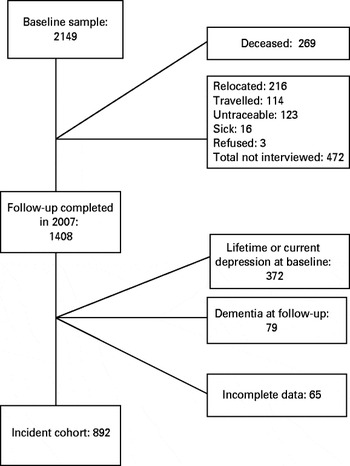
The Ibadan Study of Ageing (ISA) is a longitudinal community study of the profile and determinants of healthy ageing. A full description of the baseline methodology has been provided elsewhere (Gureje et al. Reference Gureje, Ogunniyi and Kola2006, Reference Gureje, Kola and Afolabi2007). Baseline assessments were conducted between August 2003 and November 2004. The study was conducted in eight contiguous predominantly Yoruba-speaking states in the south-west and north-central regions of Nigeria. Collectively, the population of the states in 2003 was about 25 million, representing 22% of the national population. A clustered multi-stage random sampling of households was undertaken to select a representative sample of non-institutionalized elderly persons aged ⩾65 years. In households with more than one eligible person, the Kish table was used to select one respondent (Kish, Reference Kish1965). The resulting sample of 2152 represented a response rate of 79%. Non-response was predominantly due to change of address or not being found at home after repeated visits, rather than refusal. Three subjects had incomplete assessment and were excluded from further analysis, leaving a total of 2149. The three known nursing homes in the study regions were surveyed, with a total inmate resident population of less than 100. Thus, other than elderly persons who might have been in hospital or prison, the total number of which is not known but is unlikely to be large, the sampling frame for the survey would have been close to 100% of the eligible age group in the survey areas. The cohort was followed up in 2007. Attempts were made to interview all living persons and to conduct a verbal autopsy on those who were dead. Of the 2149 with complete assessment at baseline, 1408 (65.5%) were successfully followed up approximately 3 years later. Of these 1408, 372 were excluded because they reported lifetime or current major depression at baseline, 79 because they had dementia at follow-up, and 65 had incomplete records for the analysis, leaving a cohort sample of 892. Fig. 1 represents a flow diagram of the ISA.
Study flowchart.

Subject assessment
Depression was assessed at baseline and follow-up with the World Health Organization (WHO) Composite International Diagnostic Interview version 3 (CIDI.3), a fully structured diagnostic interview (Kessler & Ustun, Reference Kessler and Ustun2004). Diagnosis of MDD was based on DSM-IV criteria (APA, 1994). DSM-IV organic exclusion rules were imposed in making the diagnosis of depression. Judgements about which organic conditions could explain a co-occurring MDD was made during clinical reviews (by a psychiatrist) of all questionnaires in which endorsements of depressive features were made.
Dementia was assessed at follow-up with the use of two previously validated cognitive assessment tools, one for screening and the other for the evaluation of cognitive and functional capacities. Screening was conducted with the 10-Word Delayed Recall Test (10-WDRT), a test of memory adapted from the Consortium to Establish a Registry of Alzheimer's Disease (CERAD) 10-word learning list (Welsh et al. Reference Welsh, Butters, Mohs, Beekly, Edland, Fillenbaum and Heyman1994). The 10-WDRT has been shown to be a valid tool for the assessment of dementia in Nigerian subjects (Prince et al. Reference Prince, Acosta, Chiu, Scazufca and Varghese2003). Evaluation of functional capacity was carried out with the Clinician Home-based Interview to assess Function (CHIF; Hendrie et al. Reference Hendrie, Lane, Ogunniyi, Baiyewu, Gureje, Evans, Smith-Gamble, Pettaway, Unverzagt, Gao and Hall2006), which was developed by our group to provide a reliable assessment of function in elderly subjects. The CHIF is a 10-item semi-structured home interview schedule that evaluates respondents' higher cognitive function by assessing their knowledge of how to perform instrumental activities of daily living (irrespective of whether they are physically capable of performing the activities). Based on a review of all available information, including performance on the animal fluency test, functional status and also physical assessment status, a psychiatrist used the validated cut-off scores on the 10-WDRT and CHIF to make an assessment of the presence or absence of dementia. All persons with a diagnosis of dementia at follow-up (either they had or did not have co-occurring MDD) were excluded from the depression incidence cohort.
At baseline, a checklist of chronic physical and pain conditions was completed (CDC, 2004). Respondents were asked if they had any chronic respiratory conditions (asthma, tuberculosis, other lung disease), digestive conditions (irritable bowel syndrome, ulcer), cardiovascular conditions (high blood pressure, heart disease, heart attack, stroke), cancer, diabetes, or epilepsy. Respondents were asked whether they had experienced any of the symptom-based conditions in the previous 12 months. The checklist also ascertained the presence of any chronic pain. Checklists have been shown to provide more complete and accurate reports than estimates derived from responses to open-ended questions (Knight et al. Reference Knight, Stewart-Brown and Fletcher2001) and to have moderate to good concordance with medical records (Baker et al. Reference Baker, Stabile and Deri2001). All respondents were assessed for functional limitations in activities of daily living and instrumental activities of daily living (Katz et al. Reference Katz, Ford, Moskowitz, Jackson and Jaffe1963; Katz & Akpom, Reference Katz and Akpom1976; Nagi, Reference Nagi1976). Each of the activities in the two domains was rated: (1) can do without difficulty, (2) can do with some difficulty, (3) can do only with assistance, or (4) unable to do. In this report, any respondent with a rating of 3 or 4 on any item was classified as disabled.
Life events in the 12 months prior to the baseline assessment were obtained with the use of the List of Threatening Experiences (LTE; Brugha et al. Reference Brugha, Bebbington, Tennant and Hurry1985). The LTE is a brief inventory of live events with particular relevance to studies in which intervening factors such as social support and network may be of interest (Brugha & Cragg, Reference Brugha and Cragg1990).
Social network was assessed with items from the CIDI (Kessler & Ustun, Reference Kessler and Ustun2004). The relevant items enquire about the frequency of a respondent's contact with family members who do not live with the respondent and the frequency of contact with friends. In this report, we have dichotomized the responses to no contacts at all versus contacts varying from less than one per month to daily.
Economic status was assessed by taking an inventory of household and personal items such as chairs, clock, bucket, radio, television set, fans, stove or cooker, car, telephone, etc. The list was composed of 21 such items. This is a standard and validated method for estimating economic status of elderly persons in low income settings (Ferguson et al. Reference Ferguson, Tandon, Gakidou and Murray2003). Respondents' economic status is categorized by relating each respondent's total possessions to the median number of possessions of the entire sample. Thus, economic status is rated low if its ratio to the median is ⩽0.5, low-average if the ratio is 0.5–1.0, high-average if it is 1.0–2.0, and high if it is >2.0. Residence was classified as rural (<12 000 households), semi-urban (12 000–20 000 households) and urban (>20 000 households).
The Yoruba versions of all the instruments used in the present survey were derived using standard protocols of iterative back-translation conducted by panels of bilingual experts.
Diagnosis of incident depression
Persons who had no lifetime history or current diagnosis of major depression at baseline were considered at risk for incident major depression in the interval. Any episode of depression meeting the DSM-IV criteria of major depression in the interval was counted as a case of incident MDD. In making a diagnosis of major depression at follow-up, persons with a diagnosis of probable dementia were excluded.
Assessment, training and quality control
All interviews were conducted in respondents' homes. The interviews at baseline were conducted by 24 trained interviewers, all of whom had at least a high-school education. A research supervisor was responsible for the work of four interviewers and checked every questionnaire returned by those interviewers for completeness and consistency. The supervisor made random field checks on at least 10% of each interviewer's respondents (more at the beginning of the survey) to ensure correct implementation of the protocol and full adherence to the interview format. Particular emphasis was placed on the detection of systematic errors or bias in the administration of the interview. At follow-up, following these interviews, a second assessment was conducted within 2 days by the supervisors, during which time several other ratings, including the CHIF, were made. Before the baseline and follow-up interviews, interviewers received 1 week of training that was followed in both instances by a further 2 days of debriefing and review after each had conducted two trial interviews in the field. Day-to-day implementation of the fieldwork, including adherence to study protocol, was monitored by supervisors (one supervisor to four interviewers) who had undergone the same training. During the fieldwork, regular debriefing sessions were held when all interviewers and supervisors returned to the central office for review of fieldwork procedure and experience.
All participants provided written or verbal consent before interviews were conducted; most participants gave verbal consent because of illiteracy or personal preference. The ISA was approved by the University of Ibadan/University College Hospital, Ibadan Joint Ethical Review Board.
Analysis
The average duration between baseline and follow-up assessments was 39.3 months [95% confidence interval (CI) 39.1–39.5]. This meant that a substantial attrition had occurred. We used χ2 and t test statistics to compare persons who completed follow-up assessments, those who had died in the interval, and those who could not be interviewed at follow-up for reasons described earlier.
Incidence rates over the entire 3-year follow-up period were calculated by dividing the number of cases with onset of major depression in each group of interest by the number of person-years of observation in that group. The person-years at risk for an individual with major depression were calculated as the time between baseline and the onset of the first reported episode of major depression in the interval. The CIDI has explicit items that allow for a determination of the first time when the respondents experienced the DSM-IV requirements for a diagnostically minimum number of symptoms and duration for MDD. Incidence rates were calculated within gender groups and four age categories (65–69, 70–74, 75–79 and ⩾80 years). We explored whether persons who reported at baseline as ever experiencing depressive syndrome that did not reach diagnostic threshold, which may be common in old age, herein termed as subsyndromal depression, were at elevated risk for incident major depression at follow-up by comparing the incidence rate for major depression in those who had some symptoms of depression at baseline and those who had none. Subsyndromal depression was defined as the presence of at least one core feature of depression (depressed mood or loss of interest) and any other symptom of depression (e.g. loss of energy, insomnia or hypersomnia, reduced or increased appetite, loss of concentration, guilt feelings).
We estimated the 95% CIs around the incidence rates by assuming a Poisson distribution. Female to male ratios for the rates were calculated using Cox proportional hazards analysis adjusted for baseline age. Baseline risk factors for incident depression were explored using logistic regression and the results are presented as odds ratios (ORs) (adjusted for age and sex) with 95% CIs (Hosmer & Lemeshow, Reference Hosmer and Lemeshow2000). All the CIs reported are adjusted for design effects. All analyses were conducted with the Stata statistical package (StataCorp, 2001).
Results
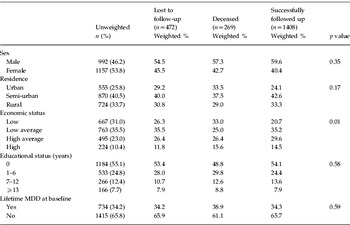
Persons who were deceased at follow-up were significantly older at baseline (75.3 years) than those who were either lost to follow-up (72.4 years) or successfully followed up (72.4 years), p<0.001. A comparison of the three groups with regard to other salient features is shown in Table 1. Persons who were successfully followed up were least likely to belong to the two lowest economic classes (55.9%) than those who were either deceased (58.0%) or lost to follow-up (61.8). The three groups were not different with regard to sex, residence, educational level or the presence or absence of subsyndromal depression.
Profile of the sample at follow-up

MDD, Major depressive disorder.
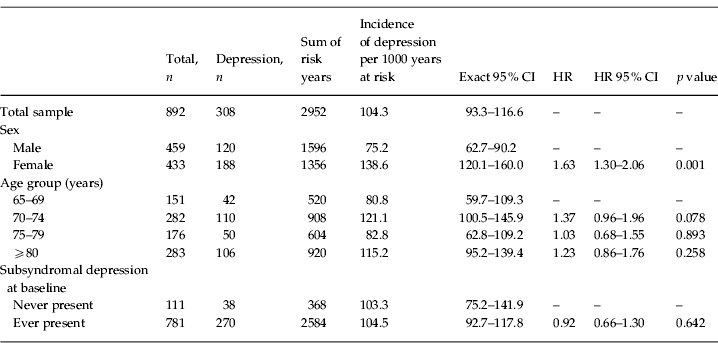
The overall rate of incident major depression was 104.3 per 1000 risk-years (Table 2). The rate for females was 138.6 and that for males was 75.2 per 1000 risk years. The Cox proportional hazards regression generated an age-adjusted female to male ratio of 1.63 (95% CI 1.30–2.06). The highest incidence rate was found among persons aged 70–74 years and the lowest was among those aged 75–79 years. However, the sex-adjusted hazard ratios between the age groups were not significant.
Incidence of first-onset MDD by sex, age and previous history of subsyndromal depression
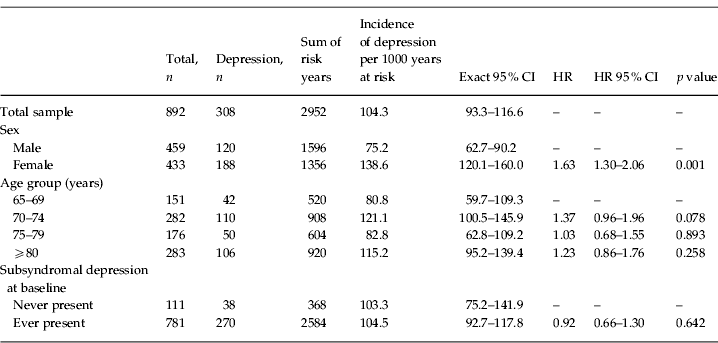
MDD, Major depressive disorder; HR, hazard ratio; CI, confidence interval.
Table 2 also shows the rates of incident MDD among persons with and without subsyndromal depressive symptoms at baseline. No significant difference was observed between the two. The former had an incident rate of MDD at follow-up of 104.5 per 1000 person-years compared to 103.3 per 1000 person-years among the latter.
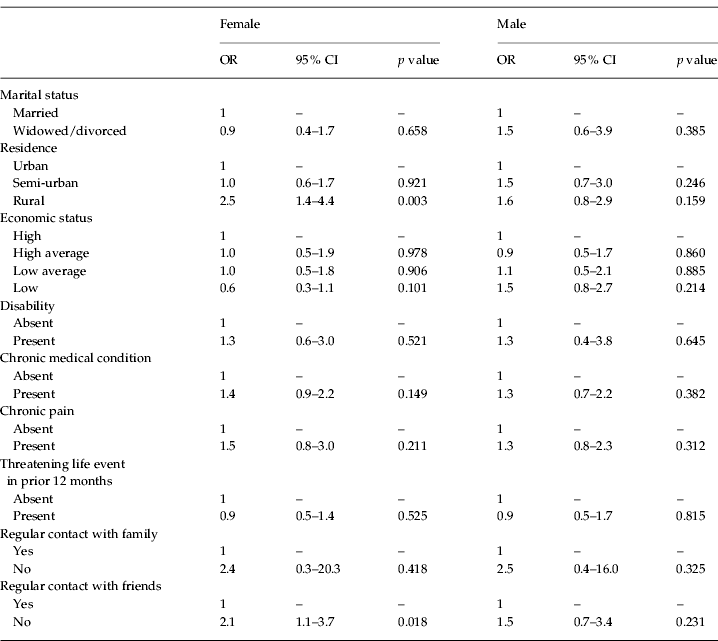
The results of the exploration of baseline factors that were associated with the onset of new episodes of MDD are shown in Table 3. The results are presented for females and males separately because different factors may operate between the sexes. Among females, respondents residing in rural areas had an elevated risk for incident MDD compared with those living in urban areas. Females who had poor social networks at baseline were also at elevated risk for incident MDD. However, even though those who had no contact with family members with whom they were not living and those who reported no contact with friends had an age-adjusted twofold likelihood of incident MDD compared with those who had contacts; only the latter was statistically significant. Among males, none of the baseline variables examined was associated with a new onset of depression.
Baseline risk factors for incident MDD by gender
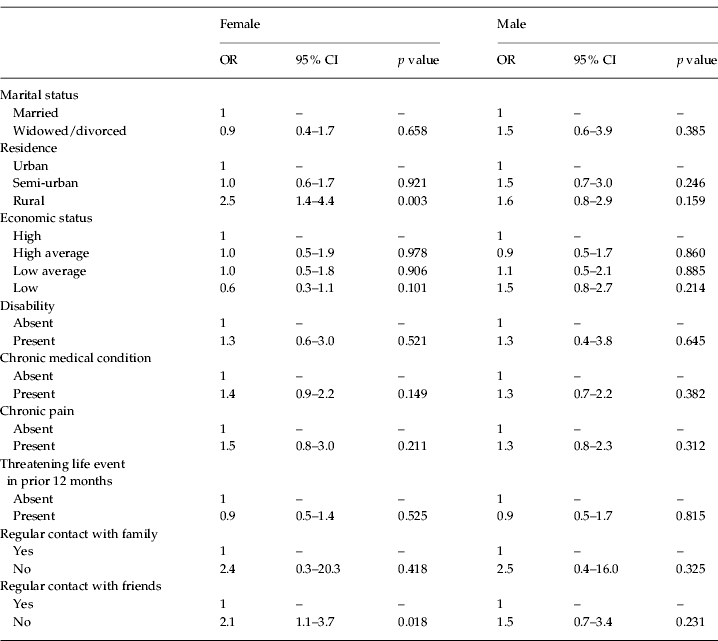
MDD, Major depressive disorder; OR, odds ratio; CI, confidence interval.
Given the variability of the scores for this elderly population on measures of disability and chronic medical conditions, we also compared the mean of the sums of scores on the measures of disability and the number of medical conditions between persons with and without incident dementia. At baseline, elderly persons who developed incident dementia over the subsequent 3 years had a mean score of 1.5 (s.e.=0.21) on the summed disability measures whereas those without incident dementia had a mean score of 1.2 (s.e.=0.12) (t test=−1.66, p=0.09). The respective mean numbers of medical conditions at baseline were 2.0 (s.e.=0.09) v. 1.9 (s.e.=0.07) (t test=–1.25, p=0.21).
Discussion
We have presented estimates of incident MDD in a cohort of elderly Nigerians followed from baseline for an average of just over 3 years. Our estimates show that one in every 10 elderly persons developed MDD during each year of the follow-up. Females had a risk of developing the disorder that was about 60% higher than males. In analysis that controlled for age and sex, a history of lifetime or the presence of current subsyndromal symptoms of depression at baseline did not affect the risk of incident depression in this sample. In general, for both sexes, health factors at baseline were not significantly related to the emergence of new onsets of MDD over the follow-up period. In addition, life events experienced within 12 months prior to the baseline assessment did not differentiate those with from those without incident depression. However, among females, persons who resided in rural areas and those with a poor social network, especially as indicated by a lack of contact with friends, were at elevated risk for incident MDD.
Our study has strengths and also weaknesses that need to be borne in mind in considering its results. The major strength of this study is that we studied a large, well-defined cohort of elderly persons over a substantial period of time, thus permitting us to have fairly stable estimates of incident depression. Another strength is that the assessments were conducted during face-to-face direct interviews with the use of an ascertainment tool that we have previously shown to identify clinically significant depressive disorder. We are nevertheless aware that the most appropriate way to assess depression in the elderly is contentious and that the approach we have chosen may not be without its drawbacks. It has been suggested that the manifestations of depression in the elderly are often different than in the general adult population and that somatic symptoms may sometimes mask underlying psychological and cognitive signs of the disorder. To the extent that this position is correct, our estimates may be conservative. A related observation is that depressive syndromes that do not meet the strict criteria of the DSM for MDD may be more common than those that do, and that such subsyndromal forms of depression are nevertheless associated with disability and mortality (Jorm, Reference Jorm2000; Magruder & Calderone, Reference Magruder and Calderone2000; Rowe & Rapaport, Reference Rowe and Rapaport2006; Luijendijk et al. Reference Luijendijk, van den Berg, Dekker, van Tuijl, Otte, Smit, Hofman, Stricker and Tiemeier2008). Again, we can assume that by focusing on DSM-defined MDD in this report, we may have under- rather than overestimated the extent of the burden of incident depression in this sample. Our assessments are based on self-reports with the associated possibility of recall bias, which could have affected our rates of depression and of chronic health conditions. Indeed, given the problems associated with lifetime recall, we cannot be certain that our incident cohort, determined on the basis of an absence of lifetime report of depression, could not have been contaminated by persons who claimed not to have experienced a previous episode when indeed they had but had failed to recall it. However, we also excluded persons who reported previous episodes of subsyndromal depression. That exclusion, even though also likely to be affected by recall bias, would nevertheless have had the effect of strengthening rather than weakening the reliability of our estimate of incidence of MDD. Persons with dementia at follow-up were excluded from the depression cohort sample, irrespective of whether they had MDD or not. They also did not contribute to the estimate of person-years. This is unlikely to have biased our estimate upwards in any significant way because some of such cases of dementia would also have had MDD, thus affecting both the numerator and the denominator, albeit minimally.
Reported incidence rates of major depression have varied widely, from a low of 2.0–4.1 per 1000 person-years for men and 7.5–11.0 for women in the Lundby study (Rorsman et al. Reference Rorsman, Gräsbeck, Hagnell, Lanke, Ohman, Ojesjö and Otterbeck1990) to a high of 14.0 in Kungsholmen (Forsell & Winblad, Reference Forsell and Winblad1999). In general, there are only a few studies in which the incidence of DSM-IV-defined MDD has been the focus, thus limiting the scope of our comparisons with other samples. The estimates that we have presented of incident DSM-IV MDD are far in excess of those commonly reported among elderly persons in these previous studies. For example, the incidence of depressive syndrome, consisting of major depression and dysthymia, in a Dutch population of elderly persons was 2.1 (95% CI 1.6–2.8) (Luijendijk et al. Reference Luijendijk, van den Berg, Dekker, van Tuijl, Otte, Smit, Hofman, Stricker and Tiemeier2008) per 1000 person-years whereas that of MDD in an American cohort study was 10.5 per 1000 person-years (Norton et al. Reference Norton, Skoog, Toone, Corcoran, Tschanz, Lisota, Hart, Zandi, Breitner, Welsh-Bohmer and Steffens2006). These earlier studies were conducted in settings in which the reported prevalence rates of depression were much lower than in ours. For example, a study in the USA in which the diagnostic interview schedule, a forerunner of the CIDI, was used to assess major depression found a point prevalence of 3.8% and a lifetime prevalence of 15.8% (Steffens et al. Reference Steffens, Skoog, Norton, Hart, Tschanz, Plassman, Wyse, Welsh-Bohmer and Breitner2000). Compared to these, we had reported much higher prevalence estimates of 7% for 12 months and 26% for lifetime in our baseline sample (Gureje et al. Reference Gureje, Kola and Afolabi2007). Thus, although the incidence estimates reported here are higher than previously reported, they are consistent with our prevalence estimates and confirm the high occurrence of MDD in this population of elderly persons.
Why are the rates so high? We believe that a major reason why rates of depression tend to fall in old age is the social and economic stability that the elderly enjoy relative to young adults who are working to earn a living and, in doing so, are confronted with various daily stresses. To enjoy this stability, financial security is probably a crucial factor. It is likely that rates of depression are high in our sample because the majority of the respondents lacked this security. Poverty is rife among them and meeting daily needs is a major problem. Furthermore, other demands that old age may make on the individual, such as those relating to health-care needs, are unlikely to be within the reach of the average elderly Nigerian person. With the non-availability of social security or pension, many of our elderly participants would find meeting basic daily needs a challenge.
Sex differences in the frequency of depression often diminish in old age. This was reflected in an earlier report of prevalence estimates in the sample, where the sex difference was not particularly striking. Our observation in the present report of a significantly higher incidence of depression in females than males may indicate that depression tends to be more chronic in males in this population, thus resulting in a narrowing of prevalence estimates between the sexes compared to incidence rates. In general, we found few baseline factors that were predictive of incident MDD. This probably reflects the limited range of variables that were examined. It was striking that health conditions were not significant risk factors for incident MDD in this population. Even though some previous studies have reported that medical burden and disability could increase the risk for depression among elderly persons (Bruce & Hoff, Reference Bruce and Hoff1994; Geerlings et al. Reference Geerlings, Beekman, Deeg and van Tilburg2000), there is also the suggestion that this association may not be a direct one but could be mediated by psychosocial factors (Bruce & Hoff, Reference Bruce and Hoff1994; Areán & Reynolds, Reference Areán and Reynolds2005). Indeed, in this sample, social factors seem to be more important as risk factors for incident depression, especially in females, where we observed that residence in rural settings and a poor social network were risk factors for incident depression. This finding contrasts with what we observed in the baseline sample, where we found urban residence to be associated with prevalent MDD (Gureje et al. Reference Gureje, Kola and Afolabi2007). Our finding of rural rather than urban residence as a risk factor for incident MDD in the current report would suggest that residence may bear a differential association with the onset and chronicity of MDD. That is, a rural setting, probably reflecting relative social isolation, is a risk factor for the new onset of MDD whereas urban residence may constitute a risk factor for chronicity, probably reflecting its more impersonal social environment. Nevertheless, the finding that a poor social network is a risk factor for incident MDD in females supports our earlier speculation that the attenuation of a traditional supportive network in this developing country undergoing rapid social changes may be stripping elderly persons of protective buffers against depression (Gureje et al. Reference Gureje, Kola and Afolabi2007). Previous studies have found decreased social support to be a risk factor for depression (Areán & Reynolds, Reference Areán and Reynolds2005). Some workers have noted that a tightening of social networks over time occurs in old age (Carstensen, Reference Carstensen1991). It is thought that when the social network begins to dwindle and sources of emotional support consequently become attenuated, the risk of depression goes up (Bruce & Hoff, Reference Bruce and Hoff1994). Our findings suggest that elderly females residing in rural settings are at greater risk of experiencing such attenuation and are therefore more vulnerable to depression onset.
In summary, the findings in this incidence study confirm our earlier observations in the prevalence study, with both showing an unusually high occurrence of depression in this elderly sample. As we found in the baseline assessment, social factors, especially those reflecting the attenuation of a protective supportive network, are risk factors for depression in the elderly. Given that these social factors are worsening with, for example, an increasing urban migration, elderly persons, especially those residing in rural settings, may be experiencing a depletion of traditional protective support, thus leaving them increasingly vulnerable to developing this disabling disorder (Gureje et al. Reference Gureje, Ademola and Olley2008). Unfortunately, as we have shown earlier (Gureje & Lasebikan, Reference Gureje and Lasebikan2006; Gureje et al. Reference Gureje, Kola and Afolabi2007), only a minority of persons with depression receive any treatment, thus creating a major public health challenge in this developing country.
Acknowledgements
The Ibadan Study of Ageing is supported by a grant from the Wellcome Trust. The Trust was not involved in data collection, analysis or the preparation of this paper. We thank L. Kola for her assistance in the preparation of this report.
Declaration of Interest
None.