Research has shown that the acquisition of second-language (SL) grammar and pragmatics differs for foreign language (FL) and SL contexts (Bardovi-Harlig & Dörnyei, Reference Bardovi-Harlig and Dörnyei1998; Kasper & Rose, Reference Kasper and Rose2002; Kasper & Schmidt, Reference Kasper and Schmidt1996; Schauer, Reference Schauer2006). However, a clear-cut distinction between the influence of FL and SL environments on the acquisition of grammar and pragmatics is difficult to draw because their impacts are complex and multilayered. For instance, some recent studies that have investigated the issue of pragmatic and grammatical acquisition have found evidence in support of the hypothesis that SL environments foster awareness of pragmatic appropriateness, whereas FL environments focus on grammatical accuracy (e.g., Bardovi-Harlig & Dörnyei; Schauer). However, evidence has also been reported that English FL (EFL) speakers showed a higher sensitivity to pragmatic errors than their English SL (ESL) counterparts (Niezgoda & Röver, Reference Niezgoda, Röver, Rose and Kasper2001).
These somewhat controversial findings in the existing research prompt further investigations about how SL and FL environments influence learners’ acquisition of specific areas of grammar and pragmatics. The present study aimed to examine the influence of SL and FL environments on the employment of tense backshifting in English indirect reported speech. The backshift phenomenon was selected as an area of the English language that provides an interesting cross section between grammar and pragmatics because the choice of whether to backshift is not simply governed by the presence of a past tense verb in the main clause but also by extralinguistic factors such as the time lapse between the actual and reported speech, the validity of the utterance at the time of the report (Bland, Reference Bland2008; Celce-Murcia & Larsen-Freeman, Reference Celce-Murcia and Larsen-Freeman1999; Goodell, Reference Goodell1987; Graver, Reference Graver1971; Standwell, Reference Standwell1985; Thewlis, Reference Thewlis2007), and the intention and attitude of the reporter toward what was said (Declerck & Tanaka, Reference Declerck and Tanaka1996; Riddle, Reference Riddle1986; Stein, Reference Stein1982), among others.
Therefore, the theoretical framework that underlies this study was derived in view of two main aspects of theory and research: (a) the body of literature about the influence of the learning environment—ESL versus EFL—on the acquisition of grammar and pragmatics and (b) the phenomenon of tense backshifting in English indirect reported speech as an insufficiently studied cross section between grammar and pragmatics. Therefore, before presenting the study and its findings, its theoretical and empirical background will be briefly outlined.
STUDIES ABOUT THE INFLUENCE OF THE LEARNING ENVIRONMENT ON GRAMMATICAL AND PRAGMATIC PROFICIENCY
Three fairly recent studies (i.e., Bardovi-Harlig & Dörnyei, Reference Bardovi-Harlig and Dörnyei1998; Niezgoda & Röver, Reference Niezgoda, Röver, Rose and Kasper2001; Schauer, Reference Schauer2006) set out to examine the influence of the acquisition environment—ESL versus EFL—on learners’ grammatical and pragmatic competence. These studies are related not only by their common research agenda but also by the use of the same research tool, originally developed by Bardovi-Harlig and Dörnyei. In fact, the other two studies were replications of Bardovi-Harlig and Dörnyei’s seminal work. Their instrument involved three sets of video-taped speech scenarios: The first set contained embedded pragmatic problems, the second embedded grammatical errors, and the third set served as distractors with no errors. The participants, which included ESL and EFL learners, were asked to judge the appropriateness of the statements (e.g., speech acts of apologies, refusals, requests, and suggestions) and to determine the severity of the perceived errors on a Likert scale.
There were also differences between and among these studies related to participants’ characteristics and modifications in the instrument as well as to the ESL and EFL contexts. Bardovi-Harlig and Dörnyei’s (Reference Bardovi-Harlig and Dörnyei1998) study involved the following samples: 370 Hungarian EFL learners in Hungary, 173 ESL learners in the United States, 25 Hungarian teachers of English, 28 American teachers of English, and 112 Italian elementary school teachers enrolled in an English training program. The inclusion of the teacher samples aimed to examine if potential differences between the ESL and EFL student samples would also be observed for their teacher counterparts.
The statistical analyses of the data showed that both groups of EFL learners consistently noticed and rated grammatical errors as more serious than pragmatic ones. In comparison, the ESL sample revealed a much higher sensitivity to pragmatic problems by accurately identifying and giving them higher priority than grammatical issues. Although to a lesser degree, the trend observed within the student samples was also valid for the teacher samples, as the EFL teachers detected grammatical errors with greater precision and gave them higher importance than pragmatic ones. In contrast, the ESL teachers were more aware of pragmatic violations and considered them of higher importance than grammatical errors. Regarding the effect of length of residence in the United States, the results revealed that the more time a participant had spent in the United States, the higher sensitivity he or she showed to pragmatic inaccuracies.
Bardovi-Harlig and Dörnyei’s (Reference Bardovi-Harlig and Dörnyei1998) findings were in great part supported by the results of Niezgoda and Röver’s (Reference Niezgoda, Röver, Rose and Kasper2001) study set in different ESL and EFL contexts. The ESL sample consisted of international students in Hawai‘i and the EFL sample included university students from an intensive teacher education program in the Czech Republic. Congruent with Bardovi-Harlig and Dörnyei’s conclusions, the Czech participants noticed more grammatical errors and perceived those as more serious than the ESL participants in Hawai‘i. This finding is rather surprising, however, in that the Czech participants also demonstrated higher awareness of pragmatic inaccuracies than the ESL participants. As mentioned in Schauer (Reference Schauer2006), one possible explanation for these observed differences between the findings of Bardovi-Harlig and Dörnyei and of Niezgoda and Röver may be related to the fact that the ESL and EFL samples in the latter study were not precisely matched in terms of their proficiency in English. The ESL sample consisted of international students in Hawai‘i, primarily of Japanese origin, with different backgrounds and levels of English proficiency, whereas the Czech participants were teachers in training with a high level of grammatical and metalinguistic awareness of the structure of English.
The most recent replication of Bardovi-Harlig and Dörnyei’s (Reference Bardovi-Harlig and Dörnyei1998) study, as conducted by Schauer (Reference Schauer2006), aimed to triangulate the participants’ severity ratings with their respective explanations through retrospective interviews. The purpose was to find whether, when participants marked a statement as erroneous, they were actually aware of what the error was (i.e., of a grammatical or pragmatic nature). The participants included two groups of German learners of English, 17 EFL university students in an intensive 3-year translation study program, and 16 ESL students from a British University enrolled in different majors. Additionally, 20 British English speakers, enrolled in undergraduate and graduate courses, served as a control group. Like Bardovi-Harlig and Dörnyei, Schauer also examined the relationship between length of residence spent in the target language country and SL speakers’ pragmatic awareness. To examine this relationship, the ESL participants’ ability to detect pragmatic infelicities was compared at two different time periods through a dependent t test: 1 month after their arrival in England and at the end of their stay (i.e., after 9 months). The results entirely supported those reported in Bardovi-Harlig and Dörnyei in that the EFL participants recognized significantly more grammatical errors than pragmatic problems. This group also assigned higher importance to grammatical errors than to pragmatic ones. In contrast, the ESL sample more closely resembled the native-speaker (NS) responses, which identified more pragmatic errors and also judged them as more important than grammatical errors. The effect of the SL environment yielded similar results to those reported in Bardovi-Harlig and Dörnyei. For instance, by the end of their stay in the United Kingdom, the ESL participants’ ratings of the seriousness of pragmatic errors had increased significantly, to the extent that they outperformed the ratings of NSs.
The effect of length of residence on pragmatic competence has also been examined by a number of other studies. These have concluded that SL speakers who have spent longer periods of time in the SL environment approximated NS appropriateness in the employment of speech acts such as refusals (Félix-Brasdefer, Reference Félix-Brasdefer2004) and requests and apologies (Blum-Kulka & Olshtain, Reference Blum-Kulka and Olshtain1986; Olshtain & Blum-Kulka, Reference Olshtain, Blum-Kulka, Gass and Madden1985), among others. Additionally, length of residence was found to be a stronger factor in pragmatic development than level of proficiency (Félix-Brasdefer).
In light of the findings of Bardovi-Harlig and Dörnyei (Reference Bardovi-Harlig and Dörnyei1998) and Schauer (Reference Schauer2006), it seems that there is strong evidence in support of the claim that SL contexts foster enhanced awareness of pragmatic norms, whereas FL contexts put emphasis on grammatical accuracy. Moreover, in SL environments, pragmatic awareness has been found to be positively correlated with length of residence (Bardovi-Harlig & Dörnyei; Félix-Brasdefer, Reference Félix-Brasdefer2004; Schauer). In contrast, as shown by Niezgoda and Röver’s (Reference Niezgoda, Röver, Rose and Kasper2001) study, there is also some evidence that suggests that pragmatic norms are not necessarily learned only in an ESL environment; EFL settings can also foster pragmatic awareness alongside grammatical competence.
In sum, the common theme of both the current study as well as other contemporary studies revolves around the need for an integrated approach to SL grammar and pragmatics in research and in teaching. The importance of teaching language forms in light of their pragmatic potential has been emphasized by a number of researchers (Akai, Reference Akai2007; Bardovi-Harlig, Reference Bardovi-Harlig1999, Reference Bardovi-Harlig, Rose and Kasper2001; Bardovi-Harlig & Griffin, Reference Bardovi-Harlig and Griffin2005; Bardovi-Harlig & Hartford, Reference Bardovi-Harlig and Hartford1996; Kasper, Reference Kasper, Bardovi-Harlig and Hartford1997; Koike & Pearson, Reference Koike and Pearson2005; Rose, Reference Rose2005; Soler, Reference Soler2005; Takahashi, Reference Takahashi2005). Kasper (Reference Kasper1996, Reference Kasper, Rose and Kasper2001) also reminded language teachers of the need for relevant practice in reinforcing certain pragmatic norms. Otherwise, SL learners develop accuracy in the use of syntactic structures and lexical items but remain unaware of the pragmatic principles that underlie the choice of one word or form over another.
The present study was performed to supplement existing research about the influence of the learning environment on pragmatic and grammatical awareness. In the context of this study, the construct of grammatical and pragmatic proficiency was operationalized through the use or nonuse of tense backshifting in English indirect reported speech; the most pertinent theoretical and pedagogical issues related to it will be briefly covered.
TENSE BACKSHIFTING IN ENGLISH REPORTED SPEECH
Reporting what other people have said is performed frequently in oral and written discourse and thus constitutes an important aspect of a speaker’s communicative skills. Because world languages follow different syntactic and pragmatic norms in constructing indirect reported speech (Celce-Murcia & Larsen-Freeman, Reference Celce-Murcia and Larsen-Freeman1999), this area of language use offers an interesting topic for SLA research. In the context of the English language, the employment of indirect reported speech deserves particular attention because it often involves deictic changes in verb tenses, modal auxiliaries, personal pronouns, adverbials, and word order. As these changes are triggered by pragmatic and semantic factors (Bland, Reference Bland2008; Declerck, Reference Declerck1990, Reference Declerck1999; Goodell, Reference Goodell1987; Riddle, Reference Riddle1986; Thewlis, Reference Thewlis2007), the acquisition of English indirect speech requires both grammatical and pragmatic competence.
A central issue in the construction of English indirect reported speech is the phenomenon of tense backshifting. The term tense backshifting was first introduced by Comrie (Reference Comrie1985, Reference Comrie1986) to refer to the phenomenon of sequence of tenses as previously described by Jespersen (Reference Jespersen1924) and his followers (Hornstein, Reference Hornstein1990; Quirk, Greenbaum, Leech, & Svartvik, Reference Quirk, Greenbaum, Leech and Svartvik1985).Footnote 1 Comrie defined backshifting as a change in the original tense of the direct speech utterance triggered by a past tense reporting verb in the main clause, where present tenses are changed to their past equivalents, past tenses to their past perfect equivalents, future tenses to their future-in-the-past equivalents, and so forth. Examples (1) and (2) illustrate the backshifting of future simple to future in the past.Footnote 2
(1) Mark to you (direct speech): I willbecome a lawyer and I willmake a lot of money.
(2) You to Mark (indirect speech): You told us that you wouldbecome a lawyer and wouldmake a lot of money.
It is interesting to note that pedagogical grammars and linguistic theory offer opposing views about the backshift phenomenon. Several English grammar books and textbooks (e.g., Bland, Reference Bland2008; Celce-Murcia & Larsen-Freeman, Reference Celce-Murcia and Larsen-Freeman1998; Haines & Stewart, Reference Haines and Stewart2004; Leech & Svartvik, Reference Leech and Svartvik1975; Norris, Reference Norris2008; Quirk et al., Reference Quirk, Greenbaum, Leech and Svartvik1985; Thewlis, Reference Thewlis2007; Vince & Sunderland, Reference Vince and Sunderland2003) follow Comrie’s definition of tense backshifting as an obligatory structural transformation triggered by a reporting verb in the past tense. They also list two exceptions to the rule.
The first exception to the rule concerns the validity of the utterance at the time of the report: Almost all grammar books and textbooks (e.g., Bland, Reference Bland2008; Celce-Murcia & Larsen-Freeman, Reference Celce-Murcia and Larsen-Freeman1998; Haines & Stewart, Reference Haines and Stewart2004; Leech & Svartvik, Reference Leech and Svartvik1975; Norris, Reference Norris2008; Quirk et al., Reference Quirk, Greenbaum, Leech and Svartvik1985; Thewlis, Reference Thewlis2007; Vince & Sunderland, Reference Vince and Sunderland2003) call attention to the fact that the backshift rule does not usually apply to statements that still hold true at the time of the report. There are two main subcategories: (a) statements that express universal truths (e.g., Our geography teacher saidthat the Earth makesone circle around its axis in 24 hours) or generally accepted values and beliefs (e.g., The man said that murder is a high-degree felony) and (b) immediate reporting. The exception in (b) is particularly emphasized by Goodell (Reference Goodell1987) and in more recent grammar sources (e.g., Bland, Reference Bland2008; Thewlis, Reference Thewlis2007; Vince & Sunderland, Reference Vince and Sunderland2003) and postulates that in reports that happen shortly after the direct speech, the backshift rule is often canceled because of the high likelihood of the original utterance to still be valid.
The second exception to the rule concerns the structure and meaning of the grammatical tense: Native speakers’ tendency of not backshifting past tenses to their past perfect equivalents has been noted by a number of authors (e.g., Bland, Reference Bland2008; Celce-Murcia & Larsen-Freeman, Reference Celce-Murcia and Larsen-Freeman1998; Standwell, Reference Standwell1985; Swan, Reference Swan1980; Thewlis, Reference Thewlis2007; Thomson & Martinet, Reference Thomson and Martinet1980). Two main reasons for avoiding the past perfect have been given: First, backshifting to past perfect may lead to a change in meaning and thus cause confusion about the actual meaning of the message. In the following examples Mary said that she wantedto finish the book last week. versus Mary said that she had wantedto finish the book last week, the second sentence carries a different meaning than the first because it implies that Mary had most probably not finished the book. Second, a shift to past perfect makes the original utterance sound “heavy and clumsy” (Standwell, Reference Standwell1985, p. 150).
Contrary to pedagogical grammar, linguistic theory (e.g., Declerck, Reference Declerck1990, Reference Declerck1999; Riddle, Reference Riddle1978, Reference Riddle1986; Salkie & Reed, Reference Salkie and Reed1997) has proposed arguments against the backshift rule, claiming that if the verb tense in reported speech is backshifted, this happens for pragmatic, semantic, structural, or contextual reasons, not because of a “formal syntactic rule that operates mechanically” (Declerck & Tanaka, Reference Declerck and Tanaka1996, p. 283). For example, Riddle (Reference Riddle1978) considered the sequence of tenses phenomenon a pragmatic tool for conveying the reporter’s rendition of the original utterance as believable or not or the reporter’s involvement with the subject or events of the original utterance. A similar view is expressed by Stein (as cited in Celce-Murcia & Larsen-Freeman, Reference Celce-Murcia and Larsen-Freeman1999), according to whom backshifting tenses conveys impartiality on behalf of the reporter, whereas not backshifting tenses implies that the reporter considers what was said to be true. In this sense, any utterance can be projected as valid by the reporter if the tense of the original is kept unchanged (The mother claimed that her son isinnocent vs. The mother claimed that her son wasinnocent).
It is interesting to note that despite the obvious controversy between linguistic and pedagogical views about tense backshifting, there is a lack of empirical research (e.g., Celce-Murcia & Larsen-Freeman, Reference Celce-Murcia and Larsen-Freeman1999) about the reasons, contexts, and purposes for which backshifting occurs in the speech of NSs. There is also a lack of empirical research (at least to the authors’ knowledge) about the status of backshifting in SLA and the influence of the learning environment—EFL or ESL contexts—on the way backshifting is acquired. In short, the observed deficiency in related empirical research served as the rationale for the present study, which sought to explore how tense backshifting is employed by native, SL, and FL speakers of English and whether there are differences in its use due to the environment of learning English, mainly comparing ESL versus EFL contexts.
METHODOLOGY
This research employed both quantitative and qualitative methods of data collection and analyses; however, for lack of space, only the quantitative part is covered in this article.
Research Questions
Three research questions guided the quantitative investigation process:
1. How do ESL and EFL speakers compare with each other and with NSs in the way they employ tense backshifting in English indirect reported speech?
2. What principles underlie their choices between employing or not employing backshifting? In other words, are the learners observing the sequence of tenses rule or are they governed by pragmatic and semantic considerations?
3. For the ESL participants, is there a relationship between length of residence in the United States and the way that they employ backshifting in English indirect reported speech?
Participants
Because the backshift phenomenon is a problematic and scantily explored area in both ESL acquisition literature and ESL pedagogy (Celce-Murcia & Larsen-Freeman, Reference Celce-Murcia and Larsen-Freeman1998; Standwell, Reference Standwell1985), this study was carried out with preservice ESL and EFL teacher samples so as to predict a way these future teachers may approach the backshift phenomenon when teaching English. All of them had studied English grammar formally and intensively and had a high metalinguistic awareness of the structure of English. None of the EFL participants had studied English abroad or resided in an English-speaking country for more than 1 month. Additionally, a sample of NSs of American English was included as a control group against which the ESL and EFL groups were compared. The NS sample was deliberately chosen not to be from an English teacher training program so that they would not have metalinguistic knowledge of English grammar and would provide authentic data of how backshifting occurs in NS use.
Overall, 151 participants took part in the study, categorized into four groups. There were 41 NSs (9 males and 32 females; mean age = 21). The NS group consisted of undergraduate students enrolled in a core curriculum gender and language class at a Midwestern university in the United States. The students enrolled in this class were of various majors, which included engineering, business administration, advertisement, physical education, mass communication, computer science, women’s studies, photography, and cinema. Linguistics and English majors were excluded from the sample.
The 35 ESL participants (12 males and 23 females; mean age = 26) were enrolled as graduate students in the teachers of English to speakers of other languages (TESOL) program at the linguistics department of the same Midwestern university. This group included international students from various countries and language backgrounds (5 Arabic, 15 Asian, 10 Hispanic, 3 German, 1 Polish, 1 Romanian) in their second or fourth semester of study in the TESOL master’s program. Overall, the ESL participants’ length of residence in the United States ranged from 1 to 6 years. This wide range was due to the fact that some participants, prior to their admission to the program, had studied English at the ESL center or received bachelor’s degrees from American universities and had thus spent a longer time in the United States.
The 37 Bulgarian EFL participants (4 males and 33 females; mean age = 21) were from an English department at a Bulgarian university that prepares EFL teachers for the Bulgarian school system. Students are accepted through a competitive entrance exam in English and go through a 4-year course of study, which includes linguistics, literature, and methodology courses, all taught in English. The students who participated in this study were in their fourth (i.e., last) year of study. In their grammar classes, tense backshifting was reinforced as an obligatory grammatical transformation triggered by a reporting verb in the past tense with exceptions that included those mentioned in several grammar books and textbooks (e.g., Bland, Reference Bland2008; Celce-Murcia & Larsen-Freeman, Reference Celce-Murcia and Larsen-Freeman1999; Haines & Stewart, Reference Haines and Stewart2004; Leech & Svartvik, Reference Leech and Svartvik1975; Norris, Reference Norris2008; Quirk et al., Reference Quirk, Greenbaum, Leech and Svartvik1985; Standwell, Reference Standwell1985; Swan, Reference Swan1980; Thewlis, Reference Thewlis2007; Thomson and Martinet, Reference Thomson and Martinet1980; Vince & Sunderland, Reference Vince and Sunderland2003). This approach was in compliance with the requirements of local departmental exams or standardized tests like the TOEFL and the Oxford Proficiency Test, among others (V. Koynakova, personal communication, May 18, 2009). The main reference grammar books used by instructors and students and available through the university library were those by Quirk et al. and Swan.
Additionally, there were 38 Bosnian EFL participants (5 males and 33 females; mean age = 21) from the faculty of philosophy at a Bosnian university. This program is very similar to the one at the Bulgarian university in that it prepares English language teachers for the Bosnian school system. The students who provided data for this research were in their third and fourth years of study. Similar to the Bulgarian situation, backshifting was reinforced as a grammatical rule with its main exceptions (S. Bilbija, personal communication, May 14, 2009), and the main reference sources for teaching reported speech included Quirk et al. (Reference Quirk, Greenbaum, Leech and Svartvik1985) and Palmer (Reference Palmer1988). Overall, neither the Bulgarian nor the Bosnian curricula reinforced backshifting as a pragmatic tool for expressing the reporter’s rendition of the actual speech as believable or not (Bilbija, personal communication, May 18, 2009; Koynakova, personal communication, May 14, 2009).
The decision to examine the Bulgarian and Bosnian samples as separate groups rather than as one EFL group stemmed from the fact that there was no previous research (at least to the authors’ knowledge) about the influence of the learning environment on the acquisition of tense backshifting. In other words, there was no evidence that the two EFL environments (i.e., Bulgaria and Bosnia) would show a similar effect. In fact, drawing samples from two separate EFL environments provided an opportunity to ascertain conclusions in this study.
Although the Bulgarian and Bosnian samples came from two different EFL environments, it is important to note here that, in terms of their native language, the two groups were not very dissimilar because both Bulgarian and Bosnian are South Slavic languages (Gvozdanović, 1996; Steinbergs, Reference Steinbergs, O’Grady, Archibald, Aronoff and Rees-Miller2005) that share lexical and structural similarities.Footnote 3 In view of tense backshifting, it is not a particular characteristic of indirect reported speech in either Bulgarian or Bosnian; that is, even in reports in which the verb in the main clause is in the past tense, the verbs in the subordinate clause occur in the present tense. This is true for all types of reporting verbs, such as verbs of speaking, cognition, emotion, and perception. In Bulgarian, it is possible to backshift to past tenses in the subordinate clause, but this shift is only used when the reporter wants to convey disbelief or surprise. In both Bulgarian and Bosnian, tense backshifting results in a different meaning, as it creates a cognitive distance between the reporter and the original utterance, usually one of doubt, uncertainty, or disbelief. This is why, in the context of the present study, a potential first language (L1) transfer from Bulgarian or Bosnian would result in the nonemployment of backshifting in all speech scenarios, regardless of time lapse or the semantics of the tense or specific verbs. Additionally, if these participants were influenced by their LI, they would tend to employ backshifting sparingly, and only if they wanted to convey disbelief or to distance themselves from the original utterance.
Instrument
The data collection instrument was developed by the researchers, one of whom is a NS of American English. The research instrument included conversational scenarios, each followed by a corresponding indirect speech report. Following Bland (Reference Bland2008), Goodell (Reference Goodell1987), and Thewlis (Reference Thewlis2007), who have pointed out the importance of the time of the report on the employment of tense backshifting, the variable time lapse between the actual and reported speech was operationalized by having two types of indirect reported speech scenarios: an immediate report that occurred within a 24-hr time span and a delayed report that occurred after 1 month. Specifically, the interest was in how the two contexts of immediate and delayed reports would influence participants’ employment of backshifting—that is, whether participants would avoid backshifting in immediate reports to render the original message as still valid and employ backshifting in delayed reports to signal that the original message may no longer be true, or whether over and above the time lapse variable, the participants would avoid backshifting tenses to convey the original message as believable or would choose to backshift tenses in order to imply doubt.
In each of these two time frames, three grammatical structures were incorporated: simple present, simple past, and future simple. These three structures represent three grammatical tenses in English (Ayoun & Salaberry, Reference Ayoun and Salaberry2008). Tenses in the progressive or the perfective aspect were intentionally avoided because they carry specific meanings (Firsten & Killian, Reference Firsten and Killian2002) that could have further complicated the interpretation of the results. Overall, there were two scenarios for each of the three grammatical structures—one in the immediate report condition and one in delayed report, which yielded a total of six scenarios (see the appendix).
The scenarios in the simple present denoted ongoing activities (e.g., work on a thesis, take guitar lessons, practice) or states (e.g., be) as part of the inherent meaning of the simple present tense and also the inherent semantics of the specific verbs (Firsten & Killian, Reference Firsten and Killian2002). The simple past tense scenarios incorporated completed past events and were included in view of the postulation that NSs do not backshift past tense forms to their past perfect equivalents to avoid meaning changes or discourse-inappropriate structures (e.g., Celce-Murcia & Larsen-Freeman, 1999; Standwell, Reference Standwell1985; Thewlis, Reference Thewlis2007). The scenarios with future time reference, more than those for the other two tenses, presented opportunities for the reporter to reveal his or her viewpoint about the plausibility of the direct speech message. This was partially due to the inherent meaning of future simple tense, which denotes future plans and intentions (Firsten & Killian) and partially to the specific contexts that were used in the scenarios. Due to the fact that both in immediate and delayed reports, the future tense scenarios incorporated future plans and predictions that extended over the time period of 1 month, the choice between backshifting to a future form in the past or not backshifting would be entirely dependent on the reporter’s rendition of the utterances as believable or not.
To control for potential influences stemming from the semantics of the reporting verb, verbs of perception, emotion, and cognition were intentionally avoided in the main clauses of the indirect speech reports. Instead, only two speaking verbs—said and told—were employed. The verbs in the subordinate clauses were given in parentheses with two options: One maintained the tense from the actual speech, the other backshifted the original tense following the sequence of tenses principle. All of the target verb tenses were used in statements; interrogative and imperative sentences were excluded.
The participants were asked to carefully read the actual speech and the reported speech and to circle those options in the reported speech that they would most likely use if they were the reporter. In the actual questionnaire, the six scenarios were given in random order, and scenarios that involved the same grammatical tense in the immediate and delayed report conditions did not appear one after the other.Footnote 4 The example in (3) presents the conversational scenario for the future simple tense in the immediate report condition.
(3) Actual speech
In class, your classmate Tara talks about her future plans.
Tara: I will graduatein two years, and then I will moveto Chicago. I am goingto find a good job, and I am goingto be independent.
Reported speech
AFTER CLASS, you tell Bob, Tara’s boyfriend who is a student at another school:
YOU: Hey dude, Tara talked about her future plans in class today. She said that she [ will/would] graduate in two years and [ will/would] move to Chicago. She also said that she [ is/was] going to find a good job and she [ is/was] going to be independent. Did she tell you this?
After each scenario, the participants were instructed to explain their choices by choosing from a list of options as many answers as relevant or giving their own reasons in the provided space. It was necessary to add this part to the instrument because the conversational scenarios alone would only have provided data about the employment or nonemployment of tense backshifting but would not have revealed the participants’ rationales for choosing to backshift or not. Additionally, the same outcome could have resulted because of completely different reasons. For example, if participants chose to backshift the tense of the original utterance to its past tense equivalent in both the immediate and delayed report condition, this might be either because they were applying backshifting as a mechanically operating rule or for a pragmatic reason, for instance, to show detachment from or disbelief in the original utterance.
To create the options, the theoretical claims about the backshift principle were taken into consideration. Participants were instructed to select all relevant options rather than one single option, because, theoretically, more than one explanation was possible. For example, retain the meaning of the actual speech, sound natural, and observe how much time has passed between the actual and reported speech could all be relevant reasons for choosing not to backshift simple past forms to past perfect in the immediate report condition. The examples in (4) show the different options given to participants.
(4) Circle ALL that explain your answers and/or write your own reasonsin the provided space.
In selecting the above choices, I was trying to:
a) follow grammatical rules
b) retain the meaningof the actual speech
c) convey certainty/beliefin what I was told
d) convey doubtabout what I was told
e) observe how much timehas passed between the actual and reported speech
f) sound natural, by following the way people would usually say it
g) Other __
The questionnaire was pilot-tested with NSs of American English and international graduate students. The students who participated in the pilot test were not included in the actual sample. Two Cronbach’s alpha tests were performed to establish the internal consistency of the items that comprised the research instrument—that is, to find out whether all items “measure the same thing” (George & Mallery, Reference George and Mallery2009, p. 223). The first test was performed with the six speech scenarios and yielded α = .865 (standardized .839). The second test involved the 36 items (6 scenarios by 6 options) in the second part of the instrument and produced α = .865 (standardized .853). According to George and Mallery, α values higher than .8 indicate good internal consistency.
Coding of the Data
In the coding of the data from the six scenarios, each instance of backshifting was given 1 point, or 0 points if the tense of the direct speech utterance was not backshifted. For example, the option she said that she willgraduate in two years received 0 points, whereas she said that she wouldgraduate in two years received 1 point. Because each conversational scenario included four target verbs, the maximum possible score for each scenario was 4; the minimum was 0. With regard to participants’ reasons for backshifting or not, the data were first examined with a particular attention to the category other for which they were given the opportunity to provide their own answers in addition to the six options given a priori. However, when the responses were coded, it was found that only a few participants had provided answers under this option and those were restatements of the given options. These were therefore calculated within their respective categories. For example, an Asian female participant wrote, “Because one month has passed and the information may no longer be true” to explain her use of backshifting in future simple delayed report. This answer was counted under the same category as observe how much timehas passed between the actual and reported speech. Percentages for each of the six types of responses within each of the six scenarios were then calculated for each participant group by dividing the frequency of occurrence of each response by the total number of participants in this group.
ANALYSES AND RESULTS
The data were analyzed through Statistical Package for the Social Sciences (SPSS) for Windows, Version 14.0 (2005). The results are presented in view of the three research questions that guided the current study.
Differences Among EFL, ESL, and NS Participants
To address the first research question, which aimed to compare ESL and EFL speakers’ use of backshifting in relation to NSs, descriptive statistics and a one-way multivariate analysis of variance (MANOVA) were employed.Footnote 5 The three verb tenses—simple present, simple past, and future simple—in the two contexts of immediate and delayed report constituted the six dependent variables, whereas the four groups of participants served as the independent variable with four levels.
The MANOVA analysis was preceded by Box’s M-test of equality of covariance matrixes, which revealed that the assumption of equal covariance matrixes was observed at α = .05, Box’s M = 85.231, F(63, 49129.098) = 1.25, p = .085. The omnibus MANOVA, performed at α = .05, revealed that group membership was significantly associated with the overall use or nonuse of backshifting, λ = .101, F(18, 399.29) = 27.78, p < .001, partial η2 = .5. To better understand the significant MANOVA effects, the MANOVA analysis was followed by univariate group comparisons on the six dependent variables—namely, the three grammatical tenses in the immediate and delayed report contexts. Prior to this analysis, Levene’s test statistics verified that the assumption of equal variances was observed at α = .05 for five of the dependent variables and at α =. 01 for the future simple delayed report.Footnote 6
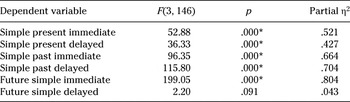
Because six univariate comparisons were involved, the initial α level of .05 was lowered to .008 (Bonferroni adjustment) to control for the familywise error rate. The results revealed that group membership was significantly associated with how backshifting was employed in all three scenarios in the immediate report context and two of the scenarios in the delayed report context (i.e., simple present and simple past). The only situation in which groups did not show significant differences was for future simple forms in the delayed report context. Univariate results are provided in Table 1.
Tests of between-subject effects

Note
The asterisk *denotes a statistically significant result at α = .008.
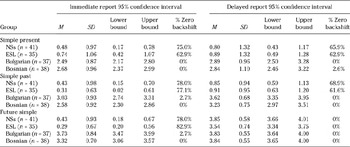
The independent variable group included four participant samples, so it was necessary to follow the univariate analyses with a post hoc multiple comparison test to establish specific group differences. The Bonferroni pairwise comparisons performed for this purpose showed that the significant differences were between the EFL groups on the one hand and the ESL and NS groups on the other hand (see Table 2 for group mean scores); that is, both EFL groups employed backshifting significantly more than the NSs and the ESL groups in the same five comparisons that were found significant through the univariate comparisons (p < .001 for all five comparisons). The only speech scenario that did not show significant differences among any of the groups was the one for future simple forms in the delayed report context, NSs-ESL, p = .183; NSs-Bulgarian, p = 1.00; NSs-Bosnian, p = 1.00; Bulgarian-ESL, p = .243; Bulgarian-Bosnian, p = 1.00; ESL-Bosnian, p = .219.
Descriptive statistics for each group’s mean use of tense backshifting

The ESL participants’ use of backshifting was not significantly different from that of the NSs on any of the six speech scenarios; the calculated p values were much higher than the α of .05, future simple delayed report, p = .183; all remaining comparisons, p = .100. In turn, there was no significant difference between the two EFL groups on any of the six dependent variables, as the p values were much higher than the α of .05, simple present immediate, p = 1.00; simple present delayed, p = 1.00; past simple immediate, p = .174; past simple delayed, p = .298; future simple immediate, p = .155; future simple delayed, p = 1.00.
Reasons for Backshifting in Relation to Grammatical Tense
Overall, the statistical analyses showed that the ESL participants used backshifting to a significantly lesser degree than the EFL groups and in a manner similar to the NS control group.
Because the differences and similarities between the groups can be better illustrated in view of the semantics of each of the three tenses in the two time frames of immediate and delayed reports, this section outlines the observed patterns within each of the three grammatical tenses. Entwined with these results are also results for the second research question, which sought to identify the reasons for the use or nonuse of backshifting. This part of the data was analyzed by calculating the percentage of occurrence of each response within each group. Because some participants had selected more than one option, the calculated percentages within groups may exceed the 100% response rate. For the sake of brevity, only the most frequently selected reasons are presented and discussed here.
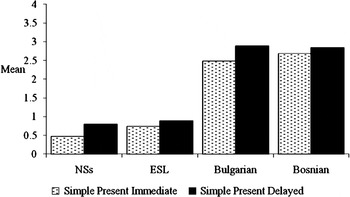
The simple present scenarios incorporated verbs that denoted ongoing actions and states. The purpose was to find out how the four groups of participants would employ backshifting in the context of immediate and delayed reports. As seen in Table 2 and Figure 1, none of the participant groups distinguished much between the two contexts of immediate and delayed reports with regard to ongoing actions and states. However, this pattern was different for the ESL and EFL groups, as shown by the percentages of participants who never employed backshifting (descriptive statistics can be found in Table 2). The majority of ESL and NS participants chose not to backshift at all in either the immediate or delayed report contexts, whereas almost none of the EFL participants employed zero backshifting. These patterns of differences were shown to be significant by the MANOVA.
Mean backshift scores per group for simple present tense.

These significant differences were further explained by the participants’ reasons to backshift the simple present or not. For example, the most prevalent reason why the EFL participants chose to backshift simple present forms to simple past, in both the immediate and delayed report contexts, was their conscious observance of the sequence of tenses rule. The results indicated that the majority of the Bulgarian participants chose this reason in both contexts (73% in immediate report and 72% in the delayed report). In a similar manner, 76% of the Bosnian participants chose this reason in the immediate report context and 70% selected this option in the delayed report. In contrast, the NSs and the ESL participants chose not to backshift to simple past mainly because they were trying to convey certainty or belief that what was said in the original utterance was still true and valid (NSs: immediate report, 55%, delayed report, 54%; ESL: immediate report, 51%, delayed report, 49%). Additionally, approximately 50% of the NSs and the ESL group indicated that they wanted to retain the meaning of the original utterance. It seems that, in both cases, the NS and the ESL participants were influenced by the semantics of the concrete verbs as well as pragmatic factors rooted in common knowledge about the denoted activities. Specific ongoing activities such as writing a thesis and taking guitar lessons would normally not be completed over a period of 1 month.
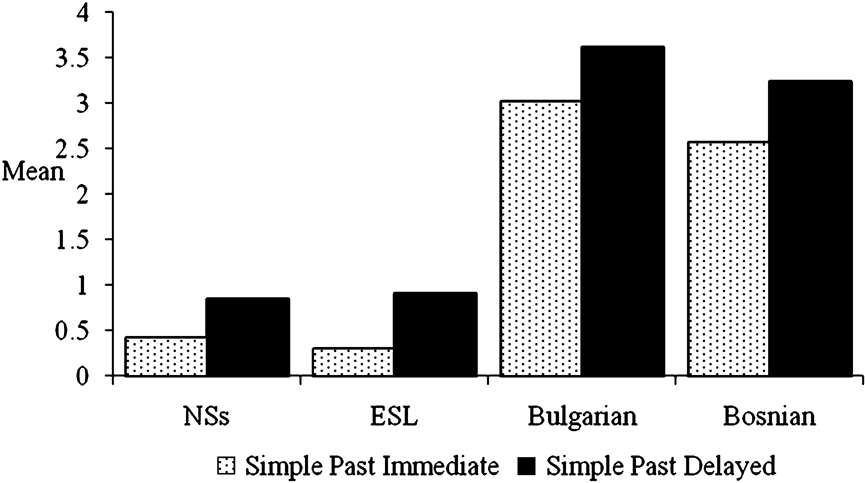
The mean scores per group for the simple past tense are given in Figure 2. The simple past scenarios were used to examine if the postulation that NSs usually do not backshift past tenses to their past perfect equivalents (e.g., Celce-Murcia & Larsen-Freeman, 1999; Standwell, Reference Standwell1985; Thewlis, Reference Thewlis2007) would be supported by the data and how the ESL and EFL samples would compare with the NS group. The results provided support for this postulation in that the majority of NSs applied zero backshifting in both the immediate and delayed report contexts. The ESL group closely resembled the NSs, in that more than 70% of these participants did not employ backshifting at all. In contrast, the EFL participants acted in a significantly different way: The majority of them preferred to backshift to past perfect in both contexts.
Mean scores per group for simple past tense.
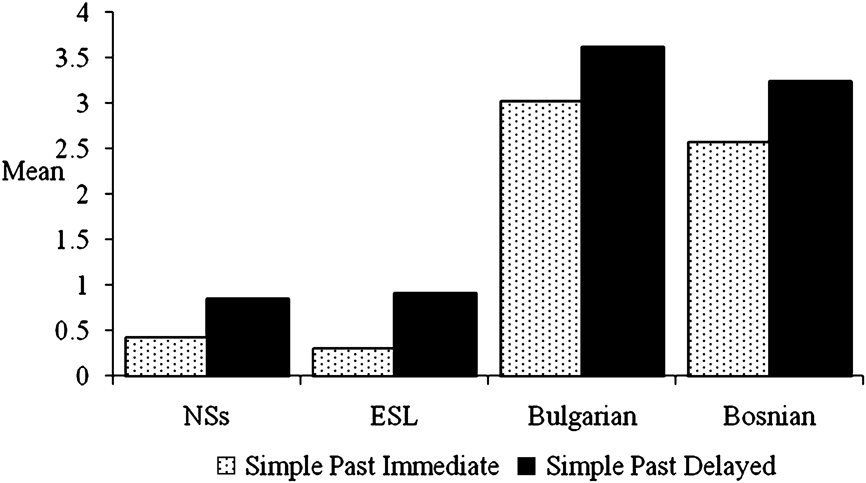
The described trends were congruent with the participants’ explanations for the principles that guided their choices; that is, the ESL and NS groups were mainly concerned about retaining the meaning of the actual speech (NSs in both reports: 66%; ESL group in both reports: 60%) and keeping the natural flow of the report (approximately 50% of both groups). In turn, the majority of EFL participants indicated adherence to the sequence of tenses rule in both the immediate and delayed report contexts (Bulgarian: 88%; Bosnian: 84%).
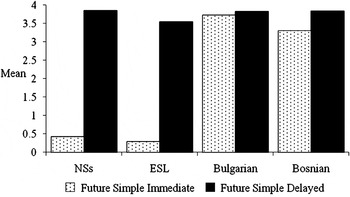
The speech scenarios for the future simple tense included two instances of will in the meaning of a definite future plan and two instances of going to in the meaning of future intentions (Firsten and Killian, Reference Firsten and Killian2002). The future tense scenarios aimed to create opportunities for the reporters to show their viewpoint of the original message as believable or not. The expectation was that, over and above the time lapse between the actual and reported speech, the participants would opt to maintain the original tense if they wanted to convey the message as believable and would backshift to future in the past if their intention was to show disbelief by taking a distance from the report. The MANOVA results showed different trends for the immediate and delayed report contexts; that is, in the immediate report context, the EFL groups backshifted significantly more than the NS and ESL participants, the majority of whom preferred to maintain the original tense. In the delayed report condition, the four groups behaved similarly, opting to backshift to future simple in the past most of the time, as shown in Figure 3.
Mean scores per group for future simple tense.

For the immediate report condition, the NSs and the ESL participants explained their decision to preserve the original tense by two main motives: to maintain the meaning (NSs: 69%, ESL: 60%) or to convey certainty (NSs: 39%, ESL: 45%). Because in the specific context of the speech scenario for future simple tense, these two principles could mean the same thing (i.e., that the reporters were trying to preserve the original meaning because they wanted to imply certainty in what they were told), it can be speculated that the majority of the NSs and the ESL group avoided the future in the past to convey the original message as believable. In contrast, the EFL participants overlooked the pragmatics of the situation and applied the backshift rule, following the sequence of tenses principle as pointed out by 95% of the Bulgarian and 92% of the Bosnian participants.
For the delayed report context, although all four groups chose to backshift, the motives underlying this choice were different. Within the EFL samples, 95% of the Bulgarian and 92% of the Bosnian participants indicated observance of the sequence of tenses rule, whereas none checked the option “convey doubt.” In contrast, 69% of the NSs and 67% of the ESL participants indicated that the main reason for backshifting to future in the past was the time lapse between the actual and the reported speech; only 17% of NSs and 15% of ESL participants intended to convey doubt through tense backshifting.
Length of Residence and Backshifting
The third research question concerned the ESL sample only. It was formulated on the basis of previous research that has found that the time of exposure to authentic SL input is positively correlated with learners’ authentic language use (e.g., Bardovi-Harlig & Dörnyei, Reference Bardovi-Harlig and Dörnyei1998; Félix-Brasdefer, Reference Félix-Brasdefer2004; Schauer, Reference Schauer2006). In the context of the present study, this question sought to find out if there was a relationship between the ESL participants’ length of residence in the United States and the way in which they employed backshifting. The expectation was that those participants who had stayed the longest in the United States would be the closest to the NSs’ performance by employing backshifting selectively and thus to a lesser degree.
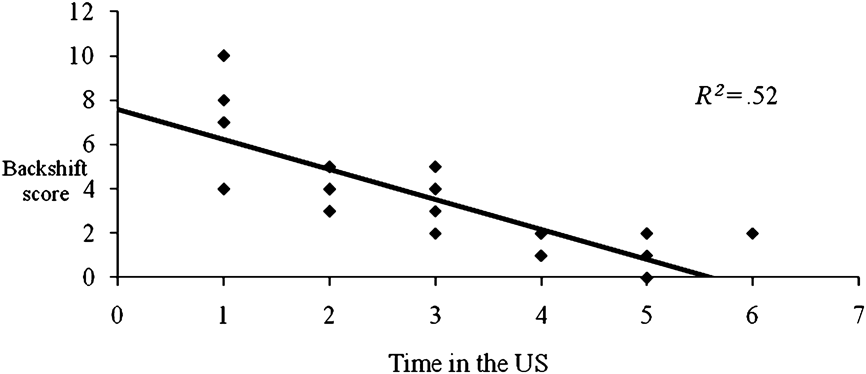
To address this question, a Pearson’s r correlation analysis was performed for the two variables: ESL participants’ length of residence in the United States and their total backshifting scores on the five dependent variables for which the significant differences were observed. The future simple in the delayed report context, in which all four groups preferred to backshift the original tense, was not included. The results showed a significant negative correlation between the two variables (r = –.723, p < .001). In other words, the more time an ESL participant had spent in the United States, the less he or she employed backshifting, thus more closely resembling the NSs. The value of the R 2 of .52 signified that nearly 52% of the variance in backshifting could be attributed to the effect of length of residence. Additionally, the scatterplot and the regression line suggest that the effect of length of residence is more systematic after the second year of an ESL speaker’s stay. Figure 4 presents these results.
Correlation between length of residence and backshift score for the ESL group. The number of dots in the scatterplot is less than the number of ESL participants (N = 35) because some dots stand for more than one case.

DISCUSSION AND CONCLUSIONS
This study examined how tense backshifting is employed in English indirect reported speech by ESL and EFL speakers in comparison with NSs to identify whether the choice to backshift is governed by the sequence of tenses rule or by pragmatic and semantic factors. If tense backshifting in English is considered a grammatical means for conveying the reporter’s viewpoint regarding the original utterance—not simply a grammatical transformation triggered by a past tense reporting verb—then the findings of this study provide support for those of previous research that have found that EFL environments promote grammatical accuracy, whereas ESL contexts foster sensitivity to pragmatic norms (Bardovi-Harlig & Dörnyei, Reference Bardovi-Harlig and Dörnyei1998; Félix-Brasdefer, Reference Félix-Brasdefer2004; Schauer, Reference Schauer2006). In this case, the EFL and ESL participants employed backshifting in a different way, in that the EFL groups employed it significantly more and automatically, without awareness of the possibility to express certainty, doubt, or impartiality or to maintain the natural flow of the speech through avoidance of grammatical structures like the past perfect tense. In turn, their ESL counterparts’ use of backshifting resembled that of the NSs: Both of these groups were more selective in backshifting tenses guided by semantic and pragmatic factors.
In view of the findings of previous research (Bardovi-Harlig & Dörnyei, Reference Bardovi-Harlig and Dörnyei1998; Blum-Kulka & Olshtain, Reference Blum-Kulka and Olshtain1986; Félix-Brasdefer, Reference Félix-Brasdefer2004; Olshtain & Blum-Kulka, Reference Olshtain, Blum-Kulka, Gass and Madden1985; Schauer, Reference Schauer2006), the observed significant differences between the EFL participants on the one hand and their ESL counterparts on the other hand can be attributed to the influence of the ESL environment with its numerous opportunities for direct contact with an authentic SL input.Footnote 7 Support for this conclusion was also provided by the correlation analysis between the ESL participants’ length of stay in the United States and the way they employed the backshift principle. The results supported the expectation that the more time an ESL speaker had spent in the United States, the more selectively he or she would employ backshifting. The significant negative correlation showed that those ESL participants who had spent more than 2 years in the United States flouted the backshift rule the most, thus closely resembling the performance of the NSs. In the cases in which they preferred to retain the original tense of the direct speech, the ESL participants compromised the backshift rule for semantic and pragmatic reasons. For instance, much like the NSs, the ESL participants avoided grammatical structures like the past perfect in order to sound natural and retain the meaning of the original utterance. Their preference not to backshift the original tenses was guided by a conscious attempt to preserve the inherent meaning of the original utterance or to show their belief in the facts presented by the speaker. In fact, the NS and ESL participants generally preferred not to backshift the original tenses in both the immediate and delayed report contexts, as the only exception was observed in the future simple delayed report. Analyses of the results for each of the three tenses suggested that the reason that NSs and ESL participants preferred not to employ backshifting was related to the inherent semantics of the specific grammatical tense or the meanings of the verbs used in the speech scenarios.
In the case of the simple present tense, the majority of the NS and ESL participants preferred not to backshift to the simple past in both the immediate and delayed report contexts, consciously or unconsciously guided by the ongoing nature of the denoted activities and states, which, even after a period of 1 month, could have been considered valid. In contrast, the semantics of the simple present verbs had little influence over the choices made by the EFL groups, the majority of whom demonstrated adherence to the sequence of tenses rule over and above pragmatic and semantic factors.
A similar trend was observed for the simple past, whereby the NSs and the ESL participants preferred not to backshift to the past perfect in either of the two contexts, following their intuition for naturalness of style. In view of related pedagogical grammar literature (e.g., Bland, Reference Bland2008; Celce-Murcia & Larsen-Freeman, Reference Celce-Murcia and Larsen-Freeman1999; Haines & Stewart, Reference Haines and Stewart2004; Leech & Svartvik, Reference Leech and Svartvik1975; Norris, Reference Norris2008; Quirk et al., Reference Quirk, Greenbaum, Leech and Svartvik1985; Thewlis, Reference Thewlis2007; Vince & Sunderland, Reference Vince and Sunderland2003), these results entirely supported the postulation that NSs tend not to backshift past tenses to past perfect due to a change in meaning usually conveyed through the perfective aspect, or for reasons of style. This exception to the backshift rule, however, remained unnoticed by the majority of the EFL participants, who applied the sequence of tenses rule with no or little consideration for the natural flow of speech.
Because future plans or intentions are more susceptible to personal interpretations, the future simple scenarios, more than those for the other two tenses, provided opportunities for the participants to express belief or disbelief in the original utterance beyond the time-lapse variable. Based on the NS and ESL data, the nonuse of backshifting was observed only in the immediate report context with the purpose of conveying the original utterances as believable. In turn, backshifting was employed in the delayed report context, and the NS and ESL participants explained this fact by their observance of the time lapse rather than by an intention to show disbelief. These results were rather contradictory to the patterns observed in the scenarios for the simple present and simple past, for which the NS and ESL participants’ choice not to backshift transcended time lapse. One explanation could be that the participants’ choice to backshift was subconsciously governed by an intention to convey disbelief, but they had not rationalized it enough and instead opted for time lapse as a possible explanation. Overall, only a few NS and ESL participants seemed to be aware of the potential to convey a message of doubt or impartiality by backshifting the original tense. In contrast, the EFL participants’ overreliance on the sequence of tenses rule was interesting because tense backshifting is not a feature of indirect speech in either Bulgarian or Bosnian. It further suggested that the reason for the EFL participants’ overuse of backshifting could be the result of the special emphasis that was put on it during their English classes (S. Bilbija, personal communication, May 14, 2009; V. Koynakova, personal communication, May 18, 2009).
Conclusions
The present study added a new dimension to the extant empirical literature (e.g., Bardovi-Harlig & Dörnyei, Reference Bardovi-Harlig and Dörnyei1998; Blum-Kulka & Olshtain, Reference Blum-Kulka and Olshtain1986; Félix-Brasdefer, Reference Félix-Brasdefer2004; Olshtain & Blum-Kulka, Reference Olshtain, Blum-Kulka, Gass and Madden1985; Schauer, Reference Schauer2006) about the impact of the learning environment on the acquisition of one specific aspect of English grammar and pragmatics, known as tense backshifting. Its major findings suggest that, under the influence of direct contact with the SL environment, advanced ESL learners with a good level of metalinguistic competence are able to adjust their formally learned interlanguage grammars to accommodate NSs’ pragmatic norms. The ESL participants seemed to have noticed that the backshift rule does not apply to all contexts and situations in which the reporting verb is in the past tense and that there are semantic and pragmatic factors that may cancel its appropriateness. In doing so, the ESL participants closely resembled the NS group and distinguished themselves from the two EFL groups, who showed significant adherence to the backshift rule with little or no consideration for pragmatic and semantic factors that cancel its appropriateness.
Considering that the ESL group in this study included preservice teachers, it can be speculated that the reason they had been able to notice the pragmatic principles that govern the use or nonuse of tense backshifting was because of their high level of grammatical and metalinguistic competence. If the ESL group had been composed of regular SL learners with no linguistic background, their interlanguage grammars may not have so successfully accommodated NS pragmatic norms.
Finally, the conclusions drawn on the basis of the EFL data—namely, having in mind that tense backshifting is not a characteristic of indirect reported speech in their L1s—suggest that the sequence of tenses rule has a steady presence in the interlanguage grammars of EFL learners and that they follow it faithfully, unaware of pragmatic or semantic factors that cancel its applicability. If the EFL participants had been influenced by their L1, they would have applied backshifting sparingly and only when they intended to convey disbelief in the original utterance, thus canceling responsibility for the truthfulness of what was said. This was not the observed trend, however. In spite of their L1s or any semantic or pragmatic considerations, both groups of EFL participants remained loyal to the sequence of tenses rule in contexts of both immediate and delayed reports.
Limitations and Recommendations for Future Research
Having drawn the final conclusions from the findings of this study, it is important to delimit the scope of their generalizability by outlining some important limitations. The first concerns the participant samples. It should be kept in mind that both the ESL and EFL groups were composed of in-service teachers who had an extensive background in English grammar and a high metalinguistic understanding of the syntactic structures of English. For this reason, generalizing the findings to other populations of ESL and EFL learners will not be appropriate. In particular, the effect of length of residence may not be observed to the same degree with ESL learners of lower proficiency or who lack metalinguistic competence.
It is obvious that studies with ESL and EFL learners of lower proficiency or less or no metalinguistic knowledge of English grammar are likely to show different results. In this light, it is important for future investigations to include learner groups of different levels of proficiency as well as ESL participants of two categories—namely, instructed and uninstructed.
Additionally, the conclusions reached with regard to the EFL groups should not be generalized to environments other than the ones from which the samples were drawn because they may differ substantially in several aspects, such as their English curricula, the methodology of teaching grammar or pragmatics, the intensity of the programs, and so on.
Some limitations concern the ESL group, which was heterogeneous and comprised an unequal number of participants from several different countries and different L1s. More balanced subgroups within the ESL sample would have strengthened the validity of the observed results and could have provided further insights into potential L1 influences on the issues investigated. Additionally, the reader should be reminded that the significant relationship between length of stay in the United States and pragmatic awareness was observed for a group of ESL participants who had an advanced level of proficiency and high metalinguistic awareness of the structure of English. Moreover, taking into consideration that the coefficient of determination (R 2) is sample-specific (Kirk, Reference Kirk1995), it is necessary to have several replications of the study to substantiate the reported results.
Another limitation stems from the research instrument, which included speech scenarios delimited to informal conversational contexts; for this reason, the results should not be generalized to other discourse styles. It should also be mentioned that, although written in conversational English, the speech scenarios were rather contrived because they were presented in a written form, were limited to one grammatical tense each, and employed a forced-choice format. Finally, the variable time lapse was operationalized by allowing a 1-month delay between the actual and reported speech for all three tenses. However, in retrospect, it seems that this variable should be operationalized in consideration of the semantics of the specific tense or verbs in each context, incorporating longer periods of time where appropriate.
Pedagogical Implications
In view of the controversial treatment of the backshift rule in pedagogical and linguistic literature about English indirect reported speech, the findings of this study have consistently provided empirical support for the arguments opposing the sequence of tenses rule (e.g., Declerck, Reference Declerck1990, Reference Declerck1999; Riddle, Reference Riddle1978, Reference Riddle1986; Salkie & Reed, Reference Salkie and Reed1997; Standwell, Reference Standwell1985). Corroboration for the irrelevancy of viewing tense backshifting as a formal syntactic rule was found in the data from the NSs. As seen throughout the results of this study, the NSs employed backshifting sparingly and only when they wanted to emphasize the past time reference of the original utterance (e.g., future simple delayed report), thus canceling implications about the reporter’s involvement with the subject or events of the original utterance. In contrast, in the rest of the conversational situations, NSs preferred not to backshift the original tense for reasons of meaning or style—namely, to present the message as believable or still valid at the time of the report or to retain its specific meaning and naturalness.
Overall, this study’s findings suggest that the treatment of tense backshifting as a formal grammatical rule in English language grammar books, teaching materials, and classes may not correspond to how backshifting is actually employed in English real-life indirect reported speech. As a consequence, English language learners, particularly those in EFL settings, are trained to produce stilted reports that fail to convey their point of view as reporters vis-à-vis the original utterance. Therefore, the treatment of the backshift phenomenon in pedagogical materials and practices should change its focus. Rather than presenting backshifting as a syntactic transformation with its many exceptions, teaching materials and practices should delimit its application to those situations and contexts in which it serves a pragmatic purpose; that is, learners should be made aware through appropriate input and continuous communicative practice that backshifting tenses when reporting other speakers’ utterances conveys a different message than when the original tense is maintained. Helping learners develop communicative competence in these subtle but important pragmatic variations in meaning triggered by the use or nonuse of tense backshifting should become the objective of teaching materials and classes.
Finally, the findings of the present study substantiate the recommendations of a number of previous studies (e.g., Akai, Reference Akai2007; Bardovi-Harlig, Reference Bardovi-Harlig1999, Reference Bardovi-Harlig, Rose and Kasper2001; Bardovi-Harlig & Griffin, Reference Bardovi-Harlig and Griffin2005; Bardovi-Harlig & Hartford, Reference Bardovi-Harlig and Hartford1996; Kasper, Reference Kasper, Bardovi-Harlig and Hartford1997; Koike & Pearson, Reference Koike and Pearson2005; Rose, Reference Rose2005; Soler, Reference Soler2005; Takahashi, Reference Takahashi2005) that emphasize the importance of teaching grammatical forms in view of their pragmatic meanings and functions. These recommendations are particularly valid for EFL environments, in which learners have a limited access to authentic language input and insufficient opportunities to communicate with NSs. Moreover, because nonnative teachers are part of the same educational system as their prospective students, the refocusing of the teaching of syntactic structures in view of their pragmatic functions should first be implemented in teacher training curricula and methodology. This implicates that grammar books and textbooks, still the major instructional input in EFL contexts, should also present and reinforce grammatical forms and phenomena in view of their pragmatic functions and meanings.
APPENDIX
CONVERSATIONAL SCENARIOS: DIRECT AND REPORTED SPEECH
Simple Present, Immediate Report
Actual speech
You see your friend Hilary who says:
Hilary: I work on my thesis eight hours every day and because of this I am tired all of
the time. My back hurts and my eyes are red.
Reported Speech
ONE HOUR LATER, you see Ann:
Ann: Have you seen Hilary lately?
YOU: I saw her an hour ago, and she told me that she [works/worked] on her thesis eight hours every day and because of this she [is/was] tired all of the time. She said that her back [hurts/hurt] and her eyes [are/were] red.
Simple Present, Delayed Report
Actual speech
You see your cousin Justin who says:
Justin: I take guitar lessons once a week and I practice every day. It takes a lot of my time, but I am happy with my progress.
Reported Speech
ONE MONTH LATER, you meet Justin’s band member Stan:
Stan: Do you think that Justin is practicing his guitar enough? Our first gig is next week.
YOU: Well, I saw him about a month ago and he said that he [takes/took] guitar lessons once a week and [practices/practiced] everyday. He also said that it [takes/took] a lot of his time, but he [is/was] happy with the progress.
Simple Past, Immediate Report
Actual speech
Your friend Melinda tells you:
Melinda: Did you know that Mary took the poem you wrote about your ex and sent it to a poetry contest and it won five hundred bucks. What are you going to do about it?
Reported speech
You IMMEDIATELY call Mary on the phone:
YOU: I just heard from Melinda that you [took/had taken] the poem that I
[wrote/had written] about my ex and [sent/had sent] it to a contest and
that it [won/had won] five hundred bucks.
Simple Past, Delayed Report
Actual speech
Your friend Marian tells you:
Marian: Did you hear about Shawn? He was arrested for underage drinking, and he tried to bite the cop when they handcuffed him. He spent the night in jail for that!
Reported Speech
A MONTH LATER, a friend asks you:
Friend: I haven’t seen Shawn in ages. What’s up with him?
YOU: Oh, I can’t believe you haven’t heard this, dude. Two weeks ago, I
met Marian and she told me that Shawn [was arrested/had been arrested] for underage drinking. She said that he actually [tried/had tried] to bite the cop when they [handcuffed/had handcuffed] him and that he [spent/had spent] the night in jail for that.
Future Simple, Immediate Report
Actual speech
In class, your classmate Tara talks about her future plans.
Tara: I will graduate in two years, and then I will move to Chicago. I am going
to find a good job, and I am going to be independent.
Reported speech
AFTER CLASS, you tell Bob, her boyfriend, about Tara’s future plans:
YOU: Hey dude—Tara talked about her future plans in class today. They don’t include you.
Bob: No way. We’re moving to LA right after graduation together.
YOU: She said, in so many words, that she [will/would] graduate in two years and [will/would] move to Chicago. She said she [is going/was going] to find a good job and she [is going/was going] to be independent.
Future Simple, Delayed Report
Actual speech
During your senior year graduation party, all your friends get together to make several predictions about what their futures will hold. Your very best friend Mark predicts:
Mark: I will become a lawyer and will make a lot of money. I am going to marry a beautiful blonde heiress and we are going to have five children.
Reported speech
AFTER A MONTH, you see Mark and remind him of his predictions:
YOU: Hey Mark, I wonder whether all your predictions will become true.
Mark: What do you mean?
YOU: You know, at the senior party you told us that you [will/would] become a lawyer and [will/would] make lots of money. You also said that you [are/were] going to marry a beautiful blonde heiress and you [are/were] going to have five children.