INTRODUCTION
Alzheimer’s disease (AD) is the sixth leading cause of death in the United States, and healthcare costs are estimated to be $148 billion annually (Alzheimer’s Association, 2008). Early detection of AD facilitates early pharmacological intervention, which may decrease or delay cognitive decline (DeKosky, Reference DeKosky2003). One method of early detection under investigation is to detect AD-related immune responses peripherally via blood testing. Recent AD research indicates that immunoglobulins (IgGs) for beta amyloid (Aβ) and receptors for the advanced glycation end products (RAGE) are produced at increasing levels when comparing older adults with normal cognition to those with probable AD (Mruthinti et al., Reference Mruthinti, Buccafusco, Hill, Waller, Jackson, Zamrini and Schade2004). Protein plaques containing Aβ have been previously demonstrated to accumulate in brain tissue at RAGE receptor sites (Emanuele et al., Reference Emanuele, D’Angelo, Tomaino, Binetti, Ghidoni and Politi2005). Formation of these Aβ plaques is associated with Alzheimer’s disease severity, including level of cognitive impairment (Berg et al., Reference Berg, McKeel, Miller, Storandt, Rubin and Morris1998). Presumably in response to this plaque build-up in the brain, IgGs for Aβ and RAGE have been found to be elevated peripherally in the bloodstream (Nath et al., Reference Nath, Hall, Tuzova, Dobbs, Jones and Anderson2003). The implication of this finding is that AD could potentially be detected and its progression monitored through simple blood testing, rather than the use of more invasive [e.g., cerebrospinal fluid (CSF) testing], time-consuming (e.g., neuropsychological testing), or expensive (e.g., brain imaging) techniques currently used to diagnose probable AD.
An important aspect of establishing Aβ and RAGE IgGs as biomarkers for AD is to determine their relation to AD-related cognitive impairment. Mruthinti and colleagues (Reference Mruthinti, Buccafusco, Hill, Waller, Jackson, Zamrini and Schade2004) demonstrated a negative relationship between both IgGs and performance on the Mini-Mental State Examination (MMSE), with higher IgG levels predicting worse performance. Similarly, Wilson and colleagues (Reference Wilson, Mruthinti, Buccafusco, Schade, Mitchell and Harrell2009) demonstrated a relationship between overall cognitive performance, as well as domain-specific performance on measures of learning and memory and both IgGs in a mixed neurological sample. These findings suggest that both IgGs are related to global decrements in cognition, in addition to specific decrements in memory and language functioning. Further investigation with more refined diagnostic groups is necessary to determine the relationship between cognition and Aβ and RAGE IgGs. In this investigation, we improved on previous studies by examining the relationship between cognitive test performance and Aβ and RAGE IgGs in an elderly control group, an MCI group, and an AD group. Unlike previous investigations, we excluded individuals with other neurological conditions and those with diabetes, as these conditions also have autoimmune components to their disease processes (Mruthinti et al., Reference Mruthinti, Schade, Harrell, Gulati, Swamy-Mruthinti, Lee and Buccafusco2006) that may influence the relationships between cognitive variables and IgG levels.
We hypothesized that there would be significant group differences in IgGs, with control participants having the lowest levels of both IgGs, MCI participants having significantly higher levels, and AD participants having the highest mean IgG levels. We additionally hypothesized that consistent with previous findings using mixed neurological samples and samples including diabetics, that in this study, we would similarly find that a global measure of cognition would be significantly related to Aβ and RAGE IgGs. We hypothesized that the Repeatable Battery for the Assessment of Neuropsychological Status (RBANS) measures of memory and language would be the specific domains of cognition that would be uniquely related to Aβ and RAGE IgGs, after accounting for shared variance with age, total IgG, visuospatial and construction ability, and attention measures. This hypothesis was based on Randolph and colleagues’ (Reference Randolph, Tierney, Mohr and Chase1998) demonstration that individuals with AD exhibit what they termed a “cortical” profile of impairment on RBANS indices of memory and language, showing impairment on subtests involving immediate and delayed memory for verbal and visual information, in addition to deficits on measures of confrontation naming and semantic verbal fluency, while showing relatively preserved functioning on measures of visuospatial ability (i.e., line orientation and figure copy) and attention (i.e., digit span and digit-symbol coding). While we recognize that language deficits in AD are typically paralleled by right hemisphere deficits in visuospatial abilities, performance on the specific tests of language function used in the RBANS has been demonstrated by the test’s authors to be more impaired in AD samples, whereas performance on the specific tests of visuospatial ability has been demonstrated to be within normal limits in AD samples (Randolph, Tierney, Mohr, & Chase, Reference Randolph, Tierney, Mohr and Chase1998).
METHODS
Participants
Participants were from the Neurological Disorders Database Repository (NDDR) at the Medical College of Georgia (MCG), the aim of which is to collect data from older adults with AD, MCI, other neurological disorders, and normal cognitive functioning. In this investigation, we used cross-sectional data, representing the first study visit for all control and AD participants. However, to approximate equal numbers in each diagnostic group, we used data from a later time point at which the participant converted from control to MCI for some participants. This was used for five participants in the MCI category, and these participants were not included in the control group. Participants with AD and other neurological conditions were primarily recruited via physician referrals from the Medical College of Georgia. Healthy control participants and those with MCI were recruited primarily through caregivers of participants with AD, as well as local advertisements in retirement centers and hospitals. Participants were adults aged 60 and older whose primary language was English. Participants with neurologic diagnoses other than Alzheimer’s disease (e.g., Parkinson’s disease, stroke, dementia with Lewy bodies) or psychiatric diagnoses (e.g., schizophrenia, bipolar disorder) were excluded. Because anti-Aβ and anti-RAGE IgGs are known to be elevated in diabetes (Mruthinti et al., Reference Mruthinti, Schade, Harrell, Gulati, Swamy-Mruthinti, Lee and Buccafusco2006), we excluded participants with diabetes. After meeting inclusion criteria, participants were assigned to the following three groups according to their Clinical Dementia Rating score (CDR; Morris, Reference Morris1993): Normal Control Group (CDR = 0), MCI Group (CDR = 0.5), AD Group (CDR ≥ 1). All participants in the AD group additionally had physician’s diagnoses of probable AD.
Procedure
Test sessions, lasting approximately two hours, began with obtaining informed consent, and included demographic information, medical history, current medical diagnoses, self-reported cognitive status, family history, and current medications. This information was obtained by the participant with assistance from caregivers and was verified for completeness by the study coordinator. Participants also completed a release to verify their medications and medical diagnoses with their physician. Each participant and caregiver next participated in a semi-structured interview from which the participant’s Clinical Dementia Rating (CDR) was derived by a CDR-certified administrator. Participants were then administered a cognitive test battery by a trained test administrator. Finally, each participant provided a blood sample that was drawn by a trained phlebotomist. This study was approved by the Medical College of Georgia and the University of Georgia Institutional Review Boards.
Materials
Repeatable Battery for the Assessment of Neuropsychological Status
The RBANS (Randolph, Reference Randolph1998) is a 30-minute neuropsychological test designed to assess cognitive decline in older adults and to serve as a screening tool for cognitive functioning in younger adults (Randolph et al., Reference Randolph, Tierney, Mohr and Chase1998). Consisting of 12 subtests, the RBANS generates 5 Index Scores: Visuospatial/Constructional, Attention, Language, Immediate Memory, and Delayed Memory. The RBANS additionally generates a global score (the Total Scale score), derived from raw scores on all 12 subtests. The 12 subtests of the RBANS are as follows: Figure Copy, Line Orientation, Digit Span, Coding, Picture Naming, Semantic Fluency, List Learning, Story Memory, List Recall, List Recognition, Story Recall, and Figure Recall. The RBANS scores have been demonstrated to have good reliability, with split-half reliability coefficients in the .80s for the Index Scores and the average reliability for the Total Scale score ranging from .86–.94 across age groups (Randolph, Reference Randolph1998).
Clinical Dementia Rating
The Clinical Dementia Rating (CDR; Morris, Reference Morris1993) is a semi-structured interview designed to rate severity of dementia through the assessment of six domains of the participant’s cognitive and functional abilities. Domains assessed on the CDR include memory, orientation, judgment and problem solving, community affairs, home and hobbies, and personal care. Each domain is rated and entered into an algorithm to generate an overall summary score on a 5-point scale of either “normal” (CDR = 0), “questionable/very mild dementia” (CDR = 0.5), “mild dementia” (CDR = 1), “moderate dementia” (CDR = 2), or “severe dementia” (CDR = 3). Administrators were trained in the CDR interview and scoring techniques by the CDR author via a CDR training course online (http://alzheimer.wustl.edu/cdr/default.htm).
The CDR has been well validated as a classification tool for dementia severity (Morris, Reference Morris1993), with demonstrated inter-rater reliability of 80% (Burke et al., Reference Burke, Miller, Rubin, Morris, Coben and Duchek1988; McCulla et al., Reference McCulla, Coats, Van Fleet, Duchek, Grant and Morris1989). We established inter-rater reliability by scoring a subset of the CDR interviews used in this article (n = 12) independently and obtained consistent inter-rater reliability across domains (Cronbach’s α range = .83–1.0). Overall rating agreement for the global CDR score in this subset was 100%.
Group classification
As summarized above, the primary method of group classification was CDR staging. Individuals were classified into three groups as follows: normal controls = CDR of 0, MCI = CDR of 0.5, AD = CDR of 1, 2, or 3. For exploratory analyses, we further classified individuals into groups based on their CDR scores combined with their performance on the RBANS. To be classified as control, individuals had to have a CDR of 0 and all RBANS index scores less than 1.5 standard deviations (SD) below the mean. The MCI group was further divided into amnestic (aMCI) and nonamnestic MCI based on cognitive test scores. We classified individuals as having amnestic MCI when their CDR score was 0.5, Immediate and/or Delayed Memory scores on the RBANS were between 1.5 and 2 SD below the mean, and all other cognitive domain scores were no lower than 2 SD below the mean. We classified individuals as having nonamnestic MCI when their CDR score was 0.5, one or more of their nonlearning and memory index scores were between 1.5 and 2 SD below the mean, and all other index scores were no lower than 2 SD below the mean. To be classified as having AD, individuals had to have a global CDR of 1 or greater, and two or more indices on the RBANS had to be greater than 2 SD below the mean. Because of incomplete RBANS data on some participants, the number of participants in each group was reduced in the control and AD groups using this classification system.
RAGE and Aβ IgG Purification from Plasma
Blood plasma analysis was conducted at the Medical College of Georgia by trained technicians in psychopharmacology, and samples were recoded in order to conduct blind assays. Plasma (0.2 ml) IgG was purified via a purification process involving initial ammonium sulfate precipitation, followed by dialyzation overnight against 1× PBS at 4ºC. Next, IgGs were purified via protein A/G isolation and dialyzed overnight against 1× PBS at 4ºC. Nonspecific total IgG was quantified after protein A/G isolation using bicinchoninic acid (BCA) assay for protein quantification.
Quantifying Specific IgGs
RAGE peptide or Aβ1-42 (1 μg / 100 μl/well) were coated to MaxiSorp™ ELISA plates and incubated overnight at 4ºC. Antigen was discarded and wells were washed once with 150 μl of 2% milk in PBS, and then wells were blocked with 150 μl of 2% milk in PBS for 2 hours. Wells were washed three times with 150 μl of 2% milk in PBS, and anti-Aβ1-42 or anti-RAGE IgG (100 μl) derived from participants were added to each well and incubated overnight at 4ºC. Wells were washed four times with 2% milk in Tris buffered saline + Tween 20 (TBST), and then 200 μl of donkey anti-human IgG(F(ab΄)2)-HRP conjugated secondary antibody (1:1000) in 2% milk in TBST was added and incubated for 3 hours at 37ºC. Plates were washed three times with 2% milk in TBST followed by adding 100 μL of ready-made tetramethylbenzedine (TMB) substrate (Sigma-Aldrich) for blue color development, which were stopped after 15 minutes by adding 100 μL 1M HCL. Absorbance was read at 450 nm providing the titer values used in this study. Each sample was run in triplicate.
To account for nonspecific binding, three wells containing the antigen and secondary antibody were included on each ELISA plate, the average value of which was subtracted from all titer values. A control sample of plasma was purified in each purification and ELISA assay and used to create standardized values in order to compare values from different assays. These standardized values were used in all statistical analyses.
Peptides
RAGE peptide was synthesized according to the following sequence (Neeper et al., Reference Neeper, Schmidt, Brett, Yan, Wang and Pan1992): “DQNITARIGKPLVLNCKGAPKKPPQQLEWKLN” representing the nucleotide and amino acid sequence of human RAGE. The peptide was synthesized by the Molecular Biology Central Core facility at MCG. Aβ1-42 was purchased from Sigma-Aldrich.
Statistical Analysis
Data were analyzed using the Statistical Package for Social Sciences (SPSS 16.0 for Windows, SPSS, Chicago, IL). Analyses of covariance (ANCOVA) were used to test group differences in anti- Aβ and RAGE IgG levels, with age and total IgG entered as covariates in each model. We used Bonferroni’s correction for multiple comparisons in ANCOVA analyses. To determine the overall relationship between each IgG and cognition, we first used correlation analysis to characterize the overall relationship between IgGs and global RBANS performance. Based on the inconsistencies found in this analysis, we do not present further regression analysis of the relationship between each IgG and domain-specific cognitive function. Throughout all of our analyses, significance tests were two-tailed.
RESULTS
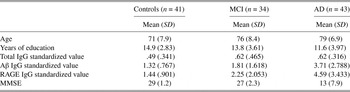
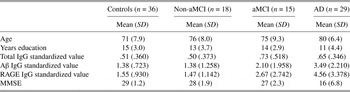
Demographic information and descriptive statistics for diagnostic groups are summarized in Tables 1 and 2. To test our hypothesis that there would be group differences in anti-Aβ and RAGE IgGs, we conducted two separate ANCOVA analyses, each entering age and total IgG as covariates. For the anti-Aβ model, both the covariates of age, F(1, 107) = 4.61, p < .05, and total IgG, F(1, 107) = 5.96, p < .05, accounted for a significant portion of the variance in anti-Aβ. Group status additionally accounted for a significant portion of the variance, F(2, 107) = 10.91, p < .001, beyond that of age and total IgG level. Pairwise comparisons using Bonferroni’s adjustment for multiple comparisons revealed that there was a significant difference in anti-Aβ levels between the AD group and the control group (p < .001). There was also a significant difference between the MCI and the AD group in anti-Aβ (p = .001). There was not a significant difference between the control group and the MCI group in anti-Aβ (p > .05). Similarly, in the anti-RAGE model, both the covariates of age, F(1, 107) = 4.03, p < .05, and total IgG, F(1, 107) = 4.72, p < .05, accounted for a significant portion of the variance in anti-RAGE. Group status additionally accounted for a significant portion of the variance, F(2, 107) = 11.94, p < .001, beyond that of age and total IgG level. Pairwise comparisons using Bonferroni’s adjustment for multiple comparisons revealed that there was a significant difference in anti-RAGE levels between the AD group and the control group (p < .001). There was also a significant difference between the MCI and the AD group in anti-RAGE (p = .001). There was not a significant difference between the control group and the MCI group in anti-RAGE (p > .05).
Descriptive statistics for groups categorized by Clinical Dementia Rating (CDR)

Note
AD = Alzheimer’s disease; MCI = mild cognitive impairment; IgG = immunoglobulins; Aβ = beta amyloid; RAGE = receptors for the advanced glycation end products; MMSE = Mini-Mental State Examination.
Descriptive statistics for groups categorized by RBANS performance

Note
RBANS = Repeatable Battery for the Assessment of Neuropsychological Status; AD = Alzheimer’s disease; aMCI = amnestic mild cognitive impairment; Non-aMCI = Non-amnestic mild cognitive impairment; IgG = immunoglobulins; Aβ = beta amyloid; RAGE = receptors for the advanced glycation end products; MMSE = Mini-Mental State Examination.
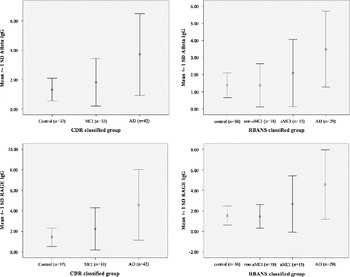
Next, we conducted exploratory analyses to determine if control–MCI group differences in anti-Aβ and anti-RAGE could be better captured using a different operational definition of MCI. When further categorizing the MCI patients into amnestic and nonamnestic MCI (see group classification description above), we again did not find significant group differences between control and amnestic or nonamnestic MCI for both anti-Aβ and anti-RAGE (all pairwise comparison p’s > .05). There were significant group differences in anti-Aβ and anti-RAGE levels between the control and AD group (p < .001), and between the nonamnestic MCI group and the AD group (p < .001). Figure 1 illustrates levels of anti-RAGE and anti-Aβ IgGs across groups using both classification systems.
Group comparisons of Aβ and RAGE IgGs using two methods of group classification. CDR = Clinical Dementia Rating; RBANS = Repeatable Battery for the Assessment of Neuropsychological Status; AD = Alzheimer’s disease; non-aMCI = non-amnestic mild cognitive impairment; aMCI = amnestic mild cognitive impairment; IgG = immunoglobulins; Ab = beta amyloid; RAGE = receptors for the advanced glycation end products.

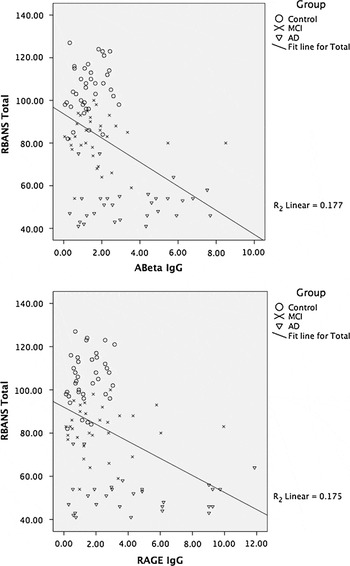
As a result of limitations in statistical power, we were unable to conduct separate regressions for each diagnostic group, but instead examined the relationship between IgGs and cognition using the entire sample of participants. As illustrated in Figure 2, the overall relationship between Global RBANS scores and both IgGs was negative, indicating that those participants with higher cognitive performance tended to have lower levels of both IgGs. Further analysis revealed that this correlation across groups did not hold when group status was added to the model, or when looking at the IgG–cognition relationship within each group separately. Thus, we did not proceed with regression analysis modeling of the prediction of domain-specific cognitive function by each IgG.
Scatterplots of the correlations between RBANS Total Scale scores and Aβ and RAGE IgGs. RBANS = Repeatable Battery for the Assessment of Neuropsychological Status; AD = Alzheimer’s disease; ABeta IgG = beta amyloid immunoglobulin; RAGE IgG = receptors for the glycation end product immunoglobulin; IgG = immunoglobulins; Aβ = beta amyloid; RAGE = receptors for the advanced glycation end products.

DISCUSSION
Our findings suggest that some individuals with amnestic mild cognitive impairment (aMCI) or AD have elevated levels of both anti-Aβ and anti-RAGE, but these levels are not consistently higher in all aMCI or AD individuals. As Figure 1 illustrates, there is a considerable amount of variability in IgG levels within diagnostic groups. Further refinement of the protein purification process used in our methodology may reduce this variability, but this remains an empirical question. Another possibility is that our MCI groups, regardless of classification systems, are heterogeneous groups, and some individuals in these groups will not progress to AD.
Our findings provide additional but limited support of previous findings that both anti-Aβ and anti-RAGE IgGs are related to global cognitive measures, as this relationship was demonstrated in this study to be largely accounted for by group differences in cognition. In our analysis of the relationship between cognition and IgGs, we were unable to account for group status in our models, or analyze the relationship between cognition and IgG levels in each diagnostic group separately. This was most likely due to limited sample sizes in each group. As Figure 2 demonstrates, the relationship between IgG levels and global cognition was quite different between diagnostic groups. Control participants tended to have high RBANS scores and low IgG levels, while AD participants tended to have low RBANS scores and variable IgG levels, ranging from some AD individuals with high IgG levels relative to controls, and other AD individuals with IgG levels similar to controls. Individuals in the MCI group tended to fall between control and AD groups on cognition and IgG levels, but similar to the AD group, there was considerable variability in their IgG levels. Thus, the exact relationship between cognition and IgG levels, while remaining thought provoking, was unclear from our results and warrants further investigation with larger samples in each diagnostic group. The large amount of variability in IgG levels in our MCI and AD groups may reflect heterogeneity in the disease process of AD, and future investigations could also investigate differences in cognition between MCI and AD participants with low versus high IgG values. Future investigations examining longitudinal changes in cognition in relation to anti-Aβ and anti-RAGE IgG levels over time will better demonstrate the unique relationships between different aspects of cognition and these two potential biomarkers for AD. It will be important to determine if elevations in anti-Aβ and anti-RAGE IgG levels predate changes in cognition in order to establish the clinical utility of these potential biomarkers, beyond being correlates of already evident cognitive impairments. In addition, it will be important to determine if these biomarkers are modulated in conjunction with cognitive changes over time in response to AD drug therapies, again to determine if they serve as a reliable monitor of disease progression. Finally, another important direction for future research is to examine the relationship between these and other blood biomarkers in AD (e.g., soluble RAGE). It is quite possible that a combined profile of interrelated biomarkers will aid in diagnosis and increase sensitivity and specificity for early disease detection.
ACKNOWLEDGMENTS
This project was supported in part by a Merit Review award from the Veterans Administration, the Medical College of Georgia Alzheimer’s Research Center, an Achievement Rewards for College Scientists (ARCS) scholarship, a University of Georgia Dissertation Completion Award, and a University of Georgia Graduate School Dean’s Award in Social Sciences. This article is dedicated to one of its coauthors, Dr. Jerry Buccafusco, who passed away suddenly and way too early, but was an indispensable senior member of this collaboration.