Introduction
Haemonchus contortus is a gastrointestinal nematode of goats and sheep with a worldwide distribution (Waller & Chandrawathani, Reference Waller and Chandrawathani2005). Infection with H. contortus in sheep and goats results in significant economic losses due to weight loss, reduced fertility, decrease in milk production and retarded growth (Holmes & Coop, Reference Holmes and Coop1994; Macedo-Barragan et al., Reference Macedo-Barragan, Arredondo-Ruiz, Ramirez-Rodriguez and Garcia-Marquez2009). Third-stage larvae of H. contortus are migratory in nature but infective to their hosts. The use of chemicals/pesticides to contain H. contortus in its microhabitat is always narrow and limited (Van Wyk, Reference Van Wyk2001; Leathwick et al., Reference Leathwick, Miller and Waghorn2011) and requires frequent anthelmintic applications. As a result, gastrointestinal worms develop resistance against anthelmintic drugs (Scheuerle, Reference Scheuerle2009). Therefore, alternative methods of control need to be investigated to avoid further complications in the fight against H. contortus. In order to avoid anthelmintic resistance in parasites and residual effects at animal grazing sites, alternative methods of control are being investigated. Biological control is one option, with numerous biological control agents that live side by side with H. contortus (Meyer, Reference Meyer2003), and these include predaceous and parasitic fungi (Mendoza de Gives & Torres Acosta, Reference Mendoza de Gives, Torres Acosta, Paz and Sol Áreas Vázquez2012), protozoa (Hoorman, Reference Hoorman2011), bacteria (Byoung Joo et al., Reference Byoung Joo, Rehish Kumar, Irfan Ahmad, Byung-Chun, Park, Se-Eun, Sang-Dal, Lim and Yong-Ha2012), predatory nematodes (Bilgrami et al., Reference Bilgrami, Brey and Gaugler2008) and predatory mites (Bilgrami, Reference Bilgrami1994; Momen et al., Reference Momen, Abou-Elela, Metwally, Naser and Saleh2011). Species of mites belonging to the genus Lasioseius (Berlese, Reference Berlese1916) are terrestrial and predatory (Imbriani & Mankau, Reference Imbriani and Mankau1983) on nematodes and other soil microbes, but no previous studies on predation by mites on animal parasitic nematodes have been undertaken. Therefore, the present aim was to investigate predator–prey interactions between predaceous mites and animal parasitic nematodes. Predator–prey interactions between a species of predatory mite, Lasioseius penicilliger (Berlese, Reference Berlese1916) and H. contortus, along with two species of bacteria-feeding nematodes, Panagrellus redivivus and Rhabditis sp., were studied, also focusing on the rate and prey preferences shown by L. penicilliger.
Materials and methods
This study was carried out at Centro Nacional de Investigación Disciplinaria en Parasitología Veterinaria (CENID-PAVET), from the Instituto Nacional de Investigaciones Forestales, Agrícolas y Pecuarias (INIFAP), Morelos, Mexico and the Department of Parasitology, Facultad de Medicina Veterinaria y Zootecnia, Universidad Nacional Autónoma de México (FMVZ-UNAM), Mexico City, Mexico. Lasioseius penicilliger was isolated and identified using keys in Hughes (Reference Hughes1976).
Culturing of mites and nematodes
Lasioseius penicilliger was cultured in 5.5-cm diameter Petri dishes containing 2% water-agar at room temperature, i.e. 27 ± 2°C, under dark conditions (Bilgrami, Reference Bilgrami1994). Bacteria-feeding nematodes, Rhabditis sp., served as food for the mites in culture dishes. Haemonchus contortus ‘Hueytamalco’ strain was obtained from the Department of Helminthology, CENID-PAVET-INIFAP, Mexico (Llerandi Juárez & Mendoza de Gives, Reference Llerandi Juárez and Mendoza de Gives1998). The bacteria-feeding nematode, P. redivivus was obtained from the Laboratory of Dr Roberto de Lara, Autonomous Metropolitan University, Xochimilco, Mexico. Rhabditis sp., another bacteria-feeding nematode, was isolated from the soil collected from Jiutepec, Morelos State, Mexico. Bacteria-feeding nematodes were cultured in 5.5-cm diameter Petri dishes containing 2% water-agar. Culture dishes were supplemented with a small amount of peanut butter to sustain the growth of bacteria, whereas H. contortus was cultured in plastic bowls using oat flakes and water as a substrate.
Experimental protocol
Three sets of experiments were conducted in 5.5-cm diameter Petri dishes containing 2% aqueous agar. Two sets contained either 1500 H. contortus infective larvae or 1000 adult nematodes of P. redivivus. In the third set, 1000 adults of Rhabditis sp. were inoculated. Five L. penicilliger adult mites were released into each Petri dish in order to record predation on nematodes. All experiments were replicated ten times. Petri dishes containing mites and nematodes were placed at room temperature, i.e. 27 ± 2°C, with 12 h light and 12 h dark cycles and examined every 24 h under stereoscopic binocular microscopes for predation by the mites.
After 5 days the nematodes were isolated using the Baermann technique and stored in 5-ml plastic tubes. Nematodes were counted in 1 ml of nematode suspension. The number of nematodes surviving was estimated in 5 ml of nematode suspension. The remaining mites were counted using Petri dishes under the stereoscopic binocular microscope. Control experiments involved similar sets of Petri dishes containing prey nematodes but without mites. A decrease (%) in nematode population due to predation by mites was estimated using the following formula: ((Final nematode population in control − Final nematode population in treatment)/Final nematode population in control) × 100.
ANOVA and Tukey's multiple comparison tests were used to determine differences in predation by mites using the Statistical Analysis System (SAS) (SAS Institute, 1998).
Results and discussion
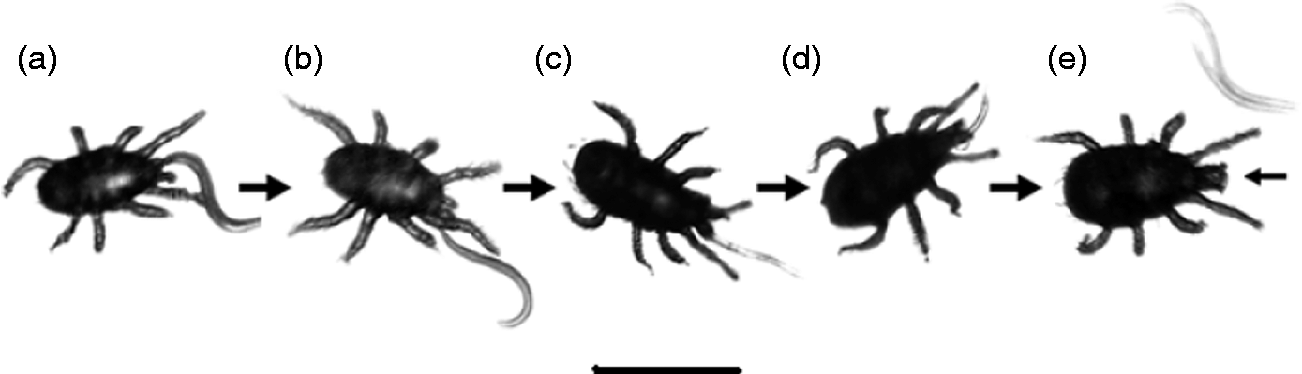
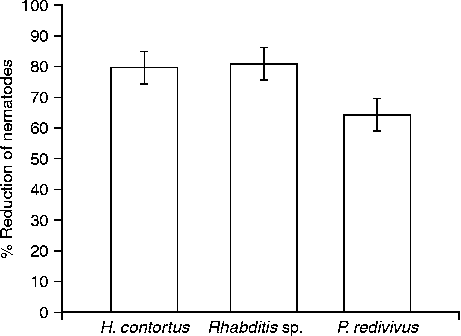
Lasioseius penicilliger was found to predate on L3 of H. contortus (fig. 1) and on all stages of the two species of bacteria-feeding nematodes. Prey searching by L. penicilliger is chance dependent and initial contact with nematodes was necessary to initiate an attack. Upon contact, each mite used its pedipalp and legs, respectively, to identify and hold its prey. This was followed by grasping and crushing the prey with its chelicerae. Ingestion of prey contents by each mite was intermittent with short pauses of inactivity. The time of feeding on prey nematodes varied with prey body size. When the nematodes were exposed to the mites, a significant reduction in the population of all three nematodes species was evident. Up to 80% of L3 of H. contortus were killed by the mites as compared with 81% of Rhabditis sp. (fig. 2). During a span of 5 days, L. penicilliger also killed P. redivivus by up to 64% when compared to controls (P < 0.05). Panagrellus redivivus was least preferred by the mites in comparison with other prey species (P < 0.05).
Predation of L3 of Haemonchus contortus by Lasioseius penicilliger. Scale bar = 500 μm.

Reductions in the populations of Haemonchus contortus, Rhabditis sp. and Panagrellus redivivus due to predation by Lasioseius penicilliger.
Predatory mites are organisms of special interest, since their population sizes can increase substantially (Wallwork, Reference Wallwork, Burges and Raweds1967); they kill and feed on other soil organisms, including plant and soil nematodes (Bilgrami & Tahseen, Reference Bilgrami and Tahseen1992); and they demonstrate potential as a successful biological control agent. The predatory ability of mites has been known since 1938 when Linford & Oliviera evaluated the predatory behaviour of the mite Tyrophagus putrescientiae (Sarcoptiformis: Acaridae) on root knot nematodes. Subsequent studies have focused on predation by mites on plant and soil nematodes (Rockett & Woodring, Reference Rockett and Woodring1966; Bilgrami, Reference Bilgrami1994, Reference Bilgrami1997). However, the present investigation is the first to evaluate the predatory potential of mites on animal parasitic nematodes such as H. contortus.
The present study has shown that L. penicilliger is predatory on L3 of H. contortus and adults of the bacteria-feeding nematodes P. redivivus and Rhabditis sp. Predation depended upon chance encounters with prey, as observed by Bilgrami (Reference Bilgrami1994, Reference Bilgrami1997). There was some aggregation of mites around a damaged prey, which suggests the ability of mites to perceive chemicals (Bilgrami & Tahseen, Reference Bilgrami and Tahseen1992). Similar to other predators, L. penicilliger showed attributes of a potential biological control agent by demonstrating moderate prey preference (Bilgrami et al., Reference Bilgrami, Brey and Gaugler2008). A significant decrease in the nematode populations after 5 days of predation by L. penicilliger shows the ability of mites to control third-stage larvae of H. contortus. As a possible biological control agent L. penicilliger has certain advantages over other mite species, e.g. a relatively short life span (ranged between 9 and 15 days) parthenogenetic reproduction, moderate to high rate of fecundity, longevity, significantly high rate of predation on both animal and soil nematodes, etc. (Christian & Karg, Reference Christian and Karg2006). Further work on the predatory abilities of mites should now be extended not only to juveniles of H. contortus but also to infective larvae and juveniles of other economically important animal parasitic nematodes.
Acknowledgements
The authors are grateful to Perla Maria del Carmen Acevedo Ramírez for donating mites from her cultures and Doctor of Veterinary Medicine Rosalia Rodríguez Martínez and Biotechnologist Gloria Sarahí Castañeda Ramírez, from the Department of Helminthology for maintaining mite cultures. We are also thankful to Consejo Nacional de Ciencia y Tecnología (CONACYT), Mexico for the grant it awarded to one of the authors (L.A.M.). Last, but not least, all the authors are very grateful to Dr Anwar L. Bilgrami, Department of Mosquito Control, New Jersey, USA for scientific and linguistic editing of the manuscript.