Introduction
Mental health has been cited as a risk factor for all-cause mortality. In clinical populations, there is considerable evidence for depression and depressive symptomology as risk factors for mortality, particularly for those individuals who present with cancer (Pinquart and Duberstein, Reference Pinquart and Duberstein2010), coronary heart disease (Barth et al., Reference Barth, Schumacher and Herrmann-Lingen2004), and stroke (Bartoli et al., Reference Bartoli2013). Depression has also been implicated as a risk for mortality in large population studies (Harris and Barraclough, Reference Harris and Barraclough1998; Saz and Dewey, Reference Saz and Dewey2001; Cuijpers and Schoevers, Reference Cuijpers and Schoevers2004). However, there are a number of limitations that have not been adequately addressed in the literature. It has been suggested that the mental health–mortality relationship could be attenuated by measurement and design issues (Wulsin et al., Reference Wulsin, Vaillant and Wells1999). Many studies also fail to control for the confounding effects of physical health and functioning (Batterham et al., Reference Batterham, Christensen and Mackinnon2012). Recently, the association between mental health and mortality has been accounted for by intra-individual variation in physical health (Burns et al., Reference Burns, Butterworth, Luszcz and Anstey2013; Reference Burns, Mitchell, Shaw and Anstey2014). That is, as individuals increasingly develop poor physical health in the years preceding death, they decline in mental health and well-being.
Batterham and colleagues (Reference Batterham, Christensen and Mackinnon2012) assessed one possible mechanism to explain the mental health–mortality risk association, proposing that physical health mediates the relationship between depression and mortality. They found that mortality risk for mental health was attenuated by an indirect pathway through physical health. Specifically, depression led to poorer physical health, which was associated with increased mortality risk. Closer examination of the physical health indicators in that study however revealed that physical health was operationalized across four domains, including history of heart attack and stroke. Given that past history of physical health was regressed on current depressive symptomology, we believe there is a need to re-examine this proposed depression–mortality pathway. Also, we believe that an equally plausible hypothesis is that current mental health is a consequence of physical health. Furthermore, we examine the concurrent intra-individual changes in both mental and physical health in the years preceding death. A limitation of findings into the mental health–mortality risk includes the use of time-invariant risk factors. That is, mortality risk is typically regressed on mental and physical health assessed at some distal point. This is a significant limitation given the episodic nature of depression and related mental disorders. The current study also recognizes the findings of prior research which emphasizes the need to clearly delineate gender differences in the epidemiology of late-life depression. While women report higher levels of depression across most of their adult lifespan (Bebbington, Reference Bebbington1998), the extent of gender differences in late-life, and their associations with physical health and mortality, is less clear. There is evidence that gender differences converge (van't Veer-Tazelaar et al., Reference van't Veer-Tazelaar2008; Pachana et al., Reference Pachana, McLaughlin, Leung, Byrne and Dobson2012), persist (Osborn et al., Reference Osborn2002; Zunzunegui et al., Reference Zunzunegui2007), or even reverse such that men are at greater risk of depression with increasing age (Anstey and Luszcz, Reference Anstey and Luszcz2002) and in the years preceding death (Burns et al., Reference Burns, Butterworth, Luszcz and Anstey2013). In the current study, we control for these issues by stratifying our analyses by gender.
For the current paper, we first replicate the Batterham study to consider the mortality risk with multiple observations of depression and physical health, utilizing data from a large community sample. Second, we compare Batterham and colleagues’ (2012) hypothesis, whereby physical health mediates the relationship between mental health and mortality, with an alternative hypothesis in which mental health mediates the association between physical health and mortality. Given the lack of consistency in findings related to gender differences in the course of late-life depression, we stratify our analyses by gender to examine the extent of gender differences in the relationships between mental health, physical health, and mortality.
Methods
Participants
Data were drawn from the DYNOPTA project (Anstey et al., Reference Anstey2010). DYNOPTA involves harmonizing data from nine Australian longitudinal studies on aging. The harmonization of the existing studies, by pooling data or parallel analysis, is increasingly recognized as an important method that contributes to, and addresses the limitations of, individual longitudinal studies (Noale et al., Reference Noale2005). Ethical approval was obtained for all individual studies from relevant supervisory bodies (see Acknowledgment), while ethical approval for the DYNOPTA project was approved by the Australian National University Human Research Ethics Committee in accordance with National guidelines and the ethical standards laid down in the 1964 Declaration of Helsinki. Baseline observations were made between 1990 and 2001, yielding 50,652 respondents in the pooled DYNOPTA dataset at baseline. As we are specifically interested in the course of late-life depression and mortality risk and intend comparing our results with other samples of older adults (Batterham et al., Reference Batterham, Christensen and Mackinnon2012), we restrict our sample to participants aged 70 years and older (range: 70–98 years). So for this study participants (N = 14,019) were mostly women (91%), aged 70–95 years (Mean (M) = 73 years; SD = 3 years) at baseline. Over the course of the study, approximately 80% were aged 70–79 years, 18% were aged 80–89 years, and 2% were aged 90+. Participants were observed on at least two occasions up to a maximum of four occasions for up to ten years (M = 9 years; SD = 2 years) from baseline to the final census date December 2006. The timing of measurement occasions occurred on average 3 years (SD = 1.5), 6 years (SD = 0.43), and 8 years (SD = 0.46) from baseline. All eventual decedents (n = 3,752, 26% of the current sample) were observed between 8 and 3,837 days (M = 2,054 days; SD = 1,065 days) from death. All decedents completed a minimum of two observations: 898 decedents (24% of the decedent sample) completed a total of three observations, and 313 (8% of the decedent sample) completed a total of four observations.
Measures
Mortality status
Mortality status was provided by the contributing studies to the DYNOPTA project. Methods of collecting mortality data included collection of death data from the National Death Index, death notices, and informants. Time to death was calculated from baseline observation until the date of death or 31st December 2006 for right-censored participants (survivors).
Mental health
We derived well-being variables from the Short-Form Health Survey-36 (SF-36; Ware et al., Reference Ware1998). The mental health index partly contributes to the SF-36 Mental Health Component Score. The mental health subscale has been validated against clinical measures of depression (Rumpf et al., Reference Rumpf, Meyer, Hapke and John2001) and has been used in epidemiological studies worldwide as an indicator of psychological distress (Skapinakis et al., Reference Skapinakis, Lewis, Araya, Jones and Williams2005; Gill et al., Reference Gill2006). The mental health subscale comprises five items, including “Been a nervous person,” “Felt so down in the dumps, nothing could cheer you up,” “Felt calm and peaceful,” “Felt down,” and “Been a happy person.” Participants indicated the extent to which they experienced each statement on a 6-point Likert-type scale, ranging from “0” (none of the time) to “6” (all of the time) over the preceding four weeks.
Physical health
Physical health was assessed with the SF-36 Physical Component Score (Ware et al., Reference Ware1998), which comprises measures of physical functioning, general health, role-physical, and bodily pain. Physical functioning rates the extent to which participants’ health limits their performance in a range of physical activities (e.g. to carry groceries, walk several blocks, bathe oneself). General health reflects how well participants rate their current health status, their susceptibility to disease, and their expectations for their future health. Role-physical reflects the extent to which participants’ health impacts on their capacity to perform physical activities. Bodily pain rates the extent to which participants’ health interferes with their day-to-day activities. Each of these scales has been validated against objective health indicators (Kravitz et al., Reference Kravitz1992), including cardiac disease (Zhang et al., Reference Zhang, Pozuelo, Brennan, Hoar and Hoogwerf2010), diabetes mellitus (Davidson, Reference Davidson2005), stroke (Kappelle et al., Reference Kappelle1994), low back pain (Garratt et al., Reference Garratt, Ruta, Abdalla, Buckingham and Russell1993), lung disease (Viramontes and O’Brien, Reference Viramontes and O’Brien1994), and renal disease (Osthus et al., Reference Osthus2012).
Covariates: socio-demographic and health variables
Time invariant covariates included baseline age, which was centered at 70 years as the reference for the youngest participant, partner status, which was defined as partnered (the reference category; coded as 0) and not partnered (coded as 1), and education status, which was coded as secondary school or less (the reference category; coded as 0;), non-tertiary study (coded as 1), and tertiary study (coded as 2).
Statistical analysis
Mental health and the physical health component scores were T-scored (M = 50; SD = 10) and standardized to baseline observation and coded so that high scores reflected negative/poor health status in order that positive coefficients (and Hazard Ratios (HR) > 1) could be interpreted as increased mortality risk. First we undertook a series of mediation models to replicate the findings of Batterham et al. (Reference Batterham, Christensen and Mackinnon2012). Three models were tested: Model B1 tested the unadjusted effect of mental health on mortality risk; Model B2 re-estimated Model B1, adjusting for age, education, and partner status; Model B3 re-estimated Model B2 and included a mediation model whereby physical health mediated the effect of mental health on mortality risk. Then our multi-level survival analyses were undertaken within a Structural Equation Modeling framework in Mplus v.7.1. Due to the complex nature of the survey design and nested nature of the data (i.e. non-independence of repeated observations within the same individual), maximum likelihood (MLR) estimates, standard errors, and model fit statistic were estimated and robust to non-normality and non-independence of observations. MLR standard errors were computed with a sandwich estimator. A series of models were estimated to (i) test the unadjusted univariate effects of mental health (Model 1) and physical health (Model 2) on survival; (ii) test the adjusted univariate effects of mental health (Model 3) and physical health (Model 4) on survival (adjusting for partner status, education, and baseline age); and (iii) compare two mediation models whereby either (a) physical health mediated the effect of mental health on mortality risk (Model 5) or (b) mental health mediated physical health on mortality risk (Model 6). Analyses are stratified by gender, whereby the subscript “a” in Model 1a, for example, denotes analysis undertaken on women only, and Model 1 without a subscript denotes analysis undertaken on men only.
Results
Mortality risk of mental health
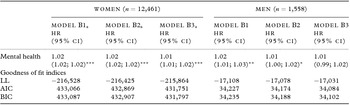
We initially attempted to replicate the analyses of Batterham et al. (Reference Batterham, Christensen and Mackinnon2012) by examining the baseline mortality risk for mental health. Results in Table 1 report the HR for mental health and model fit for three models tested by Batterham et al. (Reference Batterham, Christensen and Mackinnon2012), stratified by gender. Overall, our results confirm their findings. For men, the inclusion of both covariates and physical health accounted for the mortality risk of mental health (HR = 1.00; p = 0.120), while for women the mental health effect (HR = 1.01; p < 0.001) was highly significant, but reflected only a very small effect. Comparison of Goodness of Fit Indices (GFI) indicated that the mediation model, whereby physical health mediated the effect of mental health on mortality, was a better fitting model for both men and women than in unadjusted or direct effect-only models. We concluded that our sample produced comparable results to prior findings, and we therefore extended our analyses to consider our alternative hypothesis that mental health is more likely to mediate the effect of physical health.
Mortality risk for poor mental health following Batterham et al. (Reference Batterham, Christensen and Mackinnon2012)

Notes: ***p < 0.001; **p < 0.01; *p < 0.05.
Model B1: Mortality regressed on MH; Model B2: = Model B1 + adjusted for age, partner status and education; Model B3: = Model B2 + PH mediates regression of mortality on MH. LL: log likelihood; AIC: Akaike Information Criteria; BIC: Bayesian Information Criteria.
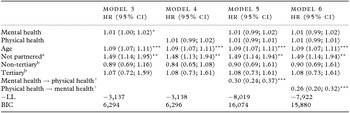
For men, unadjusted univariate analyses indicated small mortality risk for poor mental (Model 1: HR = 1.01 (95% CI = 1.00, 1.02); p = 0.012) and physical health (Model 2: HR = 1.01 (95% CI = 1.00, 1.02); p = 0.007). GFI indicated comparable model fit in these unadjusted analyses for both mental (−Log likelihood (LL) = 3,173; Bayesian Information Criteria (BIC) = 6,351) and physical health (−LL = 3,172; BIC = 6,349). Results from adjusted analyses are reported in Table 2. These results suggest that mental health was only weakly associated with mortality risk (p < 0.05). Any effect on mental health needs to be balanced by the non-substantive effect size and the sample size. Indeed, in the mediation models, neither mental health nor physical health revealed direct effects on mortality risk (Models 5 and 6). While the coefficient for physical health regressed on mental health (Model 5) was larger than that estimated with mental health regressed on physical health (Model 6), no significant difference in these effect sizes was observed (Z = 0.933; p = 0.351), suggesting that mental health and physical health yield comparably sized reciprocal effects. In the non-mediation models (Models 3 and 4), model fit was comparable. However, in the mediation models (Models 5 and 6), GFI indicated better fit for the model whereby mental health mediated the effect of physical health on mortality risk (Model 6). However, since neither physical nor mental health was associated with mortality risk in adjusted models, model comparisons are immaterial.
Cox proportional hazards regression models predicting time to death for men (n = 1,558)

Notes: +Effects of mediation paths reflect unstandardized estimates.
***p < 0.001, **p < 0.01, *p < 0.05.
aPartner status reference: partnered; bEducation status reference: secondary schooling. LL: log likelihood; AIC: Akaike Information Criteria; BIC: Bayesian Information Criteria.
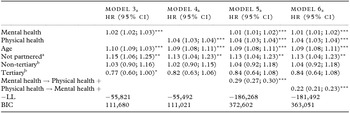
Similar to our findings for men, unadjusted analyses for women indicated only small mortality risk for poor mental (Model 1a: HR = 1.02 (95% CI = 1.02, 1.03); p < 0.001) and physical health (Model 2a: HR = 1.04 (95% CI = 1.04, 1.04); p < 0.001). In these unadjusted analyses, GFI indicated slightly better model fit for physical health as a risk factor for mortality (−LL = 55,608; BIC = 111,224) in comparison with mental health (−LL = 55,964; BIC = 111,936). Across adjusted and mediation models (Table 3), physical health consistently reported stronger direct effects on mortality risk than mental health. For the mediation analyses, the effect of mental health on physical health (Model 5a) was greater than the effect of physical health on mental health (Model 6a). In contrast to men, these effects were significantly different in women (Z = 6.90; p < 0.001), suggesting that for women, their mental health is a stronger driver of physical health. However, in spite of this stronger effect, and similar to men, GFI indicated superior fit for the model whereby mental health was regressed on physical health (Model 6a).
Cox proportional hazards regression models predicting time to death for women (n = 12,461)

Notes: +Effects of mediation paths reflect unstandardized estimates.
***p < 0.001, **p < 0.01, *p < 0.05.
aPartner status reference: partnered; bEducation status reference: secondary schooling. LL: log likelihood; AIC: Akaike Information Criteria; BIC: Bayesian Information Criteria.
Examination of the mediation of physical and mental health on mortality risk
Since significant effects for physical and mental health were reported in the mediation models for women only, we examined the extent of these mediation effects further in just women. Specifically, we examined whether the direct effects for mental or physical health on mortality risk was attenuated when they functioned as mediators. We did this by testing the significance of any change in the direct effect for the mediators on mortality in comparison with the earlier non-mediation models that tested the adjusted association between health and mortality risk. For example, the direct effect of mental health on mortality declined significantly in the mediation model (Model 3a (β = 0.021; SE = 0.002) versus Model 6a (β = 0.013; SE = 0.002): Z = 2.82; p = 0.004), suggesting that around 38% of the mental health effect on mortality is accounted for by physical health. A similar decline in the direct effect of physical health on mortality when it functioned as a mediator was also reported, although this failed to reach statistical significance (Model 4a: β = 0.038 (SE = 0.002) versus Model 5a: β = 0.036 (SE = 0.002); Z = 0.701; p = 0.478). This suggests that in spite of the stronger effect of mental health on physical health, this does not attenuate the physical health–mortality risk relationship. Overall, the mortality risk for physical health appears more robust and substantive, approximately four times stronger than the effect reported by mental health.
Discussion
In this study we sought to extend prior research on the association between mental health and mortality risk. First, we extended the current research base by including longitudinal data for a large sample of older adults on the assumption that increased information in the years leading to death will provide more detailed mortality-related information for deceased participants especially. Given the episodic nature of mental illnesses, such as depression, increased coverage for decedents, particularly in the years immediately preceding death, is important to efficiently estimate “true” population parameters. Second, we re-evaluated the association between mental and physical health on mortality risk. In contrast to prior research (Batterham et al., Reference Batterham, Christensen and Mackinnon2012), we postulated two main hypotheses. First, does mental health mediate the effect of physical health on mortality risk, and second, does physical health mediate the effect of mental health on mortality risk? For men we can conclude that there are no substantive associations for mental and physical health on mortality risk in adjusted or mediation analyses. A small effect for mental health in the adjusted model appears non-substantive and likely reaches statistical significance as a consequence of sample size. Although no mediation effects could be identified, GFI did indicate support for a model whereby mental health is regressed on physical health. In contrast, for women, associations between mental and physical health with mortality were reported in adjusted and mediation analyses with larger effect sizes, suggesting that this gender difference is not an artifact of greater statistical power. Physical health revealed stronger effects on mortality risk and accounted for half of the mental health-related mortality risks. Although mental health was a significantly stronger driver of physical health, as for the analyses of men, GFI indicated stronger support for a model, whereby mental health was regressed on physical health. Of particular note, no indirect effects were reported; physical and mental health revealed only direct effects on mortality risk.
The failure to identify any mediation effects contrasts with other findings (Batterham et al., Reference Batterham, Christensen and Mackinnon2012). These differences cannot be attributed to a different sampling frame, as our initial replication of Batterham et al. (Reference Batterham, Christensen and Mackinnon2012) confirmed their results for baseline mortality risk. For both men and women, mortality risk data were best reflected by a model in which physical health mediates the effect of mental health on mortality risk. Given our replication of these earlier findings in our sample, this provides more robust support for our findings and more defensible hypothesis that it is mental health that mediates the association of physical health on mortality risk. The findings from prior studies are not without other caveats. Much of the research into the depression–mortality link has failed to control for cofounding physical health states (Harris and Barraclough, Reference Harris and Barraclough1998; Saz and Dewey, Reference Saz and Dewey2001; Cuijpers and Schoevers, Reference Cuijpers and Schoevers2004), and where physical health has been controlled for, operationalization has limited the extent to which meaningful conclusions can be drawn (Batterham et al., Reference Batterham, Christensen and Mackinnon2012). Importantly, we have utilized longitudinal data that has examined mental and physical health repeatedly at multiple measurement occasions. Our findings demonstrate that the effect of mental health on mortality in a large observational study is weak at best, especially in contrast to the effect of physical health. However, even the effect of physical health was small in contrast to increasing age and other socio-demographic “control” variables. In line with the existing literature (Anstey and Luszcz, Reference Anstey and Luszcz2002; Burns et al., Reference Burns, Butterworth, Luszcz and Anstey2013), we have also identified gender differences in the way mental and physical health are related to mortality. Clearly, the association between mental health and mortality risk was more pronounced in women. Given the increasing heterogeneity of older populations, it is important to examine assumptions of generalization across different sample populations and socio-demographic populations, particularly with the reported gender differences identified in this study.
In spite of reporting a negligible effect on survival, for women, mental health actually reported a stronger effect on physical health than did physical health on mental health. This could be explained by the limitation of our study in which the analyses are based on self-report measures. It could be that current physical health assessments are based on self-assessments and that concurrently poor mental health is driving down women's assessments of their physical health, and conversely good physical health assessment is buoyed by positive mental health states. This effect can only be quantified by the inclusion of objective physical health states, which are not available in DYNOPTA.
The current study has compared two pathways by which mental health may place individuals at increased mortality risk. First, we examined the extent to which mental health mediates the effect of physical health on mortality. Second, we examined the extent to which physical health mediates the effect of mental health on mortality. We found little support for either hypothesis. Instead, we found that the mental health risk for mortality was fully attenuated by physical health in men and partially so for women. Physical health was implicated as a substantive mortality risk for women.
Conflicts of interest
No conflict of interest to declare.
Description of authors’ roles
All authors have read and approved the final version of this manuscript. Specifically, Richard A. Burns formulated the research question, determined the analytical methods, undertook the statistical analysis, and led the writing of the manuscript. Peter Butterworth contributed to the data collection, analytical method, and analyses, and to the writing of the manuscript. Colette Browning, Julie Byles, Mary Luszcz, Paul Mitchell, Jonathon Shaw, and Kaarin J. Anstey supervised the data collection and contributed to the writing of the manuscript.
Acknowledgments
This work was supported by a National Health and Mental Medical Research Council grant (#410215); the Australian Research Council Centre of Excellence in Population Ageing Research (project #CE110001029 to Richard A. Burns); and an NHMRC Fellowship (#1002560 to Kaarin J. Anstey). The data on which this research is based were drawn from several Australian longitudinal studies, including the Australian Longitudinal Study of Ageing (ALSA), the Australian Longitudinal Study of Women's Health (ALSWH), the Australian Diabetes, Obesity and Lifestyle Study (AusDiab), the Blue Mountain Eye Study (BMES), the Canberra Longitudinal Study of Ageing (CLS), the Household Income and Labour Dynamics in Australia study (HILDA), the Melbourne Longitudinal Studies on Healthy Ageing (MELSHA), the Personality and Total Health Through Life Study (PATH), and the Sydney Older Persons Study (SOPS). These studies were pooled and harmonized for the DYNOPTA project. All studies would like to thank the participants for volunteering their time to be involved in the respective studies. Details of all studies contributing data to DYNOPTA, including individual study leaders and funding sources, are available on the DYNOPTA website (http://DYNOPTA.anu.edu.au). The findings and views reported in this paper are those of the authors and not those of the original studies or their respective funding agencies.