Introduction
Smoking is a risk factor for many forms of head and neck cancer.Reference Jethwa and Khariwala1, Reference Wyss, Hashibe, Chuang, Lee, Zhang and Yu2 It can be difficult to change perceptions regarding smoking and this presents a barrier to the cessation process. Referral to a hospital clinic with suspected cancer can cause a high degree of anxiety.Reference Winn, Generosa, Mazzarelli, Trzeciak and Roberts3, Reference Haste, Lambert, Sharp, Thomson and Sowden4 Out-patient appointments can represent ‘teachable moments’,Reference Mcbride and Ostroff5–Reference McBride, Emmons and Lipkus7 where patients may examine their lifestyle and behavioural choices and be more suggestive to changing their habits. This tends to be under-utilised in cancer diagnosesReference Mcbride and Ostroff5, Reference Gritz, Fingeret, Vidrine, Lazev, Mehta and Reece6 and may present an opportunity to develop tools to assess and help patients with smoking cessation.
Willpower is an essential component in the process of smoking cessationReference Hughes and Naud8, Reference Smith, Carter, Dunlop, Freeman and Chapman9 and the first stage in the change model of overcoming addictions.Reference Prochaska, DiClemente and Norcross10 Although there have been significant advances in medical smoking cessation therapy, evidence suggests that smokers believe willpower is essential and sufficient to quit.Reference Hughes and Naud8 A lack of willingness or non-recognition of a behaviour as problematic can lead to lack of engagement with cessation services. This can be referred to as the pre-contemplative stage.Reference Prochaska, DiClemente and Norcross10 The contemplative stage is where individuals consider options for cessation and this may be influenced by significant life events.Reference Prochaska, DiClemente and Norcross10 Referral for a suspected cancer can be one such life event and understanding patient attitudes at this stage could be crucial in helping them quit smoking.
A number of tools have been developed to assess patient’s attitudes, perceptions and dependence towards smoking, including the Fagerstrom Test for Nicotine Dependence. This test consists of 6 questions with a total score of 0 to 10, from which patients are categorised using their cumulative score into 1 of 5 categories, with an increasing score indicative of greater dependence on nicotine.
Another questionnaire that examines attitudes towards smoking cessation is the 39-item Perceived Risk and Benefits Questionnaire.Reference McKee, O’Malley, Salovey, Krishnan-Sarin and Mazure11 The 39 questions are divided into sections assessing the perceived risks and benefits of smoking cessation, with scores on a 7-point Likert scale. An average perceived risk and average perceived benefit score for each patient is calculated. A greater perceived risk of negative side effects from quitting suggests lower cessation motivation, whereas greater perceived benefit is positively associated with motivation to quit.
In this study we set out to analyse the perceptions of current smokers referred to the urgent ENT clinic for assessment of a potential head and neck cancer.
Materials and methods
Current smokers referred by primary or secondary care during January to June 2019 with suspected head and neck cancer were asked to complete the Fagerstrom Test for Nicotine Dependence and the Perceived Risk and Benefits Questionnaire prior to being seen by medical staff. The Perceived Risk and Benefits Questionnaire specifically mentions risk of lung cancer. This was modified after discussion with the developer of the questionnaire to include the phrase ‘throat or lung cancer’, but otherwise the questionnaire was used in its original form. Data were anonymously collated and questionnaire scores calculated.
Two-tailed t-tests were used to assess for significant differences in smoking behaviour and scores for the Fagerstrom Test for Nicotine Dependence and the Perceived Risk and Benefits Questionnaire between genders. In addition, t-tests were conducted to relate the Fagerstrom Test for Nicotine Dependence and Perceived Risk and Benefits Questionnaire scores with patient demographics, smoking history and outcomes. Chi-square testing was used to determine significant differences in the categorical variables, such as methods used to quit smoking, longest duration of cessation and clinical outcomes.
Research ethics were not required following consultation using the online tool from the National Health Service health authority and Medical Research Council website.12
Results and analysis
There were 98 patients included in this study, of whom 55 (56.1 per cent) were female. Patient demographics are shown in Table 1. The average age was 50.8 years (median, 53 years; standard deviation (SD), 14.46; range, 21–82 years). The mean reported years of smoking was 28.8 (median, 30 years; range, 3–61 years) and 15 patients (15.3 per cent) reported current or previous cannabis use. Of the 98 patients, 15 (15.3 per cent) had cancer (5 laryngeal, 5 pharyngeal, 1 thyroid and 4 lymphomas). Men were significantly more likely to have a malignancy than women (p = 0.01). On average, participants had made three previous attempts to stop smoking, with willpower being the most popular method. There was no significant difference in the methods used to stop smoking between males and females. Out of seven patients in this study that had never previously attempted to quit, six were male. There was no significant association between gender and the longest length of smoking cessation (p = 0.88).
Population characteristics

The fagerstrom test for nicotine dependence
The average Fagerstrom Test for Nicotine Dependence total score was 3.5 (SD, 2.05; range, 0–9 years), with no significant difference between males and females (p = 0.53).
Patients with a higher education background (education beyond secondary or high school level) had a lower mean Fagerstrom Test for Nicotine Dependence score (p = 0.02). There was no significant association with cannabis use (p = 0.14) or alcohol intake (p = 0.76). Pearson’s correlation had no association between the Fagerstrom Test for Nicotine Dependence score and age (r = 0.19, p = 0.97) or years smoked (r = 0.34, p = 1.00).
There was no significant difference in the average Fagerstrom Test for Nicotine Dependence score between individuals with malignant and benign outcomes (p = 0.94). This finding held for subgroup analysis by gender (females, p = 0.75; males, p = 0.72). There was no significant difference in mean Fagerstrom Test for Nicotine Dependence scores between males and females with malignant outcomes.
The perceived risk and benefits questionnaire
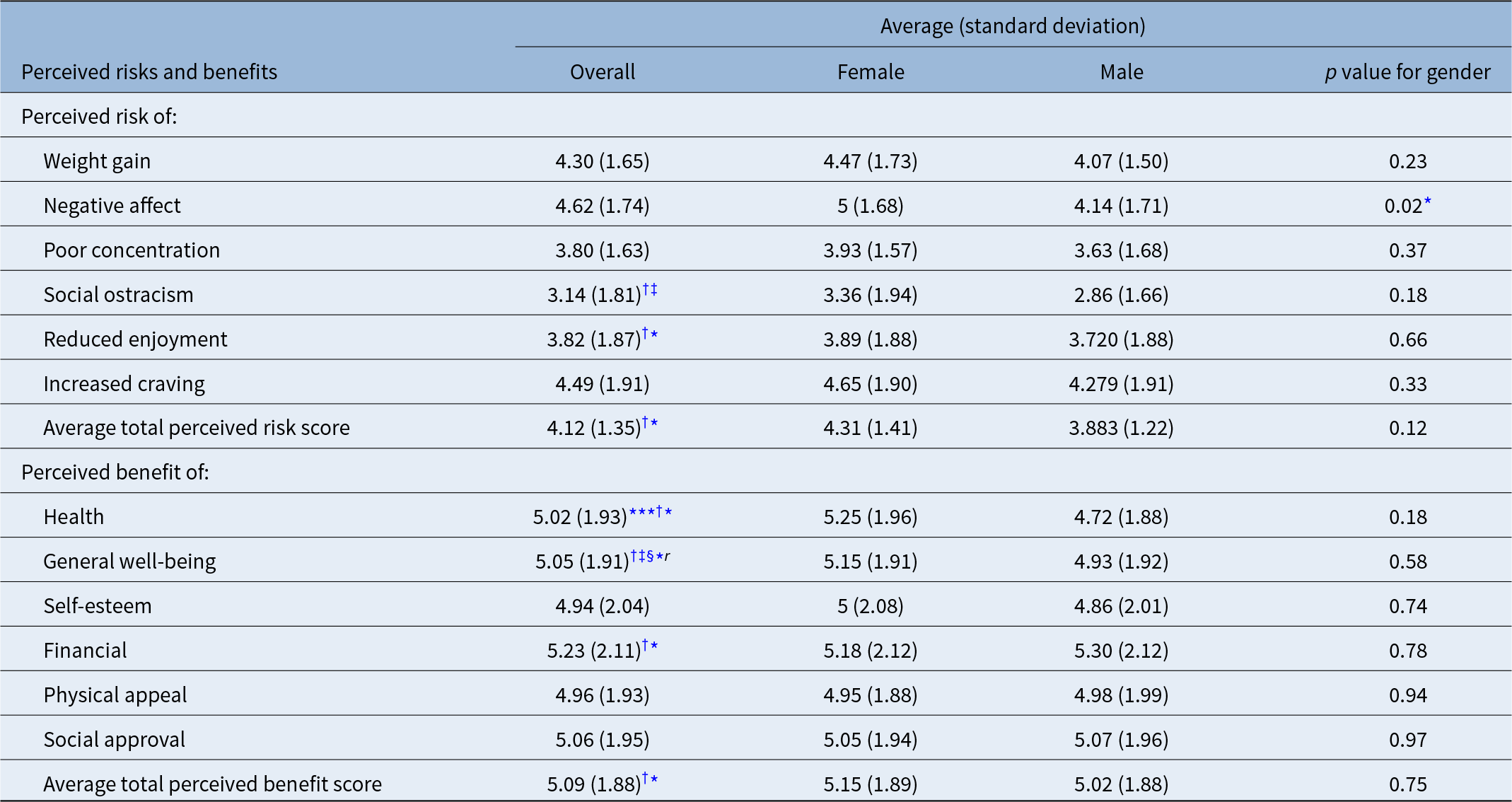
Women had higher overall total perceived risk (4.3 vs 3.9) and benefit (5.1 vs 5.0) scores, but there were no significant differences between the genders (p = 0.12 and 0.75, respectively). Women had a significantly higher score for concerns regarding the risks of the negative effects of smoking cessation compared with men (p = 0.02). The Perceived Risk and Benefits Questionnaire scores are displayed in Table 2.
Perceived risk and benefits questionnaire averages for male and female gender

* p < 0.05
** significant for higher education
† significant for cannabis use
§ correlation with years smoked
‡ p < 0.01, r = −0.2214
Patients who had been in higher education perceived greater health benefits from smoking cessation on average (p = 0.03). Participants who had ever smoked cannabis were significantly less likely to perceive risk of social ostracism (p = 0.01), loss of enjoyment (p = 0.02) and overall risk of negative effects (p = 0.03) from smoking cessation. Cannabis smokers also perceived that smoking cessation resulted in greater health benefits (p = 0.02), general well-being (p = 0.01), financial benefit with quitting (p = 0.05) and overall benefits (p = 0.03). Patients who had smoked for a longer duration perceived fewer general well-being benefits of smoking cessation (p = 0.015, r = −0.221). There was no correlation between age and any of the Perceived Risk and Benefits Questionnaire question categories.
No significant differences were found in any of the question categories between individuals with malignant and benign outcomes. This finding held for subgroup analysis by gender. There was no significant difference in any of the Perceived Risk and Benefits Questionnaire question set means between males and females with malignant outcomes.
Discussion
Main clinical findings
It is encouraging that large proportions of our population have low nicotine dependence because this has a greater likelihood of quitting smoking successfully.Reference Kozlowski, Porter, Orleans, Pope and Heatherton13 Information about degree of nicotine dependence is useful in identifying patients who might require more support for smoking cessation.
The mean Perceived Risk and Benefits Questionnaire scores in our population identified a greater number of perceived benefits of smoking cessation than risks (mean of 5.1 vs 4.1 out of 7, respectively). Studies have shown greater perceived benefit to be positively correlated with pre-treatment motivation to stop smoking, with the converse being true for a high perceived risk score in both men and women.Reference McKee, O’Malley, Salovey, Krishnan-Sarin and Mazure11 Other studies have shown smokers with a higher perceived risk score to experience higher levels of craving, withdrawal and depression during short-term abstinence.Reference Weinberger, Krishnan-Sarin, Mazure and McKee14 In our sample population, 30 people (30.6 per cent) scored maximally on total perceived benefits and 4 (4.1 per cent) scored maximally on total perceived risk scores of smoking cessation.
Overall, there were few statistically significant gender-based differences in our sample population, although we have seen evidence of males having a higher overall Fagerstrom Test for Nicotine Dependence score.Reference Bohadana, Nilsson, Rasmussen and Martinet15 Women were significantly more likely to have a perceived risk of negative effects from smoking cessation using the Perceived Risk and Benefits Questionnaire (p = 0.01), a finding also seen in the literature.Reference McKee, O’Malley, Salovey, Krishnan-Sarin and Mazure11, Reference Weinberger, Seng, Esan and Shuter16, Reference Filia, Baker, Gurvich, Richmond and Kulkarni17
Participants with higher education were significantly less dependent on nicotine based on the Fagerstrom Test for Nicotine Dependence score (p = 0.02) and more aware of the health benefits of smoking cessation (p = 0.03). Studies have shown general health education to be as effective as hypnosis, cognitive behavioural therapy and/or behaviour modification, environmental changes and other methods for smoking cessation among those withReference Schnoll, Rothman, Wielt, Lerman, Pedri and Wang18 and withoutReference Rabkin, Boyko, Shane and Kaufert19–Reference Kaufert, Rabkin, Syrotuik, Boyko and Shane22 cancer. This suggests that increasing health literacy surrounding smoking cessation at our clinics may positively impact nicotine dependence.
Previous or current history of cannabis smoking both reduced the perceived risks and increased the perceived benefits of smoking cessation. A recent study supports lower nicotine dependence in cannabis usersReference Meier, Vandrey, Rubin, Pacek, Jensen and Donny23 and another indicates that cannabis and e-cigarette co-users make more attempts to quit.Reference Reboussin, Wagoner, Ross, Suerken and Sutfin24 In the literature different motives have been identified for cannabis use.Reference Simons, Correia, Carey and Borsari25, Reference Zvolensky, Vujanovic, Bernstein, Bonn-Miller, Marshall and Leyro26 One study found that individuals whose motivation to smoke cannabis was creative expansion smoked fewer cigarettes per day.Reference Foster, Allan, Zvolensky and Schmidt27 Such individuals may be more susceptible to cessation interventions and identifying this subgroup early could be the key to success. Studies show that personalised feedback-based approaches are better at sustaining cessation efforts in smokers,Reference Dijkstra28, Reference Windsor, Cutter, Morris, Reese, Manzella and Bartlett29 which supports a tailored approach to our patients. There are several studies that show no difference in nicotine dependence between cannabis and non-cannabis users.Reference Flatz, Bélanger, Berchtold, Marclay and Surìs30–Reference Cousijn, Watson, Koenders, Vingerhoets, Goudriaan and Wiers32
A final diagnosis of malignancy seemed to have little to no impact on smoking perceptions based on the Fagerstrom Test for Nicotine Dependence and the Perceived Risk and Benefits Questionnaire. This would be explained by the fact that patients completed the questionnaires prior to assessment and management at the urgent head and neck clinic. However, future studies should assess changes in smoking perception after patients have received their final diagnosis to determine if it has a significant impact.
Previous literature shows that cancer is an under-utilised ‘teachable’ opportunity for smoking interventions.Reference Mcbride and Ostroff5, Reference Gritz, Fingeret, Vidrine, Lazev, Mehta and Reece6 Continuing smoking after cancer diagnosis is shown to have a substantial negative effect on treatment response and survival.Reference Gritz, Fingeret, Vidrine, Lazev, Mehta and Reece6 Although it is difficult to identify the optimum timing for the ‘teachable moment’ in cancer patients,Reference Rabin33 early assessment, tailoring and follow up would give the best chance of breakthrough before the known information overload associated with cancer diagnosis and treatment can occur. Established literature suggests early intervention for smoking cessation is more likely to be successful in head and neck cancer patientsReference Garces, Schroeder, Nirelli, Croghan, Croghan and Foote34 and other cancers.Reference Cox, Patten, Ebbert, Drews, Croghan and Clark35–Reference Schnoll, Zhang, Rue, Krook, Spears and Marcus37 Although only a small proportion of our cohort had a final malignant diagnosis, we would argue that the process of a referral to and assessment at a specialist cancer clinic alone can be enough to act as a ‘teachable moment’ for many of these patients.
The fagerstrom test for nicotine dependence
The Fagerstrom Test for Nicotine Dependence has been widely validated in assessing cigarette addiction.Reference Washington38 Despite this, this test lacks aspects of dependence, such as cessation attempts without success and desire to reduce use.Reference Wilcox and Redmond39 Additionally, the scoring system is dichotomous and research has suggested revisions such as Likert scale responses, which could lead to improvements in reliability and stronger association with outcomes.Reference Korte, Capron, Zvolensky and Schmidt40, Reference Etter, Vu Duc and Perneger41 However, the Fagerstrom Test for Nicotine Dependence has been shown to be a valid predictor of smoking cessation,Reference Kozlowski, Porter, Orleans, Pope and Heatherton13 therefore using it as a tool in patients to determine nicotine dependence can help guide individualised cessation support. Wilcox et al. determined a cut-off score of 7 or greater to indicate nicotine dependence.Reference Wilcox and Redmond39 Our results show a relatively low nicotine dependence with a median score of 3 (interquartile range = 3). Finally, both in our study and previous literature the Fagerstrom Test for Nicotine Dependence has been found to be completed well, with few missing answers, indicating a good degree of acceptability.Reference Etter, Vu Duc and Perneger41
The perceived risk and benefits questionnaire
The Perceived Risk and Benefits Questionnaire was developed in 2005 by McKee et al. as the result of a lack of standardised questionnaires that explored smokers’ perceived risks and benefits of cessation.Reference McKee, O’Malley, Salovey, Krishnan-Sarin and Mazure11 Gender differences have notably been seen in various studies, with larger differences observed in treatment-seeking populationsReference McKee, O’Malley, Salovey, Krishnan-Sarin and Mazure11, Reference Toll, Salovey, O’Malley, Mazure, Latimer and McKee42, Reference Weinberger, Mazure and McKee43 and mental illness.Reference Filia, Baker, Gurvich, Richmond and Kulkarni44 Females have been found to have higher perceived risk scores, particularly surrounding weight gain,Reference McKee, O’Malley, Salovey, Krishnan-Sarin and Mazure11, Reference Toll, Salovey, O’Malley, Mazure, Latimer and McKee42–Reference Baha and Le Faou45 which is validated by our population. Our results show females perceive a greater risk of negative side effects of smoking cessation, similar to previous literature.Reference McKee, O’Malley, Salovey, Krishnan-Sarin and Mazure11 This increased perceived risk of negative effects is linked to a greater expectation of the difficulty of remaining abstinent, decreased expectation of cessation success and lower confidence for quitting.Reference Weinberger, Mazure and McKee43 Nicotine Replacement Therapy (NRT) has been found to have specific protective effects on cessation among women concerned about weight gain and men concerned about withdrawal,Reference Baha and Le Faou45 which would both be applicable to our sample population given that a combined total of 31 patients (31.6 per cent) scored maximally (7 out of 7) in these two categories.
Another study in Malaysian smokers seeking treatment found no association between risks and benefit scores to cessation,Reference Yasin, Masilamani, Ming, Koh and Zaki46 but went on to implement smoking cessation counselling as well as free NRT and found that those with the greatest decrease in perceived advantage of smoking based on the Decision Balance Questionnaire had a significantly higher rate of cessation at two months.Reference Tasin, Masilamani, Ming and Koh47 This demonstrates that a change in perception is achievable and can lead to more successful cessation.
Further research is required to link perception scores to those of preparedness to quit smoking.Reference Prochaska, DiClemente and Norcross10 Other research shows that preparedness to quit increases the perceived importance of, readiness to and confidence toward cessation, which in turn increases both quit attempts and successful change.Reference Boudreaux, Sullivan, Abar, Bernstein, Ginde and Camargo48
• Referral to a specialist service for suspected cancer can be an opportunity for reassessing smoking behaviour
• This study aimed to determine individual intervention needs for patients referred urgently to ENT and to identify smokers who may be more susceptible to early cessation efforts
• Men are more nicotine dependent and may require additional cessation support
• Women may require additional counselling regarding the negative effects of smoking cessation, for example nicotine craving or weight gain
• Patients with a higher education are more receptive to cessation interventions and should be identified early
Conclusions
This is the first study to assess smoking attitudes in the setting of an urgent ENT referral for suspected head and neck cancer. We aimed to develop a better understanding of the characteristics and attitudes of our smoking patient population at the time of referral. Standardised smoking surveys as part of specialist referrals to head and neck cancer clinics could be an effective and pragmatic way of identifying patients who may be more receptive to cessation interventions and quitting successfully. Our findings suggest that men are more nicotine dependent and therefore may need more support, while women are more likely to benefit from counselling regarding the perceived negative side effects of smoking cessation. Patients with a history of cannabis use as well as those with higher education are more susceptible to cessation interventions and should be identified early.
Referrals to specialist cancer services can be a turning point for many patients, irrespective of the final diagnosis. Taking full advantage during this time to maximise opportunity, and tailoring advice and management for each patient, may improve success in smoking cessation.
Competing interests
None declared.