Introduction
Female sterilization is one of the most common methods of contraception in the developing world, owing to its long-term effectiveness and low cost (Hosseni et al., Reference Hosseni, Torabi and Bagi2014; Joshi et al., Reference Joshi, Khadilkar and Patel2015). According to United Nations estimates (United Nations, 2013), about 1 in 5 women worldwide are sterilized, with a large proportion being in Asia (28% of women in China and close to 36% in India) and Latin America (47.4% in the Dominican Republic, 35% in Colombia and 24% in Nicaragua). It is thus a highly important option for contraception, provided that the decision to undergo sterilization is voluntary and informed. However, doubts remain regarding the extent to which the method is promoted through coercion and lack of informed choice on the procedure (Hardee et al., Reference Hardee, Harris, Rodriguez, Kumar, Bakamjian, Newman and Brown2014; WHO, 2014). There have been allegations and proven cases of coercion associated with female sterilization over the years in countries around the world: Namibia (Mallet & Kalambi, Reference Mallet and Kalambi2008), South Africa (Essack & Strode, Reference Essack and Strode2012), United States (Salvo et al., Reference Salvo, Powers and Cooney1992; Stern, Reference Stern2005), Peru (Miranda & Yamin, Reference Miranda and Yamin2004) and India (Koenig et al., Reference Koenig, Foo and Joshi2000; Singh et al., Reference Singh, Ogollah, Ram and Pallikadavath2012). Yet, it is among the most used methods among women in the developing world, so it is important to ensure that women are making an informed choice when opting for sterilization.
This paper assesses the recent evidence from countries in the developing world about women’s informed choices about sterilization. In a climate of discussion around the extremes of forced and coerced female sterilization, there remains a lack of empirical research on the topic of informed choice, and reports tend to be limited to specific human rights violations, health policies or analyses of limited samples. The study aimed to bridge that gap and provide a comprehensive picture of sterilization using the best and most current quantitative data to examine informed choice and female sterilization in seven countries in Latin America and South Asia. The research was motivated by the underlying mechanisms of coercion (Hardee et al., Reference Hardee, Harris, Rodriguez, Kumar, Bakamjian, Newman and Brown2014; WHO, 2014) and highlighted specific groups of women who are not given sufficient information to make informed decisions about this permanent method.
Coerced sterilization, informed choice and contraceptive counselling
Coercion in the context of sterilization is defined as ‘actions or factors that compromise individual autonomy, agency or liberty in relation to contraceptive use or reproductive decision-making through force, violence, intimidation or manipulation’ (Hardee et al., Reference Hardee, Harris, Rodriguez, Kumar, Bakamjian, Newman and Brown2014). It has been especially problematic within family planning programmes in many countries for decades, where in some cases population control strategies are synonymous with female sterilization (Basu, Reference Basu1984; Singh et al., Reference Singh, Ogollah, Ram and Pallikadavath2012). Moreover, incentive payments in India, Bangladesh, Nepal and the Philippines have raised concerns that women in those countries are unduly pressured into being sterilized (Hardee et al., Reference Hardee, Harris, Rodriguez, Kumar, Bakamjian, Newman and Brown2014). Throughout the world, women who are poor, indigenous and/or rural residents have historically been more vulnerable to coercive sterilization (Miranda & Yamin, Reference Miranda and Yamin2004; Pieper Mooney, Reference Pieper Mooney2010; Hardee et al., Reference Hardee, Harris, Rodriguez, Kumar, Bakamjian, Newman and Brown2014). Questions thus remain about how to reconcile promotion of female sterilization as a family planning method with this problematic history. As programmes move forward, an important place to begin is the interaction between a woman and her health care provider and, specifically, whether that provider ensures the woman receives comprehensive information to make an informed choice about whether or not to be sterilized.
A woman’s ability to freely and responsibly choose a contraceptive method depends upon several components, the prime one being the information supplied to her by a medical provider. In Brazil, female sterilization is a popular method, particularly for women giving birth in a private hospital and who have health insurance (Amaral & Potter, Reference Amaral and Potter2015), indicating the importance of discussion about family planning options with a health provider. In Ethiopia, home visits by family planning workers are associated with an increase in use of long-acting reversible and permanent contraceptives, including female sterilization (Teferra & Wondifraw, Reference Teferra and Wondifraw2015). While proper information about family planning methods and choice is important when deciding whether to choose sterilization, it is unclear how many women are actually being adequately counselled. A review in India found that women were not informed about other methods and spacing options; only limited information was passed on to women from health workers about possible side-effects and how to deal with them, and quality of care was poor during and following the operation (Koenig et al., Reference Koenig, Foo and Joshi2000). A case control study in Bangladesh found that sites in which female field workers paid regular visits and emphasized a variety of contraceptive methods, and where awareness of clinics to treat complications arising from sterilization was acute, were more successful in increasing contraceptive use compared with control areas where there were no field workers (Koenig et al., Reference Koenig, Rob, Khan, Chakraborty and Fauveau1992). According to this study, these factors even outweighed the importance of socioeconomic status and education on increases in family planning, which is of critical importance given the policy focus on education in increasing contraceptive use. Studies ranging from Pakistan (Saeed et al., Reference Saeed, Fakhar, Rahim and Tabassum2008), South Africa (Credé et al., Reference Credé, Hoke, Constant, Green, Moodley and Harries2012) to the United States (Lee et al., Reference Lee, Parisi, Akers, Borrerro and Schwarz2011) have shown that there is an increase in contraceptive uptake among women who are provided with counselling and education about modern family planning methods, pointing to the importance of counselling and speaking to a health provider for making an informed choice.
National family planning programmes and the rise in female sterilization
Many countries emphasize female sterilization as part of their family planning programmes. There is no single factor that can explain the rise of this method in the two diverse regions of South Asia and Latin America. Rather, the push towards increasing accessibility of female sterilization, and in some cases explicitly promoting it, are rooted in a variety of historical and cultural factors. From the pragmatic consideration of the procedure’s effectiveness and pressure to meet targets in India, to government efforts meant to systematically reduce fertility within indigenous, disabled and HIV-positive women in Latin America, context varies and country-specific examination is imperative. What follows is a brief review of the countries analysed in this paper.
South Asia
In Asia – particularly India and Nepal – governments have put considerable effort into the promotion of female sterilization in family planning programmes. India began a state-sponsored campaign to lower fertility in the 1950s, which succeeded in steadily reducing the country’s TFR from approximately 6.5 children per woman to less than 3 children per woman in 2010 (Visaria et al., Reference Visaria, Jejeebhoy and Merrick1999). However, in a 1992 report the Indian government acknowledged significant problems in the programme: namely, the use of numerical targets that incentivized health workers to coerce couples into accepting sterilization in order to avoid negative career consequences. This led not only to misreporting and data manipulation, but also to a concerning disregard for the health and agency of women (Visaria et al., Reference Visaria, Jejeebhoy and Merrick1999). Indeed, since the government began to heavily promote sterilization as a preferred method of family planning for Indian women, there have been reports of coercion and poor quality of care for women. The twelve deaths following a mass sterilization camp in 2014 brought malpractice to light and illuminated shoddy procedures that left marginalized women the most vulnerable to coercion (Barry & Raj, Reference Barry and Raj2014).
In Nepal, women have access to family planning services through a public sector health care system, as well as several NGOs. While those services were only offered in clinics during the early years of the country’s family planning outreach, they are now offered in mobile outreach camps that target women in rural areas (Thapa & Friedman, Reference Thapa and Friedman1998). Similar to India, mobilizing the delivery of female sterilization has been integral to the reduction of fertility rates in Nepal. While Thapa and Friedman (Reference Thapa and Friedman1998) found no evidence of increased risk of coercion or complications in these camps, they also indicated that the majority of camps neither offered nor provided other methods of family planning. A more recent study found that there were no efforts to promote temporary methods of family planning, and most were not available in mobile clinics (EngenderHealth, 2003). In interviews, providers said that women did not return for follow-up visits and discontinuation rates were high, ultimately arguing for higher quality contraceptive counselling (EngenderHealth, 2003).
Latin America
In contrast to South Asia, Latin American programmes target more specific population groups: indigenous women, women living with HIV and women with disabilities (WHO, 2014). In Latin America, a mixture of religious influences, international aid and national family planning programmes has resulted in high rates of female sterilization adoption and several cases of coercion, with the most egregious being that in Peru under the Fujimori regime (Boesten, Reference Boesten2007). In Peru, commitment expansion of family planning services to all women began in the 1980s with the creation of the National Family Planning Program. Aided by donations and a supportive presidential administration, newly available contraceptives successfully reached poor and rural women (the same demographic groups targeted in South Asia) who had previously lacked access (Gribble et al., Reference Gribble, Sharma and Menotti2007). Female sterilization was not officially legalized until 1995; however, widespread reports of coerced and forced sterilization of indigenous women emerged during this period (Miranda & Yamin, Reference Miranda and Yamin2004). The Peruvian government has hedged several times in its willingness to acknowledge these events, but in 2015 it created a registry of women who had been forcibly sterilized and is now gathering further evidence in order to properly determine the extent to which it was practised (Lizarzaburu, Reference Lizarzaburu2015).
Since the 1960s, Colombia has enjoyed steady progress in reducing fertility with well-run family planning programmes. Sterilization is the most common family planning method in Colombia, and has grown in popularity over the past three decades. With that growth has come a decline in the use of temporary methods traditionally provided by private sector pharmacies, and the public sector now accounts for the majority of family planning service delivery (Bertrand, Reference Bertrand2011). However, doubts regarding the voluntary nature of sterilization were raised in the mid-1980s after Profamilia, the leading private sector provider, began mobilizing medical teams and equipment to reach hospitals in remote areas of the country (Rizo & Roper, Reference Rizo and Roper1986). In addition, there have been reports of forced sterilizations, some of which targeted girls with learning disabilities (IWHR, 2013).
Private clinics were the first to offer sterilization in the late 1970s in Nicaragua. Currently, most family planning – including female sterilization, which is the most popular method – is accessed through public Ministry of Health units (Santiso-Galvez et al., Reference Santiso-Galvez, Ward and Bertrand2015). Still then, concerning reports of forced sterilization of HIV-positive women have surfaced (Kendall & Albert, Reference Kendall and Albert2015). These countries demonstrate how governments in concert with international aid provide family planning to women, with increasing demand for, and emphasis on, female sterilization.
Conversations about sterilization and family planning in general have been difficult in conservative and religious countries in Latin America, particularly in Bolivia and Honduras. Due to pro-natalist governments and pressure from the Roman Catholic Church, Bolivia had a relatively late start in terms of effective family planning programmes. Bolivia has a large indigenous population that has proved difficult to reach; moreover, that population resisted family planning in general for many years (Terborgh et al., Reference Terborgh, Rosen, Gálvez, Terceros, Bertrand and Bull1995). Although sterilization does not dominate method mix in Bolivia, as it does in some other Latin American countries, there are some reports of forced sterilization of indigenous Quechua women in the country by Peace Corps volunteers during the 1960s (Geidel, Reference Geidel2010). These reports are unsubstantiated, but given the prevalence of coerced sterilization among indigenous women, as solidly evidenced in neighbouring Peru, Bolivia remains in the current analysis. Family planning programmes in Honduras, funded by USAID, had minimal success until the 1990s due to political and religious barriers, as well as implementation challenges. Quality clinical services were not available in rural areas, and Ministry of Health clinics provided low-quality services with limited patient education (Martin et al., Reference Martin, Buttari, Macias and Cobb1993). Female sterilization is currently one of the most widely used family planning methods in the country (Coa & Ochoa, Reference Coa and Ochoa2009).
There have clearly been allegations and proven cases of coercion associated with female sterilization in several countries around the world. Yet, female sterilization remains an integral part of any family planning programme. It is therefore important to ensure that women are making an informed decision to use this method. In this study, decision-making surrounding sterilization was explored for women by assessing recent evidence from the developing world. Specifically, the study determined whether women were informed: 1) that sterilization is a permanent method of contraception, 2) of the potential side-effects of sterilization and 3) of other available methods of contraception. To the authors’ knowledge, this is the first study to examine this issue closely and to this extent in conjunction with female sterilization.
Methods
Sample and data
The most recent waves of the Demographic and Health Surveys (DHS) were used for the analyses. The DHS are nationally representative datasets collected by ICF International in partnership with the ministries of health from the respective countries using a stratified random sampling approach. The following country-specific inclusion criteria for women between the ages of 15 and 49 were used: countries where female sterilization was reported as one of the main methods of modern contraception, where women who reported being sterilized also answered the three questions regarding informed choice, and countries with an historical emphasis on female sterilization as part of the national family planning programme or where coercive sterilization was practised. These include countries in South Asia: India (2005), Nepal (2001, 2006); and Latin America: Peru (2000, 2009, 2012), Colombia (2000, 2005), Bolivia (2003, 2008) Nicaragua (2001) and Honduras (2005, 2011). The cross-sectional surveys were pooled for each country and analyses at the country level included year-level fixed effects. The sample was restricted to women who were sterilized within 5 years of the survey to ensure limited recall bias. The total sample size of sterilized women varied by country: India (9577), Nepal (1046), Bolivia (727), Colombia (8797), Honduras (2672), Nicaragua (989) and Peru (4027).
Dependent variable
Key variables of informed choice in specific countries were identified based on questions that conform to the 2014 interagency statement on ‘Eliminating Forced, Coercive and Otherwise Involuntary Sterilization’ from the World Health Organization and six other United Nations programmes (WHO, 2014), which specifies that counselling on sterilization should include three important points: a) the procedure is considered permanent; b) there are potential side-effects of sterilization; and c) alternative temporary methods of contraception are available (WHO, 2014). The answers to three questions on informed consent were the basis of three dependent variables among women who reported being sterilized, coded as ‘0’ if the respondent was not informed and ‘1’ if the respondent was informed. The first examined whether the respondent was made aware by a health or family planning worker that sterilization is a permanent method: ‘Before your sterilization operation, were you told that you would not be able to have any more children because of the operation?’ The second question asked whether the respondent was informed about side-effects associated with female sterilization: ‘Were you ever told by a health or family planning worker about side-effects or problems you might have?’ Finally, the respondent was asked whether she had been informed of other available contraceptive methods: ‘Were you told about other methods of family planning which you could use?’ A composite index to capture informed choice based on responses to these three questions was created, in line with the Method Information Index (MII) adapted from the FP2020 2014–15 Report (Track20, 2015). This index had four levels of informed choice prior to sterilization in ascending order: 0 (not informed across any of the three indicators), 1 (informed on one indicator), 2 (informed on two indicators) and 3 (informed across all three indicators).
Independent variables
Two main sets of independent variables were used in the analysis to determine which respondent characteristics were associated with increased or decreased levels of informed consent. The first set consisted of sterilization-related variables, specifically age at sterilization (<25, 25–29, 30–34 and 35+ years), parity at sterilization (2, 3, 4, 5+ children) and source of sterilization (public sector, private sector, other). In a review of nineteen studies analysing the relationship between sterilization and regret, Curtis et al. (Reference Curtis, Mohllajee and Peterson2006) concluded that younger age at sterilization was significantly associated with regretting that decision at a later age. There is also some evidence that programmes systematically target women at higher parity for sterilization (Donaldson, Reference Donaldson2002). Source of sterilization and its relationship to informed choice are important to consider given the history of coercion within public family planning programmes, as well as for directing policy recommendations (Sullivan et al., Reference Sullivan, Bertrand, Rice and Shelton2006).
The second set of independent variables included demographic characteristics to serve as controls. These included respondent’s wealth quintile, type of residence (rural vs urban) and education (none, primary, secondary, higher). Evidence from Latin America shows that sterilization is more common among wealthy women, but some reports suggest that although poor women were less likely to be sterilized, those who had undergone the procedure were less informed and in many cases coerced (da Costa Leite et al., Reference da Costa Leite, Gupta and do Nascimento Rodrigues2004; Miranda & Yamin, Reference Miranda and Yamin2004). Sterilization camps in India specifically target poor women, many of whom live in rural areas with little opportunity for education (Barry & Raj, Reference Barry and Raj2014). Thus, while wealthy women may be the majority of those who opt for sterilization, it is important to highlight the different decision-making processes – or lack thereof – among women of different wealth and education levels.
Analysis
The analytic strategy was three-fold. First, the demographic (education, wealth quintile, type of residence) and sterilization-specific (age and parity at sterilization, source of sterilization) characteristics of women who were sterilized by country were determined. Next, the proportions of women in each country by the three indicators that constitute the MII, as well as the composite index, were calculated. Finally, an ordinal logistic regression analysis was performed to determine the odds of informed choice after controlling for key background and sterilization-related variables. For countries with multiple survey years, year-level fixed effects were included. Person-level weights for descriptive and regression analysis were applied using Stata 13 software.
Results
Descriptive results
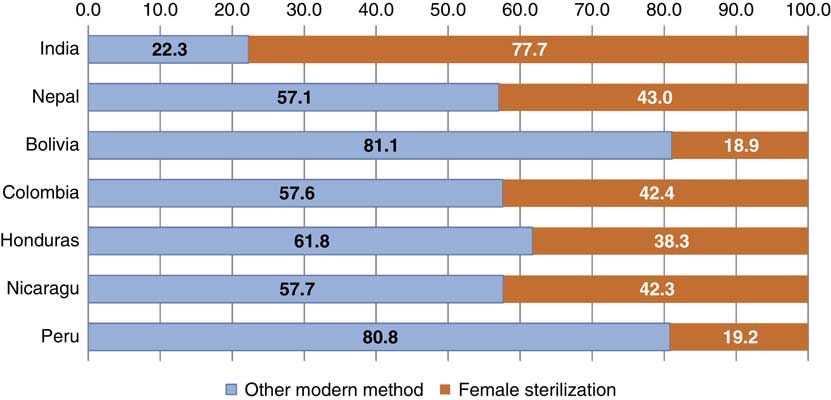
Of modern contraceptive users in each country, more women in Latin America and South Asia used female sterilization as their contraceptive method compared with other modern methods (Fig. 1). India is a striking example, with about 77% of women being sterilized compared with 23% using all other modern methods (pill, IUD, injectables, condoms). Close to half of all modern contraceptive users in Nepal (43.0%), Colombia (42.4%) and Nicaragua (42.3%) reported using female sterilization, followed closely by Honduras (38.3%). Peru (19.2%) and Bolivia (18.9%) reporting the lowest proportions, but still constituting close to one-fifth of modern contraceptive methods in those countries.
Share of female sterilization and other modern methods for modern contraceptive users by country (2000–2012).
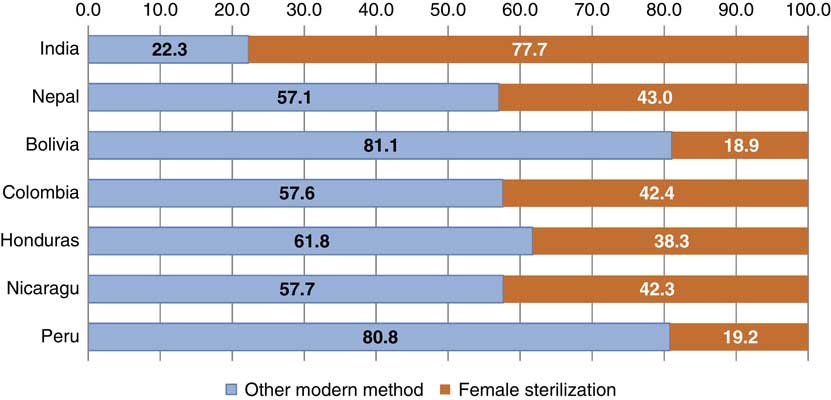
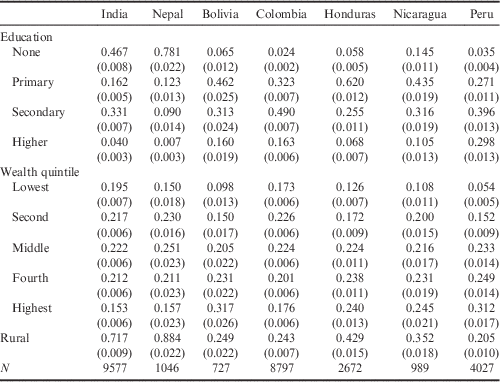
Table 1 shows the demographic characteristics of sterilized women, comparing sterilized women with other modern method users and contraceptive non-users. Three main patterns are apparent. First, most women in the sample who were sterilized had at least a primary education, with the exception of those in Nepal and India, where 78% and 47%, respectively, reported no formal education. These characteristics were significantly different for women who were sterilized compared with other modern method users and contraceptive non-users in all countries save for Nicaragua. Second, there did not seem to be a clear relationship between wealth and sterilization, with women in the higher wealth quintiles being sterilized as often as those in the second and middle quintiles. However, some countries – Bolivia, Nicaragua and Peru – had notably smaller percentages of sterilized women in the lowest quintiles. These characteristics were significantly different from other modern method users and contraceptive non-users in India, Colombia, Honduras, Nicaragua and Peru, and significantly different from contraceptive non-users in Nepal and Bolivia. Finally, sterilization was not necessarily a rural phenomenon, and within-region differences existed as well. More than 80% of sterilized women in Nepal lived in rural areas, as well as 72% of sterilized women in India. In all other countries, however, fewer than 50% of sterilized women lived in rural areas. These characteristics were significantly different from other modern method users and contraceptive non-users in all countries save for Bolivia.
Proportion of sterilized women in the study sample by demographic characteristics and country (2000–2012)

Robust standard errors are in parentheses.
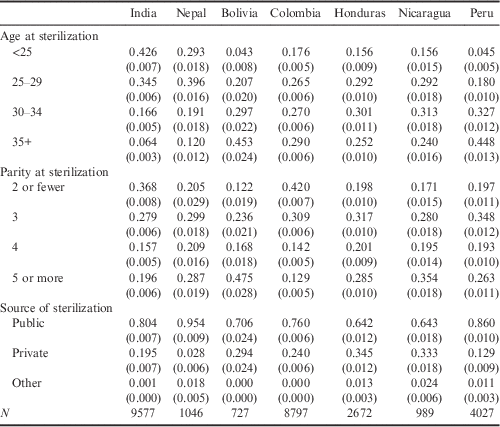
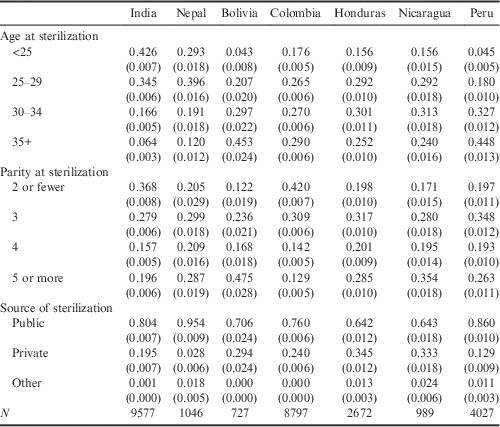
Table 2 describes the sterilization-related variables for the sample. Most women tended to undergo sterilization after the age of 25 – with the notable exception of India, where almost 43% were sterilized before that age. In Latin America, women tended to be older at the time of sterilization, with the majority in Bolivia, Colombia and Peru being sterilized at the age of 35 or higher. Women in India and Colombia reported sterilization at low parities of 2 or fewer children, while women in Nepal, Honduras and Peru were sterilized after having 3 children. In Bolivia and Nicaragua, women were at high parities of 5 or more children at the time of sterilization. Across the sample, a bulk of sterilization occurred in the public sector (governmental hospitals, rural sub-centres, mobile clinics and camps), compared with the private sector, which is not surprising given that the public sectors operate on national family planning schedules and are the most affordable option.
Proportion of sterilized women in the study sample by sterilization-related characteristics and country (2000–2012)
Robust standard errors are in parentheses.
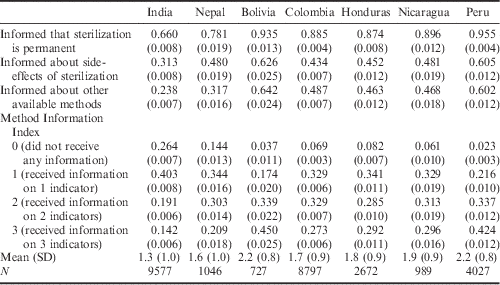
Of the three measures of informed consent (informed that sterilization is permanent, informed about potential side-effects and informed about other methods of family planning) variation again followed country rather than regional patterns (Table 3). The first panel showed that of the three indicators, a higher proportion of women were informed that sterilization was permanent across all countries, with the proportions being highest in Peru and Bolivia at around 95%, and lowest in India and Nepal at 66% and 78% respectively. While this indicator performed well, the other two did not. About 60% of women in Peru and Bolivia were informed about side-effects and other available methods of family planning; the same was true for close to half of women in Colombia, Honduras and Nicaragua. The proportion of informed choice for these two indicators was lowest in India at 31% for information about side-effects, and even lower at 24% for information about other available methods of family planning.
Proportion of sterilized women by informed choice indicators and Method Information Index (MII) and by country (2000–2012)

Robust standard errors in parentheses.
Table 3 also shows the results for the Method Information Index (MII). About a quarter of women in India and 14% in Nepal reported not receiving any information related to sterilization, in contrast to less than 1% of women in Latin America. Across all countries, most women received information on at least one of the indicators, with 40% in India and about 33% in Colombia, Honduras and Nicaragua. Notably, a majority of women in Bolivia (45%) and Peru (43%) reported receiving information across all three indicators. The highest mean score on the MII (ranging from 0 to 4) was 2.2 in Bolivia and Peru, while the lowest was in India at 1.3.
Regression results
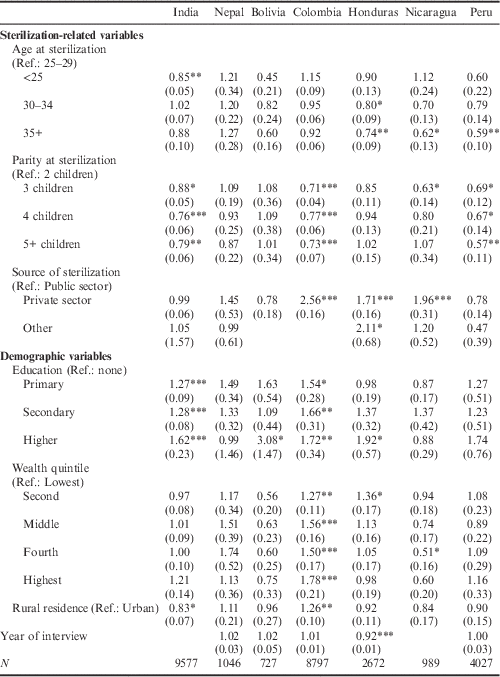
The construction of the MII sheds light on overall patterns of informed choice, and formed the basis of the regression analysis (Table 4). For women who were sterilized in India before the age of 25 (the majority of sterilization cases in the country), the odds of informed choice (a high score on the MII) were significantly lower compared with women who were sterilized at age 25–29. This was also true, though conversely, for women who were sterilized at older ages (35+) in Honduras, Nicaragua and Peru. Women who were sterilized at higher parities compared to those at 2 or fewer children were also significantly less likely to be well informed about sterilization indicators in India, Colombia and Peru across all parities. Source of sterilization was a critical factor in the dissemination of information, with women sterilized in the private sector in Colombia, Honduras and Nicaragua reporting higher odds of informed choice compared with women in those countries who were sterilized in the public sector, largely in the realm of government hospitals and clinics.
Ordinal logistic regression results for Method Information Index (MII) by country (2000–2012) for sterilization-related variables

Robust standard errors are in parentheses.
***p<0.001; **p<0.01; *p<0.05.
It was not surprising that certain demographic characteristics were protective when it came to who received information and who did not. Women who were educated compared with those who received no education had significantly higher odds of being informed in India, Bolivia, Colombia and Honduras. This was particularly true at secondary education levels and beyond. Interestingly, wealth did not seem to matter in this scenario, save for Colombia, where women in higher wealth quintiles were significantly and progressively at a higher odds of receiving information compared with the poorest women in that country. There is some indication that women in Nicaragua in the fourth highest wealth quintile actually had lower odds of receiving information compared with the poorest women, and this warrants further investigation. In a testament potentially to national family planning programmes, it seems that rural women in India had a lower odds of informed choice, while the opposite was true in Colombia, where rural women actually had higher odds of informed choice on sterilization.
Discussion
Very few studies to date have quantitatively examined the relationship between female sterilization and informed choice. A study in India in 2009 found that most sterilized women were not informed about other methods of contraception, nor were they informed about possible post-sterilization health problems by providers, and the researchers questioned the intention of the providers and governmental family planning programme and quality of services provided (Pradhan & Ram, Reference Pradhan and Ram2009). It has been shown that once women receive full information on various methods available to them by health care providers, they are able to make a decision away from permanent methods to reversible methods for spacing or stopping (Baveja et al., Reference Baveja, Buckshee, Das, Das, Hazra and Gopalan2000), signalling that the high proportions of women opting for sterilization may actually reflect lack of knowledge rather than a preference for that method. While the present study was unable to determine whether coercion took place, it is the first to quantitatively assess the current state of informed choice across countries where female sterilization is a common modern method of contraception.
The analysis shows the emerging important trends in female sterilization, and that there is some variation across countries. The most important sterilization-specific characteristic across all indicators was that of parity at the time of sterilization. This was particularly true for India and Colombia. Women at the extremes of the age distribution at the time of sterilization – younger than age 25 (India) and older than age 35 (Honduras, Nicaragua, Peru) – were less likely to score high on the MII. The private sector performed better than the public sector in Colombia, Nicaragua and Honduras in counselling women across the various indicators of informed choice.
The relationship between age at sterilization and low levels of informed choice is worrisome, and points to a lack of good-quality care for women at the youngest and oldest ages. Women who are sterilized at very young ages have been shown to have regrets at older ages (Singh et al., Reference Singh, Ogollah, Ram and Pallikadavath2012), so appropriate counselling and introduction to other methods of contraception is critical. A comprehensive review of the literature showed that the younger a woman was when undergoing sterilization, the more likely she was to regret the decision at a later age, and potentially seek to reverse the procedure (Curtis et al., Reference Curtis, Mohllajee and Peterson2006). This assumes agency in the decision to get sterilized, but may speak to the importance of a formal age of consent for sterilization across countries. This study identified one other group at risk: women over the age of 35 in Honduras, Nicaragua and Peru. This is a result that previous studies that focused on sterilization regret understandably did not address, and highlights women who may have previously been overlooked due to assumptions surrounding women at older ages.
National family planning programmes set different targets and goals for countries depending on level of fertility. These targets have been shown to be achieved by emphasizing permanent methods of contraception, like female sterilization in India, rather than temporary methods for spacing (James, Reference James2011). The consequence is that women may reach a certain desired threshold for number of children, and then choose to undergo sterilization. This is a viable and safe option, except that most of these women may not know of, or receive proper counselling on, the consequences of sterilization. Some research has found that family planning programmes actually target women at high parities for sterilization (Donaldson, Reference Donaldson2002); thus, questions of informed choice are of profound importance. If women at all parities were targeted for sterilization, one would not see the type of gradient associated with informed choice found in India, Colombia and Peru.
Given that national family planning programmes are meant to operate within the public health care system, most sterilizations in the study sample occurred in this sector. Sterilization in hospitals affiliated with the government are sometimes free, and may demonstrate a nexus between the health care providers and local politicians who see this as a tool for re-election (Caetano & Potter, Reference Caetano and Potter2004). It is no surprise, then, that to deal with large volumes of women passing through for sterilization, quality of counselling may be poor. This is especially the case in Latin American countries, and warrants further investigation. National policies that were in effect for a large part of the 20th century may favour method skew towards sterilization, with evidence of this in all countries in this study’s analysis (EngenderHealth, 2003; Sullivan et al., Reference Sullivan, Bertrand, Rice and Shelton2006; Boesten, Reference Boesten2007; IWHR, 2013). Subsequently, provider bias is something that can come into play in the public and private sectors, and may be an explanation as to why different aspects of consent are not talked about in either setting, in an effort to push sterilization over other methods. A study that examined informed choice found that choice trumped provider bias in cases where an injectable (Norplant) was the preferred method of the provider (Baveja et al., Reference Baveja, Buckshee, Das, Das, Hazra and Gopalan2000); thus female sterilization may be another potential example of such bias, although that qualitative aspect of provider bias was outside the scope of this analysis.
The study has several limitations. First, and perhaps most serious, is recall bias among respondents, who at older ages may not remember the conversations they had with health workers prior to undergoing a sterilization procedure. While the surgical nature of the procedure makes it highly unlikely that a woman would make an error in recalling that she was sterilized, her memory of the counselling process is more problematic. To account for recall bias, the analysis was restricted to women who reported being sterilized 5 or fewer years preceding the survey. Nevertheless, how the questions are understood by respondents, as well as the counselling process itself, cannot be fully analysed based on these data, and thus is was not possible to make more specific policy recommendations. Secondly, with these data it was not possible to thoroughly examine the decision-making process that each woman went through prior to a sterilization procedure. Women may feel constrained in their decision due to socio-cultural and economic factors, which render them incapable of caring for their ideal number of children. Moreover, it was not possible to evaluate the impact of conversations they have had with other sterilized women, which inevitably play into their decision (Bongaarts & Watkins, Reference Bongaarts and Watkins1996). Finally, historically, coercive sterilization programmes targeted indigenous and ethnic minority women. However, a variable for ethnicity was not available in the majority of the surveys for this study, so it was not possible to assess whether these populations were less likely to be fully informed about sterilization. In nearly every country in this study, indigenous or lower caste women are more likely to be poor and live in rural areas. Proxy variables such as the wealth index and rural residence were used to identify those populations that were particularly vulnerable to coercive sterilization. Analyses were conducted with interaction terms, but they were not significant. Ultimately, it was not possible to quantify the extent of informed choice for other vulnerable populations such as HIV-positive, disabled and transgender individuals. As data from developing countries become more comprehensive on these topics, future research should closely consider the sterilization experiences of these populations.
In conclusion, the study findings point to an urgent need to improve the quality of counselling within health systems that provide sterilization for women in South Asia and Latin America. While coercion could not be assessed due to lack of data on financial incentives for using the method, the study conclusively determined that there has not been sufficient information provided to women for them to make an informed choice about this procedure. This addresses an essential service gap within health systems and among sterilization providers. Sufficient time and willingness to counsel a woman and ensure she understands the implications of the decision to undergo sterilization will go a long way in ensuring her agency and reproductive rights.
Acknowledgments
The authors would like to thank participants at the International Family Planning Conference in Bali, Indonesia, in 2016 for their invaluable comments and suggestions.
Ethical Approval. Publically available secondary data from the DHS were used, and thus did not require ethical approval from the authors’ institutions.
Conflicts of Interest. The authors have no conflicts of interest to declare.
Funding. This research received no specific grant from any funding agency, commercial entity or not-for-profit organization.