1. Introduction
Denis Smalley has written and composed extensively within the field of acousmatic music. In his writings he has developed new concepts and theories to describe acousmatic music. Probably the best-known concept is his spectromorphology – the temporal unfolding and shaping of sound spectra (Smalley Reference Smalley1986). Other publications followed, such as ‘Defining Timbre – Refining Timbre’ (Smalley Reference Smalley1994), ‘Spectromorphology: Explaining Sound-Shapes’ (Smalley Reference Smalley1997), and the more recent ‘Space-Form and the Acousmatic Image’ (Smalley Reference Smalley2007). In a sense, these articles represent an evolution in Smalley's thinking. Indeed, Smalley himself has noted that his 1997 spectromorphology article represents an ‘extensive rewriting’ of the original 1986 publication (Smalley Reference Smalley1997: 107).
Have the writings influenced the compositions or is it the other way around? This question was actually answered by Smalley himself (Smalley Reference Smalley2004b):
The writings started as a consequence of being asked to write a paper. I wanted to articulate what it was like in working with electroacoustic music. I also wanted to re-articulate and develop Schaefferian concepts to consider a wider variety of music. To explain to others what electroacoustic music was about …
Now, as far as influencing my own work, well once you become conscious of something, you've worked out some sort of way of understanding, it is going to influence you. But all I'm doing, is bringing out these notions.
Doing Spectromorphology and Structuring Processes [Smalley Reference Smalley1986] … I think it was there unconsciously, it was a question of organising and articulating as one does have to do for written work in a way which might be called ‘action in prose’.
So you can say that it already influenced my thinking, my composition, before I even wrote it. Having written it, since it is there in the unconscious, it doesn't destroy my composition process because I don't notionally think about these things when I'm composing. I just do it.
So, for Smalley, the compositions came first, then the writings followed as a kind of reflection on the compositions and the compositional process. But is this borne out in reality?
The research questions for this article seek to test the veracity of the statements above, in practice. Firstly, what is the relationship between the concepts developed by Smalley in his earlier writings and a representative composition of that period? Secondly, what sort of comparison can be made between later writings and a later work? Then what sort of change can we observe between the two periods?
I will begin by drawing out the main concepts from ‘Spectromorphology: Explaining Sound-Shapes’ (Smalley Reference Smalley1997), and then examine an analysis of the work Wind Chimes (Smalley Reference Smalley2004a), which originally dates from 1987. Then the more recent ‘Space-Form and the Acousmatic Image’ (Smalley Reference Smalley2007) will be interpreted, and an analysis of his work Base Metals (Smalley Reference Smalley2000) will follow based on one of the concepts from his ‘Space-Form and the Acousmatic Image’ article.
2. Spectromorphology and sound shapes
This section concentrates on Smalley's article called ‘Spectromorphology: Explaining Sound-Shapes’ (Smalley Reference Smalley1997).
Smalley makes it clear that the spectromorphological approach is restricted to those types of electroacoustic music which:
are more concerned with spectral qualities than actual notes, more concerned with varieties of motion and flexible fluctuations in time rather than metrical time, more concerned to account for sounds whose sources and causes are relatively mysterious or ambiguous rather than blatantly obvious. (Smalley Reference Smalley1997: 109)
‘Spectromorphology and Structuring Processes’ (Smalley Reference Smalley1986) was an attempt to translate and extend the concepts of Pierre Schaeffer (see Chion Reference Chion1983), firmly based on les objects sonores, whereas ‘Spectromorphology: Explaining Sound-Shapes’ (Smalley Reference Smalley1997) explores the relationships between sound objects much more. Having set the boundaries of his approach, Smalley then begins to elaborate on his spectrmorphologically derived concepts.
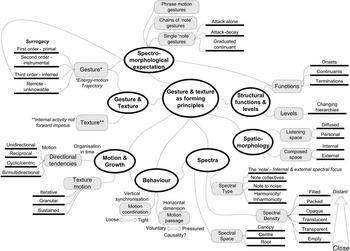
Figure 1 represents an attempt to create a concept diagram of the main ideas that Smalley develops in his article.
Spectromorphological concepts developed by Smalley (Reference Smalley1997).

2.1. Gesture and texture as forming principles
While the article is actually titled ‘Spectromorphology: Explaining Sound-Shapes’, we can observe from the concept diagram that central to the article are the concepts of gesture and texture, how they relate to each other, and how their interplay creates form. Smalley has moved away from sound objects to the point where gestures and textures are now the primary organising forces.
In instrumental music, gesture is present within a single note, or a group of notes when they form a phrase contour, and so on. Smalley extrapolates the notion of gesture as a forming principle so that it ‘is concerned with propelling time forwards, with moving away from one goal towards the next goal in the structure – the energy of motion expressed through spectral and morphological change’ (Smalley Reference Smalley1997: 113). Spectral change equates with movement through time, and gestural music ‘is governed by a sense of forward motion, of linearity, of narrativity’ (Smalley Reference Smalley1997: 113). Here we have a very clear statement that Smalley's electroacoustic music is firmly based upon the Western art music notion of narrative and goal orientation.
Electroacoustic music consists of gesture–texture mixtures, and the relationship between gesture and texture can vary widely throughout the progress of a work. The relationship may be serial or simultaneous.
2.2. Gesture and texture
Where music is concerned, Smalley is very much a traditionalist. He attests that the whole basis for his notion of gesture is the listener's prior experience of instrumental and vocal Western art music. For Smalley, electroacoustic music contains archetypes that derive from the listener's experience of this instrumental and vocal music. A gesture is an ‘energy–motion trajectory’ which has roots in the physical activity that gives rise to sounds in instrumental and vocal music (Smalley Reference Smalley1997: 111). The activity to make the sound links a cause to a source. The gesture process of cause–source–spectromorphology can also operate in the reverse direction of spectromorphology–source–cause:
When we hear spectromorphologies we detect the humanity behind them by deducing gestural activity, referring back through gesture to proprioceptive and psychological experience in general. (Smalley Reference Smalley1997: 111)
In electroacoustic music, however, the sources and causes of sound-making can become remote or detached from known sources. This increasing remoteness Smalley calls ‘gestural surrogacy’ (Smalley Reference Smalley1997: 112). For Smalley, the most adventurous acousmatic music ‘extends into third-order ambiguity and beyond to a music which, although remote from traditional sound-making activity, can nevertheless maintain a humanity’ (Smalley Reference Smalley1997: 112).
On the other hand, since gesture in electroacoustic music derives from the listener's experience of traditional instrumental music and everyday experience, Smalley warns that if one strays too far from these cultural archetypes of gesture, the music will appear to be ‘cold, difficult, even sterile’ (Smalley Reference Smalley1997: 112).
It is interesting that Smalley relies on the ‘detection of humanity’ to define gesture, and in particular by reference to instrumental and vocal music archetypes. Much electroacoustic music includes gestures derived from the natural world, including those gestures with animal origins, and those with links to the forces of nature such as the weather (wind, rain, thunderstorms). There are also those gestures that derive from the ‘modern everyday world’. Some may have human gestural associations (e.g. work activities) or gestures associated with the built environment (e.g. machine gesture patterns). Smalley does not include these in his model.
What about texture? Smalley states that if gestures are too weak or too slowly evolving, then our listening focus changes, and our ears begin to concentrate on the inner details of the music. Smalley gives us a very short definition of texture: ‘A music which is primarily textural, then, concentrates on internal activity at the expense of forward impetus’ (Smalley Reference Smalley1997: 113–14).
2.3. Spectromorphological expectation
Smalley's notion of spectromorphological expectation is really an elaboration on ‘gesture’. Gesture is an ‘energy–motion trajectory’, with a start point, an end point, and an implication of some expectation along the way. Firstly there is gesture within a sound shape. Smalley states that archetypes present within the traditional instrumental note ‘train us in spectromorphological expectation’ (Smalley Reference Smalley1997: 113). Each instrumental note must start, may be sustained or not, and then stops. These temporal phases he calls the onset, continuant and termination, and they give rise to three spectromorphological archetypes: the attack alone, the attack–decay and the graduated continuant.
Smalley expands these notions of the single note-gesture into chains of note-gestures, and gestures of phrase motion. These instrumental archetypes provide us with a knowledge base for ‘decoding patterns of expectation in musical form’ (Smalley Reference Smalley1997: 113). Electroacoustic music expands upon this knowledge base, but at the same time, ‘even when deprived of known instrumental spectromorphologies and tonal harmonic language, still relies on culturally acquired expectation patterns’ (Smalley Reference Smalley1997: 113).
Note the dependence on instrumental music for explanation of a concept once again.
2.4. Structural levels and structural functions
With regard to structure, Smalley asserts that electroacoustic music does not have the types of structural hierarchies that tonal music has. Gestures and textures could be small scale or large scale: ‘Electroacoustic gestures and textures cannot be reduced either to note or pulse; the music is not necessarily composed of discrete elements’ (Smalley Reference Smalley1997: 114). The corollary to this statement is that electroacoustic music is not easily segmented, and it may resist segmentation totally.
Although Smalley contends that electroacoustic music has no permanent type of hierarchical organisation, he does state that there may be different structural levels within a piece, and that these levels may change throughout a particular piece. Indeed, insufficient hierarchical variety becomes a criticism: ‘This occurs where the types of sounds and the structural continuity direct one to listen continuously in a global, high-level mode’ (Smalley Reference Smalley1997: 114). There can be either too much gesture or too much texture, resulting in the engagement of just a single listening mode. The interplay of gestures and textures, combined with a variety of structural levels, will encourage the engagement of a variety in modes of listening.
Structural functions involve expectation. For Smalley, expectation patterns derive from cultural experience of spectral variations in different types of sounds: ‘During listening we attempt to predict the directionality implied in spectral change’ (Smalley Reference Smalley1997: 114).
The concepts of expectation and directionality give rise to the consideration of change. Smalley uses the ideas of onset, continuant and termination to develop a vocabulary to describe the ‘functional significance of and event or context’ (Smalley Reference Smalley1997: 115). The category of onsets could include departure, emergence, anacrusis, attack or upbeat. Continuants may describe passage, transition, prolongation, maintenance or statement. Terminations may involve arrival, disappearance, closure, release or resolution. Note that these functional descriptors could be used at a higher levels or lower levels of musical structure.
2.5. Motion, growth and behaviour
Since Smalley is considering a music that is not rhythmic at all, he turns to the metaphors of motion and growth to describe a work's organisation in time. For Smalley, motion and growth have spectral contours, and are set in spectral space. These spectral qualities will be taken up further on, but for now Smalley says that motion and growth have the following directional tendencies, which assist in attributing structural functions: unidirectional motion, reciprocal motion, cyclic or centric motion, and bi/multi-directional motion (Smalley Reference Smalley1997: 116).
Just as motion and growth are further qualifications and amplifications of structural functions, the metaphor of behaviour is a refinement of growth and motion, ‘used to elaborate relationships among the varied spectromorphologies acting within a musical context’ (Smalley Reference Smalley1997: 117). Listeners intuit behavioural relationships based on their experience. So, for Smalley, behaviour is archetypal. There could also be extrinsic behavioural references present.
Smalley splits behaviour into two interactive temporal dimensions. Motion coordination is concerned with vertical synchronisation. Motion passage involves the horizontal dimension and it varies from voluntary to pressured. It expresses how one context yields to the next, and that draws the notion of causality into the framework: ‘where one event seems to cause the onset of a successor, or alter a concurrent event in some way, is an important feature of acousmatic behaviour’ (Smalley Reference Smalley1997: 118).
Interpreting behavioural relationships in terms of dominance/subordination and conflict/coexistence are useful additions to Smalley's vocabulary.
2.6. Spectra
Moving from the macro-level of behaviour, Smalley turns to a discussion of the micro-level. Instead of the terms timbre, pitch and sound quality, Smalley adopts the terms spectra and spectral space. He emphasises the difficulty in describing sounds, and poses the question: what terminology do we use? Naming a real or imagined source can differentiate spectral qualities, as can descriptions such as bright, dull, hollow or thin, but there is a need to expand the terminology to be more comprehensive and precise.
In discussing spectra, Smalley distinguishes between spectral type, spectral density and spectral space.
To discuss spectral types, Smalley once again turns to instrumental music for inspiration. This time he uses the note concept. Smalley (Reference Smalley1997: 119–21) distinguishes four different spectral types: the note, note collectives, note to noise, and harmonicity and inharmonicity.
Spectral space refers to the distance between the lowest and highest frequencies we can hear. In instrumental and vocal music, the listener has some idea of the spectral space occupied by the instruments and voices based on experience. In electroacoustic music, Smalley says we need a vocabulary to define how spectral space is occupied. He begins by defining terms which divide the entire spectrum into three separate zones (from higher frequencies to lower frequencies): canopy, centre and root.
For Smalley, spectral density is related to masking effects and to perceived distance. A dense spectrum set close to the foreground will not let other spectromorphologies through. Spectral density has these descriptors (Smalley Reference Smalley1997: 121): filled (distant), packed/compressed, opaque, translucent, transparent and empty (close).
Smalley's final words on spectral density are very enlightening: ‘high density is the enemy of low level detail’ (Smalley Reference Smalley1997: 121).
2.7. Space
In Smalley's oeuvre, space is a huge topic in itself, and the use of space in Base Metals has been considered in the article by Lotis (Reference Lotis2003). Denis Smalley himself had a massive reconsideration of space in an extensive article published ten years after the sound-shapes article (Smalley Reference Smalley2007). So the concepts from Smalley (Reference Smalley1997) won't be discussed here; rather, I shall move on to the more elaborate concepts from Smalley (Reference Smalley2007) in the ‘Space-form and the acousmatic image’ section below.
3. Analysing Wind Chimes
Just as ‘Spectromorphology: Explaining Sound-Shapes’ (Smalley Reference Smalley1997) is a refinement of Smalley's earlier writings, Wind Chimes, dating from 1987, represents a mature culmination of Smalley's earlier electroacoustic works. What are the relationships between the concepts developed by Smalley in his earlier writings and Wind Chimes, which is a representative composition of that earlier period?
In my analysis of Smalley's Wind Chimes (Hirst Reference Hirst2008), I used a model partly derived from Smalley's writings on timbre (Smalley Reference Smalley1994) and partly derived from auditory scene analysis principles. I called the model the SIAM framework for analysis of acousmatic music. SIAM stands for segregation, integration (horizontal and vertical), assimilation and meaning. The broad form of this procedure is derived from the work of Pierce (Reference Pierce1931–35), Howard and Ballas (Reference Howard and Ballas1980), Lerdahl and Jackendoff (Reference Lerdahl and Jackendoff1983), Dowling and Harwood (Reference Dowling and Harwood1986), Narmour (Reference Narmour1989), Ballas (Reference Ballas1993), Bigand (Reference Bigand1993), McAdams (Reference Mcadams1993), Smalley (Reference Smalley1994), Bregman (Reference Bregman1999) and Gygi (Reference Gygi2001).
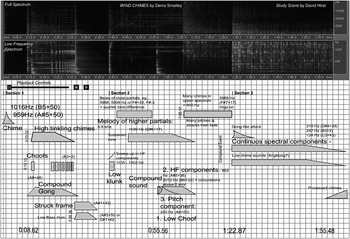
Figure 2 shows a screen shot of part of the interactive study score that was created for the Wind Chimes analysis. There are two spectrograms at the top of the image, and the shapes drawn below are meant to be crude representations of various sound events, annotated with frequency and time information.
Screen shot of the interactive study score for Wind Chimes.

3.1. Interpretation and discussion – Wind Chimes
The details of the SIAM process are given in Hirst (Reference Hirst2008). The process begins with identification and segregation of sonic objects. It is very much a ‘bottom-up’ approach and was found to be very compatible with the analysis of Wind Chimes, which was relatively easy to segment into separate sound objects.
Summarised here are the main conclusions regarding the insights gained into the organisation of Denis Smalley's Wind Chimes with respect to the concepts outlined in Section 2 above.
3.1.1. Spectral type
In Wind Chimes, Smalley is playing with the internal spectral structures of what we normally think of as single sound events, although there are still elements of a note-based concept. Smalley also uses the notion of compound sound events extensively where several simple sounds add together to produce a complex composite. The term ‘pitch centricity’ has been coined to try and convey an observation that, although Smalley doesn't use an extensive tonal music organisation of pitch materials, he does manipulate pitch to create certain points of gravitational pull that frequencies may be attracted to.
3.1.2. Spectral space
Smalley has taken some traditional tonal music concepts and pushed them higher in the frequency spectrum, or in some cases embedded them deeper in the spectrum.
3.1.3. Gesture and spectromorphological expectation
Wind Chimes makes extensive use of the attack–resonance model. An attack, which could be an agglomeration of sounds, can be extended into a resonance phase through the prolongation, or addition, of selected component frequencies.
3.1.4. Spectral density
At times, the form of the work is like an expression of the attack–resonance model on a macro scale. Sound events tend to aggregate at certain time points, then there is a relaxation of activity revealing long sustained sounds that have their own fascinating micro-colourations.
3.1.5. Behaviour
Over time, the initial attack–continuant framework becomes transformed into more of a compression–relaxation style. The tension increases within the work as sections, and phrases within sections, begin to overlap with each other. There is an increased density of activity as the work progresses. Transpositions tend to be by thirds or sixths – wider than the critical band. On the other hand, Smalley uses smaller intervals between simultaneous sounds, less than a major second, to create beats and to provide colouration.
3.1.6. Structural functions and levels
The primary strong binding force is frequency. Where simultaneous sounds share a frequency component they tend to fuse together. Where sequential sounds share a frequency component, or are very close together in frequency, they tend to link together to form a stream. Frequency components are extruded from one sound, elongated, then overlapped with the same frequency within another sound to fuse the events together to create a new gesture. The second strong binding force is time. Simultaneous events fuse together to form compound sounds, and nearly simultaneous events combine to form an association where one sound seems to trigger the other implying some common cause, or a cause–effect relationship.
3.1.7. Motion and growth
The form of the work is sectional and episodic. Smalley makes use of a lot of repetition of sound events, but the repetition is varied. The repeated sound events are either a processed version of the originals, or a literal repetition set within a new context of different surrounding sounds.
3.1.8. Gesture and texture as forming principles
In summary, the interpretation of the analytical data has resulted in the emergence of certain syntactic traits: compound sound events, stratification of the frequency spectrum, pitch centricity and harmonic fields, sectional organisation in time, and semantic and syntactic progression.
4. Space-form and the acousmatic image
By 2007, the topic of space had become so vast that it had almost become the basis for an entire theory on acousmatic music.
Smalley provides this working definition of acousmatic space-form:
Space-form in acousmatic music is an aesthetically created ‘environment’ which structures transmodal perceptual contingencies through source-bondings and spectromorphological relations. Further, it integrates attributes particular to musical culture and tradition (like pitch and rhythm, for example). Acousmatic space-form inhabits domains somewhere between space as lived and enacted, and the spaces afforded through spectromorphological contemplation – by the perceived and imagined configurations of spectral and perspectival space. (Smalley Reference Smalley2007: 40)
We can observe how Smalley's thinking has moved from contemplation of the particular (spectromorphology) to contemplation of the whole (acousmatic space-form). In referring to his ‘Spectromorphology: Explaining Sound-Shapes’ article, Smalley observes that ‘we needed to know about spectromorphology before we were in a position to understand space’ (Smalley Reference Smalley2007: 53), and, although he still adheres to the 1997 views about spatiomorphology, by 2007 he has expanded spatial notions and ‘adopted a more integrated “ecological” approach’ (Smalley Reference Smalley2007: 54).
Smalley (Reference Smalley2007) introduces us to these notions connected with space:
• holistic space and space-form;
• source-bonded spaces;
• transmodal perception;
• acousmatic space-form;
• enacted space – performed space;
• spectral space;
• perspectival space;
• vantage-point shifts; and
• containment and transcendence.
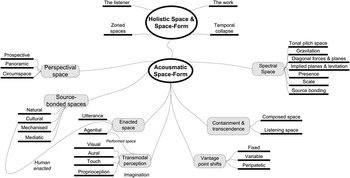
The relationship between these concepts is mapped in figure 3.
Space-form concepts developed by Smalley (Reference Smalley2007).

In the final section of his article, he provides an advisory guide as to how an analysis based upon the acousmatic space-form notions may be undertaken. Firstly, he observes that it contrasts with the bottom-up approach based on ‘an investigative process that elaborates a taxonomy of spectromorphologies, and then proceeds to try and work out how they are related and act over time’ (Smalley Reference Smalley2007: 54). He notes that this process has been inherited from tonal music. Instead, the space-form study method proceeds from a higher level of structure – top down.
Here is Smalley's method (Smalley Reference Smalley2007: 54), in an edited and point-summarised form:
• Arising from a first or second listening, I note down the main attributes and spatial forms, based on the ideas I have discussed in this article.
• I can then arrive fairly quickly at a view of the space(s) and attributes at work.
• Often this kind of diagnosis will coincide with some of the temporal divisions of the work.
• I can then dig down into details of the spaces, which will involve investigating how time articulates spaces, and how my view of spaces may evolve, adapt or change over time.
• With a spatial approach I am no longer duty bound to arrive at a convenient and complete temporal segmentation at a variety of levels, and often this is not viable. Many acousmatic works resist segmentation because they are not built on firm identities and consistent hierarchies, but on multi-faceted typologies that so readily change guise and merge with others, defying morphological boundaries and resisting categorical labelling.
• It is possible, having completed a listening act, to ‘collapse’ the temporal dimension into a spatial view, somewhat sidelining the temporal evolution that enabled space to emerge. It is often feasible to produce a succinct, holistic view that encapsulates the essentials of the space-form of an acousmatic work.
• I recognise three main space-form processes, which can be intermingled:
○ The first is the ‘journey’, a more traditional ‘narrative’ approach where one is aware of passing between spaces.
○ A second process adopts changing views of the same space; on balance the listener takes an holistic view.
○ A third process is occupied with multiple spaces, mixed materials, possibly intercuttings, dislocations, and impressions of simultaneous spaces, although the final view could well be an holistic one.
• We can also recognise a difference between what I shall call the naturalist work, and the interventionist work. A naturalist work unfolds as if ‘natural’, with few seams and ruptures, and a logic of passage; there is a certain transparency in the way things proceed, above all in the care with mixing. With the interventionist approach the composer's hand is in evidence, and the stamp of the technology and techniques is apparent in the kind of material and the way it is manipulated, whereas in the naturalist work there will be some attempt to hide techniques, and avoid exposing technological signifiers.
Smalley, quite rightly, states that this methodology can only be used for particular types of electroacoustic music works: ‘Of course space-form can only be found rewarding if it has taken on a significant formative role in the music, and this is not the case with every acousmatic work: we have to pick and choose’ (Smalley Reference Smalley2007: 54).
Although this contemplative approach to musical analysis concludes Smalley's article, his ‘Orbieu soundscape’, near the beginning, provides us with a very poetic model for how one might approach his method in practice.
5. Analysing Base Metals
Smalley's thinking has moved from sounds objects to the interplay of gesture and texture, and finally arrived at the consideration of space-form to be at the heart of acousmatic music. Having previously analysed Wind Chimes using a model partly derived from Smalley's timbre theories (Hirst Reference Hirst2003, Reference Hirst2004, Reference Hirst2005, Reference Hirst2006, Reference Hirst2008), in the following I attempt to analyse Base Metals by utilising concepts from ‘Space-Form and the Acousmatic Image’ (Smalley Reference Smalley2007).
5.1. Analytical methodology
Initially I attempted three different approaches to listening where each explores some small part of the concept map associated with ‘space-form’.
In my first listening to Base Metals, I attempted a free-form listening where the method consisted of sketching shapes on paper and writing comments in real-time as the piece was playing. The horizontal dimension of the page became a time scale, and I quickly filled up pages with symbols and comments.
The second listening attempted the contemplative approach to musical analysis using the ‘Orbieu soundscape’ method from Smalley's article. The idea is to attempt to collapse the whole work into a single, finite time frame, or memory. So I listened to the whole work first, then I wrote down some notes after the work ended. This was my attempt at a top-down perception of the work – a ‘holistic’ rendering.
The third listening was really just the first part of Smalley's third process of listening to spaces, examining multiple spaces and more detail. In this case I examined ‘spectral space’ (including pitch space) in detail for the entire work. The process for this examination involved an aid to aural analysis in the form of the program Sonic Visualiser. Developed at the Centre for Digital Music, Queen Mary, University of London, Sonic Visualiser is an application for viewing and analysing the contents of music audio files (see www.sonicvisualiser.org).
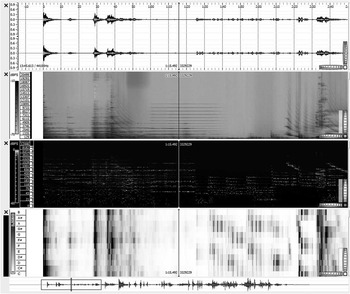
Figure 4 shows various Sonic Visualiser representations of the first 2′40″ of Base Metals. At the top there are the two channels of audio signal. Below that there is a spectrogram of both channels mixed, showing the full frequency range. Next there is a peak frequency spectrogram in the melodic range – to assist with pitch detection. Finally there is a chromagram pane at the bottom, depicting the relative strengths of the 12 chromatic pitches in the 12-tone equal temperament system. This would assist in finding pitch centricities and hot spots. Many representations are possible with Sonic Visualiser, but, after a lot of trials, this set was found to be the most useful for the examination of spectral space.
Sonic Visualiser representations of the first 2′40″ of Base Metals.

The analysis involved playing sections of the piece over and over to listen for salient spectral space features, and then using the Sonic Visualiser tools to obtain more details about those salient features. A set of observations was made for various sections of the work, considered at structurally important time points.
5.2. Selection of spectral space observations – Base Metals
Here is a selection of the types of observations made with regard to spectral space for the first 3′45″ of Base Metals. In the first 2′30″ of the piece we can already observe many of the characteristics of the work with regard to spectral space:
• Compound ‘klang’ sound. The work begins with a metallic cluster of sounds centred around C and F-sharp (pitches are approximate), using the whole spectral space.
• Sustained components. These are like parallel tracks across the spectral space. For example, the initial cluster prolongs the F-sharp pitch with some D added. From 1′00″ to about 1′30″ a higher F-sharp–A dyad is sustained using the spectrum right up to 11,700 Hertz.
• Melodic fragments. Short motives of 4 to 5 sounds, for example a high whistling-like motive from 0′40″ to 0′50″ uses a slight glissando of its components. The whistling glissandi motive is repeated at 2′15″ from G-sharp5 (1670 Hz) to D-sharp5 then to G-sharp4 (836 Hz). It is set against a higher version of the warbling-like sounds (see next item). The glissandi are consistent with the movement of sound left to right, with pitch glides perhaps corresponding to Doppler shifts.
• Warbling sounds. In contrast to the sustained components, modulated warbling-like sounds are used lower in the spectral space from 1′24″ to 2′04″. They explore an E to A ‘progression’ followed by a D to G ‘progression’. Then there is a higher version with a downward stepwise progression of A to G-sharp, E to D at 2′08″.
• Pitched sounds. At 2′31″ we have a varied repeat of the high whistling glissandi motive, this time a longer motive of G5 (1587 Hz), C-sharp5 (1090 Hz), G-sharp4 (840 Hz), F4 (702 Hz), C-sharp4 (560 Hz), C4 (520 Hz), B3 (480 Hz), plus warbling sounds centred around F-sharp. Then from 3′02″ to 3′45″, we hear a shortened encapsulation of everything we've heard so far – an attack, sustained sounds, warbling sounds, whistling glissandi, but with an E to G-sharp progression. Everything then subsides.
This kind of data was documented for the whole work.
5.3. Interpretation in spectral space terms
Using the spectral space data for the whole work, the following interprets aspects of spectral space in terms of the concepts Smalley (Reference Smalley2007) has introduced us to.
• Tonal pitch space. Looking at pitch class on the chromagram, the work begins with a central focus on F-sharp and then it moves outward in this pitch space to utilise most of the chromatic scale at 3′40″ – a structurally significant point in the piece. By about 6′00″, the pitch centroid has moved back to F-sharp, with dalliances around D and A. In the second half of the work, much more of the pitch space is explored. In particular, there is a new ‘harmonic field’ built around G-sharp/A at 9′36″. Then from 10′20″ we have another exploration of the whole pitch space following by a winding-down period with D, F-sharp and G-sharp/A being prominent.
• Gravitation. Gravitational pull is provided by those sounds that are lower in the spectral space. Acting as counter-levers are the melodic fragments and whistling sounds that are floating higher in the frequency range.
• Planes of levitation. I interpret the long sustained frequencies as my planes of levitation. They seem to suspend and transcend time in a manner that creates more expectation and anticipation the longer they are sustained. When something seems to levitate, time and belief are suspended; the sustained frequencies serve this function for me.
• Diagonal forces and planes. In spectral space, as opposed to physical space, diagonal forces are supplied by the pitches glides and glissandi, which cross the sustained ‘levitations’. They have the effect of leading the ear to another place, announce a change of some sort. Upwards inflection – a start, downwards glissando – an ending.
• Presence. For Smalley the idea of presence is the manipulation of spectral space to suggest physical space itself. Once again it is the sustained frequencies that provide a backdrop against which action takes place in the foreground. As the work progresses, action takes over and we begin to lose this continuant ‘horizon line’, and then it re-emerges near the end.
• Scale in spectral space. After a tumultuous start, we observe the scale of spectral space quickly contract and then slowly expand over time, until there is a grand climax from about 10′30″ to around 11′30″. The scale of use of spectral space then thins out. Up to 10′30″ there are a few punctuation points to add interest and keep the ear engaged. Smalley alerts us to these processes and forces operating when he refers to his own composition in Smalley (Reference Smalley2007: 47):
Gravitational tendencies and spectral scale are very much at the heart of my Base Metals, where the components of metallic resonances are configured and reconfigured, with tonal pitch playing an orientating role. The listener can become particularly conscious of this aspect of spectral space once the ear is led away from the source-bonded attacks of sounds into contemplating the progress of spectral continuities.
• Source bonding. Although, from the outset, the sound sources seem to derive from metallic timbres, they are detached from any obvious source so that a ‘reduced listening’ mode is encouraged and the timbres are explored on their own merits. This immediately liberates the work to create ambiguities, and Smalley assembles a whole new sound world where spectral frequencies are interwoven to create a captivating sonic fabric. Once again he writes about this aspect in Smalley (Reference Smalley2007: 48):
in Base Metals, … the intertwining of pitch and timbre, and extended, detailed development of spectral components calls attention to a spectral space less encumbered by source associations.
It is not until the action intensifies much later in the work that we notice some possible ‘source-bonded’ sounds at around 10′20 ″: tam tam sweep; piano frame strike; piano wire strum; organ sounds; piano cluster. Even at this time, they are presented as a ‘note complex’ so that the ear is drawn to the combinatorial whole rather than the discrete sounds. One has to listen very hard to try and separate them out.
5.4. Further interpretation and discussion – Base Metals
As noted in section 4 above, Smalley recognises three main space-form processes, which can be intermingled. The first is the ‘journey’, a more traditional ‘narrative’ approach where one is aware of passing between spaces. A second process adopts changing views of the same space; on balance the listener takes an holistic view. A third process is occupied with multiple spaces, mixed materials, possibly intercuttings, dislocations, and impressions of simultaneous spaces, although the final view could well be an holistic one.
In attempting to interpret the data from various listenings and analyses of Base Metals, it was determined that an interesting approach may be to interpret the work in terms of the first two, contrasting, space-form processes noted above, namely ‘The journey’ and ‘Changing views of the same space’.
5.4.1. The journey
Documenting ‘The journey’ is like plotting the moment-to-moment, linear form of the work. The initial gesture of the work provides the archetype that the remainder of the work is built upon. It consists of a compound sound of simultaneous metallic attacks, followed by a complex resonance. I shall call the initial attack the ‘klang’ archetype, for it re-appears and is varied throughout the work. In Smalley's parlance, the left-to-right aspect of stereo space is called the panorama, and the near-to-far dimension extends from proximate (near) to distal (distant). Thus the initial attack complex provides a proximate experience approaching the listener (enclosure), while the continuing resonance performs a receding function to distal space (ouverture – opening up). The following paragraph provides a short summary of ‘The journey’.
The initial ‘exposition’ of materials is followed by a short ‘recapitulation’ at 3′30″. We hear a loud metallic klang, and a ‘forest of klangs’. A series of vectoral wipes move across the panorama at 6′00″ and they announce a new direction consisting of a series of elaborations in the form of a ‘smearing’ of Smalley's original materials using slower attacks and decays. The climax of this activity comes at 8′40″ with an elongated klang. This kind of activity intensifies over the duration of the work until the ‘smearing’ becomes a woven fabric of frequency components that fuse together the three loud, distinctive sounds at 10′32″ (tam tam sweep, struck piano frame, metallic cluster). A low groan precedes a sustained, chorale-like section that fades to silence. This description gives us the basic form of the piece.
5.4.2. Changing views of the same space
In this listening mode, the listener must take a more holistic view. Smalley's notion of ‘perspective space’ is derived from a view of the landscape that implies a fixed vantage point. It consists of reading a series of relations of recession and approach as they cover space from the periphery inwards, and from the proximate centre outwards. The boundaries of this space are from proximate (near) to distal (far), panoramic (left to right), and elevated space (up/down). Circumspace (or immersion) is not considered since this is a stereo recording listened to over headphones. What follows is an interpretation of the work in Smalley's spatial terms, relative to a fixed vantage point.
The work begins with an initial metallic morphological gesture that is proximate in its attack but continues with a resonance that provides an ouverture recession to a distal atmosphere. It is prolonged with resonances to the left and right of the panorama. At 0′30″ there are high melodic figures in an elevated space. The distal resonances continue while low warbling sounds provide a more proximate (close-up) contrast across the left–right panorama. We then hear vectoral wipes across the panorama in elevated space. At 2′30″, there is a mixture of proximate warbling, with an organ-like figure in the middle-ground, and high vectoral wipes added to the mixture. What follows is a recapitulation and diminution of everything that has gone before.
At 3′43″, a loud klang creates a proximate enclosure. It is followed by a succession of metallic composite timbres whose spectromorphologies are spread across the panorama. They occupy a middle-ground in the proximate–distal dimension. Other spectral elements leap across from left to right or right to left. Sustained portions approach the listener when their loudness swells, and then they recede.
At 6′00″, middle-ground vectoral wipes are followed by sounds high in the elevated space, plus modified warbling sounds. A muted klang is followed by a loud, low klang that re-establishes the proximate, more intimate experience. Several more extreme vectoral wipes flash across the panorama. They are lower in the spectral space than the previous wipes.
At 8′34″, an approaching swell wells up producing a variation on the foreground experience. It announces an accelerated flourish of low vectoral wipes. Metallic timbres return, and sustained partials create an ouverture, or opening up, that becomes more of an enclosure as it swells and is mixed with vectoral wipes that move from side to side.
At 10′30″ we have the climax of the work with the source-bonded trio of distinctive attack sounds. From 11′05″ there is a section of resonant middle-ground timbres mixed with vectoral wipes – increasing in number.
At 11′55″, the final gesture begins. It consists of a ‘chorale’ of sustained timbres at different pitches, mixed across the panorama. Initially in the middle-ground, they recede into distal space as a final closing gesture. This total final phase lasts about 1′37″.
Given the above description, what is the holistic view from a fixed vantage point? My impression is that it is like being at a fixed point in outer space. The ‘klangs’ are like planets or asteroids, or perhaps exploding nebulae (proximate or close-up). The elevated glissandi and vectoral wipes are like meteors or comets (middle-ground panoramic movement). The sustained resonances are like a backdrop of stars in the heavens (distal or distant). The holistic listening experience is quite different from listening to the ‘The journey’, which is much more pragmatic – listening ‘to’ something (changing views) as opposed to listening ‘for’ something (the journey).
The sophistication and complexity of Smalley's use of space can be appreciated if one considers how difficult it would be to use the above description to create a spatial diffusion diagram of the work. It would need to be in at least three, and possibly four dimensions.
6. Conclusion
What conclusions can we make in relation to the original research questions?
Firstly, the relationships between the concepts developed by Smalley in his ‘Spectromorphology: Explaining Sound-Shapes’ (Smalley Reference Smalley1997) and the elements discovered in the analysis of Wind Chimes were easily mapped from the writings to the work itself. Wind Chimes has an approach that mainly consists of sound objects. There are still some remnants of a note-based compositional approach, even if they are obscure. In Wind Chimes, it was relatively easy to separate out sound objects, both aurally and using the spectrogram plot. The instrumental and vocal gestural basis for ‘Spectromorphology: Explaining Sound-Shapes’ and for Wind Chimes is evident in what has been exposed above.
In contrast, in the analysis of Base Metals, it was very difficult to disentangle one sound object from another – the work frustrates segmentation and makes predominant use of continuation. In fact, the notion of sound object has become almost redundant in Base Metals. In this work partials from the sound sources are woven in between each other within the spectral space. The concepts developed by Smalley in his ‘Space-Form and the Acousmatic Image’ (Smalley Reference Smalley2007) and the elements discovered in the analysis of Base Metals were easily mapped from the writings to the work itself. By the time of Base Metals (2000), Smalley had moved away from a note-based, instrumental and vocal music paradigm. He had created a new basis for electroacoustic music based on manipulations of different types of spaces, and he had finally severed his conceptual tie between instrumental music and acousmatic music.
In passing, we can briefly note that the elements of Base Metals do not map well onto the concepts of ‘Spectromorphology: Explaining Sound-Shapes’, and the elements of Wind Chimes do not easily sit with the concepts of ‘Space-Form and the Acousmatic Image’.
What we can say with respect to the change between the two periods is that there is an evolution in thinking, as evidenced in Smalley's writings, and an evolution in compositional process and output, as evidenced by an analytical comparison of Base Metals with an earlier work Wind Chimes. The compositions and writings have influenced each other, but Smalley's compositional approach is driven more by intuition that by an abstract framework.