1. Introduction
First language attrition, and to a greater extent bilingual first language acquisition and adult second language acquisition, have been widely explored in relation to many factors, such as the stages in which these phenomena take place, the contexts in which they occur and the factors affecting them. More recent research has focused on the Interface Hypothesis (Sorace & Filiaci, Reference Sorace and Filiaci2006), which postulates that structures that involve an interface between syntax and other linguistic domains, such as semantics or pragmatics, are more difficult to acquire completely and are more open to native (L1) attrition than structures that do not involve such an interface. The current hypothesis is that individual L1 attrition affects only the ability to process interface structures but not knowledge representations themselves (Sorace, Reference Sorace2011).
The prediction made by the Interface Hypothesis has been supported by many studies exploring cross-linguistic influence effects for different interface structures in different bilingual groups, such as the influence of pragmatics in the acquisition of null versus overt pronominal subjects and objects (Argyri & Sorace, Reference Argyri and Sorace2007; Belletti, Bennati & Sorace, Reference Belletti, Bennati and Sorace2007; Lozano, Reference Lozano, Snape, Leung and Sharwood-Smith2009; Montrul, Reference Montrul2004; Paradis & Navarro, Reference Paradis and Navarro2003; Rothman, Reference Rothman2009; Serratrice, Sorace, Filiaci & Baldo, Reference Serratrice, Sorace, Filiaci and Baldo2011; Serratrice, Sorace & Paoli, Reference Serratrice, Sorace and Paoli2004; Sorace, Serratrice, Filiaci & Baldo, Reference Sorace, Serratrice, Filiaci and Baldo2009; Tsimpli, Sorace, Heycock & Filiaci, Reference Tsimpli, Sorace, Heycock and Filiaci2004). However, Sorace's (Reference Sorace2011) prediction that individual L1 attrition affects the ability to process interface structures but not knowledge representations has not been tested before. Therefore, the present paper addresses the question of whether attrition effects are restricted to the processing of interface structures using a novel manipulation. Following Paradis's (Reference Paradis1993) Activation Threshold Hypothesis (henceforth, ATH), which predicts that L1 attrition will occur when an element in the L1 is disused and it has a corresponding ‘competing’ element in the L2 that is used more frequently, a group of attriters was tested after being recently re-exposed exclusively to their L1, Spanish, to examine whether attrition decreases or disappears with re-exposure to the L1. This manipulation directly investigates the cognitive effects that attrition has on the bilinguals’ L1, as well as the effects of input and exposure on the maintenance of their L1. If results show fewer or no attrition effects on the interface structure after L1 exposure, this will suggest that bilinguals are sensitive to input changes and that attrition effects are due to inconsistent or inefficient processing of interface structures in real time, rather than to a permanent change in the attriters’ L1 knowledge representations (i.e., in their L1 grammatical competence). On the other hand, if results show the same level of attrition after this re-exposure to the L1, this could be attributed to more stable changes in the attriters’ L1 knowledge representations.
2. L1 attrition effects on interface structures
Much previous research on L2 acquisition has focused on the influence of the L1 on the L2 but, to a lesser extent, researchers have also investigated the influence that the L2 might have in the L1 of second-language learners. This phenomenon, known as ‘L1 attrition’, refers to the changes occurring in a speaker's L1 as the result of the acquisition of an L2 at an adult age, after the L1 acquisition process has been completed. L1 attrition normally occurs in the L2 environment as a consequence of the speaker's immigration and consequent exposure to a great amount of L2 input, together with a drastic decrease in L1 input. Previous research on L1 attrition supports the Interface Hypothesis, revealing that the structures at the syntax–pragmatics interface are initially the most sensitive to attrition, causing emerging optionalityFootnote 1 in the attrited speakers. It is therefore important to define the type of structures that require an interface between choice of forms and pragmatic conditions.
2.1 Anaphoric forms at the syntax–pragmatics interface
Much previous research has focused on the interpretation of anaphoric forms, such as pronouns, in null-subject languages, which are characterized by allowing the subject position of a finite clause to be phonetically empty. While pro-drop languages, such as Spanish, allow for either a null or an overt subject to appear as the subject of a sentence, as in (1a), in non-null-subject languages, such as English, the use of a null subject is usually ungrammatical, as in (1b), where ‘pro’ represents a null pronoun.
-
(1)
-
a. Pedro/pro salió del restaurante.
-
b. Peter/*pro left the restaurant.
-
The distribution of null and overt subjects is pragmatically constrained by the features ‘topic’ and ‘focus’. Specifically, in Spanish, a null subject is used when the referent has been previously introduced (i.e., when it is a topic), whereas a subject is overt if there is a change of referent or if new information is introduced (i.e., when new information is in focus). In order to account for the division of labour between null and overt subject pronouns, Carminati (Reference Carminati2002) proposed the Position of Antecedent Strategy (henceforth, PAS) for Italian intra-sentential anaphora. The PAS postulates that null pronouns are generally assigned to the antecedent in the highest SpecIP (generally the subject), whereas overt pronouns are generally assigned to an antecedent in a syntactic position that is lower than the SpecIP (generally the object), as (2) shows.
-
(2) Quando Marioi ha telefonato a Giovannij, pro i/luij aveva appena finito di mangiare.
“When Mario telephoned Giovanni, (he) had just finished eating.”
The PAS was shown by Alonso-Ovalle, Fernández-Solera, Frazier and Clifton (Reference Alonso-Ovalle, Fernández-Solera, Frazier and Clifton2002) to also apply to Iberian Spanish, with some differences: their results revealed that the null pronoun consistently prefers the subject antecedent, whereas the overt pronoun has more flexible preferences. These results indicate that there might be some differences among pro-drop languages in relation to the distribution of overt subject pronouns. Filiaci (Reference Filiaci, Borgonovo, Español-Echevarría and Prévost2010) and Filiaci, Sorace and Carreiras (Reference Filiaci, Sorace and Carreiras2014) compared pronoun-antecedent preferences in Subordinate-Main forward anaphora, like those in (2), by Spanish and Italian native speakers; their results revealed that while for the null pronoun there are no cross-linguistic differences between Italian and Spanish speakers, with both groups preferring the subject as its antecedent, preferences differ in relation to overt pronouns: Italian speakers consistently prefer the object as the antecedent for overt subject pronouns, whereas the preferences of Spanish speakers are equally divided between the subject and the object antecedent.
2.2 Attrition in native speakers of null-subject languages
Tsimpli et al. (Reference Tsimpli, Sorace, Heycock and Filiaci2004) reported attrition effects in Greek and Italian near-native speakers of English in relation to the interpretation of subject pronouns in Greek and Italian. They tested the interpretation of null versus overt pronouns using a Picture Verification Task (PVT) to elicit attriters’ preferences for the subject or the object antecedent for each pronoun. Participants were presented with three pictures together with a sentence like those in (3), and asked to choose the pictures that correctly matched the meaning of each sentence.
-
(3)
-
a. Quando lei/ pro attraversa la strada, l’anziana signora saluta la ragazza.
“While (she) crosses the street, the old woman greets the girl.”
-
b. L’anziana signora saluta la ragazza quando lei/ pro attraversa la strada.
“The old woman greets the girl when (she) crosses the street.”
-
For this task, Tsimpli et al. only present results for the group of Italian attriters, since no significant effects were revealed for the Greek attriters. Attrition effects were revealed for Italian attriters on their interpretation of the overt pronoun, for which they were more likely to show indeterminate reference than the Italian control group. In contrast, no attrition was found with respect to the null pronoun, for which both groups of attriters, like monolingual controls, preferred the subject referent as the antecedent.
Tsimpli et al. (Reference Tsimpli, Sorace, Heycock and Filiaci2004) also investigated the interpretation of preverbal versus postverbal subjects in Italian and Greek, where participants were presented with three pictures and a pair of sentences like those in (4) and asked to choose the pictures that matched the sentences, in order to test the L2 learners’ preference for the ‘old’ (i.e., preverbal) referent, as in (4b), or the ‘new’ (i.e., postverbal) referent, as in (4a).
-
(4)
-
a. I gitonisa mu ston trito orofo apektise dhidhima. Xtes vradhi ena moro ekleje.
-
b. I gitonisa mu ston trito orofo apektise dhidhima. Xtes vradhi ekleje ena moro.
“My neighbour on the third floor had twins. Last night one baby was-crying/was-crying one baby.”
-
For this task, they only present results for the group of Greek bilinguals, since the Italian bilinguals did not reveal significant effects. The results for this task revealed attrition effects for the Greek group, since their interpretation of preverbal subjects was significantly more indeterminate than in the Greek control group. Tsimpli et al. concluded that these results support the hypothesis that attrition affects structures at the syntax–pragmatics interface but not purely syntactic features, which were in fact unaffected by attritionFootnote 2 .
Gürel (Reference Gürel2004) also found language attrition to be selective. She investigated the L1 attrition of null and overt pronouns in Turkish native speakers whose L2 is English. Turkish has two overt pronouns: o “s/he” and kendisi “self”, as well as the null pronoun. All three pronouns can appear in subject position, as (5) shows, and in object position, as in (6); however, only kendisi and the null pronoun can co-refer with another subject when they appear in object position, but this is not possible for the overt pronoun o.
-
(5) O/kendi-si/pro Londra’ya git-ti.
(S)he/self-3sg/pro London-dat go-pst.
“S/he went to London.”
-
(6) Buraki o-nu*i/j/kendi-si-nii/j/proi /j beğen-iyor.
Burak (s)he-acc/self-3sg-acc/pro like-prg.
“Buraki likes him*i/j/selfi/j/pro i/j.”
Participants’ interpretation of sentences like (5) and (6) above was tested with a written interpretation task, a truth-value judgement task and a picture identification-listening task. Gürel reported that the interpretation of the overt pronoun o in Turkish was influenced by English L2, because attriters appeared to treat this Turkish overt pronoun as if it was the English overt pronoun, that is, as co-referential with the subject (e.g., ‘Johni believes that hei/j is intelligent’, ‘Johni kissed hisi/j wife’). The interpretation of the null pronoun and the overt pronoun kendisi, in contrast, did not show attrition. Gürel addressed this under Paradis's ATH, which predicts that L1 attrition will occur when an element in the L1 with a high activation threshold (i.e., infrequently used because of the limited L1 exposure) has a corresponding ‘competing’ element in the L2 with a lower activation threshold (i.e., used more frequently). Gurel's results are predictable under the ATH, because it is the Turkish overt pronoun o, which is in competition with the English overt pronoun, that shows attrition due to infrequent use in Turkish and frequent use in English, but the other overt pronoun or the null pronoun in Turkish, which do not have a competing item in the L2, do not show attrition effects.
2.3 Convergence between L1 attrition and L2 acquisition
The patterns of emerging optionality attested in L1 attrition are strikingly parallel to those found in advanced L2 speakers. Sorace and Filiaci (Reference Sorace and Filiaci2006) and Belletti et al. (Reference Belletti, Bennati and Sorace2007) report on ‘residual’ optionality in the interpretation of Italian overt pronouns by English-speaking near-native speakers of L2 Italian. In one of the few studies using online experimental methods, Wilson (Reference Wilson2009) and Wilson, Keller and Sorace (Reference Wilson, Keller, Sorace, Chandlee, Franchini, Lord and Rheiner2009) investigated the online processing of German anaphora with demonstratives and pronouns, by English-speaking adult L2 learners of German and L1 German attriters (whose attrition was determined based on their length of residence in the UK, with a mean number of months of 36.54, SD = 35.77), using the visual world eye-tracking methodology. Participants were presented with a set of pictures while they heard a pair of sentences like those in (7) and were asked to answer a yes/no question that revealed their antecedent preferences for the pronouns. Similar to the distribution of null and overt pronominals in null-subject languages, there is a division of labour between anaphoric forms in German: personal pronouns preferentially refer to the subject antecedent and demonstrative pronouns refer to the object antecedent.
-
(7) Der/Den Kellner erkennt den/der Detektiv als das Bier umgekippt wird. Er/Der ist offensichtlich sehr fleißig.
The-nom/The-acc waiter recognises the-acc/the-nom detective as the beer tipped over is. He-pron/He-dem is clearly very hard working.
“The waiter recognises the detective/is recognised by the detective as the beer is tipped over. He is clearly very hard working.”
The results from these studies showed that while L2 learners performed similarly to German native speakers with pronouns, they showed indeterminacy with demonstratives, revealing no clear preference for the object as their antecedent. Similarly, attriters showed more attrition effects with demonstratives than with pronouns in comparison to monolinguals, also revealing no clear preference for a specific antecedent.
2.4 Cross-linguistic interference or bilingual strategy?
All the bilinguals in the studies reviewed so far had English as the other language. One plausible interpretation of the results is that there are interference effects of English, a language that does not offer a choice of anaphoric forms, on the language that does offer such a choice. However, the extension of the overt pronoun has also been found in adult bilingual speakers of two null-subject languages of the same type (Bini, Reference Bini and Liceras1993; Lozano, Reference Lozano, Torrens and Escobar2006; Margaza & Bel, Reference Margaza, Bel, O’Brien, Shea and Archibald2006; Mendes & Iribarren, Reference Mendes, Iribarren, Lobo and Coutinho2007; see also Sorace et al., Reference Sorace, Serratrice, Filiaci and Baldo2009 on bilingual children).
These results are important for two reasons. First, they indicate that the asymmetric extensions of marked forms (Tsimpli, Reference Tsimpli2011) cannot be due only to interference effects from English – a language that does not offer a choice of anaphoric forms – but may result from the cognitive effort of handling any two languages in real time (see Sorace, Reference Sorace2011 for further discussion). Second, the similarities between L1 attrition and L2 acquisition suggest that both languages of late bilingual speakers may be affected by cognitive changes required by accommodating a second language. The marked anaphoric form may become a ‘default’ option, both in production and in comprehension, to which speakers resort when they experience processing difficulties in computing pronoun-antecedent mappings.Footnote 3 The precise nature of these difficulties is still unknown: a current hypothesis is that these difficulties could be attributed to speakers’ reduced efficiency when integrating information from different domains in real time and updating the mental discourse model when needed, possibly as a trade-off effect of the need to exercise inhibitory control to avoid interference from the unwanted language (Costa, Hernandez, Costa-Faidella & Sebastian-Galles, Reference Costa, Hernandez, Costa-Faidella and Sebastian-Galles2009; Green, Reference Green1998). If the effects of attrition do not involve the knowledge of the language itself, but rather the cognitive strategies to access and implement this knowledge in real time, one may predict that these effects are not irreversible but may be sensitive to the amount and frequency of exposure to the native language.
This is in fact the question addressed in this study: can attrition be (partially) reversed under sustained and exclusive re-exposure to L1 input? Following the predictions made by the ATH that frequency of use of an item determines its availability to be used by the speaker, we tested a group of attriters after they had been exposed exclusively to the L1 to explore whether sustained re-exposure can offset attrition effects.
3. Research questions and scope of the study
The present study addresses the following research questions:
-
(i) Following the Interface Hypothesis, will attriters show indeterminacy with an interface structure, such as pronominal subjects?
-
(ii) If they do, is the cause of the mentioned indeterminacy attributable to difficulties in processing interface structures in real time, or is it due to permanent changes in attriters’ L1 knowledge representations?
-
(iii) Considering the ATH, does attrition decrease or disappear due to frequency and recency of re-exposure to the L1?
To explore these questions, this study investigates the interpretation and processing of an interface structure, Spanish pronominal subjects, by Spanish attrited speakers, who carried out two tasks. The first of these tasks was eye-tracking-while-reading, where the eye-movements of participants were recorded while they read sentences containing pronouns that were biased for and against the expected antecedent preferences. The eye-tracking task was designed to probe the moment-by-moment process of pronoun resolution. As we will discuss below, previous eye-tracking studies have shown that, under ideal conditions, L1 readers are able to resolve pronouns remarkably quickly. Since pronoun resolution involves the recruitment of diverse sources of information at the syntax–discourse interface, we hypothesized that this process (which is normally fast and efficient) would be disrupted for attrited speakers. The second task was a judgement task, where participants were asked to judge the naturalness of each sentence, immediately after having read it in the eye-tracking task. This naturalness judgement task was intended to probe the underlying declarative knowledge representations that support pronoun resolution. Since participants were given unlimited time to evaluate each sentence, we assumed that judgements would accurately reflect this knowledge, whether or not it had been efficiently used during the initial reading of the sentence. Note that this is analogous to the assumption made by many theoretical syntacticians that grammaticality judgements reflect underlying syntactic competence.
We believe our two tasks map onto the distinction between (a) the actual process of pronoun resolution and (b) the declarative knowledge that underlies this task. The judgement task is probing the end point of processing, while the eye-tracking task is probing the step-by-step process of how the interpretation is built up. The basic idea is that, if people have the declarative knowledge that underlies the preferences of null and overt pronouns, then they should be able to use this knowledge to make the naturalness judgements, given (unlimited) time to make the evaluation. However, even if people have this declarative knowledge, they may not apply it quickly and efficiently during processing. The eye-tracking task allows us to test whether the preferences are applied quickly and efficiently during processing, but it does not tell us about the participants’ final evaluation of the sentence, and vice versa for the judgement task.
4. Method
4.1 Participants
Three groups of participants were tested: ‘monolinguals’, ‘attriters’ and ‘exposed’. They were all from Spain and had no knowledge of any other language from birth (Spanish speakers from regions in which another L1 was spoken, such as Catalan or Basque, were excluded from the experiment).
The control group of ‘monolinguals’ (MON) were 24 Spanish native speakers (14 females, 10 males) who had recently arrived in Edinburgh (the mean number of weeks spent in the UK was 7.958, SD = 7.117), and had very little knowledge of English (considering that English is a mandatory subject in Spanish education, we assume that the participants have had some previous contact with the language). Participants were asked to complete a questionnaire and rate their use of the L1 and the L2 on a 5-point scale (1 = never; 2 = rarely; 3 = sometimes; 4 = often; 5 = always) in three different settings (at home, in their social circle and at their job or professional/educational setting) and MON used the L1 significantly more often than the L2 (p < .001). For the L1, the mean use across all three settings was 4.312, SD = .639; for the L2, the mean use was 2.708, SD = .908.
The group of ‘attriters’ (ATT) consisted of 24 Spanish native speakers (16 females, 6 males) who had been residing in the UK for a minimum of five years and were near-native speakers of English (the mean number of years spent in the UK was 7, SD = 2.844). This group, unlike MON, used the L2 significantly more often than the L1 (p < .001). For the L1, the mean use was 3.417, SD = .843; for the L2, the mean use was 4.333, SD = .434.
Finally, another group of attriters was tested after being recently exposed exclusively to their L1 to explore whether attrition can decrease or disappear after exposure to exclusively L1 input. This ‘exposed’ group (EXP) was formed by 24 Spanish native speakers (12 females, 12 males) who, as ATT, had been living in the UK for a minimum of five years and were near-native speakers of English (the mean number of years spent in the UK was 5.833, SD = 1.736). Also, like ATT, EXP used the L2 significantly more often than the L1 (p < .001). For the L1, the mean use was 2.583, SD = .880; for the L2, the mean use was 4.417, SD = .565. However, this group had been exposed exclusively to Spanish for a minimum of a week in a Spanish-speaking environment (i.e., Spain) during their Christmas holidays right before they were tested (the mean number of days that they were exposed to the L1 was 13.083, SD = 4.745).
As mentioned before, both groups of attriters, ATT and EXP, had at least 5 years of residence in the UK and used English significantly more often than Spanish. Therefore, following previous studies on L1 attrition, this long-term exposure to the L2 combined with limited exposure to the L1 is sufficient for syntactic attrition to occur (e.g., Tsimpli et al., Reference Tsimpli, Sorace, Heycock and Filiaci2004). Moreover, their English near-nativeness was assessed during the recruiting process and the experimental session, which were conducted in English, and with the questionnaire, where participants were asked to answer questions about when they started learning English, for how long, how and where they studied it, what was their proficiency level in listening, speaking, reading and writing, etc., and as mentioned above, to rate their use of English in different settings.
4.2 Stimuli
To explore whether structures at the syntax–pragmatics interface undergo attrition in the L1 under prolonged exposure to an L2, as predicted by the Interface Hypothesis, the interpretation and processing of overt versus null subject pronouns in Spanish was investigated, in which the antecedent preferences were predicted using Carminati's PAS (i.e., null pronoun: subject preference; overt pronoun: object preference). We used 32 intra-sentential semantically-neutral forward anaphora like the ones illustrated in (8). Each sentence consisted of a main clause, which contained a subject and an object antecedent of the same gender, followed by a subordinate clause always introduced by cuando “when” and followed by the subject pronoun, either overt or null, and a verb conjugated in third-person singular. The grammatical number of the antecedents was manipulated such that the pronoun could refer only to either the subject or the object antecedent. One antecedent carried singular number and the other plural number, in order to disambiguate. Since the pronoun and the verb were always in singular, they would co-refer with the antecedent in singular (in half of the items, the subject was singular and the object was plural, and in the other half, the subject was plural and the object was singular, as the four conditions in (8) show).
-
(8)
-
a. Condition 1: ?Overt/subject match Footnote 4
La madre saludó a las chicas cuando ella cruzaba una calle con mucho tráfico.
The mother greeted-sg to the girls when she crossed-sg a street with a lot of traffic.
-
b. Condition 2: Overt/object match
Las madres saludaron a la chica cuando ella cruzaba una calle con mucho tráfico.
The mothers greeted-pl to the girl when she crossed-sg (. . .).
-
c. Condition 3: Null/subject match
La madre saludó a las chicas cuando pro cruzaba una calle con mucho tráfico.
The mother greeted-sg to the girls when pro crossed-sg (. . .).
-
d. Condition 4: ?Null/object match
Las madres saludaron a la chica cuando pro cruzaba una calle con mucho tráfico.
The mothers greeted-pl to the girl when pro crossed-sg (. . .).
“The mother/s greeted the girl/s when (she) crossed a street with a lot of traffic.”
-
There were four conditions of each item, two with an overt pronoun and the other two with a null pronoun. Moreover, half of the items included all female referents and the other half all male referents. The 32 items were divided into four lists and, using a Latin square design, each list contained one of the four conditions of each of the 32 items, and all conditions appeared the same number of times in each of the lists. In addition to the experimental items, 64 fillers were also randomly included in each list. The fillers included similar structures as the experimental items, but contained inanimate referents, proper names, plural pronouns, other conjunctions such as mientras “while”, para que “so that”, etc., as well as completely different grammatical structures.
All experimental items had the same number of words, except for the ones that contained a null pronoun, which had a word less.
4.3 Procedure
As mentioned above, participants carried out two tasks: a naturalness judgement task and an eye-tracking-while-reading task. The experimental session was designed to be carried out as a single task: in each trial, the participant had to read the sentence, which was shown on a computer screen, while his or her eye-movements were recorded, and then rate the sentence in terms of its naturalness.
The experiment was run using an Eyelink 1000 tower-mounted eye-tracking system (SR Research) interfaced with a PC computer, which was connected to a 19 inch monitor that was situated around 30 inches from the eye-tracker. After participants had read the instructions, they were asked to sit in front of the eye-tracker and place their heads on the chinrest so that the eye-tracker could be fitted on their heads. Before the experiment started, a calibration process with their right eye was carried out until the calibration was successful. This process had to be repeated during the experiment if calibration failed. Eye movements were recorded from the right eye only, and the sampling rate for recordings was 1000 Hz.
The experiment began with three practice trials. For the trials to appear in the monitor screen, participants were instructed to look at the black square that appeared at the left edge of the white screen, which automatically triggered the sentence to appear in the position where the square was. Sentences were all presented in one line and the font was Times New Roman, in black, size 18. They appeared on a computer monitor, and participants were instructed to read each sentence and then press a button on a game pad once they had comprehended it. When they pressed the button, the question ¿Cómo de natural te suena esta frase? “How natural does this sentence sound to you?” followed and they were asked to rate the previous sentence on a 5-point scale in terms of their perceived naturalness (with 1 being ‘not natural at all’ and 5 being ‘totally natural’). They were instructed to say their ratings out loud and their responses were recorded.
4.4 Data analysis
With regard to the eye-tracking data, using EyeDoctor.0.5.7 (http://www.psych.umass.edu/eyelab/software/), vertical drift in the position of fixations was corrected. We also deleted fixations that fell outside of the text boundariesFootnote 5 (less than 1% of all fixations). Finally, extremely short fixations (less than 80 ms), and extremely long fixations (more than 1200 ms) were also removed, affecting 2% of the data.
Moreover, items were divided into seven regions, as (9) illustrates. The critical region (region 5) contained the pronoun and the verb (in the case of sentences with null pronoun, only the verb was included).
-
(9) La madre/saludó a/ las chicas/ cuando/ ella cruzaba/ una calle/ con mucho tráfico./
We report three different eye-movement measures: first-pass time, go-past time and total time. ‘First-pass time’ (fp) includes the summed duration of all the fixations made in a particular region from the first time the eye enters the region until it leaves the region, so it does not include regressions to previous regions or subsequent returns to the particular region. ‘Go-past time’ (gp) includes the sum of all of the fixations made from the first entry into a region, including regressions to previous regions and well as returns to the particular region, up until the eye enters any subsequent region. ‘Total time’ (tt) includes the sum of all the fixations made in a particular region during the whole trial. The analysis did not include trials in which the relevant measure returned a zero value (for fp and gp, these trials correspond to cases where the region was skipped in initial reading [8.31% of trials]; for tt, these trials correspond to cases where the region received no fixations at all [3.41% of trials]).
Fp and gp are assumed to be informative about relatively early stages of processing, since they measure fixations that occur immediately after the region of interest is entered for the first time, and before subsequent material has been read. Tt is a more general measure of processing, since it may include fixations that are made when the region is re-fixated, after subsequent regions have been read.
For the analyses of both judgement and eye-tracking tasks, two factors were manipulated, each containing two levels: Pronoun (overt or null) and Antecedent (subject or object), which were combined to create a 2×2 factorial design. For the judgement data, a repeated-measures ANOVA with these two factors was run for each of the three groups. For the eye-tracking data, a repeated-measures ANOVA for each measure and region was run for each of the three groups.
Given this design, the crucial statistical outcome is the Pronoun*Antecedent interaction, which can be used to measure the tendency for null pronouns to prefer subject antecedents and overt pronouns to prefer object antecedents, in both the fixation time data and the rating data. This interaction effectively measures the difference between the two pronoun types in their degree of preference for subject vs. object antecedents, and thus controls for other extraneous factors that could potentially affect the overall referential bias within a given set of stimuli.
Finally, for the comparison between the groups, the factor LanguageGroup (MON, ATT or EXP) was included. This factor was between-participant, and within item. Repeated-measures ANOVAs (mixed design, in the case of the participant analysis) with the three factors were run for both the ratings data and the eye-movement data. These ANOVAs focused on three planned a priori comparisons between pairs of groups, based on the theoretical predictions outlined below, namely MON vs. ATT, MON vs. EXP and ATT vs. EXP. We report analyses of the participant means collapsed over items (F1), as well as the item means collapsed over participant (F2).
4.5 Hypothesis and predictions
Two main hypotheses are tested in the present study, from which some predictions can be put forward:
-
(i) H1: L1 attriters will show sensitivity to the pronoun mismatch in their offline interpretation, but not when processing this interface structure in real time.
Therefore, no differences are expected between MON, ATT and EXP with pronominal subjects in the offline task. All groups are predicted to show a significant interaction effect of Pronoun*Antecedent in their ratings, reflecting a greater degree of subject preference for the null pronoun (relative to that of overt pronoun), and/or a greater object preference for the overt pronoun (relative to that of the null pronoun). This interaction should arise due to relatively higher ratings for the conditions where pronoun and number information are in agreement (conditions 2 and 3) compared with their respective counterparts where these two information sources are in conflict (conditions 1 and 4). No significant three-way interaction of Pronoun*Antecedent*LanguageGroup is expected to be seen when comparing MON vs. EXP, MON vs. ATT or ATT vs. EXP, since the offline task should reveal no differences among the three groups in their knowledge representations.
On the other hand, ATT are expected to show less sensitivity to the pronoun mismatch than MON in the online task. The MON group is expected to show a Pronoun*Antecedent interaction in reading times (RTs), at or soon after the critical pronoun region is first encountered (see example 9 above for the regions). This interaction should reflect relatively short RTs for the conditions where number and pronoun information are in agreement (conditions 2 and 3), compared with their respective counterparts where these two information sources are in conflict (conditions 1 and 4). Previous eye-tracking studies of pronoun resolution, testing L1 speakers within an L1 environment, have detected very early effects of factors that influence the choice of subject vs. object antecedents: for example, in an English study, effects have been found in fp RTs on the word after the pronoun (Featherstone & Sturt, Reference Featherstone and Sturt2010), or in a Dutch study, in gp at the pronoun itself (Koornneef & Van Berkum, Reference Koornneef and Van Berkum2006). Based on these observations, we expected the MON group to show the predicted interaction in the critical region in fp or gp.
In contrast, the ATT group is predicted to respond differently to the pronoun manipulation than the MON group. This may occur if the appearance of the Pronoun*Antecedent interaction is delayed in the eye-movement record relative to the MON group (e.g., occurring in a later region), or if it is completely absent in the eye-movement data. In either case, this should lead to a three-way interaction of Pronoun*Antecedent*LanguageGroup in the MON vs. ATT comparison at the pronoun region in measures of early processing.
-
(ii) H2: attrition effects will decrease or disappear with recent exposure to the L1.
EXP are expected to perform similarly to MON in both online and offline tasks, so they are also predicted to show a Pronoun*Antecedent interaction in the eye-movement data. Moreover, EXP are expected to reveal no significant three-way interaction of Pronoun*Antecedent*LanguageGroup when compared to MON.
5. Results
5.1 Acceptability judgement task
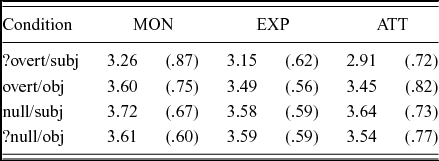
This experiment consisted of an offline judgement task in which participants were given anaphoric sentences to read and then rate on a 5-point scale depending on their perceived naturalness, in order to investigate whether participants showed any attrition effects in their offline interpretation of subject pronouns. Table 1 shows participants’ score means for each condition.
Score means and (SD) for offline anaphora resolution by all groups.

A repeated-measures ANOVA with the factors Pronoun and Antecedent was run for each of the three groups. The results revealed a significant main effect of Pronoun for all groups: MON (F 1(1, 23) = 4.345, p = .048; F 2(1, 31) = 10.465, p = .003), ATT (F 1(1, 23) = 16.681, p < .001; F 2(1, 31) = 25.393, p < .001) and EXP (F 1(1, 23) = 4.935, p = .036; F 2(1, 31) = 20.595, p < .001), which indicates that the type of pronoun presented in the stimuli had a significant influence on participants’ scores, with the null pronoun being rated higher (i.e., more natural) than the overt by all groups. On the other hand, a main effect of Antecedent was only revealed by ATT (F 1(1, 23) = 7.858, p = .010; F 2(1, 31) = 9.321, p = .005), but not for MON (F 1(1, 23) = 1.946, p = .176; F 2(1, 31) = 1.530, p = .225) or EXP (F 1(1, 23) = 3.640, p = .069; F 2(1, 31) = 2.745, p = .108), which suggest that only ATT scores are influenced by the type of antecedent matching with the pronoun presented in the stimuli, with the subject antecedent being rated generally higher than the object by this group.
More importantly, a significant Pronoun*Antecedent interaction effect for all groups’ ratings of anaphora was revealed. This interaction was significant only by subjects for MON (F 1(1, 23) = 12.328, p = .002; F 2(1, 31) = 3.880, p = .058) and EXP (F 1(1, 23) = 5.403, p = .029; F 2(1, 31) = 2.793, p = .105), and by subjects and items for ATT (F 1(1, 23) = 16.468, p < .001; F 2(1, 31) = 19.936, p < .001). This indicates that the three groups of participants were sensitive to the mismatching conditions when interpreting subject pronouns offline.
To explore the nature of these interaction effects, paired samples t-tests were conducted with all groups to compare their interpretation of overt and null pronouns. As Table 1 shows, with the overt pronoun, all three groups rated significantly lower scores for the subject antecedent than for the object antecedent: MON (t1(23) = −3.158, p = .004; t2(31) = −2.237, p = .033), ATT (t1(23) = −2.804, p = .010; t2(31) = −3.822, p = .001) and EXP (t1(23) = −2.804, p = .010; t2(31) = −3.822, p = .001); and although the ratings for the null pronoun overall revealed higher scores for the subject antecedent than for the object antecedent, this difference was not significant for any of the groups: MON (t1(23) = 1.041, p = .309; t2(31) = .577, p = .568), ATT (t1(23) = .739, p = .467; t2(31) = .858, p = .397) and EXP (t1(23) = −.141, p = .889; t2(31) = −.062, p = .951).
Finally, group comparisons were conducted running a repeated-measures ANOVA with the factors Pronoun, Antecedent and LanguageGroup for MON vs. ATT, MON vs. EXP, and ATT vs. EXP. They revealed no three-way interaction effects of Pronoun*Antecedent*LanguageGroup for any of the group comparisons: MON vs. ATT (F 1(1, 46) = .867, p = .357; F 2(1, 31) = 1.483, p = .232), MON vs. EXP (F 1(1, 46) = .456, p = .503; F 2(1, 31) = .112, p = .740) and ATT vs. EXP (F 1(1, 46) = 2.275, p = .138; F 2(1, 31) = 3.355, p = .077). These results clearly indicate that, as it was predicted, there are no significant differences between any of the groups in terms of their offline preferences for subject pronouns.
5.2 Eye-tracking task
The online experiment consisted of an eye-tracking-while-reading task, in order to explore whether participants showed online sensitivity when processing pronominal subjects in real time.
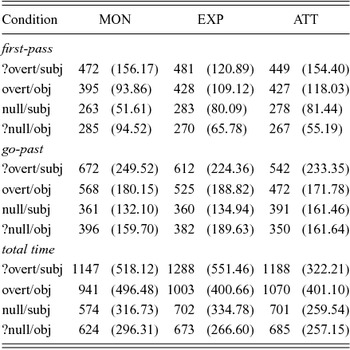
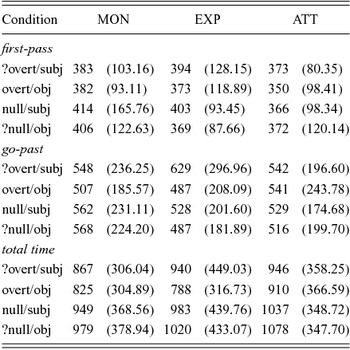
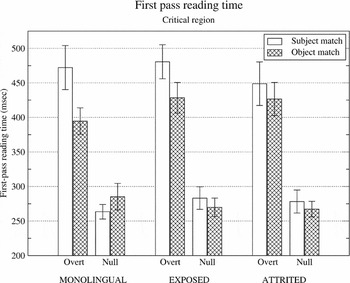
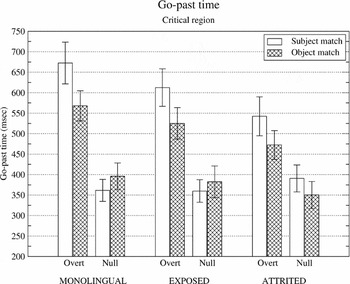
For each of the three groups, a repeated-measures ANOVA with the factors Pronoun and Antecedent was run for each measure (fp, gp and tt) and region (although only the critical and post-critical regions are reported, since the analyses for the final region are non-significant or uninterpretable due to the massive wrap-up effects that take place in reading studies). Tables 2 and 3 show the RT means revealed by each group for fp, gp and tt in the critical and post-critical regions, respectively, while Figures 1, 2 and 3 show this information graphically, for the critical region.
First-pass, go-past and total time RT means and (SD) in the critical region (ella/pro cruzaba) by the three groups.

First-pass, go-past and total time RT means and (SD) in the post-critical region (una calle) by the three groups.

First-pass RT in the critical region (ella/pro cruzaba) by the three groups.

Go-past RT in the critical region (ella/pro cruzaba) by the three groups.

Total time RT in the critical region (ella/pro cruzaba) by the three groups.

A main effect of Pronoun was revealed by all groups of participants, consistently in the critical region for all three eye-movement measures, with the overt pronouns showing longer RTs than the null. The post-critical region also showed a main effect of Pronoun, for tt, with the trend in the opposite direction. The effect in the critical region is almost certainly due to the length difference between the sentences containing a null pronoun and the sentences containing an overt pronoun (the sentences with an overt pronoun contain one more word than the sentences with a null pronoun). Note, however, that although the Pronoun main effect is confounded with length, this does not affect the interpretation of the crucial Pronoun*Antecedent interaction reported below, since interactions in ANOVA are independent of main effects. A main effect of Antecedent was revealed only by MON and EXP, and not by ATT, with the subject antecedent consistently showing longer RTs than the object. For MON, significant main effects of Antecedent were shown in the critical region for fp (F 1(1, 23) = 4.358, p = .048; F 2(1, 31) = 5.945, p = .021) and tt, although only by subjects (F 1(1, 23) = 7.850, p = .010; F 2(1, 31) = 1.465, p = .235). For EXP, significant main effects were shown for fp in the critical (F 1(1, 23) = 7.138, p = .014; F 2(1, 31) = 7.507, p = .010) and post-critical regions (F 1(1, 23) = 4.493, p = .045; F 2(1, 31) = 5.568, p = .025), for gp in the post-critical region (F 1(1, 23) = 4.997, p = .035; F 2(1, 31) = 7.808, p = .009) and for tt in the critical region (F 1(1, 23) = 8.540, p = .008; F 2(1, 31) = 11.180, p = .002).
Moreover, the repeated-measures ANOVA tests revealed significant Pronoun*Antecedent interaction effects only for MON and EXP, but not for ATT. The MON group showed interaction effects in the critical region for fp (F 1(1, 23) = 12.391, p = .002; F 2(1, 31) = 6.199, p = .018), for gp by subjects (F 1(1, 23) = 4.889, p = .037; F 2(1, 31) = 1.962, p = .171) and for tt by subjects (F 1(1, 23) = 11.896, p = .002; F 2(1, 31) = 1.016, p = .321). For the EXP group, the interaction effect in the critical region was significant for tt (F 1(1, 23) = 9.963, p = .004; F 2(1, 31) = 11.502, p = .002), and marginally significant for fp (F1(1,23) = 3.57, p = .072; F 2(1, 31) = 3.62, p = .067) . The EXP group also showed an interaction in the post-critical region in tt, which was significant by subjects and marginal by items (F 1(1, 23) = 4.644, p = .042; F 2(1, 31) = 3.906, p = .057). Finally, for the ATT group, the Pronoun*Antecedent interaction did not approach significance in any region, for any measure. This indicates that during online anaphora resolution, MON and EXP were sensitive to the mismatching conditions, but not ATT.
To explore the nature of these interaction effects, paired samples t-tests were conducted again with MON and EXP to compare their processing of overt and null pronouns. As suggested by Tables 2 and 3, and Figures 1, 2 and 3, the interaction for the MON and EXP groups is driven by significant differences between the two overt pronoun conditions (with longer RTs for the subject antecedent than the object antecedent), along with no significant differences between the two null conditions, (showing, in most cases, the opposite numerical pattern to the overt pronouns). For the MON group, the difference between the two overt pronoun conditions was found in the critical region for all measures: fp (t1(23) = 3.919, p < .001; t2(31) = 3.023, p = .005), gp by subjects (t1(23) = 2.130, p = .044; t2(31) = 1.473, p = .151) and tt by subjects (t1(23) = 4.712, p < .001; t2(31) = 1.206, p = .237). For the EXP group, the difference between the two overt conditions was found for both fp and tt in the critical region: fp (t1(23) = 2.60, p < .05; t2(31) = 2.75, p < .05) and tt (t1(23) = 3.632, p < .001; t2(31) = 3.774, p < .001) and for tt in the post-critical region (t1(23) = 2.457, p = .022; t2(31) = 2.617, p = .014). In contrast, the difference between the two null conditions was not reliable for any of these comparisons (all p's > .25).
Finally, group comparisons were conducted running a repeated-measures ANOVA with the factors Pronoun, Antecedent and LanguageGroup for MON vs. ATT, MON vs. EXP, and ATT vs. EXP for all measures and regions. The ANOVA tests revealed a three-way interaction of Pronoun*Antecedent*LanguageGroup for MON vs. ATT for fp in the critical region by subjects (F 1(1, 46) = 5.064, p = .029; F 2(1, 31) = 2.047, p = .163), which reveals that there are differences between MON and ATT in terms of how they are affected by the pronoun mismatch in their online processing of these anaphora. The pattern of these three-way interaction effects in the critical region were explored and they appear to be due to the fact that MON showed the expected Pronoun*Antecedent interaction in fp, while ATT did not.
Moreover, as predicted, no significant three-way interaction effects were found when MON and EXP were compared, which reveals that the attrition effects of this exposed group have decreased as a result of their re-exposure to the L1. Interestingly, when ATT and EXP were compared, no significant three-way interaction effects were found between these two groups either, which suggests that EXP might be somewhere between MON and ATT in terms of their online sensitivity to the pronoun mismatch.
6. Discussion
The present study aimed to explore three main research questions. First, whether attriters showed indeterminacy with an interface structure like pronominal subjects, as predicted by the Interface Hypothesis (Sorace & Filiaci, Reference Sorace and Filiaci2006). Second, whether attrition affects online sensitivity when processing these interface structures in real time or whether it is due to permanent changes in attriters’ L1 knowledge representations. Finally, whether attrition effects decrease or disappear due to frequency and recency of re-exposure to the L1, as predicted by the ATH (Paradis, Reference Paradis1993).
Since we explored attrition in the interpretation and processing of an interface structure, no difference between the groups was predicted for the acceptability judgment task with subject pronouns, but attriters were expected to show reduced online sensitivity to this structure and, consequently, to perform differently from monolinguals in the eye-tracking task. As expected, the results from the naturalness judgements revealed equal mismatch sensitivity to subject pronouns for all three groups of participants. In the eye-tracking task, the monolinguals showed very early sensitivity to the pronoun preferences, resulting in a robust Pronoun*Antecedent interaction in first-pass reading times on the critical region. This same first-pass interaction was close to traditional levels of significance for the exposed group, and was accompanied by the same pattern of significance in the paired contrasts as that of the monolingual group. Moreover, the exposed group also showed a robust interaction in total time in the critical region, confirming that the pronoun preferences for this group were operative online, during the reading of the sentence. In contrast, the attriters did not show any evidence for a Pronoun*Antecedent interaction in any measure, indicating a lack of online sensitivity to the pronoun mismatch. Overall, the results from the eye-tracking experiment revealed that, in online reading, the monolingual and exposed groups are reliably more sensitive than attriters to the pronoun mismatch (i.e., overt pronoun when null pronoun is appropriate or null pronoun where overt pronoun is appropriate). Therefore, we can conclude that L1 Spanish attrited speakers show attrition effects with the interface structure involving pronominal subjects.
This pattern of results is what would be expected based on the ATH, which predicts that attrition diminishes with frequency and recency of re-exposure to the L1. Thus, the exposed group was expected to show online sensitivity to the pronoun mismatch and, consequently, to perform similarly to monolinguals due to the fact that they had recently been exposed to their L1. As discussed above, the results obtained for the exposed group did not reveal attrition effects with pronominal subjects, since this group, unlike the attriters, showed a reliable sensitivity to the pronoun mismatch when processing this interface structure in real time. Moreover, when they were compared to the monolinguals, no significant differences between the two groups were revealed, which suggests that attrition effects diminish after recent exposure to the L1.
However, when the exposed group was compared to the attriters, no significant differences between the two groups were shown either. Therefore, given the significant differences between monolinguals and attriters, it might be the case that the exposed group is somewhere in between the attriters and the monolinguals; that is, their attrition effects have clearly diminished after having been exposed exclusively to the L1 for a period of time, but not to the point of behaving native-like. The exposed group may also have shown a slightly delayed sensitivity to the pronoun biases relative to the monolingual group, given that the monolingual group showed robust effects in first pass in the critical region, while the most robust effects for the exposed group emerged in total time. The question now is whether attrition effects with interface structures such as subject pronouns just cannot be completely overcome or whether it is a matter of the length of re-exposure to the L1, so that a longer exposure might be needed for attriters to totally reverse attrition effects and behave again like monolingual speakers.
Finally, based on the judgment data, which shows no significant differences between the three groups, and also based on the fact that the monolingual and exposed groups do not reveal significant differences in their online results, it is clear that no permanent change in the attriters’ L1 declarative knowledge representations takes place. On the one hand, we found that, despite attriters’ lack of online sensitivity to the pronoun preferences, this group behaved like the monolingual and exposed groups in the judgment task, with all groups of participants showing an equal sensitivity to the pronoun mismatch. On the other hand, it was found that the monolingual and exposed groups did not show significant differences in the eye-tracking task. These results reveal that the exposed group was able to partially overcome attrition with recent re-exposure to their L1 and therefore, that no permanent changes took place in these speakers’ L1 knowledge representations.
One aspect of the results that deserves comment is the finding that participants generally had a clear preference for the object as the antecedent for the overt pronoun, while the preference for the null pronoun was less clear: generally, subject vs. object matching null pronouns did not differ significantly in ratings or eye-movement measures, for any of the three groups. At first sight, this pattern seems to be at odds with previous findings that suggest that native speakers of Spanish consistently assign the subject antecedent to a null pronoun, whereas the overt pronoun is more flexible and not so strictly assigned to the object antecedent (Filiaci, Reference Filiaci, Borgonovo, Español-Echevarría and Prévost2010; Filiaci et al., Reference Filiaci, Sorace and Carreiras2014). However, our study may not be fully comparable to those earlier studies. One possible reason for this is the difference in tasks; Filiaci, (Reference Filiaci, Borgonovo, Español-Echevarría and Prévost2010) and Filiaci et al (Reference Filiaci, Sorace and Carreiras2014) combined a reading time measure with comprehension questions, while we combined a reading time measure with an acceptability judgement task. It is possible that this task difference may have affected the relative preference for subject versus object antecedents. A second possible reason is related to clause order. The clause order in our study was Main-Subordinate, while the earlier studies that showed clear preferences for null subjects used Subordinate-Main order, which may also have affected the overall referential bias in the stimuli. In fact, Filiaci (Reference Filiaci, Borgonovo, Español-Echevarría and Prévost2010) includes two experiments in which she tests Main-Subordinate anaphora, and her results are similar to the ones presented here, with the overt pronoun revealing a strong bias for the object antecedent and the null pronoun a weak preference for the subject antecedent for both Italian and Spanish speakers.
Interestingly, Carminati's (Reference Carminati2002) PAS was also based on Subordinate-Main anaphora. However, she conducted a questionnaire study including Main-Subordinate anaphora with temporal clauses, which are the kind of anaphora used in the present experiment, and her results revealed that more object antecedents were assigned to null pronouns in Main-Subordinate anaphora than in other types of clauses. Moreover, other studies in Italian have also found a strong preference of the object as the antecedent for the overt pronoun and a weaker subject bias for the null pronoun (Fedele & Kaiser, Reference Fedele and Kaiser2012; Sorace & Filiaci, Reference Sorace and Filiaci2006), and a similar bias towards the object antecedent has been found with German demonstrative pronouns (Bosch, Katz & Umbach, Reference Bosch, Katz, Umbach, Schwarz-Friesel, Consten and Knees2007; Bosch, Rozario & Zhao, Reference Bosch, Rozario and Zhao2003; Bosch & Umbach, Reference Bosch, Umbach, Bittner and Gargarina2007).
7. Conclusions
Considering all the findings obtained from this study, we can conclude that attrition effects decrease as a result of L1 re-exposure. This reveals that bilinguals are sensitive to input changes and that attrition affects online sensitivity rather than causing a permanent change in speakers’ L1 knowledge representations. Therefore, the results obtained from the present study clearly support Sorace's (Reference Sorace2011) proposal that individual L1 attrition affects only the ability to process interface structures but not knowledge representations themselves. Future research is needed to identify precisely which aspects of processing pronominal dependencies are affected by attrition.