Introduction
The genetic structure of a population depends on demographic, geographic and socio-cultural factors. Language, ethnicity, religious affiliation and occupation are variables that have been analysed (Smith et al., Reference Smith, Smith and Williams1984; Koertvelyessy et al., Reference Koertvelyessy, Crawford, Huntsman, Collins, Keeping and Uttley1988; Vienna & Biondi, Reference Vienna and Biondi2001; Manni et al., Reference Manni, Guérard and Heyer2004; Biondi et al., Reference Biondi, Vienna, Peña Garcìa and Mascie-Taylor2005; Tagarelli et al., Reference Tagarelli, Fiorini, Piro, Luiselli, Tagarelli and Pettener2007).
A differential mating pattern may be detected from information on birth and residence places of mates as well as from their surnames. The frequency and distribution of surnames studied by means of isonymic analysis provide insight into the genetic structure of populations (Caravello & Tasso, Reference Caravello and Tasso1999; Boattini et al., Reference Boattini, Calboli, Blanco Villegas, Gueresi, Franceschi, Paoli, Cavicchi and Pettener2006; Tagarelli et al., Reference Tagarelli, Fiorini, Piro, Luiselli, Tagarelli and Pettener2007) and the relation of the above to the geographic origin of individuals (Smith & Bittles, Reference Smith and Bittles2002; Sanna et al., Reference Sanna, Jovine, Melis and Floris2006).
Mating preference between certain lineages (Ridley, Reference Ridley1996) influenced by religion (Koertvelyessy et al., Reference Koertvelyessy, Crawford, Huntsman, Collins, Keeping and Uttley1988, Reference Koertvelyessy, Crawford, Pap and Szilagyi1992), or geography and ethnicity (Koertvelyessy et al., Reference Koertvelyessy, Crawford, Pap and Szilagyi1990; Pettener et al., Reference Pettener, Pastor and Tarazona-Santos1998) determines population subdivision. Furthermore, geographic or socio-cultural barriers to mate choice exist in some populations. One of the methods that make possible the detection of these barriers is the analysis of repeated- pairs of surnames. This method, developed by Lasker & Kaplan (Reference Lasker and Kaplan1985), quantifies the combination of surnames of couples. The analysis of repeated-pairs of surnames reveals possible subdivisions of a population (Wahlund effect) made up of genetically isolated subpopulations (Wahlund, Reference Wahlund1928). It has the advantage over other classical methods of isonymy analysis of allowing the detection of preferential mating patterns, but it is unable to identify the factors that produce this phenomenon (Biondi et al., Reference Biondi, Raspe, Mascie-Taylor and Lasker1996). Subdivisions may be detected when more repeated-pairs of surnames are observed than expected (Chakraborty, Reference Chakraborty1985; Lasker & Kaplan, Reference Lasker and Kaplan1985; Lasker, Reference Lasker1988; Relethford, Reference Relethford1992).
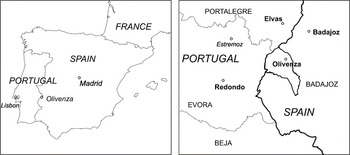
Olivenza location (in dashes the present-day limits of the municipality of Olivenza, which coincide with the border between Portugal and Spain before 1801).

A political border may also constitute a barrier limiting mating, and therefore the gene flow between populations. Several studies considering nationality have been based on surnames, such as those of Bolsen & Lasker (Reference Boldsen and Lasker1996), Riegler et al. (Reference Riegler, Marrón, Pattaro, Guerreéis and Pramstaller2007) and Scapoli et al. (Reference Scapoli, Mamolini, Carrieri, Rodriguez-Larralde and Barrai2007). Concerning previous studies on mating patterns in Spain and Portugal, Pallarés (Reference Pallarés1990), Abade (Reference Abade1992), Macbeth et al. (Reference Macbeth, Salvat, Vigo and Bertranpetit1996) and González-Martìn & Toja (Reference González-Martìn and Toja2002) considered communities close to the Spanish border, but only the study of Eizaguirre (Reference Eizaguirre1994) on some trans-frontier parishes at the northern Spanish–Portuguese border and based on surnames and places of birth and residence, is relevant to the present research.
In order to determine the effect of the change of national borders on the biodemographic structure of a population, the Spanish village of Olivenza in Badajoz Province (Fig. 1) was chosen as a case for study. Since the 13th century this village experienced alternate changes of domain between Portugal and Spain. In 1801 Spain and France declared a war on Portugal which ended with the signature of the ‘Treaty of Badajoz’ incorporating definitively Olivenza to Spain.
The municipality of Olivenza is located 24 km west of the provincial capital (Fig. 1) and occupies an area of 42,206 ha. The number of inhabitants during the period studied (1750–1850) is known only according to the censuses of 1801 (6737) and 1842 (6291). However, the comparison of these two population counts is not possible because although the 1842 census reflects the population officially inscribed, no details are given for 1801 regarding the legal or actual residence.
By using data on marital migration and diversity of surnames, the present study determines whether the modification of the border had a gradual or immediate influence on the mating pattern of Olivenza. Furthermore, by means of an analysis of repeated surname pairs, this investigation quantifies the process of mate choice in Olivenza related both to the change of sovereignty and eventually to the existence of population subdivision between Spanish and Portuguese lineages.
Methods
Information on all the available Catholic marriages (N=3954) celebrated in Olivenza during the period 1750–1850 was obtained. A copy of the ecclesiastical registers kept by the Church of Latter-Day Saints provided data on surnames of spouses and their parents, as well as their places of birth and residence.
Couples married in Olivenza were classified according to the geographical origins of males and females: Olivenza, Spain and Portugal. In order to identify differences in birthplaces coinciding with the change of border, data referring to two periods were compared: one ‘before’ the change of domain (1750–1800) and the other ‘after’ the change (1801–1850). Furthermore, a more detailed analysis dividing these data into ten consecutive periods was made (1750–60, 1761–70, 1771–80, 1781–90, 1791–1800, 1801–1810, 1911–1820, 1821–1830, 1831–1840 and 1841–1850). In both cases the corresponding frequencies were compared by means of a χ 2 test for homogeneity of samples.
Orthographic variations found in some surnames could be attributed to linguistic differences between Portuguese and Spanish. It was therefore difficult to distinguish polyphyletic surnames from those that presented Portuguese and Spanish spelling variations despite their common origin (Faure et al., Reference Faure, Ribes and Garcia2001). In order to correct possible bias because of surnames' orthographic variation, standardized spelling of surnames (i.e. Rodriguez=Rodrigues) was retained.
In the period considered, the Portuguese system of transmission of surnames was not consistent and distinct from that of Spain, which was formed by a first surname of the father and a second of the mother. To check the pattern of surname transmission in Olivenza, the correspondence of surnames of mates to their parents was determined by means of an analysis of frequencies comparing the surnames of grooms and brides with those of their respective parents. Data providing more valid cases and better correspondence between generations were used: for grooms the first own surname and for brides the first surname of their fathers (Román et al., Reference Román, Guardado-Moreira, Zuluaga, Blanco Villegas, Colantonio and Fuster2007).
The method applied to estimate the diversity of surnames in each period was the H index (Shannon & Weaver, Reference Shannon and Weaver1949):

where pi is the probability of the i th surname in each period.
In order to estimate immigration into Olivenza contemporary with the change of border, the proportion of surnames counted only once (A) was obtained following Rodriguez-Larralde & Barrai (Reference Rodriguez-Larralde and Barrai1998). Pairs of surnames in Olivenza were compared according to the Lasker & Kaplan (Reference Lasker and Kaplan1985) method, which determines the proportion of pairs of observed surnames to random pairs.
The frequency of repetition of each pair of surnames is measured by RP, which is defined as:

where Sij is the number of couples with male surname i and female surname j, and N represents the total number of marriages (N=ΣiΣjSij). This index may take values between 0 (each pair counted once) and 1 (a combination of surnames is repeated N times).
The observed values (RP) were compared with the index of repeated-pairs expected at random (RPr), corresponding to a situation in which the number of repetitions depends only on the frequency of different surnames existing in the population. RPr was calculated following Chakraborty (Reference Chakraborty1985):

where Si 2 and Sj 2 are the squared number of surnames for grooms and brides, respectively, and N is the total number of marriages.
The percentage of excess RP over the random expectation was calculated according to Relethford (Reference Relethford1992):
100(RP–RPr)/RPr
To test the hypothesis RP=RPr, the Relethford (Reference Relethford1992) method was applied to calculate the statistical z:
z=(RP–RPr)/SE(RPr).
In this formula SE(RPr) is the standard error of the random component, derived from Chakraborty (Reference Chakraborty1985).
Results and Discussion
Choice of mate: Spanish–Portuguese origin
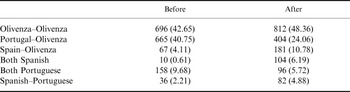
Table 1 compares the period ‘before’ with the period ‘after’ the change of domain from Portugal to Spain in 1801. The test of homogeneity of frequencies in this table gave a χ 2 value of 235.91 (p<0.001), which indicates the existence of significant differences in the distribution of marriages regarding birthplace. These differences are explained by the reduction of mixed marriages formed by Portuguese and Olivenza natives.
Number and percentage of marriages in Olivenza ‘before’ (1750–1800) the change of sovereignty from Portugal to Spain and ‘after’ this change (1801–1850)

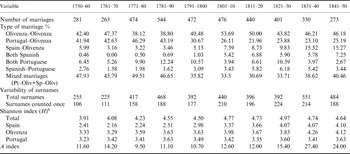
Table 2 shows data for ten consecutive periods. The low number of marriages in 1750–1770 and 1841–1850 is due to the lack of data in one of the two parishes of Olivenza (Santa Marìa Magdalena). The reduction of marriages occurring in 1831–1840 is explained by an outbreak of cholera widely affecting Spain, with maximum virulence in the summers of 1833 to 1834 (Nadal, Reference Nadal and Seix y Barral1976).
Number and types of marriages celebrated in Olivenza 1750–1850, according to the birthplace of mates, diversity of surnames and Shannon (H) and A indexesa by period

a Rodriguez-Larrade & Barrai (Reference Rodriguez-Larralde and Barrai1998).
b Shannon indexes of individuals born in Spain, Olivenza and Portugal.
In this table it is observed that the percentage of endogamous marriages according to birthplace (both spouses born in Olivenza) reached the maximum value (53.69%) following the change of sovereignty. In this period, immigration into Olivenza would have been limited due to the political instability at that time, thus resulting in increased endogamy. Although from 1791–1800 to 1801–1810 mixed Portugal–Olivenza marriages had reduced (26.11% in 1801–1810), they remained more common than Spain–Olivenza mixed marriages. Before the change of domain, mixed Spanish–Olivenza marriages had begun to increase slightly (1781–1790=3.46; 1791–1800=5.15), consolidating in the last periods studied (since 1831). By contrast, a drastic variation affected couples composed of two Spaniards (increase) while the percentage of those formed by two Portuguese remained oscillating throughout the whole period analysed. In 1841–1850 percentages in each class of mixed marriages (Portugal–Olivenza, Spain–Olivenza) became closer (25.19–15.27%) but mates from Portugal were still more frequent than those from Spain. This suggests that, although less intense, after 1801 business and social relations between Portugal and Olivenza continued. Approximately the same number of Spanish males and females contributed to mixed marriages in Olivenza, while Portuguese males outnumbered females (Fuster et al., Reference Fuster, Román, Guardado, Zuluaga, Blanco, Colantonio, Bodzsár and Zsákai2007).
Regarding homogeneity among the ten periods displayed in Table 2, no significant differences were found for the first four (χ2=19.30; p=0.200). If the period 1791–1800 is added, the statistics become χ 2=41.55 (p=0.003). According to this result, in this later period the mating pattern had already begun to change, the greater contribution to the χ 2 value corresponding to the categories Olivenza–Olivenza and Portugal–Olivenza. The first two periods after the change of domain (1801–1810 and 1811–1829) are homogeneous (χ2=8.11, p=0.150). The same applies to the last two periods (1831–40 and 1841–50; χ 2=2.57, p=0.766). The period 1821–30, however, was not homogeneous regarding the two preceding decades (χ2=22.20, p=0.014) or in comparison with the two following decades (1831 to 1850), with χ 2=26.15 (p=0.003).
These results confirm a new marriage pattern at the time of the change of domain. The number of Olivenza–Olivenza couples had begun to increase before the border change, while Portugal–Olivenza marriages had started to reduce.
Thus, a period of instability around the change of sovereignty (1791–1810) took place leading to increased endogamy and lower Portuguese immigration into Olivenza.
Variability of surnames and nationality
The initial difficulty of identifying surnames transmitted from one generation to the next during the period of Portuguese sovereignty (1750–1800) was overcome by comparing pairs of surnames of grooms and brides with those of their fathers. Following the procedure described in the Methods, the first surname of the groom and the first surname of the bride's father were used. Based on these surnames, their diversity was calculated for each consecutive period, as shown in Table 2.
Surname diversity increased in Olivenza, with the Shannon index increasing from 3.91 in the first period analysed to 4.64 in the last, becoming maximum in 1821–1830. The above corresponds to a larger Shannon index mainly for individuals of Spanish origin, for whom the index varied in the same period (1821–1830) from 3.66 a 4.07 (Table 2). This index, however, experienced slight variation among Portuguese newcomers. The Shannon index variation is concordant with a larger number of Spaniards marrying in Olivenza. Without making a distinction between Spanish or Portuguese origin, total mixed marriages remained rather uniform over time. But, from the period prior to the change of border, Spain–Olivenza matings became more numerous, resulting in the appearance of new surnames. The five most frequent surnames experienced a marked reduction following the change of domain, from 40% in 1750–1760 to 21% in 1841–1850. Concerning the frequency of surnames present only once, expressed by the A index (Rodriguez-Larralde & Barrai, Reference Rodriguez-Larralde and Barrai1998), high values occurred in the last two periods, but its increase began after the change of frontier (Table 2, bottom) as a consequence of immigration taking Spanish surnames into Olivenza.
Repeated-pairs of surnames
The method of repeated-pairs was based on 2351 pairs of surnames accounting for 1717 different combinations, 84% of which appeared only once. There are only slight variations concerning the temporal change. However, an increase of pairs of surnames counted once is noticeable during the periods under Spanish sovereignty (Table 3).
Coefficients of repeated-pairs of surnames in each period, Olivenza 1750–1850

* p<0.05.
RP=observed; RPr=expected; values multiplied by 103.
Table 3 shows the RP coefficients by period. The maximum excess of RP in comparison to RPr was during the decade prior to the change of sovereignty, and continued elevated in the period 1811–1820. The entrance of more Spanish surnames coinciding with the increase of the number of Spain–Olivenza marriages in 1791–1800 and the noticeable elevation in the number of marriages between Spaniards (1801–1810) (Table 2) could explain the elevation of RP in the period 1791–1800 and its later reduction in 1801–1810, when there was a greater frequency of Olivenza–Olivenza matings. This fact is attributed to a certain tendency to local endogamy in the years of political instability after the change of domain. However, according to the z statistics, differences are significant only between 1811 and 1820 (p<0.05), reflecting a certain increase of marriages between individuals of the same origin and the reduction of mixed marriages (Table 2).
An excess of RP over RPr shows a diminution of genetic variability because of population subdivision due to the admixture of lineages by preferential matings (Wahlund effect). Since a significant difference between RP and RPr was detected only in a short period of time (1811–1820), the excess of RP could not indicate such an effect in Olivenza over an extended time period. This difference is understood in the context of preferential matings affecting also the type of marriage according to birthplace. After the change of sovereignty, there was a tendency towards marriage among individuals of the same nationality or of common origin in the preceding generations. The observed (RP) and expected (RPr) values became close in the late periods, which could be an indication of the disappearance of limitations regarding the choice of mate due to an increased Spanish immigration beginning in 1831 (Table 2).
When these results are compared with those obtained in other European regions, RP in Olivenza is greater than reported by Vernay (Reference Vernay2000) in France, Manfredini (Reference Manfredini2003) in Italy or by Esparza et al. (Reference Esparza, Garcìa-Moro and Hernández2006) in Spain. These populations, for time periods close to those here analysed, had a smaller number of inhabitants than Olivenza, and probably less social stratification and fewer preferential marriages. In the Italian Tyrol, subdivision was detected by RP only in localities where the population size was large enough to make possible marital endogamy (Riegler et al., Reference Riegler, Marrón, Pattaro, Guerreéis and Pramstaller2007). The situation differs in Olivenza, where military presence may have encouraged marriages between members of families of a similar military rank, thus limiting mixed Spanish and Portuguese marriages after the change of border.
Lasker et al. (Reference Lasker, Mascie-Taylor and Coleman1986) and Relethford (Reference Relethford1992) demonstrated a clear relationship between RP and population size. However, an equivalent analysis was no possible in Olivenza due to the lack of information on the census size temporal variation.
The fact that Olivenza was a garrison may have resulted in a certain social stratification based on military rank. The observed RP may exceed the expected because of social stratification. However, although this factor would explain the high values of RP in comparison with other populations, it cannot explain the observed RP–RPr differences between periods in Olivenza (Table 3, bottom), because this town always maintained a garrison previous to and after the change of sovereignty. If the excess of RP had been created by social class only, the excess of RP observed throughout all the periods would have remained stable; therefore, a more likely cause is preferential mating between individuals of the same place of birth.
Using surnames as evidence for any limitation to the gene flow has been proved by several authors. These limitations include diverse factors – geographical, social, religious, linguistic and political. According to Koervelyessy et al. (Reference Koertvelyessy, Crawford, Pap and Szilagyi1992) and Manni et al. (Reference Manni, Guérard and Heyer2004), the religious factor is important as revealed by RP as an indicator of population subdivision. But ethnicity was declared a secondary factor in other studies in comparison to geography (Vienna & Biondi, Reference Vienna and Biondi2001; Biondi et al., Reference Biondi, Vienna, Peña Garcìa and Mascie-Taylor2005; Tagarelli et al., Reference Tagarelli, Fiorini, Piro, Luiselli, Tagarelli and Pettener2007). The combined effect of political and geographic barriers was studied by Eizaguirre (Reference Eizaguirre1994) at the northern Portugal–Spain border defined by the Miño River. This author was aware of the difficulties in establishing whether one or two breeding groups (Spanish–Portuguese) could be recognized. Despite this lack of definition, the Miño River was considered a barrier to gene flow in combination with the political border.
Conclusions
In Olivenza, in the period before the change of sovereignty (1791–1800), the number of mates born in Portugal reduced, whereas those born in Spain increased. This variation was initially due to couples consisting of Spaniards, while mixed marriages including one member born in Olivenza modified more gradually: mixed marriages with Spaniards increased while those with Portuguese decreased. Despite these modifications of the mating pattern, in 1841–1850 the Spanish–Olivenza marriages still remained fewer than Portuguese–Olivenza marriages. Although local endogamy increased slightly in the period 1801–1810 to 53.69%, perhaps due to the political instability after the change of border, resulting in a certain amount of isolation, there was not noticeable variation in the following periods. The genetic flow derived from the border modification was initially balanced by a population subdivision, possibly motivated by preferential mating between individuals of the same lineage or of the same national origin.
In a long-term perspective, the political barrier resulting in a change of sovereignty modified the mating pattern of the population. Permanent effects of the immigrant nationalities on the genetic structure of the native population could have been diffused because of a gradual mix following the change of sovereignty.
Acknowledgments
This work was supported by the Spanish Ministry of Education and Science (project reference CGL2004-00928/BOS), which also granted a scholarship to Jorge Román-Busto (BES-2005-7962). Thanks are expressed to the Family History Center of the Church of Jesus Christ of the Latter-Day Saints (Madrid: Pablo Iglesias Avenue) for allowing data collection and to Erik Lundin for his help in the preparation of the manuscript.