Introduction
Lazarsfeld, Berelson, and Gaudet’s (Reference Lazarsfeld, Berelson and Gaudet1944) The People’s Choice has frequently been cited as the source originator of what has become known as the ‘minimal effects paradigm’, that for a long time pervaded – or, according to Bartels (Reference Bartels1993: 267), even embarrassed – political communications research. Initially unnoticed, however, Lazarsfeld and his colleagues already pointed to significant campaign effects in that ‘political campaigns are important primarily because they activate latent predispositions’ (Lazarsfeld, Berelson, and Gaudet’s, Reference Lazarsfeld, Berelson and Gaudet1944: 74). More recently, the idea that campaigns help voters make decisions in line with their pre-existing preferences, has been picked up by other scholars who provide considerable evidence that activation effects actually do occur during the course of campaigns (for an overview, see Iyengar and Petrocik, Reference Iyengar and Petrocik1998; Iyengar and Simon, Reference Iyengar and Simon2000; Bartels, Reference Bartels2006). For instance, Finkel (Reference Finkel1993) shows that individual changes in candidate preferences over the course of the 1980 United States Presidential elections campaign, predominantly affected voters whose initial preferences were incongruent with their predispositions, as measured by race and party identification. In the same connection, Gelman and King (Reference Gelman and King1993) find that voters generally assigned more weight to such fundamental variables as the campaign progressed. Finkel and Schrott (Reference Finkel and Schrott1995) show that similar patterns emerged in the 1990 German Bundestag election campaign. For Great Britain, Andersen, Tilley, and Heath (Reference Andersen, Tilley and Heath2005) show that the predictive strength of class, religion, education, and personal ideology systematically varied over the electoral cycles 1992–97 and 1997–2001, and peaked during the campaign. Finally, Arceneaux’s (Reference Arceneaux2006) cross-national study of nine European countries also reveals activation effects as the election days approach. The empirical evidence that campaigns help voters learn about the electoral relevance of their fundamental predispositions is thus relatively unambiguous.
Disagreement exists, however, with respect to the role of partisan orientations. Although most authors consider party attachments as fundamental predispositions that, once activated, guide political judgment and voting behaviour (e.g. Finkel, Reference Finkel1993; Gelman and King, Reference Gelman and King1993; Finkel and Schrott, Reference Finkel and Schrott1995; Holbrook, 1996; Iyengar and Petrocik, Reference Iyengar and Petrocik1998; Hillygus and Jackman, Reference Hillygus and Jackman2003), others claim that party attachments merely serve as decision short cuts for voters innocent of substantial political information (Andersen, Tilley, and Heath, Reference Andersen, Tilley and Heath2005; Arceneaux, Reference Arceneaux2006).
This dissent is hardly surprising, as the former authors argue from the perspective of U.S. presidential election campaigns where partisan orientations have to be translated into candidate preferences, whereas, the latter’s focus is on parliamentary elections where voters face choices between parties. Consequently, this translation task seems trivial indeed. To some extent, however, it also reflects a more fundamental debate about the very meaning and nature of party identification (for an overview see, Green, Palmquist, and Schickler, Reference Green, Palmquist and Schickler2002). In particular, proponents of a ‘traditional’ perspective conceptualize partisanship as a primarily affective attachment to a political party that develops at an early stage through parental influences, remains largely stable throughout life, is more or less immune to situational factors, and acts as an organizing principle for other political perceptions, attitudes, and behaviours (e.g. Bartels, Reference Bartels2002). The ‘revisionist’ camp, on the other hand, conceives of party identification as an endogenous ‘running tally’ of personal party evaluations that is constantly updated in response to incoming information (e.g. Fiorina, Reference Fiorina2002). Clearly, partisan leanings qualify as fundamental predispositions according to the former notion only.
In this paper, we scrutinize the role of partisan orientations in a direct-democratic campaign where voters decide on policy propositions, not parties or candidates. Thus, partisan predispositions and electoral choices do not carry the flavour of tautology potentially inherent in studies of parliamentary and presidential elections. Although learning how one’s own partisan leaning relates to the choices at stake is a non-trivial task in direct legislation settings, such decision guidance is probably all the more important, as voters frequently face complex propositions of which they lack detailed knowledge. These features qualify direct legislation elections as a particularly fruitful ground for study. If partisan orientations indeed acted as fundamental predispositions in such settings, we would expect voters to use campaign information to learn about their parties’ stances on the issues at stake, and to align their policy choices accordingly. Moreover, we would expect partisan orientations to serve as a ‘perceptual screen’ that saves voters from ambivalences because of conflicting preferences (e.g. Bartels, Reference Bartels2002).
In the following section, we will lay out the theoretical argument in some detail. Subsequently, we will offer some background information on our empirical case, the 2006 Swiss asylum law referendum, before we describe our data and empirical model. This sets the stage for the presentation of the empirical results. We summarize our findings in conclusion.
Theory
Activation theory suggests that campaigns are information-rich events that remind the prospective voters of the electoral relevance of their fundamental predispositions (Gelman and King, Reference Gelman and King1993). According to Bartels (Reference Bartels2006), the activation of partisan predispositions by a political campaign takes different forms: first, and most directly, the impact of partisan predispositions on vote intentions could increase over the course of the campaign. Second, campaigns might strengthen partisan attachments. Finally, the evaluations of additional explanatory factors, such as candidates, issues and economic conditions, could come increasingly to reflect more basic partisan predispositions. In his analysis of partisan activation in American presidential elections, Bartels (Reference Bartels2006) finds modest evidence of the direct effect, but hardly any evidence of the other two effects. He concludes: ‘Taken together, these three sets of results provide remarkably little evidence of partisan activation in recent general election campaigns’.
As opposed to parliamentary and presidential elections, referendums are usually one-time events, frequently involving choices between unfamiliar and complex alternatives. Thus, the learning process of the campaign becomes critical in determining individual choices and aggregate referendum outcomes (see LeDuc, Reference LeDuc2002; Hobolt, Reference Hobolt2006, Reference Hobolt2007). We would therefore expect to find more substantial evidence of partisan activation, particularly in ‘election-like’ referendums where the battle lines between proponents and adversaries of a policy correspond to traditional, ideological, and partisan cleavages. Correspondingly, we expect that voters learn about the parties’ and, in particular, their preferred party’s stances on the issue at stake (hypothesis 1), and that this partisan knowledge will help the voters to connect their partisan predispositions to their electoral choices (hypothesis 2).
In addition to partisan orientations, the set of fundamental predispositions may also include issue-specific values and attitudes. The voters also need to find out how the proposition submitted to the vote relates to these values and attitudes, and which choice best serves to do them justice.Footnote 1 Typically, partisan and issue-specific orientations tend to be consistently aligned in the individuals’ minds, but this need not always be the case. To the extent that voters are aware of a mismatch between their partisan and their issue-specific orientations, they are likely to be cross-pressured or ambivalent with respect to the voting choice (Alvarez and Brehm, Reference Alvarez and Brehm1995, Reference Alvarez and Brehm2002; Rudolph, Reference Rudolph2005). Accordingly, we expect ambivalent voters to translate their partisan orientations into vote choices less consistently than do voters whose partisan and issue-specific predispositions chime well together (hypothesis 3). In line with this literature, we may also expect the effect of ambivalence to be amplified by issue-specific knowledge (hypothesis 4; see Zaller and Feldman, Reference Zaller and Feldman1992; Rudolph and Popp, Reference Rudolph and Popp2007). By contrast, we expect partisan knowledge to serve as a means of reducing the effects of ambivalence (hypothesis 5). In line with the traditional perspective of partisanship, we expect partisan predispositions to be typically very salient and to predominate incompatible issue-related attitudes by default. Reviewing a considerable amount of literature, Sniderman and Levendusky (Reference Sniderman and Levendusky2007: 451) suggest that voters strive for consistency, and that the way they resolve cross-pressures will, more often than not, be guided by party loyalty: ‘Of course, some cast away their partisan attachments when new policies conflict with their political convictions. More commonly, though, party identification is their anchor, and it is their views on issues – even on hot-button issues such as abortion – that swing around to be consistent with their party loyalties, not the other way around’.
Data and methods
The campaign under investigation is the referendum against the revised asylum law, which took place on September 24, 2006. On this issue, the left and the conservative right were diametrically opposed to each other with the moderate right siding with the conservatives, forming a centre–right coalition defending the proposal that was challenged by the referendum of the left. The proposition thus reflected traditional partisan divides, and should therefore make up a suitable empirical case to study partisan mobilization. Moreover, it is a familiar issue as there have been no less than three earlier votes on asylum law over the last 10 years – a vote in April 1987, one in June 1999 (involving two proposals), and one in November 2002. The first two votes concerned referendums by organizations from the left against the toughening of the asylum law, the last one an initiative of the conservative right, which attempted to introduce a further turning of the screw into this legislation. In addition, over the same period of time, there had been eight more votes dealing with immigration issues, all of which were concerned with the question of the restrictiveness of the immigration policy.
Our analysis of the effect of the campaign is based on individual-level data collected in a three-wave panel. The sample of 1725 randomly selected Swiss citizens was interviewed before the beginning of the campaign (4–20 July), at the height of the campaign (28 August–2 September), and immediately after the vote (25–30 September).Footnote 2
Owing to our specific focus on the effect of pre-campaign partisan orientations on the vote, we only include respondents who indicate some partisan preferences at the beginning of the campaign (see below) and have a vote intention (at t1 and t2) or who have cast a valid vote (at t3). The additional exclusion of undecided (at t1 and t2) and abstaining (at t3) voters simplifies our model specifications.Footnote 3 For our models, we are left with 1314 of the original 1725 (76%) respondents. Each of these respondents constitute an observation for each panel wave in which she participated, which means that the estimation of our models is based on 3449 observations.Footnote 4 Descriptive statistics of the variables used can be found in Appendix.
Vote intention/vote choice
Our dependent variable is the vote intention (waves 1 and 2) and the reported vote (wave 3) for the referendum on the asylum law. For the first two panel-waves, the specific questionnaire item reads as follows: ‘If there were a ballot tomorrow, would you strongly be in favour, rather in favour, rather against or strongly against the toughening of the asylum law?’ Being (strongly or rather) in favour of the new asylum law is coded as 1, and being (rather or strongly) against as 0. For the third wave, the questionnaire item read: ‘How did you vote? Did you agree or reject the asylum law?’ Again, agreement is coded as 1 and rejection as 0. The mean of the dependent variable decreases from the first (0.66) to the second panel wave (0.61), and increases again afterwards (to 0.65). This means that a two-thirds majority of our sample eventually accepted the toughening of the asylum law, which is very close to the official result of the vote in September 2006 (0.68 support for the new law).
Partisan predispositions
Although predispositions are usually conceived as being particularly strong, structured, and stable sets of beliefs and attachments to political objects (e.g. Zaller and Feldman, Reference Zaller and Feldman1992), we will, for the sake of measurability, define partisan predispositions somewhat less-strictly in terms of the likes and dislikes of political parties before an election campaign. Standard survey measures of party identification have been criticized for neglecting dimensionality issues involved when voters evaluate different parties (see, e.g., Weisberg, Reference Weisberg1980; Greene, Reference Greene2005). In particular, it has been argued that liking one party does not necessarily imply disliking another. This critique should apply to an even larger extent in multi-party settings (e.g. Tillie, Reference Tillie1995). Thus, when measuring partisan predispositions, one has to take the voters’ orientations towards different parties into account. This is the reason why, following Tillie (Reference Tillie1995) and van der Eijk et al. (Reference Van der Eijk, Van der Brug, Kroh and Franklin2006), we have chosen to operationalize the partisan preferences on the basis of a set of questions asking the respondents to indicate how likely it is that they will ever vote for each one of the four major Swiss parties – the Social Democrats (SPS), Christian-Democrats (CVP), the Liberals (FDP or LPS),Footnote 5 and the Swiss People’s Party (SVP) – as well as for the Green party (GPS). The responses range from ‘will never vote for this party’ (score 0) to ‘will certainly vote for this party at some time in the future’ (score 10).Footnote 6 On the basis of this information, we have mapped both parties and voters onto a single latent scale using a non-parametric multiple unidimensional unfolding technique (cf. Coombs, Reference Coombs1964; Van Schuur, Reference Van Schuur1993).
Conceptually, unidimensional unfolding models are closely related to the Downsian notion of proximity-based voter utilities: voters prefer parties close to their own ideal point on a latent ideological continuum (Downs, Reference Downs1997). Using voters’ preference orderings among parties, non-parametric unfolding models rank-order both parties and voters on a latent dimension.Footnote 7 Subsequently, the achieved party ordering can be tested against the null hypothesis that the parties are not represented along the latent scale in terms of their rank in the unfoldable order.Footnote 8 Not surprisingly, the unfolding model unveils a rank ordering of the five parties from left to right that matches conventional wisdom (GPS, SPS, CVP, FDP and SVP).
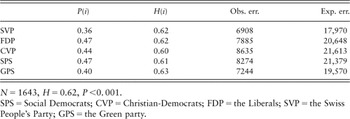
As the H-value (0.62) and its corresponding t-test in Table 1 indicate, the partisan preference rankings in our case correspond to the assumption of unidimensionality, far in excess of what might occur by chance. The H(i)-values indicate that all parties conform to the assumed ordering. P(i) is the percentage of respondents who attributed a voting probability higher than five to the respective party.
Results from the multiple unidimensional unfolding (MUDFOLD) analysis of the probabilities to vote

N = 1643, H = 0.62, P <0. 001.
SPS = Social Democrats; CVP = Christian-Democrats; FDP = the Liberals; SVP = the Swiss People’s Party; GPS = the Green party.
Ambivalence
The construction of our ambivalence measure is based on a ‘xenophobia’-scale that measures the respondent’s positioning on questions about their perception of threats by foreigners, which were posed in the first panel wave (t1). The respondents were asked whether they strongly agree, somewhat agree, somewhat disagree or strongly disagree with a series of five statements about threat perception (see Sniderman, Hagendoorn, and Prior, Reference Sniderman, Hagendoorn and Prior2004).Footnote 9 Using principle components, we have extracted a single factor from the five items with an Eigenvalue of 3.33 and factor loadings of 0.78 or higher.Footnote 10 For interpretational convenience, this xenophobia scale has been standardized so that its mean is 0 and its std. dev. is 1.
A linear regression of xenophobic attitudes on partisan predispositions reveals that there is a positive effect with an R 2 of about 0.20 between the two predispositions. This effect is, however, weak enough to suggest relatively high levels of ambivalence. There are several options to measure ambivalence. We adopted the widespread practice to infer ambivalence indirectly from responses on scales that measure different orientations and coded it as follows: Ambivalence takes the same value as the xenophobic predisposition for voters close to the Social democrats or the Green party. These parties had launched the referendum against the proposed tightening of the law and mobilized for its rejection during the campaign. For voters close to the moderate or conservative right, ambivalence corresponds to the negative value of their xenophobic predisposition. These parties had recommended acceptance of the proposal and campaigned in its favour. Thus, the ambivalence measure operationalizes the conflict between the recommendations of the parties closest to the voters’ ideal points and their xenophobic attitudes.Footnote 11
Issue-specific knowledge
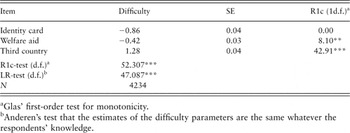
Issue-specific knowledge is measured by a Rasch model, a frequently utilized psychometric scaling technique for dichotomous items (Rasch, Reference Rasch1980). It is based on three factual questions testing the respondents’ knowledge of three particularly contested aspects of the law. The possible answers were ‘yes’, ‘no’, and ‘don’t know’.Footnote 12 This set of questions has been surveyed at each wave. The Rasch model maps both voters (according to their knowledge) and items (according to their difficulty) on the same latent continuum.Footnote 13Table 2 presents the estimates for the item difficulty parameters and test statistics, confirming that the knowledge questions do actually form a single latent continuum. Our measure of issue-specific knowledge is then the estimated location of the individuals on that latent trait by panel wave.Footnote 14
Results from a Rasch test of three issue-specific knowledge items

aGlas’ first-order test for monotonicity.
bAnderen’s test that the estimates of the difficulty parameters are the same whatever the respondents’ knowledge.
Partisan knowledge
For measuring partisan knowledge, we inquired with each of the six parties we already introduced above, whether or not the respondents knew their position with respect to the new law.Footnote 15 For operationalizing the relevant partisan cue, we took the respondents’ knowledge with respect to the party closest to their own position (as measured by the scale for partisan predisposition introduced above). The resulting indicator is a dichotomous variable, coded 1 if the respondent knows the party’s position, and 0 otherwise.Footnote 16 This variable, too, is measured at each one of the three points in time.
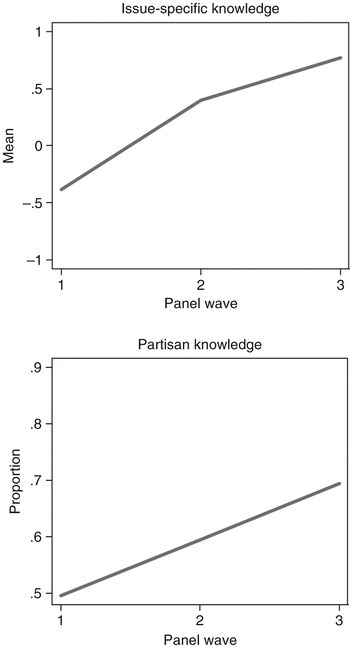
Figure 1 presents the development of these two knowledge measures during the campaign.Footnote 17 As expected (hypotheses 1 and 2), the general pattern is that people learn considerably in the course of the campaign. Knowledge of party positions in fact increases linearly, whereas issue-specific knowledge has, above all, increased during the first phase of the campaign. Note that knowledge is already relatively high at the outset of the campaign – probably a consequence of the overall rather high familiarity of the proposal.
Campaign effects on issue-specific knowledge and knowledge of partisan cues.

An empirical model of the vote choice
It has been hypothesized and shown that direct-democratic campaigns inform voters about the specific propositions at stake, as well as the stances the parties and other political actors take on these propositions. In providing such information, campaigns will, so runs the argument, help the voters to convert their fundamental predispositions into consistent vote choices, but only as long as their predispositions do not collide. If their predispositions collide, additional information will probably activate the voters’ ambivalence, and will therefore interfere in the process of translating predispositions into choices. One way or the other, campaign information is hypothesized to not primarily affect the direction of voters’ choices in terms of approval and rejection, but the variance of the voters’ underlying distribution of choices given their predispositions. Standard statistical models preclude such variance-altering types of effects by assumption, and frequently yield inefficient or even inconsistent estimates in the presence of heteroscedasticity. This problem can be addressed by directly modelling the response heterogeneity. For example, Alvarez and Brehm (Reference Alvarez and Brehm1995) develop a probit variant of Harvey’s (Reference Harvey1976) multiplicative heteroscedastic regression which assumes the error variance to depend on explanatory variables (also see Alvarez and Franklin, Reference Alvarez and Franklin1994; Alvarez and Brehm, Reference Alvarez and Brehm1995, Reference Alvarez and Brehm2002). The heteroscedastic probit is our point of departure, although we will extend this model in capitalizing on the panel structure of our data. Particularly, the repeated observation of voters allows us to conceptualize unobserved inter-individual differences in the propensity to accept or reject the proposition at stake as a random variable. Accounting for unobserved heterogeneity in this way helps resolve some of the fundamental problems of causal inference in non-experimental research settings (see e.g. Finkel, Reference Finkel1995).Footnote 18
We start with the latent variable derivation of the random intercept probit model. In this model, y* is the unobserved propensity of voter i to agree on the proposition at time t, so that the observed choice y will be 1 (approval) if y* > 0, otherwise 0 (rejection). This propensity is considered a function of a constant α that is specific to t, the partisan predispositions x of i measured at t = 1, a random variable ζ representing unobserved time-invariant personal characteristics affecting y*, for which we assume a normal distribution with mean 0 and variance τ 2, and ε, a person–time specific error term:

If we assume a normal distribution with mean 0 and variance (σ 2) for ε, the model becomes a random intercept probit model:

where Φ(·) is the standard normal cumulative distribution function. The standard probit model is usually identified by fixing the std. dev. σ at 1. However, we have hypothesized that the variance (or, equivalently, the std. dev.) of the vote function that links predispositions to choices is a function of a vector of covariates z:

where z includes different sets of variables for different model specifications. In Model 1, we will only include dummy variables for panel waves 2 and 3 to capture the overall variance-altering effect of the campaign. The variance (std. dev.) in wave 1 is fixed at 1 to identify the model. If the campaign helped the voters in translating their predispositions into choices, we would expect negative effects of the wave dummies on the standard deviation σ. Model 2 additionally includes the respondents’ issue-specific and partisan knowledge. Again, we would expect knowledgeable voters to exhibit less variance in their vote function, keeping their partisan predispositions constant. Finally, model 3 adds our ambivalence measure in the heteroscedastic model component. Additionally, we will allow ambivalence to interact with the knowledge variables, as we have hypothesized that issue-specific knowledge will potentially activate ambivalence. We would therefore expect a positive effect of ambivalence on the variance of the systematic model component, and this effect should be stronger for the voters with more issue-specific knowledge than for those with knowledge about party positions.Footnote 19
Results
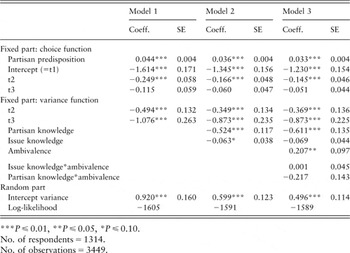
Table 3 reports the estimates for the parameters of the three models. It is divided into three sections: the first section provides the estimates for the choice function, section two, those for the variance function and section three includes τ 2, the variance estimate of the respondent-specific random intercept.
Estimates from the random intercepts heteroscedastic probit models of the vote choice

***P ⩽ 0.01, **P ⩽ 0.05, *P ⩽ 0.10.
No. of respondents = 1314.
No. of observations = 3449.
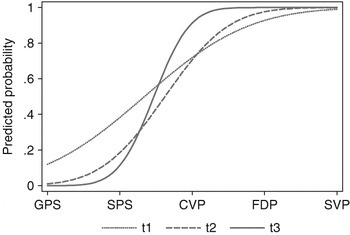
As documented by the parameters of the choice function, the partisan predisposition has a positive effect on the vote intention (the vote) in all three models. This means, that a predisposition for a right party increases the probability to vote ‘Yes’, that is, to agree with the new asylum law and vice versa. The negative coefficients for t2 and t3 indicate that, given party preferences, voters have become more inclined to cast a ‘No’ vote in the course of the campaign. Although this may at first glance appear to provide evidence for a ‘directional’ or persuasive campaign effect (Figure 2), which presents the predicted probabilities to cast a ‘Yes’ vote as a function of the voters’ partisan predispositions (as measured at the start of the campaign), it tells a different story: although the voters of the centre and the right (CVP, FDP/LPS, and SVP) have been pretty consistent with their parties’ stances all along, the activation of partisan predispositions has primarily operated among the partisans of the left (SPS, GPS), getting them more and more in line with their parties’ positions over the course of the campaign.
Predicted probabilities to cast a YES vote for partisan predisposition, before (t1), during (t2) and after the campaign (t3).

Considering the variance function in Model 1, we observe that at mid-campaign (t2), the variance of the choice function that links partisan predispositions and vote choice, considerably reduces from 1 to exp(−0.49)2=0.37. In wave 3 (t3), the corresponding variance reduces even further to exp(−1.08)2=0.12. This is a very strong empirical support for the activation effect of the campaign. Note that, given Equation (2) above, the variance also has a ‘scaling’ effect on the probit coefficients of the choice function. This means that a reduction in the variance increases the effects of the coefficients in the choice function. This becomes clearly visible in Figure 2. As the campaign proceeds, the choice function linking the partisan preferences of the voters to their vote choice becomes increasingly steep, which means that their partisan predispositions become much better predictors for their vote – exactly as predicted by the activation hypotheses (H2).
From section 3 of Table 3, we learn that there is a highly significant variance of the random intercept (0.92), which provides strong evidence of unobserved heterogeneity between the voters in their propensity to approve or reject the proposition. This finding highlights the usefulness of panel data in non-experimental settings.
Model 2 introduces the two knowledge variables into the variance function, which allows for a more explicit test of the activation hypothesis. As expected, knowledge about the partisan cues (H2) reduces the variance of the choice function, given the respondents’ partisan predispositions. The same also applies for issue-specific knowledge (H2a). However, the latter effect is barely significant, which means that issue-specific knowledge does contribute to the clarification of the relationship between partisan predispositions and the choice at hand, but only to a much more limited extent than partisan knowledge. Thus, knowing one’s party’s position reduces the variance to exp(−0.52)2=0.35, keeping the other variables constant at zero, but having issue-specific knowledge, that is, one std. dev. above the mean only decreases the variance to exp(−0.06)2=0.89. At the same time, the introduction of the two knowledge measures considerably reduces the effects of the wave dummies to (−0.35)/(−0.49)=0.71 of the initially estimated effect (Model 1) with regard to t2, and to (−0.87)/(−1.08)=0.81 with regard to t3. In other words, the knowledge effects capture about 20–30 per cent of the initially observed overall campaign effect. Obviously, there is considerable learning going on, which is not captured by our knowledge variables. At the same time, the introduction of the knowledge variables also reduces the random intercept variance by a proportion of (0.92–0.60)/0.92=0.35. This means that the knowledge differences between the individuals explain roughly one-third of the unobservable inter-individual differences in voting choices.
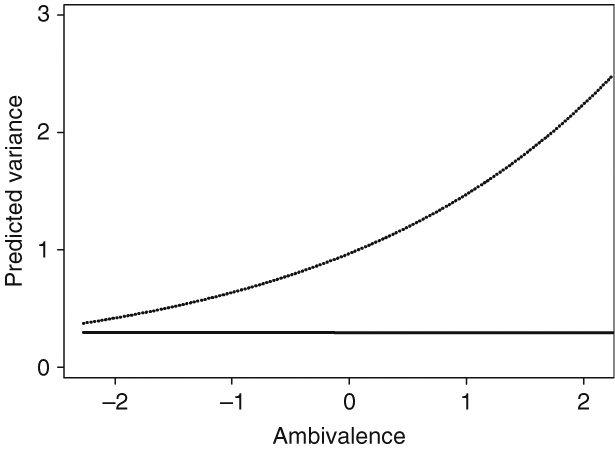
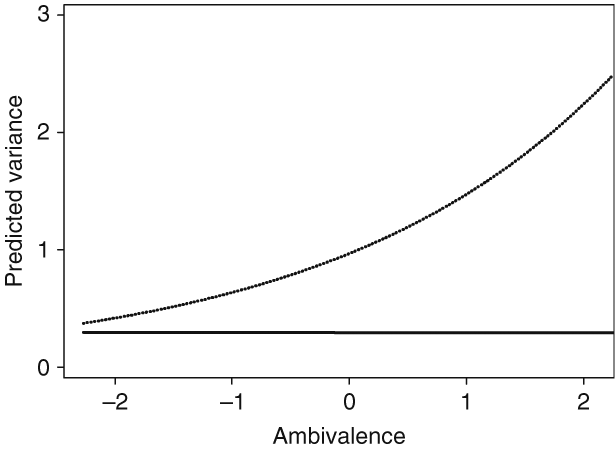
Model 3 as well as its interactions with the two knowledge variables adds ambivalence to the determinants of the variance function. The marginal effect of ambivalence with the other variables at 0 turns out to be positive and significant, which confirms hypothesis 3: ambivalence does, indeed, significantly increase the unknowledgeable voters’ hesitancy about how to vote. However, increased substantial knowledge does not increase the effect of ambivalence. Thus, hypothesis 4 is not confirmed. By contrast, the interaction effect between ambivalence and partisan knowledge is, as expected, negative and is roughly of equal size as the effect of ambivalence (although not quite significant because of a large standard error). In fact, knowledge of partisan cues perfectly counteracts the effect of ambivalence on the variance function. As illustrated in Figure 3, ambivalence increases the variance of the vote function only among those who do not know their party’s position. Among those who do, ambivalence has no effect at all, which provides support for hypothesis 5.
Predicted variances of the choice function for respondents with (solid line) and without partisan knowledge (dotted line). Issue-specific knowledge set to its sample mean.
Discussion
Ever since Lazarsfeld and his colleagues’ seminal study, it has become common wisdom that election campaigns, if anything, serve the activation of voters’ fundamental predispositions. The ‘enlightenment hypothesis’ (Gelman and King, Reference Gelman and King1993; Arceneaux, Reference Arceneaux2006) re-stated that wisdom by pointing out that campaigns do not change the citizens’ preferences but, by increasing the information about the voting decision available to the voters, help them update their beliefs regarding the issues at stake and allow them to reach a decision in line with their predispositions.
In the literature, disagreement exists with regard to the role of partisan orientations. Although some authors consider them as fundamental predispositions, which are activated during the campaign and subsequently act as filters for incoming information, others argue that party attachments are simple running tallies of political assessments, which are constantly updated in response to campaign events. In this study, where we analysed the role of partisan predispositions in a direct-democratic campaign, partisan predispositions and voting choices do not carry the flavour of tautology inherent in parliamentary and presidential elections. Our results confirm the traditional view that partisan predispositions constitute, indeed, fundamental predispositions: vote intentions dramatically converge on pre-campaign partisan orientations over the course of the campaign. Moreover, ambivalent voters, that is, voters who experience cross-pressures between their issue-specific attitudes and their partisan predispositions, more often than not, resolve such conflicts in favour of their partisan predispositions.
Although these activation effects turned out to be substantial in our empirical case of the Swiss asylum law referendum 2003, we would expect them to be even stronger with ballots propositions which are less familiar to the public but nevertheless polarize the political parties along traditional ideological divides. On the other hand, we would hypothesize partisan activation to be weaker with ballot measures that divide the political elites into ‘unholy’ alliances, for example, between the environmentalist left and the conservative right (see LeDuc, Reference LeDuc2002). In other words, we would expect that the activation of partisan predispositions in direct-democratic votes not only hinges upon individual factors such as knowledge and ambivalence that have been scrutinized in our current study, but also on contextual factors, such as the familiarity of the issues at stake, campaign intensity and balance, and the configuration of the battle lines between proponents and adversaries (see Kriesi, Reference Kriesi2005). Recently, the NCCR Democracy, an interdisciplinary research programme launched by the Swiss National Science Foundation,Footnote 20 has fielded two similar panel surveys on other ballot propositions that will allow, among other things, to investigate the role of proposition-specific factors on the activation of partisan predispositions during referendum campaigns.
Finally, in methodological terms, our results confirm that the campaign does not primarily affect the direction of the voters’ choices in terms of approval and rejection, but the variance of the voters’ underlying distribution of choices for given partisan predispositions. More specifically, the campaign contributes to the knowledge about party positions on the issue at stake and to issue-specific knowledge, both of which reduce voters’ uncertainty as to how their partisan predispositions relate to the proposition. On the basis of our empirical results, we support Braumoeller’s (Reference Braumoeller2006) recent claim that political scientists should broaden their understanding of causation to include variance-altering types of causal effects.
Acknowledgements
We thank the anonymous reviewers of the journal for their constructive comments, which helped us to clarify our argument.
Appendix. Means and standard deviations of the variables by panel wave