Public health agencies perform surveillance to monitor the spread of influenza within the United States each influenza season. Because many patients with influenza do not undergo laboratory testing to confirm the diagnosis, much of this surveillance is syndromic in nature. That is, public health agencies often track cases of influenza-like illness (ILI) rather than laboratory-confirmed influenza cases. The Centers for Disease Control and Prevention (CDC) defines ILI as fever (temperature ≥37.8°C, ≥100°F) and cough and/or sore throat without a known cause other than influenza. 1
Currently, the CDC performs surveillance for ILI predominantly in the outpatient setting via the US Outpatient ILI Surveillance Network. 1 Through this network, healthcare providers across the US report data on the total number of patients they have seen in a certain week and the total number of those patients with ILI. These data are used to calculate the level of influenza activity in different geographical regions across the country. While some hospitals do report to the CDC positive laboratory tests for influenza among hospitalized patients, no syndromic surveillance system similar to the ILI Surveillance Network is widely used for tracking ILI in settings other than the outpatient setting (eg, the emergency department [ED] or inpatient settings).
Public health agencies have increased access to detailed electronic health records (EHRs) from ED, ambulatory, and inpatient settings to use for syndromic surveillance as a result of the Centers for Medicare and Medicaid Services EHR incentive program. Through the incentive program, eligible healthcare organizations must collect and transmit electronic syndromic surveillance data to public health agencies. 2 , 3 However, how to best utilize these data to monitor ILI in different treatment settings has not yet been determined.
Prior literature regarding syndromic surveillance in different treatment settings has produced conflicting results. Several studies have found that syndromic surveillance data from outpatient settings correlated relatively closely with syndromic surveillance data from the ED,Reference Hripcsak, Soulakis and Li 4 – Reference Soulakis and Mostashari 6 but others have reported little correlation between the outpatient and ED settings.Reference Soulakis and Mostashari 6 – Reference Yih, Abrams, Hsu, Kleinman, Kulldorff and Platt 9 Furthermore, there has been little research comparing syndromic surveillance data from the inpatient setting with other contexts.
NorthShore University HealthSystem (NorthShore) is unique in that it utilizes an advanced EHR system with integrated data from different treatment settings (eg, ED, inpatient, and ambulatory settings) within the same communities. Thus, we can study the use of ILI syndromic surveillance with data collected from detailed EHRs in multiple treatment contexts for the same patient population.
In this study, we compared patterns of ILI activity using syndromic surveillance algorithm results in ED, outpatient, and inpatient settings, and among different age groups. We sought to determine whether surveillance in different settings among patients of different ages provides independent information or similar information regarding ILI activity in the community.
METHODS
We performed a retrospective cohort study at NorthShore, a large health system comprised of 4 hospitals and >50 clinics in suburban Chicago. All inpatient encounters, ED encounters, and outpatient primary care encounters from January 1, 2006, through May 31, 2013, were included. If a patient was admitted to the hospital through the ED, we classified the case only as an inpatient encounter (ie, the same patient was not counted as both an ED and inpatient encounter on the same day). An previously validated electronic ILI syndromic surveillance algorithmReference Hebert, Beaumont, Schwartz and Robicsek 10 was applied to all primary care outpatient encounters, ED encounters, and inpatient encounters. The algorithm includes chief complaint, diagnosis, and temperature (Table 1). For the inpatient setting, the algorithm was slightly adapted from the algorithm used in the other settings to also include influenza test orders. Influenza testing was included to improve the accuracy of the algorithm for inpatients because the CDC recommends influenza testing for inpatients but not necessarily for outpatients and ED patients. 11 Influenza test orders rather than test results were included to preserve the “syndromic” nature of the algorithm, ie, based on patient symptoms rather than positive laboratory results. We assumed that physicians ordering influenza testing did so because a patient’s clinical symptoms were consistent with influenza.
Details of Syndromic Surveillance Algorithm

NOTE. COPD, chronic obstructive pulmonary disease; URI, upper respiratory infection.
a Intelligent Medical Objects (Northbrook, IL) criteria: acute asthmatic bronchitis, acute bronchitis, acute bronchitis with COPD, acute nasopharyngitis, acute nasopharyngitis (common cold), acute pharyngitis, acute respiratory failure, acute URI, acute URI of multiple sites, bronchitis, bronchitis with bronchospasm, bronchitis with obstruction, bronchitis with tracheitis, cough, dyspnea, fever 41.1°C (106.0°F) or higher, fever and chills, fever with chills, fever, unknown origin fever, unspecified head cold, influenza, influenza A, influenza and pneumonia, influenza B, influenza due to influenza virus type A, porcine influenza pneumonia, influenza with gastrointestinal tract involvement, influenza with other manifestations, influenza with other respiratory manifestations, influenza with pharyngitis, influenza with pneumonia, influenza with sinusitis, bronchopneumonia, influenza pneumonia, influenza-like symptoms, labored breathing, multiple URI, nasal discharge, nasopharyngitis, nasopharyngitis acute, nasopharyngitis infective, pneumonia, pneumonia and influenza, rapid breathing, respiratory distress, shortness of breath, sore throat (viral), unspecified viral pneumonia, viral bronchitis, viral pharyngitis, and viral pneumonia.
This algorithm was used to query our health system data warehouse to identify encounters with ILI. The following data were collected for each encounter: patient age, date of encounter, temperature, chief complaint, diagnoses, and influenza test orders and their results.
The percentage of all patient encounters due to ILI was calculated within each treatment setting (ie, outpatient, ED, and inpatient) for each week during the study period. These data were further characterized according to age group: <18 years old, 18–64 years old, and ≥65 years old.
Comparisons of ILI activity over time between different treatment settings were conducted using Spearman’s rank correlation coefficient. Graphs of percentage of encounters for ILI over time within each setting were created using a 3-week moving average. The period when pandemic H1N1 was circulating (April 1, 2009–April 30, 2010) was also specifically examined for correlation to determine whether there was a difference in correlation between different treatment settings during pandemic versus seasonal influenza.
Cross correlation was used to compare ILI activity among patients grouped by age and to determine whether a group’s ILI activity led or lagged behind another group’s ILI activity. For example, if ILI activity among patients aged <18 increase 2 weeks ahead of patients aged ≥65 years, this would be reflected by a higher cross-correlation value at week +2 than at weeks +3, +1, and 0. Cross-correlation diagrams were created to visually depict the cross-correlation relationships between groups. STATA 13 statistical software (StataCorp, College Station, TX) was used.
We further investigated whether individual patients were evaluated in >1 treatment setting within a given time frame; for example, a patient may have been seen in the outpatient setting and then presented to the ED 1 day later. This procedure was adopted to determine whether correlation in ILI activity between different settings may have been due to the same patients seeking care in multiple treatment settings.
This study was approved by the NorthShore Institutional Review Board.
RESULTS
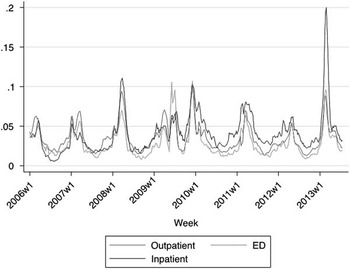
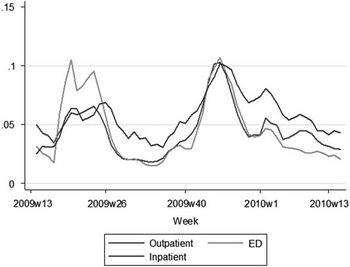
Over the study period, there were 3,443,913 outpatient visits, 393,835 inpatient encounters, and 610,021 ED encounters. Table 2 describes patient age for all patient encounters over the study period and for encounters specifically due to ILI. Figure 1 depicts patterns of ILI activity over time within each treatment setting, and Figure 2 shows ILI activity during the H1N1 influenza pandemic, in closer detail. A clear seasonal pattern was observed in all 3 settings with peaks in ILI activity each winter and in the spring/summer of 2009 during the H1N1 influenza pandemic. During seasonal influenza, similar peaks in the percentage of visits for ILI were observed in the outpatient and ED settings, but during the spring of 2009 (the beginning of pandemic H1N1 influenza activity), there was a higher peak in the percentage of ED visits for ILI (>10% of visits) than in the percentage of outpatient visits for ILI (6.5% of visits). During the winter of 2012–2013, a high peak in percentage of visits for ILI was observed in the inpatient setting (up to 20% of visits) that was not seen to the same extent in the outpatient and ED settings.
Proportion of Encounters for ILI by Treatment Setting NOTE. ILI, influenza-like illness; w, week; ED, Emergency Department

Proportion of Encounters for ILI by Treatment Setting during H1N1 Pandemic Influenza Activity NOTE. ILI, influenza-like illness; w, week; ED, Emergency Department

Encounters by Patient Age

NOTE. ILI, influenza-like illness; ED, emergency department.
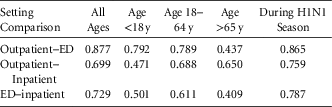
Correlation of ILI activity was stronger between outpatient and ED settings than between outpatient and inpatient settings (Table 3). Correlation between outpatient and ED ILI activity was stronger among patients aged <18 years than among those aged >65 years, but correlation between outpatients and inpatients was stronger among those aged >65 years than among those aged <18 years (Table 3). During the H1N1 influenza pandemic (April 1, 2009–April 30, 2010), a similar correlation in ILI activity among all 3 treatment settings was observed (Table 3).
Spearman Correlation Coefficients Comparing ILI Activity Over Time Between Different Treatment SettingsFootnote a

NOTE. ILI, influenza-like illness; ED, emergency department.
a P<.0005 for all correlation coefficients
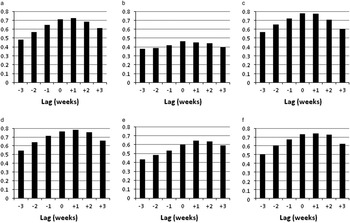
ILI activity among outpatients preceded ILI activity among inpatients by 1 week. This finding is illustrated in Figure 3a: the tallest bar (strongest correlation) occurs at week +1, with shorter bars (weaker correlation) at weeks 0 and +2. Earlier ILI activity among outpatients was especially pronounced among pediatric patients. Indeed, the seasonal uptick in ILI encounters for patients aged <18 years in the outpatient setting preceded the increase for patients aged ≥18 years in all 3 settings by 1 week (Figures 3d–f). This was not true of patients aged <18 years in the inpatient and ED settings (data not shown). Comparing ILI activity among pediatric patients in the outpatient setting with ILI activity among pediatric patients in the ED and inpatients settings, the strongest correlation was seen at week 0, indicating no lead or lag time (Figures 3b, 3c).
a: Cross-correlogram of ILI Activity among outpatients and inpatients b: Cross-correlogram of ILI Activity among outpatients age <18 and inpatients age <18 c: Cross-correlogram of ILI Activity among outpatients age <18 and ED patients age <18 d: Cross-correlogram of ILI Activity among outpatients age <18 and outpatients age 18+ e: Cross-correlogram of ILI Activity among outpatients age <18 and inpatients age 18+ f: Cross-correlogram of ILI Activity among outpatients age <18 and ED patients age 18+

Individual patients with ILI infrequently sought care in >1 location within 30 days of being seen for ILI in each treatment setting. Among outpatients with ILI, 1,142 of 120,374 (0.6%) presented with ILI to another treatment setting. Of ED patients with ILI, 53 of 16,205 (0.3%) sought care for ILI within 30 days in another treatment setting. Among inpatients with ILI, 678 of 16,028 (4.2%) were evaluated for ILI in another treatment setting within 1 month.
DISCUSSION
Using an advanced electronic algorithm to detect ILI activity over a 7.5-year period, we compared syndromic surveillance results for ILI in different treatment settings. We found that syndromic surveillance results for ILI in the outpatient setting were similar to results in the ED setting. This finding suggests that public health agencies may not need to collect ILI data from both outpatient and ED settings because the data are largely similar. Because most ILI syndromic surveillance is currently performed in the outpatient setting, the addition of ED-based syndromic surveillance may be unnecessary. Because patients with ILI were rarely seen in >1 treatment setting for an individual episode of ILI, the strong correlation between outpatient and ED settings is unlikely to be due to patients being counted more than once in different settings. Rather, it is more likely because there is similar ILI activity in the communities among patients seeking care in the ED and outpatient settings.
However, ILI activity in the outpatient and ED settings did not correlate as closely with ILI activity in the inpatient setting, perhaps because patients who are hospitalized represent a different patient population than those who seek care in the ED or outpatient settings. Indeed, hospitalized patients tended to be older than patients in the outpatient and ED settings: 44% of hospitalized patients were aged >65 years, compared with 22% of outpatients and 18% of ED patients. Inpatients are likely different from outpatients and ED patients in other substantial ways as well (eg, more comorbidities). Public health agencies might gain a fuller understanding of ILI activity within a community by routinely monitoring ILI in the inpatient setting in addition to the outpatient setting because it provides additional independent information regarding ILI activity among the elderly and those with comorbid conditions.
While the overall pattern of ILI activity over time was relatively similar among the 3 treatment settings, 2 time periods exhibited marked variations in those patterns. The first occurred during the spring of 2009 during the H1N1 influenza pandemic, when there was a higher peak in ILI visits in the ED setting than in the other 2 settings. Perhaps with the media attention brought to the H1N1 influenza pandemic, public awareness was raised so that concerned patients with ILI were more likely to seek emergency care rather than wait to see their primary care provider.Reference Keramarou, Cottrell and Evans 12 , Reference Jones and Salathe 13 The second variation occurred in the winter of 2012–2013, when there was a much higher peak of ILI activity in the inpatient setting (up to 20% of all inpatient encounters) compared with the other 2 settings. The 2012–2013 influenza season was relatively severe, with higher rates of hospitalization and mortality due to influenza than in proximal prior years. 14
We further found a seasonal uptick in ILI activity among outpatients 1 week before inpatients. Inpatients might experience ILI later because they are hospitalized for late complications of influenza or perhaps because they are frailer patients with many comorbidities who contract influenza from healthier individuals. In the outpatient setting, ILI activity among children increased before adults in all 3 treatment settings. Fleming et alReference Fleming, Zambon and Bartelds 15 similarly found that in the outpatient setting, ILI increased among young children before older patients during several influenza seasons. During the influenza season, children may contract respiratory viruses first and then transmit them to each other in school and daycare settings prior to passing the viruses on to their parents and other adults. Public health agencies could monitor outpatient pediatric ILI activity to help predict when there will be an increase in ILI activity in the general population.
This study has several potential limitations. The syndromic surveillance algorithm used in this study was created for and validated in the outpatient setting. The algorithm was previously found to have a positive predictive value of 92.8% for ILI and negative predictive value of 96.1% in the outpatient setting.Reference Hebert, Beaumont, Schwartz and Robicsek 10 For the current study, this algorithm was applied to the ED and inpatient settings, but it was not independently validated in the other settings. Because the algorithm is based on information in the EHR, it is only accurate if providers accurately document in the EHR. Because ED providers see more highly acute patients than outpatient providers, they may be less likely to have time to document their encounters as thoroughly in the EHR. Therefore, the algorithm may not as closely reflect true ILI activity in the ED setting. If that is the case, then our results might underrepresent the correlation of ILI activity between outpatient and ED settings.
For the inpatient setting, the ILI syndromic surveillance algorithm was slightly modified from the algorithm used in the outpatient and ED settings. Although they are not included in the outpatient or ED versions of the algorithm, influenza test orders were included in the inpatient algorithm. When patients are ill enough to be hospitalized with ILI, the CDC recommends obtaining an influenza test. 11 Patients in the outpatient and ED settings do not necessarily undergo influenza testing unless results of testing might affect clinical care. Modification of the algorithm for the inpatient setting likely improved its accuracy for detecting inpatients with ILI. Indeed, we performed an analysis in which we removed influenza testing orders from the inpatient algorithm, and correlation decreased to 0.376 between the inpatient and outpatient settings and to 0.416 between the inpatient and ED settings.
Finally, NorthShore utilizes an advanced EHR system that feeds into a comprehensive electronic data warehouse. The algorithms used to detect ILI in this study are based on complex queries of the data warehouse. It may not be feasible for other healthcare organizations with less advanced electronic medical records to perform similarly complex syndromic surveillance. However, through the Centers for Medicare and Medicaid Services EHR incentive program, many healthcare facilities will continue to acquire advanced EHR and will gain the capability to perform complex syndromic surveillance.
In a large healthcare system with 4.4 million patient encounters over 7.5 years, we found that a syndromic surveillance algorithm for ILI activity produced similar results in the outpatient and ED settings but less congruous results in the inpatient setting. Furthermore, ILI among pediatric patients in the outpatient setting increased prior to that in adults in the outpatient, inpatient, or ED settings. These findings suggest that surveillance for ILI might be enhanced (1) by including syndromic surveillance among inpatients and (2) by utilizing ILI information in the outpatient pediatric population to predict ILI activity among adults. As more healthcare systems adopt advanced her systems, syndromic surveillance using the EHR will become commonplace. Unlike traditional surveillance, electronic syndromic surveillance can be automated and can provide near real-time data. Public health agencies will have access to a wealth of data with which to track ILI activity within communities. The results from this study can inform public health agencies regarding which data streams can provide them with the most useful information as they monitor ILI activity and prepare for influenza season each year.
ACKNOWLEDGMENTS
Financial support: No financial support was provided relevant to this article.
Potential conflicts of interest: The authors declare no potential conflicts of interest relevant to this article.