1 Introduction
Web-based expert systems (WBESs) is a set of web applications formed as the result of integration of expert system technology with web technology and accessing the expert system via web (Dokas & Alapetite, Reference Dokas and Alapetite2006). It is becoming more popular because of its ability of providing benefits of traditional expert system as well as Internet technology. It is more widely accessible and has reach to remote areas. Web services can also be treated as an integrated part of web-based expert system (WBES) (Chang & Tseng, Reference Chang and Tseng2008). For accessing web services, various processes like discovery, selection, composition, monitoring, assessment etc. needs to be performed. A WBES can be characterized by various features such as functionalities provided by it, various web services-related processes used in its functioning, approaches used for knowledge representation, techniques used to perform reasoning, languages, implementation tools, and interface provided for user and expert interaction. WBESs are finding good use in various activities of engineering, management, medicine, agriculture, education, tourism, finance etc.
In this paper, a general architecture of WBES as an extension of the traditional expert-system architecture has been discussed. WBES has been presented as an integration of exert system technology and web technology. A brief of various web services-related processes with discussions on some representative techniques for performing each is also given. The uses of WBESs in different domain areas like engineering, management, medicine, agriculture, education, tourism, finance etc. have been presented. Some of the representative WBESs for each domain area have also been illustrated. Some notable points and observations regarding above-mentioned characteristics of WBESs are also tabulated. Surveys and assessments of WBESs are performed from different perspectives such as web services-related processes, knowledge-representation approaches, reasoning approaches, and implementation languages and tools. Using various observations, we have proposed a classification of WBESs based on the different degrees of integration of expert system technology and web technology.
The remainder of paper is organized as follows. An introduction to the WBES and web services has been presented in Section 2. Various web services-related processes and some representative approaches for performing each have also been presented in the same section. The uses of WBESs in different domain areas and some representative systems for each domain are described in Section 3. Section 4 presents surveys and observations on WBESs and web services-related processes in a very concise form. This section also proposes a classification of WBESs. Finally, the paper has been concluded in Section 5 with some concluding remarks.
2 WBES and web services
A computer program that can simulate the thought process of human experts and, hence can be used for the propagation of a domain expertize is called as expert system. Similar to many legacy computer systems, expert systems can also be accessed via web, forming a set of web applications known as WBESs (Dokas & Alapetite, Reference Dokas and Alapetite2006). WBES is the technology emerged from the integration of expert system technologies and web technologies. However, there can be different degrees of integration between the two technologies. Moreover, simulating the thought process of human experts just like the conventional expert system, WBES uses the web to propagate the domain expertise. Despite their commercial success, the conventional expert system applications have several limitations and problems such as knowledge bottleneck, performance brittleness, availability, software distribution, communication between distributed applications etc. (Grove, Reference Grove2000a). In contrast, WBES, because of their property of accessing expert system via web, gets the benefit of various features provided by web technology. Internet provides an effective base to the expert system delivery due to several factors such as wide accessibility of Internet, common multimedia interface provided by web browsers, availability of Internet-compatible tools for expert system development, inherent portability of Internet-based applications, support to cooperation among expert systems by various emerging protocols etc. (Grove, Reference Grove2000b).
The architecture of WBES is based on the traditional expert of system technology with an integration of web technology at various modules of the system. The organic design of traditional expert system architecture has been adapted to Internet use by incorporating client-server architecture and web browser-based interfaces (Grove, Reference Grove2000b). The WBES development process involves the adaptation and integration of two technologies. In addition to their usual activities, various processes involved are also adapted to perform activities providing integration of two technologies. The knowledge acquisition process is also adapted to capture the requirements regarding the web application. The acquired knowledge is also used in the data design stage to define the implementable data structures for web application development. The expert system development process, now also motivates the definition and use of some web page objects in web application. These changes during the expert system development process further demand changes in the architectural design of web application and vice versa. Verification and validation process is adapted not only to identify the problems within the expert system but also in the web application. The knowledge-base evolution and expansion process is adapted to consider the evolution of both expert system knowledge base and web application collectively (Dokas, Reference Dokas2005; Dokas & Alapetite, Reference Dokas and Alapetite2006). The traditional knowledge representation needs to be adapted to provide the online knowledge induction and representation and effective online knowledge base management. The expert system shell also needs to be web based. Both client-side as well as server-side inferencing have to be provided (Duan et al., Reference Duan, Edwards and Xu2005).
A general architecture of WBES is shown in Figure 1. In these systems, the inference engine usually executes on the server-side. Though in some applications, it may be downloaded as Java Applets and run on the client-side. Inference in the systems is based on the rule-based and case-based reasoning primarily. The knowledge representation in the knowledge base is primarily performed using the production rules. The data store at the server-side includes both knowledge base as well as the web applications related databases. Personal computer (PC) web browsers at the client-side usually provide the user-interactive graphical user interface (GUI) to users. The knowledge acquisition from the expert is performed via the web browser-based interfaces. The functionalities provided by the WBESs are usually provided through the web services, which allow the integration of WBESs in web portals (Gamboa et al., Reference Gamboa, Sapateiro and Filipe2006). Web services can be integrated with the WBESs by integrating web services requester at the client-side and web services provider at the server-side (Chang & Tseng, Reference Chang and Tseng2008). Web services add a new level of functionality on top of current web by providing a distributed and programmatically accessible environment for information access over standard Internet protocols. Web services have loosely coupled and reusable components, generally. Web Service Description Language (WSDL), Universal Description, Discovery, and Integration Protocol (UDDI) and Simple Object Access Protocol (SOAP) are among the standard languages and protocols for the web services. WSDL is a World Wide Web Consortium (W3C) effort and describes the interface for consuming a web service. UDDI is an Organization for the Advancement of Structured Information StandardsFootnote 1 standardization and provides a registry for web service providers and web service information. SOAP, a W3C recommendation, deals with communication aspects between consumer and web server using Extensible Mark-up Language (XML) messages. For getting the appropriate combination of web services and using them for satisfying the user request, various processes like discovery, selection, filtering, composition, monitoring, prediction, assessment, orchestration, choreography etc. have to be performed on them. Various web services-related processes are collectively used in a WBES in a coordinated manner to perform the assigned task. Some of the representative techniques for performing these web services-related processes are discussed below.
Web-based expert system

2.1 Discovery
Web service discovery is the process of locating the services that can be possibly used to perform a certain task. Service discovery depends on the reach ability of services and the devices that a user plans to perform the services with. Sometime services are offered for a variety of devices, automatically adapting the contents involved. Discovery is generally an automatic step performed by the user’s device. A web service discovery technique based on quality of service (QoS) has been proposed by Rao et al. (Reference Rao, Kungas and Matskin2004). As this technique is based on QoS, so it also gives confidence to the user about quality of discovered services. This framework has a role called Certifier, which is used for verifying the QoS claims. The peer-to-peer indexing and storage system has also been used for web service discovery (Schmidt & Parashar, Reference Schmidt and Parashar2004). This system implements a distributed hash table. Hence, it can support large-scale, decentralized, and real-time search capabilities by supporting complex queries containing partial keywords and wildcards. It also guarantees that all data elements matching a query will be found with bounded cost (in terms of number of messages and number of nodes). The system uses a locality-preserving mapping from the data element keyword space to the index space. The service discovery can also be performed using registry/repository style service description mechanism (Willmott et al., Reference Willmott, Ronsdorf and Krempels2005). The technologies like UDDI, ebXML registries etc. adopt this model. These systems have an interface for uploading, storing, and managing the information, to be presented before users in response to their queries. A discovery technique, which uses public indexes and is based on ‘Publish Once-Reuse Everywhere’ methodology, has been proposed by Willmott et al. (Reference Willmott, Ronsdorf and Krempels2005). In this approach, service providers publish their descriptions on public accessible medium like World Wide Web, which can then be indexed by search engines or other systems while searching these descriptions on the web. Then, search engines are allowed to aggregate the descriptions from several sources about each service, which can be further looked up by any third party. A hypergraph theory-based approach has been used for performing the service discovery (Benatallah et al., Reference Benatallah, Hacid, Rey and Toumani2003). This approach will not only discover the combinations of web services that best match a given request, but also computes the extra information related to a request. A discovery technique based on Web Service Discovery Architecture has been proposed by Hoschek (Reference Hoschek2002). This architecture can be used by grid applications to discover remote services. It provides an interoperable web service discovery layer by defining appropriate services, interfaces, operations, and protocol bindings. It also provides a modular approach for discovery by defining a small set of orthogonal multipurpose communication primitives. As each of these primitives can be used, implemented, extended, and customized in many ways, so this architecture provides an open and flexible approach.
2.2 Selection
Web service selection is the process of selecting the most appropriate service(s) among the available suitable services. It is the step of deciding the service(s) to use, to finally perform the task. For example, there may be services performing similar goals or performing same goal, but offering different objects at different costs and quality levels, then this process is used to select the one that is closest to the user’s intention (Balke & Wagner, Reference Balke and Wagner2003). An agent-based automatic web service selection technique has been developed by Maximilien and Singh (Reference Maximilien and Singh2003), for selecting the best service from the matching suitable services for a task. In this approach, the middle agents serve as proxies, who help an application to select the service best matching the quality requirements. The system is based on the autonomic computing, wherein a community of agents helps each other in evaluating the services. A service selection approach based on quality-broker architecture has been proposed by Seo et al. (Reference Seo, Jeong and Song2005). This architecture selects the service-provider providing maximum benefits and also provides the platform for binding the services dynamically. An interaction composition technique, which uses a matchmaking algorithm, has been developed for selecting and filtering the large number of available similar services (Sirin et al., Reference Sirin, Parsia and Hendler2004). In this approach, at each step of composition, some of the services are filtered, which helps in selecting from the more appropriate services after each step. Web service selection has also been provided through a personalized selection according to the user-specific demands and wishes (Balke & Wagner, Reference Balke and Wagner2003). In this approach, first partitioning of user profile to support different steps of interaction with services takes place and then subsequent steps are personalized. Services not matching a certain profile are discarded on the fly. After that, the equally useful results of different alternative services are obtained, which can further be compared with respect to user provided strategies to select the most appropriate one. A web service selection approach based on grid service architecture has also been proposed (Marchi et al., Reference Marchi, Mileo and Provetti2005). In this approach, only service requests need to be analyzed and filtered. This system uses a declarative policy specification language, Preferential Policy Description Language, for expressing simple preferences and integrity constraints. These policies are translated into logic programs and are evaluated using ordered disjunctions and bsmodels interpreter. A web service selection approach that considers different QoS categories for determining the most suitable selection has also been proposed (Jaeger et al., Reference Jaeger, Muhl and Golze2005). In this approach, the selection problem can be one dimensional or multidimensional optimization problem depending on the one or more categories of QoS being used for optimization. The used selection approaches are based on greedy selection, discarding subsets, bottom-up approximation, or pattern-wise selection. Depending on the different parameters, different approaches are used for the selection. However, different QoS is delivered by the different selection approaches. Another approach of service selection based on QoS (Yu & Lin, Reference Yu and Lin2004) uses a QoS broker for selecting and coordinating individual service components. This method can either be based on the combinatorial approach or graph theory, depending on the problem is modeled as Multiple Choice Knapsack Problem or as constrained shortest path problem, respectively. Kumar and Mishra (Reference Kumar and Mishra2008b) have presented a semantic web service selection approach based on their QoS and cognitive parameters. They have proposed a hybrid model providing formalization of various QoS and cognitive parameters of services. Using these parameters, the proposed model calculates an index of selection and the service with highest index is selected.
2.3 Composition
Web service composition is the process of aggregation of services to build complex applications able to fulfill client’s requirements (Majithia et al., Reference Majithia, Shields, Taylor and Wang2004). Many standard languages and interfaces have been developed by different organizations for web service composition such as Web Service Choreography Interface (WSCI) by Sun, BEA, SAP, and Intalio, XLANG by Microsoft, Web Service Flow Language (WSFL) by IBM, XML Process Definition Language by workflow management coalition, Business Process Execution Language for Web Services (BPEL4WS) etc. WSFL and WSCI are considered to be the first generation composition languages. BPEL4WS is a second generation web service composition language, which is a combination of WSFL, WSCI, and XLANG. It is an XML language and provides process-oriented service composition (Curbera et al., Reference Curbera, Khalaf, Mukhi, Tai and Weerawarana2003). An aspect-oriented approach for web service composition in Aspect Oriented extension to Business Process Execution Language (AO4BPEL) has been proposed by Charfi and Mezini (Reference Charfi and Mezini2004). AO4BPEL is the aspect-oriented extension of BPEL4WS, the basic idea of which is to combine existing web services to get more sophisticated ones. Simple Hierarchical Ordered Planner 2 (SHOP2), which is a hierarchical task network planning system based on artificial intelligence (AI) planning methodology, has also been used for automatic web service composition (Wu et al., Reference Wu, Sirin, Hendler, Nau and Parsia2003). In this approach, the process models of web services are translated into the sets of SHOP2 methods and operators, which are then used with DARPA Agent Markup Language for Services (DAML-S) web service descriptors to compose web services. An approach for automatic web service composition based on linear-logic theorem proving has been proposed by Rao et al. (Reference Rao, Kungas and Matskin2004). In this method, services are presented using extralogical axioms and proofs in linear logic, while external presentation is provided by DAML-S for semantic web services. This combination of linear logic theorem proving and semantic reasoning provides a flexible approach to web service composition. Web Ontology Language for Services (OWL-S ) is a service ontology language that can also be used for web service composition (Ankolekar et al., Reference Ankolekar, Burstein, Hobbs, Lassila, Martin, McDermott, Mcllrath, Narayanan, Paolucci, Payne and Sycara2002). OWL-S models services using three-part ontology: profile (describes what service requires from user), model (specifies how service works), and grounding (gives information on how to use services). An approach based on web service components has also been proposed for service composition (Yang & Papazoglou, Reference Yang and Papazoglou2002). This approach treats services as components and uses software engineering principles such as reuse, specialization, extension etc. for service composition. Kumar and Mishra (Reference Kumar and Mishra2008a) have proposed a multiagent-based approach for the composition of semantic web services. In this approach, each of the web services is considered as an agent capability. The composite request is broken into the tasks of varying granularity. For each task, an agent is selected to perform it, using various cognitive and QoS parameters. This approach involves the selection of a coordinator agent that controls the entire composition process. The work also deals with various issues and challenges involved in the composition process. Milner (Reference Milner1993) has shown the use of algebraic process composition techniques for service composition. In his work, services are treated as mobile processes and mobile-process theory based on Π-calculus is used for the composition. Petri-nets have also been used for modeling web services (Milanovic & Malek, Reference Milanovic and Malek2004). Petri-net is a directed, connected, and bipartite graph, representing places by nodes and transitions by places occupied by tokens. Petri-nets model services by assigning transitions to methods and places to states. The use of workflow techniques for web service composition has been explored by Rao and Su (Reference Rao and Su2004). But, these techniques can be used only when the process model has been already defined by the requester. Milanovic and Malek (Reference Milanovic and Malek2004) have proposed the web service composition approaches based on model checking and finite-state machines.
2.4 Orchestration and choreography
Orchestration of web services provides control-structure for getting the functionalities of services by aggregation of other web services. It refers to the executable process that can interact with both internal and external web services. Hence, orchestration represents control from one party’s perspective (Peltz, Reference Peltz2003b). Orchestration provides an open, standard-based approach for connecting web services together to create high-level business processes. It is also supported by various standards like WSCI, BPEL4WS, and Business Process Management Language. These standards reduce the complexity and hence the cost of orchestrating web services and increases efficiency and accuracy of processes (Peltz, Reference Peltz2003a). On the other hand, choreography provides the interface for interacting with the web services, so that functionalities provided by it, can be consumed. The external visible behavior of the choreography system is described by workflow constructs such as sequence, split, loop, and parallel. The communication structure of the system decides the order in which messages are sent or received. It can also be used to track message sequence among multiple parties (Peltz, Reference Peltz2003b).
2.5 Monitoring
Service level agreements (SLAs) monitoring has been used for web services monitoring by Sahai et al. (Reference Sahai, Machiraju, Sayal, Jin and Casati2002). The web services that interact intelligently and negotiate with each other, usually need to create and manage SLAs among each other. Automating the SLAs monitoring process can lead to the monitoring of the web services. Monitoring SLAs needs a customizable engine that collects the right measurement, models the data, and evaluates the SLAs at certain time or when certain events happen. An SLA is a set of service level objectives (SLOs). Sequencing is involved among the SLOs. A sequencing engine is used for handling SLO sequencing and to hand over the SLO to monitoring engine for execution. Hence, an SLO can be evaluated only if its preceding SLO has been already fulfilled.
2.6 Quality of service
The present era of business-market requires enabling businesses and organizations to collaborate in an unprecedented manner using web services and to get rapid and dynamic composition of services meeting requester’s functional requirements. This is possible only when web services are located and bounded dynamically from a large and changing service providers based on their QoS. In addition, while computing the QoS parameters, it must be taken into mind that the fair computation of QoS of web services should have minimal overhead and it should have sufficient trust by both service requesters and service providers (Liu et al., Reference Liu, Ngu and Zeng2004). The dynamic and fair computation of QoS of web services can be achieved through a secure active user’s feedback and active monitoring. The business-related criteria such as compensation, penalty-policies, transaction, etc. can also be measured and included in the QoS computation. However, the formula for QoS computation can be varied for different domains. The parameters of QoS computed for a web service can also be used for web service discovery and selection (Liu et al., Reference Liu, Ngu and Zeng2004).
2.7 Security and privacy
The semantic model of a system consists of a semantic metadata model and the semantic services to leverage the semantic metadata within application services. The semantic-based security management framework of this model can be extended to provide safety of services. The existing semantic-based security management of open services framework can be extended to use semantic error management model also, which further can provide improved safety of services. This framework can also be applied to the applications having distributed environmental database resources (Poslad et al., Reference Poslad, Tan, Huang and Zuo2005).
Expert systems’ delivery via the Internet provides several benefits. But in addition, it also presents many problems to developers such as keeping up with rapid technological changes to intelligent tools, servers, browsers, programming languages, inference engines, knowledge bases, client-server software, interface components etc., need to provide decentralized support and training for users, reducing potential delivery bottleneck caused by the communication loads, and a limited infrastructure especially with the use of multimedia in expert systems (Grove, Reference Grove2000b; Duan et al., Reference Duan, Edwards and Xu2005). In spite of this, the examples of WBESs in different domains like engineering, management, education, medicine, agriculture, tourism, finance etc. are available. In the next section, some examples of the WBESs in engineering, management, education, medicine, agriculture, tourism, and finance domains are discussed. Observations are also presented on these WBESs from different perspectives including the web services-related processes they need to perform.
3 Some WBESs
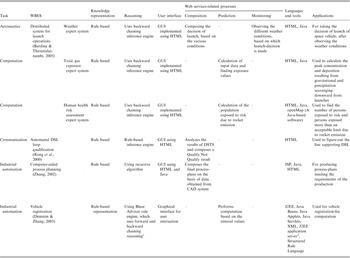
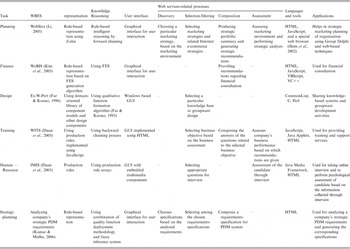
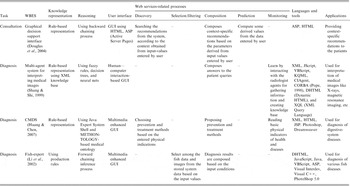
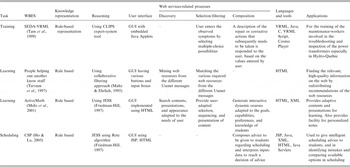
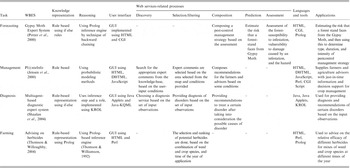
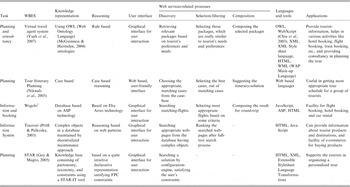
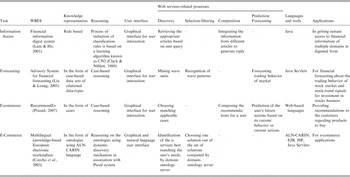
WBES is a technology emerged from the merger of Internet-based techniques and expert system in AI. Various WBESs useful in different disciplines like engineering, management, medicine, education, agriculture, tourism, finance, etc. have been developed. This section summarizes and provides observations on few of the representative WBESs in above-mentioned domains. Observations and comparisons on the different factors like knowledge representation, inference, user interface, use of various web services-related processes, and applications have been tabulated for WBESs of each domain (Tables 1–7).
3.1 Engineering
WBESs in the engineering domain are used for various purposes like industrial automation, communication, computation, aeronautics, etc. Owing to their relatively high computational speed, accuracy, and efficiency, they are finding good use in this domain. Some of the representative WBESs are summarized below (Section 3.1.1).
3.1.1 Distributed WBES for launch operations
A distributed system for launch operations, which works for forecasting and taking launch-decisions of space vehicles, has been developed by Bardina and Thirumalainambi (Reference Bardina and Thirumalainambi2005). It is used for taking Go/No-Go decision of launch of space vehicle (Bardina & Thirumalainambi, Reference Bardina and Thirumalainambi2003). This system is further composed of three expert systems: weather expert system, toxic gas exposure expert system, and human health risk assessment expert system. Weather expert system is applied for taking the decision of launch of space vehicle, after observing the weather conditions. It monitors the different weather conditions and composes the decision of launch based on these conditions. Toxic gas exposure expert system calculates peak concentration and deposition resulting from the gravitational and precipitation scavenging downward from launches. Human health risk assessment expert system calculates the number of persons exposed to risk and persons exposed more than an acceptable limit due to rocket emission. The toxic gas exposure expert system and human health risk assessment expert system computes the various exposure values and number of persons exposed to risk because of rocket emission, respectively.
3.1.2 Automated digital subscriber line (DSL) loop qualification
DSL uses standard twisted-pair copper wire to support voice and data simultaneously. But, all twisted-pair copper wires cannot support DSL services. Hence, a lot of time and expertise is required to figure-out the lines supporting DSL. A WBES to solve this problem, providing automated DSL loop qualification, has been developed by Rong et al. (Reference Rong, Brooks, Fu and Eichen2000). It is used for automatically qualifying lines based on the real-time electrical measurements and records stored in telephone databases. It analyzes the results of digital services test system and composes a qualify/not qualify result for a particular twisted-pair copper wire.
3.1.3 Computer-aided process planning
With the severity of global market competition and development of concurrency, a WBES handling computer-aided process planning (CAPP) can be of immense use. One such WBES has been proposed by Zhang (Reference Zhang2002). The system is used for producing the process-plans meeting the requirements of the production. The final process-plan in the system is composed on the basis of the data obtained from computer-aided design system. The web applications in the CAPP use three-tier architecture. The knowledge-base methods in the system are implemented using Java Server Pages (JSP). The system is implemented using various modern languages like HTML, Java, and JSP and the results by the system are derived by using reasoning based on recursive algorithms.
3.1.4 Vehicle registration
The inference capability of an expert system can also be used to administer the business logic for an enterprise, within a web-based architecture. A WBES for vehicle registration (Demmin & Zhang, Reference Demmin and Zhang2003) fulfills the same purpose. In this system, basically the fee computation logic for vessel vehicle-types is chosen. The system works for the automation of vehicle registration-fee computation process. The computation of the registration fee is done based on the entered input values. A web browser interface has been developed to allow users to inquire about registration fee. The system has been implemented using the Blaze Advisor rules engine and has been deployed to Sun’s J2EE (Java 2 platform, Enterprise Edition) reference implementation of a java application server. Blaze Advisor rule engine uses forward and backward chaining methods for performing the reasoning processFootnote 2. The rules in the knowledge base are represented using XML and the business-logic for the fee-computation application has been designed in enterprise java beans on the server side of a multitier environment. The technologies like Java Applets, Java Servlets, and Structured Rule Language have also been used in the implementation of system.
Observations: WBESs in engineering domain

WBESs=web-based expert systems; GUI=graphical user interface; DSL=digital subscriber line; DSTS=Digital Services Test System; CAD=computer-aided design; HTML=Hyper Text Mark-up Language; XML=Extensible Mark-up Language.
3.2 Management
Various WBESs, helpful in the different activities of managing an organization, have been developed. WBESs are found to be helpful in performing different managerial activities of various departments of an organization like human resource, strategic planning, finance, design, training, etc. Some of the representative WBESs are discussed below (Section 3.2.1).
3.2.1 WebStra
WebStra (Li, Reference Li2005) is used to support in some key stages of the strategic marketing planning process. This system is based on the client-server architecture, which enables the sharing of the computerized planning models over the network, and hence a widespread access of the planning models by authorized users. It uses a hybrid approach, Group Delphi technique, for strategic marketing planning. It has graphical interface for user interaction, providing conventional input items and graphical screens for getting input. The system performs rule-based intelligent reasoning by forward chaining process, driven by user inputs (Turban & Aronson, Reference Turban and Aronson2001). The system performs the assessment and monitoring of the marketing environment. Then, the obtained results are used for the selection of different marketing strategies and related internet or electronic-commerce (e-commerce) strategies. The selected strategies are used in the marketing planning process of the organization. The system also produces strategic portfolio summary and strategic recommendations for helping the managers.
3.2.2 WeBIS
WeBIS (Kim et al., Reference Kim, Song and Hong2005), a WBES based on the hyperlink-based inference mechanism, can be used for the financial consultation in the organizations. The use of hyperlink-based inference mechanism enables the system to overcome the limitations of the existing Common Gateway Interface (CGI) based expert systems such as overburdening, when there are too many service demands at the same time. It uses a graphic-rule editing methodology called Expert’s Diagram (Lee et al., Reference Lee, Lee and Choi1990) for facilitating rule generation and maintenance. The system provides GUI by taking input via a text editor or graphical rule editor, which is further converted into HTML. Graphical rule editor is based on the Expert’s Diagram methodology. WeBIS takes input from the user and provides recommendations regarding financial consultation using functionally equivalent hyperlinked HTML document set (FES) reasoning method. The knowledge in the system is represented using rule-based representation based on the FES generation algorithm. However, rules can also be represented in graphics using Expert’s Diagram scheme. The system has been implemented using HTML and VC++. JavaScript and VBScript have been embedded in HTML for performing computations on the client-side.
3.2.3 Ex-W-Pert system
Ex-W-Pert (Far & Koono, Reference Far and Koono1996) can be applied for sharing the knowledge-based systems and groupware development activities. In this system, resources and knowledge bases are distributed and can be accessed via the Internet. The system is composed of various platforms like workstation, PC etc. that run their own local expert-system clients. Each of the platforms with a running expert-system client is called as expert unit. Local units at a platform are connected by the local area network and communicate to each other using the Network File System and Hyper Text Transfer Protocol protocols. The system provides the users with a facility to select a particular knowledge base or groupware design. The reasoning in the system is implemented using CommonLisp and C programming languages and is based on the qualitative function formation algorithm (Far & Koono, Reference Far and Koono1993). This algorithm is further based on the functional reasoning technology. The reasoning module of the system also consists of a qualitative simulator and customization and learning modules. Perl is also used in the system, for implementing some features in the communication methods.
3.2.4 Web-based Intelligent Training and support System (WITS)
WITS (Duan et al., Reference Duan, Edwards and Xu2005) has been developed for providing training and support services in small-scale enterprises. It has two components: WITS-Training and WITS-Advisor. WITS-Training is used for training services, while WITS-Advisor provides support, advice, and suggestion type of services. The system has no server-side processing and database. It performs processing on the client-side only. The system assesses the company’s business performance that is then used to select the business objective. The system also provides the recommendations and answers of the questions related to the selected business objective.
3.2.5 Intelligent multimedia interview system (IMIS)
IMIS (Duan et al., Reference Duan, Edwards and Xu2005) is a web-based intelligent interviewing system. The system takes the online interviews of the candidate. After that, the information collected through interview is used for psychological assessments of the candidate. First, the appropriate questions are selected for the interview of the candidate. Then, assessment of the candidate is done based on his/her answers. The system can be very useful in the manpower hiring process of an organization. It uses Java Media framework for implementing multimedia framework in the system. A user friendly, multimedia enhanced interface is provided to the user.
3.2.6 Analyzing company’s strategic product data management (PDM) requirements
Kumar and Midha (Reference Kumar and Midha2006) have proposed a WBES for analyzing a company’s strategic PDM requirements. It can help the managers in strategic planning of the product. The system can also generate the corresponding PDM requirements specifications. For creating the requirements specifications, the system chooses appropriate specifications based on the analyzed requirements and composes them for user presentation. The inference process is performed using a combination of two technologies: quality function deployment (QFD) methodology and fuzzy inference system (FIS). Thus, system uses a fusion of three technologies viz. QFD, FIS, and web within a single framework and can provide an intelligent, robust, and powerful framework for PDM requirements analysis.
Observations: WBESs in management domain

WBESs=web-based expert systems; HTML=Hyper Text Mark-up Language; FES=functionally equivalent hyperlinked HTML document set; PDM=product data management.
3.3 Medicine
In the medicine domain, WBESs are finding immense use in various activities such as consultation, diagnosis, etc. It may be due to the lack of expertise, costly expertise, and problems in timely reach ability of the experts to remote and needy areas. In this section, some of the WBESs of this domain are summarized.
3.3.1 Graphical decision support interface (GDSI)
Clinical practice guidelines (CPGs) (Field & Lohr, Reference Field and Lohr1990) are systematically developed healthcare recommendations. The aim of providing these recommendations are to improve quality and control costs by reducing errors, minimizing practice variability, and promoting best practices. A good amount of resources and considerable efforts have been applied to the design, development, and deployment of CPGs (Zielstorff, Reference Zielstorff1998). Even then, the impact of CPGs on clinician’s behavior is not consistent. A WBES, GDSI (Douglas et al., Reference Douglas, Rouse, Ko and Niland2004), has been developed to facilitate utilization of CPGs in a variety of clinical environments. The system employs a relational database-driven state machine architecture, adapted from an instrument control system. The system can be used for medical consultancy and is capable of providing context specific recommendations to the patients. It takes some input values from the user and uses them to derive the parameters useful in composing the context specific recommendations. Thus, the system is expected to improve data collection and decision support services in the community.
3.3.2 Multiagent system for interpreting medical images
Interpretation of medical images like X-rays, Magnetic Resonance Imaging, etc. is a difficult problem requiring high level of expertise, because there exists a specific solution for every image type and every body organ. On account of this problem, the generalization of the solution is not possible, and hence a computerized physician cannot be produced. To solve this problem, a web-based multiagent system has been developed by Shang and Shi (Reference Shang and Shi1999). This system is based on the agent-oriented programming, which is a merger of object-oriented programming and expert system technology. The system has two types of intelligent agents: radiologist agents and patient representative agent. The patient representative agent takes questions from the patient through a web-based interface, asks for multiple opinions from radiologist agents in interpreting a given set of images, and then integrates the opinions to respond the patient. This agent can also answer questions based on the information from medical information database. The radiologist agent decomposes the image interpretation task into smaller subtasks, uses multiple agents to solve the subtasks, and combines the solutions to the subtasks intelligently to solve the complete image interpretation problem. The system uses natural language-based human—computer interaction techniques (Jennings & Wooldridge, Reference Jennings and Wooldridge1998) for user interaction. Voice recognition in the system is performed by using Microsoft Agents. The system uses Knowledge Query and Manipulation Language like language for agent communication and CIAgent (Bigus & Bigus, Reference Bigus and Bigus1998) as agent programming environment.
3.3.3 Chinese medical diagnostic system (CMDS)
CMDS (Huang & Chen, Reference Huang and Chen2007) is a WBES useful for the Chinese medical physicians and education. It can help in diagnosis of a number of digestive system diseases. The system can diagnose up to 50 types of diseases among 10 species of primary digestive system. The system, after getting the physical indications of the health and diseases from the user, proposes different treatment and prevention measures. CMDS uses repertory grid interviewing technique (Kelly, Reference Kelly1955) for generating the essential rules. XML–DTDs are used by the system for representing the rules. The system uses Java Expert System Shell (JESS) (Friedman-Hill, Reference Friedman-Hill1997) and METHONTOLOGY methodology (Fernandez et al., Reference Fernandez, Gomez-Perez and Juristo1997) based medical ontology in the reasoning process. In this system, multimedia enhanced graphical interface is provided for the user interaction. Multimedia software such as Photoshop and Dreamweaver are used for generating the art designs in the user interface.
3.3.4 Fish Expert
Fish Expert (Li et al., Reference Li, Fu and Duan2002) can help in the diagnosis of various fish diseases. The system takes various fish diseases indicators as the input and uses them to select the particular fish data and images from the stored system data. On the basis of these input conditions, the diagnosis results are delivered to the user. The system provides multimedia enhanced user interface with the help of PhotoShop 5.0 package.
Observations: WBESs in medicine domain

WBESs=web-based expert systems; GUI=graphical user interface; HTML=Hyper Text Mark-up Language; XML=Extensible Mark-up Language, CMDS=Chinese medical diagnostic system.
3.4 Education
WBESs in education domain not only help the trainers, but also increase the reach ability of expert knowledge to remote areas. They are found to be useful in performing various activities like student training, personnel training, scheduling, etc. Some of such WBESs are discussed below.
3.4.1 SEDA-virtual reality modeling language (VRML)
SEDA-VRML (Tam et al., Reference Tam, Badra, Marceau, Marin and Malowany1999) is a virtual reality-based learn-by-doing system. It has been developed for the training of maintenance workers involved in the troubleshooting and inspection of power transformers. It can provide a cost-effective training to the operators in selected complex technical environments. The system is specially deployed for the training of workers working in Hydro-Quebec. It provides the users with a user-friendly graphical interface, through which user enters the observed symptoms by selecting multiple choice possibilities. On the basis of the selected possibilities, a description of the repair or corrective actions that subsequently needs to be taken is responded. C Language Integrated Production System expert system tool is used by the system in reasoning process. The system also employs a VRML interpreter, Cosmo Player, for providing three-dimensional navigation.
3.4.2 People helping one another know stuff (PHOAKS)
The web is a source of vast information in diversity of areas. Hence, finding relevant, high-quality information on the web is considered to be a difficult task. A WBES, PHOAKS, has been proposed by Terveen et al. (Reference Terveen, Hill, Amento, Mcdonald and Creter1997) to handle this problem. The system uses a collaborative filtering approach (Maltz & Ehrlich, Reference Maltz and Ehrlich1995) for automatically recognizing, tallying, and redistributing the recommendations of the web resources mined from the Usenet news messages. Hence, the system can be used for finding the relevant, high-quality information on the web by redistributing recommendations of web resources obtained from the Usenet messages.
3.4.3 ActiveMath
ActiveMath (Melis et al., Reference Melis, Andres, Budenbender, Frischauf, Goguadze, Libbrecht and Pollet2001) is a learning system that can be used for dynamically generating the mathematical courses. It also enables the adaptation of these courses according to the goals, capabilities, preferences, and knowledge of students. The system also provides the facility for getting the personalized notes. It provides user-adapted selection, sequencing, and presentation of content. The graphical interface of the system is implemented using HTML. Knowledge in the system is represented based on the pedagogical rules methodology, which is compliant with the standards such as Dublin Core, openMath (Caprotti & Cohen, Reference Caprotti and Cohen1998), MathML, and LOM. The representation is based on the semantic XML by an extension of OMDOC (Kohlhase, Reference Kohlhase2001), in which metadata and ontological XML is used for mathematics and standardized content packaging.
3.4.4 Class schedule planner (CSP)
Changing requirements, transferable units of different schools, and availability of classes are among the various factors that make the class scheduling process a difficult one. These usually cause some mistakes to occur in the schedule. An automated tool like, CSP (Ho & Lu, Reference Ho and Lu2005), can be of immense use for the students for finding the mistakes in the schedule. CSP encapsulates class scheduling knowledge, and gives intelligent scheduling advises to the students. It also allows the students to compare available options. The system translates the requests into facts and applies JESS using Rete Algorithm (Friedman-Hill, Reference Friedman-Hill1997) to process facts and rules for generating schedules to be presented before the user. Unlike other expert systems, which require static expert knowledge for their operation, this system provides dynamic management of knowledge in real-time using a web interface.
Observations: WBESs in education domain

WBESs=web-based expert systems; GUI=graphical user interface; JESS=Java Expert System Shell; HTML=Hyper Text Mark-up Language; XML=Extensible Mark-up Language.
3.5 Agriculture
WBESs in the agriculture domain are beneficial mainly because of their easy reach to the remote areas and to large community of farmers. In addition, they also enable to deliver the advices based on the knowledge of multiple experts. These systems are helpful in various agricultural activities like forecasting, farming, managing farming activities, etc. Some of the representative systems are discussed below.
3.5.1 Gypsy moth expert system
Gypsy moth, a forest pest, causes the loss of valuable oak species and wildlife habitat. It also causes the degradation of aesthetics and detrimental effects on watersheds. Owing to the increasing and wide infestation of the gypsy moth, the need of expert system arises, which can provide decision aids in assessing the risks of this pest to the forests. The gypsy moth expert system (Potter et al., Reference Potter, Deng, Li, Xu, Wei and Lappas2000) has been developed to fulfill the same purpose. It can be used to estimate the risk that a forest stand faces from the gypsy moth, and then determining type, duration, and intensity of pest control management strategy depending on the estimated risk. The system first estimates the risk that a forest stand faces from gypsy moth, and then assessment of forest susceptibility to infestation is done. The system also assesses the vulnerability to damage caused by an infestation, and the hazard for a target forest. After that, based on the assessment results, a pest-control management strategy is suggested. This system can also be accessed via the Netscape Communicator (Brown & Honeycutt, Reference Brown and Honeycutt1998).
3.5.2 Pl@nteInfo
Pl@nteInfoFootnote 3 (Jensen et al., Reference Jensen, Boll, Thysen and Pathak2000) is a decision support system, which supplies the farmers and agriculture advisors with just-in-time personalized information and decision support for crop management. In this system, some background data is collected from different sources, and then after processing this data using decision support models, the results are displayed on the personalized web pages. These web pages have attractive embedded graphics, expert interpretations, and links to additional information. On the basis of the area selected from the map and conditions provided, expert comments are selected. Furthermore, these comments are used in deriving the recommendations for the farmers and advisors.
3.5.3 Multiagent-based diagnostic expert system
Shaalan et al. (Reference Shaalan, El-Badry and Rafea2004) have developed a multiagent-based system for providing diagnosis and recommendations for certain disorders. The system mainly consists of a society of diagnosis agents and treatment agents working in different domains. It also uses a user-interface agent that employs an intelligent data collector and works on the client-side for interacting with the user. This system develops diagnosis of disorder based on the set of input observations, and then provides recommendations to treat the same after taking into consideration the possible causes of concerned disorder. In this system, Knowledge Representation Object Language, which is based on the KADS (Knowledge Acquisition Design System) knowledge engineering methodology (Shaalan et al., Reference Shaalan, Rafea and Rafea1998), is used for implementing the inference step and a role to be used in the reasoning process.
3.5.4 Advising on herbicides
A WBES has been developed by Thomson and Willoughby (Reference Thomson and Willoughby2004), which can be used in forestry or farm-forestry setting for advising the relative efficacy of different herbicides for mixes of weed and crop species at different times of the year. The system performs the selection and ranking of the potential herbicides based on the combination of weed and crop species and time of year of application. It can therefore be of good use in the farming industry and can be easily used by even a non-technical person, through a user-friendly graphical interface implemented using HTML and Perl.
Observations: WBESs in agriculture domain

WBESs=web-based expert systems; GUI=graphical user interface; HTML=Hyper Text Mark-up Language; XML=Extensible Mark-up Language, DHTML=dynamic HTML; KQML=Knowledge Query and Manipulation Language; KROL=Knowledge Representation Object Language.
3.6 Tourism
The tourism industry involves a lot of activities requiring expert knowledge. Planning a trip for tourists involves various activities like collecting information about relevant tourist places, arranging a proper schedule, planning the trip-activities, booking for travel and lodging etc. WBESs are not only helpful in performing these activities, but also provide remote and mobile help to the tourists. Discussed below are some of the representative ones.
3.6.1 Virtual travel agent system (VTAS)
VTAS, a system based on the multiagent information system architecture and semantic web technology, has been developed for handling the major processes of a tourist’s trip (Yueh et al., Reference Yueh, Chiu, Leung and Hung2007). Its architecture consists of various agent clusters for service coordination and integration. Each agent cluster has several agents integrated into it, which can interact with each other to perform various major tasks related to tourist’s trip like information gathering and integration, preference-matchmaking, planning, scheduling, mobile-services etc. The system uses mobile devices, on which intelligent software agents are running, to provide effective coordination and integration of disparate information and service resources. VTAS provides tourist information and consultancy in tour planning, including the activities like flight booking, train booking, hotel –booking, etc. using agents. The agents are used for mainly five types of processes: ontology maintenance and search processes, requirement and preference management processes, package planning processes, local tour planning processes, and tourist assistant processes.
3.6.2 Tour Itinerary Planning
A system that uses case-based reasoning in e-tourism and provides suggestions for a most appropriate travel schedule for a group of tourists, has been presented by Niknafs et al. (Reference Niknafs, Shiri and Javidi2003). The system has a database containing information about the former tourists, in the form of cases. The system takes some data related to tourists like their age, budget, interests, etc. as the input. This input is considered as the ‘new case’. Using some similarity functions and adaptation criteria, the most matching cases are retrieved from the database. The best chosen cases, out of the matched ones, are used to suggest the itinerary solution and the present case is also added in the database to be used in future. The system uses user-friendly, web-based interface for data acquisition as well as for getting the query from tourist.
3.6.3 Wegolo
WegoloFootnote 4 is a web-based system providing the facility for booking airlines-tickets primarily and some additional facilities for hotel-booking and car-rental. It provides the facility to search, select, combine, and book flights with low-cost airlines. Wegolo provides links to the additional web services for handling hotel booking and car rental. The system takes different essential parameters such as date of departure, date of return, number of seats, etc. and some user-preferences as the input, and suggests some appropriate matching flights based on the cost and other criteria. The matching flights are searched for all possible routes. The system not only provides information about the availability of flights, but also provides the facility for booking them online. It uses the search and booking engine, Elsy Arres, for performing the various operations. Elsy Arres engine searches real-time for the requested flights in the airlines’ reservation systems via XML or on the airlines’ websites using data mining techniques. The system has been implemented using the latest ASP.NET server programming technology of Microsoft and web services technologies and standards.
3.6.4 Tiscover
Tiscover (Pröll & Palkoska, Reference Pröll and Palkoska2002) is a generic platform for web-based destination information systems. It not only provides access to various tourism products, but also presents information accompanying various destinations like hotels, museums, or other places. For buying the tourism products online, the facility for performing all the phases of e-commerce is also provided by the system. For accessing the cultural-heritage objects, Tiscover provides three different access paradigms: navigation, structural search, and text retrieval. All of these access paradigms further use web patterns (Rossi et al., Reference Rossi, Schwabe and Lyardet1999) to facilitate more convenience in accessing the cultural-heritage objects. The system also uses a customization mechanism to adapt existing cultural-heritage objects and layout aspects, according to the needs of different tourism information providers. The system provides access possibilities via various medias like World Wide Web, mobile phones, information kiosks, call centers, etc.
3.6.5 Smart Tourist Agenda Recommender (STAR)
STAR (Goy & Magro, Reference Goy and Magro2005) is a web-based system, which can support the user in organizing a personalized tour to a given area by exploiting the configuration technology (Magro & Torasso, Reference Magro and Torasso2003). The system uses a configuration engine based on the FPC (Frames, Parts and Constraints) framework (Magro & Torasso, Reference Magro and Torasso2003), which resides in the backend of the system. The system architecture is composed of mainly three components: front-end, back-end, and knowledge base. The user interface of system consists of web pages dynamically generated by exploiting Extensible Stylesheet Language Transformations (XSLT) to transform XML objects into HTML web pages. Various reasoning activities are performed in the backend. In this system, reasoning mechanisms are based on a quite intuitive declarative representation of a generic agenda as a complex entity, in which tourist items are the basic components. The activities corresponding to tourist items are also denoted and these activities have to satisfy various constraints like time, distance, etc. encoded as FPC constraints. The knowledge base of the system represents a generic agenda in the form of three parts: partonomy, taxonomy, and constraints.
Observations: WBESs in tourism domain

WBESs=web-based expert systems; HTML=Hyper Text Mark-up Language; XML=Extensible Mark-up Language; WAP=Wireless Access Protocol; WML=Wireless Mark-up Language; STAR=Smart Tourist Agenda Recommender.
1http://www.wegolo.com, http://www.elsyarres.com/, and information obtained by contacting the PR Aviation Support.
3.7 Finance
WBESs in the finance domain are helpful in performing various activities like financial forecasting, financial advising, online payment, e-commerce, providing financial news, etc. Finance being one of the most important issues, the concerned persons usually prefer to take services of multiple experts before taking any decision. The WBESs can be useful in this regard in facilitating the knowledge of multiple experts collectively, and that also at any place through the web. Following are the summaries of some such WBESs.
3.7.1 Financial information digest system (FIDS)
FIDS (Lam & Ho, Reference Lam and Ho2001) is an intelligent system for digesting the online financial news automatically by integrating the information from different articles by conducting automatic content-based classification and information item extraction. The system is mainly composed of three subsystems: automatic classification subsystem, information extraction subsystem, and information enquiry subsystem. The different financial news articles, which are downloaded periodically from the online news servers, are classified into some predefined categories using predefined classification rules. Each of the categories has a predefined template, listing the items of information that one usually expects from a standard article of that category. The information is extracted from the article to fill the template and this information from the template can be presented before the user or can be stored into the database in the form of article. The system can simultaneously understand the news articles of multiple domains concerning finance. It can help in rapid decision-making by providing instant access to multiple news-items.
3.7.2 Advisory system for financial forecasting
A web-based agent framework, forming part of an advisory system for financial forecasting, has been developed by Liu and Leung (Reference Liu and Leung2001). A case-based reasoning model has been developed conforming to the agent framework, which can assist the investors in determining stock-trend signals for investment in stocks-business. The cases in the system are defined by the theory of wave features and their combinations. Predicative wave-combination features are based on the Elliott wave theoryFootnote 5. The agent framework supports processes including knowledge generation, wave units mining, wave-pattern recognition, and case revise and learning. The system can capture the trading behavior of market with expandable case options. The case-based reasoning deployed in the system refers to the wave pattern combination as a reference case. The agent architecture of the system conforms to the intelligent iJADE model for easy integration.
3.7.3 RecommendEx
RecommendEx (Prasad, Reference Prasad2007) is a knowledge-based product recommendation system for business-to-customer (B2C) e-commerce, providing recommendations to the customers regarding the product to buy with a goal of increasing the purchases. The system can handle various important issues related to e-commerce such as sequence recognition problem in B2C e-commerce, capture, organization, and utilization of plans, storage and recommendation of sub-plans, issues of handling the repeated products, that is, purchase of same product again and again by the same customer at different times, and identification and adjustment to the change of trends. The system is based on the automated collaborative filtering and case-based reasoning plan-recognition approaches. Automated collaborative filtering is used to automate the recommendations for the purchases made in online stores. Case-based reasoning plan-recognition is used to develop automated reasoning and to observe the current actions or behavior of user to predict its future actions.
3.7.4 Multilingual knowledge-based European electronic marketplace (MKBEEM)
MKBEEM (Corcho et al., Reference Corcho, Gómez-Pérez, Leger, Rey and Toumani2003) aims at creating an intelligent knowledge-based multilingual mediation service, providing natural language interfaces to both end-user and service providers. In this system, service providers can perform automatic multilingual cataloguing of products. The system provides online e-commerce contractual negotiation mechanisms in the language of the user. It is based on the mediator/wrapper approach, supporting an integrated view over multiple heterogeneous resources. The system presents a three-layer ontology-based mediation framework for e-commerce applications. It includes three ontology layers: domain ontology, source descriptions, and electronic services (e-services) ontology. In this framework, electronic service is defined as an integrated provider-independent offer, available on a given e-commerce platform. The framework mainly deploys two reasoning mechanisms: dynamic discovery of e-services and query plan generation.
Observations: WBESs in finance domain

WBESs=web-based expert systems.
4 Observations
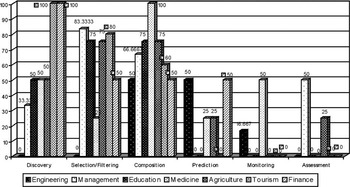
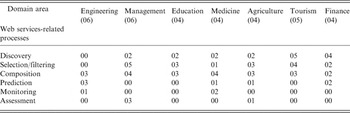
This section presents our assessments and observations on WBESs from different perspectives. In the previous section, some important features of WBESs useful in different domain areas were highlighted through tabular comparisons. We have used these tables to draw the observations and concluding remarks. The observations on use of different web services-related processes in various WBESs of different domain areas are represented in Figure 2 and Table 8.
Percentages of web-based expert systems in different domain areas vs. web services-related processes used by them

Comparative view: web services-related processes and domain areas of WBESs

WBESs=web-based expert systems.
It is observable from Figure 2 and Table 8 that half of the WBESs in engineering domain are using composition and prediction processes. But, other processes are only used by some of the systems. The WBESs in management domain are using selection and composition processes mainly, with 83.33% and 66.67% of WBESs for each, respectively. The assessment and discovery processes are used by an average number of WBESs of this domain. In the case of education domain, it is observed that WBESs are using selection and composition mainly, with 75% of the systems for each. Discovery process is also used by half of the WBESs. But, other processes are used by only a negligible number of systems. Almost all of the WBESs in medicine domain are using composition process. Discovery and monitoring is used by half of the systems, while other processes are only used by a few of the WBESs. The WBESs of agriculture domain are using selection and composition processes primarily, with 75% of WBESs for each. About half of the systems are using discovery process. But, other processes are only used by a few of the WBESs. In the case of tourism, most of the WBESs are using discovery process. The selection and composition are also the mainly used processes with 80% and 60% of WBESs using each, respectively. But, the other processes are used by a negligible number of systems. Almost all of the WBESs in finance domain are using discovery process. Selection, composition, and prediction are used by about half of the systems. But, other processes are only used by negligible number of systems. Overall, it can be observed from Figure 2 that discovery, selection, and composition are the most important and highly used web services-related processes.
Figures 3 and 4 show the observations on the use of knowledge-representation and reasoning methods, respectively. As shown in Figure 3, from the study of WBESs in different domains, it is observed that WBESs primarily use the rule-based knowledge representation. The case-based representation and representation using ontologies are also adopted by some of the systems for representing knowledge. It can be observed from Figure 4 that backward chaining, rule-based inference, and case-based reasoning are among the most popular reasoning approaches. Forward chaining and use of commercial reasoning tools like JESS are also popular techniques of reasoning. It is also observed that some systems uses combination of both backward chaining and forward chaining for performing the reasoning process.
Percentages of web-based expert systems vs. knowledge representation methods

Percentages of web-based expert systems vs. reasoning methods

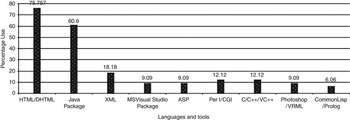
The observations on the use of different programming languages and implementation-tools for the WBESs are shown in Figure 5. The conventional web presentation languages like HTML, DHTML are highly used for presenting the WBESs. Indeed more than 75% of systems use these languages. The popular, platform-independent language Java and its related tools and packages like Java Servlets, Java Beans, Java Applets, J2EE, and JSP are heavily used for implementing the functionalities of WBESs, with about 60% of systems using them. Apart from this, the other programming languages C, C++, and VC++ are used by an average number, that is, 12.12% of systems. For implementing the functionalities, ASP and various tools related to Microsoft Visual Studio like Visual Basic, Visual Interdev, VB Script, etc. are also used by a fair number of systems, with 9.09% of systems using them. The logic programming languages like CommonLisp/Prolog are used by about 6% of the WBESs. XML also seems to be popular language and is used by about 18.18% of WBESs. The modern technologies like CGI/Perl and multimedia-related tools like Photoshop and VRML are also finding good use in the implementation of WBESs with about 12.12% and 9.09% of the systems using them, respectively.
Percentages of web-based expert systems vs. use of languages and tools

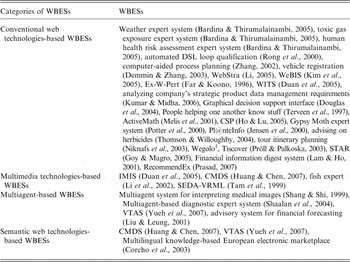
It can be observed that the WBESs can also be classified on the basis of different degrees of integration of the two technologies, that is, expert system technology and web technology. On the basis of this parameter, we have classified the WBESs into four categories: conventional web technologies-based WBESs, multimedia technologies-based WBESs, multiagent-based WBESs, and semantic web technologies-based WBESs. The first category of WBESs uses only conventional web technologies such as HTML, DHTML, ASP, Java-based technologies, etc. while the second category of WBESs also uses multimedia-based technologies like Photoshop, VRML, etc. The third category of WBESs is based on the multiagent-based technologies. The fourth category of WBESs uses various semantic web technologies such as the use of semantic web languages, etc. Table 9 shows some of the WBESs classified according to the proposed classification.
Classification of WBESs

WBESs=web-based expert systems; IMIS=Intelligent multimedia interview system; VTAS=Virtual travel agent system.
1http://www.wegolo.com, http://www.elsyarres.com/, and information obtained by contacting the PR Aviation Support.
5 Conclusions
In this paper, some observations on WBESs and web services have been presented. The paper presents a general architecture of WBES as an integration of expert system technology and web technology. Uses of web services and related processes in WBESs have also been discussed. Discovery, selection, composition, orchestration, choreography, and monitoring are among the various processes needed for accessing the web services. Some representative techniques for performing these processes are also enumerated. Uses of WBESs in some important domain areas such as engineering, management, medicine, agriculture, education, tourism, and finance have been discussed. WBESs have been classified according to their domain of use. Some representative systems for each domain are presented with emphasis on their important features for example knowledge-representation, reasoning, user-interface, application, and use of various web services-related processes. Observations on WBESs and web services-related processes have been taken from different perspectives and surveys are performed on them. It can be concluded from the various presented surveys that discovery, selection, and composition are the mostly used web services-related processes. Rule-based representation is the mostly used technique for representing knowledge. As was the case in traditional expert systems, the WBESs also use rule-based and case-based reasoning primarily. It is also observed that the conventional web presentation languages like HTML and DHTML are widely used for presentation purposes in WBESs. The platform-independent programming language, Java and its related tools are highly used in the implementation of these systems. The modern technologies like Perl and multimedia packages like Photoshop, VRML are also used by some of the systems for implementation purposes. Using various observations, this paper presents a classification of WBESs based on the different degrees of integration of two technologies, that is, expert system technology and web technology. Hence, it may be observed that the implementation of WBESs is adopting the emerging and modern technologies and there are ample opportunities for further research to make these systems more widely used. This work may help the research-community, especially the beginners, with start-up material ushering in the research in WBESs.
Acknowledgments
We would like to thank the extremely helpful editors and reviewers of the journal for their valuable comments. We are also highly thankful to D. K. Rohilla and Hill Christopher of The University of Nottingham, UK for proofreading this paper.